
Tag Archives: writing

Creativity is the Mother Tongue

Victor Wooten delivered this talk to TEDx Gabriola Island. He is a remarkable musician, master of the bass and a genuine and erudite educator.

The focus of his talk is music as a language. Listen carefully and you will learn.

I want to take his words and comment on them as they apply to other creative arts: writing and art.

Creativity (writing, art, film and music) is a language. Learn to speak a different tongue. Or in some cases, we need to relearn to speak our mother tongue.

Victor Wooten – Music as a Language (click link to view the talk)

I have taken excerpts from his talk, either quoted directly or paraphrased, and extrapolated their application to other artistic endeavours such as writing and art.

Your first language is not taught. People spoke to you. You were allowed to speak back – creativity should be learned with your mother tongue. Give children pencils and paper and allow them to speak in their own way. Give yourself pencils and paper and find your mother tongue again.

Beginners are not allowed to play with the masters – in music, the beginner and the amateur are separated from the genius of the master, able to watch but not participate. In all aspects of creativity we should learn from and participate alongside the masters.

As a baby, you’re jamming with language. Not made to sit in a corner and practice; not corrected when you’re wrong. Even to the point your parents learn the new way of speaking. You remain free in how you talk. When you could hear it (language), you started learning – Language is a freedom we have, a freedom of expression. Creativity is another freedom of expression. Learning language is immersive; we are around it all the time and learn the nuances from what we hear.

Growing up in Hawaii, Victor learned to play not by being given an instrument, but by being played to. A plastic stool was there for him to sit on and so he sat and listened. When older he was given something to hold – even before we understand what creativity is, how we should hold a pencil or a paintbrush, we must immerse ourselves in creativity activities and involve our children so they too, learn the language. When we surround ourselves with creativity we internalise the language.

Music is a pure voice. We want to teach the rules and the instrument first. We teach to play the instrument before they understand music. Learning to play music, not the instrument. Knowing the phrases, tones etc, learning – when we instigate boundaries and restrictions, demonstrate how-to or chastise for what we perceive as incorrect, we must stop and let the creativity flow from within. When our children see, and when we see, the joy flowing from the creativity within, we understand the process. The rules and techniques are there to serve as a creative conduit, not the tool itself.

When he was finally given a bass to play, Victor was playing to songs he already knew. He has listened and internalised the music. Therefore music flowed through the instrument. He was musical first, learning to talk not about learning the instrument first. It’s about what you have to say. He learned how to speak through his instrument – when our children have been given opportunity to be creative with great freedom, given the chance to express themselves, they will find their voice to speak clearly.

Practicing works but it is a slow process – practice alone for the sake of practice will develop skills but we will learn more when we participate in community and learn to speak with our own voice.

Children are born with freedom. A lot of us are taught out of our musical freedom when we’re first given a lesson because a teacher rarely finds out why we’re there in the first place. Playing air guitar where there’s no right and wrong. It’s not about right and wrong notes; they’re playing because it feels right

A woman said to me, “I’m Ella Fitzgerald when I’m in the shower.” And she’s right. The freedom we have a child is grown out of us, but we need to find a way to keep the freedom. Approach music like a language and allow it to keep that freedom, to keep the smile on the face, and not taken away by lessons – Creativity is expressive freedom and we would do well to instil into our children the freedom of creativity.

What does the world need with another good musician? *insert own creative choice here* It has become a lifestyle. To be a good musician, you have to be a good listener – this is good life advice. Choose your words wisely before you speak, or better still, saying nothing at all. It’s not all about you, or me; it’s about the people around us.

If you want music to come out of you, out of your instrument, you have to put it into you – do not let the well run dry. Fill it at every opportunity from whatever source.

If I use my greatness in the right way, it can help others rise up. If you’re on a pedastal, don’t come down, bring them up so they can see and they’ll grow faster – help others to find their creative voice if they have lost it. Create community to help others grow. Better still teach your children to be creative so they never lose their voice.

We speak our mother tongue verbally and artistically.

For some, we need to find our voice again.

For others, it is strengthening their voice.

Creativity is our mother tongue. Let people hear your voice.
Walking Lonely

The walk of the lonely brushes
shoulders with the multitudes
contact without connection
as silence walks besides
hand on shoulder

Birth and Death in Creativity

Creativity is a birthing act. Its genesis lies in the conception of an idea and by a word it is spoken into being. 

It begins as a formless void. It is given shape and form through contemplation and meditation.

Once it takes shape it is subjected to the process of revision and refinement. The form is given definition, perspective, depth and clarity.

Yet some ideas do not germinate; they die in the ground or spark brightly only to last a brief while. Others grow and develop but their death is unexpected, brutal, surprising, or nurtured and cared for until the last breath.

There is a period of mourning as the elements reclaim what was but is no now longer.

Even in the midst of a death or dying, life is extolled and remembered in and through death, sharing humanity.

In the act of creating we experience a little death.

And in the end we see that it is good.

The Bridge Between Imagination and Reality

Creativity is the bridge between imagination and reality. We live in a divided state of how we see the world as it is and the vision of how we see the world as we want it to be.

What we see in our mind’s eye is a reflection of how we perceive the world, and how we perceive the world we want. Our acts of creativity are therefore an attempt to bridge the divide between our imagination and reality.

Our acts of creativity reflect the negativity of humanity as it is: the horrors and deprivations, and reflect the positivity of humanity as it is: the awesomeness of people when our humanity is shared.

Our acts of creativity are an attempt to understand why the world the way it is and an attempt to demonstrate how it could be.

Remember your purpose and your message in your creative acts.

Each creative act is building the bridge between imagination and reality.

Creative Dichotomy

Creative Dichotomy

Make art from the beautiful and the ugly;

From the joyful events of life and from the circumstances marked by sorrow.

Make art to evoke laughter and to break someone’s heart;

To provide fun for celebration and provide solemnities for mourning.

Make art to teach and inform, and to prick the conscience;

To elevate the humble and bring down the proud,

To encourage and to chastise.

Make art to provoke anger and rebellion;

To reflect and critique, to warn and admonish.

Make art to give voice to the voiceless and to silence the mouthpieces.

Make art to reflect and embrace the ordinary and the extraordinary.

The Fence Between My Fingers

I peer between the fractured fingers of the old paling fence, the common connection of our backyards. The weathered wood splays out with lichen fingernails and mossy knuckles.

Putting my foot on the bottom rail I push up. I can just loop my fingers over the top and my lips move closer to the splintered wood, riddled with deepening cracks of age and ants in their travels. I hear it creak as it takes my added weight. The fence bears it like I’m in my father’s arms, leaning against the strain.

I imagine your hair smells like the jasmine and the wisteria crowning the fence; tangled threads and strands of green shot through with sprigs of white flowers and clusters of purple reminding me of grapes.

I peer into your backyard catching slatted snippets of sight. Squinting one eye I can see the clothesline turning slowly in the breeze. And I wonder which t-shirt belongs to you; there is a new one on the line I don’t recognise. Maybe you have some new undies too. Mum bought me Superman undies and Teenage Mutant Ninja Turtle ones.

There’s your bike leaning against the house. And you’re riding without training wheels now.

The fence is biting into my fingers and I let go, dropping back to the grass. But I look through the slatted wall again, my nose pressed into the fence. Your back door opens and I run back to mine afraid you might see me.

I wonder if you sometimes look into my backyard.

Contrails

Contrails

Jack wound down the car window and felt the gush of summer air strike his face. His hands held onto the sill as he edged his nose closer to the invisible barrier between the interior and exterior of the car.

In the winter he would press his hands to the glass and bring his nose closer, but not quite touching, so he could watch the condensation form around his fingers. Taking a deep breath he experimented with different exhalations, from close, pursed lips to wide, open mouth and watched it condense on the glass and evaporate.

The summer wind grabbed at his hair and ruffled it with wild abandon. Jack was forced to squint into the force of the wind as he approached the event horizon of the windowsill. He observed the muted scenery through half-closed eyelashes, frequently blinking to push irritants out. The tears trickled out of the corner of his eyes and he felt them dry in the warm air.

“You ok back there, buddy?” his father asked from the front seat.

“Yeah, Dad.” Jack withdrew his face and let the wind continue to rush past.

Across the sky a miniscule spot moved, tearing the blue, leaving a scar of white. Jack followed the scar backwards until it grew broader and broke up, absorbed by the blue.

“Dad, are they clouds coming from the back of the plane?”

“Sort of. They’re called contrails.”

“What are they?”

“Contrails are clouds formed by the exhaust from the engines or from the change in air pressure.”

Jack looked back at the receding white scar, raised his hand, squinted through one eye and held the aeroplane between thumb and forefinger. Dropping his grip on the plane Jack extended his hand out of the window and let the wind catch in the cup of his hand. His arm rose and fell, a weightless object supported by the movement of air.

Resting his elbow on the will he expanded his fingers, letting star systems slip through. The landscape formed a blurred universe, his fingers in focus, in sharp relief against the smudged greens interrupted by splashes of red, blue, white and black cars.

From the tips of his fingers he imagined contrails, forming slowly and drifting into the quiet pocket of air behind his hand before spun like spider’s silk into the slipstream behind the car.

“What’cha doing, Jack?”

“Learning to fly.”

And The Kettle’s Whistle Went Unattended

A cold torrent shudders from the tap into the cauldron-like bowels of the kettle. He clanks it down on the stove and presses the ignition switch, hearing the click, click, click, WHOOOSH as prelude and prologue to conversation. The flames tickle the kettle’s underbelly as an anticipatory act, fostering his nervousness while he waits.

He dispenses one, two, three teaspoons of leaves into the round-bellied glass pot. On the bench two cups sit side-by-side, their handles turned inward, barely touching.

The kettle whistles and he pours a question. Silently she lets it draw. He pours the milk, stopping when she nods and stirs the words again. She adds sugar to both cups, two for him and one for her, and posits a question of her own.

The tendrils of steam rush headlong into each other, tripping over one another and caught in tangles, melding into one breath.

Lest they burn their lips the conversation is spoken in sips. As the beverage tempers and cools, deeper thoughts are expressed in longer draughts. Drained almost to the dregs, remainders of words stain the bottom of each cup. An unfinished conversation threatens to evaporate as each hand holds the cup for the last whispers of disseminating heat.

She ignites the flame knowing it simmers close to the boil.

They depart while the kettle’s whistle remains unattended.

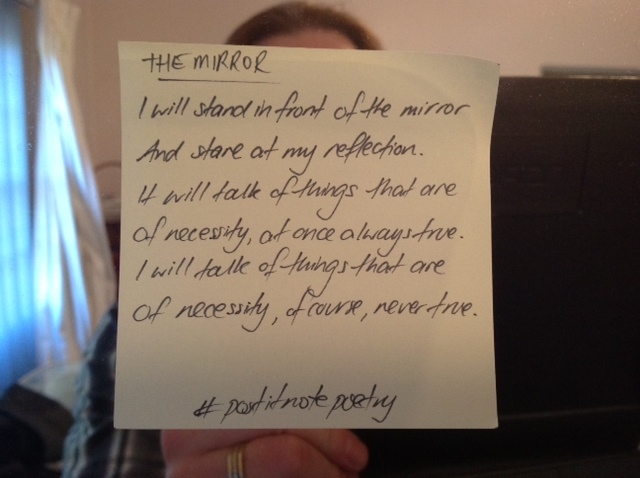
The Mirror

The Mirror

I will stand in front of the mirror

And stare at my reflection.

It will talk of things that are

Of necessity, at once always true.

I will talk of things that are

Of necessity, of course, never true.

The Mirror

Inspired by a quote from Bas Jan Ader, Dutch performance and conceptual artist, when reading James Roy’s blog, “Head Vs Desk.”

The Sound of Noise and Silence

The Sound of Noise and Silence

Go placidly amid the noise and haste, and remember what peace there may be in silence – Max Ehrmann, “Desiderata” (Desired Things)

Creativity is birthed in the chaos of noise and the silence of meditation.

As a drummer, I love sounds. Four limbs working together in synchronous co-ordination to create a pattern whether it’s a beat, groove or fill.

I create by reading the chart and playing the pattern.

But sometimes I forget something. I forget about the spaces between the notes, the gaps and silences. It is as important to understand the correct notes to play as it is to understand the silences between the notes.

It doesn’t matter if the tempo is slow or fast; if the beat is simple or complex, the gaps and silences are just as important. I am conscious of the silent movement of my hands and feet before they create a sound.

Noise in Creative Production

I can create out of the noise and I can create out of the silence.

Noise is the default creative setting: white noise, background noise, conversational noise. However, it’s where ideas are birthed and generated. The noise in the to and fro of conversation and found in the noise of information I sift through in my tweet stream.

As a drummer, I love sounds. Out of the noise something musical is created.

Silence in Creative Production

As a creative person I also need silence. I sit behind my drum kit and visualise the movements of my hands and feet, imagining the sounds I create when I strike a drum or cymbal and the pattern I am creating. In a similar way the sportsperson visualises the perfect throw, pass, stroke, movement in silence.

For writers, musicians, artists, dancers, filmmakers, there is a need for silence.

Silence is not a state of nothingness.

Silence is a state of meditation and mastication of ideas.

Silence requires time.

Silence requires patience.

Silence requires meditative focus.

Silence cannot be rushed.

Silence allows the mind to become still.

Silence brings introspection, clarity and solutions.

Silence restores strength and refreshment.

Silence is engaging with the moment as it is now.

As a writer, I need moments of silence to think through plot or characterisation, themes or symbolism, dialogue or description. I need moments of silence to compost ideas, turning them over in my mind like a koan.

Out of the silence and stillness comes creativity.

Find your place amongst the noise and the silence.