Post It Note Philosophy on Creativity 8
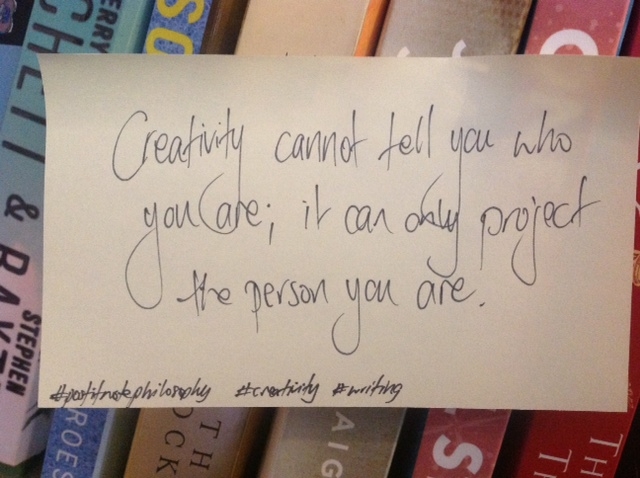
Creativity cannot tell you who you are; it can only project the person you are.

Post It Note Philosophy on Creativity 8
Creativity cannot tell you who you are; it can only project the person you are.
Posted in Creativity, Post It Note Philosophy
Tagged creativity, post it note philosophy, slice of life, writers, writing
Post It Note Philosophy on Creativity 7
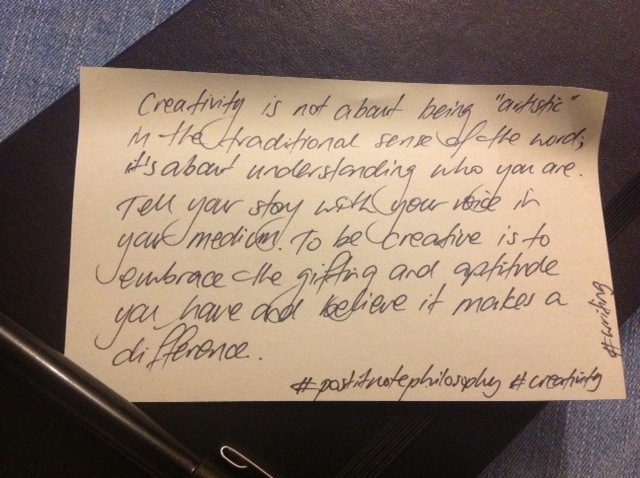
Creativity is not about being “artistic” in the traditional sense of the word; it’s about understanding who you are. Tell your story with your voice in your medium. To be creative is to embrace the gifting and aptitude you have and believe it makes a difference.
Posted in Creativity, Post It Note Philosophy
Tagged creativity, post it note, post it note philosophy, writers, writing
Post It Note Philosophy on Creativity 6
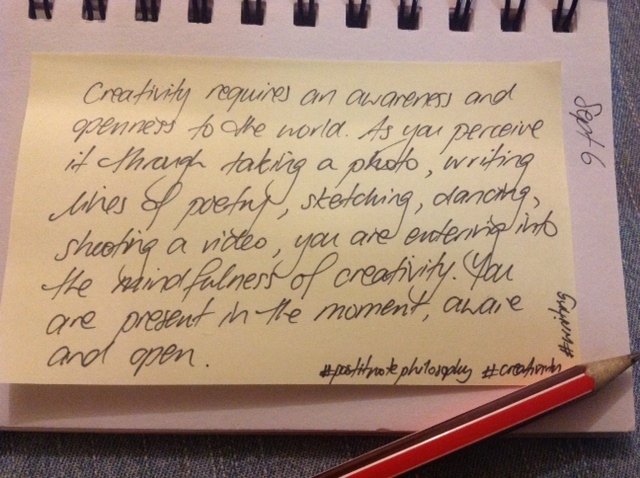
Creativity requires an awareness and openness to the world. As you perceive it through taking a photo, writing lines of poetry, sketching, dancing, shooting a video, you are entering into the mindfulness of creativity. You are present in the moment, aware and open.
Post It Note Philosophy on Creativity 5
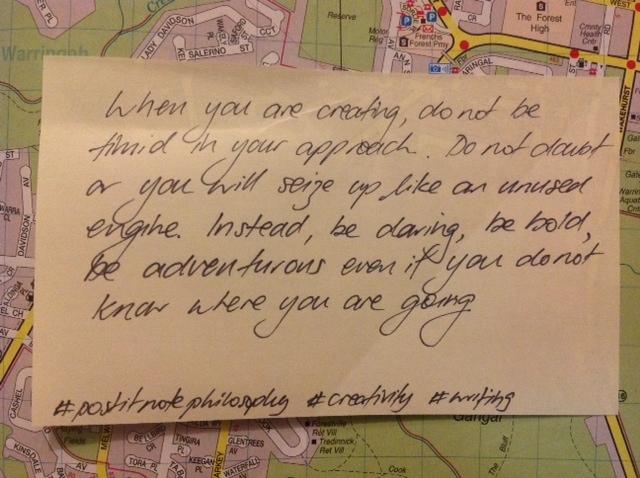
When you are creating, do not be timid in your approach. Do not doubt or you will seize up like an unused engine. Instead, be daring, be bold, be adventurous even if you do not know where you are going.
Post It Note Philosophy on Creativity – Day 4
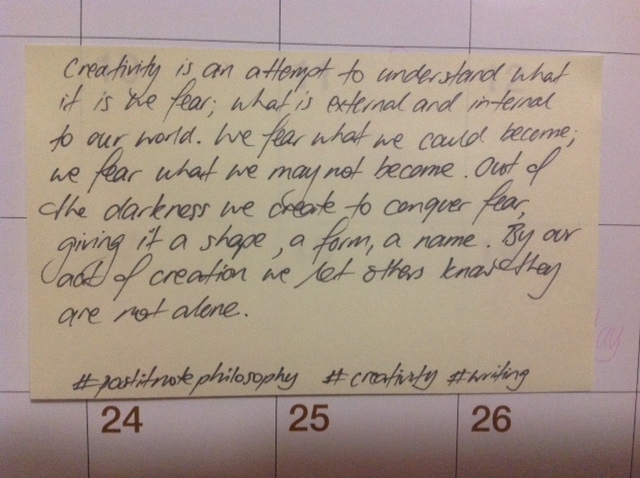
Creativity is an attempt to understand what it is we fear; what is external and internal to our world. We fear what we could become; we fear what we may not become. Out of the darkness, we create to conquer our fear, giving it a shape, a form, a name. By our act of creation we let others know they are not alone.
Post It Note Philosophy and Creativity – Day 3
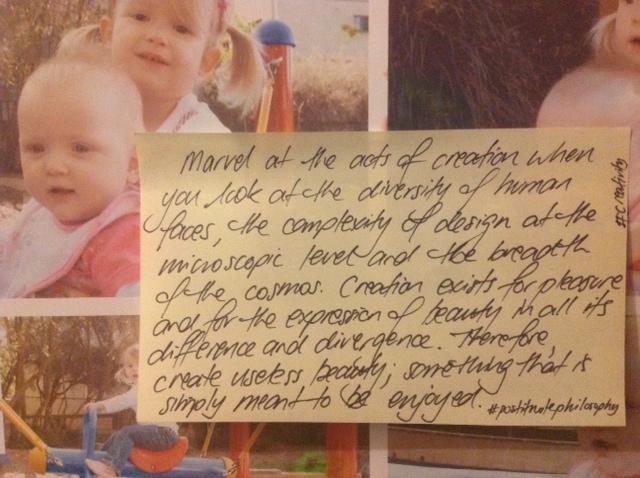
Marvel at the acts of creation when you look at the diversity of human faces, the complexity of design at the microscopic level and the breadth of the cosmos. Creation exists for pleasure and for the expression of beauty in all its difference and divergence. Therefore, create useless beauty; something that is simply meant to be enjoyed.
Posted in Creativity, Post It Note Philosophy
Tagged creativity, nature, post it note, post it note philosophy, slice of life, useless beauty, writers, writing
Creativity Philosophy Day 2
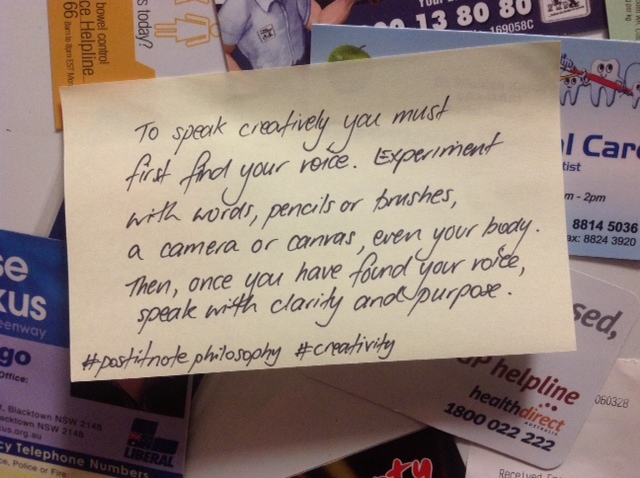
To speak creatively you must first find your voice. Experiment with words, pencils or brushes, a camera or canvas, even your body. Then, once you have found your voice, speak with clarity and purpose.
Today is the first of September. It is the first day of Spring in Australia and it is Father’s Day. Symbolically it is a time of new beginnings, of creation, of celebrating new life.
I firmly believe in the creative dynamic is a part of everyone’s life; it is not the sole domain of the writer, the artist or the musician, the film maker or dancer. Therefore for the month of September I will post a Post It Note with a statement about creativity. It will be an exploration of what I believe creativity is, and how it can be a dynamic part of everyone’s existence.
Please share and encourage people to find their creativity.
Here’s the first one.
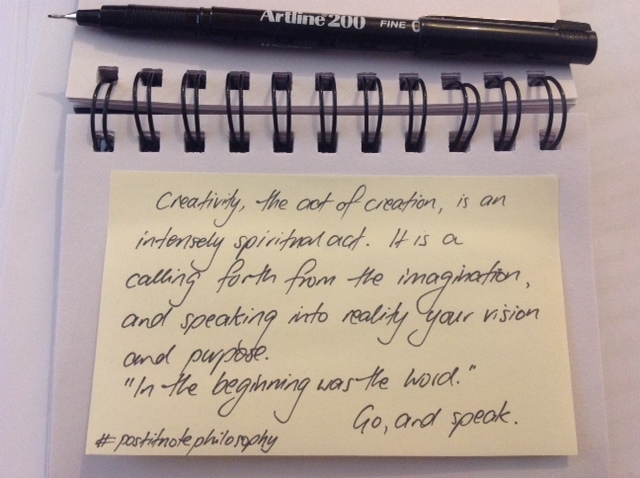
Creativity, the act of creation, is an intensely spiritual act. It is a calling forth from the imagination and speaking into reality your vision and purpose.
“In the beginning was the Word.”
Go, and speak.
Posted in Creativity, Post It Note Philosophy
Tagged creation, creativity, post it note, post it note philosophy, reflection, slice of life, writers, writing
As a writer I look for great examples of creativity and approaches to art, whether it is writing, art, film, photography, dance, as sources of inspiration, technique or information.
I came across this video, initially drawn to it by the chalk art, but listening to the artist’s approach I saw it had applicability to writing. It confronted me about how as a writer I am attached to my words. It made me view the permanency of my words in a different light and to become less attached to them.
Watch the video here: Hand Drawn Chalk Art
As a writer, I want the words I write to have an existence beyond when I write them.
This video has taught me to let go of it, to understand I can erase and rewrite.
The process becomes important; the writing, drafting and editing until what I have left is a permanent record of what I do and say.
But even then I cannot be too precious about my words. When my words are read they will be interpreted, reinterpreted and misinterpreted; quoted and misquoted. And I’m cool with that.
For example, I wrote a piece of flash fiction, “The History of a Relationship As Told By A Mix Tape of U2 Songs.” It is in the reader’s interpretation of the song titles to make meaning. It doesn’t require knowledge of U2 songs, but if you know them it does enhance the story. I could have used almost any other band’s back catalogue for the same purpose; now I am imagining a story told by Pink Floyd song titles.
I have quoted some of the statements made in the video and make their connection and application to writing and the writing process.
“With paper, you’re using white paper or a toned paper and you’re going darker in value, which means you’re going black. On the chalkboard it’s already black so you’re working in the opposite way; you’re bringing your highlights to the front.”
The white paper or the white screen of a new document is often a terrifying prospect for the writer. Once you have reached “The End” of the first draft you are confronted with the darkness of the page inscribed with words. The editing process is like drawing on a chalkboard, bringing the highlights to the front, seeing the essence of the scene and the story and paring away what is not required.
“It’s about the biggest shape to the smallest shape. It’s about the big picture, not about the smallest detail… What is the biggest shape you see?”
Whether you plan everything in minute detail or let the wind blow past your bare butt cheeks as you fly merrily along where the plot and characters take you, there is still a simple premise and focus of the narrative. Developing a log line or brief statement about your work in progress means you have the really simple shape outlined. From there it is filling in the blanks and adding detail.
“Dynamic sketching – it’s about the interpretation of really simple shapes.”
When I am writing a new story, I like to know the end from the beginning, and have some of the points in between mapped out. This gives me the big picture, the biggest shape of the story. If I get focused on the little details, the motifs, symbols, characterisation, I lose sight of the big picture. Each of these details is an interpretation of the simple shape of the story arc.
“Because I enjoy the process more than the finished product, I can erase, I can let go of it… When you can let go of it, you can give yourself to it, give it focus.”
This is what first drafts are for. They are called ‘brain vomit,’ ‘word explosions,’ ‘smearing the alphabet with wild abandon.’ Call it what you will, the process is important. The finished product is a culmination of the process but if you’re too focused on the end, to be able to say, “I gave birth to this novel,” you won’t let go and you’ll focus on word counts, sentence structure and wickedly crafted metaphors to be the doyen of your writing group. You have to know when something isn’t working and not be afraid to excise it from your manuscript. It may be a character, a plot point, symbolism, dialogue, or sentences of description.
“When you’re too limited by how you think about your pieces, your pieces become limited as well.”
Letting go of preconceived ideas about the purpose of your narrative allows you to explore the ideas further, rather than being restricted in the parameters you have established. Let the narrative breath on its own rather than relying on you to breath for it, compressing its chest in the vain hope it will be revived.
In the words of Princess Leia to Grand Moff Tarkin, “The more you tighten your grip, the more star systems will slip through your fingers.”
Hold onto your work loosely but keep a firm hold. Be prepared to let it go if necessary and never lose sight of the big picture.
How tightly do you hold onto your words? Are you prepared to let go?
Posted in Creativity, The Writer's Life
Tagged creativity, drawing, fiction, letting go, slice of life, writers, writing, writing tips
I am an English teacher and drummer/percussionist with an interest in literary pursuits, creative endeavours, rhythmic permutations, theological amplifications and comedic outbursts.
Here you will find my creative detritus: articles on living a creative life and writing explorations.
And other ideas I have snaffled from the papers stuck on the fridge door.
Twitter: @RevHappiness
Instagram: @handwrittenpages
My collaborative epistolary novel, "Post Marked: Piper's Reach," written with Jodi Cleghorn (@JodiCleghorn) out now via Vine Leaves Press.
Come and browse through the library; there is no need to be silent.

 A Fullness in Brevity - Adam Byatt
How Do You Write An Epistolary Novel?
How do you write an epistolary novel?
Easy. Follow these simple steps:
I co-wrote Post Marked: Piper’s Reach with Jodi Cleghorn (@JodiCleghorn) and we are now in the middle of editing the story.
Of course, you could write the letters yourself from the perspective of different characters but you don’t get the anticipatory Pavlovian response when you’re waiting for the sound of the postman’s motorbike (as they use on my street). Delayed gratification was something we had to deal with as we waited for each letter to arrive; 2 or 3 days can be an agonising wait.
You’re waiting on the newest letter to reveal the next part in the narrative, to learn more about the other character, and learn about your own character too (we both dropped in parts of each other’s character’s history – it’s how I found out Jude busted his knee skateboarding prior to Ella-Louise’s stage debut in “West Side Story”).
We wrote it for fun with no pressure, no constraint, no limitations or time frame. It was for us; writing for the pure enjoyment of it, and indulging in the lost art of letter writing we both had long since neglected.
For the first 3 months we wrote for ourselves yet knowing we would post them online eventually. Once it started online we began to gain a following. It grew to a small, but core, audience we dubbed the “Posties.”
Something positive changed. I realised I was writing for more than an audience of one. No longer was I writing with Jodi in mind (she was always my primary audience as the writer of Ella-Louise), but a wider readership who were invested in the lives of Ella-Louise and Jude. It gained traction and I saw the potential for this beyond the online community we had established.
After 16 months of writing, 52 letters and 85,500 words we wrote “The End.” It has only been in recent months that I realised I have written a novel. Surprising, really. Still shocked by it. Happy, certainly, but quite pleasantly surprised we did it (Jodi said she could never write a novel and I never thought I’d manage to write one – experience has made liars of us both).
This is what I wrote as a reflection when we had finished: What Happens When You Reach ‘The End’?
And now we ask the big questions and dream the big dreams.
How far can we take this epistolary narrative?
It is a question yet to be answered; in due time it will come to fruition.
While we wait for that day to come, we are hard at work editing the letters and smoothing out the roughness. Writing a web serial can allow for minor discrepancies and inconsistencies but a novel cannot.
For example, the character of Marion, Jude’s mother, became a very different character than when she started. This is the down side of the No Spoiler policy meaning we didn’t talk plot – originally Jodi’s suggestion was a character who was suffering from early onset dementia, but I missed the clue. Instead she became a far more complex character. It meant retconning the opening letters to reflect who she had become.
We have edited Season 1 and sent it off to our editor, Toni. Meanwhile we plough on through edits on Season 2.
Does this narrative have an audience beyond the core readership? I wrote back in July about the relationship between writer and reader: Piper’s Reach – The Writer and the Reader.
Jodi came across a site, First Impressions, hosted by Marcy Hatch and Dianne Salerni, offering a critique on the first 350-400 words. We bounced around the idea and decided to give Piper’s Reach a road test with an unknown audience to see if it engaged them and what reaction we’d get.
We spent a week or so writing and rewriting Ella-Louie’s first letter. Jodi wrote about her experience here: How Do I Love Thee? Let Me Count The Ways.
I was too caught up in school work to stress about it all but I was very keen and a little anxious to see what other people thought about a project I have invested very heavily into. Even though the opening words are not mine, they are Jodi’s; we had input into each letter in the editing phase so they become our words to an extent.
The first letter is critical to engage the reader and make them want to read on.
So, how did we do?
You can read the critiques and comments here:
Dianne Salerni and Marcy Hatch
They both praised the opening letter highly.
Marcy said, “This is an interesting beginning. I don’t think I’ve ever read an adult epistolary novel and I’m curious to see where this goes. This first page/first letter tells me quite a bit. Like the fact that Jude and whoever is writing the letter were probably once lovers, that they were close but that for some reason Jude didn’t come to see our narrator off, and that Piper’s Reach has some shared meaning for them. What’s great about this first page is that it sets up lots of questions about the past between these two people but also suggests a question about the future. Why is the narrator writing to Jude now, twenty years later? I want to know what happens next!“
Dianne commented: “First of all, I have to say that I’ve never heard of a novel being written this way before, especially in today’s world of instant communication. It’s quite original – and because I’m a pantster who also lets stories develop organically, I’m intrigued! The voice of the first letter writer (Ella-Louise) comes through strongly in this opening, and the premise is clear: She is trying to re-connect with a close friend (possibly a lover) whom she hasn’t spoken to in twenty years via the medium they used in the past. Letters.
What did readers have to say about Post Marked: Piper’s Reach?
A couple of readers stumbled on the colloquialism “pashed,” an Australian term for kissing, but other than that, the response was overwhelmingly positive.
Farawayeyes: “I’m intrigued, and completely hooked. I love the idea. It’s so different and refreshing. I will certainly read on.”
Kittie: “There’s no middle ground with epistolary writing. It either hits or misses. This one hits!”
Liz: “I love all of the little hooks and mysteries you managed to get in just one short letter. I was worried you were going to answer all of my questions too fast, but you didn’t – you held back and gave me a taste of an answer and then more questions, which is perfect. Great start :)”
Alex: “That simple letter says a lot. The authors nailed so much in just a few paragraphs.”
Jodi has a great write up on her blog: First Impressions for Post Marked: Piper’s Reach
For me, it shows we have an engaging narrative. We are on to something. Let’s see how the rest of it bears out.
Meanwhile, back to the edits.
Leave a comment
Posted in The Writer's Life
Tagged audience, comments, critique, feedback, jodi cleghorn, piper's reach, writers, writing