Tag Archives: writing

Things To Throw Away – A Poem And Its Deconstruction

This started as a poem on twitter and I thought I wanted to expand on the idea a little as a practice exercise.

Things to Throw Away:
the shaggy toothbrush
the unworn shirt
the leftovers
the poetry I wrote as a child
the fear I cannot do this

When I came to expand it, I saw the completeness of it; adding to it would be padding out the original idea, hastily written as it was.

Instead, let me explain why I chose the images and the final line. As an English teacher, this is what I get my students to do: deconstruct a text to see how the components fit together. Therefore it behoves me to do it to my own work, to understand what I am doing and why; to make conscious the unconscious.

I chose the images as concrete ones, specific items the reader would recognise, an item they could visualise in their own house. Each item contains the principle that they have been held on to for too long, or has outlived its usefulness.

I am known to hang on to toothbrushes for longer than is recommended, and it’s not a big effort to get a new one, but there’s a comfort in what is known. I could replace the shaggy toothbrush image with that of holey underpants for more of a giggle.

The image of the unworn shirt suggests an item that we hold on to because it was a gift, or it was something we want to fit into, but it’s another delusion of ourselves.

Leftovers in my fridge are either consumed immediately or linger like a lost soul, discovered when there is a culture of organisms breeding. Why do we do it? Neglect? Forgetfulness? Apathy? 

Bad emo poetry; we all have to start somewhere as writers. I still have notebooks I wrote in as a teenager and I recognise the child that I was. Nostalgia holds very tightly onto objects of significance and is afraid to relinquish them.

The final line was always designed to be a twist, a shift from the concrete to the metaphysical and emotional. For me, a poem about emotions needs to be grounded in physical objects, a concrete image. It can also be done with clever similes or metaphors but I prefer physical descriptions (perhaps a weakness to strengthen – to think more poetically).

It’s about letting go, releasing yourself and being free of objects, memories or emotions that restrict your development. Would it help you to know it’s autobiographical?

There you have it. A poem and its deconstruction. If you disagree, have at it in the comments.

Thanks for reading.

Creative Boundaries

A comment made on one of my recent posts made me consider how I consider the idea of boundaries.

The theme of boundaries has been pushing my creative buttons… I have been thinking about all kinds of boundaries and barriers from the physical to the psychological and emotional. Are they a challenge to be met and breached, or a restriction to prevent us from moving on?

How do people define boundaries? The common thinking is, I believe, that boundaries are restrictive and a construction to keep people held in certain behaviours or status. In the words of Talking Heads, “Don’t fence me in.” Hence the need to express freedom, to rebel, to become an individual. Which makes me think of Monty Python.

“You’re all individuals,” says Brian.

“Yes, we’re all individuals,” parrots the crowd.

“I’m not,” says one intelligent individual.

Or in the epitome of 1950s rebellious expression, “Rebel Without A Cause.”

“What are you rebelling against?”

“What have you got?” says James Dean.

In regards to boundaries I’ve never thought of them as an either/or proposition. For me they are both a restriction and as a challenge to be met.

Boundaries act as a restriction, a defining marker point. Think of the fence that delineates your property from the neighbour’s. Therefore boundaries in this sense serve as a means of knowing the limitations and confinements of who we are. They provide a definition, a discipline, providing a sense of safety and comfort.

Boundaries also act as a challenge to be met. Once we understand why the boundaries are put in place, and how we operate within them, can we transgress or expand them. We can push the limits, positively and negatively, to expand on our own sense of self.

The creative person needs both sets of boundaries.

Boundaries are the ways we learn, learning and knowing the rules, history and traditions of our chosen creative field. Only then can the boundaries be transgressed, challenged and extended. 

The boundaries imposed upon us (physical, psychological, emotional, mental, spiritual) and the boundaries we impose upon ourselves are the topic for another post.

Boundaries define who we are, what characteristics we want to keep as permanent territorial markers in our lives and ones we want to challenge and extend.

In the words or Inigo Montoya, “Let me explain. No, there is too much. Let me sum up.”

1. Boundaries give us defined parameters when we first learn a creative art.

2. Those boundaries are a means of helping us learn and define our craft, to begin to excel at it, to find our voice.

3. When we are comfortable we can begin to push and extend the boundaries, comfortable in our sense of self and our art.

What are your thoughts? Are boundaries a help or a hindrance to your developing creativity?

A Little Prompting #17

Welcome to another week of A Little Prompting.

I didn’t quite manage to reach the deadline of the comp I wanted to sub to. Not a problem as there will be another opportunity later in the year. It will give me a chance to work over my idea thoroughly and address the issues my beta reader gave me to mull over.

THEME Games
RANDOM LINE PROMPT The discreet theft of the letter “Q” was the precipitation for divorce.
PHOTOGRAPH  Monopoly-Vintage
SONG/MUSIC VIDEO Peter Gabriel – Games Without Frontiers

SENSORY SUGGESTION The stale stench of cigarettes and body odour in the pinball parlour.
QUOTE “Time is a game played beautifully by children.” – Heraclitus

Have a creative weekend. 

Absence – A Poem

It’s been a week of rediscovering micropoetry, using the boundaries and confines of 140 characters on Twitter.

This poem was inspired by a comment from Australian author, James Bradley, on depression. His comment also inspired an idea for a short story I have written down and filed away for further development. Right now it’s on the compost heap, fed with scraps of thought until I see what sprouts.

Absence

Absence grows like a shadow
lengthening with the sun
and turns light to darkness
to fill the space
retreating at its turn
never disappearing

On reflection on the type of poetry I write, focused on the little things of the everyday, I resist the urge to use simile. Metaphor, or sustained metaphor, feels less jarring than the input of a simile. However for this one the imagery required the simile to set up the remainder of the poem and the final line. 

Looking at it now, I could replace the first line with a metaphor, “Absence is a shadow,” and I feel it works better, making the link to the imagery cleaner and less like a teacher demonstration. 

The other issue is the use of “its” (line 5) as it is unclear what is the subject of the preposition. I know “its” refers to the sun but that may be unclear to the reader and you want the imagery and lines to stand for itself, not require the reader to unpack the grammar to find out what is truly meant.

So, an edited version.

Absence is a shadow
lengthening with the sun
turns light to darkness
to fill the space
retreating at the turn
never disappearing

Slogans for Poetry – A Poem

This excerpt was the inspiration for another twitter poem. 

Tomorrowland, directed by Brad Bird, was a box office disappointment and has been poorly received by critics. It has a 49% on Rotten Tomatoes. A. O. Scott of the New York Times wrote that the film, “searching for incitements to dream, finds slogans and mistakes them for poetry.”
The full article is here on Buzzfeed.

our poetic voice
of heart’s passion
mind’s emotion
is reduced to
soundbite
slogan
sycophancy
slowing the heart
until the pulse
peters
out

To be honest, I’m not happy with the result because A. O. Scott says it so much better. There’s such poetry in his statement that my attempt to remix his words into something new seems feeble.

It’s a sentiment I like and one I will return to after it has composted in my head for a while longer.

What do you think of it? In the words of Count Rugen, “Remember, this is for posterity, so please, be honest.”

The Death of Youth – A Poem

The Death of Youth

This then,
is the death of youth:
the blunt pencil
the dried out pen
the paper, crumpled
and tossed into the bin
untouched

I love twitter as a forum for having conversations, speaking my mind on something and using it as a boundary when writing poetry. It is similar in scope to Post It Note Poetry where the size of the Post It Note defines the length of the poem.

Twitter’s limitation of 140 characters means brevity is the essence of the writing. Make a statement, make it clearly and let it go.

This poem was inspired by another poem I read on twitter and gave me the opening two lines. My mind was asking the question, “What signifies the end of youth?” It echoes a line from my favourite novel, “Maestro” by Peter Goldsworthy, where the narrator, Paul Crabbe says that the end of childhood is when one becomes aware of it.

As a creative person, it was the idea of the death of creativity that connected me with the death of youth. Thus the last image of the untouched piece of paper, unsullied by the first explorations of creativity, or that time in our life when we are told to put away “childish things” that signals the death of youth. 

We can have a child-like enthusiasm for creativity and not lose the spark, and develop a creative maturity so that we do not mourn the death of the thing we love.


Practice Pages – Music To Die By

This Practice Page was inspired by a line in a text I was reading (I wish I wrote down what it was – it may have been an article I was reading online). The line that sparked the thought forms the title, Music to Die By.

Oh, it’s all flaws and problems but I like the idea of simply throwing words down on paper to explore an idea; try to excise the cliches and boring prose with something different. I find the same phrases or half-sentences popping up in my writing like dandelions, spreading their seed when I fart and sowing a new crop of half-arsed sentences.

Therefore, the practice pages are a good way to expunge tired expressions from my writing and find new images and constructions. And, yes, this is all just practice and in no way should be considered ‘art.’

Music To Die By

The funeral march, never heard by your own ears, is a cadence of steps bearing the weight of the coffin with you inside it. The missed step and misstep, Perhaps the last thing you heard was the shufflely slap of slippers in the hallway, the click of the bathroom light and stop/start splash of urination.

You have a set list of songs you’d like played at your funeral; even one or two put on there as an ‘up yours’ to certain family members. But if there was one song to play, that best encapsulated who you are, and who you were, what would it be? The sentiment of a song, meaningless to everyone else but you, and you can’t hear it.

While mulling it over, there are playbacks of other songs: the frenetic two-beat of punk, a stuttering motorcycle of attempted rebellion until the motor smooths out and rebellion is understood as a revolution of the mind, not the clothing.

Or the rushed climax of lovers as the radio plays some innocuous pop song in the background, a soundtrack gouged in wax and on each subsequent listen the memory replaces the physical engagement until the only thing left is chemical memory and the desire of what it represented.

This then, is the purest music: the silence between heartbeats until at last, the needle of the record lifts, pauses, returns to the carriage and with the final click, the revolutions cease.

A Little Prompting #16

Welcome to another week of A Little Prompting.

How has your creative life been travelling? Mine’s doing well. Currently working on a short story with aim to sub it for a comp with a May 31 deadline. I need to get cracking.

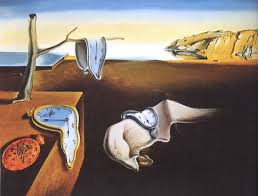
THEME  The Persistence of Time
RANDOM LINE PROMPT  “Time you enjoy wasting is not wasted time.” 
― Marthe Troly-Curtin, Phrynette Married
PHOTOGRAPH  

Salvador Dali - The Persistence of Time

Salvador Dali – The Persistence of Time

SONG/MUSIC VIDEO  Anthrax – Got The Time
SENSORY SUGGESTION Feeling the weight of great-grandfather’s pocket watch in the hand of a six-year-old
QUOTE “I wish it need not have happened in my time,” said Frodo.
“So do I,” said Gandalf, “and so do all who live to see such times. But that is not for them to decide. All we have to decide is what to do with the time that is given us.” 
― J.R.R. Tolkien, The Fellowship of the Ring


Practice Pages – The Disappearance of Noise

As drills are to an athlete, or scales to a musician, practice paragraphs are to a writer.
Here’s a little sample of an idea I foraged from my notebook.
Feel free to remix it in the comments section.

The Disappearance of Noise

All of the clocks of my childhood are silenced into obscurity:

– the bedside alarm clocks in my grandparents’ bedroom, wound at the back

– the grandfather clock in the hall where time always seemed to move slower as I watched the pendulum arc back and forth, slicing the moment, shaving it second by second. The inscription, tempus fugit, the first Latin I learned, and didn’t understand the irony until I stood thirty years in the future.

– the clock on the mantle in Nanna and Grandpa’s house was more hurried, urgent, pacing the time to meet appointments, chiming the quarter hour in mimicry of Big Ben.

All of these sounds, the midnight soundtrack to treading the hallway carpet barefoot, its texture a fresh cut lawn, skipping to the cold tiles of the bathroom. And back again.

Now I lie awake and listen, in between the passing of cars at two o’clock in the morning, for the ticking of my watch. I know it’s battery operated, no longer the wind up mechanism of the watch of my youth. Finding it wound down to silence, bringing it back to life, then placing it to my ear to hear the cogs pushing and pulling.

It was the mechanical rhythm, a lullaby of space. The tut-tutting of disapproval for wasted time, the snap of Lego connecting and the skipping of Nan’s knitting needles.

The digital age has created silence.

Those Who Can, Do AND Teach

There is a saying: “Those who can, do. Those who can’t, teach.”

What a load of bollocks.

It’s said as an insult; a derogatory, snide remark to elevate one person and denigrate another.

As a teacher, it’s particularly insulting because it’s my profession, my career, my calling. To teach is to pass on knowledge, information, insight, technique, skills, habits.

To say those who can’t, teach, is to abrogate responsibility of all people to teach one another. 

Fundamentally, every interaction is teaching. We give it different names or titles like coach, mentor, professor, guru, but the interaction is the dissemination of knowledge and the acquiring of skills.

Teaching is an aspect of our relationships with one another. As parents we teach our children right from wrong, good from bad. We teach them to tie shoelaces, ride bikes, make sandwiches, treat people with dignity and respect, how to make friends. We should also teach them to create. Never let a child feel like creativity is a waste of time.

There are skilled and gifted teachers in every creative endeavour and every profession. While they may not receive the praise and accolades of some of their peers at the higher echelons, or their names are not well known, their work is far more significant. They allow the next generation to stand on their shoulders and see further. In turn, they pass on their skills and knowledge to the next generation, hoist them onto their shoulders and help them see further still.

To teach is to create. It creates interest, passion, wonder, curiosity, desire, engagement, questions. It creates a learner.

A student is never greater than the master. No, a master should ensure that the student IS greater than the master. This is creativity. This is teaching. Equip the student with the necessary skills and understandings to excel.

Explore the “family tree” of an artist in whatever medium. See where they came from, who they learned under, what ideas they developed and passed on. Know the origins of your art. 

Understand you can teach someone. It doesn’t require a degree, time in a classroom. Teaching is done in the quiet moments of conversation, time shared over tea and doughnuts.

Those who can, do AND teach.