Tag Archives: writing tips

Breaking the Drought

Today marks the end of the rather intense Chaotic Marking and Editing month  for work: Trial HSC marking and 6 Major Works for my Extension 2 students. I can, if I want to, break the writing drought. And there’s a couple of lessons to share.

Firstly, returning to projects after the drought. I said a few weeks back I would be absent, and for the most part I was. My works in progress were put on hold and I can now return to them.

But not yet. Why?

Because I am absolutely knackered mentally, emotionally and physically. Today is a day of rest. Well, sort of. Washing done, biscuits made with Miss #2, couch time watching footy with Miss #1 and a gig to play tonight.

The adage, often said in all caps and repeated as a mantra, YOU MUST WRITE EVERY DAY, is in my mind, piffley twaddle. It would be ideal to write every day but the caveat is that every person is different, their schedules are different and you work out when and how you fit writing, or any creative activity, into your schedule.

During this last month, I gave myself permission not to write because I knew when the time was done I could return to it. It has been a writing drought. However, while washing up last night I had another idea for a poem to include in my verse novel, The Broken Chord. I found my notebook, scribbled the idea and returned to washing up. This is still writing. 

Secondly, the month of Chaotic Marking and Editing abated, I began to reflect on the work of my students. I posted this to Facebook and I’ll reproduce it here.

As I prepare for my Extension 2 English students to hand in their Major Works on Friday, I have a new credo as a teacher. And it comes (with a slight adaptation) from Doctor Who.

Great men (and women) are forged in fire. It is the privilege of lesser men to light the flame.

To completely misappropriate the quote and apply it to teaching, I am very proud of the work my students have produced. I am proud because they took on a challenge some of them were unsure they could tackle, and they have known what it is to work hard. And succeed.

As a teacher, I get to light the flame in my students. I want to instil in them a love of learning, not just my subject.
Sometimes that flame is encouragement, words of praise and congratulations.
Sometimes it’s telling the student the hard truth.
Sometimes it’s confronting their attitude, beliefs, values, and sometimes it’s supporting them.
Sometimes it’s asking them how they are, acknowledging their presence, saying hello as they enter the classroom and wishing them a good day as they leave.

To light the flame is to wish my students the very best in their endeavours and to do things better than I ever could.

I hope I never run out of matches.

I still need some rest before I tackle my WIP. No rush. It is knowing your creative cycle and how to ride it. It will take a little while to break the drought and gain momentum in my writing but that is fine.

How do you break the creative drought?

Random Creativity (And Why It’s Important)

On Friday my Year 8 class were set the task of writing haiku.

The English approximation of a beautiful Japanese art form is known to most, if not all, primary school children. They learn it is a poem of 17 syllables broken into 3 lines (5, 7, 5) and it is about nature (or something…).

It is taught because it is easy and accessible for students. It gives definite boundaries and restrictions, confinements for words and their interplay of meaning.

But writing great haiku is difficult.

I told my students I wanted them to experiment and play with language. I encouraged them to enjoy the process, to have fun with language. And so I had a go at writing a couple myself.

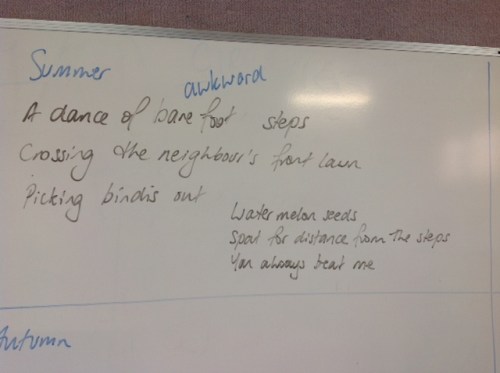
Summer Haiku

Summer Haiku

A dance of barefoot (awkward) steps
Crossing the neighbour’s front lawn
Picking bindis out

Watermelon seeds
Spat for distance from the steps
You always beat me

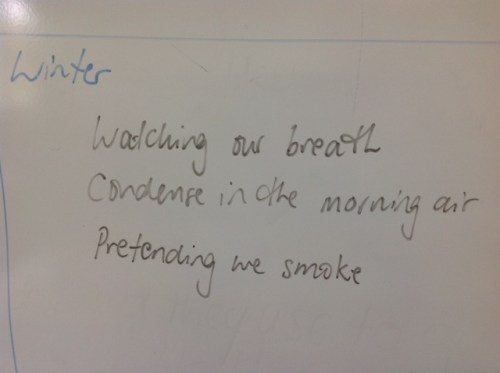
Winter Haiku

Winter Haiku

Watching our breath
Condense in the morning air
Pretending we smoke

Are they any good? Probably not.

Why is random creativity important?

It can be done quickly and in spare moments, disposable as an empty soft drink container or laboured over and agonised and deliberated for each and every syllable.

This is why creativity is important. 


Understanding Alchemy – My Writing Process

I suspect many readers, and indeed if conference questions are anything to go by, are mystified by the process writers have of hunting down, killing and skinning an idea and presenting it as a story. It’s like the medieval alchemists who attempted to combine elements and transform it into gold.

I was reluctant to write this post, tagged by another writer, my collaborative writing partner Jodi, but realised if I believe everyone can be creative then it behooves me to explain the process and guide new writers into the mystery.

Please don your robes and grab a doughnut; the initiation is about to begin.

There are many pithy quotes by writers about how to write but they are only relevant if you have immersed yourself in the craft of writing. Experienced writers nod sagely and ironically at the pithy wit and wisdom of those they admire but it doesn’t let the novice into an understanding.

The focus of the My Writing Process tagalong was to ask writers 4 questions. Here are the 4 questions asked and my attempt at an answer. Particularly #4 where I will attempt to show how I work and see if it helps novice writers on their journey.

1. What are you working on at the moment?

Too many things. Here are the most significant projects.

a. Post Marked: Piper’s Reach is a collaborate epistolary novel written with Jodi Cleghorn. It was hand written in real time and sent through the mail.
We are now at the stage of finalising our synopsis and getting it ready to submit to a variety of avenues.

b. The Java Finch (novella – working title) This is the logline I developed in my planning:
When Jack displays his finches at a bird breeding convention he meets Takashi who is painting the birds. They form an unlikely friendship and begin to come to terms with their experiences of World War 2 that shaped their lives, discovering that the very things that trap them are the things that give them the most freedom.

c. The Broken Chord (YA verse novel – working title) The (very rough) logline: Caitlyn-Rose is a gifted musician in her final year of high school, and having lost her mother in her first year of high school, struggles with her identity and purpose on the verge of graduating, afraid of the future and who she is.

d. I am also working on Degenerate Dictionary, Post It Note Poetry and a non-fiction book on creativity.

2. How do you think your writing differs from that of other writers in your genre?

I honestly have no idea. I am a newbie author so comparisons to other writers is unfounded.I do not have a substantial body of work to hold up for scrutiny. What I do have is an interest in authors who writing I admire: Tim Winton, Marcus Zusak, Craig Silvey. It is from these writers that I take inspiration in terms of style. I like Winton’s poetic prose, Zusak’s voice and Silvey’s humour.
My own writing infuses elements of all three, but it is my voice. I do not intend to be a slavish copyist but to speak articulately in my own voice. I love how the minutiae of life is a smaller version of the bigger thematic concerns of a work.

3. Why do you write what you do?

I remember watching an indie film with an old friend when we were growing up called ‘The Saint of Fort Washington’ and it was a couple of lines of dialogue that stuck with me.
“What’s your story?”
“I haven’t got one.”
“Everybody got a story.”
At the heart of it is a desire to know people’s story; how often do you hear someone say, “My life is uninteresting” or “I’m so boring” but that is the point of intersection where I want to ask the person about his or her life and listen to the stories that are important to them (I have plans for a project to take this idea a step further).
I write what I do because it’s the little things in life that interest me. For example:
* who decided it was a good idea to share a bed with someone?
* why does it take so long to hang out socks and underpants on the washing line?
* how long should you let someone walk around with their fly unzipped?
* is falling in love better or worse than getting gravel rash when you fall off your skateboard?
I wrote a manifesto some time ago, to articulate my vision for why I write.

I am a writer.

I write because I want to tell a story, but not just any story.

I write because I want to tell the story of those who are not heard.

I write because I want to tell the story of those who cannot speak.

I write because I want to tell the story of those who are disempowered.

I write because I want to tell the story for those who cannot.

I write because I believe that telling a person’s story is integral in understanding who they are.

I create art to speak into the darkness, that I may be a light for others to ignite their own flame and walk clearly.

People’s lives are not boring; writing is an exploration of how and why the everyday variables and events impact a person.

4. What’s your writing process, and how does it work?

Process assumes a regularity of work habit. Yeah, about that. Nope. Doesn’t work for me.
I know writers who can park their backside in a seat for an entire day and churn out 2000 words, 5000 words or even 10,000 words. Others I know work in small chunks of time, half an hour or an hour while others write until they have 1000 words.
For me, I work in bite-sized portions of time, snatching words in paragraph fashion. I have, in the past, written in chunks of time and written to 1000 words. It is always dependent on the workload of my day job.
I can go days or weeks without substantial writing yet still manage to scrawl words here and there. And I write slowly.
I also don’t have a regular process because I also write poetry and short stories. What I am working towards is a more consistent pattern, say 2-3 times a week of set aside time to write.
There is no formula to writing; you simply write.

How you create stories is another matter.

When I first started writing I knew a story needed a beginning, a middle and an end; a complication, a series of events, a resolution. But how to put these into a cohesive piece was what I needed to learn. I read as many blogs as I could about the writing process and how to craft a good story. I wrote 1000 word pieces of flash fiction and posted them to my blog, linked them to others and sought feedback to improve my work.

You learn to write by writing and reading. A writer is the sum of their reading influences and their vision and perspective on the world. You tell stories for myriad reasons but at the heart of it for me is the power of story to transform the individual and also a love of words and language.

Find a pen, a piece of paper, and write a story. Find your voice.

Checkout Manga – Micropoetry

Checkout Manga

In between customers
She draws manga
On the back of receipts
Slips them into groceries
And wonders if Godzilla
Eats breakfast cereal

Author’s Note: I don’t comment on why I write, the reasons behind a poem or its meaning. But today is different.

I was going through the checkout at Woolworth’s tonight, buying milk. The girl at the checkout, while waiting for customers, was writing on the back of a discarded receipt.

There was Japanese writing and a little manga-style cartoon. I said, “Cool drawing” and she was a little embarrassed.

Quick transaction and I was on my way. It was the little drawing I found intriguing; an insight into another person’s life. It inspired the first half of the poem and I turned the second half into a little whimsy.

The power of story from someone’s life. Look for the moments.

What Makes Your Life Extraordinary?

What Makes Your Life Extraordinary?

In Dead Poet’s Society, Mr Keating takes the boys to the hallway to see the photos of past students and whispers the immortal lines, “Carpe diem. Seize the days, boys. Makes your lives extraordinary.”

A current television commercial runs the slogan, “Escape ordinary.”

What makes a life extraordinary?

People buy into this idea of your life having to be a Broadway extravaganza or a Hollywood blockbuster ALL. THE. TIME.

We are presented with hyper-idealised notions of reality. Do life BIGGER, BETTER, FASTER, LOUDER, MORE DEMONSTRATIVE, IN YOUR FACE and (dare I use it because I hate the acronym) YOLO! It’s perfectly captured in the Selfie Generation: LOOK AT ME, I’M IMPORTANT AND I DESERVE YOUR ATTENTION.

It is the wrong perspective.*adjusts cardigan and puts on slippers*

What’s wrong with ordinary? Ordinary is where I live and find my inspiration. I joke my life is coloured beige for boring, making my life extra ordinary.

For the creative person, extraordinary is a way to burn out because it demands you give out so much more of yourself than is returning to you.

“The candle that burns twice as bright burns half as long.”

For me as a writer, the greatest stories are not the ones we see in films, the lives of movie stars, but in the embarrassing ordinariness of people doing things in their every day lives that benefits others. The ones who don’t see their work as anything important; they are filling a need, taking care of their community, advocating for the poor and disadvantaged. Living an extraordinary life is one lived in service of others and pursing your own dreams. Balancing the self with the care of others. Telling their story is an extraordinary privilege.

I like to think of the word as “extra-ordinary.” The one thing that defines the ordinary from the extraordinary is passion. Mr Keating exhorted his young charges to engage with the aspects of life that they were passionate about.

For the creative person, the passion manifests itself in the choice of medium whether it’s writing, art or music.

As it relates to creativity, to continually produce great art, to live an extra ordinary life, requires repetition, ritual and reflection.

Repetition

Not once, not twice, not even thrice but continually and habitually. Continue to produce art: write regularly; sketch, doodle, scribble whenever possible; practice scale and rudiments.

Repetition can become staid and uninspiring so it requires a dedication and committed work ethic to maintain your focus on being creative.

Early efforts will be complete and utter rubbish. But that’s the point of repetition: you do it until you get better.

Ritual

Setting aside an assigned time to work on your creative project is like attending church or settling onto the couch to watch your favourite television show or sport team compete. Like repetition, it is a repeated event but the goal is one of individual development.

Ritual provides structure and is an active reminder to develop a disciplined approach to our creativity.

Reflection

Movement without reflection will only end up with you moving in a circular fashion, only ever returning to the starting point without having learned or progressed.

Every once in a while it is important to reflect on your goals, your progress in terms of work produced and skills developed. Are you improving? Has anything weakened? What else do you need to know?

Creativity makes your life extraordinary because you have embraced repetition, ritual and reflection. You are taking the ordinariness of life and giving it meaning through creating great art.

This makes you extraordinary.

Addendum: This morning in the shower (place of many great epiphanies along with the kitchen sink while washing up) I had another idea to add. It was the one thing that makes a life extraordinary: Relationship.

Without relationship, we are merely individuals without community and connection. In relationship with other creative people we make our lives extraordinary because we have companionship, connection and community. We are no longer alone. This is fundamental in making our lives extraordinary.

Want To Be Creative? Ask Good Questions

The key to unlocking creativity is asking good questions.

There is no singular question, like having the key to a cupboard, to unlock creativity. It’s more like being given a set of keys to unlock many cupboards, boxes, safes, vaults and the little box you thought you’d forgotten about.

When you know which key unlocks which box, you have an opportunity to develop your creative skills.

Non-creative people, those who are yet to understand that they too, can BE a creative person, look on in wonder and ask, “Where do you get your ideas from?” They are looking at the key in their hand and using it to dig the wax out of their ears or stir the milk and sugar into their cup of tea.

Last year I wrote 11 Facetious (and 1 Serious) Answers to the Question, “Where Do You Get Your Ideas?”

The question is a default position where the person does not believe they can be a creative person, and they are seeking out a secret formula to unlock the means to creativity. The non-creative person thinks, “If only I had an idea I could be creative.” There is a two-fold belief system happening. First, I can’t be creative and second, I just need an idea and I’ll be creative.

These two belief systems stem from a lack of belief in a person’s ability to be creative. It gives the non-creative person an excuse NOT to do something, because they don’t believe they can generate an idea nor do they believe they have the skills to be creative. They compare themselves to others and think, “I can never be as creative as Person A or Person Z.”

For the creative person, the generation of ideas varies. Some have no problem finding ideas, others select their ideas judiciously while still others discover their ideas like diamonds, digging through layers and layers until they strike upon it.

Questions, Questions, Questions

The key to being creative lies in asking good questions. What those questions are will vary from person to person, and from medium to medium.

The writer may not ask the same question as the painter, or the photographer may not ask the same question as the musician.

There are two fundamental questions that all creative people ask:
What is the purpose of this work?
Who is my intended audience?

Beyond these basic questions, creative types need impetus and direction. To develop a creative life we need to ask questions that begin with “What…?” or “How…?” or “Why…?”

  • What will challenge me?
  • What have I not tried before?
  • Who can I collaborate with?
  • Why do I want to write or paint or draw or learn an instrument?
  • Can I try this piece in a different genre? a different form?
  • What inspires me?
  • What negates my inspiration and sucks me dry?
  • What do I want to achieve?
  • What have I not achieved yet?
  • Have I set a timeline for my goals?
  • What skills can I learn from experimenting in a different medium?

In the search for understanding about what it means to be creative, to understand how a creative person generates ideas, we must ask good questions; ones that provide momentum and direction to our creative endeavours. Good questions help us understand our creative processes and build good creative habits.

If you have ever wanted to be creative, learn to ask good questions to help unlock your creativity and have a fulfilling creative life.

What questions would you ask to unlock your creativity?

6 Things A Writer Can Learn From Watching A Dance Show

The current season of So You Think You Can Dance is airing on television in Australia. It’s the home-grown version, not the US version telecast. I’m fascinated with the performance and artistry of physical movement that can be graceful, violent, articulate, mechanical, whimsical and profoundly intellectual.

I have two daughters who are enamoured with dance as a performing art, and my wife danced when she was younger. Many years ago, she stood in front of me, feet planted flat on the ground and proceeded to kick cleanly over my head. I’m approaching six feet tall and my wife is somewhat shorter. I vowed never to get on her bad side after that.

As a writer and creative type person I look for inspiration from a variety of sources. After watching a couple of episodes I saw parallels for writers.

1. Style in dance is genre in literature

The beginning of the series divided the dancers into their preferred style: ballet, jazz, contemporary and urban. They learned choreography in their style by an expert in the field. The dancers knew the talent and reputation of their teacher and sought to excel in the choreography they were taught.

For a writer the equivalent is immersing yourself in your preferred genre: literary, science fiction, western, romance, horror, speculative fiction, gothic. Learn from the masters of your field; absorb the lessons by reading and deconstructing their work.

2. Adaptability is essential (but know your strengths)

To whittle down the contestants, the dancers were then asked to perform in a style they were unfamiliar with. Ballet dancers had to learn an urban performance; jazz dancers had to learn a contemporary routine.

Some dancers adapted quickly to the new movements and techniques; others struggled. Yet they persevered. The results varied for each dancer; some excelled while others maintained a form of equilibrium, enough to get by but not enough to stand out from the pack.

As a writer, know your form, your technique, your movements. Then learn from another style. Adapt. But know your strengths. Learning from other genres will enhance your own writing and may even separate you from the pack and put you in front of it.

3. Discipline is Key

Part of the reality tv schtick is to give the viewer some background on individuals of note. The focus is on those who are endeavouring to succeed, but ultimately are shown their skills are wanting, and on those dancers who excel in their gifting.

And it is in these gifted individuals that you see due diligence and discipline in their practice and an innate sense of understanding about their chosen art form.

For a writer, as it is for a dancer, it is practice, practice, practice. I firmly suspect that practice for a writer and a dancer is two-fold: maintenance and improvement.

Practice for maintenance keeps you writing stories and producing work.

Practice for improvement means you’re seeking feedback on your work or taking classes, attending forums and conferences, to seek to understand your art form better and to produce better work.

4. Movement and rhythm is both graceful and violent

Every dance style has its form, repertoire, vocabulary and structure. Its manifestation in movement and rhythm is both graceful and violent. I don’t mean violence in an aggressive, physical act but the ability to portray emotion through face, body, limbs and the overall form of the dancer.

Vocabulary for the writer is the raw material to capture the emotion of the scene and engage the reader with its visceral description of beauty or horror.

A colleague described the language of “Lolita” as exquisitely beautiful while the content became darker and offensive.

Learn to utilise the movement and rhythm of language to create grace and violence.

5. Stories are interpreted through different forms

Ask a ballet dancer, a jazz dancer, a contemporary dancer and an urban dancer to perform a love story and the interpretation will vary, based on the lexicon of the specific dance style. I love contemporary dancing for its narrative capabilities, but what can I learn from the narrative in ballet? Or jazz? Or urban?

Learn to tell stories in a different form. Learn to tell a narrative from another angle.

6. Show your work, and know when to hide it

The show is built around showing the progression and development of each dancer as they learn new routines, often in styles they are not conversant with. I like seeing the growth of the dancer as artist when they are open to learning, stepping into an arena they are unfamiliar with and untrained in. Yet the psychology of dance, the mental framework of adaptability and learning allows them to rise above it.

As the viewer, I get to see the falls and stacks during rehearsal, and so appreciate the performance knowing the effort they have sustained to make it look effortless.

Sometimes as writers we are too quick to show off a new piece of work, not allowing it to settle before another round of edits or sent to a trusted beta reader.

Snippets on blogs is a good way of keeping readers hooked prior to a new release, or showing them works in progress. Know when to show your working; make it shiny and new and fresh and of a high standard.

Don’t rush it.

Now if you’ll excuse me I hear a lively tune; I’m inspired to dance.

Tears in the Writer, Tears in the Reader

It has been 2 years this month since Piper’s Reach (an epistolary novel hand-written and posted in real time) was conceived, written, finished, and now, the end of the editing process.

And I am emotionally spent.

Here is the premise: 

In December 1992 Ella-Louise Wilson boarded the Greyhound Coach for Sydney leaving behind the small coastal town of Piper’s Reach and her best friend and soulmate, Jude Smith. After twenty years of silence, a letter arrives at Piper’s Reach reopening wounds that never really healed.

When the past reaches into the future, is it worth risking a second chance?

How We Edited Collaboratively Via Distance

Last night my collaborative writing partner, Jodi Cleghorn, and I sat down via Skype to put the final pages of our novel, Post Marked: Piper’s Reach through the edits.

As we live in different cities in Australia (I live in Sydney, Jodi lives in Brisbane) the process of editing involved reading through the document and making changes, and posting the main document to Dropbox for the other to work on. Track changes is an awesome function.

The novel was divided into 3 ‘seasons,’ natural climaxes in the story’s developing plot, each approximately one third of the novel’s length. At the end of editing each season we forwarded it on to our friend Toni, who gratefully offered to edit for us.

We then sat down via Skype and read each of the letters aloud to the other, taking on the persona of the character we wrote (I wrote the character of Jude, Jodi wrote Ella-Louise) while accepting or rejecting edits.

Editing is, by and large, a clinical process where as the writer, you are looking for inconsistencies, errors, character motivation and analysis. You are not looking to be engaged by the story although you are aware it’s there.

However, during our various editing sessions throughout the latter half of 2013 we found we became entangled in the story again, its emotional push and pull, often stopping after a letter to talk about it, or even pausing at the end of a paragraph mid-letter to comment on how we felt the characters were reacting, or our reaction to a particularly visceral and emotional paragraph.

Along the way we overcame our fear of reading aloud. By reading it aloud as we edited, we were coming to the story as writers, and as readers. There was laughter, titters, nervous giggles as we read certain parts, and there was uncomfortable silence while we read others when the tone of the letters was angry and aggressive. 

At the beginning of Season 2 there is a section of juicy, saucy letters  but we read through them with nary a titter or giggle or sense of awkwardness (there’s no way my Mum is reading what I wrote). What gutted, and surprised, us more was the letters that followed where the characters’ anger was evident and pronounced after we rearranged some paragraphs. There were moments of quietness as we contemplated the passion and aggression our characters had found in their words.

We posted hash tags via twitter during our Skype editing sessions. For example, there was a time back when we were editing Season 2 when the content of the letters was a little bit racy so we called it #cigarettesession. Which leads into last night’s final editing session and the accompanying hash tag.

Jodi put the call out early and I suggested #iamnotcrying. It was a little tongue in cheek as firstly it was the ending of the editing sessions, the ending of the novel (a grieving process in itself) and because we knew how the story finished.

Throughout the writing process Jodi was determined to make me cry as I had made her dissolve into tears on a number of occasions. She texted me one afternoon after a specific letter I wrote: “That was one f**king awesome letter. Have read it four times now and I cry and shake and the whole full body emotive experience.”

I can’t remember which letter it was now, but I loved the reaction. There had been moments when I *almost* cried, but had yet to succumb to full on tears. Even at the end of the writing process when I was reading the final letter, I did not cry, which upset and confused Jodi. 

Fortuitously we ended up writing the final letters across my dining room table during Easter 2013 after having spent the previous 16 months sending the letters via Australia Post. I was blindsided by the ending that I laughed, somewhat nervously. I couldn’t comprehend what Jodi had done; I hadn’t seen it coming. I was gobsmacked at how it ended (it would be another 3 months before our online readership experienced the emotional roller coaster). 

Admittedly, I approached each letter as if I was the character, not trying to predict the development of the plot. And in conjunction with the No Spoiler Policy (meaning we didn’t discuss potential plot ideas), neither of us knew how it would all end, nor where the plot would take us.

In the mean time, she’s at the other end of the table blubbering as she reads Jude’s last letter knowing what she has written and paired with what she was reading from Jude.

It took me a while to come to terms with how it all ended and its emotional impact on me. 

But last night was something different.

It had been almost 3 months since our last editing session (due to life’s constraints) and we were approaching the last 50 pages of our manuscript with a little mix of trepidation and hesitation. We knew, as writers, how our story ended; that wasn’t a problem. It was knowing we had to come to The End.

The hash tag #iamnotcrying was good to go and off we went.

And there were certainly tears.

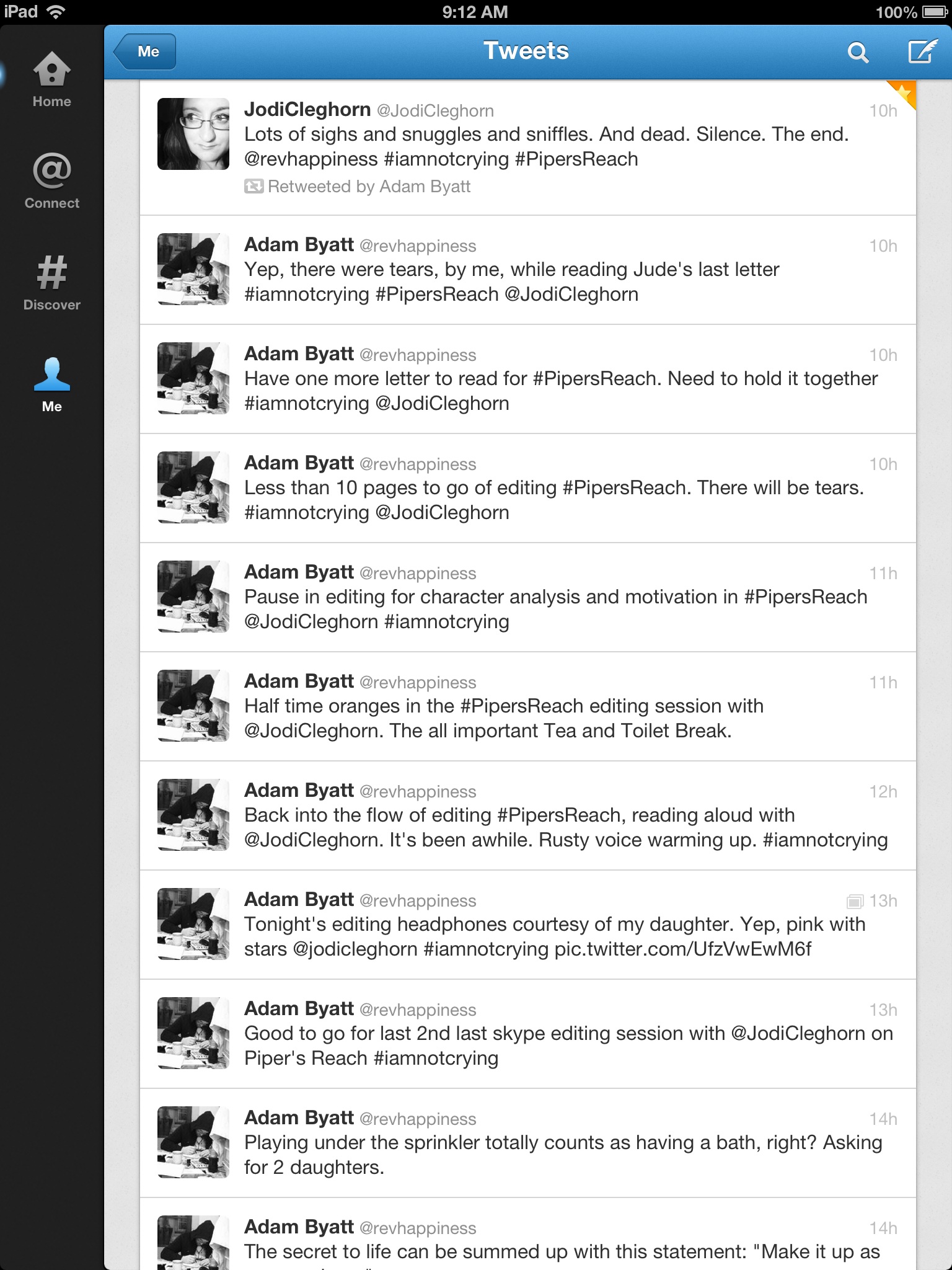
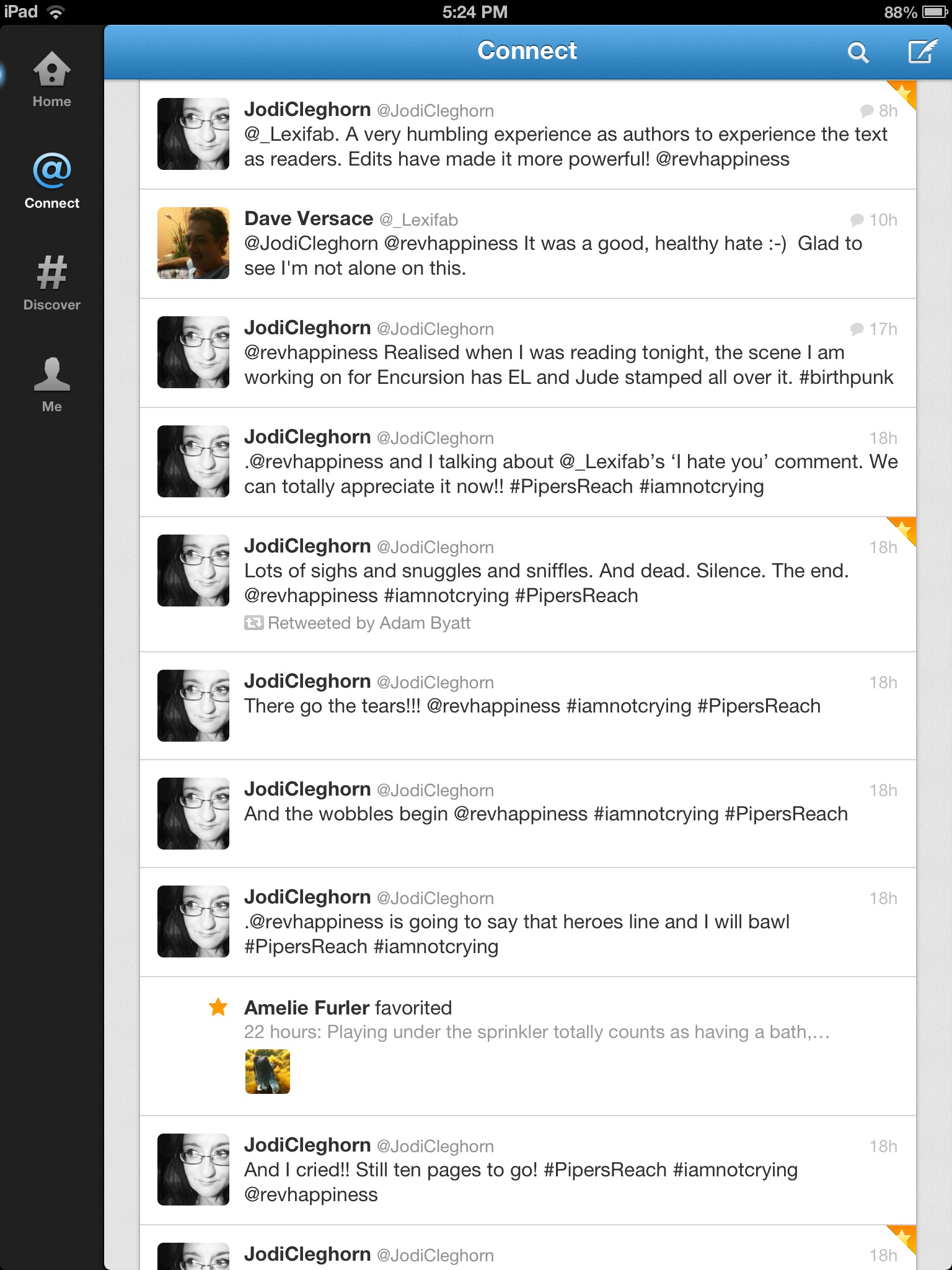
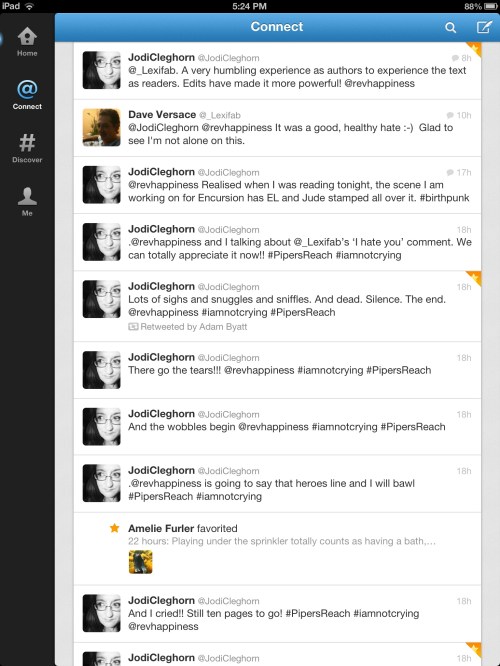
Below is a couple of screen shots from my twitter feed (you will need to read the  feed from the bottom up). You can see I was beginning to lose it when I said there were 10 pages to go. The emotion was threatening to overflow and I could hear Jodi begin to lose it a little.
image

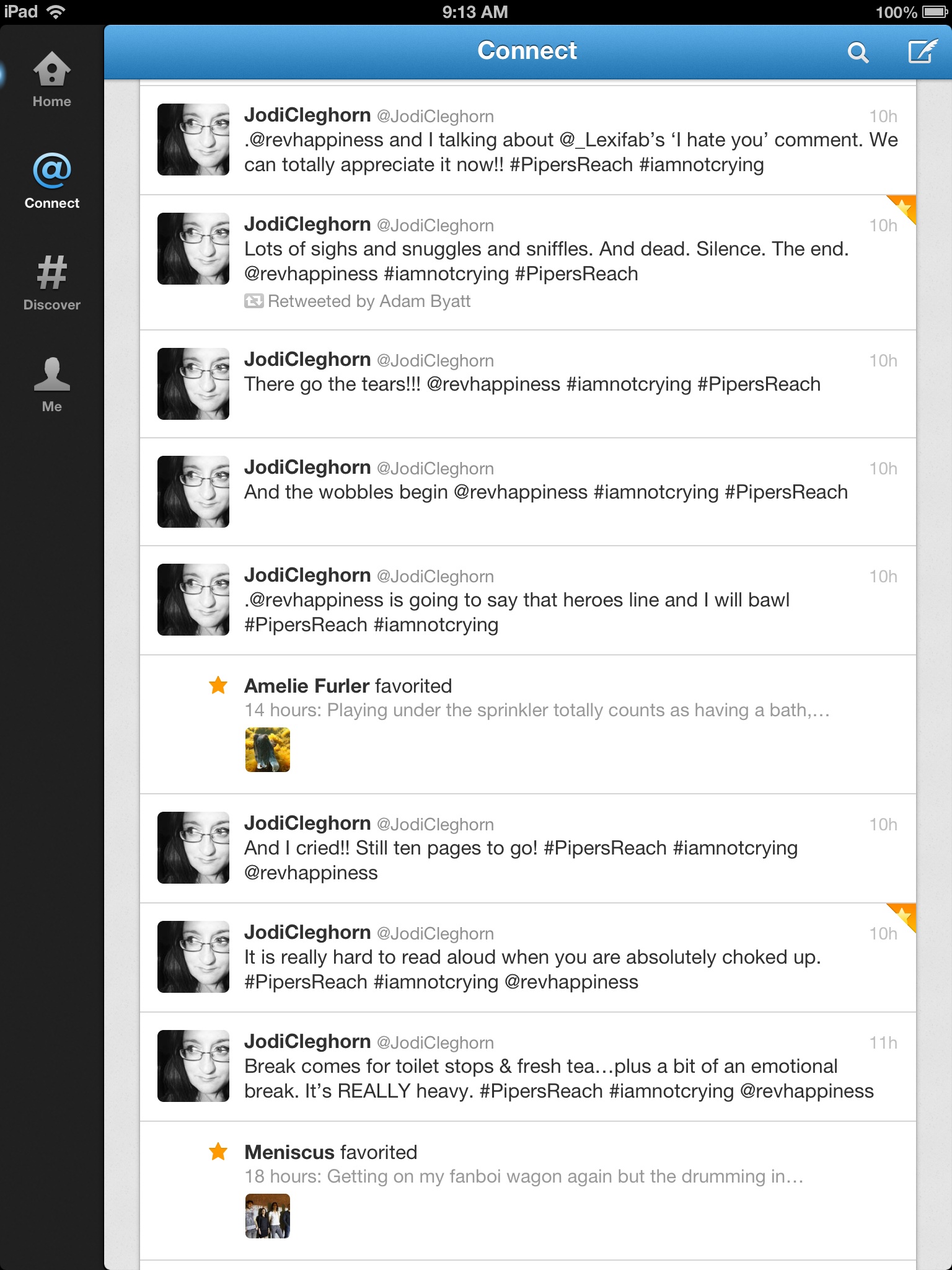
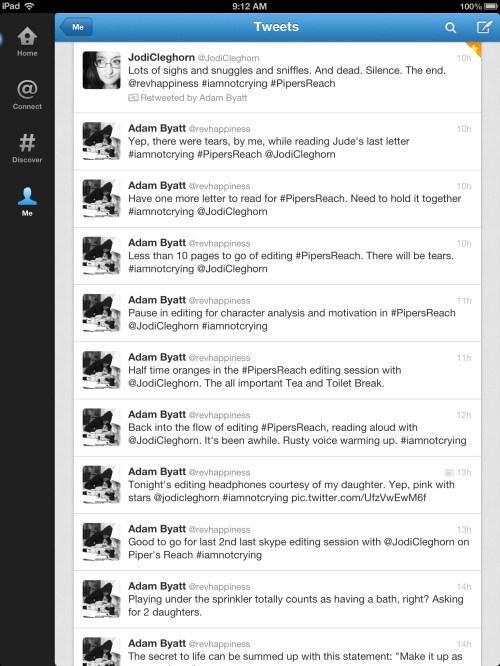
I’ve included Jodi’s stream via my Connect screen. There’s a line in Jude’s last letter where he mentions David Bowie’s song, “Heroes,” and I knew that was going to be the line to make me lose it. Jodi referenced it below. 

In the lead up to the last letters, we could both feel the surge of sadness threaten to overwhelm. 

As I read Jude’s last letter it became harder and harder, and when I hit the Bowie line, the pauses between sentences became longer, the silence more weighty and the voice cracking. Even now it still has an impact just thinking about it.
image

There were a few more letters to read, and during the very last one, read by Jodi, there was no clicking of the mouse as changes were accepted or rejected. It was simply read aloud.

And it was bloody hard to listen to. I can only imagine how hard it was for Jodi to read it. I was crying, Jodi was crying and when we reached The End, there was only silence save for the sniffling of noses and scrunching of tissues.

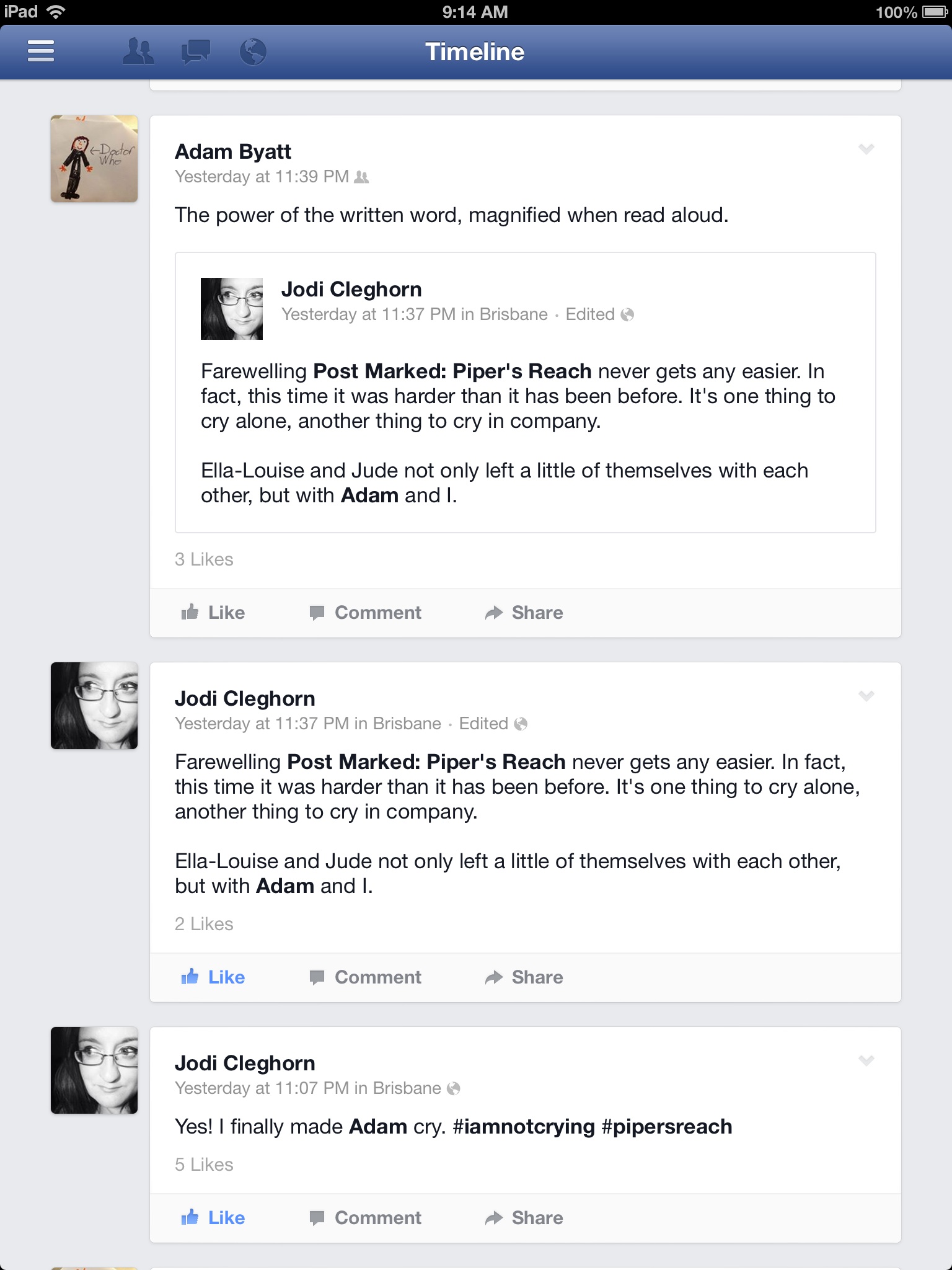
By way of conclusion, Jodi was triumphant in that she had made me cry. We were both mentally and emotionally spent; the investment in our characters over the past two years coming to fruition.
image

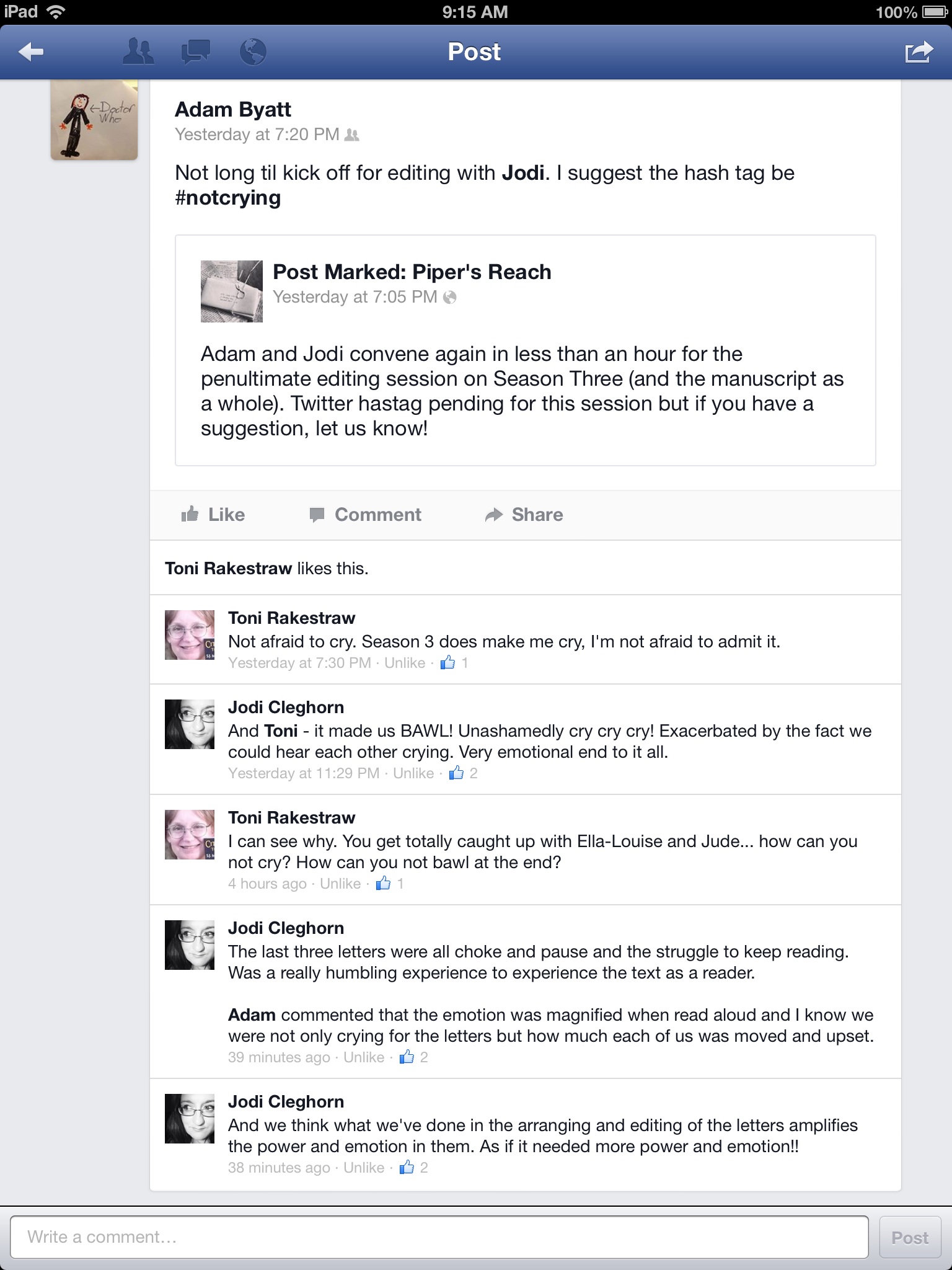
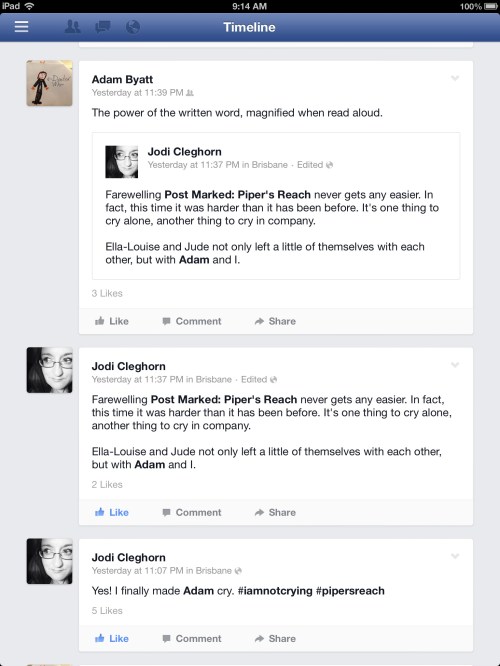
The adage of “tears in the writer, tears in the reader” was true last night. As Jodi says below,  the last three letters were all choke and pause and the struggle to keep reading. It was a really humbling experience to experience the text as a reader. I commented below that the emotion was magnified when read aloud (maybe we’ll do an audio version of the book).

While we were editing, Toni our awesome editor chimed in.
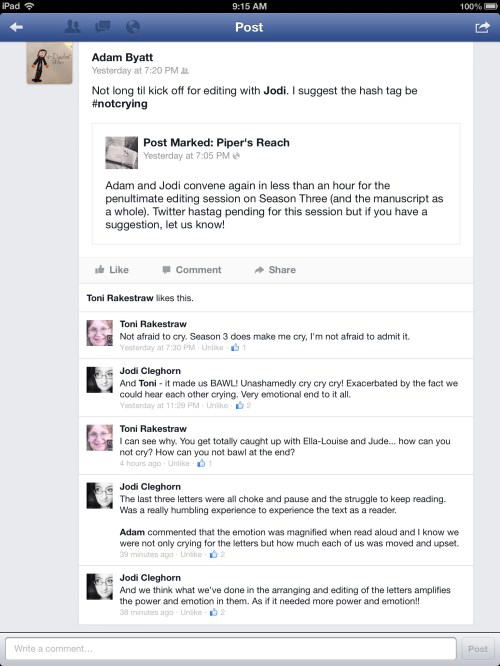
image

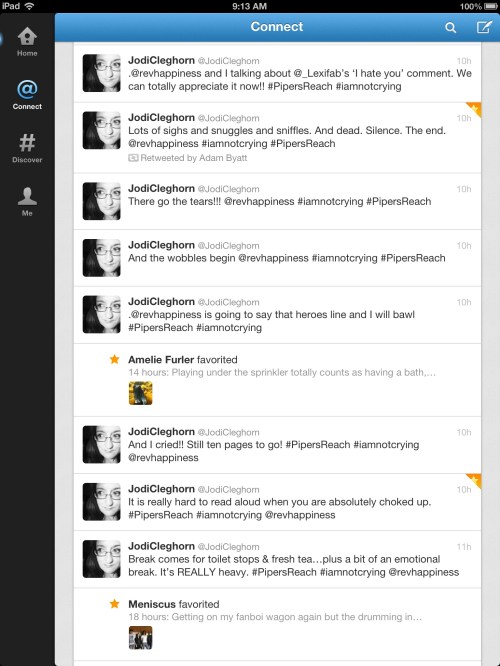
And speaking reactions, a friend of Jodi’s read the online version before we took it down for editing last July. When he met up with her at conference, he said, “I hate you.” It was done playfully and without malice but in response to his reaction to the end of the book. 

Read the texts referencing @_Lexifab
image

You can read Jodi’s reflection on last night’s editing on her website 1000 Pieces of Blue Sky and follow her on twitter @JodiCleghorn

Jude and Ella-Louise had the lighthouse at The Point as the focal point for understanding their relationship. It served as invitation, warning, refuge, security. I feel like I am there, under the lighthouse, watching the light sweep out over the ocean, waiting for the return of our characters.

We can’t wait until we can get this story into the hands of readers because we think we have a powerful story.

Letting Go in Creativity and Writing

Letting Go in Creativity And Writing

As a writer I look for great examples of creativity and approaches to art, whether it is writing, art, film, photography, dance, as sources of inspiration, technique or information.

I came across this video, initially drawn to it by the chalk art, but listening to the artist’s approach I saw it had applicability to writing. It confronted me about how as a writer I am attached to my words. It made me view the permanency of my words in a different light and to become less attached to them.

Watch the video here: Hand Drawn Chalk Art

As a writer, I want the words I write to have an existence beyond when I write them.

This video has taught me to let go of it, to understand I can erase and rewrite.

The process becomes important; the writing, drafting and editing until what I have left is a permanent record of what I do and say.

But even then I cannot be too precious about my words. When my words are read they will be interpreted, reinterpreted and misinterpreted; quoted and misquoted. And I’m cool with that.

For example, I wrote a piece of flash fiction, “The History of a Relationship As Told By A Mix Tape of U2 Songs.” It is in the reader’s interpretation of the song titles to make meaning. It doesn’t require knowledge of U2 songs, but if you know them it does enhance the story. I could have used almost any other band’s back catalogue for the same purpose; now I am imagining a story told by Pink Floyd song titles.

I have quoted some of the statements made in the video and make their connection and application to writing and the writing process.

“With paper, you’re using white paper or a toned paper and you’re going darker in value, which means you’re going black. On the chalkboard it’s already black so you’re working in the opposite way; you’re bringing your highlights to the front.”

The white paper or the white screen of a new document is often a terrifying prospect for the writer. Once you have reached “The End” of the first draft you are confronted with the darkness of the page inscribed with words. The editing process is like drawing on a chalkboard, bringing the highlights to the front, seeing the essence of the scene and the story and paring away what is not required.

“It’s about the biggest shape to the smallest shape. It’s about the big picture, not about the smallest detail… What is the biggest shape you see?”

Whether you plan everything in minute detail or let the wind blow past your bare butt cheeks as you fly merrily along where the plot and characters take you, there is still a simple premise and focus of the narrative. Developing a log line or brief statement about your work in progress means you have the really simple shape outlined. From there it is filling in the blanks and adding detail.

“Dynamic sketching – it’s about the interpretation of really simple shapes.”

When I am writing a new story, I like to know the end from the beginning, and have some of the points in between mapped out. This gives me the big picture, the biggest shape of the story. If I get focused on the little details, the motifs, symbols, characterisation, I lose sight of the big picture. Each of these details is an interpretation of the simple shape of the story arc.

“Because I enjoy the process more than the finished product, I can erase, I can let go of it… When you can let go of it, you can give yourself to it, give it focus.”

This is what first drafts are for. They are called ‘brain vomit,’ ‘word explosions,’ ‘smearing the alphabet with wild abandon.’ Call it what you will, the process is important. The finished product is a culmination of the process but if you’re too focused on the end, to be able to say, “I gave birth to this novel,” you won’t let go and you’ll focus on word counts, sentence structure and wickedly crafted metaphors to be the doyen of your writing group. You have to know when something isn’t working and not be afraid to excise it from your manuscript. It may be a character, a plot point, symbolism, dialogue, or sentences of description.

“When you’re too limited by how you think about your pieces, your pieces become limited as well.”

Letting go of preconceived ideas about the purpose of your narrative allows you to explore the ideas further, rather than being restricted in the parameters you have established. Let the narrative breath on its own rather than relying on you to breath for it, compressing its chest in the vain hope it will be revived.

In the words of Princess Leia to Grand Moff Tarkin, “The more you tighten your grip, the more star systems will slip through your fingers.”

Hold onto your work loosely but keep a firm hold. Be prepared to let it go if necessary and never lose sight of the big picture.

How tightly do you hold onto your words? Are you prepared to let go?

Write Clothed. Edit Naked.

Write Clothed. Edit Naked.

I am ripping off the maxim, “Write drunk. Edit sober.”

I’m not a drinking man so I’ll go for a metaphor that works for me.

Write clothed. Edit naked.

When you are getting ready to write, get dressed in your finest outfit. Pick something lavish and opulent.

Then, during the first draft of a manuscript, write with all the embellishments: describe in minute detail the way a man’s beard reflects the sunlight of a winter’s morn; the sound a woman makes when passing flatus during lovemaking; the focused intensity of a child sorting out the M&M’s into colours before eating them alphabetically.

Over write that sucker.

Write with all the adornments.

Use adverbs! And exclamation points! While using three superfluous, over-reaching, hyperbolic adjectives!

Recreate the Gatsby-esque lavish champagne soaked prose you want to. Go all “Pretty Woman” and tart up that wardrobe.

When you’re done, go for a walk in all your finery. Parade yourself around the lounge room and glory in the splendour that is your first draft.

Now, go to the front door. Close the door and lock it. Find a full-length mirror in the house. If you don’t have one, find one where you can see most of yourself.

Stand in front of the mirror.

Undress, taking off one piece of clothing at a time. Fold each piece of clothing and put it away.

Stand in front of the mirror. Look at yourself and admire what is there. Look at all the good bits, the wobbly bits, the bits you glorify in and the bits you are embarrassed by.

Now you can edit your manuscript. Sit down naked. 

As you read the words again look for what it is you are trying to say. When you’ve found the message of your manuscript, strip it back to the bare essentials. Take out everything decorative and glittery. Learn to revel in the nakedness of your story. Learn to appreciate the perfection of its form and function before disguising and embellishing it with prose so it looks like the discount bin exploded all over your work.

Remain naked while you edit.

When you have reached the end of Act 1 you may put on some underwear. Nothing flash or fancy but comfortable and practical. Allow a little bit of lace if you’re feeling special.

Continue to edit naked.

At the end of Act 2 you may choose a pair of pants, a dress, something suitable to fit your narrative. This could be a pair of tracky daks or a three-piece suit; a pair of cotton short and a t-shirt or a simple, elegant dress.

Choose an outfit that enhances the body of your work and tells the reader exactly what it is.

Only when you’ve reached the end of your manuscript can you allow yourself to get fully dressed. When you have reached “The End” of your manuscript, you will be dressed perfectly and appropriately. Resist the temptation for ostentatious accoutrement; be selective: a good watch or a diamond pendant; a ring or a favourite pair of sneakers.

(Remember, it’s a metaphor, but if you want to do it naked, let the breeze play wherever it may roam)

Learn to write clothed and edit naked.