Tag Archives: writing tips

Finding The Flaws In Your Writing Practice

I have found a flaw in my writing.

More specifically, I have found a flaw in my writing practice. It is found in the word ‘practice’ because that is the specific aspect that I am NOT doing.

I watch artists Kathleen Jennings (@tanaudel), Terry Whidborne (@Tezzabold) and Eric Orchard (@Inkybat), post their samples and sketches on twitter, or works in progress. I love seeing the behind the scenes look at their art.

But it made me realise what I DON’T do. I don’t practice my writing. I don’t experiment with ideas, words, sentences, phrases, paragraphs, characters. 

I am NOT practicing.

You’ll have to excuse this hack for a moment because he learned something that you all probably already know. I’m hearing the chorus of, “Well, d’uh!” resonate, accompanied by a slow clap. 

I expect to turn up to the page of a current work in progress and produce words of reasonable quality in the initial drafts before tidying them up in revisions.

I’m surprised I didn’t cotton on to this earlier; as a drummer, practice is essential to becoming proficient (but then I don’t practice nearly enough in this area either). I’m a slow learner.

Some might argue that the act of writing the story, the initial phases of writing and editing is practice, and I would agree. However working on a specific project means your focus is on the established parameters. Practice for practice sake means you can attempt new perspectives or styles without the constraint of an existing work.

So, what can I do to improve? Here are a couple of practice strategies.

1. Morning Pages

Morning pages, the downloading of the mental jumble, is a good way to seek clarity and I know of authors who use it to find their focus and clarity before returning to their current WIP. 

2. Copying

Write out a passage from your favourite author. See how and why it works on the page.

3. Sketching

Another is to create sketches, like an artist practicing a certain pose or facial feature. Tumblr is funny for that; seeing artists strike odd poses for reference.

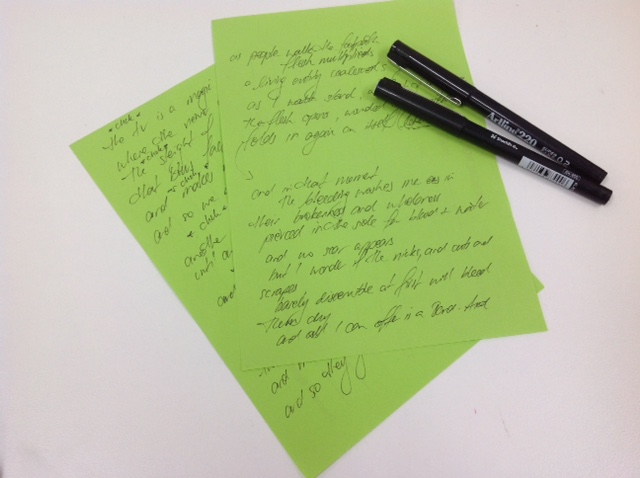
I want to take an idea from my notebook, or a line or poetry and write, free-association, or timed, or thematic, or stylistic.

And then I will leave it. Words without context. Sentences without a plot. Characters without a complication. They will be the equivalent of an artist’s sketches, the woodcarvings of the carpenter, the drills of the athlete, the rudiments and scales of the musician.

All methods have validity. You need to work out what helps your own writing. 

I am going to try Number 3 for a while, in the spare minutes here and there in the day and see how it goes. I will let you know how it goes.

What do you do for practice?
The Parallel Between Writing and Drumming Part 2

A little while ago I wrote about the parallel between drumming and writing and I’d like to extend the idea with a few more examples.

I’ve been having a bit of dig into U2’s back catalogue lately and really enjoying the drumming of Larry Mullen Jnr. He is not touted as one of the world’s best drummers but he has some inventive drum parts that are fundamental to U2’s sound. It’s a unique voice.

The same applies to writing; each writer has their own voice, their own turn of phrase and vision of seeing the world that is evident in their work.

Here are my Top 5 U2 songs where the drum part is an integral feature, a way of finding and expressing voice. For me as a writer and drummer, sometimes the simplest groove can speak volumes but then it’s the little touches and flourishes that make your work stand out from the rest.

5. Pride (In The Name of Love)

There are 2 touches that I love in this song. The first is the floor tom hit just after the snare. The other is the snare roll into the chorus. Nothing flash; just solid and accented beautifully.

4. 40

I’m a sucker for a sixteenth note pattern on the hi hat (played on one hand) and this song delivers. It provides the motor to the song, accompanied with quick, open accents, and 32nd flourishes. Tasty.

3. Sunday Bloody Sunday

A military march played on hi hats and snare. Crisp, focused and aggressive. 

2. Bad

I love this song for its build. The kick drum is the foundation while the snare and hats become layers as the song builds to its climax. There are echoes of Sunday Bloody Sunday (and you can also hear the 16th note pattern feature heavily in other U2 songs like Where The Streets Have No Name, All I Want Is You, Sometimes You Can’t Make It On Your Own. It’s a feature of Larry’s drumming and I love it).

1. With or Without You

The pattern on the floor tom, the snare hit and the open hi hat bark. Simple, elegant and brilliant.

I have my drumming heroes and my literary heroes. I am influenced by what they play, what they write, and through experimentation, amalgamation, inspiration I find my own voice.

How do you find your writing voice? 

Why Do You Write? A Revision

Almost four years ago I wrote this post, The Reasons Why. It lead to Light My Way – A Creative Manifesto. It was first and foremost an exploration of why I write. It also examined why others write. 

This is my manifesto:

I write because I want to tell a story, but not just any story.

I write because I want to tell the story of those who are not heard.

I write because I want to tell the story of those who cannot speak.

I write because I want to tell the story of those who are disempowered.

I write because I want to tell the story for those who cannot.

I write because I believe that telling a person’s story is integral in understanding who they are.

I create art to speak into the darkness, that I may be a light for others to ignite their own flame and walk clearly.

The other night I was talking with my collaborator, Jodi, via Skype and she was discussing her social media sabbatical. Part of the sabbatical involved a three-week camping trip to the middle of nowhere in Central Queensland, without phone reception. It allowed her time to revisit the fundamental question of “Why do I write?” 

For her, the stripped back existence allowed her to return to what it was about writing that inspired and motivated her.

Every so often we need to pause where we are and revisit why we write and see if it still aligns with the vision we had. It may need a revision, a realignment, a reappraisal, a reworking.

If you’ve moved away from the core reason for writing, you’ve lost vision.

I returned to my creative manifesto and asked if these were still the reasons I wrote. I am pleased to respond in the affirmative. It’s a good check, perhaps once every six months or once a year, to reevaluate why you write to ensure you are aiming to produce the best work you can.

Why do you write? Have you made a revision of your purpose?

Sowing the Seeds of Creativity

In the Gospel of Matthew is the Parable of the Sower. A farmer goes out and sows the seeds for his future crops.

“Some fell along the path, and the birds came and ate it up. Some fell on rocky places, where it did not have much soil. It sprang up quickly, because the soil was shallow. But when the sun came up, the plants were scorched, and they withered because they had no root. Other seed fell among thorns, which grew up and choked the plants. Still other seed fell on good soil, where it produced a crop—a hundred, sixty or thirty times what was sown.” Chapter 13 Verses 5-8

If I may be so bold to appropriate the parable for another purpose, please follow me.

A frequently asked question of creative people, writers in particular, is “Where do you get your ideas from?” Each writer has their own response.

In truth, I don’t find it difficult to find ideas. I find them anywhere and everywhere.

What I do have difficulty with is knowing which ideas will grow and flourish. I carry around a notebook and pen wherever I go. Into it I record ideas, sentences, lines of poetry, fragments of thoughts, pictures. These are potential stories I want to write. These are my seeds.

Some ideas fall on the path. Some on the rocky ground. Some between the thorns and some fall on the good soil.

New Poems

Two new poem ideas planted. Must add compost.

Will these two ideas grow? I don’t know. I often refer to ‘composting stories;’ leaving stories on the pile and see what sprouts. Sometimes an idea will need more fertiliser, or removal or pruning if it gets too unmanageable.

In terms of ideas that become good stories, the yield (thirty, sixty or a hundred fold) is in the reader and her/his connection to it. 

Have ideas. Have many ideas. Have a notebook so full of ideas so you can give them to other people who need ideas.

But more importantly, plant seeds. To paraphrase (and appropriate) the Gospel of John (12:24), “Unless a seed falls to the ground and dies, it remains only seed. If it dies, it produces much seed.”

Tend the new shoots that come up; don’t leave your ideas neglected. Work on them; experiment with the idea, come back to it every so often and admire it.

Keep sowing.

Asking Permission

IN the light of yesterday’s blog post about Jodi’s mentor program, she followed it up with a post about the fear of asking: Maybe I Was Only Then Becoming.

It is a remarkable insight into the creative mind and what fear can do to you when you’re a creative person. She references Amanda Palmer’s book, The Art of Asking. After reading the blog post, and hearing Amanda’s remarkable TED Talk from a few years ago, I need a copy. I’ll be putting it on my Christmas list and asking Santa nicely.

I can attest to how fear can be debilitating. I have been too afraid.

Too afraid to say ‘Yes.’

Too afraid to try.

Too afraid to fail.

Too afraid to believe.

Too afraid to ask.

Too afraid…

When we fear to ask we stand still, only to watch our shadows grow.

Mentorship Opportunity

My very good friend, writing collaborator and co-conspirator, Jodi Cleghorn (@JodiCleghorn) is offering a 12-week mentorship program for new and emerging writers.

If you are wanting to pursue writing then this is an opportunity to invest into your passion and start meeting your writing goals.

You can read Jodi’s account of how she came to this point, what she is offering and download the application form on her blog here: Mentorship and the Future Me.

I have known Jodi from my first writing days in 2009 when I stumbled upon Jodi and Paul Anderson’s website, Write Anything, and their weekly writing prompts. From there I gained her attention and was eventually asked to write for their site until it folded.

Jodi’s enthusiasm for new and emerging writers is unbridled; she was the person who offered me my very first publication in an anthology of new and emerging writers. She is dedicated to the emergence of new writers, taking them through the writer/editor relationship to hone and refine your work.

I am also blessed to have had the opportunity to write a novel with her, Post Marked: Piper’s Reach, which we are currently getting ready to shop around to agents and subs.

She is also a firm believer in the community of writers, helping to build connections between writers as a mix of support network, cheer squad, critiquing group, and beta readers.

I know she is looking forward to working with new writers, to help you realise your writing goals.

The cost of the mentorship is $250. For a 12-week program this is a remarkable investment into your writing life.

This opportunity is what you are looking for to set you on the right path. You will learn, grow in confidence and understand how and why it is what you do as a writer. Click the link below. You won’t regret it.

Mentorship and the Future Me.

Hopes and Fears – A Poem and Deconstruction

As I am wont to do, I write poetry on twitter to explore, experiment and elucidate. 

This is today’s poem

Hopes and Fears

we are scared of our dreams;
not that our worst fears
will come to life
but the fulfilment of our hopes
will be the end of who we are

But I also have a good group of writing friends who are happy to pile on critique and feedback. Rob C suggested this: “This is great: simple-yet-complex, hugely poignant, heavily true. If you’ll allow a suggestion – ‘afraid’ instead of ‘scared’, for the softer sound, the more thoughtful intonation to match the philosophical backbone of the poem, and to match the ‘f’ sounds that run throughout.”

My response was this: It’s a little more philosophical than I am used to writing; there is no concrete imagery to ground the idea (my writing modus operandi), relying more on the intellectual to make it function.

Rob felt he may have overstepped the mark. He hadn’t. I said to him, “Nope; I like the feedback. Helps to see new things. It was written on the spur of the moment, as is most of my twitter poetry so refinement is not a part of the process. Some editing is involved but without depth. Comments help refine and edit, with the hope of putting it into an anthology in the near future.”

Writing is never a solitary act; it’s collaborative. I may write in isolation but my writing tribe helps me refine and improve my work. 

So a simple suggestion, the replacement of a single word, has made the poem stronger. 

we are afraid of our dreams;
not that our worst fears
will come to life
but the fulfilment of our hopes
will be the end of who we are

Finally, there is the reader who is involved in the construction of meaning. That’s you. What meaning do you make?

Things To Throw Away – A Poem And Its Deconstruction

This started as a poem on twitter and I thought I wanted to expand on the idea a little as a practice exercise.

Things to Throw Away:
the shaggy toothbrush
the unworn shirt
the leftovers
the poetry I wrote as a child
the fear I cannot do this

When I came to expand it, I saw the completeness of it; adding to it would be padding out the original idea, hastily written as it was.

Instead, let me explain why I chose the images and the final line. As an English teacher, this is what I get my students to do: deconstruct a text to see how the components fit together. Therefore it behoves me to do it to my own work, to understand what I am doing and why; to make conscious the unconscious.

I chose the images as concrete ones, specific items the reader would recognise, an item they could visualise in their own house. Each item contains the principle that they have been held on to for too long, or has outlived its usefulness.

I am known to hang on to toothbrushes for longer than is recommended, and it’s not a big effort to get a new one, but there’s a comfort in what is known. I could replace the shaggy toothbrush image with that of holey underpants for more of a giggle.

The image of the unworn shirt suggests an item that we hold on to because it was a gift, or it was something we want to fit into, but it’s another delusion of ourselves.

Leftovers in my fridge are either consumed immediately or linger like a lost soul, discovered when there is a culture of organisms breeding. Why do we do it? Neglect? Forgetfulness? Apathy? 

Bad emo poetry; we all have to start somewhere as writers. I still have notebooks I wrote in as a teenager and I recognise the child that I was. Nostalgia holds very tightly onto objects of significance and is afraid to relinquish them.

The final line was always designed to be a twist, a shift from the concrete to the metaphysical and emotional. For me, a poem about emotions needs to be grounded in physical objects, a concrete image. It can also be done with clever similes or metaphors but I prefer physical descriptions (perhaps a weakness to strengthen – to think more poetically).

It’s about letting go, releasing yourself and being free of objects, memories or emotions that restrict your development. Would it help you to know it’s autobiographical?

There you have it. A poem and its deconstruction. If you disagree, have at it in the comments.

Thanks for reading.

Creative Boundaries

A comment made on one of my recent posts made me consider how I consider the idea of boundaries.

The theme of boundaries has been pushing my creative buttons… I have been thinking about all kinds of boundaries and barriers from the physical to the psychological and emotional. Are they a challenge to be met and breached, or a restriction to prevent us from moving on?

How do people define boundaries? The common thinking is, I believe, that boundaries are restrictive and a construction to keep people held in certain behaviours or status. In the words of Talking Heads, “Don’t fence me in.” Hence the need to express freedom, to rebel, to become an individual. Which makes me think of Monty Python.

“You’re all individuals,” says Brian.

“Yes, we’re all individuals,” parrots the crowd.

“I’m not,” says one intelligent individual.

Or in the epitome of 1950s rebellious expression, “Rebel Without A Cause.”

“What are you rebelling against?”

“What have you got?” says James Dean.

In regards to boundaries I’ve never thought of them as an either/or proposition. For me they are both a restriction and as a challenge to be met.

Boundaries act as a restriction, a defining marker point. Think of the fence that delineates your property from the neighbour’s. Therefore boundaries in this sense serve as a means of knowing the limitations and confinements of who we are. They provide a definition, a discipline, providing a sense of safety and comfort.

Boundaries also act as a challenge to be met. Once we understand why the boundaries are put in place, and how we operate within them, can we transgress or expand them. We can push the limits, positively and negatively, to expand on our own sense of self.

The creative person needs both sets of boundaries.

Boundaries are the ways we learn, learning and knowing the rules, history and traditions of our chosen creative field. Only then can the boundaries be transgressed, challenged and extended. 

The boundaries imposed upon us (physical, psychological, emotional, mental, spiritual) and the boundaries we impose upon ourselves are the topic for another post.

Boundaries define who we are, what characteristics we want to keep as permanent territorial markers in our lives and ones we want to challenge and extend.

In the words or Inigo Montoya, “Let me explain. No, there is too much. Let me sum up.”

1. Boundaries give us defined parameters when we first learn a creative art.

2. Those boundaries are a means of helping us learn and define our craft, to begin to excel at it, to find our voice.

3. When we are comfortable we can begin to push and extend the boundaries, comfortable in our sense of self and our art.

What are your thoughts? Are boundaries a help or a hindrance to your developing creativity?

A Little Prompting #17

Welcome to another week of A Little Prompting.

I didn’t quite manage to reach the deadline of the comp I wanted to sub to. Not a problem as there will be another opportunity later in the year. It will give me a chance to work over my idea thoroughly and address the issues my beta reader gave me to mull over.

THEME Games
RANDOM LINE PROMPT The discreet theft of the letter “Q” was the precipitation for divorce.
PHOTOGRAPH  Monopoly-Vintage
SONG/MUSIC VIDEO Peter Gabriel – Games Without Frontiers

SENSORY SUGGESTION The stale stench of cigarettes and body odour in the pinball parlour.
QUOTE “Time is a game played beautifully by children.” – Heraclitus

Have a creative weekend.