Tag Archives: writing tips

Handwritten Pages

What I don’t do enough of is write by hand, letting the pen and paper become an exploration. Yesterday I was inspired by a blog post on calligraphy to use my notebooks more effectively.

I know writers who use Julia Cameron’s (The Artist’s Way) technique of morning pages. The idea is you free write first thing in the morning as it clears the head and channels a creative flow. Mornings don’t work for me but the concept of free writing association can be done at any time. 

I want to use a specific notebook of mine for this exercise as it is unlined meaning I can use the space on the page to convey meaning as much as the words do. I can alter my handwriting style, use colour, draw shapes or doodle images. Over the coming months I will share more handwritten explorations.

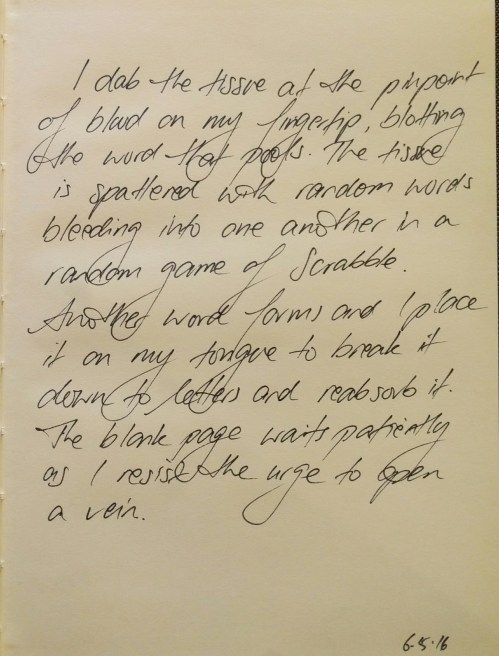
Below is the first attempt at using a notebook for handwritten explorations. Nothing fancy. Just text. 

IMG_20160506_070148~2

“I dab the tissue at the pinpoint of blood on my fingertip, blotting the word that pools. The tissue is spattered with random words bleeding into one another in a random game of Scrabble. Another word forms and I place it on my tongue to break it down to letters and reabsorb it. The blank page waits patiently as I resist the urge to open a vein.”

Two New Poems for Old Acquaintances

At the end of last year, two of my colleagues left. One retired and one was returning home to another state before heading off travelling.

In a sudden moment of ideas, I composed a poem for each. I couldn’t read them aloud myself because I hate farewells and ended up a blubbering mess in the corner while other colleagues read them for me. Wuss that I am.

I will share them with you, even though you don’t have the context of the people I know because I like them as stand alone poems.


Athena’s Owl

The light is extinguished at day’s end
the filament fades from white to orange to yellow to black
                                                              to signal slumber’s rest
          shadows encroach where light once reached

Athena’s owl ruffles her feathers for one last flight
          preens from quill to tip and one soft downy feather
          falls like a summer cloud
          rides the drafts and settles in the corner

In the silent moment before flight
          she takes one final glance
launches on soundless wings
          the warrior of the night.

We wake at morning’s first touch and
                               find the roost empty

Our hearts turn to sorrow and mourning
for wisdom’s presence is no longer amongst us
we run our fingers along the perch, the grooved indentations
of claws leave furrowed rows of knowledge

The wind reaches into the corner
                              lifts the single feather
the movement catches our eye; we reach down
                              hold the quill between thumb and forefinger
                              our extant memory
a reminder of wisdom’s presence,
                              her integrity and compassion
We are made the wiser because of her.

Diaspora

The wind asked,
“How now, spirit? Whither wander you?”
Wherever you may take me
But I will not be driven like the autumn leaves
Aimless, directionless, at your capricious mercy.
I will set my sails and use your strength
To take me to foreign lands.

The wind said,
“You have not moved.”
I have travelled the length and breadth
Of my imagination; my feet are not weary.
I will choose when to tie my laces
shoulder my pack and
Cross the threshold of my volition.

The wind asked,
“When will you find a home?”
I find a home where there is a bed for rest
a cup of tea
a book to read
a pen to write with
a nook for study
a place where my heart is at peace.

And the wind was silent.

Book Versus Movie Part 2

A little while back I argued in Book Versus Movie that there is much to gain from seeing film as a different language of art. 

But I’ve been thinking about it some more and watching The Book Thief on tv recently crystallised another aspect of the book versus movie debate. I didn’t watch the entirety of the movie (I will watch it in full one day) for one reason that  I hadn’t thought of: voice.

I love The Book Thief. It is a magnificently written book and one of my favourites. Death narrates the story and it is this voice, and the voice of the author, that makes it such a stirring novel for me. While watching the film, I didn’t have the same sense of voice. The film looks superb, the characters well defined, but it was the lack of authorial voice that I was expecting that made me turn off. 

Similarly, my viewing of The Lord of The Rings is informed by my reading of the novels. There are parts that I love and adore in the film, and others that are just downright cheesy and lacking the right voice to give the scene its proper gravitas or humour. The voice of LOTR is sometimes as dry as mortuary dust but that is what gives the novel is authenticity and pathos and humour.

Voice is one of those almost intangible aspects of writing; you know what voice you like, those you do not, those that sound mellifluous, those that sound like a Year 9 class on Friday afternoon. I think voice works for cinema too but it is more a chorus.

The “book was better than the movie” debate is too simplistic and we need to unpack it to understand why it is said, and whether we believe it or not. Both are art forms, with different voices and different modes of production, and should be treated as such. To simply divide is to denigrate one art form, extol the other and the division is not helpful. 

Appreciation and understanding is the aim.

One Image, Two Conclusions

Last Friday I had a shocker of a day at work; the end of a long and tiring week which meant that I did not shower myself in glorious brilliance. And, as they say, the hits kept on coming.

It was nothing earth-shattering and it didn’t affect me directly but a piece of news that hit me at my weakest in terms of creativity and my own writing progress because over the past few months my writing time has suffered due to work commitments, and the ability to find the mental and emotional energy was sorely lacking. And it manifested itself in frustration and, if I am at all honest, jealousy.

I hit up a creative friend and simply vented in private. In the words of John Farnham, to “take the pressure down.” And it felt better to whinge about my own predicament and celebrate the success of others.

Over Saturday I was playing around with my phone, a new notebook and my fountain pen, to take a photo.

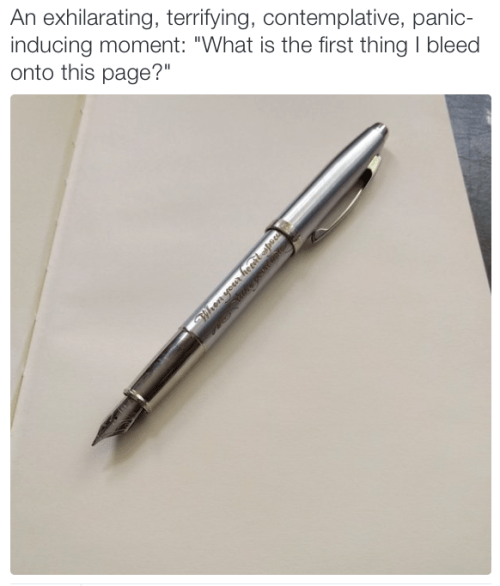
The first result was this:

Screen Shot 2016-03-05 at 10.03.38 PM

Aside: The fountain pen was a gift from my colleagues for my 40th birthday a couple of years back and the inscription reads, “When your heart speaks, take good notes.”

And every writer knows this feeling. However, in my current feral state of mind about getting stuff done, it was a challenge, an affront, a curse, a mockery.

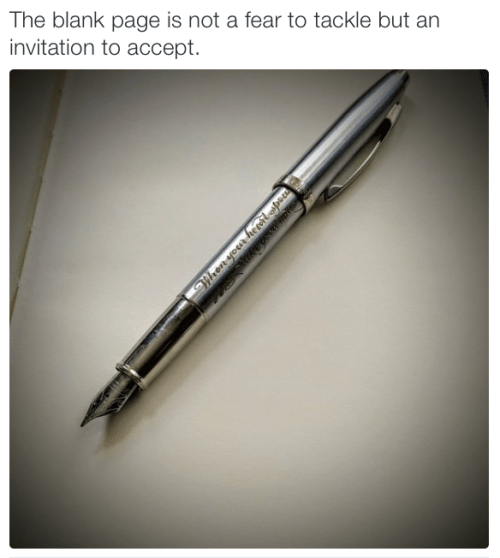
But, shaking off the negativity, I changed the photo to this:

Screen Shot 2016-03-05 at 10.03.18 PM

Comparing yourself to others is a sure road to bitter disaster. Pursuit of your own goals and dreams is the correct path. 

Create Even When You Have To Use Someone Else’s Tools

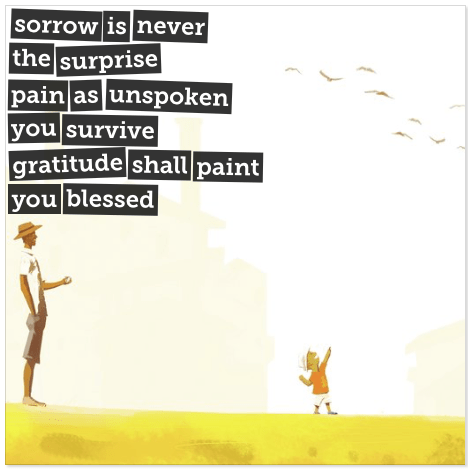
Late last year I came across Storybird. I posted about it here and here.

Normally during the month of February I engage and indulge in Post It Note Poetry (follow the hashtag #pinp16 on Twitter). This year I am not doing it. Things are chaotic with work right now so the opportunity to use someone else’s tools to create is a shortcut to keeping my creativity on the boil. 

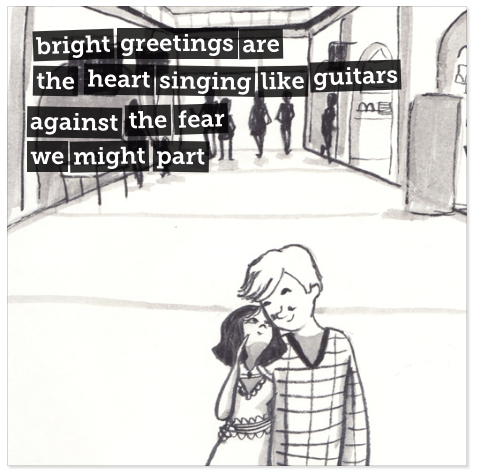
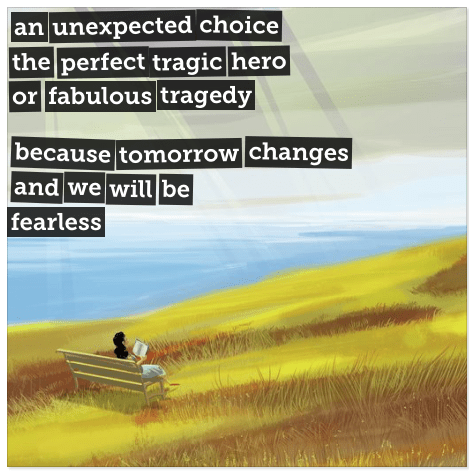
Simply select an image, you are given some random words and go forth and create. This is the genius of it. It’s someone else’s tools to use and make them work for you.

Here are some recent additions.

A different take on Post It Note Poetry this year.

Screen Shot 2016-02-16 at 7.28.26 AM Screen Shot 2016-02-16 at 7.28.36 AM Screen Shot 2016-02-16 at 7.28.42 AM Screen Shot 2016-02-16 at 9.10.48 AM

Book Versus Movie

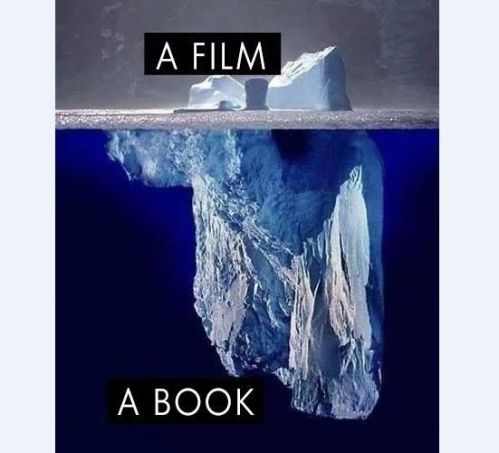
I’ve seen this image floating around the interwebz lately and initially agreed with it. 

Book Versus Movie Iceberg

The obvious suggestion is that a book offers the reader more complexity and depth than a movie; that a movie is a passive activity without detailed narrative, skipping over the juiciest and meatiest parts of a novel.

However, the more I saw it popping up in my social media feeds the more I questioned it.

The image implies a superiority of the printed word over the celluloid film, that a novel trumps film for storytelling and attention to detail. It’s a simplistic interpretation; it’s elitist and fails to embrace the complexity of film as art.

I, for one, have been disappointed in book-to-film adaptations (The Hobbit) yet also greatly impressed by book-to-film adaptations (The Lord of the Rings). I read intently the hue and cry from LOTR fans who bemoaned the excising of large swathes of narrative e.g. Tom Bombadil for the movie adaptation. Peter Jackson’s reasoning was simple: does this section move Frodo closer to Mount Doom or take him away from it?

I tell my students that film narrative is different to book narrative; each has their own language and vocabulary required to tell the story. Great film making is an art requiring a control of language more than simply words: framing, movement, lighting, sound, music, symbolism, colour, allusions, editing. 

We learn to read the shorthand of film to understand the emotional depth conveyed (dialogue, camera angles, music, sound etc) whereas in the novel we rely on the author’s words to bring us into the interior world of the character or situation.

Auteurs are adept at constructing a narrative for the audience that doesn’t rely on words alone, building their narrative through their medium. This does not make it inferior to a novel. Nor is a novel superior to a film because it requires only the imagination to create a world for the reader.

There are great novels and great films. There are rubbish novels and rubbish films. There are flaws and weaknesses in each when it comes to the power of the narrative arc but we must learn to read them differently, with a different eye and ear, with a different vocabulary and language. We must be conversant with both.

We cannot be snobbish and declare, “The book was better” if we are not conversant with the language of the other medium. True communication comes through understanding and appreciation.

A New Year’s Writing and Reading Reflection

I had a little twitter brain explosion one afternoon when I was thinking about the editing I was planning for later that evening on a short piece of flash fiction. Think of this as a series of brain farts, a Macbeth if you will, “a tale told by an idiot, full of sound and fury, signifying nothing” (one of my favourite lines from Shakespeare).

Why do I love to write? Because I love to read. The interplay of language to describe, emote, challenge, question, intrigue & entertain.

As readers we have favourite sentences or passages that capture the essence of our emotive response, better than our own words.

Passages w/ rhythm, illogical allusions that resonate, visceral gut punch, emotional core of who we are erupts as a volcano

These are the sentences we use as mantra, prayer, statement of intent, flirtation with a lover, standard of character.

E.g. ‘To be or not to be’ or ‘The Lord is my shepherd,’ almost cliche yet strike at our heart’s vortex & echo with symbolism. 

This is why I read and write, and why I believe reading is so important, so necessary, so vital to our humanity.

The Year That Was; The Year That Will Be

The end of a calendar year often marks a moment of reflection, contemplation and wondering why the toilet paper runs out at the most inopportune time.

And so it is with me. 

Side note: I know someone who uses the Chinese New Year as their starting point for a creative year. I’m seriously considering using the New Financial Year (June 30/July 1) as  my starting point. That way, if I stuff up the first half of the year I can reboot in the second half. Win.

In terms of reflection here’s the tl;dr version – I achieved nothing of substance and note. No progress on synopsis, novella, verse novel, short stories. Many half started efforts, scribbled poems, half-baked ideas. Nothing finished.

I could list a rather long inventory of excuses, reasons, happenstance or circumstance for it all.

Four Takeaways from This Year

  1. It’s virtually impossible to rebuild when you’re burnt out. Even doing small, seemingly achievable pieces can be a chore and have no significance.  
  2. Indecision and lack of focus are detrimental to making progress
  3. Without setting realistic goals and targets you will get nowhere.
  4. I didn’t read enough.

Four Steps to Making Progress Next Year

  1. Read more frequently – feed the soul and fill the well. This includes more drumming practice (too often neglected as a way of refilling the well).
  2. Set realistic goals and targets. I received a Pilot Press diary this year to keep track of my goals and targets. I have already set up my goals for January.
  3. Take care of my mental health to avoid burn out. Learn when to say “No,” when to say “Yes,” and work out what is important. Prioritise.
  4. Get Stuff Done. This is my mantra for 2016. 

May your 2016 be a productive year. 

Practice Pages – Peeling Fruit

I haven’t had much time to write lately and the lack of practice is an area I want to correct so I can maintain discipline. It was the focus of a recent blog post, Finding the Flaws in Your Writing. As I noted, I am a slow learner.

Therefore I gave myself 10 – 15 minutes to write a paragraph with no care of editing, purpose, structure. No other agenda except to explore an idea pulled from my note book.

I pulled the following idea from my notebook to form the starting point:

The peeling of a mandarin; the damage to the skin to eat the flesh inside.

In my hands I hold the mandarin you picked from the fruit bowl. I wasn’t particularly hungry but you were and wanted me to peel it for you. A child-like invocation of trust and acceptance. You are seated across from me, hands clasped together, waiting.

“Can I have some?” I asked.

A nod. Acquiescence to share.

The autumnal grace of peeling a mandarin, stripping the skin from the flesh and piling it on the table like a tree sheds its leaves, is undermined by the viciousness of its action. My thumb pushes in to the knobbed skin on top, an outward belly button you called it, breaks through and the spray of citric acid spits. It is caught in the summer afternoon light, hovers, reflects, dissipates. The freshness of the scent makes you rub your nose as if it tickled the very tip.

I catch you smiling and my eyes drop to the line of your singlet top. Your breasts move as you raise your hand to tuck a loose strand of hair behind your ear. 

There is a question, which, if asked, will change everything between us.

The skin forms a pile, broken pieces of a puzzle it would be impossible to solve. I could lay out the pieces, align them from where they came but without the flesh there is no substance to hold it. In the act of consuming I have destroyed.

You fidget, wanting to bite into the segments, held up by me until the entirety of the mandarin is peeled. I pull away a few segments for myself and hand the remainder over. As I pull away the fibrous strings, flensing the flesh even further, you rip two segments and bite into them. A stream of juice spouts onto the table as more dribbles down your chin. With the back of your hand you wipe your chin then the table smearing the juice further.

“I’ll clean it later,” you say with a mouth full of flesh before spitting the pips into your hand, reaching across the table and dumping them onto the torn skins as discarded bones. 

Our intimacy is bound in the question I want to ask for it will strip our skin like peeling a mandarin that we may eat the flesh inside.

Planning With Post It Notes

Over the past couple of weeks I’ve been mapping out the verse novel I keep referring to. I started it last year with no real plan and began writing. 13.5K words later it petered to a halt as the year ended and I endeavoured to pick it up at the beginning of this year.

Best laid plans often involve doughnuts but returning to this project stalled for a number of reasons.

However…!

Staring at a document is not always the best way to find the holes and work out what needs to be fixed. When it comes to learning styles I am not much of a visual person, preferring verbal/auditory and writing (no surprises there). 

After a lot of thinking and composting trying to work out how this would all hold together, I thought about using Post It Notes to visually map the story I was telling.

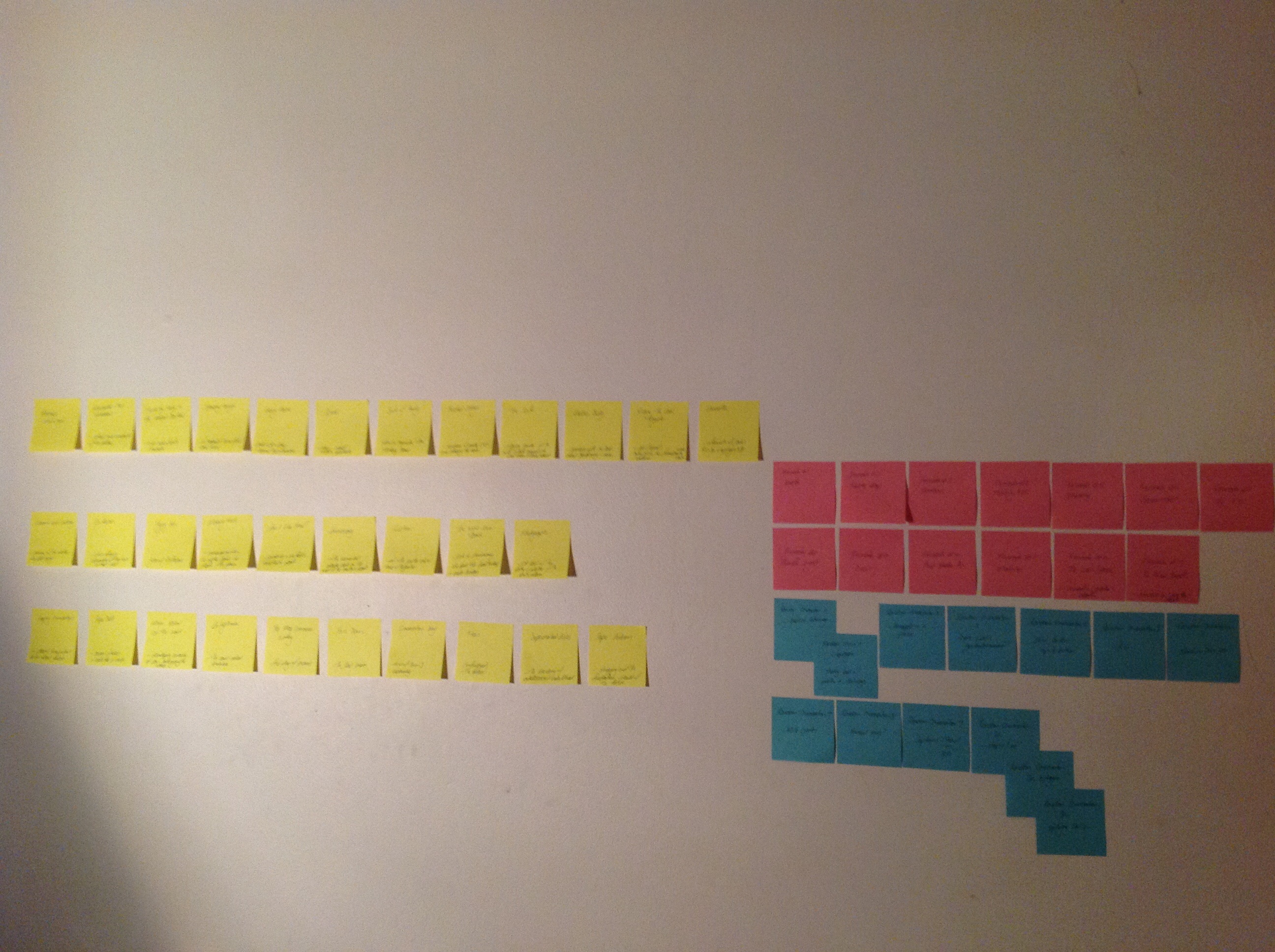
Therefore, I printed it out, bought a wad of Post It Notes and started scribing, the title of each poem on individual notes. I needed to see the overall arching narrative, find out where the gaps were and think through what ending it was working towards.

Phase One – Beginning Mapping
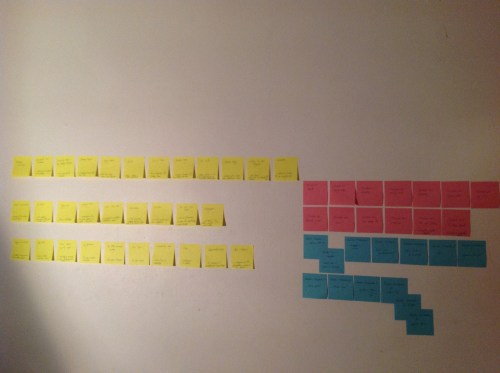
image

The yellow Post It Notes is the MC arranged as the document appears on my computer. The pink is the MC’s own poetry, her Fermata (musical pauses – there is a strong musical reference in this verse novel). The blue is the MC’s boyfriend and his contribution to the narrative, his Random Conversations.

It reads from left to right (using the yellow Post It notes).

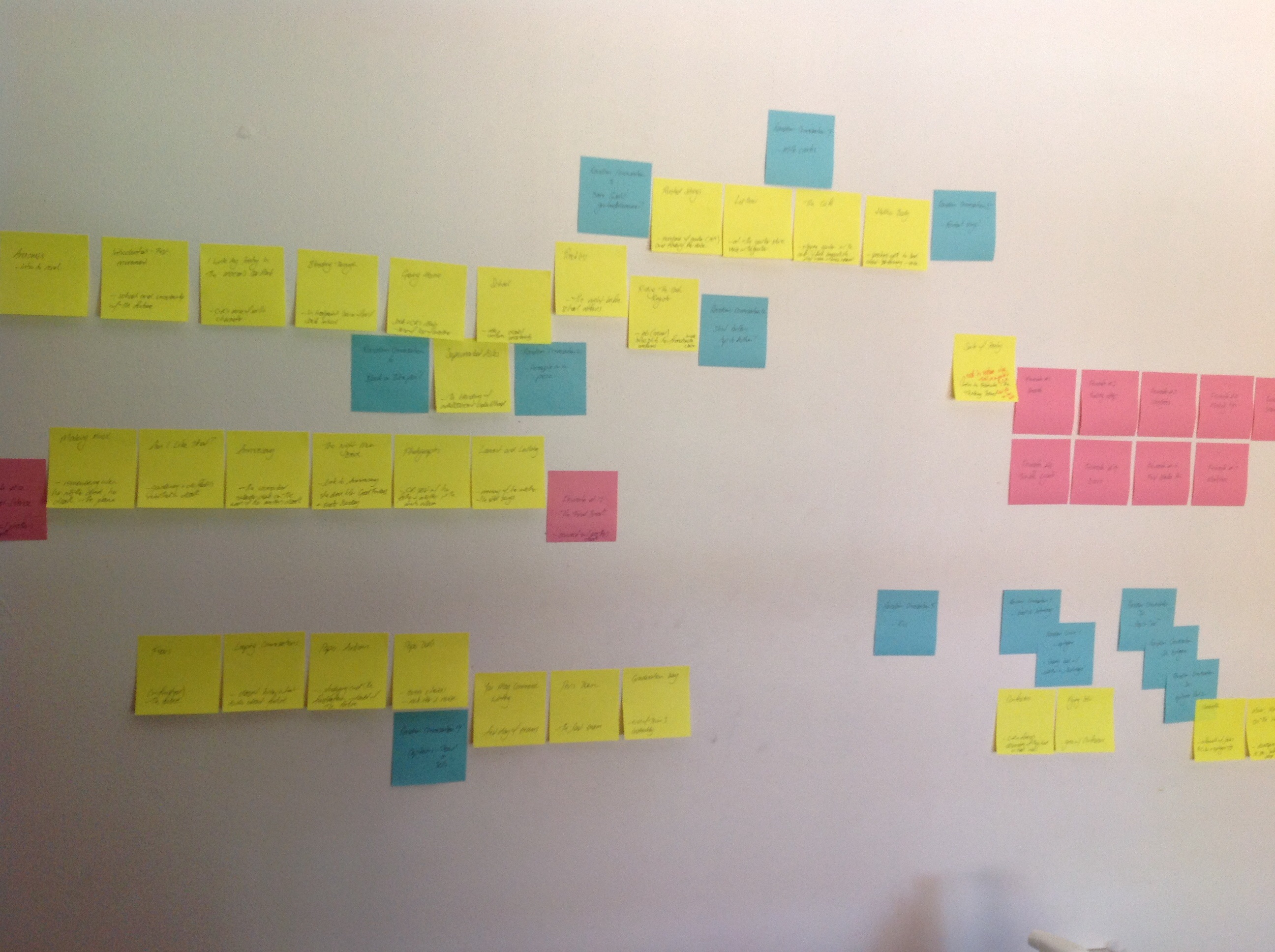
Phase Two – Playing With the Pieces
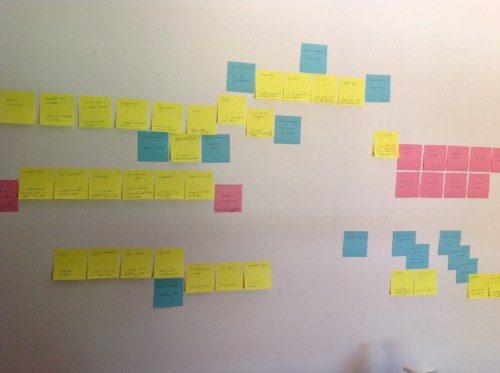
image

I began to rearrange the order of the poems and play around as to where the Fermata and Random Conversations would fit. Still reading from left to right but now adding in more of the narrative.

From here I went back to my notebook and started making notes about the plot and characters, scribbling out a brief synopsis to help work out the structure and development of the narrative.

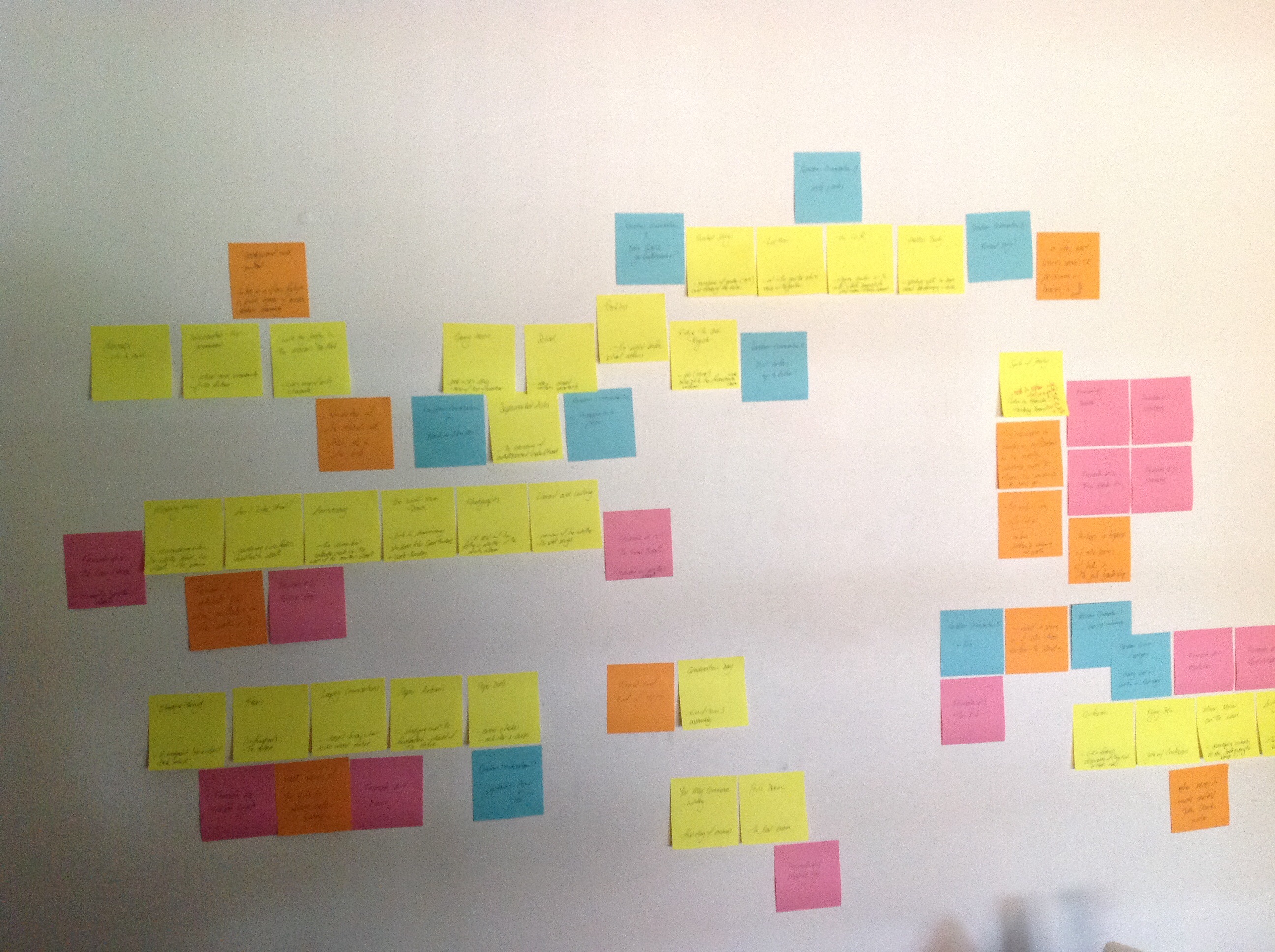
Phase Three – I’m Thinking of Something Orange
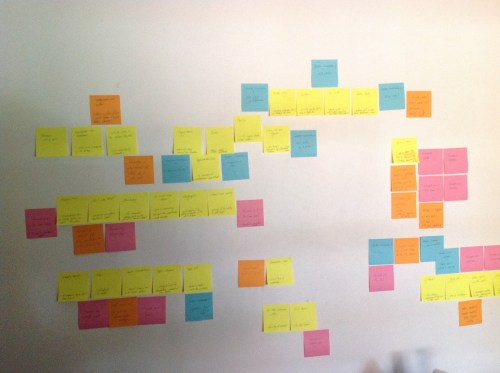
image

The benefit of doing it on the wall was to see where there were gaps in the narrative. I used orange notes to suggest scenes/ideas/concepts to help build the storyline.

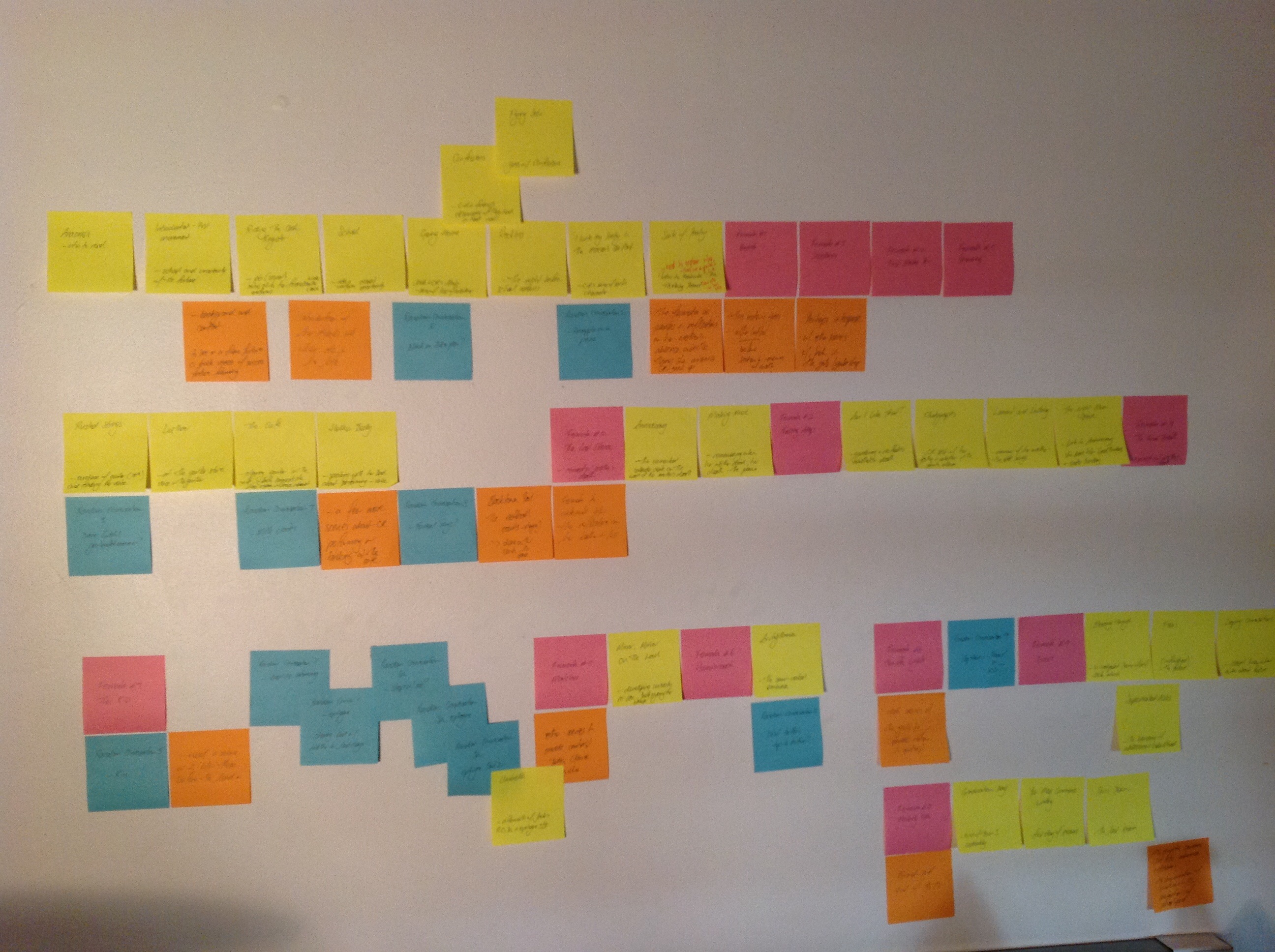
Phase Four – The “Final” Version
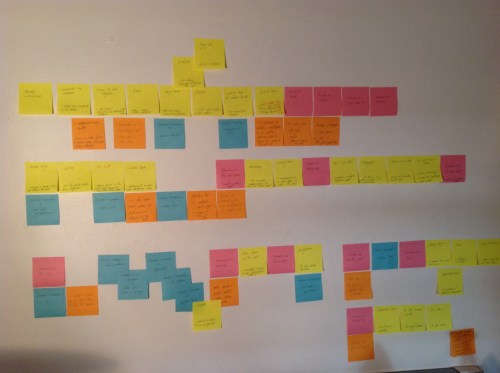
image

This mess makes sense to me. The story now has a structure and a flow (of sorts). I have now transferred the Post It Notes to my exercise book so I can begin the rewriting and editing.

I am going to take my print out and rearrange the pages as per the order shown above and reread to see if it holds together, even allowing for the gaps and silences yet to be written. 

I doubt this will be the final iteration in terms of plot and structure but doing this has given me a clearer idea of the form and direction of my verse novel.

Handy Hints

  • buy quality Post It notes as you don’t want them falling off
  • have a large handy piece of blank wall, or windows.
  • take a photo regularly in case they fall off so you can return them
  • colour code (character, plot, problems, themes)

I intend to use Post It Notes to help with the planning and mapping of a vignette collection I am working towards. Many, many uses.

Perhaps you’d like to join in Post It Note Poetry in February, 2016.