Tag Archives: writers

Intentional Art

Watching this TED talk by Hannah Brencher, a single thought struck me: letter writing is an intentional art form.

Hannah Brencher TED Talk The World Needs More Love Letters

I have paraphrased some of what she said below and added in my own thoughts.

In the midst of writing Post Marked: Piper’s Reach, at a point where the story has taken a sharp turn, the concept resonated.

When I sit down to write as my character Jude to Ella-Louise (Jodi’s character), there is an intention and a focus. All other distractions must be put aside to write a letter.

As a teenager I wrote long, lengthy missives to friends near and far. Sad to say, the development of the internet has changed that.

Letter writing is not about efficiency, creating pithy comments in 140 characters or less. We are a generation that has learned to become paperless where the best conversations happen on a screen.

In the modern world, pace and superficiality have taken the place of reflection and communion.

I love the conversations I can have with people in real time around the world, regardless of geography or time. Yet I want more.

Letter writing is intentional. It is focused on the recipient. It helps if all other distractions that “demand” our attention are removed: the open browser, the phone pinging with messages.

A letter gives you a reason to wait by the mailbox. It communicates your worth to someone because a person has intentionally and deliberately focused their attention on you.

From this brief five minute talk I picked out 3 important lessons about creativity and art.

1. Art is intentional and deliberate

With intention comes focus and an awareness of your audience. And more importantly, ANYONE can do it.

You don’t need to call yourself an artist to be intentional and deliberate.

Write a letter. Draw a sketch. Take a photo. Record a piece of music.

But do it for someone else. Give it to them or leave it for someone to find.

Check out Lucas Jatoba. In 2011, on his 30th birthday he gave 30 gifts to 30 strangers in recognition of the blessings he has received. Read the news article and see the video here. Makes me tear up every time.

2. Intentional art has a ripple effect

A church minister I know stands at the back of church and shakes people’s hands as they walk out, connecting with them for a brief moment. One reason he does it is the belief that a simple action of a handshake may be the only positive physical interaction they receive all week.

In the same way I make a point of ending my classes with “Have a great day” regardless of the behaviour that lesson. I aim to speak positively into their lives.

In the same way, what effect will your art have on someone? Will it inspire them to reciprocate? Or model your actions and replicate the deliberate intention?

Creativity joins people together in the same way sport brings people together to cheer and applaud.

Our world is broken and we need people to believe in the power of intentional and deliberate acts to heal.

3. With intention comes impact.

Your art may reach one person. It may reach five people. It may ripple out and reach 50, 100, 500 or 1,000. What if it reached one million?

The point is to impact on someone. Even if it’s just ONE person, it has significance and meaning.

I am merely a storyteller. I write fiction and I blog about writing and creativity. My intention is for you to find a way to be creative and bless others.

It is more blessed to give than to receive.

Write someone a letter, today.
Lessons in Creativity from Ferris Bueller

One of my all time favourite films is “Ferris Bueller’s Day Off.” It’s cheeky, irreverent, sassy, the epitome of cool, and let’s face it, I want to be Ferris Bueller.

But what can this film teach us about creativity? From the words of Ferris come these words of wisdom.

Life moves pretty fast. If you don’t stop to look around once in a while, you could miss it.

Don’t miss opportunities to be creative. It is too easy to let life control you. Creativity allows you to control your life. It brings a new focus to your daily activities. It requires you to look around and be an active observer of the world. 

Pardon my French, but Cameron is so tight that if you stuck a lump of coal up his ass, in two weeks you’d have a diamond.

Creativity cannot be forced. Relax. Initial attempts may be failures or you’re too tense to let it flow. Perhaps you’ve had a period of time when ideas feel like you’ve pulled them out of your belly button or other deeper, darker orifices. When practised regularly, creativity becomes a natural extension of your life.

Ladies and gentlemen, you are such a wonderful crowd, we’d like to play a little tune for you. It’s one of my personal favorites and I’d like to dedicate it to a young man who doesn’t think he’s seen anything good today – Cameron Frye, this one’s for you.

Nothing – wha – what do you mean nothing good? We’ve seen everything good. We’ve seen the whole city! We went to a museum, we saw priceless works of art! We ate pancreas!

Creativity is best when you open yourself to new experiences and opportunities. Tell a story using an artist’s painting or photograph. Watch a dancer and write a poem or stream of consciousness based on their movement. Visit an art gallery, the zoo, watch children play, go for a walk, sit in the food court of the shopping centre and watch people, eat something different (which potentially proves my point that all food is based on a dare). Collaborate. Make sure you see something good today.

The question isn’t “what are we going to do,” the question is “what aren’t we going to do?”

Sometimes it is good to break the rules. Use the negative space to prove 1+1= a dancing elephant fairy.

The place is like a museum. It’s very beautiful and very cold, and you’re not allowed to touch anything.

Museums are for cultural history, an encyclopaedia of learning. Creativity is about creating community. Creativity can be about creating works of art for posterity’s sake, but it is more about giving life to your creative work, from a handmade card to a quilt passed on to the next generation. Creativity is to be lived and engaged with, admired and questioned.

Grace: Oh, he’s very popular Ed. The sportos, the motorheads, geeks, sluts, bloods, wastoids, dweebies, dickheads – they all adore him. They think he’s a righteous dude.

Know your audience and cultivate your brand. But do not limit yourself to who you think is your ideal audience. Be authentic to your audience.

They bought it. One of the worst performances of my career and they never doubted it for a second.

It’s always about your audience. It’s not about how much time and effort you put into something, the audience doesn’t need to know that. The audience doesn’t need to know if you think it has the artistic merit of congealed monkey vomit smeared on glass. It’s about how your audience engages with your creativity.

Cameron: The 1961 Ferrari 250GT California. Less than a hundred were made. My father spent three years restoring this car. It is his love, it is his passion.

Know your focus and your passion. Give your creative endeavour life.

Cameron: Ferris, my father loves this car more than life itself.
Ferris: A man with priorities so far out of whack doesn’t deserve such a fine automobile.

That being said, don’t be a pillock. Being creative and artistic requires sacrifice, but not at the expense of your health, family, marriage or relationships. Creativity serves to enhance your life, not consume it.

Cameron: [Whispering to himself after hanging up from a phone call with Ferris] I’m dying.
[Phone rings, and Cameron answers]

Ferris: (over the phone) You’re not dying, you just can’t think of anything good to do.

Life without creativity is being bored to death. Creativity doesn’t mean writing a novel or painting a masterpiece. It can be a simple act of writing a story for your family Christmas letter, cooking a new recipe, planting new bulbs and seedlings, learning an instrument, taking candid photos while you’re out for a walk, writing a quick play for your kids to perform.

You CAN be creative.

Ferris Bueller, you’re my hero.

Don’t Let The Fear Stop You

My long service leave is over and I have returned to work. The glorious hours of time for writing are gone. 

I completed about one-third of my novel (as well as writing a number of blog posts for my own site and Write Anything, and a couple of flash fiction pieces). I am disappointed in the output, but satisfied with what I have done. 

Back at work, my senior students are preparing for their Trial Higher School Certificate examinations. It means time has to be given over for marking exam papers. Lots of exam papers. 

The reduction of time to write has amplified something that started off benignly, close to the end of my leave, but has now taken root.

Something has crept into my thinking.

It’s like a bad song you hear on the radio and it burrows into your ear (anything cheesy will do, or something from “The Sound of Music” or “Mary Poppins” – yep, you’re humming something already). You start humming it in the shower, while you’re driving, and it somehow becomes the theme song during the most intimate moments with your partner.

And it’s starting to worry me. Something has happened and it’s affecting my writing.

I haven’t added to my word count in almost 4 weeks. I have stopped. My novel gathers digital dust as it waits patiently for me to return.

But this something has crept into other parts of my writing, too.

I have two short stories waiting for me to return to them. I have a short piece ready to send out, but hesitate to click the “Submit” button.

Why?

What is this thing that haunts my writing?

Fear.

Fear affects almost every creative person and almost every creative endeavour at some point. Whether you’re starting out or been creating for a long time. 

Fear is crippling and debilitating. It can cause a work in progress to stall, languishing in digital purgatory while it waits for you to get back to it.

Fear makes you question your ability and belief in your writing. You end up asking, “Why am I doing this? My work sucks greater than a vacuum cleaner.”

Fear makes you create excuses for not writing, to find some other activity to fill your time. Suddenly your socks and underwear drawer is tidied, labelled, alphabetised and colour-coded.

Fear distracts you with all manner of shiny things on the internet. 

Fear short changes your dreams. It gives you a Happy Meal (without the toy) when you asked for steak with the side order of chips and salad, and a strawberry milkshake.

Fear undermines the core of any creative endeavour.

Fear steals your creative flow.

What can you do about it?

Listen to the fear.

Hear what it has to say.

Weigh up carefully what it says. Act upon good advice if it is warranted.

Then upside its head and give it a wedgie.

A creative life lived in fear is a travesty and accomplishes nothing.

Someone will say, “I want to be creative but I am afraid to start.”

Do not be afraid.

Trust in yourself – self belief is crucial. Do not doubt. He who doubts is like a wave of the sea, blown and tossed by the wind (James 1:6). You create because it’s a compulsion, a drive, a passion.

Trust your planning – Know when you intend to create (write, painting, draw, sculpt, rehearse). Protect the time, and get it done. Writers: this also applies to your outlining: if you know where you are going, you have already joined the dots. All you’re then doing is colouring in between the line to make a pretty picture (you can, of course, colour outside the lines too).

Trust in the work –  There is a difference in knowing if a piece of work is below par and letting the fear subvert a good work. If the work is good enough (drafted, edited, beta read, rewritten etc), trust in its ability to reach and engage an audience.

Final Thoughts

Fear manifests itself to each creative person in different ways. Some doubt, others procrastinate, some quit.

Turn the fear into a motivating factor. Let it become a driving force.

I have faced the fear. I am moving forward.

Turn your fear into excitement. Same chemical in the brain, different interpretation.

Don’t let the fear defeat you.

When was the last time you faced up and confronted your fears, and won?

Give Me Your Hands

Checking her watch in the dim light of the community theatre, Louise approximated the ending of the performance and gauged she would miss seeing her favourite band. At best, she could catch the last couple of songs of the set. Looking back down to her notepad with the programme folded inside the back cover, she skimmed over her notes.

In the shadows of the stage, a solitary actor moved towards a cardboard boulder. Sitting down, the stage lights focused on him and Louise watched his thick tongue protrude slightly from his mouth and move from side to side as he scrunched his eyes. His face took on a look of concentration, trying to recall information. He looked at his hands and then off stage, the pause lengthening causing the audience to shuffle in their seats, as he failed to remember the final lines.

A quiet prompt whispered from the side of the stage caused a wide smile to appear. Short hands and stubby fingers repositioned the ivy wreath crowning his broad and listing forehead and began.

If we shadows have offended,


Think but this, and all is mended,


Louise stopped scrawling notes for The Hopetoun Chronicle’s entertainment blog.  She had come along to the opening night at the invitation of the director, in order to spruik the performance. Shuffling back in her seat, Louise replayed the earlier mental conversation with herself.  Work was work and some things needed to be done to move up the journalistic ladder.  Amateur theatre was a rung above school theatre and musicals.  She had scorned the black skivvy and beret brigade at college, concluding that it would be ironic to not use a silencer should you need to kill a mime. 

That you have but slumber’d here


While these visions did appear.

Titania was a vision, entering the stage in a wheelchair, festooned like a Mardi Gras float. She pushed by a retinue of fairies and elves with the disjointed gait of legs like insects, or a pudgy waddle or felt their way across the stage with the aid of a long white cane. There was a party in the carriage of the Fairy Queen accented by costume and streaks of glitter reflecting the stage lights.

And this weak and idle theme,


No more yielding but a dream,


She scanned the list of actors’ profiles and found the actor playing Puck.  Andrew Davison.  His first performance, the program stated.  The glossy black and white photo showed a rounded, slightly pudgy face characterised with an expansive smile that creased the corners of his eyes and somehow captured the essence of life and innocence.

Gentles, do not reprehend:


if you pardon, we will mend:

Scanning back through the list of actors Louise noted the different abilities: Downs Syndrome, cerebral palsy, deaf, blind, spina bifida. Puck continued his delivery with the slightly slurred and mumbled delivery of a person with Downs Syndrome. Yet the cadence and metre of the Bard’s words shaped itself to the timbre of Puck’s delivery like water rolling over stones on the creek bed creating its own music.

And, as I am an honest Puck,

If we have unearned luck


Now to ‘scape the serpent’s tongue,

We will make amends ere long;

Louise scanned the audience and saw the attentive faces of fathers and mothers, aunts and uncles, brothers and sisters.  She saw in their faces a distinct pride, a connection with the actor on stage that Louise did not share. The faces in the program had family in the audience, all who had come to watch a play. They did not see physical impediment or intellectual disability.

Else the Puck a liar call;

It pricked at Louise.  Here in the forest, they were kings and queens and mischievous sprites. This was a world in which she had no connection.

So, good night unto you all.

When the lights would be turned up and costumes packed away, Louise surmised the actors would return to this world, existing as the forgotten ones; the shadows around the periphery of community, held at arm’s length as lower castes.

Give me your hands, if we be friends,

And Robin shall restore amends.

The audience erupted in applause as Puck walked to the front of the stage and bowed stiffly from the waist, his right arm across his stomach and his left behind his back. Here was life and love and acceptance. 

Louise realised her hands had retreated, firmly pushed into metaphorical pockets. Even the openness of the simple act of a handshake refused. She found herself applauding, not as Puck requested, but in the words she scrawled into her notebook.

Author’s Note: Last week I wrote a post, Speaking for the Voiceless, in which I outlined a little of my thinking regarding the focus of my writing. It reminded me of a story I wrote about 2 years ago for the now defunct [fiction]Friday. I dragged it out and gave it a little polish to present here. Still not perfect, but it captures the essence of last week’s post.

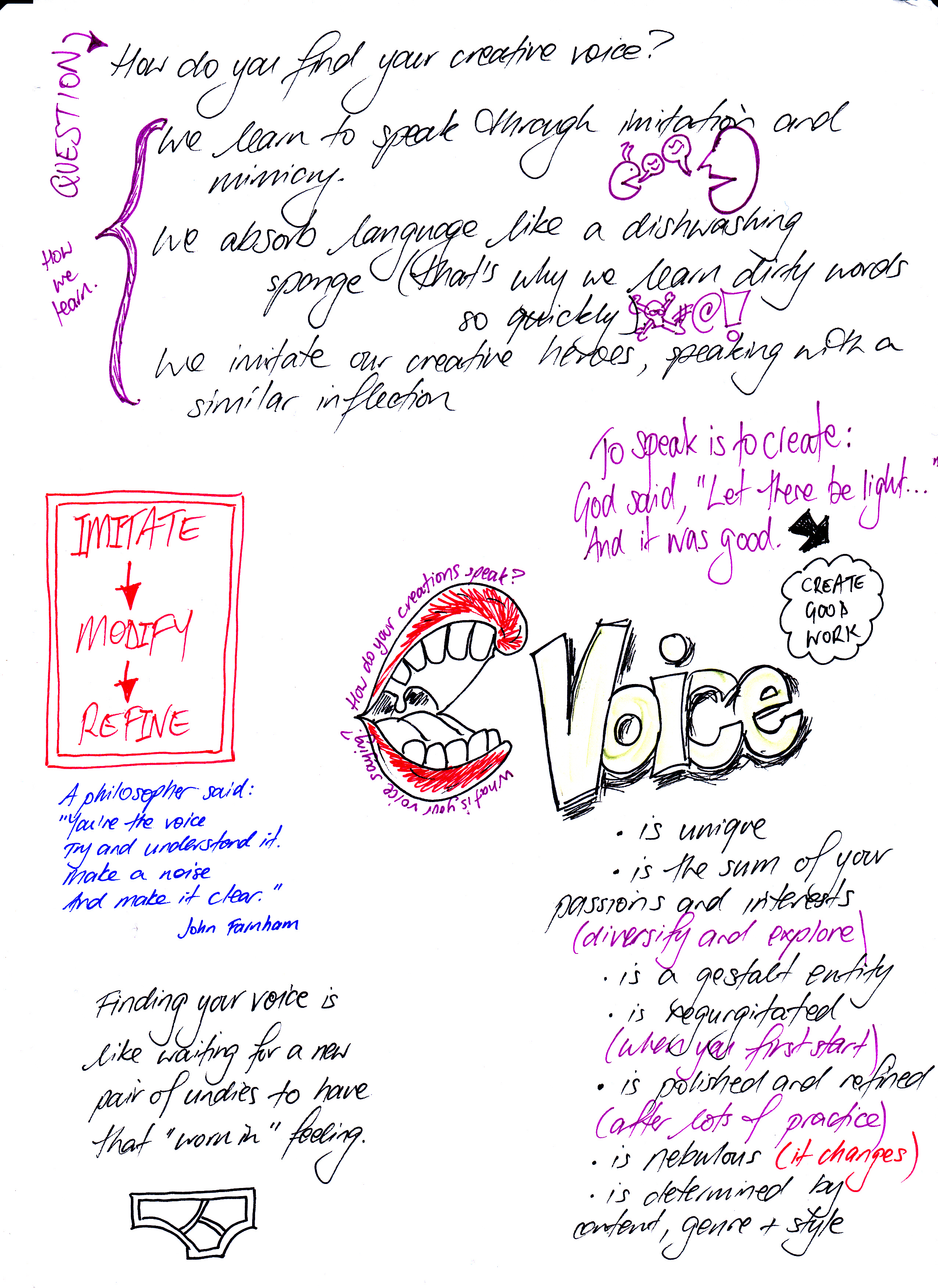
You’re the Voice

Another visual blog post about voice in creativity.

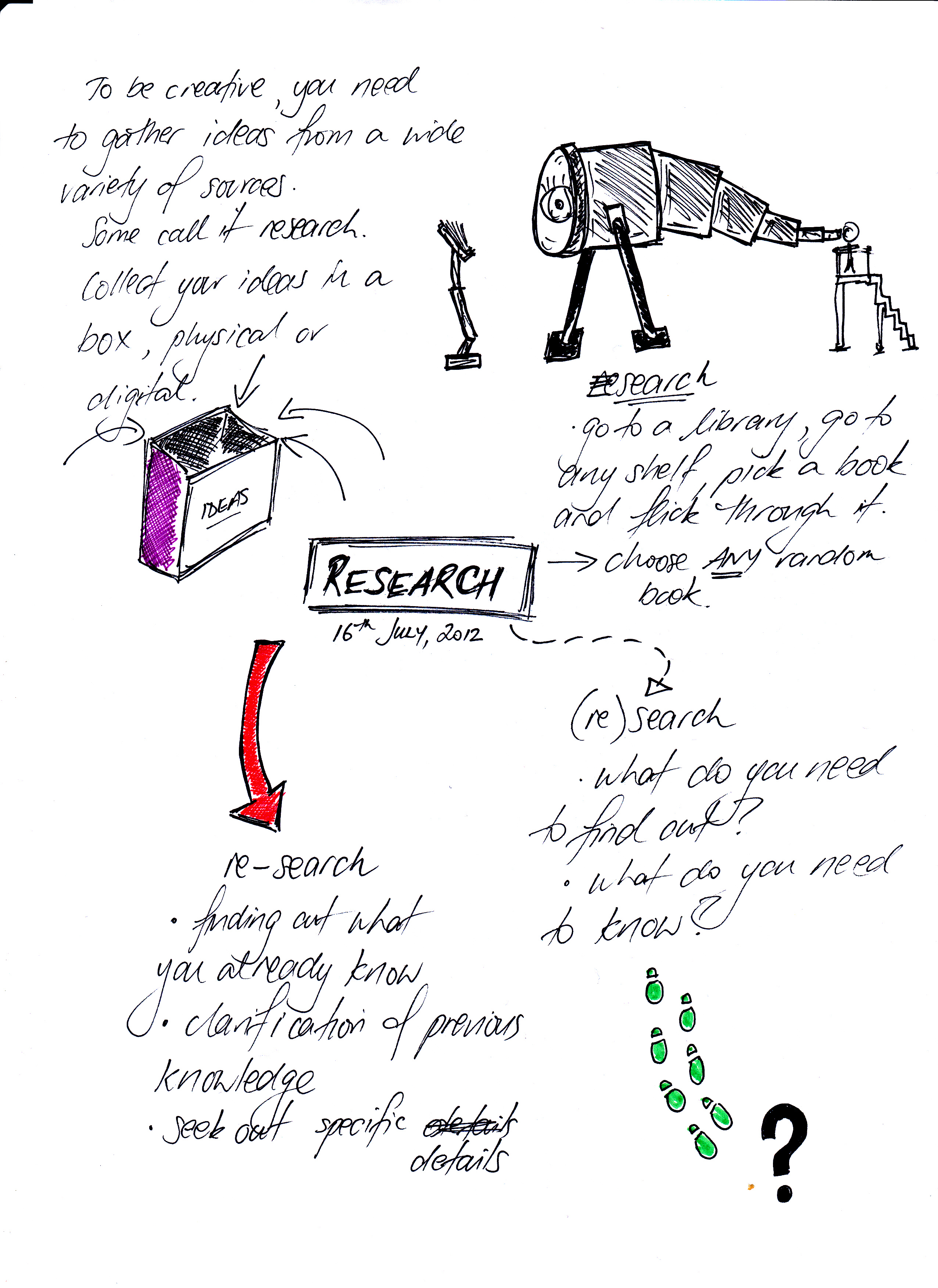
(re)search

A different blog post today inspired by Austin Kleon’s book, Steal Like An Artist. Go and read it.

I was picking apart the idea of research, and what artists do to slake their thirst for ideas.

I am not an artist, as should be evident, but I was simply exploring and deconstructing the word “research.”

Speaking for the Voiceless

While working on my novel I was thinking about its content and thematic concerns. I then thought about another novel idea I have in development and ideas I have for a couple of short stories and noticed there was some similarities in regards to their thematic focus. 

My stories are not about people who are broken, because we all are broken, and I like to explore that aspect of people in what I write. My stories are about those who are unable to express themselves, are marginalised, the outsider, the forgotten.

In particular, seeing my mother working with people with disabilities at the art studio where she works, has influenced the focus of what will be my second novel.

In part I am also influenced by the parables in the Gospels and the stories that revolve around the dispossessed and those considered “outsiders.”

I wrote down some statements to clarify my thinking about the purpose of my writing and what I want to achieve from it. These statements will inform the basis for my writing.

I am yet to fully explore what this all means, but I am excited by the prospect of what it can do for the focus of my writing. Perhaps in a later post I’ll explore the connection between speaking the voiceless and the innate ability for everyone to be creative.

  • I write because I want to tell the story of those who are not heard.
  • I write because I want to tell the story of those who cannot speak.
  • I write because I want to tell the story for those who cannot.
  • I write because I want to tell the story of those who are disempowered.
  • I write because I believe that telling a person’s story is integral in understanding who they are.

Don’t Wait for Permission

From a young age we encourage children to experiment with pencils and crayons, textas and pens, scissors and glue. And if we’re really daring, we give them some glitter.

Recently, my four-year old daughter had great fun making a car out of a cardboard box. She made a dashboard using paper and a highlighter, cutting out things she has seen in the car. Helping out, I made some “tools” so she could fix her car. Imaginative play at its best.

How many fridges or walls are adorned with creative works from preschool? We celebrate creativity and put it on display.

But what will happen as my daughter gets older and starts school? The forming of letters, numbers, handwriting and knowledge of subject material takes over from creative play (although creative play is incorporated into the learning of essential skills).

Something happens to our creative side.

Permission Denied

Creativity is compartmentalised as another academic adjunct, but a subservient one.

Creativity is often sidelined from academic foci, pushed to one side in the latter part of our school education system.

The assumption, particularly in high school, is that English (as a critical analysis subject) mathematics, the sciences, history and geography are more important than art, music, creative writing and other manual creative endeavours like woodwork and metalwork.

Creativity is often sidelined as  a ‘hobby,’ derided as a semi-serious concern. If it doesn’t make money, or you can’t make a career from it, what’s the point? After all, who wants to be treated by a “hobbyist surgeon?”

As a high school teacher, I see so many students without a creative outlet, focused as they are on academic success. Creativity is limited to specific text forms, rather than exploring different media to express their ideas.

Permission to be creative is denied. Why?

At the lowest level of Bloom’s taxonomy is Knowledge, then Comprehension, Application, Analysis, Synthesis to Evaluation at the pinnacle.

The focus is on the reconstitution of information.

In a newer version of Bloom’s, the nouns are replaced with verbs: Remembering, Understanding, Applying, Analysing and Evaluating. At the highest tier of the taxonomy, “Evaluation” is replaced with “Creating.” It means using the knowledge we have to create new knowledge, new ideas.

This is a clear indication of the role creativity plays in our learning.

We need to be doing something. Creating is an active verb.

So why are we waiting for permission to be creative?

If you are a creative person, if you feel like being creative, if you have had thoughts of doing something creative, what are you waiting for?

If your workbooks are covered in marginalia, random doodlings and scribbled couplets, break out of the edges and move to the centre of the page.

Give Yourself Permission

Don’t wait for permission.

Start creating. Now.

It doesn’t matter whether you intend to make your creativity outlet a career or simply to enrich your life.

I have given myself permission to be a creative person.

I am a writer. 

My goal is to be a published author.

Your creative medium may not be the same as mine. It may be photography, painting, music, dance, cooking.

Your goals may be different. It might be to hold an exhibition of your photography or paintings. To learn an instrument, develop a new cooking skill. Whatever.

Whatever your creative interest, here are 4 things to do once you have given yourself permission.

1. Be Deliberate and Courageous

Choose to make creativity a part of your lifestyle.

Choose something you are passionate about and is interesting for you.

Choose a creative activity to bring fulfillment and pleasure to your life because creativity enriches.

2. Make Time

Set aside time to be creative on a regular basis. Do whatever it takes. Turn off the television, put on some music and create.

3. Be Diligent

Protect your time. If you have committed to doing something, follow through on the decision. Make creativity a habit.

4. Share Your Work

There is great risk in putting your work out there for others to see. Be bold.

Depending on your creative medium, try flickr, tumblr, a blog like WordPress, somewhere to make your work visible. If you’re unsure at first, post it to your facebook wall if you don’t want the broader public to see.

Permission Granted

Don’t wait to be given permission.

Give yourself permission.

Start now.

Go and create.

50 Shades of Writing Style

“Murder your darlings” is a catch cry of the writing fraternity, painted on placards and waved around as if it were a protest rally cry.

What do we want? Destruction of adverbs.

When do we want it? Immediately.

It is touted as one of the foremost rules of writing. But what does it REALLY mean?

Sir Arthur Quiller-Couch, in 1916, said, “Whenever you feel an impulse to perpetrate a piece of exceptionally fine writing, obey it – wholeheartedly – and delete it before sending your manuscript to press. Murder your darlings.”

I’m calling shenanigans. I’m calling it an old fashioned dictum that needs to be questioned.

Writers are fond of dispensing advice. I’ve just finished ready Stephen King’s memoir/instruction manual On Writing, and he’s not short of dishing out advice either, including the above mentioned idea of excising all adverbs.

The interweb is full of pithy statements by known authors, which could be distilled into a handy gospel of “Thou shalt…” and “Thou shalt not…”

But have we actually asked the question of “Why?” Why dispense with all adverbs? Why excise long descriptions? Why should we write with the idea that there needs to be a pause for the reader to put down the book so they can void their bladder?

The “rules of writing” is actually a combination of cultural and aesthetic preferences. Cultural and aesthetic taste is reflected in its art, music and media. And it changes. Tastes change in all types of culture, writing not the least of them. The rules about writing are arbitrary and they, too, will change.

Art and culture are the revolutionaries, the questioners, the pragmatists of a society. They push forward, restrain, challenge a culture.

For writers, the question of HOW we do it is the focus of all the writing dictum and rules. Only writers care about “good” writing (as we should, but does the reader care about good writing? I posit they care more about the story).

We decry the shabby writing of “Twilight” and “50 Shades of Grey” and rightly so. Bad writing is bad writing and will always be present like the foul smell emanating from a teenage boy’s bedroom. Is there, perhaps, a twinge of jealousy at the success of a story badly told?

Think about music, where lists of the “Worst Pop Songs of All Time” appear from time to time. We may hate them if we are a musician for their cliched style or gimmick. If you’re a non-musician, maybe it’s a “guilty pleasure” knowing it’s not highbrow but enjoying it nonetheless.

But most important of all is story.

HOW that story is expressed is the choice of the author.

The expression of our ideas through story demands a style. For some writers, they prefer clean, simple prose. Others prefer lengthier descriptions, philosophical concepts, arcane language and paragraphs of prose postulating on the placement of condiments on the breakfast table and its significance to the character’s sense of self and power.

Consider why texts are considered “classics?” Is it the language, the ideas, the characters or a combination of all? Where would the “classics” fit into the scheme of things if they were presented today? The languid, turgid prose of the Brontes and Austens would surely be decried as overdone, but they are still read and republished, as is Shakespeare.

There should be “high” and “low” art, but not to create a divide; it should be recognised as a continuum. No one art form is superior to another; it is simply an expression. Some artists will want to go deeper and use a form where it is permissible. Others will prefer a more consumer-orientated form.

It’s a grey area between low and high art, and I would argue that writers should protect and champion language.

Before we dismiss a writer’s prose (whether it conforms to preconceived “rules” about writing or challenges them), we should listen to how the writer speaks in their work. We need to listen to their voice. It is as important to listen to the voice of the writer as it is to listen to what they have to say.

Are we listening?

When Things Turn Pear-Shaped

What do you do when your plans head south? Turn pear-shaped? Or resemble a dried up pile of dog poo?

The Plan

I took long service leave from teaching in order to write my first novel. My aim was to have a 90,000 word manuscript finished by the time I went back to work in the middle of July. Having 14 weeks of leave (2 weeks of school holidays, the entire 10 week term and 2 weeks of holidays) I planned for a few weeks of outlining, followed by weeks of writing where I could commit a few hours a day and write a couple of thousand words. This would allow for more family time and for a few other bits and pieces.

Then it all went pear-shaped.

My wife’s grandmother had a serious stroke and died in the first few week of the term (I used the school holidays to rest and recuperate). She died 10 days later. My wife spent a lot of time at the hospital with family. I took up the domestic duties of getting children to school and other places.

This was followed by the funeral and the wake held at our house, which meant a whole lot of cleaning and tidying.

When things go wrong, what do you do? Change the plans.

My new plan went like this: outline for the latter part of May, write for all of June and *ta da* there’s a novel.

I had a plan. I wrote an 11 page, 6.6K word outline. I had an aim of 3000 words a day. Did it work?

Nope.

I couldn’t write 3000 words a day. The best I managed was 2.6K. One day I managed the grand total of 437. Right now, my novel stands at 24,000 words.

What to do now? The best laid plans of mice and men become the equivalent of sitting in a wad of chewing gum in your best trousers. Sometimes stuff just happens and even if you feel right royally shafted, you have to rethink and plan again.

To say the least, I am a little disappointed. It has forced some thinking and introspection and here is my solution.

Identify the Problems

Problems can be external (things you cannot control) and internal (things you can control).

External – illness, family commitments, domestic duties, unexpected visitors. Things just happen and there’s not a thing you can do about it. You work around it.

Internal – these are the things you have control over and I identified a number of reasons why I wasn’t successful in my planning.

* I’m easily distracted – discipline is a key characteristic I’m developing

* I was thinking about the scene, the characters, the conflict and tension, where it might end. I had done the planning, but spent time thinking about the scene rather than writing what I had in mind. Thinking time is not wasted time, but it is if it detracts from writing.

* It’s a whole lot harder than I thought – being more prepared for me is essential and I had no idea how hard is it to write a novel. I didn’t think it was going to be easy; I know it’s hard to write. I am still developing routines and disciplines.

Make New Plans

Over the next two weeks I will be writing when I can, adding to the word count and continuing with my outline. I will not be finished by the time I return to work, but I my new plan will have the novel completed by September.

I am not defeated, just rethinking and planning. It’s taking a little longer than I wanted, but so it be it.

I have also learned I could conceivably plan and write a novel in a year to 18 months, allowing for the busyness of my job and allowing for life’s little distractions to get in the way.

What do you do when your plans go pear-shaped?