Tag Archives: writers

Light My Way – Towards A Creative Manifesto

Towards a Creative Manifesto

I am a writer.

I write because I want to tell a story, but not just any story.

I write because I want to tell the story of those who are not heard.

I write because I want to tell the story of those who cannot speak.

I write because I want to tell the story of those who are disempowered.

I write because I want to tell the story for those who cannot.

I write because I believe that telling a person’s story is integral in understanding who they are.

I create art to speak into the darkness, that I may be a light for others to ignite their own flame and walk clearly.

Brave Enough to Use a Map?

As creative people, we should never be aimless and directionless in our work.

Our work must have a purpose.

Our work must take us to new and different places.

Our work are cairns, reminders of where we have come from.

Our work points us towards the goals we have set for ourselves.

This great post from Deane Patterson @ReceiverITW says it so very well: Are You Brave Enough To Use A Map?

Explore the uncharted territory.

On the Creative Couch: Icy Sedgwick

Sitting on the Creative Couch today is Icy Sedgwick. She is a writer, academic working towards her PhD in film studies, teacher, artist, wicked with a pair of knitting needles and constant supervillain.

Icy was one of the first people to encourage my interest in writing when I first started participating in the now defunct [fiction]Friday. Without someone to champion the cause, I may have let my writing slide away into nothingness.

Today she shares her perspective on creativity.

How do you define yourself as a creative person?

Creativity’s one of the strange phenomena since it’s not really something you are, more something that you do. You have your traditional forms of creativity, but then you have your approach to problems or issues that come up in life which require a creative approach to solve them. I do plenty of photography, jewellery making, knitting, painting and writing to satisfy the ‘creative outlets’ part of my existence, but I like to think I approach problems with a fairly creative mindset. Some people call it thinking laterally, I like to think of it as using the tools at my disposal to get the job done.

What is your chosen creative medium and how does it allow you to express your creativity?

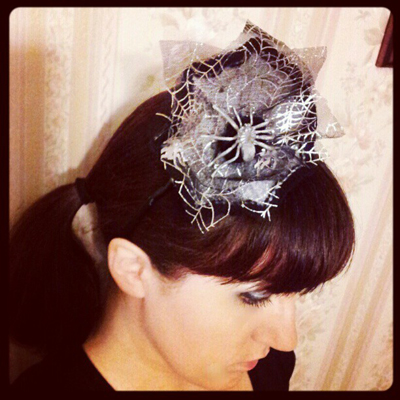
I don’t have just one, it depends on what the end product is going to be. Sometimes I just want to capture what I see, so photography (and the creative editing that goes with it) is better suited to the process, but other days I just want to make something pretty that says something about me. Hence the spider fascinator I made.

Having said that, I think that words are my usual medium, whether I’m writing handouts at work, producing academic writing, or writing fiction. Language is one of the most pliable, but temperamental, creative media and I love seeing what I can make it do.

Can you explain your creative process?

I have two when it comes to writing. With one approach, it starts with a ‘What if…?’ My task is to take the data at hand and extrapolate potential scenarios. I choose the most plausible, and write it. That’s how I get the story. And yes, that applies to horror as well – when I’m looking at plausibility, I mean what would be plausible within that world and with that set of characters, not what is plausible according to the known laws of science. With my other approach, it all starts with a picture in my head, usually kicked off by a smell or a snippet of music. I work out what’s happening in the picture, and then that becomes my ‘What if…?’ scenario.

Who or what gives your creativity impetus and direction?

I’m not entirely sure it has a direction, other than the logical route from A to B. I have a creative idea, point A, and I want to see it finished, point B. I suppose the impetus is the joy of seeing a finished product, whether that’s a knitted garment, a beautiful photo or a piece of writing. I suppose the impetus is seeing it finished. So to answer the question, I think I rely a lot on my own curiosity, and my need to see things completed.

Who has inspired you in your creative journey?

Oh that’s a difficult question because technically it would include everyone I’ve ever met, and even those I haven’t. Creativity is such a broad thing, and I’ve been just as inspired by negative people as I have anyone who’s supported me. True, there are writers or filmmakers that I look up to, but for the inspiration that I use in my stories or my photos…I suppose it’s the world around me, and how I see it.

What are you currently working on?

I have different knitting and jewellery projects at various stages of completion, but I’m still working on the edits for my horror/fantasy novella, The Necromancer’s Apprentice. Once I’ve finished this editing pass, it’ll go to the beta readers and I’ll return to editing my Fowlis Westerby novel while they’re reading Necromancer.

What is your “go to” piece to inspire you?

Anything by Mozart. I truly believe that different forms of music resonate with people in different ways, and I tend to find that anything by Mozart gets me going. Sometimes a piece will give me pictures in my head that turn into stories, other times it’s just a mood relaxant that gets me in the right frame of mind to start creating.

How do you see technology impacting or affecting people’s ability to be creative?

I see it a lot at work because half of the students hate computers, and half of them hate doing things by hand. The ones that hate computers believe technology is hampering their creative abilities, and the others think that the computers will do the work for them. As with anything, technology is a tool that can be used to create different kinds of art, or to enhance existing art. It doesn’t do the work for you, but nor should it hamper your process. Having said that, technology makes sharing your creative endeavours a lot easier, and helps you to network with like-minded individuals. I love technology!

What is a piece that is representative of your creative purpose?

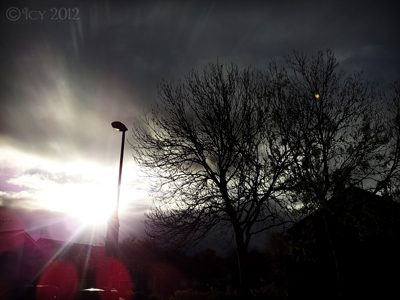
I’m not entirely sure I know what my purpose is, other than to create things that please me. Having said that, since I often do creative work to help combat my depression, I think this photo sums it up quite well – being creative helps me see the light among the storm clouds.

 Thanks for sharing on the Creative Couch today, Icy.


Icy Sedgwick was born in the North East of England, and is based in Newcastle upon Tyne. She has been writing with a view to doing so professionally for over ten years, and has had several stories included in anthologies, including Short Stack and Eighty-Nine. She teaches graphic design and spends her non-writing time working on a PhD in Film Studies. Icy had her first book, a Western named The Guns of Retribution, published through Pulp Press in September 2011.

My blog – http://blog.icysedgwick.com

Find me on Twitter @icypop

Facebook – https://www.facebook.com/miss.icy.sedgwick

Goodreads – http://www.goodreads.com/Icy_Sedgwick

Buy The Guns of Retribution – http://www.amazon.com/dp/1908544007/

Confess Your Creativity

The default position of the creative person is one of self-doubt and lack of belief. A creative person questions his/her ability and creativity.

You hear them make statements such as:

“I’m a writer but I think what I write is rubbish.”
“I paint a little bit but I don’t display my work.”
“I play guitar but I’m not very good.”

We make a statement about our creativity and weaken it with a caveat: “but.”

It’s an act of self-deprecation in an attempt to sound humble or a way to avoid embarrassment. We make a trite statement, borne out of fear.

Fear of ridicule.

Fear of mockery.

Fear of failure.

Fear of scorn.

Fear of apathy.

We believe we are not worthy, that we know nothing, that we will be exposed as a sham or a farce dancing around in the Emperor’s new clothes.

The default position as a creative person should be one of confidence and belief. Confidence in your ability to write, paint, sculpt, play an instrument, or whatever creative endeavour you pursue; and a belief in the yourself as a creative person.

How do you move the default position from self-doubt and lack of belief to a new default position of confidence and belief?

The words we speak over ourselves have power.

For out of the overflow of his heart his mouth speaks. Luke 6:45

Above all else, guard your heart,
for everything you do flows from it.
Proverbs 4:23

A creative person is passionate about his work and will speak with confidence about current projects and his ability as an artist. An artist knows he is always learning, creating the best product he can with the skills and resources he has. But he believes in who he is and what he does.

Do not let any unwholesome talk come out of your mouths, but only what is helpful for building others up according to their needs, that it may benefit those who listen. Ephesians 4:29

Keep your mouth free of perversity;
keep corrupt talk far from your lips.
Proverbs 4:24

Just as how you talk about yourself creates a positive perspective, so too does your talk about other people. Tearing down people is too easy and benefits no one. Speak positively about others and speak positively into their lives. Encourage and enable other creative people to fulfill their potential.

The tongue has the power of life and death, and those who love it will eat its fruit. Proverbs 18:21

If you are a creative person, how will you speak about your work? How will you speak about yourself?

What will your default position be?

Make a statement today.

To take the first step, check out Jeff Goins’s (@JeffGoins) book, You Are A Writer.

I am making a statement, “I am a writer.”

Make a bold statement.

Make a bold, declarative statement.

Make a bold, declarative, confessional statement today to pronounce what you are to the world.

I am a ___________.

How will you fill in the blank?

Best of Friday Flash 2: Australian Blog Hop Tour

Today marks the launch of Best of Friday Flash 2 which contains one of my stories, Scar Tissue.

#FridayFlash is an online writing community where people post a piece of flash fiction (1000 words or less) to their blog, link it to http://www.fridayflash.org/ and drop in to read and comment on the work of others.

Writers are from all over the world and five of us included in this anthology are from Australia.

It is my privilege to host Jason Coggins (Melbourne) whose Moult World stories are brilliant (and not for the faint of heart).

Vigilance

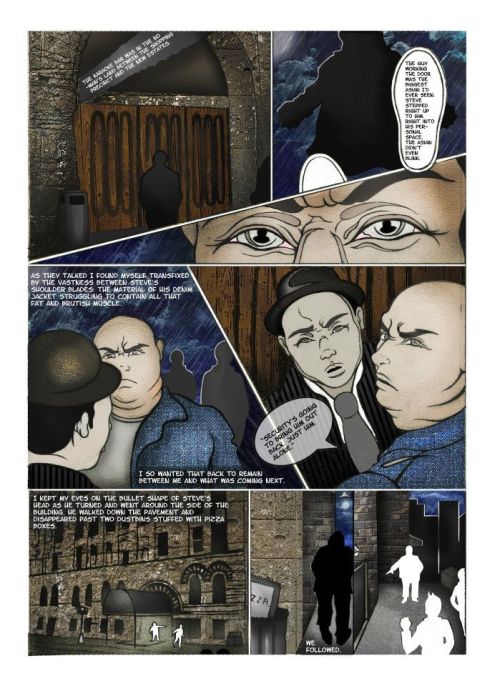
Back in town the amber beams of the street lamps swept us like inept search lights. They lit nothing more than our shoulders and baseball caps. The night wanted us out of its darkness. The roads were empty of traffic. The streets silent save for the sound of heavy breathing and thud of our footfalls.

It was gone Nine when we reached Cutlers flat.

The note taped to the door said: “See you at Wild Notes Karaoke Bar”.

Steve tore it from the door with his fat fist. The two pink rolls beneath his chin –which wrapped around where his neck should have been– wobbled.

We got the bastard,” he growled.

Blake Byrnes Art - all rights reserved

Blake Byrnes Art – all rights reserved

For a couple of years back there I was knocking out tales of monsters and wise-ass protagonists as if I was mining a big fat, juicy mother lode of fantasy fic. I was hitting a word count of a few thousand a week as my mind kept me awake at night telling me bonkers narratives I was simply compelled to share with the interwebs. Sadly, this proliferation was pretty much fuelled by a solitude you can only experience upon moving to a new country and having no friends. The only ‘friends’ I actually had any day to day ‘contact’ with existed behind the #FridayFlash and  #TuesdaySerial hashtags. Anyway, I guess I was carving a bit of an outrageous niche writing that which I loved to write. Still, I got to thinking about those poor pathetic actors who are typecast in the same role for their entire careers. And urged on by the amazing Carrie Clevenger to “ditch the unicorns and break the mould!” I decided to write something, gulp … realistic.

Thing is I am an ICU nurse and I get “real” handed to me in big globules of hard to swallow reality all the time. That is why I wrote bonkers stories in the first place. So, no way was I going to retreat into the bloody and often macabre world of modern day hospitals for the ‘authenticity’ I craved.

Fortunately, my iPod saved me! When good old fashion, gritty realism smacked me in the face as New Model Army’s “The Hunt” rang out from my playlist.

The song evoked images of teenage years spent walking the perpetually raining streets of my hometown; always in a gang, always walking with grim intent (though to be honest our only intent was to look menacing). Dark imagery galore! Yet provocative as the imagery of the song was it played second fiddle to the inference that something really … really … nasty was about to be done to someone who totally deserved it … and then some.

Anyway, not once stopping to consider why I was operating under the assumption that for something to be considered real it also had to be dark and nasty I opened Jodi Cleghorn’s #[Fiction]Friday prompt #169. “The note taped to the door said: See you at Wild Notes Karaoke Bar. ” and was off!

The comic strip adaption you see attached above came some time later and in collaboration with Blake Byrnes who wields a paintbrush like Zorro wields a sword. Now, with this story being published in the Best of #FridayFlash 2 courtesy of the mastermind, which is J.M Strother I feel I have come full-circle.

So thank you to all my old friends who lived behind the hashtags #FridayFlash and #TuesdaySerial … it was a honour and an absolutely pleasure hanging out with you x

Once upon a time Jason Coggins wrote speculative fiction to escape the real world. He wrote (a lot) and was published (a little). However, the real world bit him on the ass in 2011 to 2012. He came to realize that outside his door, a growing disenfranchisement in society was growing and playtime was over. Today, he organizes a Street Medic collective, which provides medical and emotional support to social justice activists throughout Melbourne and Victoria.

Jason may return to writing one day … but that day probably will only happen when the sun rises to shine upon a much nicer world.

You can visit the other Australian writers listed below and read a little about what inspired their story.
Jodi Cleghorn (who is hosting Stacey Larner)

Jason Coggins (who is hosting Jodi Cleghorn)

Tim Collard (who is hosting me)

Stacey Larner (who is hosting Tim Collard)

You can purchase Best of Friday Flash 2 from eMergent Publishing.

On the Creative Couch: Deane Patterson

Welcome to the first interview for “On the Creative Couch.” This is my opportunity to ask a range of creative people from different creative fields about what they do, how they do it and how they understand the creative process.

The first guest to the couch is Deane Patterson (@ReceiverITW); film maker, musician, writer, bibliophile and someone who has inspired me for many years.

How do you define yourself as a creative person?

Well, you got it in one. I’ve struggled since my early 20s to put a label on what I do. I have to write something on my tax return, business card, Facebook bio – but lately I’ve given up and tell people I make things up. I don’t get any respect for that, but it’s the truth. I’ve owned “Creative Guys” as a business name for well over a decade now, and while I might not always use it publicly, it is a reminder to me that it’s just about being creative.

The struggle really comes from trying to define myself by what I do, when really it should be about who ‘I AM’ is in my life. What I do should come from who I am – not the other way around, because circumstances, passions and jobs change, but you as a person need to be the anchor point, the launch pad of your ideas.

If all you have is what you do, and that gets taken away from you, you can get really depressed, angry or just plain unproductive really quick.

I have an expression that’s all but tattooed on my heart (I should do it on my hand so I see it more frequently): Reveal The Kingdom. Everything I do is filtered through that. If it doesn’t fit through there, I’m in trouble, as I’ve strayed from my true love’s purpose, and my own heart’s desire.

I spent a year and a bit trying to be a commercial photographer, and one day I woke up and realized I was just in it for the money. I’m still recovering from that nearly a year later, and I’m still a little wobbly – but you have to forget the money and love the people – then you’ll touch lives (and get the support you need to carry on).

All I know is to tell stories and do that through music and video – it’s great that they go together so well – but within that is an infinite scope of possibilities from just 2 ingredients of making a story. And there are a ton of sub skills like writing, sound engineering, lighting, editing, design, publishing (the list goes on) that you work your way through just trying to tell the simplest story with music and moving pictures.

What is your chosen creative medium and how does it allow you to express your creativity?

I shoot stills, motion picture (video if you want to dumb it down), write and record music, write stories and advertising, I’m frequently designing things in Photoshop. I love music and would choose that if I really had to pick one, but I’ll do that when I’m grown up, and for now I enjoy stories and words, particularly as it applies to film.

Can you explain your creative process.

Immersive. Method. Obsessive. Frequently splintered and distracted. I struggle with focus and finishing the most because everything is damned interesting and I keep exploring the tributaries. It’s hard to remember: be the river, not the swamp.

Who or what gives your creativity impetus and direction?

Is this a thinly veiled question about God?

Who has inspired you in your creative journey?

Community. I care more about the encouragement of my family, especially my wife, and friends than a paycheck. My wife is encouraged by the paycheck too – so please, give generously.

What are you currently working on?

A screenplay for a creature feature (giant bugs), short orchestral music compositions (moving out of ambient and into a more symphonic vibe), some short story comps and a couple of submission offers, building a film/music production studio in the new house, a short film with a script based on an award winning stage play.

Long term, I’m hoping to get a timeline of 3 or 4 indie movies underway. Each project is more elaborate than the last so I can get the most experience with the lowest risk. The first film is 4 actors and someone else’s play that I’ve adapted for screen. The next is 4 actors and my script in one location. The one after that is 4 main characters and a lot of bit parts on a lot of locations. And then I’ve got a story with 7 main characters, but back to mostly one location – that project’s really about learning to work with actors more than film production issues – so you can see there is a long term plan there to grow into.

I’m also really into creating music, and sometimes I wonder if the music should come first – you know, which one is the driving force is, and which is the vehicle? I could just make music videos for my compositions and film school would have been worth it. But I really enjoy story telling in all forms, and film seems to put a bunch of things I do in a powerful mix where the sum is greater than the parts.

I once read a publisher being quoted, “Never believe what a creative person tells you what they’re working on. Just believe what they’ve finished.” So I use that as my escape clause.

What I plan, and God enables (because it’s totally dependant on Him) may change as I follow His lead – but that’s kinda the plan. If I change my mind, it’s because I wasn’t’ listening and wandered from the path. It’s been known to happen to creative people.

I’m a wanderer.

How do you see technology impacting or affecting people’s ability to be creative?

It makes it easier for people to get published, distributed, and easier to create stuff. But people are consequently making easier choices and not putting the same level of effort and expertise in.

Any idiot can use technology to get a result – and all their sycophantic facebook friends might even ‘like’ it – but much of what I see in terms of film/video production, photography, music and even writing is crap. And I include a lot of what I’m doing in the crap pile.

My only defense is that I’m learning. Failing forward. Getting better. You should be too. Get better, damn it. When I started in film, you shot film, and it cost literally hundreds of dollars to buy the freaking film, let alone process it. I learned photography the same way – you shot very limited numbers of stills, and didn’t know if you had until it came out of the lab days later, and then you had to print it.

No one got their book published.

If your band had a 4 track recording on cassette, you were awesome – forget making your own CDs, or even being able to record yourself on anything other than cassette.

This has turned into a full on rant – but when we took away all the barriers to entry, and technology made it easy, we slumped back to the lowest forms of using those opportunities.

Those barriers meant you had to work hard for the opportunity to work hard on making something. And it forced the cream to rise.

Work harder, dammit! And learn your craft. Make the effort to improve.

If you are totally dependent on technology as a crutch, then at least pay attention when the little red and green lines start breeding like nymphomaniac rats on your screen. You at least learned spelling and grammar at school you lazy sons of motherless idioms!

What is a piece of yours that is representative of your creative purpose?

I once read a publisher being quoted, “Never believe what a creative person tells you what they’re working on. Just believe what they’ve finished. So I use that as my escape clause.

I have a children’s book published called “The Purple Pirate Pants of Peril” that I’m extremely proud of, and if I could find where it is on my hard drive, I will re-publish. But that’s something that sold well and the target audience raved about.

I get paid for my music, but never get told where it’s being used, and I get very little feedback, so at this point, I’m still developing that. But I do have some music online (http://receiverinthewild.bandcamp.com/ ) that represents what I like to do musically. I find the money keeps the wolves from the door, but it’s feedback that really rewards my ego. And I like my ego. I like to have it stroked.

I’ve not released any of my personal video work that really says what I’m about yet – my best work is so far on other people’s projects – but it’s my goal to address this before I’m too far gone. How about February next year? Maybe.

Anything else to add?

Only God knows who you really are, and if you really want to know, He’s waiting to tell you. And then you’ll know what to do next.

Find Deane on Twitter @ReceiverITW

Blog: http://www.dcpatterson.com/

Bandcamp: http://receiverinthewild.bandcamp.com/

If you want to be a part of “On The Creative Couch” get in touch with me via twitter @revhappiness or leave a message in the comments below.

The Message or The Money

Recently I wrote about musicians, labour and payment – Making Money from Creativity. In summary of the previous post: it’s the choice of the artist to be paid or work for free, but they have a right to earn.

Cool creative type Deane @ReceiverITW, someone whose perspective and creative endeavours have inspired me for years (check out his ideas and thoughts here) commented and something within it resonated. I will give you the full comment for context: 

“I have over 20 years invested in what I do, and still people think that the fact I know them gives them the right to ask for a freebie for their charity, their church or their [insert thing they don’t want to spend money on, but will benefit them].

I have found an export business (online sales) that lets me bypass most, if not all, of the locals. I sell to businesses who understand you pay for things, add value and on sell them. 

Is what I’m selling art – absolutely. It can be done.

Do I get paid for all of my art? No. An audience is reward enough for me – and that is my greatest weakness, that it’s more important that the message be sent, than payment. But it is also my greatest strength, because I can ignore the money and say anything, with no thought to pleasing people’s wallets – only challenging their thinking.” (emphasis is mine)

An audience is reward enough for me… that’s it’s more important that the message be sent.

 To address the issue of money briefly: it gives you more opportunity to deliver your message; to get your work to a wider audience; it allows you to continue to do what you are passionate about. Every artist has to come to his/her own decision on this topic because an artist will create regardless of recompense.

Fundamentally, every artist must examine his/her motivation: why am I creating this piece of work? What is its purpose? What is its message?

The sense of having a purpose, and of having a message (some would label it a “calling”) is the focal point of a creative person’s existence.

PURPOSE

Purpose is the reason for which something is created or for which something exists. An artist’s PURPOSE is to create, just as it is the teacher’s purpose to teach and the nurse’s purpose to heal. It is the reason we do something. In the act of creating we find purpose.

I see two types of purposeful creativity.

The first purpose is to create for ourselves. It is practice and dedication to the discipline of the art we have chosen. The act of creation gives the self a great sense of satisfaction. As writers, artists, musicians, painters, sculptors, filmmakers it fulfils a basic and fundamental need in our lives.

The Book of Genesis puts it this way in relation to the completed work of creation, “And God saw that it was good.” Beautifully understated.

The second type of purposeful creativity is for the benefit of someone else. Returning to the Book of Genesis, the creation is given over to mankind, to replicate the creative act by caring for the creation. And for mankind a helper is created (there’s a reason why sex is so much fun – to quote Shakespeare, “There was much sport at his making”).

An artist must create. It is our purpose.

I am a writer. My purpose is to write.

An artist must have a message. But what is my message? 

MESSAGE

Having a purpose requires the clear articulation of your message. A creative work without a message is static, a resounding gong or clanging cymbal, a discordant noise shouted into the maelstrom of pedestrians streaming past.

You have to ask yourself, “What am I trying to say?”

As a writer, it is not enough to “tell a good story.” I want the story to have a purpose, to have a message, framed by good narrative technique. I practice, draft, edit, rewrite so my message is clear.

The individual message may vary from project to project, yet underlying your corpus is a core foundation of beliefs and values that will influence your creative endeavours.

Is your message:

  • the redemptive power of love and sacrifice
  • encouraging others to speak for the voiceless
  • to rally people to bring justice where there is injustice
  • the power of light to overcome the darkness
  • the strength to have hope even in the midst of hopelessness
  • to demonstrate laughter is indeed good for the soul and a subtle way of making a political or social point
  • the undeniable pain of grief, and in doing so, to mourn with those who are grieving and to help them find comfort and solace
  • the healing power of reconciliation where there is division

AUDIENCE

But a message with no audience edifies no one. Creativity requires an audience. Even if it only an audience of one.

As artistic and creative people, we want our works to be appreciated by others, for others to gain enjoyment from what we have created. Writers, artists, filmmakers turn to blogs to share their work and find an audience.

Our purpose is to create works with a clear message that arrests the attention of our audience.

Our work should be something that causes people to harness themselves, tie onto a secure tether and help them navigate their way through the treacherous digital abyss that seeks to swallow them whole.

Our creative works should give our audience meaning through its message. They should be a lighthouse in their darkness, a compass in their distress and a fellow traveller’s hand to hold for security, comfort and companionship.

 The purpose for our creating sustains us and gives us life.

The message of our creation sustains and gives life to our audience.

As a creative person: What is your purpose? What is your message?

Creativity as an Adventure of the Soul

Every production of an artist should be the expression of an adventure of his soul – Somerset Maugham

 Recently I watched my five year old daughter wander around the house and out in the backyard the other day with a piece of scrap paper, an off cut from the end of a roll of boys’ birthday wrapping paper. On it she had drawn some rudimentary marks, but she was pretending it was a map.

She was on an adventure that only a five year old can imagine, making it up as she went along. And it was beautiful to watch her creativity take her on an adventure (personally, I think Dora the Explorer has a lot to answer for).

What does it mean to have an adventure of the soul in regards to creativity?

An adventure of the soul is an exploration of what it means to be human.

It explores what it means to love,

to hope,

to have faith,

to cry,

to be offended,

to be outraged,

to burn with passionate desire,

to understand sorrow and pain,

to know joy,

to experience the breadth and depth of human emotion.

An adventure of the soul gives the creative person purpose and meaning. It means we come to a greater understanding of one another.

Every writer, artist, musician or filmmaker, every creative person, is an explorer.

Every creation and every piece of work is a reflection of his or her physical, emotional, mental, spiritual, political or philosophical journey.

It may be a personal reflection, a cathartic exposition that no one ever sees; a hidden testament.

It may be created for a broader audience, a mirror held up to society or a cairn that says, “Remember.”

To create, to express our understanding, we must first undertake the journey.

Sometimes we go willingly, eager to explore.

Sometimes we are directed by circumstance or situation and must go unprepared.

Sometimes it’s through familiar grounds, places well worn and trodden, well kept and maintained.

Yet in the familiar there can be revelations. Sometimes we see the familiar from a different perspective and capture a new thought: a simple piece of wrapping paper, a child’s embrace, the giving of a gift, the colour of the flowers in the vase as they fade.

Have you ever walked the same way, or driven the same route on a regular basis, only to notice the house along the street is now no longer? And then you try to remember what it looked like, what was there.

Sometimes it’s through unexplored territory.

When we are in unfamiliar and unexplored territory, everything is new, almost too much to take in and comprehend. We take notes, file away information, pictures for slide nights. It takes time for our minds to absorb new information, to meditate and compost and percolate until such time the idea is ready to germinate, break forth and be birthed into the world.

Sometimes the adventure takes us into the Valley of the Shadow of Death. Yet even in the dark places, sustenance can be found.

“It’s a dangerous business, Frodo, going out of your door,” he used to say. “You step into the Road, and if you don’t keep your feet, there is no knowing where you might be swept off to.” Frodo quoting Bilbo Baggins, The Lord of the Rings – The Fellowship of the Ring

The creative person makes the journey a learning experience.

The creative person makes it an adventure.

The creative person knows and understands what it is to be human.

And then lets others in on the secret.

Making Money from Creativity


The discussion regarding Amanda Palmer’s choice to ask for musicians to donate their time and talents to her recent tour has elicited a wide ranging discussion about the arts, labour and payment for services.

For Amanda Palmer’s own words, drop in here: http://www.amandapalmer.net/blog/20120914/

For commentary go here: http://kotaku.com/5943112/amanda-palmer-asks-musicians-to-play-for-free-pisses-off-musicians

and here: http://overland.org.au/blogs/lfmg/2012/10/art-is-a-labour-issue-part-1-wages/

and a recent post from Amanda in response to the lengthy discourse, to understand where she is coming from and what she is doing about it: http://www.amandapalmer.net/blog/20120919/

Click your linky way around the threads of argument. Well worth your time. I am not intending to pour fuel onto sparking match heads, but simply help raise some questions for creative people to think about.

There is no single way of doing things; flame wars and vitriolic comments achieve nothing. Discussion, when informed by reading and research, is the preferred method we should all follow.

Disclaimer done. On with my perspective.

The breadth of the argument can be divided into two lines of thinking:

  1. It is about an artist’s choice to volunteer their time and talents.
  2. It is about an artist’s choice to receive payment for services rendered.

Within the artistic community, I am sure there are times when people will volunteer their time and talents for free, while at other times they will opt for payment for services rendered.

It is still the artist’s choice, but I think there is something else behind it, and it stems from those who are perhaps not within the artistic community. I am a firm believer that each individual can, and should be creative, in whatever media is appropriate.

But those from outside the artistic community see art not as an occupation, but as a hobby, a pastime, something to fill in the lazy Saturday afternoons. Art is considered a fringe activity, not a focal point of a person’s existence.

The arts should never be considered a fringe activity of society; it should be embraced as the heart, soul and mind of society. Just as science, philosophy, religion, capitalism are other aspects that make up our society and community, so too is the artistic circle. These different paradigms give meaning to the individual, a way of seeing and understanding the world around them.

Art (writing, painting, film making, theatre, performance poetry etc) is not play, it’s work. It’s fun work, but work nonetheless.

And work requires recompense. Art can be monetised, as with any occupation. It is worth someone’s financial investment whether it’s a painting, a novel, CD, film.

While some people become teachers, nurses, train drivers, others pursue artistic endeavours as their work, their life style and primary source of income.

Creative arts will always be about an individual’s expression and definition of themselves as some define themselves by their occupation as a designer, IT programmer or business owner.

How do you support the arts?


Be A Better Writer: Learn To Play the Drums

Want to be a better writer? Learn to play the drums.

This is a strong statement to make, but one worth pursuing. I am postulating that understanding the tenets of rhythm in drumming helps to understand the tenets of rhythm in writing.

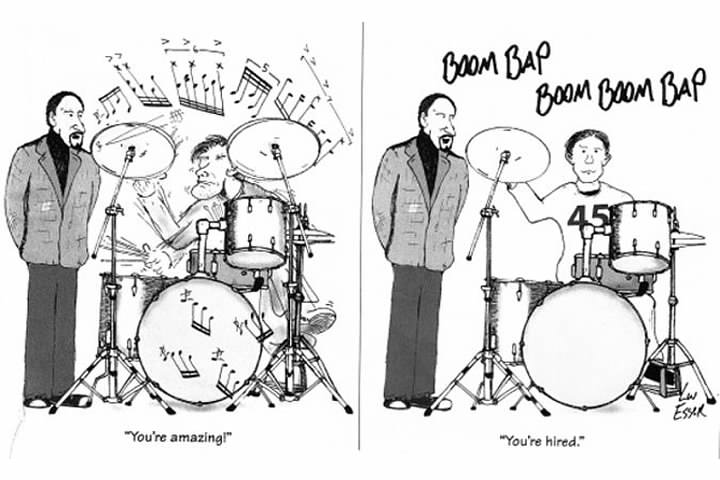
As a drummer it is very frustrating to have someone come up to me and say, “Can I have a go?” If I’m feeling generous I will offer the sticks and step aside.What is worse is when they sit down without permission.

Then they proceed to go about bashing and thumping my drums. They hack and whack. There is no rhythm, no pattern or structure. No thought to dynamics, velocity or touch.

And writing is just the same. If you have no idea what you are doing, you are going to be making a lot of noise and not a lot of sense.

Learning to play drums is fundamentally about understanding rhythm and how it relates to the purpose of the music.

Learning to write is fundamentally about understanding how the rhythm and cadence of words relates to the purpose of the narrative.

Learning to play the drums is like first learning how to write. We are still learning the rules of drumming (or the rules of writing) and our playing (or prose).

Let’s learn a few basic principles of drumming to understand how playing drums can improve your writing.

When you learn to play drums, you learn the simple action of RLRL (where R= right hand and L = left hand)
Then you learn to play doubles: RRLL RRLL
Combine the singles and the doubles to create a new combination known as a paradiddles: RLRR LRLL
Then there is the triplet (counted 1 2 3): RLR LRL (or RLL RLL or LRR LRR)
One more thing to know: the flam. The flam is an unaccented note (or grace note) followed by a main note. It is written as lR, rL.

Then you learn a basic rock pattern:

or a basic jazz pattern:


Once you know these basic phrases of vocabulary, everything else is simply a combination of these phrases to form a fill pattern (or musical sentence).

When you learn to play drums, it first sounds mechanical and awkward as you adjust your body to learn new movements and patterns. It takes time to internalise the rudiments, patterns and techniques. Once you internalise the methods and patterns, it ceases to be simply rudimentary techniques, but becomes a free flowing extension of your playing.

The same applies to writing. Our first pieces of prose are often clunky and formulaic, lacking finesse and a sense of style. It takes time to internalise the process and structures of writing. For example, learning to write short sentences increases the pace or action of a passage while longer sentences slow down the pace. It’s a matter of knowing when to use different techniques.

And learning to understand rhythm in a piece of music will help you understand how rhythm works in a piece of writing and will help you to construct better prose. You understand how to achieve your purpose by using or amending the rules.

In music, as in writing, there is a place for the simple and the complex.

The simple can be effective as evidenced by Phil Rudd from AC/DC – Back In Black. It’s not a complex drum pattern, but it fits the music perfectly.

But the complex also has its place, both in writing and in drumming. Frank Zappa wrote The Black Page for drumming virtuoso, Terry Bozzio as a challenge. Nailed it.

But more importantly, knowing you can be complex does not mean you have to show it off.


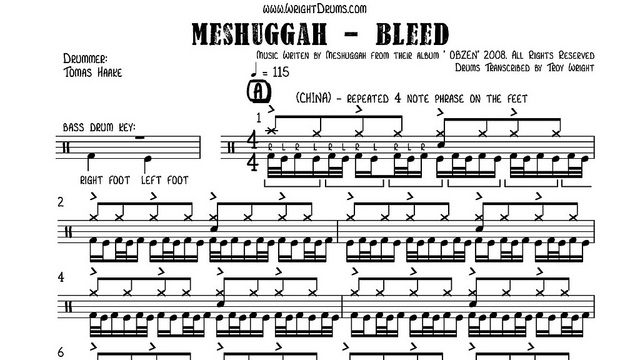
Whenever we learn a new writing trick, it is tempting to incorporate it into our latest work in progress. Drummers are no different. Learning a new fill or pattern, we tend to use it at every opportunity. Not always appropriately. Imagine a dramatic Meshuggah-style double bass drum onslaught in the middle of a jazz standard. Not always going to work. But mash ups can work. Try this:  Meshuggah vs Lady Gaga– Bleedarazzi

And this is what the drums look like

In writing, the same principles apply.
Sometimes simple prose communicates the message most clearly while at other times complex, dense prose is required to communicate the ideas of the writer. Neither is necessarily superior although we still tend to elevate some genres and forms (both in writing and music) over others. But each writer needs to work out what vocabulary and style is required for the message he or she wants to communicate.

Drummers: Learn. Practice. Internalise. Repeat.

Writers: Write. Edit. Revise. Show someone your work. Edit. Revise. Repeat.

I can now play drums with ease and write with ease (some of the time). But I still have a lot to learn.

When I learn a new drum pattern or piece (whether it is simple or complex), I break it down into one or two bar phrases and practice it until I have it right and internalised the pattern. Then I can move on to the next phrase and repeat the process until I have learned the whole passage. Something new always takes time to learn.

When I am writing, I am aware of the rhythm I want to create in the sentences, paragraphs, descriptions and dialogue and the emotional impact I want to create in my reader. When revising and editing, I am looking for when the writing is not fulfilling my intentions and aims, to hasten or slow down the narrative, or increase the flow and rhythm of the narrative.

A wrong word disturbs the rhythm of the narrative, much like playing the wrong fill or hitting the wrong cymbal breaks the feel of a song. The best patterns and fills sound effortless, as does beautiful passages of prose, but you know there has been a lot of thinking (and writing, editing, revising) behind it to make it seem effortless.

Learning to play drums is another way to understand how you approach the process of writing.You are building a foundation of rhythm, drawing the reader into the world you have created. You want the reader’s heartbeat to increase in the tense moments, relax during the languid moments, and to break because they have become invested in your character’s life.

Trying something new and different, perhaps difficult (for those who think they have no sense of rhythm, I think everyone can grasp the fundamentals of rhythm and beat) will have a benefit – tapping into another aspect of the creative side of your brain, and allow you to extrapolate how it can have an impact and influence on your writing.

Go and buy a pair of sticks and a practice pad, and learn how to improve your writing. If you can’t afford them, buy a small shaker. Listen to a song on the radio and play along.

If you are a writer who plays an instrument other than drums e.g. guitar, piano, saxophone or bagpipes, does that musical knowledge make you understand and approach your writing differently?