It has begun!
I am collating all my poems to a separate page, Post It Note Poetry 2015.
Drop in each day for a new poem. The new poem will be posted at the top of the page each day.
Here is today’s poem.
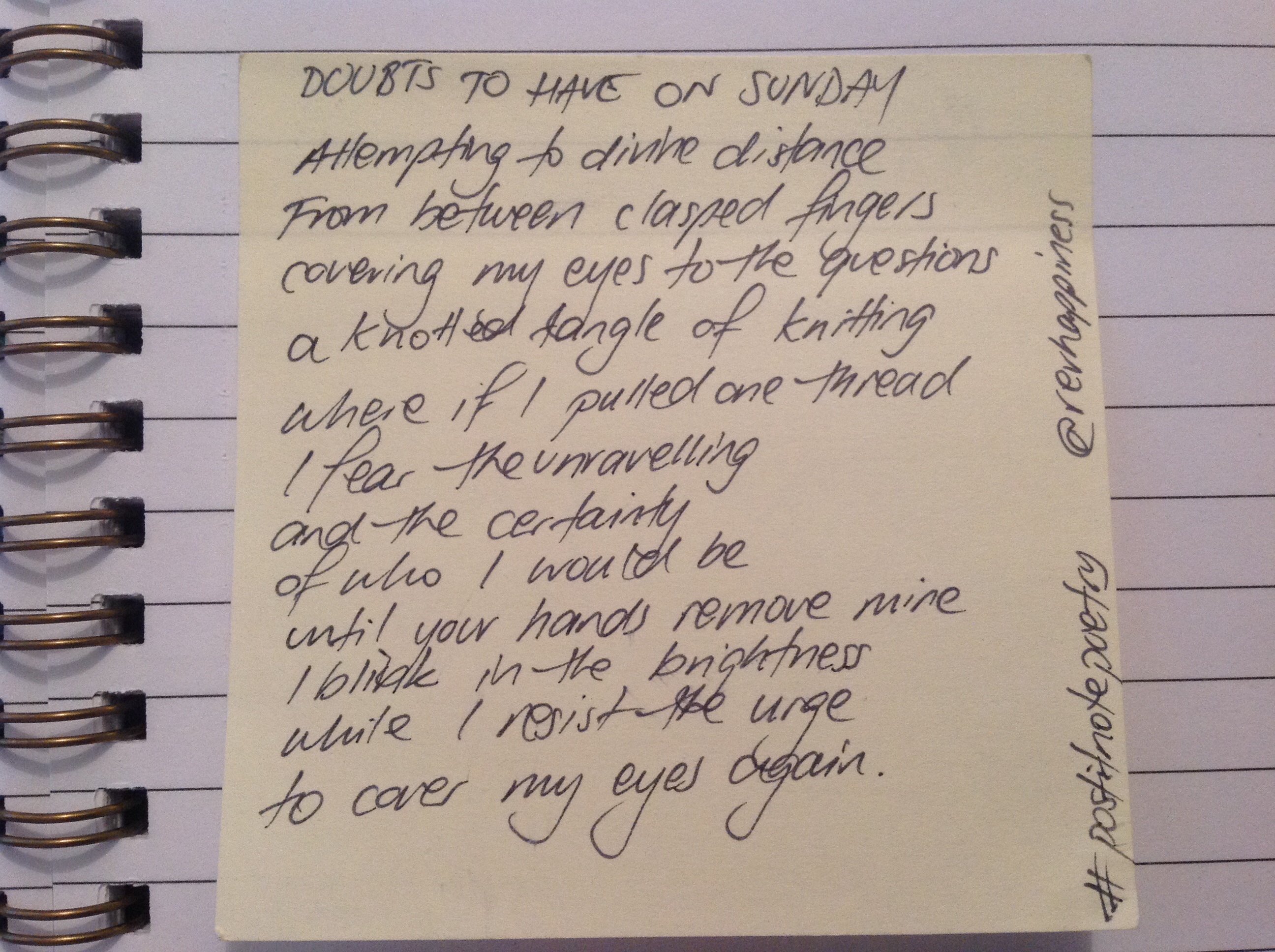

It has begun!
I am collating all my poems to a separate page, Post It Note Poetry 2015.
Drop in each day for a new poem. The new poem will be posted at the top of the page each day.
Here is today’s poem.
Posted in Ars Poetica, Creativity, Post It Note Poetry
Tagged creativity, experimental, micropoetry, poetry, post it note, post it note poetry, writers, writing
February marks the beginning of Post It Note Poetry month. It began 3 years ago as a challenge between myself and my writing partner at the time, Jodi Cleghorn – a month of bad poetry, written on a Post It Note.
You can find my collection of Post It Note Poetry over on tumblr as well as some other poetry including blackout/erasure poetry.
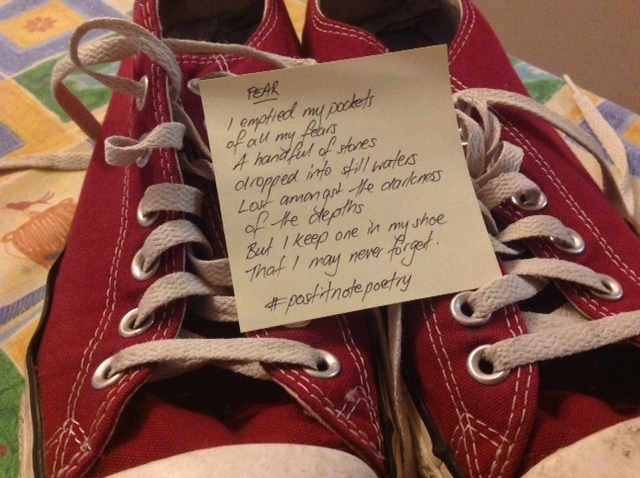
My first Post It Note poem written on February 1, 2013.
I will be posting a new poem daily in February #postitnotepoetry and will also curate the poems here each week.
But here’s the challenge: why don’t you have a go? Grab a packet of Post It Notes (any colour will do) and write a poem each day. Post it to twitter and include the hashtag. Include me too (@revhappiness) so I can see what’s going on.
If you can’t do it every day, no stress. Do what you can. Don’t censor. Write with both heart and mind.
Sunday marks the First of February and a month of writing poetry on Post It Notes. Have at it!
Posted in Ars Poetica, Post It Note Poetry
Tagged creativity, poetry, post it note, post it note poetry, writers, writing, writing tips
What is the power of creativity to contribute a verse?
This is the ending of one of my favourite films, Dead Poet’s Society, starring Robin Williams. It was a film that defined my generation growing up, along with Ferris Bueller’s Day Off, The Breakfast Club and the like. The phrase, carpe diem, “seize the day,” was synonymous with this film.
But the power of this final scene only emerges with an understanding of a previous one. It was purloined for a recent advertising campaign by a computer company named after a piece of fruit. The ad is a complete piece of onanism but the sentiment is what I want to explore.
“We don’t read and write poetry because it’s cute. We read and write poetry because we are members of the human race. And the human race is filled with passion. Medicine, law, business, engineering, these are noble pursuits, and necessary to sustain life. But poetry, beauty, romance, love, these are what we stay alive for. To quote from Whitman: ‘O me, o life of the questions of these recurring, of the endless trains of the faithless, of cities filled with the foolish. What good amid these, o me, o life?’ Answer: that you are here. That life exists, and identity. That the powerful play goes on, and you may contribute a verse. That the powerful play goes on and you may contribute a verse. What will your verse be?”
How do you contribute a verse?
Grandiose plans to change the world are good and well but I want to look closer to home.
You contribute a verse by starting small.
Start small by writing a poem in an old notebook.
Start small by writing someone a letter (a friend recently asked for her birthday for people to send her some thing in the mail using the good old fashioned postal service).
Start small by getting out a colouring book and pencils.
Start small by taking a photo a day on your camera (an intentional act of creativity).
Start small by joining a local amateur dramatic or musical society either as a chorus member, backstage crew, admin, promotion, anything. Ask.
Start small by taking an art class or a writing class.
Start small by learning an instrument.
Start small by asking, “What can I do?” to help meet a need.
You need a job to provide a living but you also need a cause to be passionate about, something you believe in.
Creativity provides that outlet.
You contribute a verse because you learned to create for yourself first. Then you understand that it can be used to help someone else. And your creativity can contribute to the job you do, the ‘noble pursuits’ mentioned above, that allows you to begin changing the world.
But you start with one person; you start with yourself. You create, make it a habit, teach others to create, inspire others to pursue their own creative path.
That is how you contribute a verse.
Posted in Creativity
Tagged creative help, creativity, creativity tips, start small, writers, writing, writing tips
Over the last few weeks I’ve been plugging away at some older pieces of work, deciding whether to forge on with them or cut them loose.
I had just closed the document of a poem I had been working on after having decided it was not worth pursuing at this time and launched into a quick twitter self-evaluation session.
The conversation I had with myself is below.
Cleared the desk of old projects hanging around. Abandoned some. Others into storage. Time to focus on the new things. And Get Stuff Done.
Come to conclusion some ideas are worth exploring but awareness they are practice, amassing the hours needed to master the craft.
Nothing wrong with that. Some ideas sprout early, look good but produce only weeds. Cut them down, turn them into compost for new ones.
It does seem to contradict “finish what you started” but sometimes the piece will not work no matter how much manure you pour on it.
Commitment to an idea is noble but not at the expense of developing as a writer, artist, creative person. Shelve it. File it. Let it go.
Sometimes ideas just suck. Sometimes they turn into manure. Put it on the compost pile and let it feed new ideas and projects.
Do you ever let something go or do you see it out to the end?
Posted in Creativity, The Writer's Life
Tagged creativity, manure, poetry, writers, writing, writing tips
Ever wondered how to kick start your creativity?
Besides a swift kick up the bum (which is easy to do by the way. Tie a piece of rope around your right ankle. Bring the rope up and over your shoulder from behind. Pull the rope swiftly and kick yourself in the bum).
There is an easy way to kick start your creativity.
You start by DOING.
No thinking. No procrastinating. No making a cup of tea first. No checking twitter or Facebook. No worrying. No hesitation. No. No. And no.
To get you started in the DOING phase of kick starting your creativity, there are a list of suggestions. Pick the appropriate category and off you go and DO IT.
For Aspiring Writers
* write 5 very short stories or pieces of description. Each story must be 6 sentences in length and include one sentence of dialogue.
For Curious Poets
* write 5 poems. It doesn’t matter about how bad you think they are, write them. Give yourself 5 minutes to write each poem. Do them all at once or one at time.
For Ingenious Artists
* draw 5 pictures. Draw each picture on a Post It Note.
For Ambitious Photographers
* select one random object from around the house or office and take 5 photographs in different locations.
Which one are you doing?
If you’ve given it a go why not show the world what you’ve done and link it back here?
Meeting a piece of art (I am defining ‘art’ to mean literature, music, painting, sculpture, photography, dance; in fact any creative endeavour) for the first time it is an introduction to the artist and his/her work, the rationale and purpose behind the work and what it means to the artist.
Here’s a thought to bounce around with you: art is an introduction, then a conversation, a relationship, an understanding, a sharing.
A tangent to start with: I suspect much of the reaction to an artist’s work stems not from an offence created by the composer (unless that is the specified intention) but more from the responder’s own set of values, attitudes and beliefs.
In the media an artist is forced to apologise for an artistic statement they have made regardless of their intention. In the past week, recording artist Sia has issued an apology about the content of her most recent video clip featuring Shia Labeouf and a young girl engaged in interpretive dance. The complaints focused on the age of the girl, allegedly 12, and the state of undress of Shia.
This article is a good summation of how people react without understanding. Even the writer of article shows his lack of understanding. Sia Sorry Over Pedophilia Upset
It didn’t take in to consideration the content of the song, the purpose of the lyrics or the meaning of the video clip itself.
A glib summation: TRIGGER WARNING – it’s your fault I’m offended.
An artist’s work should be questioned, interrogated, debated. But we have to also confront WHY we are offended and feel uncomfortable.
I remember the controversy surrounding the artistic work, Immersion (Piss Christ) when I was in my late teens/early twenties. The art was a small plastic crucifix immersed in a yellow liquid.
It was exhibited in Australia and two attempts were made to vandalise the artwork. There were threats made against the artist and the gallery.
It is a significant religious icon and thus, hold supreme importance to Christians and Catholics. I can’t find the reference now but a friend had done some research into the artist’s intention, and it was not to be sacrilegious. Crucifixion, as a Roman form of punishment, was barbaric and intended as an act of humiliation. The artist had made a parallel in the modern age to another act of humiliation: to urinate on someone is to denigrate and proclaim that person worthless.
It also means having an understanding of the significance of the icon, why it is important and how it is used. The New Testament writer of the Book of First Corinthians understood the complexity, and controversy, of crucifixion: “For the message of the cross is foolishness to those who are perishing, but to us who are being saved it is the power of God.” Therefore, as an act of salvation it is contradictory.
Therefore art is an introduction.
Then it is a conversation between the artist and the responder, coming to a common ground. The first thing you do at a party when you are meeting new people is to ask for their name, what they do, find out what they are interested in or passionate about. Once you have established commonalities, a conversation begins.
From there it develops into a relationship. Aside: you can tell if a conversation is going nowhere as you run out of topics, lacking a connection. And it’s ok to not like a piece of art, to have no connection with it. But know why you don’t connect with it.
If there is a connection, you seek to develop it, leading to an understanding of the artist, his/her worldview, purpose, intention, vision. You see out other works, attend other performances, read more novels, and even if it confronts you, there is still a point of understanding.
And all of this leads to sharing. When you have taken the time to cultivate a relationship, to understand the artist’s vision and purpose, you can eloquently share your love of the artist’s work.
Art can, and indeed should, offend. The right to free speech entitles that. My caveat on that is offensive, racist, sexist bollocks should not be tolerated. Call it out for the garbage that it is.
It is the conversation we engage in with the art that makes it beneficial, even if we do not like it. Saying “I’m offended” reveals more about your own insecurities, values and attitudes than it does about an attempt to understand the art. You have every right to be offended but have a sustained and logical reason to defend your proposition.
Art is an introduction, then a conversation, a relationship, an understanding, a sharing.
Have you been introduced to any great art lately?
Posted in Creativity, The Writer's Life
Tagged art, creativity, offence, writers, writing
Being creative is a powerful tool for an individual because it releases a person’s sense of actualisation. But I believe there is more power in teaching others to be creative.
To teach someone is to give the person the knowledge, skills and understanding that they, too, can be a powerful creative person.
I learned this lesson from Benjamin Zander, a classical pianist, and more importantly, the conductor of the Boston Philharmonic Orchestra.
You can see his TED Talk here: Benjamin Zander – TED Talk
Here’s the takeaways from a delightfully rousing discussion.
When you have mastered your own creative endeavour, even if you haven’t, teach someone else how to do what you do.
Help the person unlock their own creativity, to realise their own potential as a creative person.
Creativity is a secret you want someone else to know.
Posted in Creativity
Tagged Benjamin Zander, conducting, creativity, lessons, music, orchestra, writers, writing
Happy New Year to you all.
2015 is here and whether you celebrate it with good intentions or good champagne, there is something about the marking of a new year that sets it apart.
Last night I played at a New Year’s Eve gig (I play drums in my spare time when I’m not teaching English or writing) and we always end our set with the song, ‘Wish You Well’ by Bernard Fanning (Powderfinger).
It’s a beautiful sentiment and we love playing it at weddings especially, to bless the new bride and groom, but it’s a positive sentiment to give to all our audiences.
This year holds so many possibilities, many of which I have not foreseen, some I have planned for, but I intend to live out the year focused on the adage to ‘love thy neighbour’ because only when I seek to serve others will there be freedom and peace on Earth.
And so, with that in mind, I just want to wish you well for 2015.
I am an English teacher and drummer/percussionist with an interest in literary pursuits, creative endeavours, rhythmic permutations, theological amplifications and comedic outbursts.
Here you will find my creative detritus: articles on living a creative life and writing explorations.
And other ideas I have snaffled from the papers stuck on the fridge door.
Twitter: @RevHappiness
Instagram: @handwrittenpages
My collaborative epistolary novel, "Post Marked: Piper's Reach," written with Jodi Cleghorn (@JodiCleghorn) out now via Vine Leaves Press.
Come and browse through the library; there is no need to be silent.

 A Fullness in Brevity - Adam Byatt