
Tag Archives: tanka

More Collaborative Poetry

I wrote another haiku yesterday, posted it to twitter and copied in Sean (@SeanBlogonaut) to see what he could add to form a tanka.

fading amber leaves
blown into the courtyard corner
lovers’ forgotten kisses

Sean added the final lines:

fading amber leaves
blown into the courtyard corner
lovers’ forgotten kisses
would that my love return
like the green leaves of spring

He also played with the second last line

fading amber leaves
blown into the courtyard corner
lovers’ forgotten kisses
how I wish my lover would return
like the green leaves of spring

We were playing around with this on Facebook, on a private page for our small group of writers, and after reading through Sean’s ideas, I added my own versions.

fading amber leaves
blown into the courtyard corner
lovers’ forgotten kisses
I wait for my love’s return
with the green shoots of spring

*****

fading amber leaves
blown into the courtyard corner
lovers’ forgotten kisses
I wait for my heart’s return
with the green shoots of spring

This is the fun of collaboration, learning with each other the intricacies of a new art form.

Into the mix Jodi Cleghorn (@JodiCleghorn) added her own version using my original haiku and added her own final lines to form another tanka.

fading amber leaves
blown into the courtyard corner
lovers’ forgotten kisses
left to decay
with the memory of you

As she said, “Thank you for new ways to play and collaborate.” 

Ultimately, this is what it is all about: new ways to play and collaborate. The apparent simplicity of haiku and tanka reveals a deeper, more sophisticated art form that while simple to learn is difficult to execute and takes years to master.

But the evening’s fun continued. Jodi wrote two haiku while out at the shops and posted them for us to add two final lines to form a tanka.

an autumnal drift
shedding selves compost
buried beneath

*****

frost-bitten feet
walk from the place
I forgot to leave

I took the haiku and added my own final couplet

an autumnal drift
shedding selves compost
buried beneath
resurrection of the dead
in someone else’s life

*****

frost-bitten feet
walk from the place
I forgot to leave
in the hope
your heart will thaw

frost-bitten feet
walk from the place
I forgot to leave
in the hope
your heart would thaw

In the last two, the change of a single word, “would” for “will” creates two very different meanings and both a valid.

Here’s a challenge: take my haiku and write two final lines to form a tanka.

fading amber leaves
blown into the courtyard corner
lovers’ forgotten kisses
Collaborative Poetry

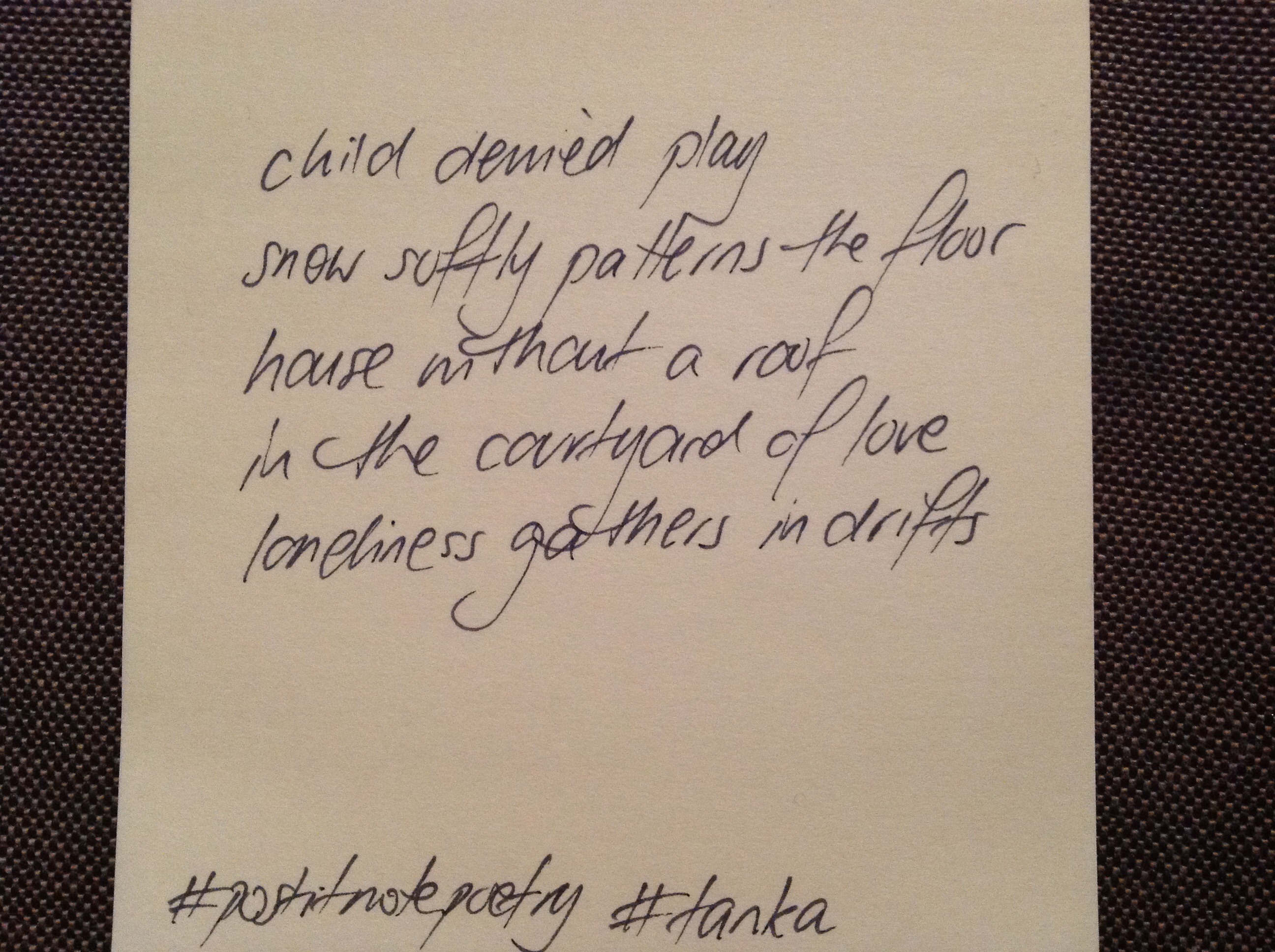
Recently I tweeted the following haiku:

child denied play
snow softly patterns the floor
house without a roof

and tagged a friend, Sean (@SeanBlogonaut) who is another poet and writer. He is particularly fond of haiku, tanka and renga. He has given my wonderful insight into how haiku should be written in English (focus more on the imagery, the phrase and the fragment, rather than the counting of syllables. It is one of the vagaries of using a poetic form which has its origins in another language; the Japanese use sound units which are different to English syllables).

He added the following two lines to form a tanka:

in the courtyard of love
loneliness gathers in drifts

Creating a new poem

child denied play
snow softly patterns the floor
house without a roof
in the courtyard of love
loneliness gathers in drifts

I am used to collaborative writing and I want to further explore it with Sean, particularly as he raised the idea with me a couple of weeks back but we haven’t been able to catch up yet to write renga.

Collaborating with a new writing partner has benefits:

1. You learn new skills

A collaboration can be of equals, or a master and novice. In the case of writing renga with Sean, I would be the novice. But the collaboration is one of exploring a poetic form and learning more from each other.

2. The sum is greater than its parts

Or, two heads are better than one. New eyes, old heads, different perspectives, new ways of writing. You learn from another about your own writing from the writing of others. You learn how the other person constructs a phrase, sentence or image, and you get to explore why. It’s another skill/technique you can add to your own writer’s toolbox.

3. It’s fun

Yep. It’s fun. Creating a piece of work should be fun. It’s also hard work but the fun of creating something together, a shared community and body of work is a fantastic feeling.

image

Find a creative partner and create something new. It may only be a one-off piece of work or it may lead to a long term collaboration. Try it. Invite someone to participate.

Throw Out Thursday – Changing Form

During the week I was sifting through old poems on my hard drive looking for possible works to submit to an anthology a friend worded me up to (didn’t find anything of note although I did find a younger version of me writing complete tripe).

I came across two half-finished pieces and combined some stanzas to make a relatively cohesive whole.

The starry satellites stand sentinel
over silent musings while an observer
of a different reality speculates on the starry host
these pinpoints of silver across the velvety blanket
blink without recognisance
Looking towards the blanket of the night sky
He sees a thousand times a thousand times a thousand
pinpoints of light and asks
“Does God shine a torch at night through the little holes?”

Posting it to my crit group for giggles brought one of the group to suggest it would work as a tanka. No, not a tank top.

What is tanka? Think of it as an extended haiku.

It has a 5-7-5-7-7 syllable count, as per the Japanese guidelines (not necessarily the same in English when translated but English writers use this basic format when starting out).

Go here for an introduction: http://www.ahapoetry.com/Bare%20Bones/wfftocintro.html (with thanks to my crit member, Sean for the link. There are some wonderful examples to read.)

A quick check with my copy of Stephen Fry’s ‘The Ode Less Travelled’ and the link above, I had a grasp of the basics of tanka. And by grip I mean a loose hold. And by loose, barely touching.

And this is what I came up with:

pinpoints of silver
against the velvety black
a blanket of stars
“Does God shine a torch at night
through the little holes?” he asks

I now have a new understanding of how form can affect and benefit a piece of writing. Changing form, in this case, forced me to focus on what were the significant images I wanted to convey in the poem, leading to the final line. Sometimes it could be as simple as breaking the line or stanza arrangement. Sometimes less is more.

But changes to a piece could be in the form of changing point of view, turning a story into a poem or a poem into a short story.

Has changing form helped you with a piece of writing?