Tag Archives: stupid stuff I like to write

When Things Turn Pear-Shaped

What do you do when your plans head south? Turn pear-shaped? Or resemble a dried up pile of dog poo?

The Plan

I took long service leave from teaching in order to write my first novel. My aim was to have a 90,000 word manuscript finished by the time I went back to work in the middle of July. Having 14 weeks of leave (2 weeks of school holidays, the entire 10 week term and 2 weeks of holidays) I planned for a few weeks of outlining, followed by weeks of writing where I could commit a few hours a day and write a couple of thousand words. This would allow for more family time and for a few other bits and pieces.

Then it all went pear-shaped.

My wife’s grandmother had a serious stroke and died in the first few week of the term (I used the school holidays to rest and recuperate). She died 10 days later. My wife spent a lot of time at the hospital with family. I took up the domestic duties of getting children to school and other places.

This was followed by the funeral and the wake held at our house, which meant a whole lot of cleaning and tidying.

When things go wrong, what do you do? Change the plans.

My new plan went like this: outline for the latter part of May, write for all of June and *ta da* there’s a novel.

I had a plan. I wrote an 11 page, 6.6K word outline. I had an aim of 3000 words a day. Did it work?

Nope.

I couldn’t write 3000 words a day. The best I managed was 2.6K. One day I managed the grand total of 437. Right now, my novel stands at 24,000 words.

What to do now? The best laid plans of mice and men become the equivalent of sitting in a wad of chewing gum in your best trousers. Sometimes stuff just happens and even if you feel right royally shafted, you have to rethink and plan again.

To say the least, I am a little disappointed. It has forced some thinking and introspection and here is my solution.

Identify the Problems

Problems can be external (things you cannot control) and internal (things you can control).

External – illness, family commitments, domestic duties, unexpected visitors. Things just happen and there’s not a thing you can do about it. You work around it.

Internal – these are the things you have control over and I identified a number of reasons why I wasn’t successful in my planning.

* I’m easily distracted – discipline is a key characteristic I’m developing

* I was thinking about the scene, the characters, the conflict and tension, where it might end. I had done the planning, but spent time thinking about the scene rather than writing what I had in mind. Thinking time is not wasted time, but it is if it detracts from writing.

* It’s a whole lot harder than I thought – being more prepared for me is essential and I had no idea how hard is it to write a novel. I didn’t think it was going to be easy; I know it’s hard to write. I am still developing routines and disciplines.

Make New Plans

Over the next two weeks I will be writing when I can, adding to the word count and continuing with my outline. I will not be finished by the time I return to work, but I my new plan will have the novel completed by September.

I am not defeated, just rethinking and planning. It’s taking a little longer than I wanted, but so it be it.

I have also learned I could conceivably plan and write a novel in a year to 18 months, allowing for the busyness of my job and allowing for life’s little distractions to get in the way.

What do you do when your plans go pear-shaped?
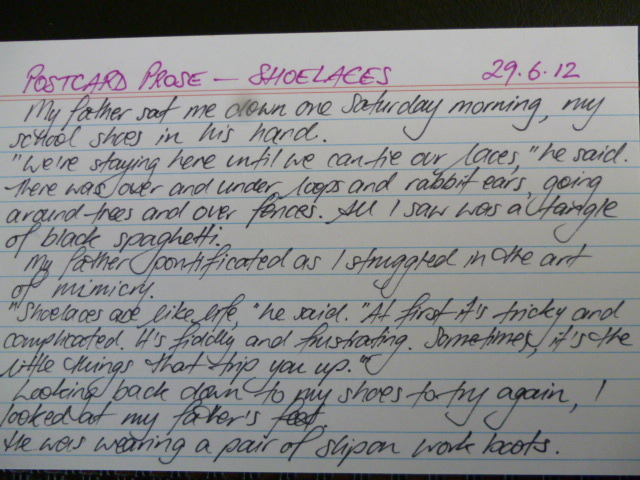
Shoelaces – Postcard Prose


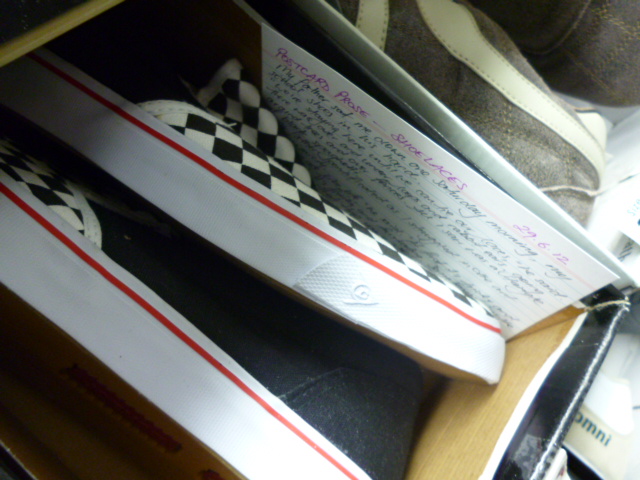
My latest effort in guerrilla literature, ironically dropped in a shoe store as I was buying new shoes.

Payless Shoes – Centro Shopping Centre, Seven Hills

My father sat me down one Saturday morning, my school shoes in his hand.

“We’re staying here until we can tie our laces,” he said.

There was over and under, loops and rabbit ears, going around trees and over fences. All I saw was a tangle of black spaghetti.

My father pontificated as I struggled in the art of mimicry.

“Shoelaces are like life,” he said. “At first it’s tricky and complicated. It’s fiddly and frustrating. Sometimes, it’s the little things that trip you up.”

Looking back down to my shoes to try again, I looked at my father’s feet. He was wearing a pair of slip on work boots.

And, yes, I did put the postcard into a box of slip on shoes.


Postcard Prose

Today I subverted the literary establishment in an act of guerrilla warfare against the digitisation of literature and the commodification of words.

I gave away my words for free.

I give away my words for free here on my blog, but this is subterfuge of the highest order, infiltrating the reading minds of the public one by one.

Moving away from faux hyperbolic rhetoric, I started a new project today: Postcard Prose.

The idea is simple.

Write a story (about 100 words or less is the maximum space) on a 6″x4″ index card (for all intents and purposes, a postcard) and leave it in a public place for someone to find and read.

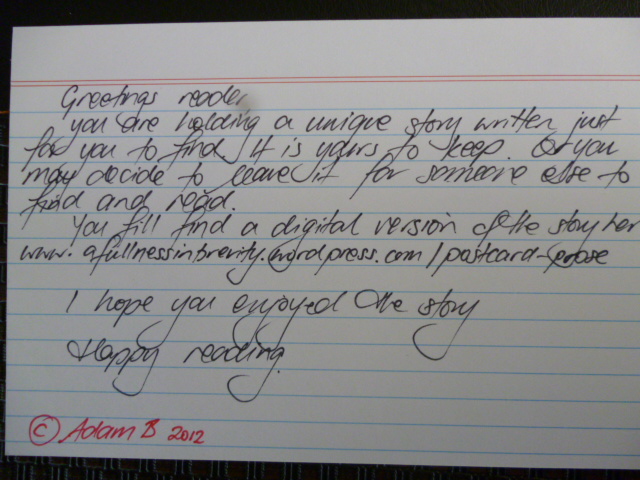
On the back of the postcard, the reader is invited to take the story home or leave it for someone else to read. It may be read by one person, five people, or no one at all. Also on the back is my web address, and a link to the Postcard Prose page.

It is an individual, handwritten story for the enjoyment of someone to read.

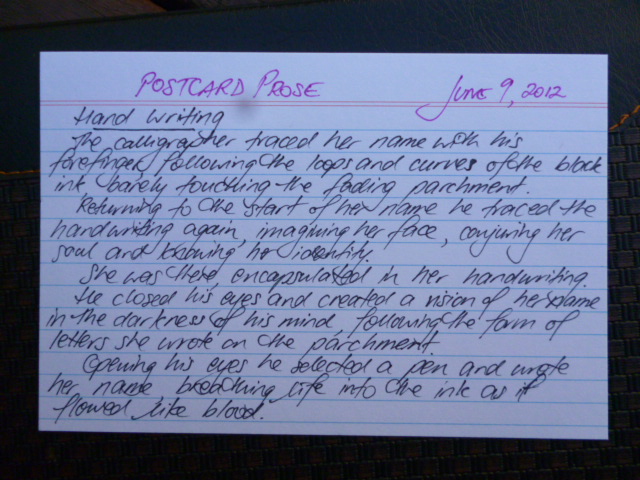
Today I wrote out my #fridayflash Hand Writing from yesterday and left it in the food court of Rouse Hill Town Centre.

You can read the story and see the pictures here – https://afullnessinbrevity.wordpress.com/postcard-prose/

I am always carrying a notebook and pen, ready for ideas. I am now carrying around a packet of index cards should the moment strike. Some will be planned drops, others will be spur of the moment compositions. Wherever I write a piece of Postcard Prose, I will take photos and post them to the Postcard Prose page.

I have plans for two other Postcard Prose projects which will see the light of day later this year.

Now it’s your turn to write someone a story.

Who Is Jude Smith?

Since the release of Post Marked: Piper’s Reach, I’ve been asking the question “Who is Jude Smith?”

On Tuesday, the seventh letter in the series was posted, (open The Shoe Box to read the letters so far) but Jude has only had two. Readers have seen a lot of Ella-Louise and can glimpse into the darkness that is her past. Jude, on the other hand, is a mystery. Ostensibly, he is the character I am writing as he responds to the letters of his best friend of 20 years ago, Ella-Louise Wilson.

The premise of the project is the exploring the relationship between two old friends who shared a very close friendship, reconnecting after 20 years. But what do you say to someone after 20 years of silence once the ennui and minutiae have been covered?

Initially Jude is reluctant to reveal his present situation to Ella-Louise, for fear of offending her. Even as Ella-Louise opens up about what has happened to her, Jude remains closed, reticent to confront the collision of the past and the present.

The intensity of their friendship and its sudden dissolution left many unanswered questions for both of them. In Jude’s mind it is safer to reconnect through shared memories of events that were significant, from Ella-Louise’s arrival in Piper’s Reach to skinny-dipping and sneaking a glance, to the Year 12 Formal and after party.

Jude is an “everyman,” yet more than that. In the initial exchange of letters, I feared Jude had nothing to say in comparison to Ella-Louise’s revelations of the darkness of her life. It felt too light (emotionally, spiritually, relationally) but he could not see the balance he was to Ella-Louise.

In the present Jude remembers Ella-Louise as she was in the past and the relationship they shared. He loved Ella-Louise but something held him back. The strong nostalgic sentimentality prevents him from fully understanding of how Ella-Louise has changed, and from understanding her intentions (which may or may not be clear).

But I am writing his letters some months later and a lot has changed. What I am looking at now is Jude’s emotional capacity. Was he emotionally naive in high school to be able to cope with what Ella-Louise was going through? Is he emotionally unready to deal with it now? Is it the cause of his inability to share?

The reader is about to embark on a very intense emotional journey with both characters in the coming weeks, almost voyeuristic in the intimate details shared, in particular by Jude. He is enamoured by nostalgia and in his letters  recounts in vivid detail the moments he remembers sharing with Ella-Louise; what he did do, what he didn’t do and what he wished he did.

There are lots of questions, as there are revelations.

Voices of Creativity

A brief twitter discussion about maths, science and the humanities took me down a little garden path about the subjects we studied at school and the voice of creativity we develop.

It began with a discussion about the correlation between music and mathematics (explains my humanities/maths/music balance) then veered into the vagaries of the quality of the teacher in front of the room (caveat: I am an English teacher).

The quality of the teacher does have an impact on the learning of the student. A good teacher recognises the different learning styles of the students in the classroom and differentiates the curriculum. A good teacher also understands there is a world beyond the classroom and brings it into the dialogue of the classroom. A good teacher shows students the applicability of the curriculum and content to the wider world.

But it led to one person in the discussion recounting a statement that discounts a student’s aptitude: “You’re not mathematically inclined.”

You can substitute “mathematically” for any subject: You’re not artistically inclined. You’re not historically inclined. You’re not scientifically inclined.

We all have preferred learning styles and ways of expressing our learning and creativity. I refuse to believe students should be placed into categories regarding their learning. We need to expand our thinking beyond the boundaries and confines of subjects (English, Maths, Science etc) to learning skills and problem solving, to develop higher order thinking skills.

The modern approach to learning is to know a lot about a narrow field of enquiry. Rather, we need to know a little about a wider field of enquiry. Kind of like a talk back radio host, except with a higher IQ and a lot more common sense; a modern Renaissance Man. I want to be a modern Renaissance Man.

However, we have preferences and passions in our learning and our interests. For some it is the humanities (English and History) while for others it is the formulae of Maths and Sciences. I am securely in the former while I enjoyed Maths and Sciences in high school. And others find their passion in music and instruments or paints and pencils.

We have voices. We have different voices. Each subject is a different voice to express one’s creativity and passion.

I have found my voice in writing. I also another voice that dabbles in music and there is some correlation and cross over between the two.

Creativity is not limited to the “arts” i.e. writing, music, drama, art, dance, film making.

There is beauty in the mathematical language of the universe, a deeper understanding of the shape and form of the natural world in the patterns of the ecosystem.

Find your own voice.

The Family Vernacular

Mother and Father Guildford sat at the dining room table, conscious of the young ears present in their company. The two sprogs shovelled peas and carrots into their mouths, apparently more intent on consuming than listening.

Mother Guildford questioned her husband, “At this time of year of the death of our Saviour, were you able to purchase the seasonal confectionery?”

“Affirmative,” said Father Guildford. “And I also was able to purchase the prescribed item for someone’s chronological advancement.”

Mother and Father Guildford eyed their children, but no spark of recognition interrupted the clink of cutlery on china. As intuitive ears had long been able to spell, Mother and Father found new ways to converse without letting on.

“Got a call from my mother today,” said Father Guildford. “She told me that Mrs Hannah from across the road bought the farm.”

“That’s sad. When are the arrangements for?”

“Next Tuesday. Kids, how was school today? What was the best part of the day for you?”

Young Master replied, “Best part was Recess, Lunch and Home Time.”

His elder sister rolled her eyes at the ceiling. Then she cast the line to snare her father, “Today, we learnt all about the reproductive system from the pages of ‘Girlfriend’ magazine.”

A choking sound followed a snort. Father Guildford went red in the face. The elder girl smiled to herself.

Taking his glass of wine to wash away the idea of his little girl growing up, he caught a strange odour. Father Guildford wrinkled his nose, his face contorting. “Which one of you let fluffy off the chain?”

“It wasn’t me, Dad,” said the elder girl.

Young Master added, “Nah, I didn’t crack the sewer pipe.”

All eyes turned towards Mother Guildford. “I place the blame squarely on the dog.”