Tag Archives: stupid stuff I like to write

This Is How We Should Make New Friends

How should we make new friends?

I am a shy individual who masks it with bravado and a quip. New social situations makes my underpants an uncomfortable shade of brown. But it’s good to make connections with new people. Makes the village more welcoming and hospitable.

Here’s how I propose to do it: Everyone needs to carry a novel.

In a new social situation the novel is a means of beginning a conversation. We can talk about the book, what we liked, didn’t like, read aloud our favourite passages.

And when we’re finished, we can swap the book with the person we are talking with, read it and return it when done, or pass it on to the next new person we meet.

And it would be even better if it’s our own story in the book we give away. That way we must trust the other person to treat our book with respect and kindness.

And there should be blank pages for the new person to add in how we met, what we talked about, what the day was like. Then we can pass it on, receive the new person’s book and add our own details. If we happen to cross paths again, we can catchup on what has happened.

Imagine all the people’s stories we could read.

This is how we should make new friends. What do you reckon?


Please, Make Yourself At Home

Throw Out Thursday – The Breaking News

Over the next few weeks my work life is going to dominate all my spare time. One of the vagaries of being a teacher is knowing there are intense times in the course of a term when there is a lot to do be done to the exclusion of pretty much everything else.

This means I won’t be around here so much posting; I’ll still be thinking , making notes and taking down ideas, but probably no full posts for a little while. I have scheduled a couple of posts that I had ready so you won’t be too short on reading material when you have to visit the bathroom.

While I am gone, I’ve stocked the fridge, made sure the cupboards are not Mother Hubbard and there is enough rolls of toilet paper in the bathroom.

Make yourself at home here, take time to browse through the library of posts, leave a comment, spread the good word, even find some of my early fiction writing from when I first started out back in 2009/2010.

Please don’t short-sheet my bed while I’m gone. Bin night is Thursday night and when replacing the toilet paper, it hangs over, not under.

In the immortal words of the wise body-building philosopher, Arnold Schwarzenegger, “I’ll be back.”

A Museum of Domesticity’s Austerity – Micropoetry

a single white orchid
in a glass vase
on a glass coffee table
I press my thumb
onto the glass
to humanise austerity

Colouring Outside The Lines

As a child, colouring outside the lines was the mark of a juvenile understanding of boundaries and parameters: they were ignored.

You were handed a pencil or crayon and a colouring book and told to have fun. And fun was most definitely had. Scratched lines of pencil or crayon all over the page. There was fun simply in the act of creating marks on the page.

Yet gentle adult encouragement made you aware of the lines of the picture; the boundaries drawn to keep the colours within.

So you took extra care and effort to colour within the lines and make the picture look special. You were disappointed if your pencil or crayon slipped over the line, extending the colour beyond its prearranged designation.

And so it is with any creative endeavour. Initial enthusiasm and fun is gradually replaced with awareness of the skills, parameters and boundaries of your chosen creative medium. You become a skilled practitioner of your creative art and can produce good work.

So, how do you extend your creative skills? How do you extend your knowledge and understanding of your medium? When you are entrenched in your chosen creative medium, whether it’s art, literature, film, painting or music, how do you extend the boundaries and parameters?

You learn to colour outside the lines again.

As a drummer playing contemporary music and musical theatre, I am used to the drums forming a rhythmic foundation, providing timbre, dynamics and tone colour, the beat and rhythm.

The other day I had the opportunity to meet up with Adrian, an old teaching colleague of mine who is an art teacher, musician, boutique record label owner and producer, and a mutual friend and drummer, Costa.

P1010973

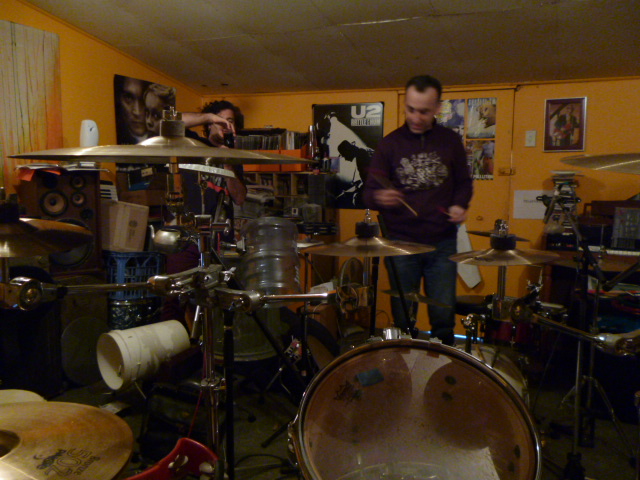
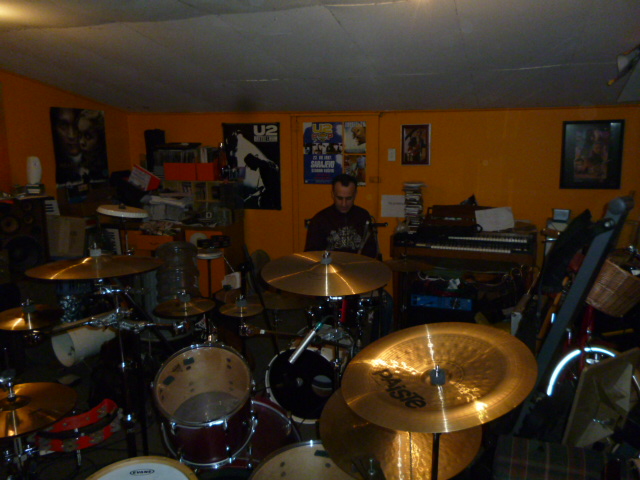
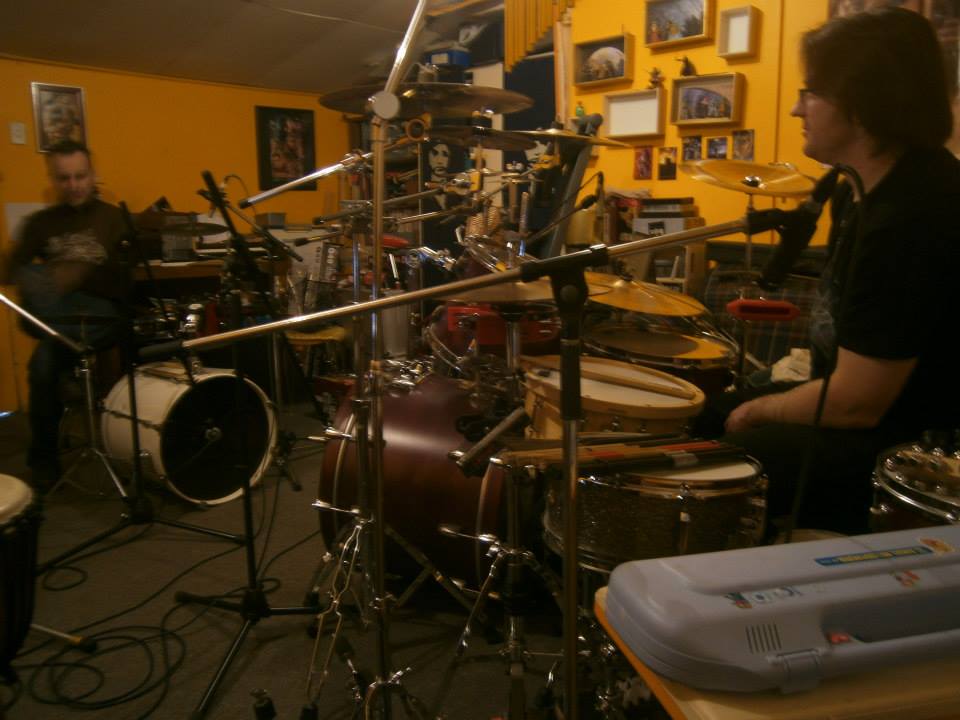
The three of us convened in a small home studio out the back of Adrian’s house. We lugged gear in and set up while Adrian placed mics.

There was no preconceived ideas as to what we were going to play and record, except for some youtube clips we had looked at earlier. There were no lines to demarcate the boundaries of our creativity.

Yet how easy it is to rely on the boundaries of what we know. As drummers Costa and I fell into an improvised jam in 6/8, using a form that was familiar to us, creating a beat and rhythm. As we played we listened to each other, playing around each other’s grooves and timbres, sometimes playing with the groove, sometimes playing against it.

We were colouring within the lines.

P1010968

I learned to colour outside the lines because of Adrian’s artistic vision and creativity.

Adrian suggested for the second jam an experimental form playing in different time signatures: Costa played in 4/4, I played in 5/4 and Adrian played in 7/4. It sounded gloriously messy as we experimented within the constraints of the time signature allocated while listening to what the others were playing.

The Junk Collective 3

The last jam was truly a learning experience of colouring outside the lines. Adrian suggested we play not rhythms or beats, but focus on the sounds produced from each part of our instrument.

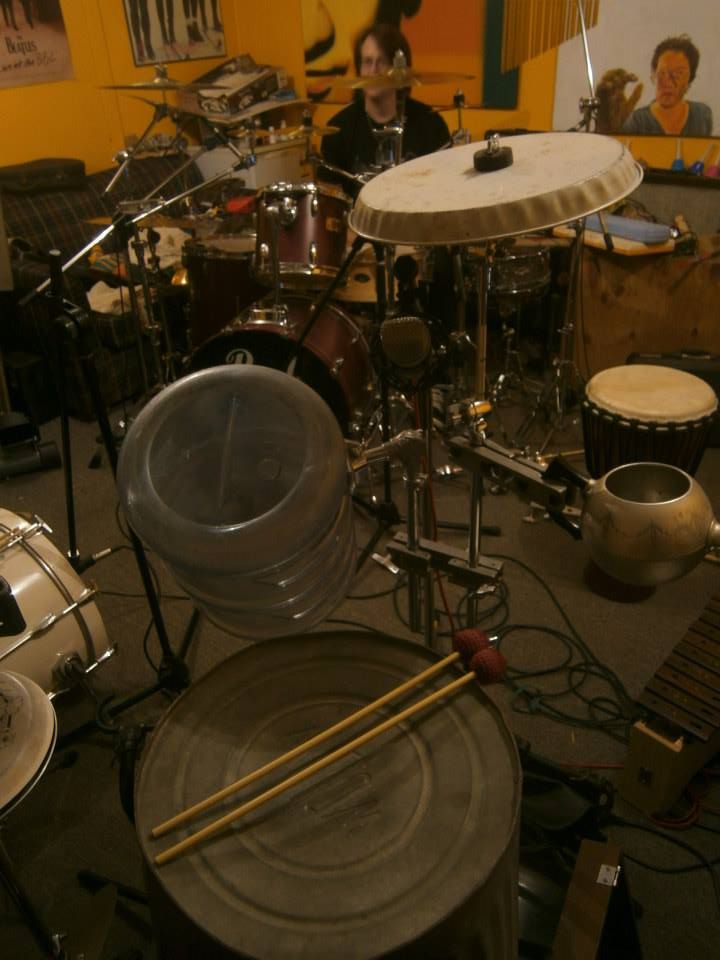
We used sticks, mallets, brushes, rods, plastic rods on all parts of the drums and cymbals including the rims and stands. I threw a handful of sticks into the air and let them fall where they may. I bounced sticks, mallets and rods off my snare to see where they landed. Adrian used a violin bow on cymbals and played mallets on my kit, Costa’s kit and their “junk” drum kit which consisted of a metal garbage bin, water bottles, saucepan lids made into hi-hats and a metal tea pot.

The Junk Collective 2

It was this last improvisational jam that really expanded my understanding of rhythm, drums and music in terms of creativity. It allowed me to colour outside the lines as I was not focused on the traditional parameters of my instrument, rather learning to see outside the lines and create accordingly.

Artists talk about the ‘negative space’ on the page; what is not there is as important as what is there.

My next step is to apply this principle to my writing.

Whatever creative medium you are engaged in, whether it’s writing, music, art, have you learned to colour outside the lines again?

Create Art “Just Because”

We had our school Art Show during the week and I popped in to view the HSC (Higher School Certificate) Major Works.

There was a wonderful array of art utilising a variety of media from painting, photography, mixed media, sculpture, installation and pencil.

Accompanying each body of Major Work was a brief statement by the artist, explaining the purpose and intention behind the piece. Some statements were fluid pieces of prose, capturing the essence and beauty of the work in a brief paragraph.

And then there was one statement that struck me. 

The statement did not explain or describe the artwork. The artist put forward the idea that the expression in the art work was an expression of what was in his head. It was the equivalent of shrugging one’s shoulders and saying, “Just because.”

And I love that idea. 

Sometimes we want to explain our idea, describe the beauty of our creative work, wax lyrical on the deconstructivist, post-modern interpretation of Freud’s analysis in the subliminal metaphors of our work.

Our words, pictures, music, film or art does not always require an explanation or a reason for being. We do it for no deep philosophical reason or existential afterthought.

Sometimes, we created a piece of art, “Just because.”

Lessons in Creativity from Ferris Bueller

One of my all time favourite films is “Ferris Bueller’s Day Off.” It’s cheeky, irreverent, sassy, the epitome of cool, and let’s face it, I want to be Ferris Bueller.

But what can this film teach us about creativity? From the words of Ferris come these words of wisdom.

Life moves pretty fast. If you don’t stop to look around once in a while, you could miss it.

Don’t miss opportunities to be creative. It is too easy to let life control you. Creativity allows you to control your life. It brings a new focus to your daily activities. It requires you to look around and be an active observer of the world. 

Pardon my French, but Cameron is so tight that if you stuck a lump of coal up his ass, in two weeks you’d have a diamond.

Creativity cannot be forced. Relax. Initial attempts may be failures or you’re too tense to let it flow. Perhaps you’ve had a period of time when ideas feel like you’ve pulled them out of your belly button or other deeper, darker orifices. When practised regularly, creativity becomes a natural extension of your life.

Ladies and gentlemen, you are such a wonderful crowd, we’d like to play a little tune for you. It’s one of my personal favorites and I’d like to dedicate it to a young man who doesn’t think he’s seen anything good today – Cameron Frye, this one’s for you.

Nothing – wha – what do you mean nothing good? We’ve seen everything good. We’ve seen the whole city! We went to a museum, we saw priceless works of art! We ate pancreas!

Creativity is best when you open yourself to new experiences and opportunities. Tell a story using an artist’s painting or photograph. Watch a dancer and write a poem or stream of consciousness based on their movement. Visit an art gallery, the zoo, watch children play, go for a walk, sit in the food court of the shopping centre and watch people, eat something different (which potentially proves my point that all food is based on a dare). Collaborate. Make sure you see something good today.

The question isn’t “what are we going to do,” the question is “what aren’t we going to do?”

Sometimes it is good to break the rules. Use the negative space to prove 1+1= a dancing elephant fairy.

The place is like a museum. It’s very beautiful and very cold, and you’re not allowed to touch anything.

Museums are for cultural history, an encyclopaedia of learning. Creativity is about creating community. Creativity can be about creating works of art for posterity’s sake, but it is more about giving life to your creative work, from a handmade card to a quilt passed on to the next generation. Creativity is to be lived and engaged with, admired and questioned.

Grace: Oh, he’s very popular Ed. The sportos, the motorheads, geeks, sluts, bloods, wastoids, dweebies, dickheads – they all adore him. They think he’s a righteous dude.

Know your audience and cultivate your brand. But do not limit yourself to who you think is your ideal audience. Be authentic to your audience.

They bought it. One of the worst performances of my career and they never doubted it for a second.

It’s always about your audience. It’s not about how much time and effort you put into something, the audience doesn’t need to know that. The audience doesn’t need to know if you think it has the artistic merit of congealed monkey vomit smeared on glass. It’s about how your audience engages with your creativity.

Cameron: The 1961 Ferrari 250GT California. Less than a hundred were made. My father spent three years restoring this car. It is his love, it is his passion.

Know your focus and your passion. Give your creative endeavour life.

Cameron: Ferris, my father loves this car more than life itself.
Ferris: A man with priorities so far out of whack doesn’t deserve such a fine automobile.

That being said, don’t be a pillock. Being creative and artistic requires sacrifice, but not at the expense of your health, family, marriage or relationships. Creativity serves to enhance your life, not consume it.

Cameron: [Whispering to himself after hanging up from a phone call with Ferris] I’m dying.
[Phone rings, and Cameron answers]

Ferris: (over the phone) You’re not dying, you just can’t think of anything good to do.

Life without creativity is being bored to death. Creativity doesn’t mean writing a novel or painting a masterpiece. It can be a simple act of writing a story for your family Christmas letter, cooking a new recipe, planting new bulbs and seedlings, learning an instrument, taking candid photos while you’re out for a walk, writing a quick play for your kids to perform.

You CAN be creative.

Ferris Bueller, you’re my hero.

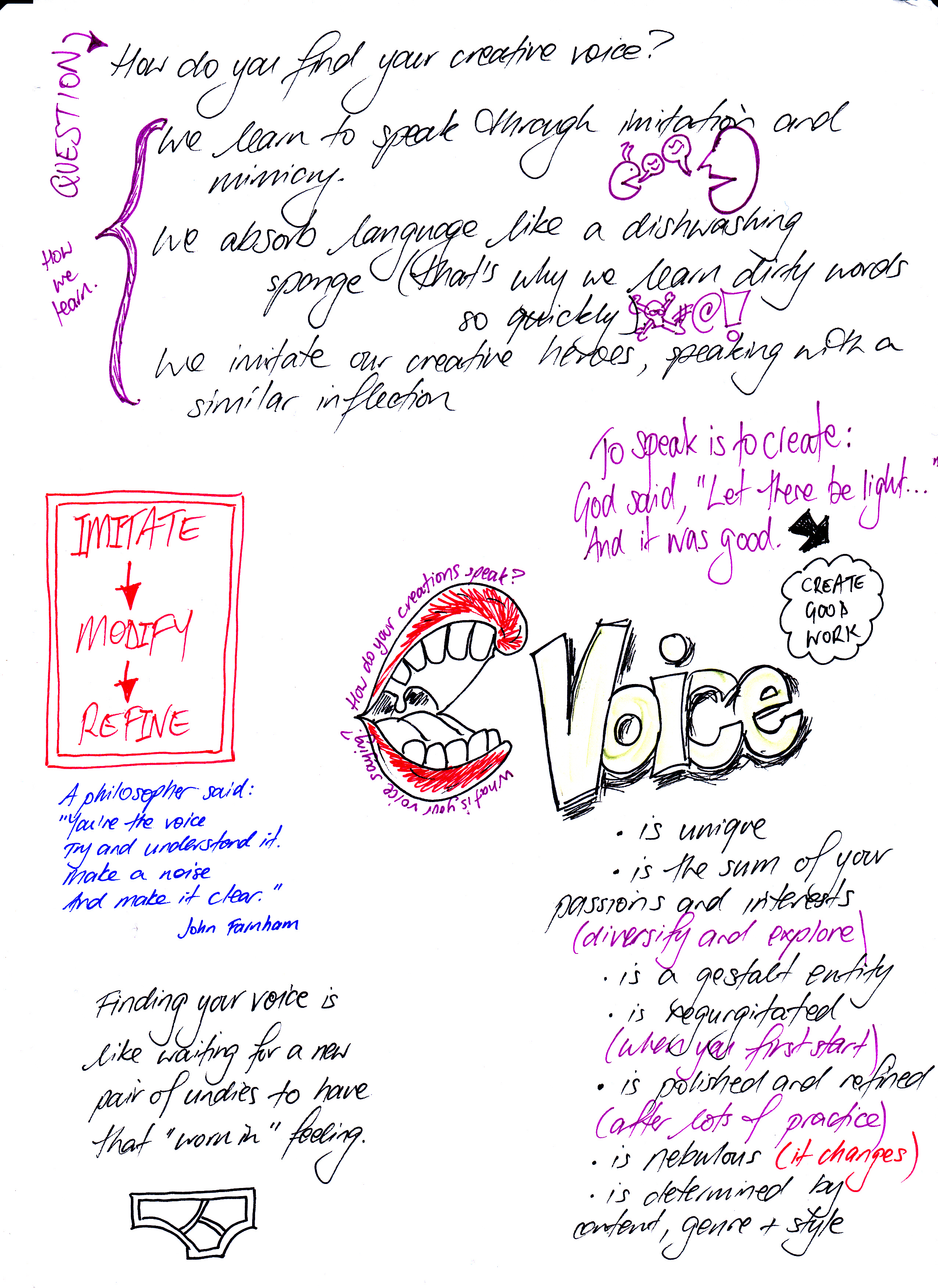
You’re the Voice

Another visual blog post about voice in creativity.

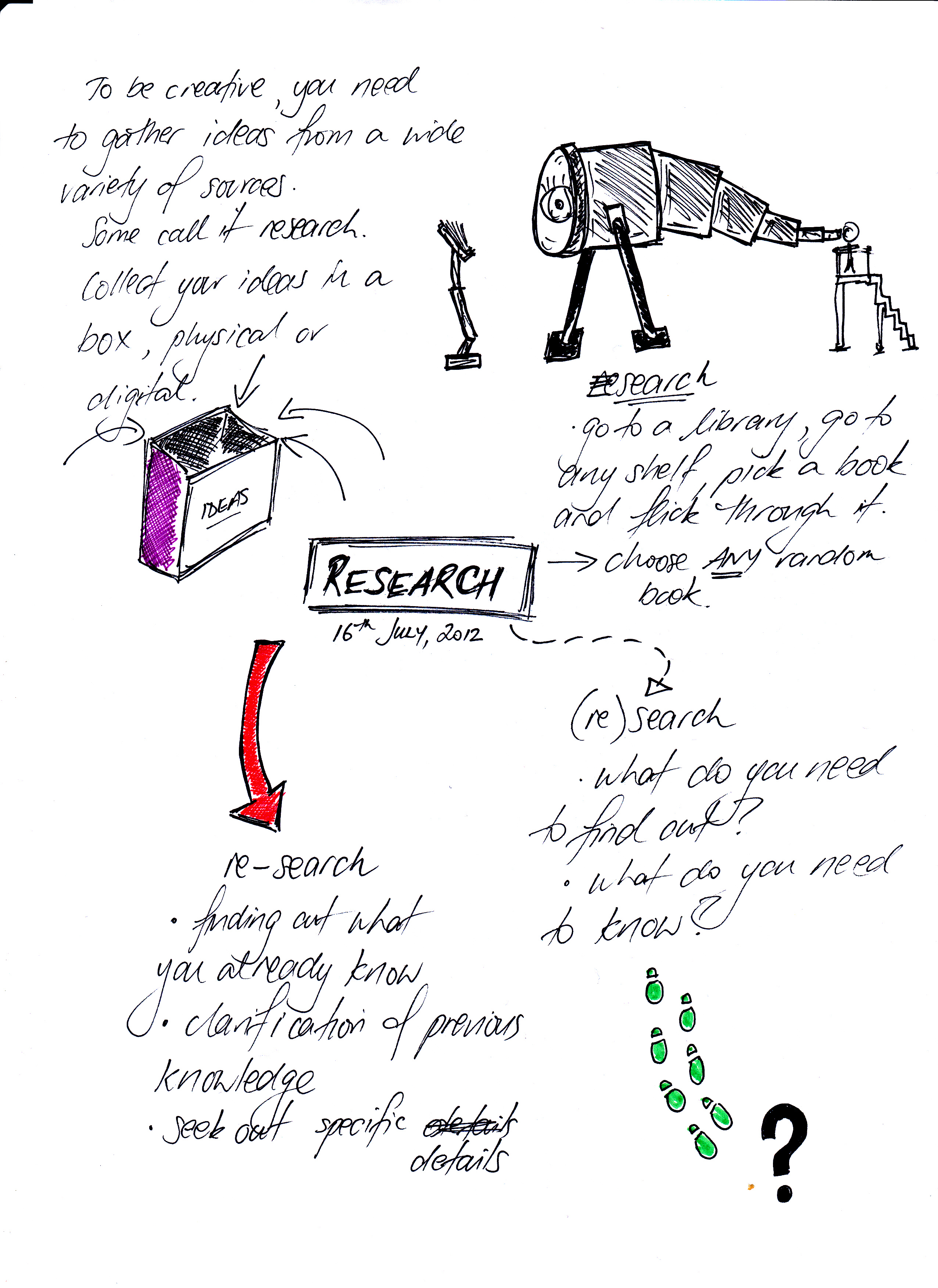
(re)search

A different blog post today inspired by Austin Kleon’s book, Steal Like An Artist. Go and read it.

I was picking apart the idea of research, and what artists do to slake their thirst for ideas.

I am not an artist, as should be evident, but I was simply exploring and deconstructing the word “research.”

Speaking for the Voiceless

While working on my novel I was thinking about its content and thematic concerns. I then thought about another novel idea I have in development and ideas I have for a couple of short stories and noticed there was some similarities in regards to their thematic focus. 

My stories are not about people who are broken, because we all are broken, and I like to explore that aspect of people in what I write. My stories are about those who are unable to express themselves, are marginalised, the outsider, the forgotten.

In particular, seeing my mother working with people with disabilities at the art studio where she works, has influenced the focus of what will be my second novel.

In part I am also influenced by the parables in the Gospels and the stories that revolve around the dispossessed and those considered “outsiders.”

I wrote down some statements to clarify my thinking about the purpose of my writing and what I want to achieve from it. These statements will inform the basis for my writing.

I am yet to fully explore what this all means, but I am excited by the prospect of what it can do for the focus of my writing. Perhaps in a later post I’ll explore the connection between speaking the voiceless and the innate ability for everyone to be creative.

  • I write because I want to tell the story of those who are not heard.
  • I write because I want to tell the story of those who cannot speak.
  • I write because I want to tell the story for those who cannot.
  • I write because I want to tell the story of those who are disempowered.
  • I write because I believe that telling a person’s story is integral in understanding who they are.

50 Shades of Writing Style

“Murder your darlings” is a catch cry of the writing fraternity, painted on placards and waved around as if it were a protest rally cry.

What do we want? Destruction of adverbs.

When do we want it? Immediately.

It is touted as one of the foremost rules of writing. But what does it REALLY mean?

Sir Arthur Quiller-Couch, in 1916, said, “Whenever you feel an impulse to perpetrate a piece of exceptionally fine writing, obey it – wholeheartedly – and delete it before sending your manuscript to press. Murder your darlings.”

I’m calling shenanigans. I’m calling it an old fashioned dictum that needs to be questioned.

Writers are fond of dispensing advice. I’ve just finished ready Stephen King’s memoir/instruction manual On Writing, and he’s not short of dishing out advice either, including the above mentioned idea of excising all adverbs.

The interweb is full of pithy statements by known authors, which could be distilled into a handy gospel of “Thou shalt…” and “Thou shalt not…”

But have we actually asked the question of “Why?” Why dispense with all adverbs? Why excise long descriptions? Why should we write with the idea that there needs to be a pause for the reader to put down the book so they can void their bladder?

The “rules of writing” is actually a combination of cultural and aesthetic preferences. Cultural and aesthetic taste is reflected in its art, music and media. And it changes. Tastes change in all types of culture, writing not the least of them. The rules about writing are arbitrary and they, too, will change.

Art and culture are the revolutionaries, the questioners, the pragmatists of a society. They push forward, restrain, challenge a culture.

For writers, the question of HOW we do it is the focus of all the writing dictum and rules. Only writers care about “good” writing (as we should, but does the reader care about good writing? I posit they care more about the story).

We decry the shabby writing of “Twilight” and “50 Shades of Grey” and rightly so. Bad writing is bad writing and will always be present like the foul smell emanating from a teenage boy’s bedroom. Is there, perhaps, a twinge of jealousy at the success of a story badly told?

Think about music, where lists of the “Worst Pop Songs of All Time” appear from time to time. We may hate them if we are a musician for their cliched style or gimmick. If you’re a non-musician, maybe it’s a “guilty pleasure” knowing it’s not highbrow but enjoying it nonetheless.

But most important of all is story.

HOW that story is expressed is the choice of the author.

The expression of our ideas through story demands a style. For some writers, they prefer clean, simple prose. Others prefer lengthier descriptions, philosophical concepts, arcane language and paragraphs of prose postulating on the placement of condiments on the breakfast table and its significance to the character’s sense of self and power.

Consider why texts are considered “classics?” Is it the language, the ideas, the characters or a combination of all? Where would the “classics” fit into the scheme of things if they were presented today? The languid, turgid prose of the Brontes and Austens would surely be decried as overdone, but they are still read and republished, as is Shakespeare.

There should be “high” and “low” art, but not to create a divide; it should be recognised as a continuum. No one art form is superior to another; it is simply an expression. Some artists will want to go deeper and use a form where it is permissible. Others will prefer a more consumer-orientated form.

It’s a grey area between low and high art, and I would argue that writers should protect and champion language.

Before we dismiss a writer’s prose (whether it conforms to preconceived “rules” about writing or challenges them), we should listen to how the writer speaks in their work. We need to listen to their voice. It is as important to listen to the voice of the writer as it is to listen to what they have to say.

Are we listening?