Tag Archives: slice of life

Handwritten Pages

What I don’t do enough of is write by hand, letting the pen and paper become an exploration. Yesterday I was inspired by a blog post on calligraphy to use my notebooks more effectively.

I know writers who use Julia Cameron’s (The Artist’s Way) technique of morning pages. The idea is you free write first thing in the morning as it clears the head and channels a creative flow. Mornings don’t work for me but the concept of free writing association can be done at any time. 

I want to use a specific notebook of mine for this exercise as it is unlined meaning I can use the space on the page to convey meaning as much as the words do. I can alter my handwriting style, use colour, draw shapes or doodle images. Over the coming months I will share more handwritten explorations.

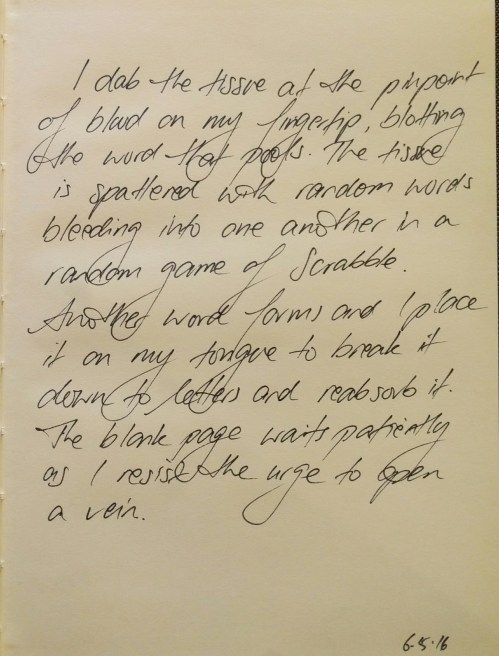
Below is the first attempt at using a notebook for handwritten explorations. Nothing fancy. Just text. 

IMG_20160506_070148~2

“I dab the tissue at the pinpoint of blood on my fingertip, blotting the word that pools. The tissue is spattered with random words bleeding into one another in a random game of Scrabble. Another word forms and I place it on my tongue to break it down to letters and reabsorb it. The blank page waits patiently as I resist the urge to open a vein.”

Two New Poems for Old Acquaintances

At the end of last year, two of my colleagues left. One retired and one was returning home to another state before heading off travelling.

In a sudden moment of ideas, I composed a poem for each. I couldn’t read them aloud myself because I hate farewells and ended up a blubbering mess in the corner while other colleagues read them for me. Wuss that I am.

I will share them with you, even though you don’t have the context of the people I know because I like them as stand alone poems.


Athena’s Owl

The light is extinguished at day’s end
the filament fades from white to orange to yellow to black
                                                              to signal slumber’s rest
          shadows encroach where light once reached

Athena’s owl ruffles her feathers for one last flight
          preens from quill to tip and one soft downy feather
          falls like a summer cloud
          rides the drafts and settles in the corner

In the silent moment before flight
          she takes one final glance
launches on soundless wings
          the warrior of the night.

We wake at morning’s first touch and
                               find the roost empty

Our hearts turn to sorrow and mourning
for wisdom’s presence is no longer amongst us
we run our fingers along the perch, the grooved indentations
of claws leave furrowed rows of knowledge

The wind reaches into the corner
                              lifts the single feather
the movement catches our eye; we reach down
                              hold the quill between thumb and forefinger
                              our extant memory
a reminder of wisdom’s presence,
                              her integrity and compassion
We are made the wiser because of her.

Diaspora

The wind asked,
“How now, spirit? Whither wander you?”
Wherever you may take me
But I will not be driven like the autumn leaves
Aimless, directionless, at your capricious mercy.
I will set my sails and use your strength
To take me to foreign lands.

The wind said,
“You have not moved.”
I have travelled the length and breadth
Of my imagination; my feet are not weary.
I will choose when to tie my laces
shoulder my pack and
Cross the threshold of my volition.

The wind asked,
“When will you find a home?”
I find a home where there is a bed for rest
a cup of tea
a book to read
a pen to write with
a nook for study
a place where my heart is at peace.

And the wind was silent.

The Earthen Man

This was an attempt at a spoken word poem whose genesis was at school where a group of Year 10 students were being introduced to slam poetry.

I took one of the prompts and explored the origins of my name. It is rough but a fun activity to explore. Hope you enjoy it.

The Earthen Man
When I heard the minister pronounce the benediction

At my grandfather’s funeral
“Ashes to ashes, dust to dust”
the recitation of symbolic circulation
I hear echoes of my name

Adam

accent the first letter with exhalation of breath, “Ah”

“Ah-dam”

a whisper of life escaping.
Count those breaths, man of earth, keep a record, keep a tally.
Know its origins lie in ancient roots and ancient lands
your genesis is found in holy writ
the clay, the breath, the man created
the Play-Dough of God’s creative work

“Ah-dam”

a synonym of man and earth
a story deposited and poured from one jar of clay to the next
through eternity’s hourglass until the dust and ashes settle
inverted and another life begins

“Ah-dam”

this life begins as the conjugation of my father’s seed, my mother’s soil
the banker and the occupational therapist
the handy man and the artist
and I look at the dirt beneath my fingernails
see it is more my father than me
but I have mown my fair share of lawns, dug holes and shifted topsoil
I am more likely to find ink beneath my nails
from pens where words seep out like
the sap from a tree I never planted but I am learning to climb
now I garden with words
planting syllable seedlings in the the dust accumulating on the windowsill
in notebooks and diaries and journals
whose pages I imagine falling out like the petals of the cherry blossom
in my parents’ backyard, a delicate cascade of vowels and consonants

“Ah-dam”

in retrospect, memory is an archaeological examination of a past
digging through layers of soil
stratified artefacts poured through a sieve of inconsistency

“Ah-dam”

while the root system seeks out good soil
the surface is choked by weeds and caged by thorns
the fruits of labour harvested
a meagre handful, barely a morsel
a portion for one
let alone enough to feed a family
or the overflow to lay out a feast for friends
and strangers
I would be wise to reap the harvest
plant new seed at season’s turn

“Ah-dam”

the late starter to a race
trying to peg his pace with the front runners
rather than running his own marathon
the rhythm of a heartbeat
I have not kept time with
a pulse I lag behind most often
while trying to rush ahead

“Ah-dam”

Feet of clay baked over many summers
Running barefoot through the streets
Dodging bindies, stones and once, a rusty nail
Embedded into the sole of my foot
A fissure that now lets the water in
disintegrating in the tides
of people

“Ah-dam”

are we more than bags and bags of soil or fertiliser
stacked on shelves in mausoleums of DIY self-aggrandisement?
let me remove the speck of dirt from my eye
form the rain around this granule of dirt
and I will water the ground
from which I came

Book Versus Movie Part 2

A little while back I argued in Book Versus Movie that there is much to gain from seeing film as a different language of art. 

But I’ve been thinking about it some more and watching The Book Thief on tv recently crystallised another aspect of the book versus movie debate. I didn’t watch the entirety of the movie (I will watch it in full one day) for one reason that  I hadn’t thought of: voice.

I love The Book Thief. It is a magnificently written book and one of my favourites. Death narrates the story and it is this voice, and the voice of the author, that makes it such a stirring novel for me. While watching the film, I didn’t have the same sense of voice. The film looks superb, the characters well defined, but it was the lack of authorial voice that I was expecting that made me turn off. 

Similarly, my viewing of The Lord of The Rings is informed by my reading of the novels. There are parts that I love and adore in the film, and others that are just downright cheesy and lacking the right voice to give the scene its proper gravitas or humour. The voice of LOTR is sometimes as dry as mortuary dust but that is what gives the novel is authenticity and pathos and humour.

Voice is one of those almost intangible aspects of writing; you know what voice you like, those you do not, those that sound mellifluous, those that sound like a Year 9 class on Friday afternoon. I think voice works for cinema too but it is more a chorus.

The “book was better than the movie” debate is too simplistic and we need to unpack it to understand why it is said, and whether we believe it or not. Both are art forms, with different voices and different modes of production, and should be treated as such. To simply divide is to denigrate one art form, extol the other and the division is not helpful. 

Appreciation and understanding is the aim.

One Image, Two Conclusions

Last Friday I had a shocker of a day at work; the end of a long and tiring week which meant that I did not shower myself in glorious brilliance. And, as they say, the hits kept on coming.

It was nothing earth-shattering and it didn’t affect me directly but a piece of news that hit me at my weakest in terms of creativity and my own writing progress because over the past few months my writing time has suffered due to work commitments, and the ability to find the mental and emotional energy was sorely lacking. And it manifested itself in frustration and, if I am at all honest, jealousy.

I hit up a creative friend and simply vented in private. In the words of John Farnham, to “take the pressure down.” And it felt better to whinge about my own predicament and celebrate the success of others.

Over Saturday I was playing around with my phone, a new notebook and my fountain pen, to take a photo.

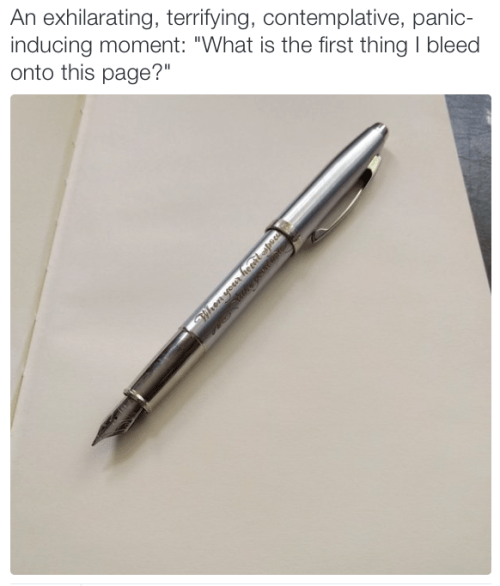
The first result was this:

Screen Shot 2016-03-05 at 10.03.38 PM

Aside: The fountain pen was a gift from my colleagues for my 40th birthday a couple of years back and the inscription reads, “When your heart speaks, take good notes.”

And every writer knows this feeling. However, in my current feral state of mind about getting stuff done, it was a challenge, an affront, a curse, a mockery.

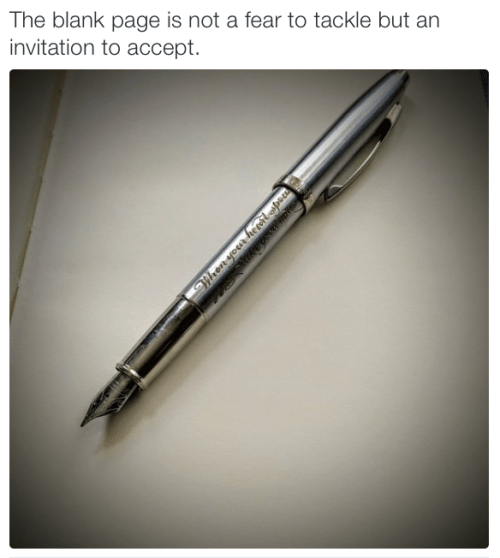
But, shaking off the negativity, I changed the photo to this:

Screen Shot 2016-03-05 at 10.03.18 PM

Comparing yourself to others is a sure road to bitter disaster. Pursuit of your own goals and dreams is the correct path. 

Photo A Day In January – Part 2

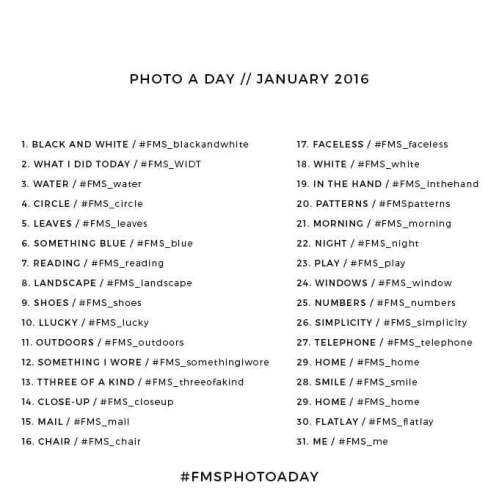
Here is the second collection of images from the Photo A Day in January challenge.

A reminder of what this looks like:

FB_IMG_1451775280415

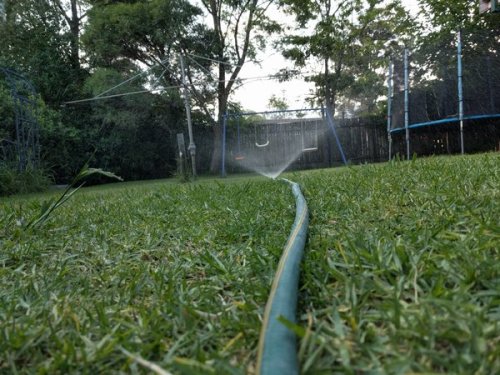
Day 11 – Outdoors

CYbFbQtUkAAMpUx

Day 12 – Something I Wore

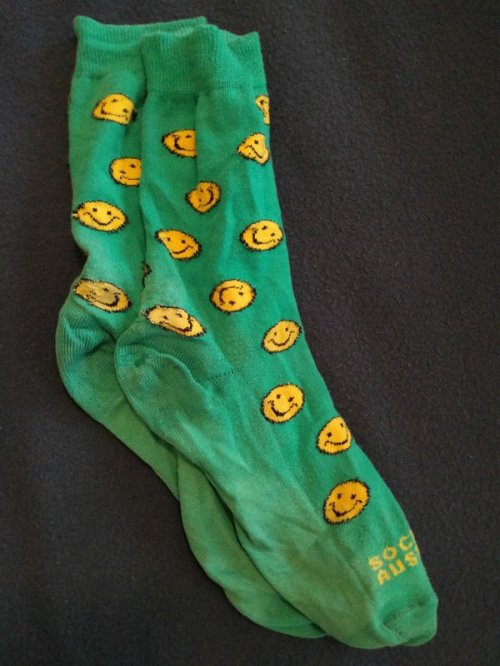
I wore these for a friend's wedding almost 20 years ago. They have held up really well. Still wear them from time to time.

I wore these for a friend’s wedding almost 20 years ago. They have held up really well. Still wear them from time to time.

Day 13 – Three of a Kind

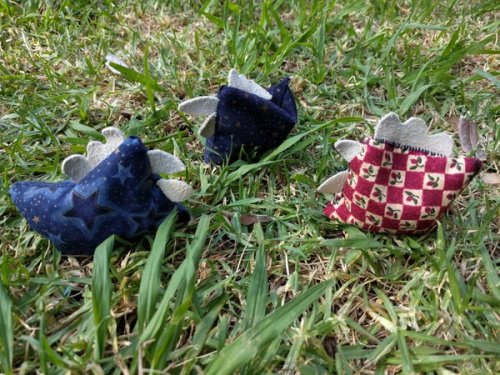
Tiny beanbag chickens

Tiny beanbag chickens

Day 14 – Close-Up

CYtZP4UUMAE8lNc

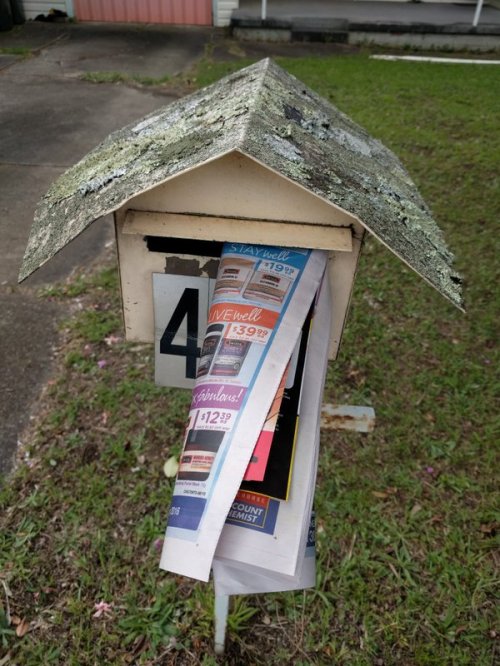
Day 15 – Mail

CY0gYRgVAAADY_p

Day 16 – Chair

CY0g2kwUEAIqILa

Day 17  – Faceless

CY9MTgkVAAIa9a-

Day 18 – White

CZDe2EEUMAEvVsB

Day 19 – In the Hand

CZH10hWUAAA3tiI

Day 20 – Patterns

CZNquK4WIAE-plb

A New Year’s Writing and Reading Reflection

I had a little twitter brain explosion one afternoon when I was thinking about the editing I was planning for later that evening on a short piece of flash fiction. Think of this as a series of brain farts, a Macbeth if you will, “a tale told by an idiot, full of sound and fury, signifying nothing” (one of my favourite lines from Shakespeare).

Why do I love to write? Because I love to read. The interplay of language to describe, emote, challenge, question, intrigue & entertain.

As readers we have favourite sentences or passages that capture the essence of our emotive response, better than our own words.

Passages w/ rhythm, illogical allusions that resonate, visceral gut punch, emotional core of who we are erupts as a volcano

These are the sentences we use as mantra, prayer, statement of intent, flirtation with a lover, standard of character.

E.g. ‘To be or not to be’ or ‘The Lord is my shepherd,’ almost cliche yet strike at our heart’s vortex & echo with symbolism. 

This is why I read and write, and why I believe reading is so important, so necessary, so vital to our humanity.

Practice Pages – Peeling Fruit

I haven’t had much time to write lately and the lack of practice is an area I want to correct so I can maintain discipline. It was the focus of a recent blog post, Finding the Flaws in Your Writing. As I noted, I am a slow learner.

Therefore I gave myself 10 – 15 minutes to write a paragraph with no care of editing, purpose, structure. No other agenda except to explore an idea pulled from my note book.

I pulled the following idea from my notebook to form the starting point:

The peeling of a mandarin; the damage to the skin to eat the flesh inside.

In my hands I hold the mandarin you picked from the fruit bowl. I wasn’t particularly hungry but you were and wanted me to peel it for you. A child-like invocation of trust and acceptance. You are seated across from me, hands clasped together, waiting.

“Can I have some?” I asked.

A nod. Acquiescence to share.

The autumnal grace of peeling a mandarin, stripping the skin from the flesh and piling it on the table like a tree sheds its leaves, is undermined by the viciousness of its action. My thumb pushes in to the knobbed skin on top, an outward belly button you called it, breaks through and the spray of citric acid spits. It is caught in the summer afternoon light, hovers, reflects, dissipates. The freshness of the scent makes you rub your nose as if it tickled the very tip.

I catch you smiling and my eyes drop to the line of your singlet top. Your breasts move as you raise your hand to tuck a loose strand of hair behind your ear. 

There is a question, which, if asked, will change everything between us.

The skin forms a pile, broken pieces of a puzzle it would be impossible to solve. I could lay out the pieces, align them from where they came but without the flesh there is no substance to hold it. In the act of consuming I have destroyed.

You fidget, wanting to bite into the segments, held up by me until the entirety of the mandarin is peeled. I pull away a few segments for myself and hand the remainder over. As I pull away the fibrous strings, flensing the flesh even further, you rip two segments and bite into them. A stream of juice spouts onto the table as more dribbles down your chin. With the back of your hand you wipe your chin then the table smearing the juice further.

“I’ll clean it later,” you say with a mouth full of flesh before spitting the pips into your hand, reaching across the table and dumping them onto the torn skins as discarded bones. 

Our intimacy is bound in the question I want to ask for it will strip our skin like peeling a mandarin that we may eat the flesh inside.

Can I Get A Haibun Over Here?

Thanks to my pet friend, Sean Wright, I have been experimenting with haibun. It is a Japanese form utilising haiku and prose. The haiku is meant to be stand alone as well as illuminating aspects of the prose. They are brief and focused.

I wrote a few to play with the form, a way of practising. 

I have included two of them here. I used a third on Storybird as a picture book experiment and have had some good response to it. You can read it here: Pendulum

Exhalation

In the silent moment before the alarm makes its declaration of the birth of the day, I wait, awake. Outside my window the main road is silent, a petulant child trying to see how long she can hold her breath as if it can stop the day from starting.

spark of life
measured in two movements
light follows dark

The fanfare of the hourly news is followed by the burst of exhalation: the rapid, rasping, laboured breath of rubber on bitumen. It is a too-quick heartbeat, and if I lie here long enough I hear the rise and fall of cars. They lumber away, wheezing their way up the hill hoping the lights turn red to catch their breath again.

If I hit the ‘snooze’ button, I can pretend the news never happened and the breaths taken outside my window are nothing more than the wind playing with the trees shaking their thoughts onto the ground.

I want to see how long I can hold my breath until I find a pencil and a scrap of paper to keep tally. They will be filed in pockets of jeans, jackets and shirts, ensuring the stipend is not exhausted, and hoping the remainder can be carried over to the following day.

receipts kept in pockets
fall with autumn’s grace
kindling for the fire

Gunning Station

I only met you once in real life, officially, when I stood on your platform, my toes deliberately hanging over the edge, uncertain if a train was due to arrive.

Our first, formal introduction, where the firm handshake betrayed the frailty of the weatherboard spruced with a fresh coat of beige and capped with terracotta coloured corrugated iron. The blue Countrylink sign on each of the matching seats announced your name.

I felt the awkward familiarity of meeting a robust memory known only from photographs and second hand reminisces, seeing the aged decrepitude beyond. A faded discolouration, a tea-soaked sepia superimposed over the glare of a late winter’s afternoon.

shadow obscures
the printed timetable
a faded memory

A place as familiar as a Sunday lunch of roast lamb and vegetables, gravy thickened from the pan, linen napkins, silver cutlery and the lingering scent of tobacco rolled through your fingers. The smoke drifts up in curls like the steam engines who once waited on shunting lines now no longer connected.

Five generations of my wife’s family including her lived at some point in the stationmaster’s house on the hill overlooking the station. I look at the corrugated iron, rusting in the silence while paint peels off stone walls in a town redefining its face with brick veneer, upmarket cafes and gentrified real estate.

I walk the length of one platform, descend the ramp to cross the tracks and feel the rebellious rush of stepping over the rails. I half expect, even want, a passenger train or freight train to crest the curve and suggest that the pulse, however thready, exists for at least one more day. But none come.

I walk the length of the other platform and reach the boundaries of a circumscribed world defined by memories that are not my own.

Life Doesn’t Follow the Archetypal Structure

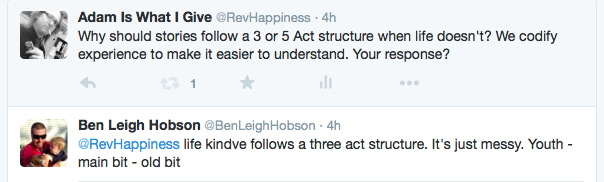
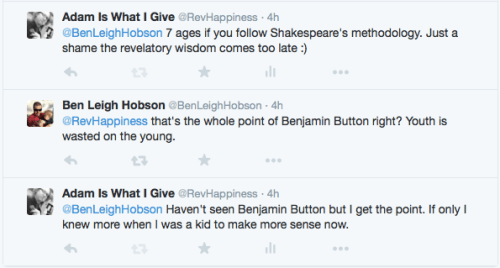
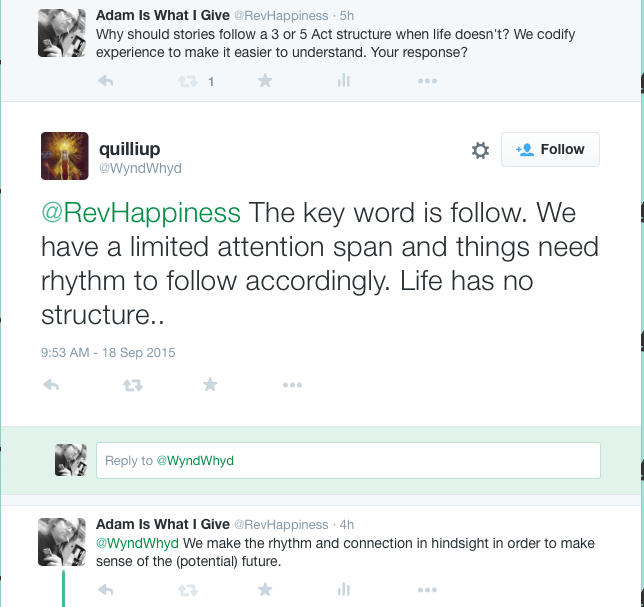
Why should stories follow a 3 or 5 Act structure when life doesn’t?

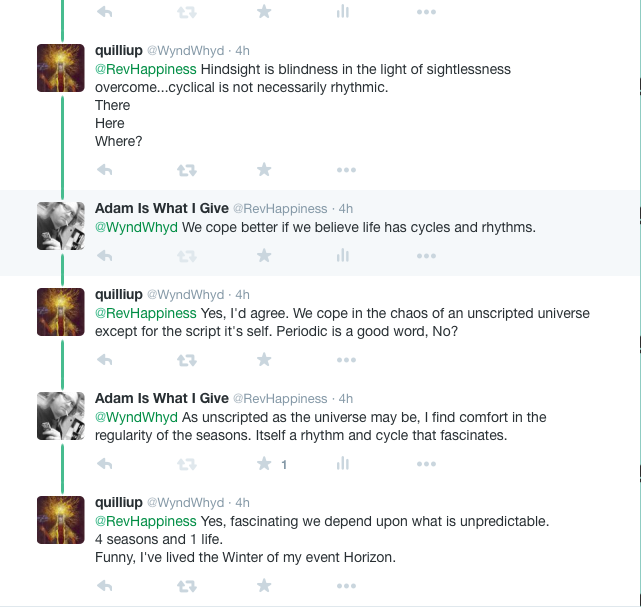
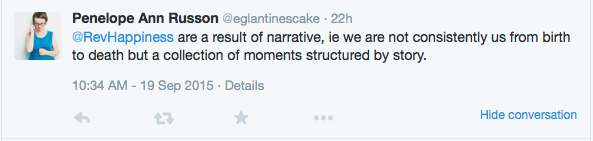
I posed the question on Twitter to see what responses might be generated. I received a couple. One went off on a philosophical tangent. And my answer is already given.

Screen Shot 2015-09-18 at 2.14.26 pm

Screen Shot 2015-09-18 at 2.14.58 pm

Screen Shot 2015-09-18 at 2.17.30 pm

Screen Shot 2015-09-18 at 2.17.45 pm

I suspect there is a field of narrative sociology (now there’s topic for a PhD) where this might apply and I remembered one of my twitter connections who is doing something like this.

Screen Shot 2015-09-20 at 8.38.56 am Screen Shot 2015-09-20 at 8.39.16 am Screen Shot 2015-09-20 at 8.39.23 am Screen Shot 2015-09-20 at 8.39.29 am Screen Shot 2015-09-20 at 8.39.37 am Screen Shot 2015-09-20 at 8.39.46 am Screen Shot 2015-09-20 at 8.39.53 am

I write stories where I follow the practiced methodology of the 3- or 5- Act structure, following the characters’ development and complications. It is the fundamental aspect of story telling you can find on most writing blogs. Other experimental forms still adhere to this idea in some tangential form or another.

You can start the Ira Glass research here.

Life is chaotic, messy, rhythmic, cyclical, disorganised, organised, coincidental, planned.

The takeaway is this: we codify experience to make it easier to understand.

Your response?