Tag Archives: slice of life

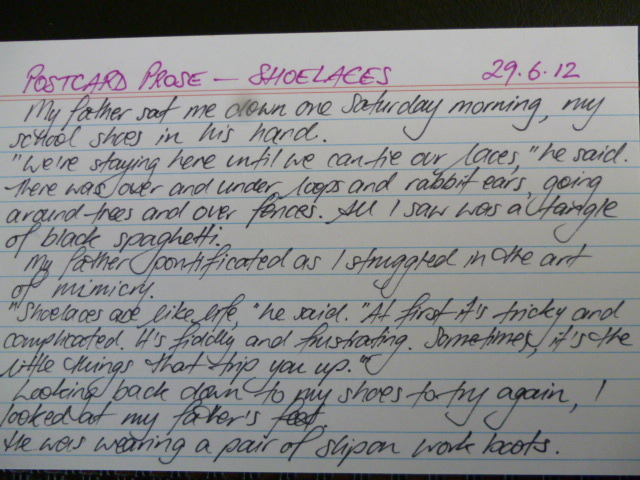
Shoelaces – Postcard Prose


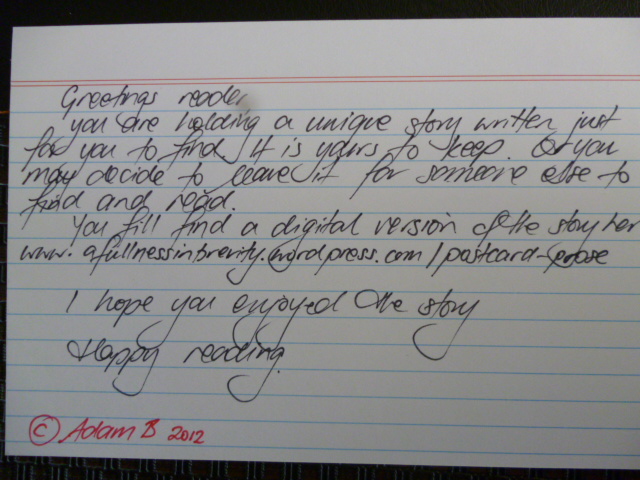
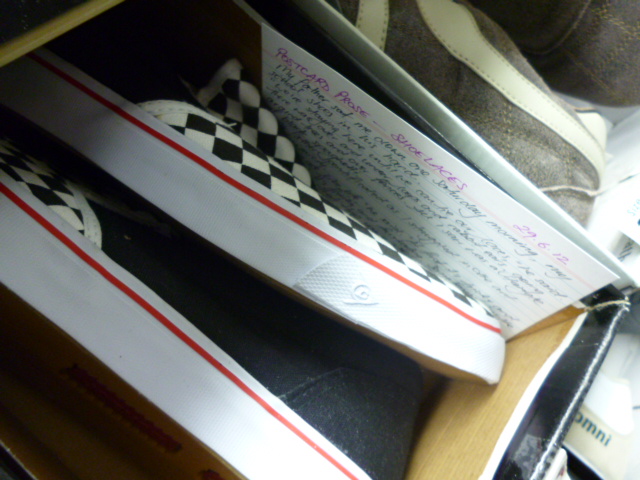
My latest effort in guerrilla literature, ironically dropped in a shoe store as I was buying new shoes.

Payless Shoes – Centro Shopping Centre, Seven Hills

My father sat me down one Saturday morning, my school shoes in his hand.

“We’re staying here until we can tie our laces,” he said.

There was over and under, loops and rabbit ears, going around trees and over fences. All I saw was a tangle of black spaghetti.

My father pontificated as I struggled in the art of mimicry.

“Shoelaces are like life,” he said. “At first it’s tricky and complicated. It’s fiddly and frustrating. Sometimes, it’s the little things that trip you up.”

Looking back down to my shoes to try again, I looked at my father’s feet. He was wearing a pair of slip on work boots.

And, yes, I did put the postcard into a box of slip on shoes.


10 Signs Your Child Is Destined to be a Writer

You might be a failed pen monkey, a starter of stories (but not a finisher of fables), or a wit in conversation but witless with words, yet your progeny has inherited the gift of the gab and the social mores of Hunter S. Thompson.

Here are 10 signs your child is destined to be a writer (hopefully without the social mores of Hunter S. Thompson).

1. The first gift they ask for is Roget’s Thesaurus and a copy of the Oxford English Dictionary (the 20 volume hardback edition, including supplementary volumes).

2. On their birthday they receive a card and gift certificate from their local bookstore AND local stationery supply store.

3. At bed time they don’t ask for a bed-time story; they ask you to read from Roget’s Thesaurus and the Oxford English Dictionary.

4. Your child categorically states, “a red pen is not for marking, it’s for editing.”

5. Your child is editing the work of other students. In kindergarten. For a fee (usually biscuits or first turn with the toys).

6. Your child has memorised the Associated Press Style Guide.

7. Your child no longer refers to you as “mother” or “father.” Instead you are referred to as “agent” or “publisher.”

8. You spend more money on printer ink cartridges and stationery than clothes for your child. You’ve even considered buying stocks in companies producing printer ink cartridges and paper manufacturers.

9. Last week’s family argument suddenly appears in the latest edition (completely fictitious, mind you, so they say) of their weekly web serial, “Stress Family Robinson.”

10. Your child edits the family Christmas letter and sends it back to you for revisions.


10 Reasons Why Writers Can’t Have Nice Things

Writers, we can’t have nice things. Here are 10 reasons why.

1. We believe we have a capricious muse who wanders in (rarely) and out of our head space (often at the worst possible time). We curse him or her or it (can’t be genderist) when we can’t write and praise and worship when the words flow with the viscosity and taste of honey. We are kidding ourselves when we say, “I couldn’t write today because my Muse was off at the day spa and didn’t invite me.”

2. We invent characters loosely based on the our own fears and misgivings, but make them thinly veiled caricatures of people we know (yes, you have irritated us once too often, so we made you into a character who dies a slow death by having your buttocks scrubbed with sand paper and washed with lemon juice).

3. We eavesdrop on every conversation, squirrelling away choice bits of dialogue, character traits and personality tics. Whenever the family gets together our brains melt with all the juicy tidbits. On Christmas Day we experience the high of a sugar junkie.

4. We haunt twitter and facebook and any other avenue of social media to pimp our wares. Support for one another is important, but we end up feeding the circle creating narcissistic, preening believers of our own onanism, making us grow extra digits, and probably another head. Look beyond the immediate circle and seek an audience. Do something that doesn’t involve writing.

5. We believe our ego has the tensile strength of an egg shell. And I’ve seen a raw egg thrown a fair distance only to bounce and not break. If you can handle being popped out a sphincter with no harm done, you can handle a bit of criticism and rejection. Go and play in the dirt like chickens. It builds character.

6. We can teach glaciers a thing or two about procrastination. Apply a blowtorch to the things that have frozen up, and liberally spray WD-40 as if it were a can of Lynx deodorant body spray and create your own climate change. Get it done!

7. We believe we hold the monopoly of ideas creation and generation (along with artists and musicians). Psst… look at the business world, corporate strategy, management, child care, education, health care. They have some bloody good ideas. Now, go outside and play, and learn from other areas of life.

8. We arbitrarily create rules for writing. And then change them because we anticipate the ad break to allow us to void our bladder. Rules are cultural, aesthetic and social constructs of ‘taste’ when it comes to writing. I will use adverbs summarily. Simply write to your purpose and function, not ideas of fashion and taste.

9. We complain, whinge, tweet, start flame wars, and troll about the publishing industry because it’s in a state of flux and we are afraid of the changes. When the dust settles, publishing will still be there. It will look different, but there will still be avenues to publish, even if we have to invent it.

10. We believe reading, and our words,  is important and therefore require recompense. We do not have a right to make money from our art. It’s a privilege. Even if we don’t get paid, let’s use our words to reflect, question, entertain, amuse, horrify, and challenge, even in the one story.

[FGC#9] Songbird

“Why does the fat lady get to sing the last song?” asked Claire. “I mean, it’s not like she’s Aretha Franklin or anything.” She dragged on the cigarette before extinguishing it. “This songbird’s gonna have the final note tonight. Fat chick be damned.”

The karaoke microphone was vacant, illuminated by a single spot light. Claire’s best friend, Rachelle, dubbed it The Truth Amplifier. The microphone revealed a person’s ability, she said. If they could sing, it magnified the singer’s competent vocal chords. If the singer was a hairbrush vocalist, it simply amplified their cat-being-pulled-by-a-toddler screeching.

Flicking through the karaoke menu, Claire chose her song. It was 2 am and the bar was emptying. MIDI strains of Bon Jovi clambered out of the speaker. From their table, Rachelle whooped her encouragement. Claire pulled the wireless microphone from the stand, feeling its weight, balancing it before winking at Rachelle. In her head she counted off the final bar before the lyrics started. On the last beat she spun the mic in her hand, caught it, leaned forward and breathed the lyrics, “If you’re ready, I’m willing and able/Help me lay my cards out on the table.”

At the first chorus she pushed the vocals, but deliberately held back from giving it everything, “Lay your hands on me, lay your hands on me, lay your hands on me.” Her hands followed the curves of her body, starting at her breasts, moving over her hips and towards her crotch before she extended her hand towards the crowd. A polite smattering of applause came from the thinning crowd, but Claire knew she had them. The second verse spun from her lips like caramel. Perched on the edge of the tiny stage, she could feel herself flying with the music. Grasping the mic stand in her left hand she threw her head back for the final chorus and released the diva within, finding the pure note and producing a sonic boom.

Putting the mic back into the clip, the audience erupted in whoops, cheers and whistles.

“Take that, you fat cow,” said Claire, dropping into the chair beside Rachelle.

What Am I Doing?

Yesterday, in a moment of sheer, blind, unreasoning panic I questioned whether I was doing the right thing. On the eve of taking a long service leave, a 3 month break from my job, I doubted myself.

I am taking leave to write a novel, my first. Every negative idea ran through like the after effects of a bad curry: I can’t do this. You’re a fool to think you can write a novel. What if you get stuck? Will you ever finish it? No one’s going to read it.

This is something I am passionate about and want to succeed in. The journey of a thousand miles might begin with a single step, but it requires a hell of a lot of planning and a large supply of Band Aids for the blisters. In the same way, the finishing of a novel begins with the setting down of a single word. Then another. And another until The End is reached.

I am in this for the long haul. I have a dream to write novels. This time off is the first step to achieving that dream. I have plans in place to help make this dream a reality. I will learn a lot in the time it takes to write my first novel and I can translate this to the next, then the next and so on.

Following a conversation on twitter between Alan Baxter (@AlanBaxter) and Tom Dullemond (@Cacotopus) yielded this gem of thought: Those who maintain their focus and diligence in the face of rejection and disappointment will find it easier to sustain themselves than those who find success comes easily.

I know I have a cheer squad who will shake their virtual pom poms if I get stuck.

Hand me my cardigan and tracky dacks; I have a novel to write.

Polaroid Memories

 I

He waved the Polaroid like a fan, an invocation to the camera gods. Greys and whites morphed into a toothy smile, pigtails and brown eyes.

 II

He remembers the pinhole camera made in science class and his first over exposed photo of his gangly best mate with a pudding bowl haircut.

 III

A thousand images plastered to his folder, replicating an editor’s cutting room floor, yet shaped by a teenage boy’s view of the world.

IV

Spooling rolls of film into an old fashioned camera, he searched for her soul through the viewfinder. The weaving of two lives printed onto paper.

V

Breathe in. Breathe out. Push. A held breath as the doctor delivered a little girl. A memory imprinted into his mind like a photograph.

VI

He turned the pages of albums, sheets of acetate and leaves of paper crinkling like autumn drifts pushed and pulled by the winds of memory.

VII

“Make a wish.” Grasping the dandelion in pudgy hands she blew a mix of air and spit, watching the tiny blossoms parachute to the ground.

[FGC #2] The Photographer’s Concerto

[FGC #2] The Photographer’s Concerto

 “Charlotte,” she said, extending a hand. “Charlotte MacKay. I’m the photographer.”

A figure in black extended his hand. It was sweaty but cold and the reek of curry wafted over her. “Michael Bailey, band manager. Knock yourself out.” He stepped to one side allowing her through to the side of the stage. Around her black figures unwound mic cables, tuned guitars and placed various bottles around the stage. The crowd congregated at the other end of the room, sipping beers and drawing on cigarettes.

The thud of a kick drum felt like a punch to the stomach as the drummer ran through a sound check. From the side of stage, Charlotte watched the lean musculature of the drummer’s left arm as it raised and lowered like a pendulum, cracking the snare. Through the viewfinder of her camera she reeled off a few shots.

With the sound check over, the crowd pressed forward to the barrier, drinks abandoned at the bar. The lights dimmed and the crowd gave its approval: whistling and yelling, their voices tearing apart the darkness. Four shadows crossed the stage, fine-tuning, swigging from bottles, turning volume knobs. At the crescendo of the crowd’s voice the lights exploded like a thousand suns and the band struck the opening chords.

Across her line of sight past the bass player and lead singer, Charlotte glimpsed the guitarist. He wore an unbuttoned paisley vest, no t-shirt and long shorts with his guitar sitting slightly high. His hair danced around his shoulders and the guitar was an extension of his arms. Moving from the side Charlotte dropped between the barrier and the stage. Squeezing past the bouncers she stood before the guitarist, a worshipper before the shrine. Putting the viewfinder to her eye she sought the soul of this man.

Behind her the crowd pulsed in an orgiastic cycle of adoration, worship and dancing. Charlotte’s heart quickened, racing in concert with the shutter. Each frame captured a little of his essence, a relic to be fingered in quiet moments of prayer and contemplation.

The set finished and the house lights raised but the crowd lingered, unwilling to let go just yet, savouring the rapture of the music. Charlotte squeezed past security, back to her camera bag. From the corridor leading off stage a figure emerged, his head wrapped in a towel. His chest gleamed with sweat as he towelled off his head, drying his hands before offering one to Charlotte.

“Jake de Brito.”

His voice was softer than she imagined, and she noted a slight fragility in his frame, obscured by the stage lights. Bereft of his guitar he stood before her, a mere mortal. She watched his fingers move involuntarily, forming shapes and patterns in the air like a secret language; the fingers invoking sounds from the darkness of the void.

“Thanks for, like, coming to take photos of the band.”

“No, it was fantastic. I haven’t done a band shoot for ages and this was an awesome gig. What the street press are writing about you guys is spot on.”

He shrugged. “Did Michael, like, look after you?”

“Yes, thank you.”

A voice called from the corridor leading back stage. “Jake, you comin’ man?”

“Yeah. Hang on,” he yelled back. “Might see you soon, yeah?”

“Sure.”

Charlotte watched Jake disappear into the black. The persona captured on film was powerful and articulate; a shaman who summoned life and let it explode through his guitar. Without it, he was human but the magic boiled away at his fingertips.

“Hey, MacKay.” The waft of curry shot through with beer and cigarettes announced Michael Bailey’s arrival behind her. “Thanks for shooting. Send your invoice to my office.” He handed over a business card. “If you want, you’re invited to the post-gig party. Address is on the back.”

Charlotte scanned the address and pocketed it like an Access All Areas back stage pass.

Killing the engine of her Datsun 180 she flicked on the interior light and rummaged amongst the loose papers and film canisters on the floor of the passenger side. Finding an old lipstick she applied it while looking in the rear vision mirror. Pocketing another full roll of film she made her up the driveway to a broad fronted house.

At the end of a long corridor a second-hand clothes store explosion of flannelette, torn denim, scuffed boots lounged on chairs, stood in doorways and congregated in every spare area of the huge lounge room. The stereo cranked out late night radio through the haze of cigarette smoke. Adjusting her leather mini skirt Charlotte felt more glam metal than grunge, the bulkiness of her camera bag against her thigh an added layer of self-consciousness.

She lent against the doorframe, scanning the room unsure of where to go.

“Hey, you’re the photographer from the gig.”

“And you’re the drummer.”

“Mitch. Come in and grab a beer.”

Following through the house Mitch took her to the kitchen and grabbed a beer from the fridge.

“Let me introduce you around,” said Mitch.

Mitch lead her through the lounge, the only name Charlotte remembered was a girl’s with a towering teased and tasselled fringe in need of a structural engineer to code it for safety.

In the kitchen a group of guys gathered around the table, populated with loose cards, a bottle of Jack, cans of beer and bottle tops, and loose change. She recognised Michael Bailey, the bass player and singer but her eye fell onto Jake.

“I suck. That’s why I’m not invited to play,” said Mitch.

“Mind if I take some photos?”

Through the lens she snapped Jake’s fingers as they tapped the back of the cards. His hair was tied back into a ponytail and Charlotte noticed again the fragility. Not as a weakness, more a humility of character.

The radio cranked another tune. At the sound of a cello Jake inclined his ear to the sound and mimicked the song.

“Nice work cello boy,” said Michael.

Jake shrugged the insult and caught Charlotte’s eye as she moved the camera from her face. A brief smile formed on his lips as the opening lyrics invaded the smoky haze.

“I just died in your arms tonight.”

There was a chorus of disapproval from the flannelette wearing crowd but enough supporters to form a sing along.

“Mitch, take my place,” said Jake holding up his hand of cards. Moving from his seat Jake came to Charlotte.
“I’m seeing you sooner than I, like, thought.”

He led her out onto a concrete verandah, a rusted Hills Hoist rearing up from an overgrown lawn. They tossed musical preferences back and forth until they found a common ground.

“You remind me of the drummer in my first band,” he said after half an hour of false starts and half-finished sentences. “His time was, like, more fluid than water and he often didn’t know where the ‘1’ was. We were playing rock’n’roll, meat and potatoes music, not some Billy Cobham fusion piece from Mahavishnu Orchestra.”

“Sorry I’m so awkward,” said Charlotte, pulling on the strap of her camera bag. “I’m usually more… articulate.”

“I find music, like, easier. Notes, arpeggios, solos. Words are clumsy in comparison.”

“Next time I’ll be less like your first drummer. Promise.”

“I’ll get your number from Michael.”

****

Tucking the photo portfolio under her arm to avoid the rain, Charlotte dashed from the taxi to the restaurant awning. In her mind she replayed Jake’s message from earlier in the week.

“Hi Charlotte, it’s Jake de Brito. I was wondering, if you had your photos ready you could, like, join us for dinner on Saturday night. We’re at Belafonte’s, say seven-thirty. See you then.” Even through the tinny machine speakers his voice sounded musical.

She had spent the week arranging the shots from the gig and after party, agonising over which shot and in which order to present them.

Shaking off the rain she stepped inside and the raucous laughter from the table at the rear pointed her in the right direction. Jake stood and kissed her politely on the cheek and introduced her to the rest of the table. The band was there, Michael, and a girlfriend or two.

“Would you like something to drink?” he asked.

“Red wine, please.”

Charlotte sat down in the vacant chair, still awkward around these new people. She’d made a habit of existing on the periphery, invisible behind the camera. Putting the portfolio on the table, the girl to her left quickly snapped it up.

“These are brilliant,” she cried and the table turned its attention to Charlotte’s photography. “Oh my God, Mitch. Look at your arm!”

Blushing at the adulation she fielded questions from the girl to her left, identifying herself as an artist. A familiar topic allowed her to proceed smoothly, unaware Jake had returned. She sensed the quietness beside her, a reserved figure simply observing.

For the remainder of the evening her attention was divided between commentary on her portfolio and Jake. It pulled at her; she revelled in the attention her work received but it didn’t allow her to focus her attention on Jake. He politely deferred to the table, not offended by the interruptions. She wanted to drink from his presence, bathe in it. The continual movement of his fingers, playing imaginary songs, created gossamer strands around her heart.

Back at his place, she was surprised to see a cello positioned in the corner of the lounge room.

“I was classically trained from an early age. I wanted to learn guitar but my folks were classical musos. The guitar was, like, beneath them. Had they never heard of Slava Grigoryan?But it was Eddie Van Halen I idolised. I learnt cello as a concession in order to play the guitar. I even learned a bit of piano until they were convinced guitar wasn’t a passing phase.”

He poured two glasses of wine, offering her a seat on the lounge. “Besides, playing cello doesn’t get you the chicks.”

“Do you still play?”

“All the time. It’s different to guitar. Feel. Tone. Pitch. Sound.”

“Would you please show me?”

Setting his wine on the low bookshelf Jake placed the cello between his legs, resting it against his shoulder, tightening the tension in the bow. With a light finger he plucked the strings, his ear held close to the strings as if he were listening for a heartbeat. Charlotte watched the tattooed arm adjust the tuning pegs.

Satisfied with the tuning Jake drew the bow across the strings, pulling out long notes, full of longing, resonating deep in Charlotte’s chest. She pulled a camera from her handbag and a roll of film. Careful not to interrupt the virtuoso she adjusted the camera’s settings and closed her eyes for a moment, carried by the music. Opening her eyes Charlotte moved between notes and passages with the rhythm, pressing the shutter in time with the music. Through the view finder her eye caught the lines of the bow perpendicular to the strings; Jake’s arched fingers against the neck, his knee hooked into the curve of the cello’s body.

Jake grinned at her once, changing the tune to a quicker, lighter pace before the sonorous tones emerged again. Charlotte crossed her arms and held her camera to the right of her chin, studying her subject. Moving back to the couch she wound off the film and began to reload.

“The sound is sensuous, almost melancholic, yet beautiful,” she said.

“Playing cello is like making love to a woman,” said Jake, his legs straddling the dark stained wood. His fingers rested lightly on the body of the cello, the bow waiting for the invocation of music, the horsehair tickling the strings above the bridge.

“And like all guitarists, you name your instrument.”

Charlotte crossed her legs on the couch and sipped at her wine.

“What’s her name?” she asked.

“Celie.”

The woman frowned, no knowledge forthcoming.

“From The Color Purple,” he said.

“The movie with Oprah in it. I’ve seen it. But isn’t Celie raped by her father and beaten by her husband?”

“I read the novel. It’s the redemption found in love. And you can’t treat a cello like a loose woman. That’s what guitars are for.”

Returning his focus he looked at the woman seated on his couch. She leaned back into the furnishings, her feet crossed beneath her.

“If this is your lover,” Charlotte said indicating the cello with her wine glass, “how do you make love to her?”

Jake adjusted his legs around the cello. “You embrace her. Find the position where she is resting against you, comfortable and intimate. The body of the cello has the shape of a woman, curved and full.” Jake ran his hand down its body as if he were feeling a woman’s breast or the curvature of her thigh. Taking up the bow he began to play.

The cello’s notes, full of anticipation, took up the melody. “Each note made up here on the neck is her breasts: sensuous, ripe, engorged. With each touch you develop the song. You caress, press, touch.”

Jake saw Charlotte glance down at her own breasts, the fingers of her hand fiddling with the shirt button, perhaps conscious of their small size. He hesitated to make eye contact and let the music weave throughout the room, passionate incense perfuming the room.

“When you make love, you must remember all parts of a woman’s body. You embrace her to feel the softness of her skin, to inhale her fragrance, to consume her. But her breasts are but one part of the symphony.”

The bow arched and fell as Jake pulled and pushed it across the strings watching flakes of resin disintegrate from the hair and float under the light. The strokes gained intensity, no longer pushing and pulling, but thrusting with controlled ferocity. The music reached a crescendo, held sustained but not resolved. Jake plucked at the strings, a quick pizzicato, holding the tension. Attacking with the bow, the notes were drawn out in a hasty flight up and down the neck of the cello. An improvised solo, pushing, pulling, thrusting.

The bow arched sharply, the final note held in a vibrato by his fingers on the neck. Jake felt his breathing slow and become deeper. He rested his hands on his knees, touching the body of the cello, a light intimacy, with the headstock leaning into his shoulder.

Charlotte, the raven-haired woman with the camera for eyes, placed her empty glass on the table. Crossing the floor she felt Jake’s arm curve around her waist, pulling her into his lap. Positioning the cello between her thighs, her hands shadowed his fingers. The bow moved arched slowly over the strings and her fingers followed his like a spider on the neck. Even now she could feel the vibration through the bow moving up his hand and into hers.

Turning her head, her mouth brushed against his ear.

“Play me.”

I must thank Jodi Cleghorn for giving me permission to use her characters, writing the beginning of their relationship. Thank you for the trust in staying faithful to the characters you created.

You can read the story that inspired it, and what happens to them here: What I Left to Forget

Word Count: 2500

Jake and Charlotte


He invited her back to his place, their conversation far from finished. She was surprised to see the cello positioned in the corner of the lounge room.

“Classically trained from an early age and all through high school. My folks were classical musos and the guitar was beneath them. Had they never heard of Slava Grigoryan? But it was Eddie Van Halen I idolised. I learnt cello as a concession in order to play the guitar. I even learned a bit of piano until they were convinced guitar wasn’t a passing phase.”

He poured two glasses of wine, offering her a seat on the lounge. “Besides, playing cello doesn’t get you the chicks.”

“Do you still play?”

“All the time. It’s different to guitar in its feel, tone, pitch, sound.”

“Would you please show me?”

Setting his wine on the low bookshelf Jake placed the cello between his legs, resting it against his shoulder as he tightened the tension in the bow. With a light finger he plucked the strings, his ear held close to the strings as if he were listening for a heartbeat. Charlotte watched the tattooed arm tune the strings.

Satisfied with the tuning Jake drew the bow across the strings, pulling out long notes, full of longing, resonating deep in Charlotte’s chest. She pulled a camera from her handbag and a roll of film. Careful not to interrupt the virtuoso she adjusted the camera’s settings and closed her eyes for a moment, carried by the music. Opening her eyes Charlotte moved between notes and passages with the rhythm pressing the shutter in time with the music. Through the view finder her eye caught the lines of the bow perpendicular to the strings; Jake’s arched fingers against the neck, his knee hooked into the curve of the cello’s body.

Jake grinned at her once, changing the tune to a quicker, lighter pace before the sonorous tones emerged again. Charlotte crossed her arms and held her camera to the right of her chin, studying her subject. Moving back to the couch she wound off the film and began to reload.

“The sound is sensuous, almost melancholic, yet beautiful,” she said.

“Playing cello is like making love to a woman,” said Jake, his legs straddling the dark stained wood. His fingers rested lightly on the strings, the bow waiting for the invocation of music, the horsehair tickling the strings above the bridge.

“And like all guitarists, you name your instrument.”

The raven-haired woman crossed her legs on the couch and sipped at her wine.

“What’s her name?” she asked.

“Celie.”

The woman frowned, no knowledge forthcoming.

“From The Color Purple,” he said.

“The movie with Oprah in it. I’ve seen it. But isn’t Celie raped by her father and beaten by her husband?”

“I read the novel. It’s the redemption found in love. And you can’t treat a cello like a loose woman. That’s what guitars are for.”

Returning his focus he looked at the woman seated on his couch. She leaned back into the furnishings, her feet crossed beneath her.

“So this is your lover?” Charlotte asked indicating the cello with her wine glass. “How do you make love to her?”

Jake adjusted his legs around the cello. “You embrace her. Find the position where she is resting against you, comfortable and intimate. The body of the cello has the shape of a woman, curved and full.” Jake ran his hand down its body as if he were feeling a woman’s breast or the curvature of her thigh. Taking up the bow he began to play.

The cello’s notes, full of longing, took up the melody. “Each note made up here on the neck is her breasts: sensuous, ripe, engorged. With each touch you develop the song. You caress, press, touch.”

Jake saw Charlotte glance down at her own breasts, the fingers of her hand fiddling with the shirt button, perhaps conscious of their small size. He hesitated to make eye contact and let the music weave throughout the room, passionate incense perfuming the room.

“When you make love, you must remember all parts of a woman’s body. You embrace her to feel the softness of her skin, to inhale her fragrance, to consume her. But her breasts are but one part of the symphony.”

The bow arched and fell as Jake pulled and pushed it across the strings watching flakes of resin disintegrate from the hair and float under the light. The strokes gained intensity, no longer pushing and pulling, but thrusting with controlled ferocity. The music reached a crescendo, held sustained but not resolved. Jake plucked at the strings, the pizzicato quick, flicking the strings, holding the tension. Attacking the strings with the bow, the notes were drawn out in a hasty flight up and down the neck of the cello. An improvised solo, pushing, pulling, thrusting.

The bow arched sharply, the final note held in a vibrato by his fingers on the neck. Jake felt his breathing slow and become deeper. He rested his hands on his knees, touching the body of the cello, a light intimacy, the headstock leaning into his shoulder.

Charlotte, the raven-haired woman with the camera for eyes, put down her empty glass. Crossing the floor she felt Jake’s arm curve around her waist, pulling her into his lap. Positioning the cello between her thighs, her hands shadowing his as fingers. The bow moved arched slowly over the strings and her fingers followed his like a spider on the neck. Even now she could feel the vibration through the bow moving up his hand and into hers. Turning her head, her mouth brushed against his ear.

“Play me.”


This is an extract of a longer piece, which you can read on Sunday, as part of the Write Anything Form and Genre Challenge. Many thanks to Jodi Cleghorn for giving me permission to use her characters, writing the beginning of their relationship.

You can read the story that inspired it here: What I Left to Forget


The Writer and Fashion: Tracky Dacks

In late April I am taking long service leave from my job as a teacher. I am taking 10 glorious weeks of leave to write a novel or two.

If I am going to sit on my behind for that time, I want to be comfortable.

And the most comfortable accoutrement for that time is a pair of tracky dacks. Tracky dacks is what we in the southern hemisphere and The Antipodes is our term for sweat pants. Think of Sue Sylvester from Glee without the matching top and megaphone. Although, come to think of it, a matching track suit might be the way to go.

But I need your help. I need your corporate sponsorship for this pret-a-porter collection.

Here’s what I am proposing: during my time writing The Next Big Thing In Novels, I will wear your trakky daks and post a photo of me wearing them, accompanied by an update of the day’s progress. Send me your tired, worn out, holey tracky dacks; your pink fluffy numbers with “Juicy” written across the derriere; your forgotten MC Hammer pants.

Emblazon them with your novel, website address, picture of your kitten, band logo.

Free promotion: priceless.

Send me your tracky dacks.

I have even found tracky dacks for the more formal writing times: Dress Pant Tracky Dacks.

They will go lovely with a pair of suit pyjamas. Maybe I could find the Hamish and Andy track-xedo.

And if you could sling me a pair of ugg boots too, that would be glorious.

Addendum. Was thinking that if people really wanted to send me tracky dacks with their own promotional material, I would be more than happy. Then, once I have finished the novel, I can give them away to lucky readers with a copy of the book. (This will depend on how you define ‘lucky’ if you want to receive a pair of worn, but laundered, tracky dacks).

2012 Anti-Resolutions

I am not one for New Year’s Resolutions. I simply lack the required discipline.

Therefore, here are 10 things I will not be doing in 2012. They are not hard and fast rules. Rather, consider them more as guidelines or suggestions.

1. I will not let grammatical travesties go unedited. I will be there with chalk, pencil, pen, permanent marker to rid this world of apostrophe abuse. Time to form the Punktuation Squad with my English Department.

2. I will not always be wearing pants.

3. I will not give up strawberry-iced doughnuts, strawberry milkshakes and caffeine-enhanced, temperature-decreased beverages. Elvis would be proud. I will, however, cut back. Sort of.

4. I will not let popular culture and the media reduce my level of intellect to that of a cesspool of mediocrity. I will tell stories of worth and intellectual depth. However, I will also include the occasional fart joke.

5. I will not forsake my faith. To others it may appear to be an opiate or a crutch, but it is my anchor, hope and love.

6. I will not believe that a cardigan is a fashion faux pas. I intend to purchase one from a second hand store for when I am writing. I have made every effort to ensure the wearing of a waistcoat, pocket watch and a hat are all in for a fashion resurgence.

7. I will not tell Year 7 their music choices are rubbish. I will lead by example and have them listen to the great music. They will come to know why it is great. I will also not spend the first 40 minutes of their music lesson playing a drum solo. But it would be pretty cool.

8. I will not forsake the company of good friends (and tell them they are loved and cherished), good books and good music. All three are integral to make this writer happy. Especially when combined with a cup of tea.

9. I will not let social media dominate my life. I’ll be right with you after I check my email, update my facebook, check twitter, comment on a few blog posts and browse Google+.

10. I will not measure my success against what others are achieving. Nor will I compare myself to what others have achieved or completed. I will measure my success by the goals I have established.