Tag Archives: slice of life

Your Life In Centimetres

You stood beside me as the workmen gutted the kitchen, stripping the carcass to its constituent framework. Twenty-eight years of old Formica and lino, wonky hanging doors, spilled food stains and enough crockery broken through accident and anger.

“Hey Dad, I’m Jonah trapped inside the belly of the whale,” you said waving your hands beneath the exposed timber beams.

You winced as a crowbar jammed into the doorframe leading into the dining room and levered the old timber.

“Please be careful,” you said. Almost an invocation and the workman stopped. You walked over to the bending wood and ran your hand over the names and numbers. My hand followed yours down the lists like a medieval scribe interpreting the sacred texts and pictograms.

I remember when it started, when you were a wobbly one year old, unsteady on her feet. Against the doorframe between the kitchen and the dining room I measured your life in centimetres.

On the evening of each birthday you stood with your feet flat on the floor and I placed a ruler on your head and scratched at the mark with a pencil. You slipped out from under the ruler at the first instance to compare it against last year’s mark. I reached for the permanent marker and fixed your height against the wall like the rising marker of a flood level.

When you were smaller you bounced on the balls of your feet, pigtails dancing in unison, the tape measure in your hand. You wanted to hold the end of the tape measure flat to the floor, looking up it extended towards the ceiling. Scrambling up, you watched me scribe your height onto the wall, writing the secret code shared between us on the wall.

“How high am I now, Daddy?”

“How tall are you now.”

“How tall am I now, Daddy?”

“One hundred and twenty one centimetres.”

Sometimes I would catch you measuring yourself against the wall in-between birthdays.

“Measure me today Dad because I’m taller.”

“It’s not your birthday.”

“I can’t wait that long.”

“You’ll have to.”

A resigned smile followed by a mental calculation of how many days remained until your birthday.

Against the markers the extended family was subjected to a heightist conspiracy: uncles, aunts, cousins, friends. And Gary Brown remains the tallest person you know and measured against the wall, even taller than your younger brothers.

Your mother refused to be measured after a certain age, convinced she was shrinking. Especially after you celebrated the day your line passed your mother’s. You even tried to stand on your tiptoes to prove you were taller than me when you maxxed out at nineteen.

You charted and graphed the growth of you and your brothers for a maths assignment, logging the differences in height from year to year; the growth spurts and the gradual slowing down.

And when I thought you were too old to care about measuring your height, when your friends became more important, you sidled up to me as I was sitting in my chair working on the computer. In your hand was a ruler, pencil and permanent marker. You kissed my forehead, took my hand and pulled me towards the doorframe and said, “You have to measure me, Dad. It’s my birthday.”

Now the wall is flaking and peeling in a thousand layers of sunburnt skin. Or pulled up by the Batlow Red Delicious apple stickers (your favourite) applied around the doorframe. A trail of two hundred and twenty six minute green stepping stones traversing the frame beginning at the floor, following the markers of your height and extending beyond until it came back down the other side of the frame. It annoyed your mother but she relented.            

“At least she’s eating fruit,” she said.

This is your life, measured in increments, dated and catalogued until you were taller no more. This is my photo album, my filing system of memories.

At each evening meal you sat on my left hand side to see the television better but I watched your face and matched it to the lines on the wall.

And then there’s the photo on your wedding day, crouched beside the doorframe pointing at your first height marker. The freckles are still there, I know they are, hidden beneath the layer of makeup. You played dot-to-dot on your nose with a purple texta when you were seven. You scrubbed your face until it was red and raw. Going to school the next day you were so embarrassed about faint lines evident on your face.

Taking your hand from the wood the workmen continued and you waited for the delivery of the totem.

You cradled the wrenched wood as you would a child. Moving out of the noise of the renovations I followed you outside where you leaned it against the wall near the back door.

“It won’t be the same without the old height marker there,” I said.

“It would be nice if you started a new one,” you said. “For the grandchildren.”

You circled your stomach with your hand, looked at me and smiled.
Tell Me Your Story

“What’s your story, boy?”
“I don’t have a story.”
“Every man got a story.”
The Saint of Fort Washington

Three simple lines of dialogue.

A simple declaration by a homeless man: “Every man has a story.”

I saw this film, starring Danny Glover and Matt Dillon, many years ago in my late teens and the lines above resonated with me, deep in my spirit and in my soul.

I wrote down the lines in a notebook (which I still have). Deep in my spirit and deep within my soul these words planted a seed that is only now beginning to germinate and take root.

When I am asked why I write, this will be my answer: “Every man got a story.”

I wrote a manifesto.

It is my declaration of who I am as a creative person.

It is my declaration of who I am as a writer.

Towards A Creative Manifesto

I am a writer.

I write because I want to tell a story, but not just any story.

I write because I want to tell the story of those who are not heard.

I write because I want to tell the story of those who cannot speak.

I write because I want to tell the story of those who are disempowered.

I write because I want to tell the story for those who cannot.

I write because I believe that telling a person’s story is integral in understanding who they are.

I create art to speak into the darkness, that I may be a light for others to ignite their own flame and walk clearly.

Last night in a quick burst of ideas on twitter I threw down some words. It extrapolates further on my manifesto. I have compiled them here (with some editing for clarity and development).

People matter because every individual has the potential to be amazing in their own way. We ignore the everyday because we think it’s insignificant.

Instead we worship the grandeur of the successful and the famous. They are inspirational and we learn from them but it is little more than hollow idolatry.

The most influential people in our lives are the ones we know intimately because we’ve learned from their example, both in word and in deed, even when they are not looking. We have been mentored by their advice, corrected by their discipline and modelled our lives after theirs.

They are fathers, mothers, brothers, sisters, cousins, friends, coaches, teachers. They are servants at heart.

And they are ordinary people.

But in their ordinariness, they have become extraordinary.

We have learned to listen to their story and recognise its value and importance.
Celebrate the little things people do. Believe in them. Support them. Love them.

For in doing so, we grant them dignity & respect.

I write truths about life through story by focusing on the little things, the seemingly insignificant: an argument before a family holiday (The Holiday), a gardening accident (Open Wounds), mental illness (Scar Tissue/Pieces of A Puzzle), cancer (The Naked Jacaranda), discrimination and disability (Give Me Your Hands), life expressed through sound (Sounds of the Heartbeat).

Simple truths expressed through story; parables and fables in their own way. It is an expression of loving your neighbour as yourself because story connects people.

Let me tell you a story.

But first, tell me your story.

Creativity as an Adventure of the Soul

Every production of an artist should be the expression of an adventure of his soul – Somerset Maugham

 Recently I watched my five year old daughter wander around the house and out in the backyard the other day with a piece of scrap paper, an off cut from the end of a roll of boys’ birthday wrapping paper. On it she had drawn some rudimentary marks, but she was pretending it was a map.

She was on an adventure that only a five year old can imagine, making it up as she went along. And it was beautiful to watch her creativity take her on an adventure (personally, I think Dora the Explorer has a lot to answer for).

What does it mean to have an adventure of the soul in regards to creativity?

An adventure of the soul is an exploration of what it means to be human.

It explores what it means to love,

to hope,

to have faith,

to cry,

to be offended,

to be outraged,

to burn with passionate desire,

to understand sorrow and pain,

to know joy,

to experience the breadth and depth of human emotion.

An adventure of the soul gives the creative person purpose and meaning. It means we come to a greater understanding of one another.

Every writer, artist, musician or filmmaker, every creative person, is an explorer.

Every creation and every piece of work is a reflection of his or her physical, emotional, mental, spiritual, political or philosophical journey.

It may be a personal reflection, a cathartic exposition that no one ever sees; a hidden testament.

It may be created for a broader audience, a mirror held up to society or a cairn that says, “Remember.”

To create, to express our understanding, we must first undertake the journey.

Sometimes we go willingly, eager to explore.

Sometimes we are directed by circumstance or situation and must go unprepared.

Sometimes it’s through familiar grounds, places well worn and trodden, well kept and maintained.

Yet in the familiar there can be revelations. Sometimes we see the familiar from a different perspective and capture a new thought: a simple piece of wrapping paper, a child’s embrace, the giving of a gift, the colour of the flowers in the vase as they fade.

Have you ever walked the same way, or driven the same route on a regular basis, only to notice the house along the street is now no longer? And then you try to remember what it looked like, what was there.

Sometimes it’s through unexplored territory.

When we are in unfamiliar and unexplored territory, everything is new, almost too much to take in and comprehend. We take notes, file away information, pictures for slide nights. It takes time for our minds to absorb new information, to meditate and compost and percolate until such time the idea is ready to germinate, break forth and be birthed into the world.

Sometimes the adventure takes us into the Valley of the Shadow of Death. Yet even in the dark places, sustenance can be found.

“It’s a dangerous business, Frodo, going out of your door,” he used to say. “You step into the Road, and if you don’t keep your feet, there is no knowing where you might be swept off to.” Frodo quoting Bilbo Baggins, The Lord of the Rings – The Fellowship of the Ring

The creative person makes the journey a learning experience.

The creative person makes it an adventure.

The creative person knows and understands what it is to be human.

And then lets others in on the secret.

Cataloging The Chaos

Hands up if you know a creative person who is disorganised, dishevelled and is the physical embodiment of Chaos Theory.

Hands up if YOU are a creative person who is disorganised, dishevelled and the physical embodiment of Chaos Theory.

Do you have multiple projects in various states of completion? Do you jump from one project to the next without finishing the first?

Creative people tend to have that aura of brilliance dropping from their shadows like scraps from the table as mere mortals pick at the morsels to feed themselves. I know a few of them.

But they are hopeless in some areas. Usually in the mundane things that matter, like paying the bills on time or wearing pants when going outside.

The myth of the creative genius (sometimes bordering on insanity) gallivanting around a studio or workspace when the Muse strikes them has been perpetuated over time and needs to be dumped in the bin like a pair of underpants with no elastic and holes in all the wrong places.

Because it creates the impression that creativity is something you wait for. People new to creative endeavours wait for the spark of inspiration to fire up the synapses to create brilliance.

And there are times when creativity is like that.

But not usually.

Most of the time creativity is focused, hard work.

  • Creativity is productive.
  • Creativity requires diligent focus.
  • Creativity is the result of time dedicated to producing work.

This is my own organisational tendencies showing, but the more I read about authors’ work habits and talk to people about their creative processes, they have found a process that works.

Their time is allocated, set aside. They have daily, weekly, monthly, quarterly and yearly goals to achieve. From the simplicity of 500 or 2000 words a day, to draft time lines, publication dates and commencement dates for new projects.

Inspiration and creativity can strike at any time, often in the quiet moments when you’re doing something mundane and your brain has a chance to sift through the bits and pieces and put them into an order that makes sense.

It’s not about the physical space where you create. How you use your space is a personal choice. It may be neat and tidy or ramshackle or a museum to kitsch.

It’s about how you approach your creative flow and output. Too few ideas and you pause, waiting for something else to pop up. Too many ideas and you stall for want of knowing which thing to start first.

Chaos can be organised.

Chaos can be catalogued.

Lack of organisation is not an excuse for lack of creative output.

Get organised.

  • Make a list.
  • Fill in a spreadsheet.
  • Colour code a timetable.
  • Alphabetise your books.
  • Sharpen all the pencils.
  • Write down all your ideas in a notebook.

Catalogue your chaos.

ADDENDUM: Jodi has written a fantastic post detailing how she deals with the practicalities of organising the chaos. Click here.

Intentional Art

Watching this TED talk by Hannah Brencher, a single thought struck me: letter writing is an intentional art form.

Hannah Brencher TED Talk The World Needs More Love Letters

I have paraphrased some of what she said below and added in my own thoughts.

In the midst of writing Post Marked: Piper’s Reach, at a point where the story has taken a sharp turn, the concept resonated.

When I sit down to write as my character Jude to Ella-Louise (Jodi’s character), there is an intention and a focus. All other distractions must be put aside to write a letter.

As a teenager I wrote long, lengthy missives to friends near and far. Sad to say, the development of the internet has changed that.

Letter writing is not about efficiency, creating pithy comments in 140 characters or less. We are a generation that has learned to become paperless where the best conversations happen on a screen.

In the modern world, pace and superficiality have taken the place of reflection and communion.

I love the conversations I can have with people in real time around the world, regardless of geography or time. Yet I want more.

Letter writing is intentional. It is focused on the recipient. It helps if all other distractions that “demand” our attention are removed: the open browser, the phone pinging with messages.

A letter gives you a reason to wait by the mailbox. It communicates your worth to someone because a person has intentionally and deliberately focused their attention on you.

From this brief five minute talk I picked out 3 important lessons about creativity and art.

1. Art is intentional and deliberate

With intention comes focus and an awareness of your audience. And more importantly, ANYONE can do it.

You don’t need to call yourself an artist to be intentional and deliberate.

Write a letter. Draw a sketch. Take a photo. Record a piece of music.

But do it for someone else. Give it to them or leave it for someone to find.

Check out Lucas Jatoba. In 2011, on his 30th birthday he gave 30 gifts to 30 strangers in recognition of the blessings he has received. Read the news article and see the video here. Makes me tear up every time.

2. Intentional art has a ripple effect

A church minister I know stands at the back of church and shakes people’s hands as they walk out, connecting with them for a brief moment. One reason he does it is the belief that a simple action of a handshake may be the only positive physical interaction they receive all week.

In the same way I make a point of ending my classes with “Have a great day” regardless of the behaviour that lesson. I aim to speak positively into their lives.

In the same way, what effect will your art have on someone? Will it inspire them to reciprocate? Or model your actions and replicate the deliberate intention?

Creativity joins people together in the same way sport brings people together to cheer and applaud.

Our world is broken and we need people to believe in the power of intentional and deliberate acts to heal.

3. With intention comes impact.

Your art may reach one person. It may reach five people. It may ripple out and reach 50, 100, 500 or 1,000. What if it reached one million?

The point is to impact on someone. Even if it’s just ONE person, it has significance and meaning.

I am merely a storyteller. I write fiction and I blog about writing and creativity. My intention is for you to find a way to be creative and bless others.

It is more blessed to give than to receive.

Write someone a letter, today.

Give Me Your Hands

Checking her watch in the dim light of the community theatre, Louise approximated the ending of the performance and gauged she would miss seeing her favourite band. At best, she could catch the last couple of songs of the set. Looking back down to her notepad with the programme folded inside the back cover, she skimmed over her notes.

In the shadows of the stage, a solitary actor moved towards a cardboard boulder. Sitting down, the stage lights focused on him and Louise watched his thick tongue protrude slightly from his mouth and move from side to side as he scrunched his eyes. His face took on a look of concentration, trying to recall information. He looked at his hands and then off stage, the pause lengthening causing the audience to shuffle in their seats, as he failed to remember the final lines.

A quiet prompt whispered from the side of the stage caused a wide smile to appear. Short hands and stubby fingers repositioned the ivy wreath crowning his broad and listing forehead and began.

If we shadows have offended,


Think but this, and all is mended,


Louise stopped scrawling notes for The Hopetoun Chronicle’s entertainment blog.  She had come along to the opening night at the invitation of the director, in order to spruik the performance. Shuffling back in her seat, Louise replayed the earlier mental conversation with herself.  Work was work and some things needed to be done to move up the journalistic ladder.  Amateur theatre was a rung above school theatre and musicals.  She had scorned the black skivvy and beret brigade at college, concluding that it would be ironic to not use a silencer should you need to kill a mime. 

That you have but slumber’d here


While these visions did appear.

Titania was a vision, entering the stage in a wheelchair, festooned like a Mardi Gras float. She pushed by a retinue of fairies and elves with the disjointed gait of legs like insects, or a pudgy waddle or felt their way across the stage with the aid of a long white cane. There was a party in the carriage of the Fairy Queen accented by costume and streaks of glitter reflecting the stage lights.

And this weak and idle theme,


No more yielding but a dream,


She scanned the list of actors’ profiles and found the actor playing Puck.  Andrew Davison.  His first performance, the program stated.  The glossy black and white photo showed a rounded, slightly pudgy face characterised with an expansive smile that creased the corners of his eyes and somehow captured the essence of life and innocence.

Gentles, do not reprehend:


if you pardon, we will mend:

Scanning back through the list of actors Louise noted the different abilities: Downs Syndrome, cerebral palsy, deaf, blind, spina bifida. Puck continued his delivery with the slightly slurred and mumbled delivery of a person with Downs Syndrome. Yet the cadence and metre of the Bard’s words shaped itself to the timbre of Puck’s delivery like water rolling over stones on the creek bed creating its own music.

And, as I am an honest Puck,

If we have unearned luck


Now to ‘scape the serpent’s tongue,

We will make amends ere long;

Louise scanned the audience and saw the attentive faces of fathers and mothers, aunts and uncles, brothers and sisters.  She saw in their faces a distinct pride, a connection with the actor on stage that Louise did not share. The faces in the program had family in the audience, all who had come to watch a play. They did not see physical impediment or intellectual disability.

Else the Puck a liar call;

It pricked at Louise.  Here in the forest, they were kings and queens and mischievous sprites. This was a world in which she had no connection.

So, good night unto you all.

When the lights would be turned up and costumes packed away, Louise surmised the actors would return to this world, existing as the forgotten ones; the shadows around the periphery of community, held at arm’s length as lower castes.

Give me your hands, if we be friends,

And Robin shall restore amends.

The audience erupted in applause as Puck walked to the front of the stage and bowed stiffly from the waist, his right arm across his stomach and his left behind his back. Here was life and love and acceptance. 

Louise realised her hands had retreated, firmly pushed into metaphorical pockets. Even the openness of the simple act of a handshake refused. She found herself applauding, not as Puck requested, but in the words she scrawled into her notebook.

Author’s Note: Last week I wrote a post, Speaking for the Voiceless, in which I outlined a little of my thinking regarding the focus of my writing. It reminded me of a story I wrote about 2 years ago for the now defunct [fiction]Friday. I dragged it out and gave it a little polish to present here. Still not perfect, but it captures the essence of last week’s post.

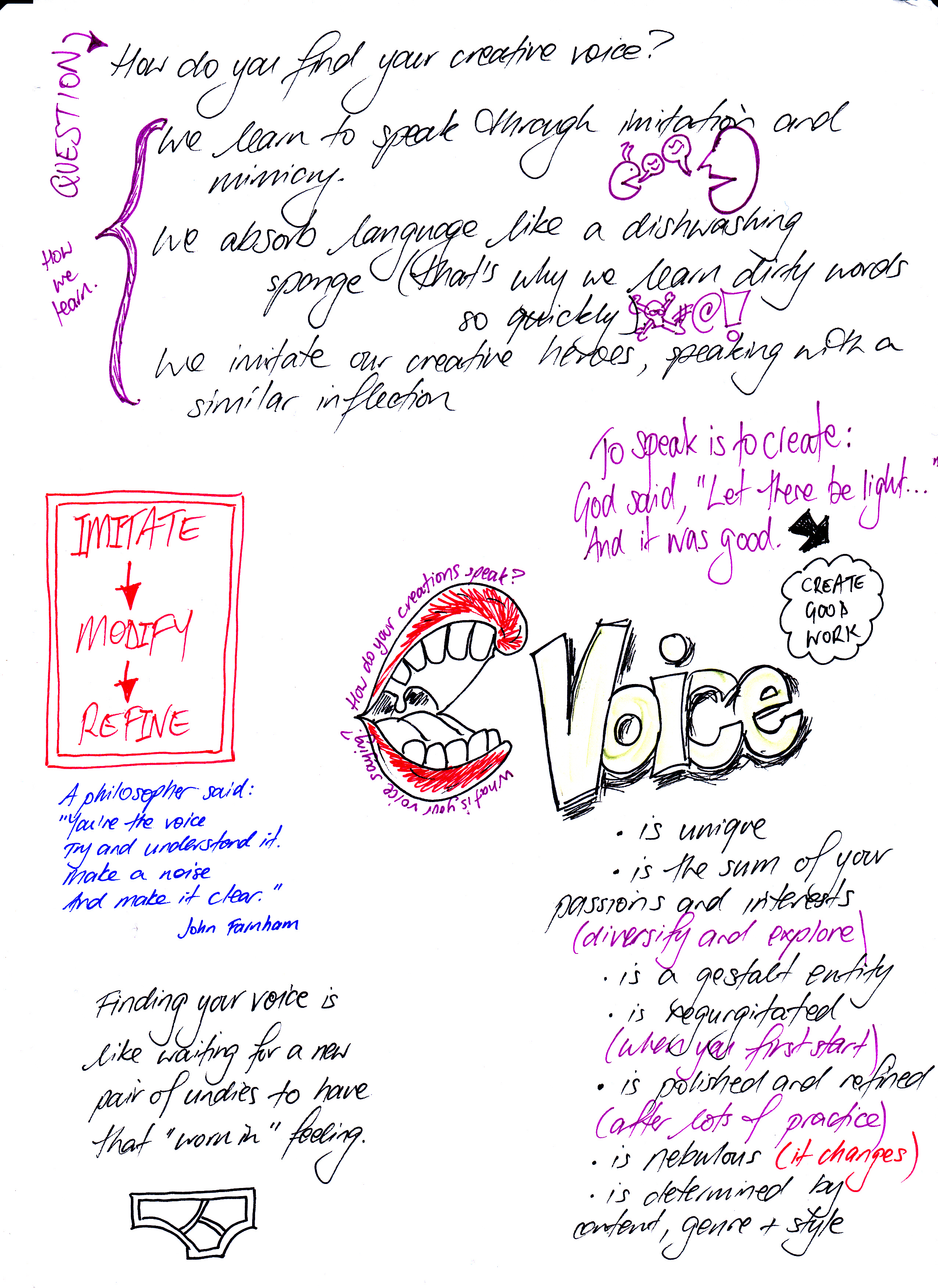
You’re the Voice

Another visual blog post about voice in creativity.

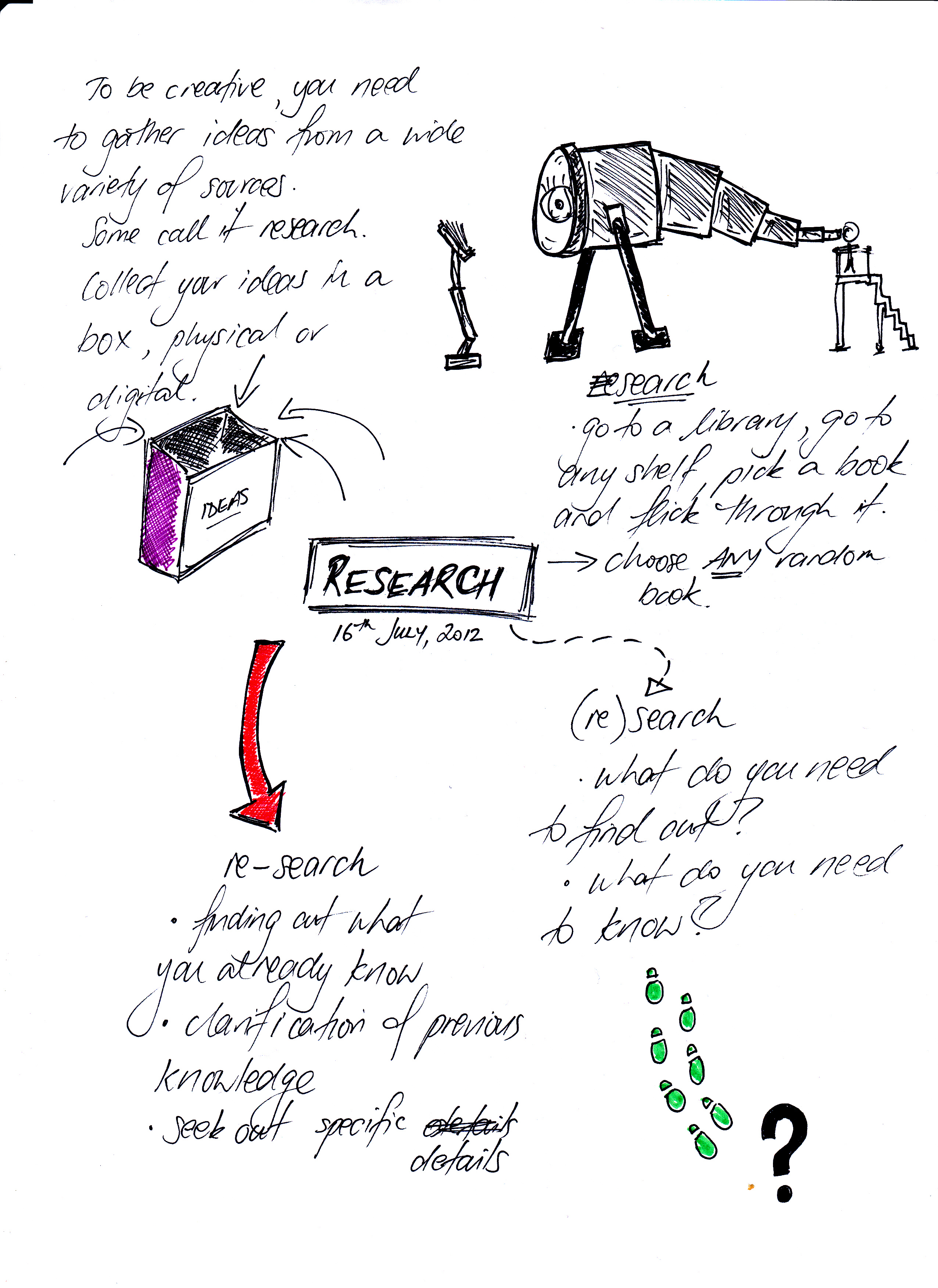
(re)search

A different blog post today inspired by Austin Kleon’s book, Steal Like An Artist. Go and read it.

I was picking apart the idea of research, and what artists do to slake their thirst for ideas.

I am not an artist, as should be evident, but I was simply exploring and deconstructing the word “research.”

Speaking for the Voiceless

While working on my novel I was thinking about its content and thematic concerns. I then thought about another novel idea I have in development and ideas I have for a couple of short stories and noticed there was some similarities in regards to their thematic focus. 

My stories are not about people who are broken, because we all are broken, and I like to explore that aspect of people in what I write. My stories are about those who are unable to express themselves, are marginalised, the outsider, the forgotten.

In particular, seeing my mother working with people with disabilities at the art studio where she works, has influenced the focus of what will be my second novel.

In part I am also influenced by the parables in the Gospels and the stories that revolve around the dispossessed and those considered “outsiders.”

I wrote down some statements to clarify my thinking about the purpose of my writing and what I want to achieve from it. These statements will inform the basis for my writing.

I am yet to fully explore what this all means, but I am excited by the prospect of what it can do for the focus of my writing. Perhaps in a later post I’ll explore the connection between speaking the voiceless and the innate ability for everyone to be creative.

  • I write because I want to tell the story of those who are not heard.
  • I write because I want to tell the story of those who cannot speak.
  • I write because I want to tell the story for those who cannot.
  • I write because I want to tell the story of those who are disempowered.
  • I write because I believe that telling a person’s story is integral in understanding who they are.

When Things Turn Pear-Shaped

What do you do when your plans head south? Turn pear-shaped? Or resemble a dried up pile of dog poo?

The Plan

I took long service leave from teaching in order to write my first novel. My aim was to have a 90,000 word manuscript finished by the time I went back to work in the middle of July. Having 14 weeks of leave (2 weeks of school holidays, the entire 10 week term and 2 weeks of holidays) I planned for a few weeks of outlining, followed by weeks of writing where I could commit a few hours a day and write a couple of thousand words. This would allow for more family time and for a few other bits and pieces.

Then it all went pear-shaped.

My wife’s grandmother had a serious stroke and died in the first few week of the term (I used the school holidays to rest and recuperate). She died 10 days later. My wife spent a lot of time at the hospital with family. I took up the domestic duties of getting children to school and other places.

This was followed by the funeral and the wake held at our house, which meant a whole lot of cleaning and tidying.

When things go wrong, what do you do? Change the plans.

My new plan went like this: outline for the latter part of May, write for all of June and *ta da* there’s a novel.

I had a plan. I wrote an 11 page, 6.6K word outline. I had an aim of 3000 words a day. Did it work?

Nope.

I couldn’t write 3000 words a day. The best I managed was 2.6K. One day I managed the grand total of 437. Right now, my novel stands at 24,000 words.

What to do now? The best laid plans of mice and men become the equivalent of sitting in a wad of chewing gum in your best trousers. Sometimes stuff just happens and even if you feel right royally shafted, you have to rethink and plan again.

To say the least, I am a little disappointed. It has forced some thinking and introspection and here is my solution.

Identify the Problems

Problems can be external (things you cannot control) and internal (things you can control).

External – illness, family commitments, domestic duties, unexpected visitors. Things just happen and there’s not a thing you can do about it. You work around it.

Internal – these are the things you have control over and I identified a number of reasons why I wasn’t successful in my planning.

* I’m easily distracted – discipline is a key characteristic I’m developing

* I was thinking about the scene, the characters, the conflict and tension, where it might end. I had done the planning, but spent time thinking about the scene rather than writing what I had in mind. Thinking time is not wasted time, but it is if it detracts from writing.

* It’s a whole lot harder than I thought – being more prepared for me is essential and I had no idea how hard is it to write a novel. I didn’t think it was going to be easy; I know it’s hard to write. I am still developing routines and disciplines.

Make New Plans

Over the next two weeks I will be writing when I can, adding to the word count and continuing with my outline. I will not be finished by the time I return to work, but I my new plan will have the novel completed by September.

I am not defeated, just rethinking and planning. It’s taking a little longer than I wanted, but so it be it.

I have also learned I could conceivably plan and write a novel in a year to 18 months, allowing for the busyness of my job and allowing for life’s little distractions to get in the way.

What do you do when your plans go pear-shaped?