Tag Archives: slice of life

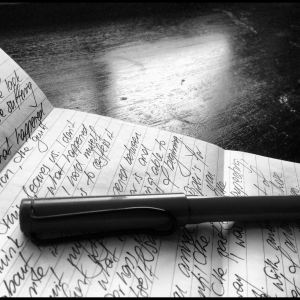
A Thought’s Reliquary

A Thought’s Reliquary

Friday Flash 19 July, 2013


I.

He opened the notebook, the creak of cracking cardboard a writer’s melody.
“I see you have yourself a reliquary,” said Grandfather.

“Amen.”


II.

Proofs of holy writ, held within the ink of the pen, waited for the opening incantation. He paused and found no words. Was he a heretic?


III.

The first words were important and they rushed from the pen; not so much writing as scribbling random thoughts in search of a repository.


IV.

Shuffled sheets in a lectionary of unrequited (or unsent) love letters, parables of adolescent anxiety and beatitudes of pop song lyricists,


V.

Scratched sonnets and ambling discourses with a hip-hop feel competed for space between the lines. An epistolary apocryphal gospel at best.


VI.

He rested the pen between the pages in the crook of the hymnal’s spine, a genuflection, as the last sentence dried in the valley’s shadows.


VII.

As the cover of the notebook closed it murmured, sighed through paper exhalations, as one who held their breath waiting for the benediction.

The Lines (Very Short Story)

Decades away from a colouring book, he paused the pencil above the page’s lines of demarcation. He questioned: inside the lines or out?

In the light of last week’s post, Colouring Outside the Lines, I wrote this piece of twitfic.

How would you tell a story about learning something new? Write it in the comments.

The Tap (Very Short Fiction)

He watched the tap dripping, spanner in hand while his thumb rubbed against his wedding band. To fix the leak would destroy the charm.
Twitfic, twitter fiction, is a challenge to write a story in 140 characters or less.
Is it really a story?
Can you have a beginning, a middle and an end in such a tightly defined space?
It’s taking a snapshot of a moment within a narrative, a held breath implying the breadth and depth of the narrative within a few short sentences.
Last year I tried my hand at a few, The Slap and Polaroid Memories, and will continue to write and post them here on the blog.
Giving parameters to your creativity can liberate your thinking and provide new opportunities to produce new work.
Have a go at writing one yourself.
Post them in the comments.

Colouring Outside The Lines

As a child, colouring outside the lines was the mark of a juvenile understanding of boundaries and parameters: they were ignored.

You were handed a pencil or crayon and a colouring book and told to have fun. And fun was most definitely had. Scratched lines of pencil or crayon all over the page. There was fun simply in the act of creating marks on the page.

Yet gentle adult encouragement made you aware of the lines of the picture; the boundaries drawn to keep the colours within.

So you took extra care and effort to colour within the lines and make the picture look special. You were disappointed if your pencil or crayon slipped over the line, extending the colour beyond its prearranged designation.

And so it is with any creative endeavour. Initial enthusiasm and fun is gradually replaced with awareness of the skills, parameters and boundaries of your chosen creative medium. You become a skilled practitioner of your creative art and can produce good work.

So, how do you extend your creative skills? How do you extend your knowledge and understanding of your medium? When you are entrenched in your chosen creative medium, whether it’s art, literature, film, painting or music, how do you extend the boundaries and parameters?

You learn to colour outside the lines again.

As a drummer playing contemporary music and musical theatre, I am used to the drums forming a rhythmic foundation, providing timbre, dynamics and tone colour, the beat and rhythm.

The other day I had the opportunity to meet up with Adrian, an old teaching colleague of mine who is an art teacher, musician, boutique record label owner and producer, and a mutual friend and drummer, Costa.

P1010973

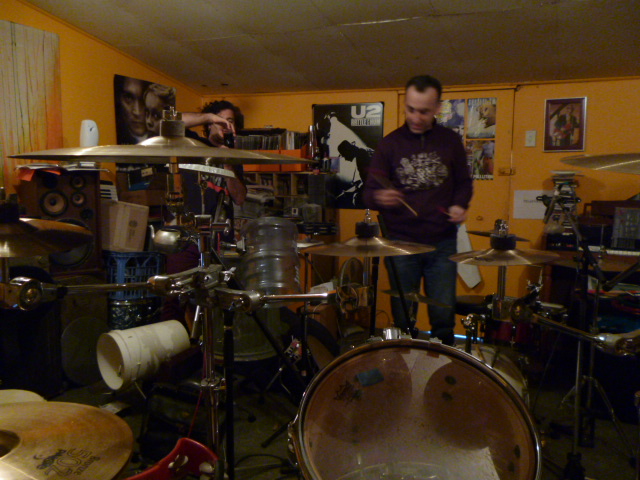
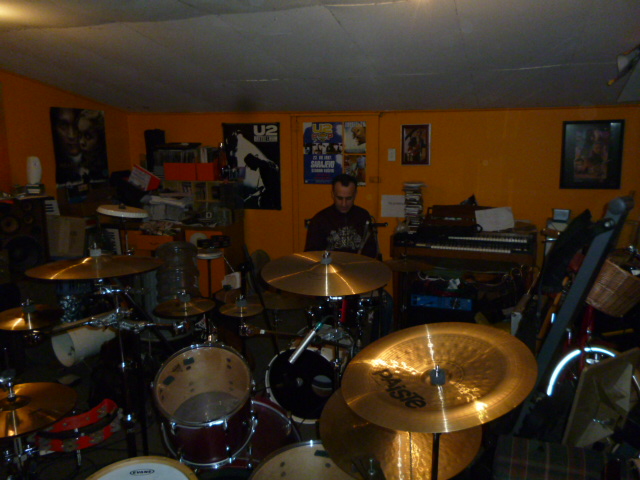
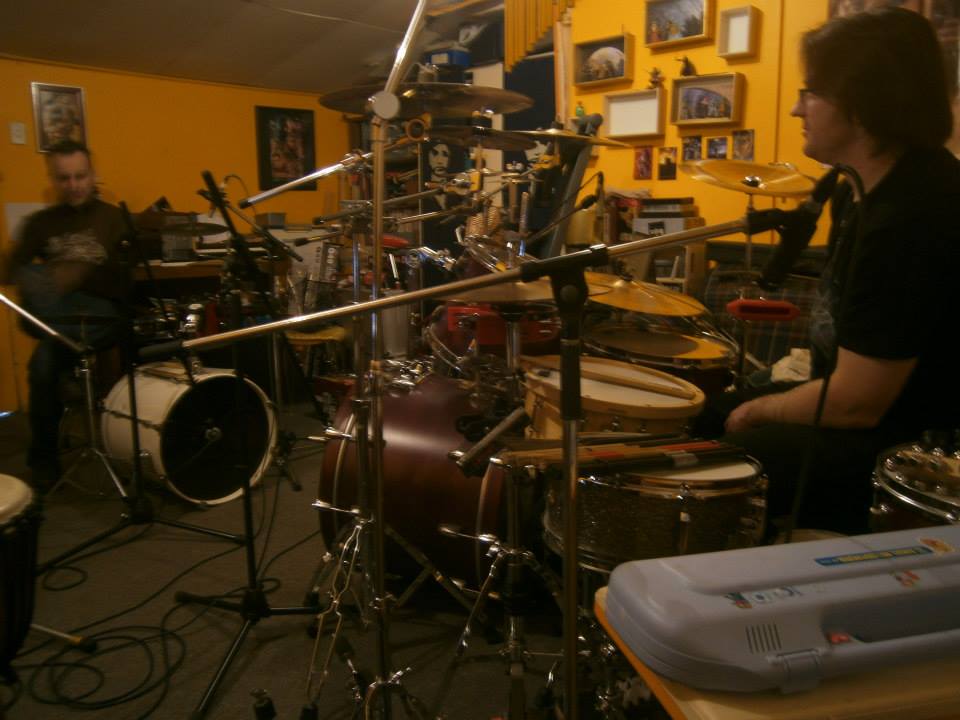
The three of us convened in a small home studio out the back of Adrian’s house. We lugged gear in and set up while Adrian placed mics.

There was no preconceived ideas as to what we were going to play and record, except for some youtube clips we had looked at earlier. There were no lines to demarcate the boundaries of our creativity.

Yet how easy it is to rely on the boundaries of what we know. As drummers Costa and I fell into an improvised jam in 6/8, using a form that was familiar to us, creating a beat and rhythm. As we played we listened to each other, playing around each other’s grooves and timbres, sometimes playing with the groove, sometimes playing against it.

We were colouring within the lines.

P1010968

I learned to colour outside the lines because of Adrian’s artistic vision and creativity.

Adrian suggested for the second jam an experimental form playing in different time signatures: Costa played in 4/4, I played in 5/4 and Adrian played in 7/4. It sounded gloriously messy as we experimented within the constraints of the time signature allocated while listening to what the others were playing.

The Junk Collective 3

The last jam was truly a learning experience of colouring outside the lines. Adrian suggested we play not rhythms or beats, but focus on the sounds produced from each part of our instrument.

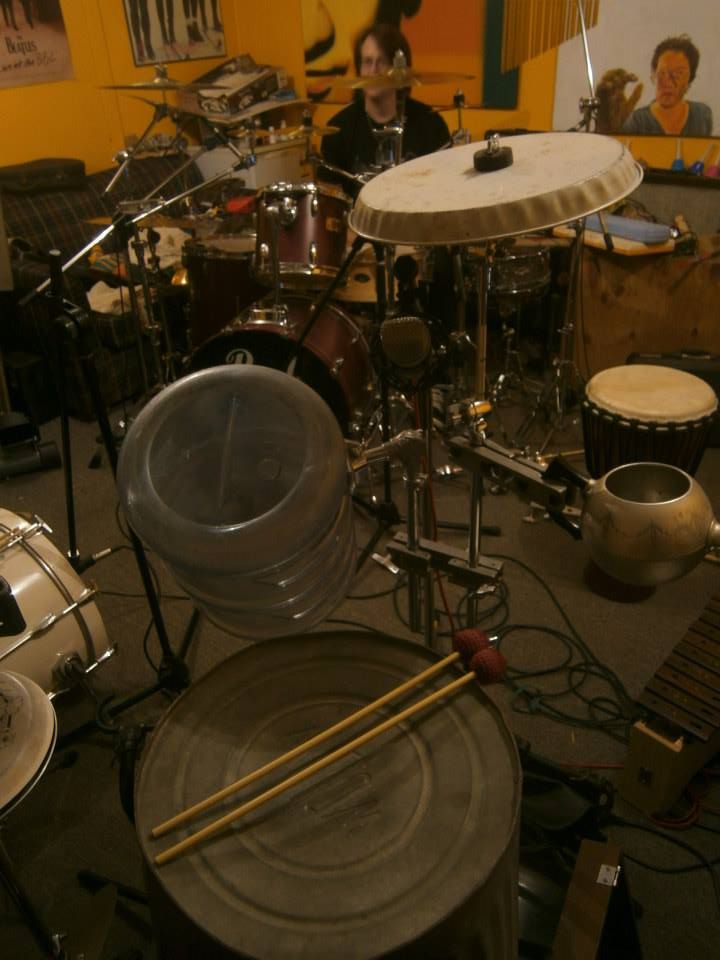
We used sticks, mallets, brushes, rods, plastic rods on all parts of the drums and cymbals including the rims and stands. I threw a handful of sticks into the air and let them fall where they may. I bounced sticks, mallets and rods off my snare to see where they landed. Adrian used a violin bow on cymbals and played mallets on my kit, Costa’s kit and their “junk” drum kit which consisted of a metal garbage bin, water bottles, saucepan lids made into hi-hats and a metal tea pot.

The Junk Collective 2

It was this last improvisational jam that really expanded my understanding of rhythm, drums and music in terms of creativity. It allowed me to colour outside the lines as I was not focused on the traditional parameters of my instrument, rather learning to see outside the lines and create accordingly.

Artists talk about the ‘negative space’ on the page; what is not there is as important as what is there.

My next step is to apply this principle to my writing.

Whatever creative medium you are engaged in, whether it’s writing, music, art, have you learned to colour outside the lines again?

Piper’s Reach: The Writer and the Reader

Piper’s Reach – The Writer and the Reader

A writing adage you see on various blogs is to write for your ideal reader, the audience you want to read your work. You create in your mind an image of a specific person, male and/or female, the type of person you imagine will enjoy reading your novel. The specific reader in mind, may in fact, be you.

When Jodi Cleghorn (@JodiCleghorn) and I sat down to write the epistolary serial Post Marked: Piper’s Reach (now being edited as an epistolary novel), it presented an interesting dichotomy. The instigation of the No Spoiler Policy (we did not discuss the plot or character development, but rather let the narrative form as an organic process) meant we were thrust into the role as simultaneous writer and reader.

It was unique as Jodi wrote as the character of Ella-Louise and I wrote as the character of Jude; two high school friends reunited by letter after 20 years of silence.

Click here to read about Piper’s Reach – The Project

img_1100

As each letter was written, posted and received, we had no idea of its content in regards to plot or character. It was the perfect balance between writer and reader. 

We wrote as authors, read it as readers. 

With each letter we would read and reread from different perspectives:

As writers:

  • Looking for the momentum and motivation in the character’s actions and how it moved the plot forward
  • Contemplating different permutations of plot for both characters
  • Establishing back-story and history for each character, events significant to both characters and how it affected the present day.

As readers:

  • We became caught up in the lives of the characters; how their past and present intertwined, split, became a messy entanglement and how they tried to sort it out.
  • We read the voice of each character, how Ella-Louise and Jude articulated their thoughts, what they wrote about and how they expressed it; what they revealed and what they kept hidden.

Jodi asked if I read the letters as the character of Jude or as myself because I was both catalyst and consumer, the writer and the reader. It was hard to separate myself from the narrative of Ella-Louise and Jude, to be solely the reader as each new letter was a revelation of character, plot, motivation and secrets.

There were times when I deliberately distanced myself from the character of Jude to read a letter, to be the reader and not the writer. I let myself be absorbed into the world of Ella-Louise as she revealed it, taking it at face value, rereading it again to further my understanding of who she was and what she wanted.

In the same way there were letters I read intentionally read as the character of Jude to feel the impact of the letter as Ella-Louise wrote to her dearest and most-loved friend.

Engaging with the letter as either writer or reader produced strong emotions, even to the point of tears.

Now we are in the editing phase, we get to experience the narrative of our characters all over again, this time solely as readers. After we have made our notes and compared them we will return to our role as writers and continue fashioning the narrative and our characters.

It lead me back to a question I have asked myself over the last couple of years in regards to writing and reading: Is a reader more interested in the story or the writing?

Is it an either/or, both/and dichotomy? Is the reader more interested in being moved by the story than the power of the words? Or is it the power of the words the more important aspect for the reader?

The power of storytelling versus power of writing with which there is no clear answer. The answer will not be a “Yes” or “No” response but a sliding continuum of responses. For some readers story will trump the writing and for other readers the power of the words will enhance the story and be the focus.

As a writer I aim to balance the power of the story with power of the word. I use words to convey the power and strength of the story, and I want you to be engaged as a reader with the story, drawn in by the power of the words.

Keep an eye for updates on the progress of Post Marked: Piper’s Reach and I hope you enjoy the story.

Creativity Week Wrap Up

Each day this week I posted a new idea on aspects of creativity.

I have gathered all the links for you in one easy place for you to catch up. I would love to hear what you have to say on creativity.

Monday – Create Useless Beauty

“Create a piece of art because it has no other function than to beautify your presence, illuminate your thoughts, elevate your attitude, satisfy your creativity, to please only yourself.”

Tuesday – Creative Dichotomy

“Make art from the beautiful and the ugly;

From the joyful events of life and from the circumstances marked by sorrow.”

Wednesday – The Bridge Between Imagination and Reality

“Creativity is the bridge between imagination and reality. We live in a divided state of how we see the world as it is and the vision of how we see the world as we want it to be.”

Thursday – Birth and Death in Creativity

“Creativity is a birthing act. Its genesis lies in the conception of an idea and by a word it is spoken into being.

And in the end we see that it is good.”

Friday – Creativity is the Mother Tongue

“We speak our mother tongue verbally and artistically. For some, we need to find our voice again. For others, it is strengthening their voice. Creativity is our mother tongue. Let people hear your voice.”

Have  a creative weekend.

Creativity is the Mother Tongue

Victor Wooten delivered this talk to TEDx Gabriola Island. He is a remarkable musician, master of the bass and a genuine and erudite educator.

The focus of his talk is music as a language. Listen carefully and you will learn.

I want to take his words and comment on them as they apply to other creative arts: writing and art.

Creativity (writing, art, film and music) is a language. Learn to speak a different tongue. Or in some cases, we need to relearn to speak our mother tongue.

Victor Wooten – Music as a Language (click link to view the talk)

I have taken excerpts from his talk, either quoted directly or paraphrased, and extrapolated their application to other artistic endeavours such as writing and art.

Your first language is not taught. People spoke to you. You were allowed to speak back – creativity should be learned with your mother tongue. Give children pencils and paper and allow them to speak in their own way. Give yourself pencils and paper and find your mother tongue again.

Beginners are not allowed to play with the masters – in music, the beginner and the amateur are separated from the genius of the master, able to watch but not participate. In all aspects of creativity we should learn from and participate alongside the masters.

As a baby, you’re jamming with language. Not made to sit in a corner and practice; not corrected when you’re wrong. Even to the point your parents learn the new way of speaking. You remain free in how you talk. When you could hear it (language), you started learning – Language is a freedom we have, a freedom of expression. Creativity is another freedom of expression. Learning language is immersive; we are around it all the time and learn the nuances from what we hear.

Growing up in Hawaii, Victor learned to play not by being given an instrument, but by being played to. A plastic stool was there for him to sit on and so he sat and listened. When older he was given something to hold – even before we understand what creativity is, how we should hold a pencil or a paintbrush, we must immerse ourselves in creativity activities and involve our children so they too, learn the language. When we surround ourselves with creativity we internalise the language.

Music is a pure voice. We want to teach the rules and the instrument first. We teach to play the instrument before they understand music. Learning to play music, not the instrument. Knowing the phrases, tones etc, learning – when we instigate boundaries and restrictions, demonstrate how-to or chastise for what we perceive as incorrect, we must stop and let the creativity flow from within. When our children see, and when we see, the joy flowing from the creativity within, we understand the process. The rules and techniques are there to serve as a creative conduit, not the tool itself.

When he was finally given a bass to play, Victor was playing to songs he already knew. He has listened and internalised the music. Therefore music flowed through the instrument. He was musical first, learning to talk not about learning the instrument first. It’s about what you have to say. He learned how to speak through his instrument – when our children have been given opportunity to be creative with great freedom, given the chance to express themselves, they will find their voice to speak clearly.

Practicing works but it is a slow process – practice alone for the sake of practice will develop skills but we will learn more when we participate in community and learn to speak with our own voice.

Children are born with freedom. A lot of us are taught out of our musical freedom when we’re first given a lesson because a teacher rarely finds out why we’re there in the first place. Playing air guitar where there’s no right and wrong. It’s not about right and wrong notes; they’re playing because it feels right

A woman said to me, “I’m Ella Fitzgerald when I’m in the shower.” And she’s right. The freedom we have a child is grown out of us, but we need to find a way to keep the freedom. Approach music like a language and allow it to keep that freedom, to keep the smile on the face, and not taken away by lessons – Creativity is expressive freedom and we would do well to instil into our children the freedom of creativity.

What does the world need with another good musician? *insert own creative choice here* It has become a lifestyle. To be a good musician, you have to be a good listener – this is good life advice. Choose your words wisely before you speak, or better still, saying nothing at all. It’s not all about you, or me; it’s about the people around us.

If you want music to come out of you, out of your instrument, you have to put it into you – do not let the well run dry. Fill it at every opportunity from whatever source.

If I use my greatness in the right way, it can help others rise up. If you’re on a pedastal, don’t come down, bring them up so they can see and they’ll grow faster – help others to find their creative voice if they have lost it. Create community to help others grow. Better still teach your children to be creative so they never lose their voice.

We speak our mother tongue verbally and artistically.

For some, we need to find our voice again.

For others, it is strengthening their voice.

Creativity is our mother tongue. Let people hear your voice.

Walking Lonely

The walk of the lonely brushes
shoulders with the multitudes
contact without connection
as silence walks besides
hand on shoulder

Birth and Death in Creativity

Creativity is a birthing act. Its genesis lies in the conception of an idea and by a word it is spoken into being. 

It begins as a formless void. It is given shape and form through contemplation and meditation.

Once it takes shape it is subjected to the process of revision and refinement. The form is given definition, perspective, depth and clarity.

Yet some ideas do not germinate; they die in the ground or spark brightly only to last a brief while. Others grow and develop but their death is unexpected, brutal, surprising, or nurtured and cared for until the last breath.

There is a period of mourning as the elements reclaim what was but is no now longer.

Even in the midst of a death or dying, life is extolled and remembered in and through death, sharing humanity.

In the act of creating we experience a little death.

And in the end we see that it is good.

The Bridge Between Imagination and Reality

Creativity is the bridge between imagination and reality. We live in a divided state of how we see the world as it is and the vision of how we see the world as we want it to be.

What we see in our mind’s eye is a reflection of how we perceive the world, and how we perceive the world we want. Our acts of creativity are therefore an attempt to bridge the divide between our imagination and reality.

Our acts of creativity reflect the negativity of humanity as it is: the horrors and deprivations, and reflect the positivity of humanity as it is: the awesomeness of people when our humanity is shared.

Our acts of creativity are an attempt to understand why the world the way it is and an attempt to demonstrate how it could be.

Remember your purpose and your message in your creative acts.

Each creative act is building the bridge between imagination and reality.