Tag Archives: slice of life

Watching – Very Short Story

He lay his head on his arm, ear against the watch, listening to the soft clicking of the mechanism and counted until the monsters left.

Is Comparison Killing Your Creativity?

Is Comparison Killing Your Creativity?

How do you feel when someone says, “I wrote 5000 words today” when all you managed was 500 or 50 or only 5?

What is your response when you see someone produce a new story every week and you struggle to write a new story once a month, or even once a year?

Do you feel discouraged when you see someone produce new art works when you’re still stuck on your first?

Do you want to give up when you can’t practice your instrument as often as you like and you see your skills slipping behind in comparison to another player?

I’ve seen people excel in word counts, submissions, practice routines and regimes, art works. I’ve compared myself to others in what I haven’t done. I have flagellated myself with,

“What if…?”

“Why haven’t you…?”

“If you’d only…”

With the beginning of National Novel Writing Month (NaNoWriMo) I am seeing writers post their spectacular word counts over the early days: two or three thousand words, up to five thousand words in a few sittings.

I am not participating in NaNoWriMo. Instead, I am working on a novella. Because I am a teacher, time is precious, so I have committed to writing a minimum of 100 words, five days a week. Since the start of Term 4 I have managed 3,500 words.

In comparison, my word count is paltry, pitiful, execrable, measly and *feel free to insert your own choice words here*

Comparison will kill your creativity.

It will stifle your ambition and plans until your dreams and visions are merely dried out husks, rotting in the back of the fridge like forgotten leftovers.

When you compare yourself with others, you kill any opportunity of developing your creativity. Comparison against others is measuring yourself against another person’s set of values, attitudes, structures, plans, visions. They are not your values, attitudes, structures, plans, visions.

If I compare myself to what others are achieving in NaNoWriMo, I will feel less than the scrapings from the bottom of student’s school bag. I will not compare myself with others and regret what I haven’t done but celebrate what I have achieved.

You have your own race to run. You have your own values, attitudes, structures, plans and visions to fulfil.

You can use others as inspiration, just not as a comparison.


How do you avoid the demoralising impact of comparing yourself with others and maintain creative integrity?

Creativity is about:

Connection

Conversation

Community 

Connection brings you into contact with other like-minded people. Finding a shared connection in creative pursuits leads to conversation.

Conversation is the opportunity to discuss ideas, habits, routines, progress. We engage with one another in conversation, to share our individual journeys and encourage one another to continue. We celebrate the victories with each other, encourage those who have fallen behind by attending to their blistered heels and untied shoelaces. By doing so, we develop community.

Community is about serving one another in love, developing and building each others’ creative skills. Community builds character not comparison. Community builds creativity because it empowers the individual to fulfil their plans and visions and dreams.

Comparison creates a sense of inferiority causing you to change your view of your goals and visions. It drains you of your creative vitality. You see other’s creative triumphs and victories but not your own. Ultimately, you lose your creative vision.

 Instead, find a connection with creative people. Engage in conversation with them and develop a community.

Expressing Your Pain Through The Creative Arts

Expressing Your Pain Through Creative Arts

“Life is pain, Highness. Anyone who says otherwise is selling something.”

The Dread Pirate Roberts (The Princess Bride)

Society doesn’t teach you to accept pain. It teaches you to look for wish fulfilment, constant euphoria and ecstasy; to be continuously and deliriously happy like a child drinking red cordial straight from the bottle.

We are the inhabitants of Brave New World who take their soma and remain blissfully unaware of the full breadth of human emotion while frolicking naked down the slippery dip of self-absorbed instant gratification. Pass the microwave dinner, please.

We must become like John the Savage and question our world about the spectacular depth of emotion garnered and expressed in poetry, film, song, literature, dance and music.

We need to know what it’s like to have Dettol applied to our gravel-grazed knee; to know the pain of heartache from our first break up (and then write bad poetry to immortalise the event), the gut-wrenching sorrow of losing a loved one and every other expression of pain and suffering capable in our experience.

Pain is often a stimulant for creativity; a genesis for a piece of writing, a song, developing a dance or striking a canvas with paint.

Acts of creativity brought about by pain and trauma have three expressions for the creative person:

  1. Catharsis
  2. Reflection
  3. Teaching and Learning

1. Catharsis

In order to understand pain and suffering there needs to be a release, a purging of the emotions, resulting in the renewal of heart and mind. One of the ways we do this is to tell stories.

Physical scars become stories and shared experiences

Our childhood is characterised by physical scars; I have one just below my knee where I met with the corner of a fish tank and another in the middle of my back from a staff Christmas party. My brother, the carpenter, is a museum of scars and stories (and it is nothing short of a miracle he still has all fingers, toes and limbs).

Yet we often repress those experiences that have caused us to experience emotional and mental pain.

Emotional scars become silent considerations and isolating experiences.

As children we find it difficult to understand the emotional and mental scars from the trauma we experience. I remember the passing of my paternal grandmother when I was 13 and not having the emotional maturity to understand and comprehend the enormity of it. After recently attending the funeral of my best friend’s father who died of cancer, I doubt I have the emotional maturity even now.

The catharsis of emotions allows for a creative act to be expressed in its most primeval and unformed way; a raw, uncensored, unchecked and deliberate action to release the pressure of the pain.

And the creative act may go no further than the initial purge; allowing the vented emotions to dissipate on the wind and be no more.

Sometimes, though, we need more.

2. Reflection

The painful and traumatic experiences of our lives can find expression in acts of creativity as we come to understand the complexity of our emotional scars and through the maturation of our emotional wounds. Severe trauma can cause a blockage in our creativity and cause our expression and understanding to stop.

Yet it is pain that is often the trigger for creativity as we reflect on our experiences – as catharsis, inspiration, questioning, understanding.

Understand your pain; know what causes it. Learn from it. Keep a journal. Paint. Draw. Write music. Write a story. Create something from it, even if it’s only a piece of paper entirely coloured in with a black texta.

Tell others about your pain through your creativity. It may resonate with them and speak to them.

A friend, Janetta, who has worked with people using art as therapy, explained it this way:

“From what I’ve seen working with people in art therapy, using art making to creatively process trauma gives people the ability to express the inexpressible and help them tell their story.

“Trauma is non-verbal (stored in the subcortical, non-verbal parts of the brain), so making art can allow the person to explore the non-verbal traumatic memory/experience and externalise it, so it can be processed with the verbal parts of the brain.”

3. Teaching and Learning

Creativity teaches you to express your pain and come to an understanding of the experience

Janetta continues:

 “Suddenly you can speak and talk about something that was too much to cope with. This makes the issue more manageable & less overwhelming and restores the person’s sense of control, all of which are lost through traumatic experiences, which primarily are beyond our ability to cope & make us feel overwhelmed & out of control.

“Some of my clients have also reported feeling understood when they can finally talk about it and when I can see what they were dealing with on the inside.

“For the mental health patients and dementia residents I work with, creativity, especially in group settings, offers an opportunity to connect with others and gives people relatively safe things to talk about, which is great for healing loneliness, isolation and dealing with loss of independence.”

A creative act is a teaching and learning moment for the creator and a teaching and learning moment for the reader/viewer/listener. It is a shared moment.

In my collaborative novel, Post Marked: Piper’s Reach (currently being edited), is it the emotional resonance of the past, a form of trauma, which defines the protagonists, Ella-Louise and Jude. As an author I explore how the past defines and influences the present, how the trauma affects the characters. Without pain, a story has no momentum, no movement forward. A story with no pain or conflict is no story at all.

Final Notes

To focus on pain alone, in all its manifestations, in the composition of a creative piece, to the exclusion of other emotions, is limiting. Creativity is about expressing the breadth and depth of human emotional experience.

We create with pain as the focus to understand ourselves and our relationship to the experience.

We read stories or watch films or listen to music about pain to understand that our experiences are not individual to us alone; to know someone else shares what we have gone through and to seek redemption in the hope of their success.

To express our pain we write stories, compose music, draw, paint, dance, sculpt. We find a creative outlet to deal with the pain.

We create firstly to understand our experiences, and secondly to share those experiences as the connection of our humanity.

How has creativity helped you through the painful times in your life?

Living Between the Known and the Unknown

Creativity is an attempt to strike out from what is known into what is unknown.

We all start from a place of the unknown, sparked by curiosity to find out what lurks in the corners, under the lounge cushion and why fresh, hot cinnamon doughnuts are not classified as a food group.

We begin to learn, to understand, to make connections between knowledge and its application; the beginning of wisdom.

We feel safe in what we know, beginning to explore within the boundaries of our knowledge. Outside the boundaries is the dark unknown.

Until we get to the point when the dark unknown entices with thoughts of new knowledge.

As a creative person, we balance what we know about our craft with what we don’t know about our craft. (For me as a writer, this is a continual learning curve.)

The unknown, therefore,  is not to be feared, but explored.

Curiosity regarding what is unknown about our craft leads to seeking out what is there and leads to new ideas, new connections, new forms, new media to express our creative vision.

Spending too long with what we know, and not expanding our creative boundaries leads to stagnation. Spending too much time researching what we do not know can lead to an aimless wandering without establishing our creative boundaries.

We need to live on the border of the known and the unknown; with the light of our campfire illuminating our work while we reside under the shadow of the mountains of the unknown.

Creativity is finding the balance between what is known and what is unknown.

Creating Community and Collaborative Creativity

Creating Community and Collaborative Creativity

Making my own music is ALL about self-expression. Working on other people’s is all about the privilege of helping realise their visionSteve Lawson (@solobasssteve)

Music, like literature, art, film, photography and dance, any other creative medium or form, are aspects of self-expression. As a writer, I use words as my vehicle for self-expression to create stories. I use words to create imagery, atmosphere and stories to create emotional responses in the reader.

Literature, music and dance are the foundational aspects of community; an integral voice of culture and community as representative of a society. It celebrates, connects, questions, makes political statements, raises philosophical debate, criticises and praises.

Without community we are isolated individuals trapped by the artificial boundaries surrounding ourselves. Literature, music and dance create a cultural identity and shared awareness of each other.

“Here we are now, entertain us.”

When did the creative arts become an entertainment rather than a shared community experience?

I postulate we’ve made art, music and literature an entertainment. In doing so, we have made creativity a product, a brand, an identity. Survey the popular artists and look at the products they are flogging apart from their music: perfume, clothing, jewellery, personal hygiene products. It’s hard to see a writer being asked to endorse a product, as if the writer him/herself is a brand and an identity to market.

Music has become a spectacle and an entertainment, dividing the artist from the audience. You go to a pub, a coffee shop, an opera house, and you go to see someone perform for you. You are transferred into the world of the performer as they create it for you.

There are transcendental moments of euphoria, a shared connection with the musicians or performer on stage. I’ve been to gigs where the excitement and passion are almost palpable, but I know I am there to be entertained. I have no personal connection with the artist nor the audience. We share physical space, unknown to one another except in shared connection with the music we are listening to.

I like music, literature and art as entertainment but I want to explore the community aspect of the creative arts. Artists have collaborated and supported one another for millennia. Ultimately I see creativity (literature, music and the arts) as a shared community and communication. Creativity takes on a stronger voice when we combine as a group of people to create, to share, to communicate.

Creativity as entertainment is passive. Creativity as a communication is active and engaging.

The Dichotomy of Audience and Community

What if we changed the perspective and stopped talking about an audience for our work, whether it’s literature or music or art, and talked about community instead?

When we speak of an audience, we are speaking of one-way communication from the artist to the receiver.

When we speak of a community, we enter into a dialogue. Our voice becomes stronger when there are many to spread the message.

Our stories, our music, our dance, our art; this is the voice we have to communicate our message.

By having the artist/audience dichotomy we have weakened our voice to communicate our message.

Creating Community

In the age of digital connection and hyper connectivity, the link between artist and community is ever present and easy to do.

Amanda Palmer’s (@amandapalmer) TED Talk, “The Art of Asking” is a brilliant explanation of her art. It’s worth your time to watch and engage with her vision.

Here is a summary of her vision as I see it and its relationship to creating community in the creative arts.

Art is metaphorically, and sometimes literally, falling into your audience and trusting one another. It is an act of asking because through the act of asking, you make a connection and when you connect, people want to help you. But asking makes you vulnerable and you have to have trust in your tribe (or your community). Give and receive freely. Ask without shame. Musicians and artists (and writers) are part of the community; they are connectors and openers. Celebrity is being loved from a distance instead of being loved up close.

This is what I want from my art, my writing: the direct connection with the reader so that we create a community. In my last post, “What Will Be Your Creative Legacy?”, I spoke about what I will leave behind. I’m not worried about my words; I’m worried about my community. It’s about direct connection with people and creating a moment of contact, a moment of prolonged contact in order to build trust and build a community.

How Do You Create Community? You Ask.

In the last few years the rise of crowd-sourcing and crowd-funding has caused debate in and out of the creative community, but I see it has benefit for musicians and artists like film makers, more so than for writers. Think kickstarter, pozible or indiegogo or something similar. These platforms are generating the community aspect to creativity.

Here are a few examples that I know of where creative people have asked for help:

Australian-based metal outfit, Twelve Foot Ninja (@twelvefootninja) had a comic written for the release of their album, Silent Machine and had the largest and most successful crowd-funding campaign for their new video clip because they had engaged their community.

Helen Perris (@helenperris) was recently able to attract enough funding to record her new EP. One of the contributors was rewarded with time in the studio with Helen and try her hand at backing vocals.

It’s about creating community and connection, rewarding contributors and engaging in meaningful conversations. If you’re an artist, offer the reward to create art and liner notes or design work (cut them in for a share or a fee – I’m all for the artist being paid.) Some may choose to volunteer their time or efforts, but there is also a place for paid contributors.

Other Ways To Create Community?

What if we made venues conducive to community? What if coffee shops, cafes, art galleries and libraries made it a point of creating community between musician, artist, writer and their clients?

Create spaces for creative communities by moving into cafes and coffee shops, parks and houses for art groups or writers groups (I know they already exist but let’s broaden the horizon), perform music in the form of house concerts (Steve Lawson is big proponent of house concerts) and have literature groups meet in art galleries.

Let’s learn from the DIY aesthetic and bring the crowd right up to the band and share in the dialogue and discussion.

One of my favourite bands, Sydney-based post-rock band Dumbsaint, make short films to accompany their post-rock instrumental songs. Both music and films stand alone and the experience of watching the film and the band perform live is fantastic. Check out their new song, The Auteur.

With my current penchant for post-rock (instrumental music) in the likes of sleepmakeswaves (@sleepmakeswaves), Meniscus (@Meniscusmusic) (representing my home town) I’d like to write short narratives based on the titles of their songs to appear on the CD liner notes or on the band’s website. I haven’t asked the bands yet but what if you could engage with the artist in a creative collaboration?

I first came across this idea when reading the liner notes to King’s X album “Gretchen Goes to Nebraska.” You can read it here.

What about collaborating with a band to create a short film or video clip or a visual background for one of their songs? Offer to create visuals for their flyers, website, album artwork. Ask. Ask a writer if you could design a book cover. Ask a dancer if you could write a piece of music for them as the inspiration for new choreography.

It’s about connection (and fandom; can I get a fan “squee”?) and extending the focus outwards, not inwards.

As a writer, collaboration is a great way of helping someone realise his/her vision. The epistolary serial I co-wrote with Jodi Cleghorn, Post Marked: Piper’s Reach, was a way of realising Jodi’s vision for a new writing adventure. We are now at the editing stage, turning it into a novel and pursuing publication options.

The vision we hold for our own creative and artistic endeavours is our self-expression, our goal and purpose.

Yet, it is better to give than to receive.

To help foster and create community and assist others in realising their artistic vision is a remarkable privilege. By creating a positive and encouraging artistic community we enrich our lives.

Ask.

Be involved.

Create community.

New For Old Replacement

What do you do with old stories and old ideas you want to rehash, recycle or revisit?

I have a list of old stories and old ideas waiting for my attention. But what to do with them?

Recently I looked at the list of stories I have, both old and new, and came to a decision: Ditch the old and focus on the new.

It’s like an infomercial offering you a ‘new for old replacement’ deal.

I am not the kind of writer who can sustain multiple projects at various stages; I prefer to give my attention to one work in progress at at time. My focus right now is on the editing of my first novel, a collaborative tome, Post Marked: Piper’s Reach.

If new ideas pop up, I write them down in my notebooks and file the idea away in the back of the mashed potato I call my brain.

While I like the old stories, their ideas and expression, it’s not moving me forward towards the writing goals I have set. I have a 3 Year Plan of projects (which may have to extend to 5 years as I think I was being a little over ambitious).

My blog is a testament to the beginning of my writing journey, and while there is less fiction being posted here, I will leave it as a reference point (at least for the short term) while I work on my novel and plan out a novella and new short stories. I will let them stand as markers of my writing journey, a testament to how I wrote.

Looking back too far will only stymie the progress forward.

It’s good to take stock of your writing inventory from time to time, clear the decks of those projects prohibiting your progress forward and focus on the new works you will write to achieve your goals.

Will you have a “New For Old Replacement”?


What Will Be Your Creative Legacy?

I stand at the beginning of my writing journey, still wearing in the new shoes of “writer” and attending to the blisters on my heels with Band Aids.

I look forward down the road where other writers have been and look at the legacy they have left behind. I read the graffiti scrawled on the walls of the underpasses and bridges of commentators and critics, other readers and writers and come to understand the place of writers and storytellers, the mischief-makers of language and those who guard its legitimacy with fervour and zeal.

What Will Be Your Creative Legacy?

As I walk, I wonder what my creative legacy will be. Will my words live on beyond me in tomes of dead trees or digital imprint?

I’m not sure I really care because I want to leave a different legacy.

The essence of creativity is not to leave a body of work but to leave a legacy of relationships.

Through digital connections and real life conversations I’ve made great relationships. As a writer, I’ve made connections with people who are further along the journey than me who are willing to share their insight and input even if it’s limited by 140 characters. I’ve met other writers who I walk along side, encouraging, supporting and cheering on for their successes and offering Band Aids and support when needed.

And it is my hope to offer to new writers the same support and encouragement I received when I started writing. Everyone needs someone to champion your creative cause: writing, music, art, dance, film, photography, business or sport.

Your champion will provide encouragement when it appears hardest and swift kick in the backside when you’re slacking off.

Your champion will smile and nod when you tell them your latest crazy idea and won’t be afraid to ask how you’ll be able to pull it off.

Your champion will trumpet your success and commiserate your failure (and later on, make it an object lesson so you learn from your mistakes).

Be A Champion and Leave a Legacy

And then there will come a time when you will become the champion for someone else because it is the biggest and best thing you can do.

I want to ensure my character lasts longer than my words (although it would be nice if my words and works were recognised, too).

I want to create a community where we champion each other’s causes whether it’s writing, music, art, dance, film, photography, business or sport because it is more blessed to give than to receive and it fulfills the commandment to ‘love thy neighbour as thyself.’ 

Go the extra step; offer the jacket when you’re asked for the shirt.

Champion someone’s creative cause.

Can I offer you a Band Aid?

Post It Note Philosophy 10

Post It Note Philosophy on Creativity 10

PIN Philosophy 10

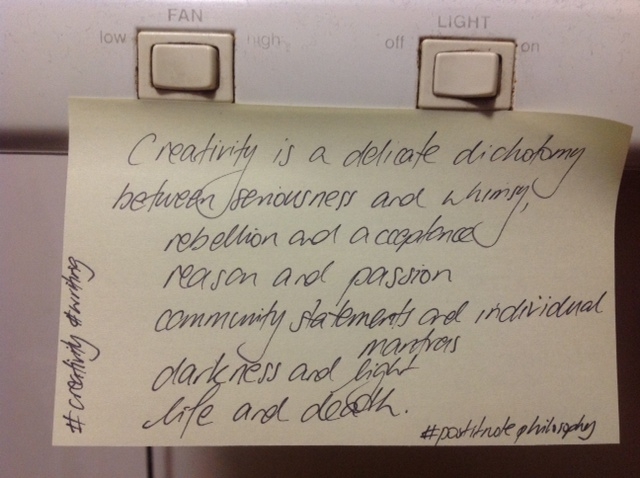
Creativity is a delicate dichotomy between seriousness and whimsy, rebellion and acceptance, reason and passion, community statements and individual mantras, darkness and light, life and death.

Post It Note Philosophy 9

Post It Note Philosophy on Creativity 9

PIN Philosophy 9

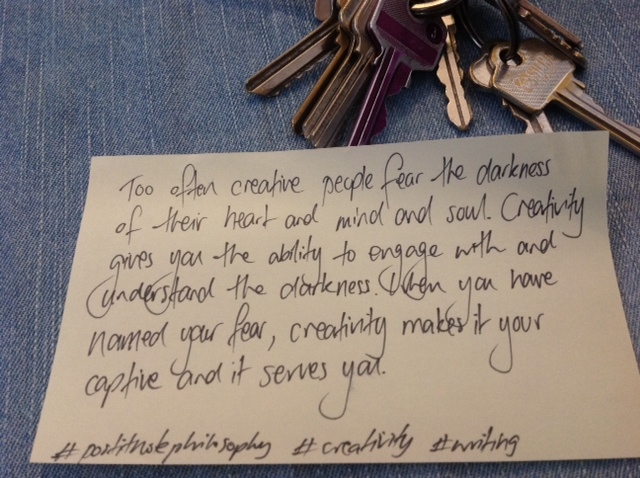
Too often creative people fear the darkness of their heart and mind and soul. Creativity gives you the ability to engage with and understand the darkness. When you have named your fear, creativity makes it your captive and it serves you.

Post It Note Philosophy 8

Post It Note Philosophy on Creativity 8

PIN Philosophy 8

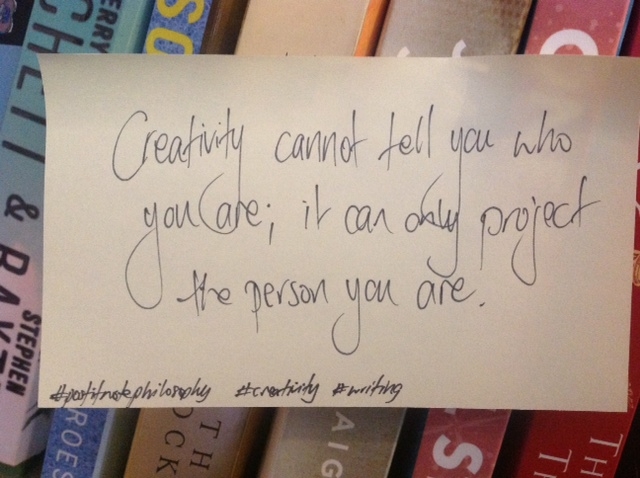
Creativity cannot tell you who you are; it can only project the person you are.