Tag Archives: sketches

You’re the Voice

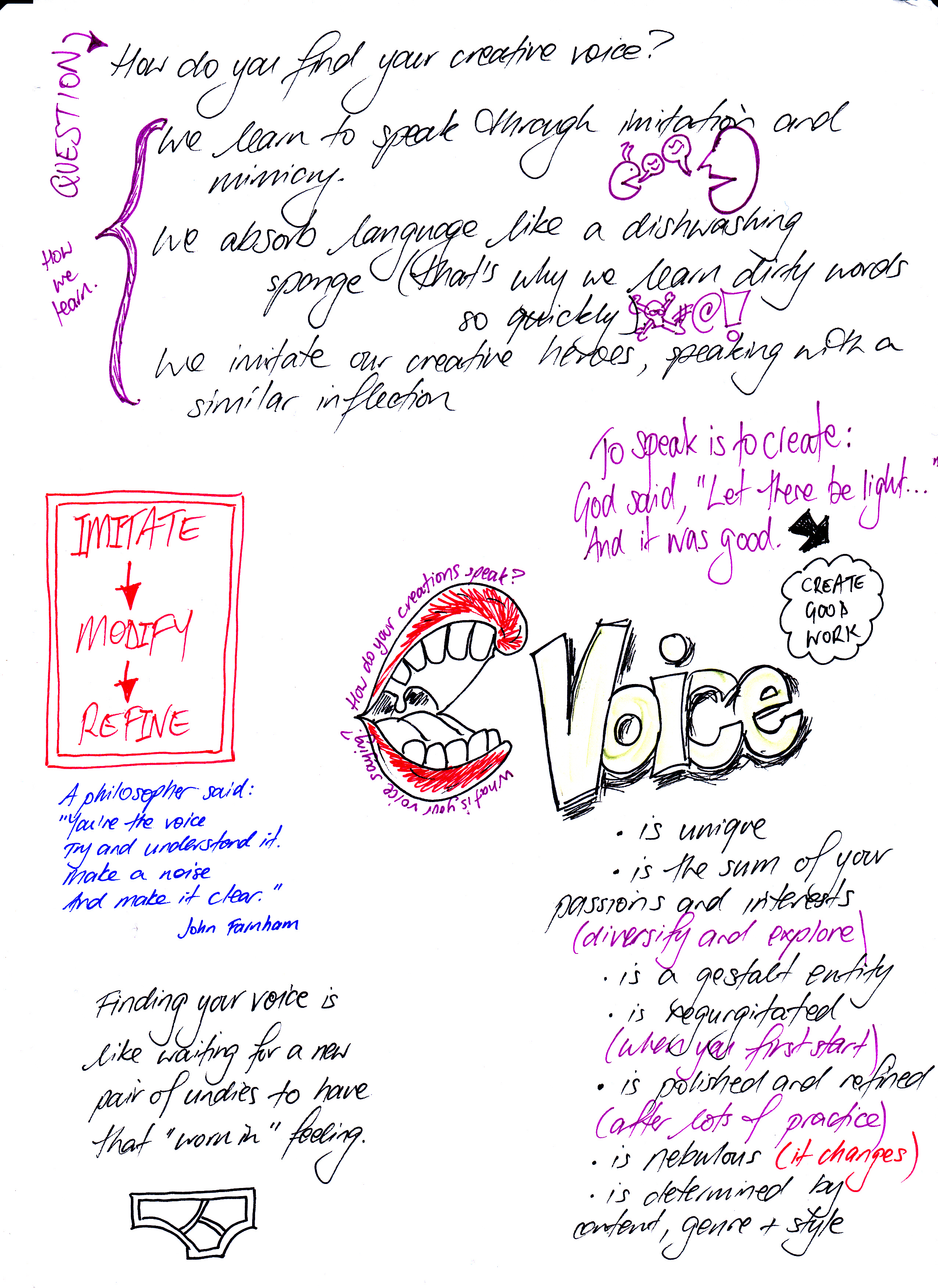
Another visual blog post about voice in creativity.

What Am I Doing?

Yesterday, in a moment of sheer, blind, unreasoning panic I questioned whether I was doing the right thing. On the eve of taking a long service leave, a 3 month break from my job, I doubted myself.

I am taking leave to write a novel, my first. Every negative idea ran through like the after effects of a bad curry: I can’t do this. You’re a fool to think you can write a novel. What if you get stuck? Will you ever finish it? No one’s going to read it.

This is something I am passionate about and want to succeed in. The journey of a thousand miles might begin with a single step, but it requires a hell of a lot of planning and a large supply of Band Aids for the blisters. In the same way, the finishing of a novel begins with the setting down of a single word. Then another. And another until The End is reached.

I am in this for the long haul. I have a dream to write novels. This time off is the first step to achieving that dream. I have plans in place to help make this dream a reality. I will learn a lot in the time it takes to write my first novel and I can translate this to the next, then the next and so on.

Following a conversation on twitter between Alan Baxter (@AlanBaxter) and Tom Dullemond (@Cacotopus) yielded this gem of thought: Those who maintain their focus and diligence in the face of rejection and disappointment will find it easier to sustain themselves than those who find success comes easily.

I know I have a cheer squad who will shake their virtual pom poms if I get stuck.

Hand me my cardigan and tracky dacks; I have a novel to write.

Ashes to Ashes – Behind the Scenes

What do you do when you are asked to take a song from 1989, combine it with an historical event from the same year AND make it speculative fiction? This was the brief given for the latest Literary Mix Tapes’ anthology, “Eighty Nine.”

You can do one of two things. Firstly, you run screaming in falsetto tones like your favourite hair metal band. Imagine your testicles squashed into a pair of leather pants 2 sizes too small.

Secondly, you can dig out your denim jacket, black t-shirt, acid wash jeans and hair gel; grab a roll of gaffer tape, Swiss Army knife, some matches and take it on MacGyver-style.

The authors from “Nothing But Flowers” submitted a song from 1989. By process of random number generation, Jodi Cleghorn (editor) allocated each writer to their song. I received Bon Jovi’s “Lay Your Hands On Me.”

The next step was to research the historical events of the year. I was only in Year 9 in high school at the time, so a refresher history lesson was in order. There were so many events from that year, not only of historical significance, but also of cultural/social significance.

As a writer, one event piqued my interest: the fatwa against Salman Rushdie. What if the fatwa had been successful, creating a group called The Book Burners? This became the launching point for an alternative history. Would it have sparked a cultural or social, or even a theological revolution? Would books have been affected, regardless if they were sacred or secular, theological or pornographic? The Book Burners sought moral integrity, but the indiscriminate nature of their acts calls into question their motivations.

In part, my story has echoes of Ray Bradbury’s “Fahrenheit 451.” A quote attributed to Bradbury was spoken by Father Jim:

“There are worse crimes than burning books,” Jim said. “One is not reading them.”

In my notebook I had two characters: a priest, Father Jim, and his best friend, Robert Forsyth, a publican. They are old friends who represent two different perspectives and became the focal point of the story. Jim is a priest and scholar and understands the value of books, even having a collection of novels and comics. Rob is his good friend, trying to understand the philosophical reasons for burning books. I had written one line of dialogue in my notebook, which I had to include in the final version of the story: “I’ve had more shags than you’ve had belts of communion wine.”

But, how to include the song into the story? I decided to use the song as a part of a scene.  For Father Jim and Rob, it was a light comic moment; another way of exploring the characters’ relationship and their ideas.

For a few months, there were times when I loathed my story. It read like the scrawling of a madman, written in litres of rancid custard on vellum made from baby seals. I considered ditching the whole thing and starting again, but thanks to the input of Jason Coggins, Icy Sedgwick and Rebecca Dobbie, they rescued me from drowning in the vat of rancid custard.

I was not consciously looking at religious fundamentalism as the focus for the story. At its heart, the story is about ideas. Are ideas, even controversial ones, to be dismissed simply as unorthodox? Is cultural homogeneity to be prized about discourse and dialogue? I may not agree with someone’s ideas or perspectives, but I respect their right to express it. I should also seek to learn from it.

In the modern technological age, the rhetoric of those who shout the loudest becomes the static that fills our ears. We need to listen more carefully before we open our mouths.

The pen is mightier than the sword.

Scrappy Sketches

Writing for eMergent Publishing’s new anthology “89” has proven to be an interesting task.

The brief asks for a retro speculative fiction story based in 1989 with a reference to a significant event from that year, all prompted by a song from the same year. Following? Good, because it’s doing my head in.

Some of us have been slogging through ideas while others have written their story quickly. I am in the former group. What follows below is a sketch I wrote to help get the ideas flowing. It is not being used in the final story but I thought I would share this scrappy sketch with you.

*****     *****     *****     *****     *****     *****     *****     *****     *****

“Why does the fat lady get to sing the last song?” asked Claire. “I mean, it’s not like she’s Whitney Houston or anything.” She dragged on the cigarette before extinguishing it. “This songbird’s gonna have the final note tonight. Fat chick be damned.”

The karaoke microphone was vacant, illuminated by a single spot lights. Claire’s best friend, Rachelle, dubbed it The Truth Amplifier. The microphone revealed a person’s ability, she said. If they could sing, it magnified the singer’s competent vocal chords. If the singer was a hairbrush vocalist, it simply amplified their cat-being-pulled-by-a-toddler screeching.

Flicking through the karaoke menu, Claire chose her song. It was 2 am and the bar was emptying. MIDI strains of Bon Jovi clambered out of the speaker. Rachelle whooped her encouragement from the table. Claire pulled the microphone from the stand, feeling its weight, balancing it before winking at Rachelle. In her head she counted off the final bar before the lyrics started. On the last beat she spun the mic in her hand, caught it, leaned forward and breathed the lyrics, “If you’re ready, I’m willing and able. Help me lay my cards out on the table.”

The crowd was caught in her performance. At the first chorus she pushed the vocals, but deliberately held back from giving it everything, “Lay your hands on me, lay your hands on me, lay your hands on me.” She extended her hand towards the crowd. A polite smattering of applause came from the thinning crowd, but Claire knew she had them. The second verse spun from her lips like caramel, despite the MIDI-synth backing track. Perched on the edge of the tiny stage, she could feel herself flying with the music. Grasping the mic stand in her left hand she threw her head back for the final chorus and released the diva within, finding the pure note and producing a sonic boom.

Putting the mic back into the clip, the audience erupted in whoops, cheers and whistles.

Dropping into the chair beside Rachelle, Claire said, “Elvis and the fat lady have left the building. Together. Eating deep friend sandwiches and caressing their arses where I kicked it.”

Camouflage

Jake slipped into Biology class, head down, eyes up, heading for his usual seat near the window, close to the front of the room. The teacher wheeled a trolley out from the Prep Store. Lifting a large fish tank she placed it in the middle of the teacher’s desk, inviting the students to come forward.

The class crowded around the teacher’s desk staring into the large fish tank jostling for best viewing rights. It was converted into a terrarium, the top covered with thin wire gauze, filled with twigs of eucalyptus leaves. Jake found himself nearest one end of the fish tank with two girls peering around his shoulders. Heads swayed backwards and forwards, peering in, hoping to spot something.

Finally a curious student asked, “Miss, what’s in there? Apart from leaves and stuff.”

“Look closer. Look for shapes that look like sticks but perhaps are not.”

The class reconvened their search.

“Oh, look. There.” Jake pointed, his finger close enough to the glass of the fish tank to form condensation. He wiped it clean and pointed again before withdrawing.

“Where?” someone asked. “I can’t see anything.”

“Hang on, I can see it,” said the girl behind him. “It looks like a stick is hanging upside down.”

With the puzzle solved, exclamations of discovery sounded around the desk.

“Found one here.”

“There’s another on this side of the tank and it’s different again.”

The teacher began writing on the whiteboard, telling the class the scientific names of the occupants of the fish tank.

“What you see are phasmids, or more commonly known as stick insects. To be more precise, they are of the class Insecta and the family Phasmatidae.
The teacher removed the wire gauze and reached into the leaves. Drawing her hand out, a stick insect spanned the length of her hand, its legs dancing an insect version of The Robot.

“This little beauty is ctenomorpha chronus.”

“It’s like a pencil on steroids,” said one lad, causing laughter to erupt.

Jake laughed too, taking note of its pencil-like body shape, angular legs and looking for all intents and purposes, like a stick.

A few students recoiled, uttering shrieks and expressing shivers as the alien insect began to move along her hand.

“Can I hold it, Miss?” asked Jake in a bold show of visibility.

The teacher extended her arm towards Jake who offered his open palm to the insect.

Jake mimicked the stick insect’s movement with his head, rocking backwards and forwards, swaying like there was a breeze. He wished it was a fire-breathing dragon.

It had been hidden away in shape and hue. The camouflaged shades of green and brown and angular lines of legs shielded it from spying students. Outside the safety of leaf and twig the insect was vulnerable; Jake felt an affinity with the creature.

“Oi, dancing boy. Give us a go,” said one boy.

Unaware he had continued to mimic the insect’s actions ever so slightly, Jake’s face flushed. Extending his hand he watched the stick insect traverse the fleshy terrain.

The array of school uniform framing the edge of the teacher’s desk caught Jake’s attention. They looked like the leaves on a branch in their uniformity: white shirts and grey shorts for the boys and white shirts and blue skirts for the girls. A navy tie completed the camouflage.

Around the edges subtle differences emerged. Shirts tucked in and shirts tucked out. Ties adjusted to the top button, also done up, to ties flying at half-mast. Skirts exposing more thigh than covering it or knee length decorum. Blouses framed cleavage and an array of coloured bras, signals of defiance or signs of invitation. Hair was spiked, straightened, teased, gelled and preened while metal fragments adorned ears, eyebrows, lips and noses.
Jake loosened his tie slightly, fingering the top button until he felt the pressure of the collar release.

Returning the insect to its environment was a signal for the students to return to their desks. Jake retreated to his seat, blending in again as the lesson continued.

At the conclusion of the lesson Jake slipstreamed from the classroom to the corridor in the wake of the student body as it ebbed and flowed from one class to the next, pushed and pulled by the phases of the bell, disappearing from sight in a whitewash of uniforms.

Photographs and Diamonds

Joseph picked up the silver-gilded frame and stared at the image. A nervous young man stood stiffly in an army dress uniform with his arm around the waist of his new wife, dressed elegantly in a simple, straight white satin dress and carrying a simple bouquet. The couple stood in front of the church doors as well-wishers broke into applause.

He remembered how giddy Helen was with excitement the day they decided to get married. Home on leave he asked her. The war prompted quick action on the field of battle and off it. A promise was a promise until the day you died. And that could be any day. It was a time when memory was long, a handshake communicated trust and steadfastness was an anchor in a marriage.

The young man aged into the weathered reflection staring into the photograph. Sixty years had passed since that day and with it a million memories.

Returning the photograph to the dresser Joseph straightened his tie and adjusted his cuffs. In the mirror a formal black suit replaced the dress uniform. Helen interrupted his reverie.

“It’s time for the party, dear and we are the guests of honour. Everyone is waiting for us. Happy anniversary, darling.”

The Magnifying Glass

“All you have ever done is find fault and be critical, without ever taking a look at yourself,” his wife said as she slapped a magnifying glass into his hand.

He turned the object over in his hands in bemusement but remembered times as a child crouched in the dirt, magnifying glass focused inches from the ground watching the ants move in their industrial symmetry.  Back then it allowed him to peer into the nooks and crannies of insects and under rocks, yet as he grew into adolescence he turned his magnified gaze onto the people around him.  He explored the crevices of people’s character, pinpointing their weaknesses to his advantage.  Proudly he stood with chest of burnished bronze and crown of gold; too caught up in his reflection to notice the feet of clay.

“Turn this lens back on yourself and perhaps you’ll see something,” she said before turning on her heel and collecting her last bags from the front door.