Tag Archives: short story

The Heart Is An Echo Chamber Release Date

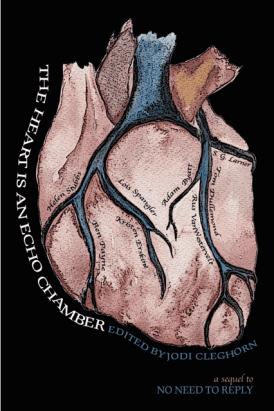
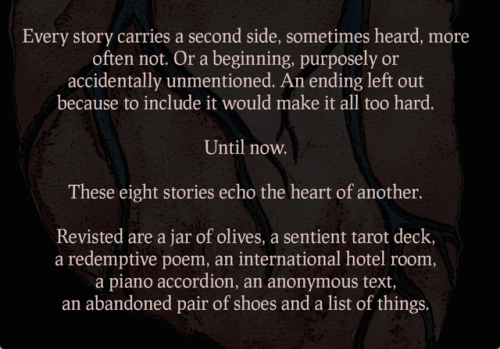
It has taken a little while but on August 10th I will have a new story coming out in Jodi Cleghorn’s collection, The Heart is An Echo Chamber.

My story, “Untethering” is a response story to “Squeezebox” from No Need to Reply.

Screen Shot 2016-04-28 at 12.19.01 AM

Screen Shot 2016-04-28 at 12.18.52 AM

Follow the link below to get your hands on one or both of the books.

The Heart Is An Echo Chamber

Handwritten Pages #8

IMG_20160713_141420

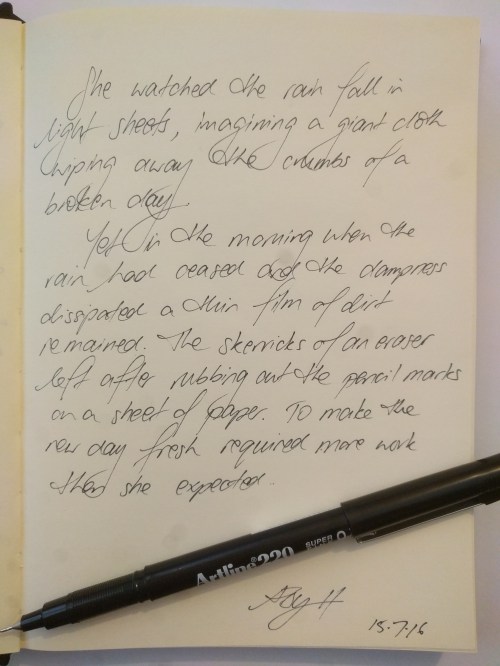
She watched the rain fall in light sheets, imagining a giant cloth wiping away the crumbs of a broken day.
Yet in the morning when the rain had ceased and the dampness dissipated a thin film of dirt remained. The skerricks of an eraser left after rubbing out the pencil marks on a sheet of paper. To make the new day fresh required more work than she expected.


SIDE NOTE: When I was writing this, transcribing it from my notebook where I first scribbled the idea, I asked myself why I ascribed the feminine pronoun to the character of the narrative. It was arbitrary, without conscious assignation.

I then reread the paragraph replacing ‘she’ with ‘he’ and saw a different reading. As a personal reflection, I think I tend to write more from a female perspective than a male one. For purely unscientific research I did a gender breakdown on the Handwritten Pages.

  1. “I” (indeterminate)
  2. Couple (male/female)
  3. Female (2 sisters)
  4. Female 
  5. “I” (indeterminate)
  6. He
  7. Male (2 brothers)
  8. Female

In examining the content of each piece, the seemingly arbitrary allocation of gender pronouns was determined by its focus. The third Handwritten Page was inspired by a friend’s recollection of her childhood with her sisters so it was a natural response to use the feminine. 

In last week’s Handwritten Page I ascribed masculine pronouns, except to the “I” persona. In reality it could easily be the sibling rivalry between a brother and sister yet in my head it was between brothers; we tend to pair brothers with brothers and sisters with sisters in terms of sibling rivalry and not a brother/sister combination.

It also made me think about how the content of a narrative influences the reader’s understanding of gender. Does it affirm or subvert paradigms? Why or why not? Just asking.

But the distinction of female or male POV in a narrative made me think about how I read gender in a story (being male) and how others would read the piece above (male or female). I know men and women will read the paragraph differently based on their own gender, and their reading of gender. 

Try reading today’s piece replacing ‘she’ with ‘he’. Does it make a difference in your reading? What nuances or differences are borne out of a different reading? Does it matter? I’m interested in your ideas.

Handwritten Pages #7

IMG_20160708_105922

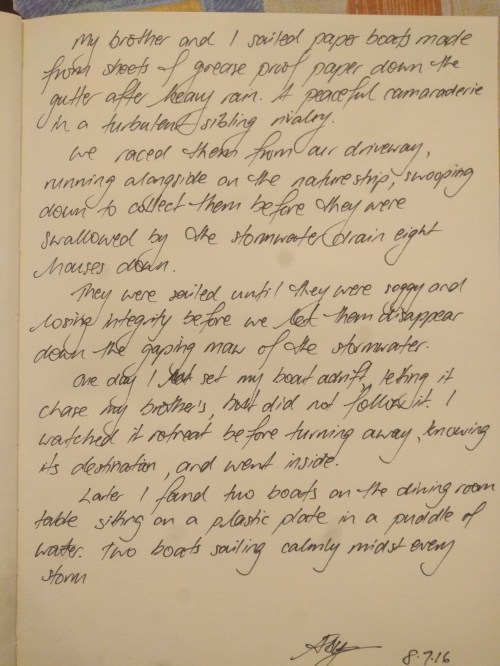
My brother and I sailed paper boats made from sheets of grease proof paper down the gutter after heavy rain. A peaceful camaraderie in a turbulent sibling rivalry. 
We raced them from our driveway, running alongside on the nature strip, swooping down to collect them before they were swallowed by stormwater drain eight houses down.
They were sailed until they were soggy and losing integrity before we let them disappear down the gaping maw of the stormwater.
One day I set my boat adrift, letting it chase my brother’s, but did not follow it. I watched it retreat before turning away, knowing its destination, and went inside.
Later I found two boats on the dining room table sitting on a plastic plate in a puddle of water. Two boats sailing calmly midst every storm.

Handwritten Pages #5

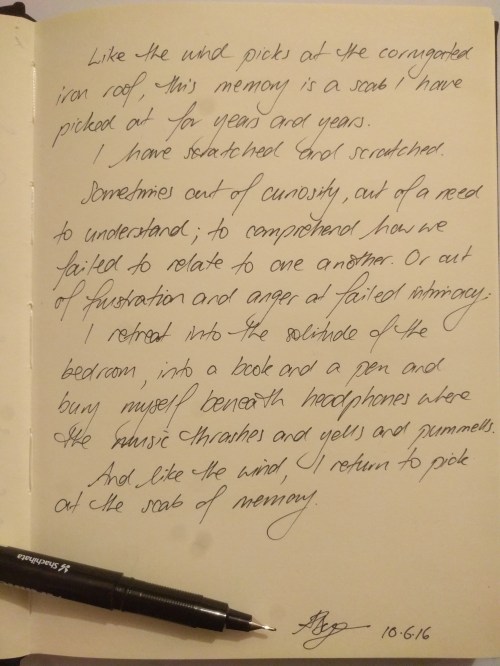
I grew up in a house with a corrugated iron roof and loved hearing the sound the rain made on it. It’s a familiar sound and a familiar memory and I used it as the basis for an idea developed below.

IMG_20160609_080729

Like the wind picks at the corrugated iron roof, this memory is a scab I have picked at for years and years.
I have scratched and scratched.
Sometimes out of curiosity, out of a need to understand; to comprehend how we failed to relate to one another. Or out of frustration and anger at failed intimacy. 
I retreat into the solitude of the bedroom, into a book and a pen and bury myself beneath headphones where the music thrashes and yells and pummels.
And like the wind, I return to pick at the scab of memory.

Handwritten Pages #4

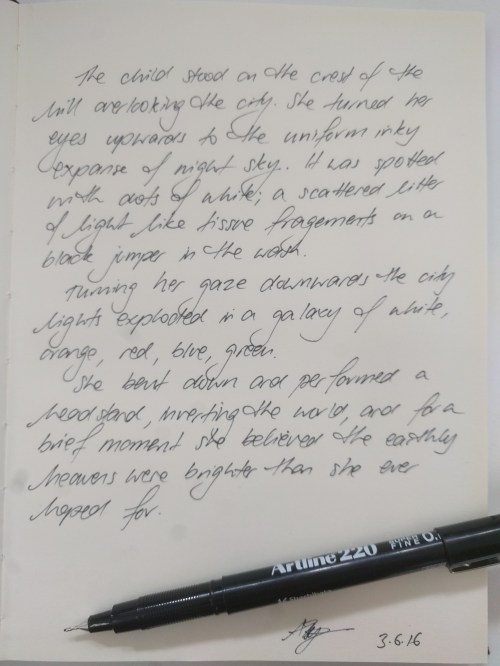
Sometimes it’s random images that lodge in my head like a splinter. This is one of them. I think there’s more to this story but I’m putting it aside for later to see what grows out of the compost heap.

IMG_20160603_100132

The child stood on the crest of the hill overlooking the city. She turned her eyes upwards to the uniform inky expanse of night sky. It was spotted with dots of white; a scattered litter of light like tissue fragments on a black jumper in the wash.
Turning her gaze downwards the city lights exploded in a galaxy of white, orange, red, blue, green.
She bent down and performed a headstand, inverting the world, and for a brief moment she believed the earthly heavens were brighter than she ever hoped for.

Why Do You Write? A Revision

Almost four years ago I wrote this post, The Reasons Why. It lead to Light My Way – A Creative Manifesto. It was first and foremost an exploration of why I write. It also examined why others write. 

This is my manifesto:

I write because I want to tell a story, but not just any story.

I write because I want to tell the story of those who are not heard.

I write because I want to tell the story of those who cannot speak.

I write because I want to tell the story of those who are disempowered.

I write because I want to tell the story for those who cannot.

I write because I believe that telling a person’s story is integral in understanding who they are.

I create art to speak into the darkness, that I may be a light for others to ignite their own flame and walk clearly.

The other night I was talking with my collaborator, Jodi, via Skype and she was discussing her social media sabbatical. Part of the sabbatical involved a three-week camping trip to the middle of nowhere in Central Queensland, without phone reception. It allowed her time to revisit the fundamental question of “Why do I write?” 

For her, the stripped back existence allowed her to return to what it was about writing that inspired and motivated her.

Every so often we need to pause where we are and revisit why we write and see if it still aligns with the vision we had. It may need a revision, a realignment, a reappraisal, a reworking.

If you’ve moved away from the core reason for writing, you’ve lost vision.

I returned to my creative manifesto and asked if these were still the reasons I wrote. I am pleased to respond in the affirmative. It’s a good check, perhaps once every six months or once a year, to reevaluate why you write to ensure you are aiming to produce the best work you can.

Why do you write? Have you made a revision of your purpose?

Practice Pages – The Disappearance of Noise

As drills are to an athlete, or scales to a musician, practice paragraphs are to a writer.
Here’s a little sample of an idea I foraged from my notebook.
Feel free to remix it in the comments section.

The Disappearance of Noise

All of the clocks of my childhood are silenced into obscurity:

– the bedside alarm clocks in my grandparents’ bedroom, wound at the back

– the grandfather clock in the hall where time always seemed to move slower as I watched the pendulum arc back and forth, slicing the moment, shaving it second by second. The inscription, tempus fugit, the first Latin I learned, and didn’t understand the irony until I stood thirty years in the future.

– the clock on the mantle in Nanna and Grandpa’s house was more hurried, urgent, pacing the time to meet appointments, chiming the quarter hour in mimicry of Big Ben.

All of these sounds, the midnight soundtrack to treading the hallway carpet barefoot, its texture a fresh cut lawn, skipping to the cold tiles of the bathroom. And back again.

Now I lie awake and listen, in between the passing of cars at two o’clock in the morning, for the ticking of my watch. I know it’s battery operated, no longer the wind up mechanism of the watch of my youth. Finding it wound down to silence, bringing it back to life, then placing it to my ear to hear the cogs pushing and pulling.

It was the mechanical rhythm, a lullaby of space. The tut-tutting of disapproval for wasted time, the snap of Lego connecting and the skipping of Nan’s knitting needles.

The digital age has created silence.

Mending the War – Flash Fiction

This was a piece I submitted last year to a competition. No result. Another piece to help me practice. 

But I’d like you to have a read and tell me what you think.

She looked up from the sock she was darning, needle paused mid-stitch, and watched the missile burn across the blank expanse of blue sky, rending it in two.

“Where is it going?” asked her granddaughter.

“To war.”

The smoke trail began as a small tear, slowly expanding, making the rift wider, ragged. Slowly, imperceptibly at first, the blue pushed through the vapour trail, dissipating the smoke.

“There will be another,” said the grandmother.

“When will we have peace?”

The needle wound through the fabric and pulled the two halves together.

“When we have learned to mend our hearts.”

Friday Flash Fiction – Indentation

Welcome to another Friday Flash Fiction.

This piece was the development of a very short piece (sub-200 words) I had submitted for a competition. I wanted to explore the idea a little further and see what happened. 

I toyed with the idea of subbing it out again but am leaving it on the digital practice pile. 

Indentation

I dislodged your glasses the first time we kissed, tripping over the hidden arms of the frames as I ran my hands through your hair. Unseated physically and linguistically, I fumbled an apology.

“Romance inhibitors,” you said pushing the glasses over your forehead, collecting your fringe, before taking them off.

The kiss interrupted we drew away from each other. You felt behind your ears the indent of a new paragraph.

“I’ve worn glasses for years,” you said. “Never really noticed it before.”

You drew me in again and before our lips cautiously brushed, I wondered how you could see without your glasses; a stupid thing to think because our eyes were closed. My fingers returned to the place behind your ear and traced the indentation, a small eroded furrow, and I stopped, retreating my lips from yours.

Your face, now naked without adornment, I saw two more dents, small and red, on either side of your nose. The slight weight of pressure bridging your face giving you the chance to see.

Over the years I watched the indentations change shape with each new pair of glasses, watch you adjust to how the new frames sat on your nose and behind the ears. You pinch your nose when you buy new frames, adjusting to a new bridge; push them back up your nose when you’re sweaty and they slip down when you lean forward. You push them onto your head when you read a book.

You never really get to see it, except when you look in the mirror, but with each new pair of glasses I create a new character: the bookish librarian, a 50s executive, the hipster folk musician. Only when we retire to bed do I see the character removed when you put your glasses beside the clock radio on your bedside table. Your face is no longer framed by what I impose upon it; the only evidence the two small, red indentations on your nose.

 On the couch I slip under your arm, fit into the shape of your body, perhaps worn as smooth as the spot behind your ears and wonder if we have worn a furrow between my legs each time we make love. I feel the shape of you within me, the pacing of your movement when you’re above me and I focus on the bridge of your nose. Or when I sit astride you and move with my own rhythm. Have I worn you down through the repetition of our lovemaking?

Now I turn the wedding band around my finger, notice the furrowed shape encircling, evidence of the presence of you in my life.

I still run my finger along the indentation behind your ear, searching for that first kiss. But you hate it when I dislodge your glasses, especially while you’re watching TV.

I’ve learned to wait until the ad breaks.


Friday Flash Fiction – Up and Down

Today I am posting a piece of flash fiction I have been working on for a while. The second half of 2014 was turbulent mentally and emotionally from a creative viewpoint where my day job demanded a lot of my attention.

I put off some short pieces until later in the year and was trying to decide whether I put more work into them to get them ready to sub, or put them out to pasture and let them go the way of cassettes and VHS tapes.

When the school year ended I managed to come back to these short pieces to have a closer look at them. I worked them over and decided that it was not worth subbing them out as I didn’t think they would sell. Maybe they would have sold but I felt it was time to put the old things aside and focus on the new. I’m also clearing my virtual desk to make way for some other projects that I want to attend to. 

Any piece of work is a practice, a development of voice, tone, structure, ideas. Some of them will work, others won’t and it shows you what you need to improve. It’s also a case of ‘showing my work,’ seeing some of the progress, some of my ideas, what’s working, what isn’t.

But you get the benefit of a FREE READ. Please enjoy it.

Up and Down

The blank television screen flickered on as he pressed ‘Play’ on the video camera. A young boy wearing a Superman cape was engaged mid sequence moving like a pendulum, arcing back and forth, on a set of swings. The cape fluttered behind him on the upward trajectory and stuck fast to his bottom on the downward pass.

A disembodied voice, too loud against the background noise, jumped from the speakers. “Hey buddy, how you doing?”

The boy waved. “Hi Dad.”

The camera flicked sideways and a woman with her arms crossed filled the frame, focused on the boy on the swings and her gaze did not alter. With another flick the scene changed again to see-saw, a simple old-fashioned broad wooden beam with a metallic T-shaped handle. Once painted green, only flecks remained between the splinters.

“Want to swing a leg over?” his voice asked.

“We haven’t done that in years,” she said, her arms folded stedfastly.

Jerky movements and the shuffling of feet accompanied the quick passing of ground. The handle came into view, then a hand grasped it, pulled it closer to the camera. A bump, clatter and suddenly the movement ceased.

He raised his end to equilibrium, the seat in line with the horizon behind it then dipped it lower.

“Chivalrous,” she said and walked to the other end. “What have you done to the camera?”

“Attached it to the handle,” his too loud voice said.

She straddled her end, filling the frame, and took the weight. The camera jerked slightly as the sounds of him lifting himself onto his end filtered through. She moved higher as the horizon dipped beneath her.

“Think we’re a bit old for this?” she asked.

With a gentle push upwards, she descended, the horizon moving up and down like a pilot’s instrument as she stayed in the centre of the frame, an odd optical illusion. She bent her knees and absorbed the weight, feeling the pressure, making it difficult to gain purchase.

Slowly, momentum begat momentum.

Up

     and

            down.

            up.

     and

Down.

Movement opened conversation.

“Remember the roundabout in the old park by the railway station?”

“It always made me dizzy.”

“You felt sick on the carousel at Luna Park on our honeymoon.”

Up

     and

            down.

“But you did win me the big teddy bear.”

            up.

     and

Down.

“How are the kids going with their homework?”

“I am now adept at my times tables.”

“Katie’s teacher is worried about her progress.”

Up

     and

            down.

“Remember the holidays to Coffs Harbour when the kids were in primary school.”

“Car sickness all the way.”

“Katie was stung by bluebottles.”

“And bananas with every meal.”

“Stuart was convinced he’d become a monkey if he ate any more.”

            up.

     and

Down.

“I heard Susan’s mother died. How is she coping after the funeral?”

“She’s finding it very tough but she’s managing.”

Up

     and

            down.

“Want to try for equilibrium?”

The camera wobbled and rocked as they shifted and slid, her body leaning forwards and backwards, as her arms outstretched like she was balancing. The horizon settled in a moment of balance.

The afternoon breeze picked up, punching into the camera’s microphone, and almost imperceptibly the horizon behind her lowered as the balance shifted until he knew for certain he was descending while she ascended.

Up

     and

            down.

            up.

     and

Down.

            Two young faces crowded the centre of the seesaw, careening into the view of the camera.

“Mum and Dad, what are you doing?”

“Going up and down, sweetie.”

“That’s not a real answer.”

“Help your Mum off, please.”

His son offered a small hand to his wife. She twisted sideways and with a little girlish yelp, jumped off.

The imbalance of weight jolted the camera and when it steadied she was no longer in frame, the end of the seesaw vacant. The camera wobbled again as it was unclipped and the view pulled backwards until the whole seesaw was in the frame, slowly coming to a halt with his end paused above the ground.

Her voice broke in over the image. “You still ok to have the kids same time in a fortnight?”

“Yes.”

“Say goodbye to Dad.”

There was a sudden collision of bodies and arms, muffled farewells and the wet smack of kisses as the camera pointed to the dirty patchwork of grass and dirt. In the bottom half of the frame arms entanged each other and feet shuffled.

The embrace finished, the camera swung up and captured the boy and girl walking hand in hand with their mother, disappearing towards the car as a focal point.

The camera turned, focused on the seesaw paused in its trajectory.

Two young children raced over for their turn, chose an end, scrambled on and bounced

Up

     and

            down.

            up.

     and

Down.

Leaning forward he pressed the ‘Stop’ button and stared at the blank television screen.