
Tag Archives: satire

Why Writing is Like Building Furniture from Ikea

Pick up the novel nearest to your hand you have read. Flick through it. You understand the plot, the characters, thematic concerns and the nuances of the language used by the author. It is said that everyone has a novel in them. Then you think, “I can give one of these novel things a crack. Doesn’t seem too hard.”

In your hand you hold a pen, ready to scribe your first novel. You know your story will unfold like a fresh bed sheet snapped out, floating down with delicate grace. The characters are complex individuals; the dialogue witty and full of sly observations; the plot is fresh and modern; the thematic concern touches on the toughest questions of life (but you have all the answers).

Sitting down you aim to start, but suddenly you are verbally constipated, stuck with the result of too much cheese and crackers. There are brief starts and squeezing out paragraphs with such force you could turn coal into a diamond.

So while it is said there is a novel in everyone, it is also said that no man is an island or that, all in all, we’re just another brick in the wall. And maybe that novel inside you should stay there because not everyone is called to be a novelist in the same way I am not called to be the Prime Minister of Australia (it would be a benevolent dictatorship, I assure you).

And it is because writing is difficult. It is hard. It is brutal at times. To understand how hard writing is, let me write you a simile.

Writing is like building furniture from Ikea.

In your hands you hold the instruction manual and emblazoned on the front is a catalogue image of what the finished product should look like. Caveat Addendum: power tools and me are mutually exclusive entities. I am useless with things that would validate my Man Card for all eternity.

Turning to the first page, the opening declaration states: “You must be two people to assemble this item.” (True story – was in the instructional leaflet for a lamp my wife and I received as a wedding gift).

So you lay out on the ground all the component pieces, checking you have everything you need. Then there’s the Allen key, the hexagonal tool of mystery. It is the key to success but lose it and you’re doomed to a lifetime of failure if you cannot wield it’s magical properties.

And so you begin. The instructions make no sense, you need the input of 6 people and certain words fly out of your mouth that would cause your mother to wash your mouth out with a wire brush and Dettol if she heard you.

People know to stand clear because the vein in your temple is throbbing and pulsating like a death metal blast beat, and one more inconvenient dropped screw or slipped piece of timber will cause your frustration level to become cataclysmic.
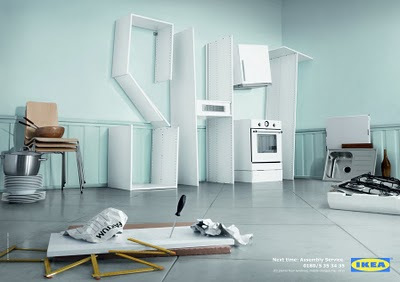
I am not usually a swear-y person, but this ad was too good not to include. Please excuse me.
http://madisonadblog.wordpress.com/2011/05/05/oh-sht/

The object before you takes on the appearance of Frankenstein’s monster; it is ugly, gangly, obtuse, imperfect, but dammit, you’re making it!

And yet you persevere; this thing will not beat you. Your aim is to give it life, and LIFE IT SHALL HAVE!

Finally, after hours of building, cursing, swearing, begging, pleading and grovelling, IT IS FINISHED. All the lines and angles are straight. Its beauty and function are unparalleled.

You did it!! (with a little help from your friends) And you don’t have a piece missing or a leftover screw.

And then someone asks why couldn’t have just bought one that was already put together.

This is why writing is like building furniture from Ikea.

With thanks to Jodi Cleghorn (@JodiCleghorn) and Monica Marier (@lil-monmon) whose comments I have appropriated.

Add your own additions to this idea in the comments below.
10 Signs Your Child Is Destined to be a Writer

You might be a failed pen monkey, a starter of stories (but not a finisher of fables), or a wit in conversation but witless with words, yet your progeny has inherited the gift of the gab and the social mores of Hunter S. Thompson.

Here are 10 signs your child is destined to be a writer (hopefully without the social mores of Hunter S. Thompson).

1. The first gift they ask for is Roget’s Thesaurus and a copy of the Oxford English Dictionary (the 20 volume hardback edition, including supplementary volumes).

2. On their birthday they receive a card and gift certificate from their local bookstore AND local stationery supply store.

3. At bed time they don’t ask for a bed-time story; they ask you to read from Roget’s Thesaurus and the Oxford English Dictionary.

4. Your child categorically states, “a red pen is not for marking, it’s for editing.”

5. Your child is editing the work of other students. In kindergarten. For a fee (usually biscuits or first turn with the toys).

6. Your child has memorised the Associated Press Style Guide.

7. Your child no longer refers to you as “mother” or “father.” Instead you are referred to as “agent” or “publisher.”

8. You spend more money on printer ink cartridges and stationery than clothes for your child. You’ve even considered buying stocks in companies producing printer ink cartridges and paper manufacturers.

9. Last week’s family argument suddenly appears in the latest edition (completely fictitious, mind you, so they say) of their weekly web serial, “Stress Family Robinson.”

10. Your child edits the family Christmas letter and sends it back to you for revisions.


2012 Anti-Resolutions

I am not one for New Year’s Resolutions. I simply lack the required discipline.

Therefore, here are 10 things I will not be doing in 2012. They are not hard and fast rules. Rather, consider them more as guidelines or suggestions.

1. I will not let grammatical travesties go unedited. I will be there with chalk, pencil, pen, permanent marker to rid this world of apostrophe abuse. Time to form the Punktuation Squad with my English Department.

2. I will not always be wearing pants.

3. I will not give up strawberry-iced doughnuts, strawberry milkshakes and caffeine-enhanced, temperature-decreased beverages. Elvis would be proud. I will, however, cut back. Sort of.

4. I will not let popular culture and the media reduce my level of intellect to that of a cesspool of mediocrity. I will tell stories of worth and intellectual depth. However, I will also include the occasional fart joke.

5. I will not forsake my faith. To others it may appear to be an opiate or a crutch, but it is my anchor, hope and love.

6. I will not believe that a cardigan is a fashion faux pas. I intend to purchase one from a second hand store for when I am writing. I have made every effort to ensure the wearing of a waistcoat, pocket watch and a hat are all in for a fashion resurgence.

7. I will not tell Year 7 their music choices are rubbish. I will lead by example and have them listen to the great music. They will come to know why it is great. I will also not spend the first 40 minutes of their music lesson playing a drum solo. But it would be pretty cool.

8. I will not forsake the company of good friends (and tell them they are loved and cherished), good books and good music. All three are integral to make this writer happy. Especially when combined with a cup of tea.

9. I will not let social media dominate my life. I’ll be right with you after I check my email, update my facebook, check twitter, comment on a few blog posts and browse Google+.

10. I will not measure my success against what others are achieving. Nor will I compare myself to what others have achieved or completed. I will measure my success by the goals I have established.

A Modern Family Christmas Letter

Greetings to family, friends, acquaintances, hangers-on and my parole officer,

2011 has been a great year for the Bright family.

The beginning of the year saw the release of Father Robert Bright from his time as a suit and tie man with his retirement. He said he was glad to be rid of the routine of work. Now his routine consists of the couch, the newspaper, television and the garden shed. His favourite couch bears the burden of his backside but is given respite during the afternoons when he potters down to the local pub for a beer. It is a little embarrassing when he trundles down in his tracksuit pants with the threadbare bottom and slippers where his toes poke out the end. I’ve tried to make him change but his response is always the same, “But they’re comfortable, woman.”

Retirement has given him more time in the garden. This year he exhibited his orchids in the local show and did quite well. He seems to have taken up smoking again, although it doesn’t smell the same as the pipe tobacco he used to smoke all those years ago. It tends to make him quite peckish and he asks for a toasted cheese sandwich before breaking into a fit of giggles. And for some reason, Robert has gotten to know a large number of young people who come along to the flower shows. It is good to see young people taking an interest in botany.

Retirement suits us and we are thinking of buying a caravan and living the life of grey nomads. The children are old enough to take care of themselves now and we deserve a little fun in our dotage.

Adrianna finished her third year of law and her twelfth phase of experimentation. This year she explored the many varied definitions of the word “gay.” Before that there was veganism, socialism, ecological concerns and some obsession with a book about vampires and werewolves. She is our little “quiet achiever” so we aren’t too concerned.

We finally managed to get Jack over the line in his final year of schooling. It took many hours and many visits to the Principal’s office, but we managed. The Principal even wrote us a lovely letter of recommendation when Jack finished.

Jack’s fascination with fast cars landed him an apprenticeship with a local car dealer and he has been loving every minute of it. My little Datsun 120B has never run smoother. However, the addition of new paintwork makes me a little embarrassed to run down to the shops. Jack added some flames pouring from the wheel arches. I think it looks like a Matchbox car. And the fluffy dice and garter hanging from the rear vision mirror do make it a little hard to see sometimes.

He has been seeing a lovely young lass by the name of Felicity. They met at TAFE studying auto engineering and have been inseparable ever since. She and Jack spend many hours discussing cars, although I do wish she would put some clothes on sometimes. She’ll catch her death of cold if her skirt climbs any higher up her thighs. And she has an unfortunate tattoo on her lower back. I can see it as her jeans tend to sit quite low, revealing her underwear, although I fail to see how a piece of string counts as underwear these days. The tattoo reads, “Ride it like you stole it.” She must love cars to express her passion in such a permanent way. Coincidentally, I once found an unused prophylactic on the back seat. Jack swears it belonged to a friend and that it must have fallen out of his pocket one evening.

I think young Jack needs a new prescription for his glasses. He keeps getting pulled over by the police for speeding. He swears he was doing the speed limit.

Great Aunt Beryl is getting younger every year. This year it’s been her knee. Her knee is one of those new-fangled plasticy doo-dads that comes with a lifetime guarantee (which for Great Aunt Beryl may not be that much longer).

This knee goes along with her other knee, both hips and a set of breasts Dolly Parton would be proud of. For the life of me I can’t imagine young looking perky breasts protruding from a chest which Robert says had enough folds of skin she could be a MAD magazine fold in.

This year for me has been one with its ups and downs.

It’s been a tough year on the tennis circuit. We had a new member join us who looks like Anna Kournikova. Well, Anna Kournikova in 40 years’ time. I’ve had to attend a number of funerals of ladies from the club whose time has been called. “Game, Set and Match” as one wit described it. The old black tennis skirt has been getting a workout. It may need replacing next season.

What with Bridge Club, my Book Club, the Country Women’s Association, Meals on Wheels and meeting with my parole officer, I never seem to have a moment to myself.

Have to run along and tend to the Christmas pudding.

Wishing you all a fabulous 2012.

Much love and hugs and kisses from me and all the Bright family,

Miranda

Merry Christmas 2011

Baa Baa “Adjectival Colour Nomenclature” Sheep

The Committee members shuffled papers and snapped locks on briefcases. Coffee orders were taken and promptly delivered before withdrawal symptoms set in. The small bowls of lollies were passed from hand to hand and rapidly emptied. The cream biscuits were always popular comestibles, except for those who believed in the fattening effects of dairy-based products. Otherwise they were simply scoffed down with slurps of tea or coffee. Chocolate biscuits had been banned after an unfortunate incident involving The Chocolate Orgasm, otherwise known as The Tim Tam Slam, the Heimlich manoeuvre and an emergency clean up response crew from Domestic Hygiene.

The Chair of Non-specific Gender motioned for the meeting to start.

“First order of business: Inappropriate Adjectival Colour Nomenclature in the emergent adult nursery rhyme Baa Baa Black Sheep.”

Mutters of consternation rippled along the table. Tortoise shell spectacles and twin set cardigans were shuffled back into place. Spectacle chains rattled on pearl necklaces.

The Chair raised his hand and the murmurs ceased. “It is clearly understood that ‘black’ as a colour nomenclature is not appropriate. While as a colour designation it allows for a stunning example of alliteration in conjunction with onomatopoeia for pre-educational individuals, it has been suggested the adjectival colour nomenclature of the sheep contains racial overtones derogatory to the descendants of African origin. It is out task to determine another adjectival colour nomenclature. What other colours can we propose?”

“How about ‘Baa baa blue sheep? It maintains the alliterative structure of the nursery rhyme and has no apparent discriminatory overtones.”

From the other end of the desk came a response. “Blue is a stereotypical boys’ colour and we’d only be reinforcing the inherent patriarchal notions of gender, subjugating the feminine and universal womanhood.”

“What about pink, then?”

“Then you’re espousing matriarchal hegemony, which while brings a measure of equality back into society, only serves to reinforce the stereotypical colour of femininity for girls.”

“Baa baa red sheep?” someone else volunteered.

“It will give you the socialist vote, however I don’t see them reciting a chant that programs an economic model of the mode and means of production where the sheep has to give up its hard grown wool for the sake of a snotty young capitalist.”

A snort of muted laughter drew attention. “Three words: feminine hygiene product. I wonder if there’s a commercial featuring sheep playing tennis, running along beaches and generally being carefree?”

“And you can discount the colour grey as a monotonous capitalist framework for serving the system.”

“What about purple?”

“Historically it’s the colour of royalty. The monarchists would be saluting with Earl Grey Tea from their Wedgewood china cups. Especially with a royal wedding front and centre of the public eye at the moment. However, the republicans wouldn’t stand for it.”

“White?”

“Too many colonial and imperialist overtones. And besides, it’s too bland. It’s like vanilla ice cream; everyone eats it, but no one really enjoys it.”

“Yellow?”

“Well, sheep aren’t really an Asian thing are they?”

“Green?”

“It gives you the environmental vote, but then you’ve lost the capitalist community.”

“Orange?”

“Too Dutch. Have you ever watched a sporting event where they are playing? It’s an eye sore seeing a wall of orange.”

“Can I suggest ‘Baa Baa Rainbow Sheep’?”

“The rainbow has been appropriated by the GLBT community so come Mardi Gras time you could sing about sheep all you want. But then you’ve marginalised the heterosexual community and let’s face it, they are the ones currently filling the majority of vacancies in formative adult nurturing centres and pre-educational institutions.”

There was a pause as the committee stalled at the lack of remaining colours. An impasse looked inevitable. A voice broke their ruminations.

“I think we are overlooking a very important part of this nursery rhyme.”

The committee looked towards the member.

“Well, if you ask me, isn’t this little ditty a little bit species-ist? Why does it have to be a sheep? What about other wool-bearing animals: llamas, alpacas, goats? Shouldn’t they have a say in all of this?”


Another Brick in the Wall

[Fiction] Friday Challenge #161 for June 25th, 2010

Include a telepathic parrot in your story.

The Education Revolution of 2015 brought an end to conventional warfare.  The guns were turned into iphones.  The bombs were transformed into children’s play equipment.  But the war of the mind had just begun.

Out of the shadow of the Revolution came a new army: the hearts and souls and minds of thousands upon thousands of school children, called to learn for the advancement of their country.  They were to take over the ivory towers and wage algebraic war.  Universities and high schools waged brutal war as academic papers filled the ether like gun smoke.

But…

The Homework Police appeared as silent ghosts, sentinels of academia.

These are their stories…

“Probationary Constable Dawkins, it would be much appreciated if you could hurry up for your first shift on the beat,” said Senior Sergeant Croydon.  “And make sure you collect the parrot.”
“Yes, sir.”
Probationary Constable Dawkins followed his superior officer to the patrol car, the birdcage cradled in his arms.
“Just watch your fingers as Polly here takes a fancy to the odd digit poked inside his territory,” said Croydon.  “And his name is ‘Fingers’ which happens to be ironic and a clever pun.”
Croydon fired up the ignition and pulled onto the main road.

“We are the guardians of intellectual integrity,” intoned Croydon.  “We are the matrix that binds our community and gives us the upper edge on other fourth-grade reading nations who prefer the sandpit to intellectual endeavours.

“You see, there are two types of intellectual avoiders, cheaters if you like.  The first is your simple down and out.  They know that their life is destined for menial tasks, totally required for the function of society mind you, but their sights are not set on world domination.  All they are trying to do is boost their marks a bit to get a better job.

“The second is your driven individual.  You know, the one who was reading Stephen Hawking’s A Brief History of Time at age four and playing Mozart’s concerto on violin and piano simultaneously by age six.  They will try anything to get ahead: brain vitamins, mental arithmetic, anything legal or illegal.

“And that’s where we come in.  Identify and prosecute.”

“But where does the parrot come in to all of this?”

“It’s telepathic.  It can read the brainwaves of students and knows if they are cheating or trying to hide something, even when kids take beta-blockers and delta wave inhibitors.”

Croydon pulled the patrol car into the grounds of the school and parked in the spot marked “Principal.”  Dawkins followed in Croydon’s wake to Reception and was directed down a corridor towards the main auditorium.

The sound of two hundred and fifty pens and pencils scratching on exam papers sounded like a bunch of mice having a Bacchanal orgy whilst writing a cryptic apocryphal gospel.

“Kids these days with their ipods and facebookspace and their make out parties.  Best thing they did was stop computer testing and go back to old fashioned pen and paper,” said Croydon.

“What was that, boss?”

“Nothing.  Just talking to myself.”

Senior Sergeant Croydon crossed his arms, moved his feet slightly apart and scanned the hall.  The presence of Homework Police was nothing new during final exams; it hardly raised an eyebrow.  Nevertheless, the guilty could feel their heart rate quicken as their breathing became shallower.

“Release the parrot, Dawkins.”

With a hop and a step the parrot exited the cage and took off around the room.  Croydon began to amble down the aisles, watching for tells and signs.  The fidgety glance; the uncomfortable bum shuffle; the dropped pencil.

Croydon whipped out a tissue and thrust it into the face of a fair haired lad.

“Stop your sniffing.  It’s just annoying.”

The parrot squawked and alighted on a desk a couple of rows over from Croydon.   A young girl let the wavy brown locks cover her face.

“Come on.  Let’s see you,” said Croydon.

“Hello, Uncle Jack,” said his niece.

Croydon lifted his cap and scratched his thinning hair.

“This is going to make Christmas a very awkward affair this year.  Let’s go.  On your feet.”

Two hundred and forty eight pairs of students’ eyes followed the parade of the guilty, while only one noticed the pencil roll off the edge of the table, watching it tumble like an acrobat until it hit the floor, its point fragmenting into splinters.

A Walk in the Black Forest

[Fiction] Friday

Friday 19th March
Your character doesn’t make impulse purchases, but one day at the market they felt compelled to buy… what?

Geoff followed in the slipstream of his girlfriend around the flea market as she moved from stall to stall like a bee after nectar.  She took in racks of oddment clothing, holding them against her and asking if he liked the colour, but didn’t usually wait for an answer.  This was followed by handmade knick knacks and jewellery, pot plants and the requisite doner kebab stand.

He didn’t mind the day out with Miranda, but what really got him was her impulsiveness.  Everything she bought was a bargain, she claimed, and Geoff nodded assent and observed the cacophony of the senses abused by the toothless, dreadlocked, bearded and heavily tattooed busker whose guitar seemed to be missing a number of strings.  At the moment Miranda was poring over a trestle table of dye tied cloths.

Geoff took the moment to glance around and settled his eye on the stall behind to his right.  Amongst the dream catchers and shamanic artefacts were blankets.  At least that’s what Geoff thought they were.  On closer inspection he saw that they were in fact bear pelts with their heads drooping over the edge of the table.

The woman behind the stall stepped up to the bench and said, “Do you like them?”

Geoff looked up, literally, into the sapphire eyes of a Germanic looking woman with broad shoulders, ample bosom and flaxen hair shot through with silver tied into a plait the thickness of a ship’s rope.

“You don’t see these all too often,” said Geoff.

“They belonged to my great-great grandmother back in the motherland and she brought them out with her many moons ago.”

“What’s the history behind them?”

“It’s a family of European brown bears; father, mother and cub who were menacing a village near the Black Forest.”

“Wonder if Goldilocks met them?” quipped Geoff.

“Fairy tales have a strange way of being somewhat true, no matter what Disney does to them.”

Beside the pelts was an array of knives, plain and ornate.  Geoff spotted one with a horse head handle with an ivory inlay.

“My great-great grandmother was good with a knife.  Or so the legends say.  This is apparently the one she used on these three,” the woman said indicating the pelts.

“How much?”

“Thirty dollars.”

Geoff opened his wallet and handed over the money.  Taking his purchase from the Germanic woman with the ample bosom he went over to catch up with Miranda.

“Oh you bought something.  That is so unlike you.  You’ll have to show me later.  Come on, let’s get something to eat.”

The afternoon clouds interrupted with sudden peals of thunder and spits of rain.  As the crowd dispersed to find shelter and stall holders quickly covered their wares, Geoff took a final glance at the stall.

The woman grabbed a stole and cast it around her shoulders.  It was a burnished red and the hood resembled a wolf’s head like a Roman centurion.  She disappeared as the rain formed a curtain between them.