
Want to be a better writer? Learn to play the drums.
This is a strong statement to make, but one worth pursuing. I am postulating that understanding the tenets of rhythm in drumming helps to understand the tenets of rhythm in writing.
As a drummer it is very frustrating to have someone come up to me and say, “Can I have a go?” If I’m feeling generous I will offer the sticks and step aside.What is worse is when they sit down without permission.
Then they proceed to go about bashing and thumping my drums. They hack and whack. There is no rhythm, no pattern or structure. No thought to dynamics, velocity or touch.
And writing is just the same. If you have no idea what you are doing, you are going to be making a lot of noise and not a lot of sense.
Learning to play drums is fundamentally about understanding rhythm and how it relates to the purpose of the music.
Learning to write is fundamentally about understanding how the rhythm and cadence of words relates to the purpose of the narrative.
Learning to play the drums is like first learning how to write. We are still learning the rules of drumming (or the rules of writing) and our playing (or prose).
Let’s learn a few basic principles of drumming to understand how playing drums can improve your writing.
When you learn to play drums, you learn the simple action of RLRL (where R= right hand and L = left hand)
Then you learn to play doubles: RRLL RRLL
Combine the singles and the doubles to create a new combination known as a paradiddles: RLRR LRLL
Then there is the triplet (counted 1 2 3): RLR LRL (or RLL RLL or LRR LRR)
One more thing to know: the flam. The flam is an unaccented note (or grace note) followed by a main note. It is written as lR, rL.
Then you learn a basic rock pattern:

or a basic jazz pattern:

Once you know these basic phrases of vocabulary, everything else is simply a combination of these phrases to form a fill pattern (or musical sentence).
When you learn to play drums, it first sounds mechanical and awkward as you adjust your body to learn new movements and patterns. It takes time to internalise the rudiments, patterns and techniques. Once you internalise the methods and patterns, it ceases to be simply rudimentary techniques, but becomes a free flowing extension of your playing.
The same applies to writing. Our first pieces of prose are often clunky and formulaic, lacking finesse and a sense of style. It takes time to internalise the process and structures of writing. For example, learning to write short sentences increases the pace or action of a passage while longer sentences slow down the pace. It’s a matter of knowing when to use different techniques.
And learning to understand rhythm in a piece of music will help you understand how rhythm works in a piece of writing and will help you to construct better prose. You understand how to achieve your purpose by using or amending the rules.
In music, as in writing, there is a place for the simple and the complex.
The simple can be effective as evidenced by Phil Rudd from AC/DC – Back In Black. It’s not a complex drum pattern, but it fits the music perfectly.
But the complex also has its place, both in writing and in drumming. Frank Zappa wrote The Black Page for drumming virtuoso, Terry Bozzio as a challenge. Nailed it.
But more importantly, knowing you can be complex does not mean you have to show it off.
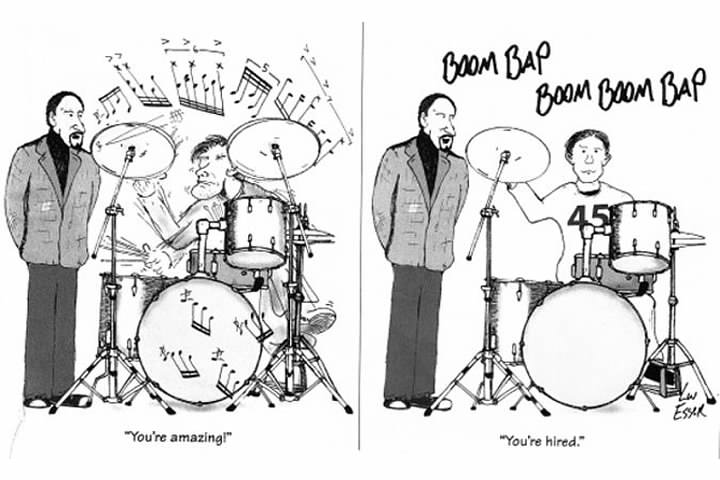
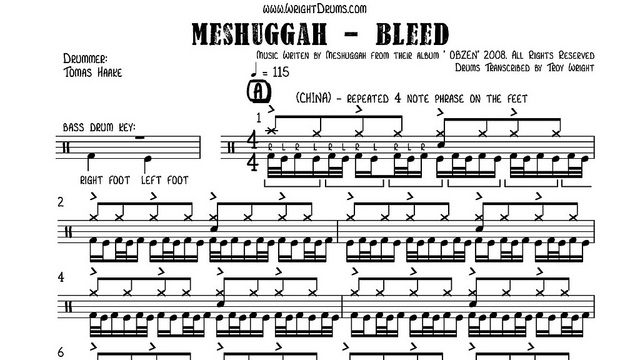
Whenever we learn a new writing trick, it is tempting to incorporate it into our latest work in progress. Drummers are no different. Learning a new fill or pattern, we tend to use it at every opportunity. Not always appropriately. Imagine a dramatic Meshuggah-style double bass drum onslaught in the middle of a jazz standard. Not always going to work. But mash ups can work. Try this: Meshuggah vs Lady Gaga– Bleedarazzi
And this is what the drums look like
In writing, the same principles apply.
Sometimes simple prose communicates the message most clearly while at other times complex, dense prose is required to communicate the ideas of the writer. Neither is necessarily superior although we still tend to elevate some genres and forms (both in writing and music) over others. But each writer needs to work out what vocabulary and style is required for the message he or she wants to communicate.
Drummers: Learn. Practice. Internalise. Repeat.
Writers: Write. Edit. Revise. Show someone your work. Edit. Revise. Repeat.
I can now play drums with ease and write with ease (some of the time). But I still have a lot to learn.
When I learn a new drum pattern or piece (whether it is simple or complex), I break it down into one or two bar phrases and practice it until I have it right and internalised the pattern. Then I can move on to the next phrase and repeat the process until I have learned the whole passage. Something new always takes time to learn.
When I am writing, I am aware of the rhythm I want to create in the sentences, paragraphs, descriptions and dialogue and the emotional impact I want to create in my reader. When revising and editing, I am looking for when the writing is not fulfilling my intentions and aims, to hasten or slow down the narrative, or increase the flow and rhythm of the narrative.
A wrong word disturbs the rhythm of the narrative, much like playing the wrong fill or hitting the wrong cymbal breaks the feel of a song. The best patterns and fills sound effortless, as does beautiful passages of prose, but you know there has been a lot of thinking (and writing, editing, revising) behind it to make it seem effortless.
Learning to play drums is another way to understand how you approach the process of writing.You are building a foundation of rhythm, drawing the reader into the world you have created. You want the reader’s heartbeat to increase in the tense moments, relax during the languid moments, and to break because they have become invested in your character’s life.
Trying something new and different, perhaps difficult (for those who think they have no sense of rhythm, I think everyone can grasp the fundamentals of rhythm and beat) will have a benefit – tapping into another aspect of the creative side of your brain, and allow you to extrapolate how it can have an impact and influence on your writing.
Go and buy a pair of sticks and a practice pad, and learn how to improve your writing. If you can’t afford them, buy a small shaker. Listen to a song on the radio and play along.
If you are a writer who plays an instrument other than drums e.g. guitar, piano, saxophone or bagpipes, does that musical knowledge make you understand and approach your writing differently?

 A Fullness in Brevity - Adam Byatt