Tag Archives: reflection

Piper’s Reach: The Writer and the Reader

Piper’s Reach – The Writer and the Reader

A writing adage you see on various blogs is to write for your ideal reader, the audience you want to read your work. You create in your mind an image of a specific person, male and/or female, the type of person you imagine will enjoy reading your novel. The specific reader in mind, may in fact, be you.

When Jodi Cleghorn (@JodiCleghorn) and I sat down to write the epistolary serial Post Marked: Piper’s Reach (now being edited as an epistolary novel), it presented an interesting dichotomy. The instigation of the No Spoiler Policy (we did not discuss the plot or character development, but rather let the narrative form as an organic process) meant we were thrust into the role as simultaneous writer and reader.

It was unique as Jodi wrote as the character of Ella-Louise and I wrote as the character of Jude; two high school friends reunited by letter after 20 years of silence.

Click here to read about Piper’s Reach – The Project
img_1100

As each letter was written, posted and received, we had no idea of its content in regards to plot or character. It was the perfect balance between writer and reader. 

We wrote as authors, read it as readers. 

With each letter we would read and reread from different perspectives:

As writers:

  • Looking for the momentum and motivation in the character’s actions and how it moved the plot forward
  • Contemplating different permutations of plot for both characters
  • Establishing back-story and history for each character, events significant to both characters and how it affected the present day.

As readers:

  • We became caught up in the lives of the characters; how their past and present intertwined, split, became a messy entanglement and how they tried to sort it out.
  • We read the voice of each character, how Ella-Louise and Jude articulated their thoughts, what they wrote about and how they expressed it; what they revealed and what they kept hidden.

Jodi asked if I read the letters as the character of Jude or as myself because I was both catalyst and consumer, the writer and the reader. It was hard to separate myself from the narrative of Ella-Louise and Jude, to be solely the reader as each new letter was a revelation of character, plot, motivation and secrets.

There were times when I deliberately distanced myself from the character of Jude to read a letter, to be the reader and not the writer. I let myself be absorbed into the world of Ella-Louise as she revealed it, taking it at face value, rereading it again to further my understanding of who she was and what she wanted.

In the same way there were letters I read intentionally read as the character of Jude to feel the impact of the letter as Ella-Louise wrote to her dearest and most-loved friend.

Engaging with the letter as either writer or reader produced strong emotions, even to the point of tears.

Now we are in the editing phase, we get to experience the narrative of our characters all over again, this time solely as readers. After we have made our notes and compared them we will return to our role as writers and continue fashioning the narrative and our characters.

It lead me back to a question I have asked myself over the last couple of years in regards to writing and reading: Is a reader more interested in the story or the writing?

Is it an either/or, both/and dichotomy? Is the reader more interested in being moved by the story than the power of the words? Or is it the power of the words the more important aspect for the reader?

The power of storytelling versus power of writing with which there is no clear answer. The answer will not be a “Yes” or “No” response but a sliding continuum of responses. For some readers story will trump the writing and for other readers the power of the words will enhance the story and be the focus.

As a writer I aim to balance the power of the story with power of the word. I use words to convey the power and strength of the story, and I want you to be engaged as a reader with the story, drawn in by the power of the words.

Keep an eye for updates on the progress of Post Marked: Piper’s Reach and I hope you enjoy the story.
Creativity Week Wrap Up

Each day this week I posted a new idea on aspects of creativity.

I have gathered all the links for you in one easy place for you to catch up. I would love to hear what you have to say on creativity.

Monday – Create Useless Beauty

“Create a piece of art because it has no other function than to beautify your presence, illuminate your thoughts, elevate your attitude, satisfy your creativity, to please only yourself.”

Tuesday – Creative Dichotomy

“Make art from the beautiful and the ugly;

From the joyful events of life and from the circumstances marked by sorrow.”

Wednesday – The Bridge Between Imagination and Reality

“Creativity is the bridge between imagination and reality. We live in a divided state of how we see the world as it is and the vision of how we see the world as we want it to be.”

Thursday – Birth and Death in Creativity

“Creativity is a birthing act. Its genesis lies in the conception of an idea and by a word it is spoken into being.

And in the end we see that it is good.”

Friday – Creativity is the Mother Tongue

“We speak our mother tongue verbally and artistically. For some, we need to find our voice again. For others, it is strengthening their voice. Creativity is our mother tongue. Let people hear your voice.”

Have  a creative weekend.

Creativity is the Mother Tongue

Victor Wooten delivered this talk to TEDx Gabriola Island. He is a remarkable musician, master of the bass and a genuine and erudite educator.

The focus of his talk is music as a language. Listen carefully and you will learn.

I want to take his words and comment on them as they apply to other creative arts: writing and art.

Creativity (writing, art, film and music) is a language. Learn to speak a different tongue. Or in some cases, we need to relearn to speak our mother tongue.

Victor Wooten – Music as a Language (click link to view the talk)

I have taken excerpts from his talk, either quoted directly or paraphrased, and extrapolated their application to other artistic endeavours such as writing and art.

Your first language is not taught. People spoke to you. You were allowed to speak back – creativity should be learned with your mother tongue. Give children pencils and paper and allow them to speak in their own way. Give yourself pencils and paper and find your mother tongue again.

Beginners are not allowed to play with the masters – in music, the beginner and the amateur are separated from the genius of the master, able to watch but not participate. In all aspects of creativity we should learn from and participate alongside the masters.

As a baby, you’re jamming with language. Not made to sit in a corner and practice; not corrected when you’re wrong. Even to the point your parents learn the new way of speaking. You remain free in how you talk. When you could hear it (language), you started learning – Language is a freedom we have, a freedom of expression. Creativity is another freedom of expression. Learning language is immersive; we are around it all the time and learn the nuances from what we hear.

Growing up in Hawaii, Victor learned to play not by being given an instrument, but by being played to. A plastic stool was there for him to sit on and so he sat and listened. When older he was given something to hold – even before we understand what creativity is, how we should hold a pencil or a paintbrush, we must immerse ourselves in creativity activities and involve our children so they too, learn the language. When we surround ourselves with creativity we internalise the language.

Music is a pure voice. We want to teach the rules and the instrument first. We teach to play the instrument before they understand music. Learning to play music, not the instrument. Knowing the phrases, tones etc, learning – when we instigate boundaries and restrictions, demonstrate how-to or chastise for what we perceive as incorrect, we must stop and let the creativity flow from within. When our children see, and when we see, the joy flowing from the creativity within, we understand the process. The rules and techniques are there to serve as a creative conduit, not the tool itself.

When he was finally given a bass to play, Victor was playing to songs he already knew. He has listened and internalised the music. Therefore music flowed through the instrument. He was musical first, learning to talk not about learning the instrument first. It’s about what you have to say. He learned how to speak through his instrument – when our children have been given opportunity to be creative with great freedom, given the chance to express themselves, they will find their voice to speak clearly.

Practicing works but it is a slow process – practice alone for the sake of practice will develop skills but we will learn more when we participate in community and learn to speak with our own voice.

Children are born with freedom. A lot of us are taught out of our musical freedom when we’re first given a lesson because a teacher rarely finds out why we’re there in the first place. Playing air guitar where there’s no right and wrong. It’s not about right and wrong notes; they’re playing because it feels right

A woman said to me, “I’m Ella Fitzgerald when I’m in the shower.” And she’s right. The freedom we have a child is grown out of us, but we need to find a way to keep the freedom. Approach music like a language and allow it to keep that freedom, to keep the smile on the face, and not taken away by lessons – Creativity is expressive freedom and we would do well to instil into our children the freedom of creativity.

What does the world need with another good musician? *insert own creative choice here* It has become a lifestyle. To be a good musician, you have to be a good listener – this is good life advice. Choose your words wisely before you speak, or better still, saying nothing at all. It’s not all about you, or me; it’s about the people around us.

If you want music to come out of you, out of your instrument, you have to put it into you – do not let the well run dry. Fill it at every opportunity from whatever source.

If I use my greatness in the right way, it can help others rise up. If you’re on a pedastal, don’t come down, bring them up so they can see and they’ll grow faster – help others to find their creative voice if they have lost it. Create community to help others grow. Better still teach your children to be creative so they never lose their voice.

We speak our mother tongue verbally and artistically.

For some, we need to find our voice again.

For others, it is strengthening their voice.

Creativity is our mother tongue. Let people hear your voice.

Birth and Death in Creativity

Creativity is a birthing act. Its genesis lies in the conception of an idea and by a word it is spoken into being. 

It begins as a formless void. It is given shape and form through contemplation and meditation.

Once it takes shape it is subjected to the process of revision and refinement. The form is given definition, perspective, depth and clarity.

Yet some ideas do not germinate; they die in the ground or spark brightly only to last a brief while. Others grow and develop but their death is unexpected, brutal, surprising, or nurtured and cared for until the last breath.

There is a period of mourning as the elements reclaim what was but is no now longer.

Even in the midst of a death or dying, life is extolled and remembered in and through death, sharing humanity.

In the act of creating we experience a little death.

And in the end we see that it is good.

The Bridge Between Imagination and Reality

Creativity is the bridge between imagination and reality. We live in a divided state of how we see the world as it is and the vision of how we see the world as we want it to be.

What we see in our mind’s eye is a reflection of how we perceive the world, and how we perceive the world we want. Our acts of creativity are therefore an attempt to bridge the divide between our imagination and reality.

Our acts of creativity reflect the negativity of humanity as it is: the horrors and deprivations, and reflect the positivity of humanity as it is: the awesomeness of people when our humanity is shared.

Our acts of creativity are an attempt to understand why the world the way it is and an attempt to demonstrate how it could be.

Remember your purpose and your message in your creative acts.

Each creative act is building the bridge between imagination and reality.

Creative Dichotomy

Creative Dichotomy

Make art from the beautiful and the ugly;

From the joyful events of life and from the circumstances marked by sorrow.

Make art to evoke laughter and to break someone’s heart;

To provide fun for celebration and provide solemnities for mourning.

Make art to teach and inform, and to prick the conscience;

To elevate the humble and bring down the proud,

To encourage and to chastise.

Make art to provoke anger and rebellion;

To reflect and critique, to warn and admonish.

Make art to give voice to the voiceless and to silence the mouthpieces.

Make art to reflect and embrace the ordinary and the extraordinary.

Create Useless Beauty

Create Useless Beauty

Take a gander around the natural world and you will see a remarkable diversity. Even in the depths of the oceans where the creatures are nightmare fodder there is incredible diversity and beauty.

I’ve had the phrase “useless beauty” stuck in my head since I read Franky Schaeffer’s book, Addicted To Mediocrity (*) as a teenager. In reference to the diversity and beauty of nature he cited the jellyfish as an example. It exists within the ecosystem simply because it is. It exists because the creator designed it to be there. Therefore, it is beautiful.

What I mean by “create useless beauty” is this:

Create a piece of art because it has no other function than to beautify your presence, illuminate your thoughts, elevate your attitude, satisfy your creativity, to please only yourself.

Create a piece of art you can throw away or give away

Create a piece of art you can leave behind on a park bench or a cafeteria table.

The Beatles sang, “I heard the news today, oh boy.”

Every day we are surrounded by examples of the negativity, despair, the depths of depravity mankind can conjure and inflict upon one another on a daily basis.

However it does not take much searching to find the beauty of humanity in a shared experience of creativity.

And it begins with each of us creating useless beauty.

  • Write a short story scribbled on a Post It Note
  • Draw a random sketch on the back of a serviette
  • Record a hastily composed melody on your phone
  • Learn a favourite song, record it and post it to your blog or youtube
  • Fold an origami flower or a crane or a boat
  • Draw marginalia in the borders of the book you’re reading
  • Deface magazine pictures with a permanent marker
  • Take a picture a day (of the same spot, of something interesting you see about your day, but please don’t make it a selfie unless you’re making a documentary about yourself)
  • Decorate your office desk (or someone else’s desk).
  • Make a model aeroplane like you did when you were a kid.
  • Bake a cake (packet mix cakes are perfectly acceptable)

Make it something you would willingly give away, throw away or delete (don’t throw away the cake, eat it. Better yet, share it with others over a cup of tea).

Creativity is about communication.

Communicate first with yourself then communicate with others.

Practice random acts of creativity.

Create useless beauty.

(*) For those of you who have read “Addicted to Mediocrity” I realise I am taking a different angle to what Schaeffer was proposing, that of excellence in the arts. I believe in excellence in the arts, but I also believe in creativity as an integral part of the human experience. Excellence comes through refinement and dedication, learning and education in the arts. Schaeffer is addressing a cultural issue; I am addressing the need for creativity to be an important expression of our humanity.

And The Kettle’s Whistle Went Unattended

A cold torrent shudders from the tap into the cauldron-like bowels of the kettle. He clanks it down on the stove and presses the ignition switch, hearing the click, click, click, WHOOOSH as prelude and prologue to conversation. The flames tickle the kettle’s underbelly as an anticipatory act, fostering his nervousness while he waits.

He dispenses one, two, three teaspoons of leaves into the round-bellied glass pot. On the bench two cups sit side-by-side, their handles turned inward, barely touching.

The kettle whistles and he pours a question. Silently she lets it draw. He pours the milk, stopping when she nods and stirs the words again. She adds sugar to both cups, two for him and one for her, and posits a question of her own.

The tendrils of steam rush headlong into each other, tripping over one another and caught in tangles, melding into one breath.

Lest they burn their lips the conversation is spoken in sips. As the beverage tempers and cools, deeper thoughts are expressed in longer draughts. Drained almost to the dregs, remainders of words stain the bottom of each cup. An unfinished conversation threatens to evaporate as each hand holds the cup for the last whispers of disseminating heat.

She ignites the flame knowing it simmers close to the boil.

They depart while the kettle’s whistle remains unattended.

Tempest’s Questions – A Poem

Tempest’s Questions

Tempest's Questions

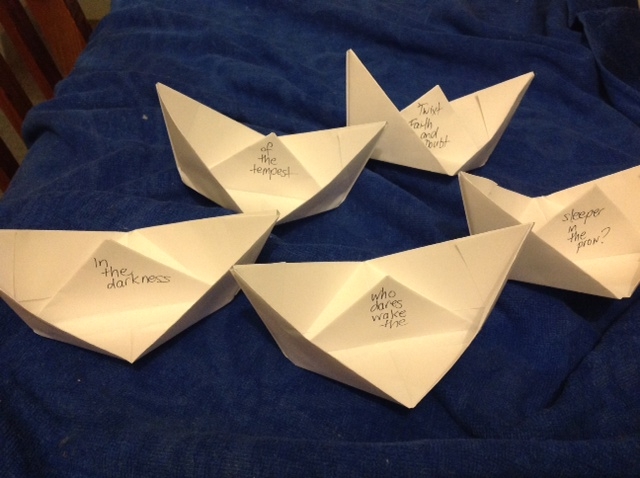
In the darkness

of the tempest

twixt Faith and Doubt

who dares wake the

sleeper in the prow?

Hands – A Poem

Hands

Hands 1Hands 2Hands 3Hands 4

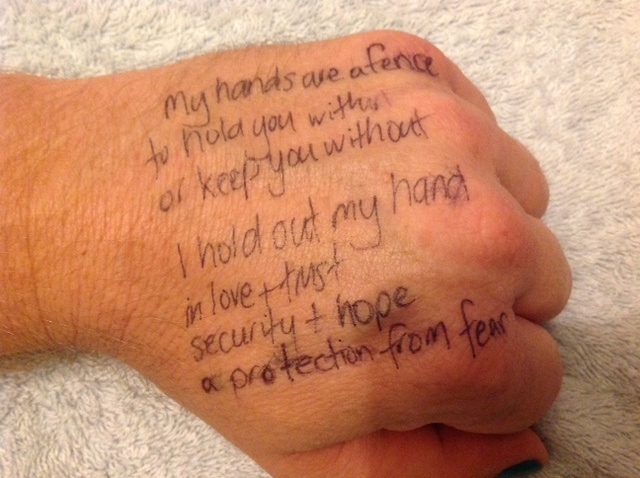
My hands are a fence

to hold you within

or keep you out

I hold out my hand

In love + trust, security + hope

a protection from fear

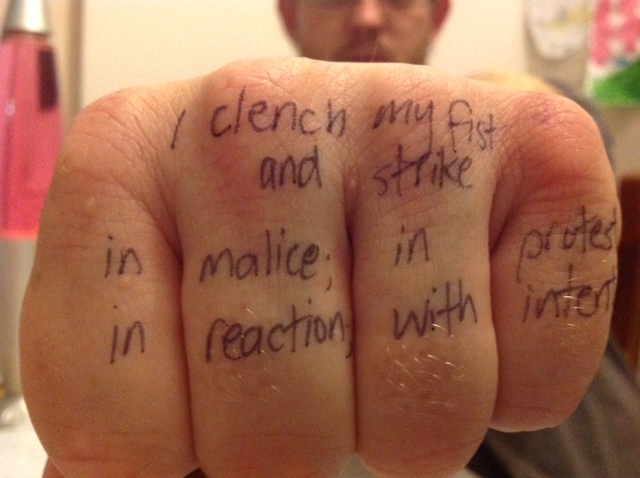
I clench my fist and strike

in malice; in protest

in reaction; with intent

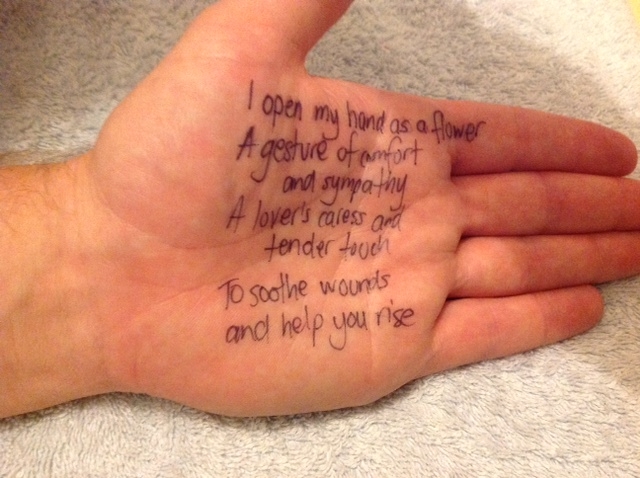
I open my hand as a flower

A gesture of comfort and sympathy

A lover’s caress and tender touch

To soothe wounds and help you rise

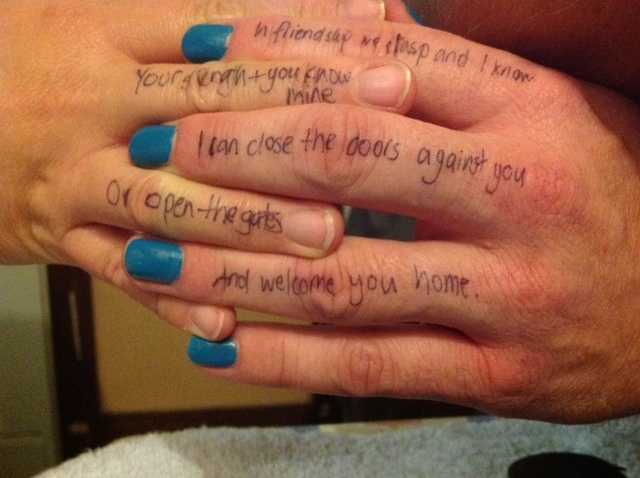
In friendship we clasp and I know

Your strength and you know mine

I can close the doors against you

or open the gates

and welcome you home