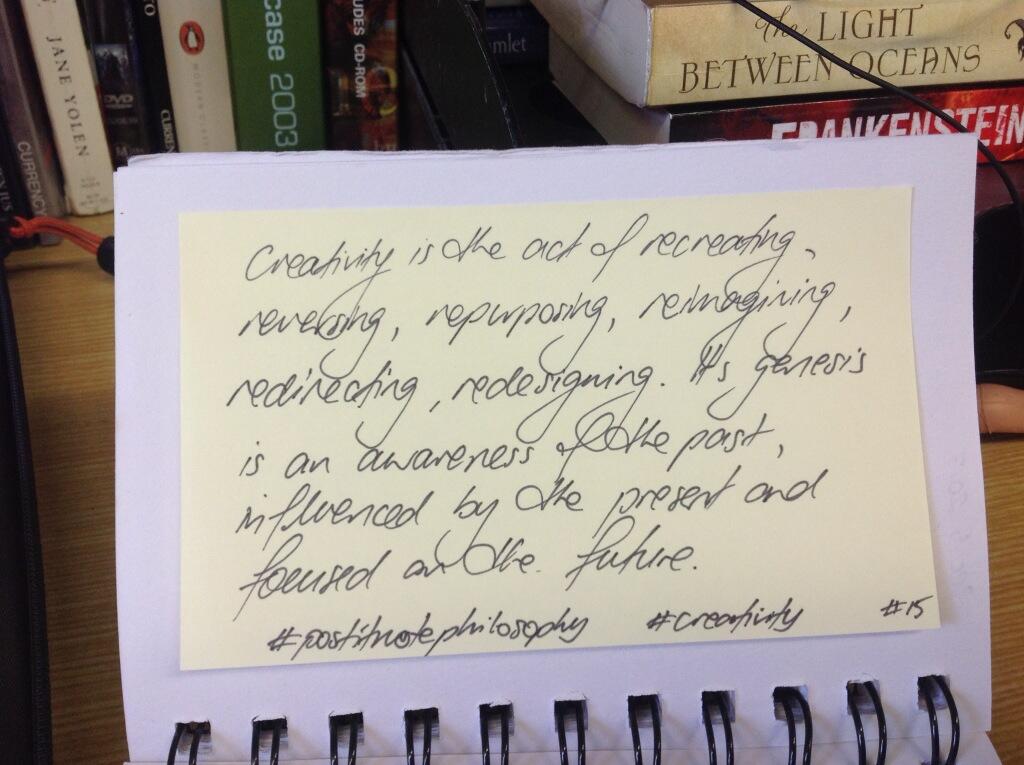
Creativity is the act of recreating, reversing, repurposing, reimagining, redirecting, redesigning. Its genesis is an awareness of the past, influenced by the present and focused on the future.

Creativity is the act of recreating, reversing, repurposing, reimagining, redirecting, redesigning. Its genesis is an awareness of the past, influenced by the present and focused on the future.
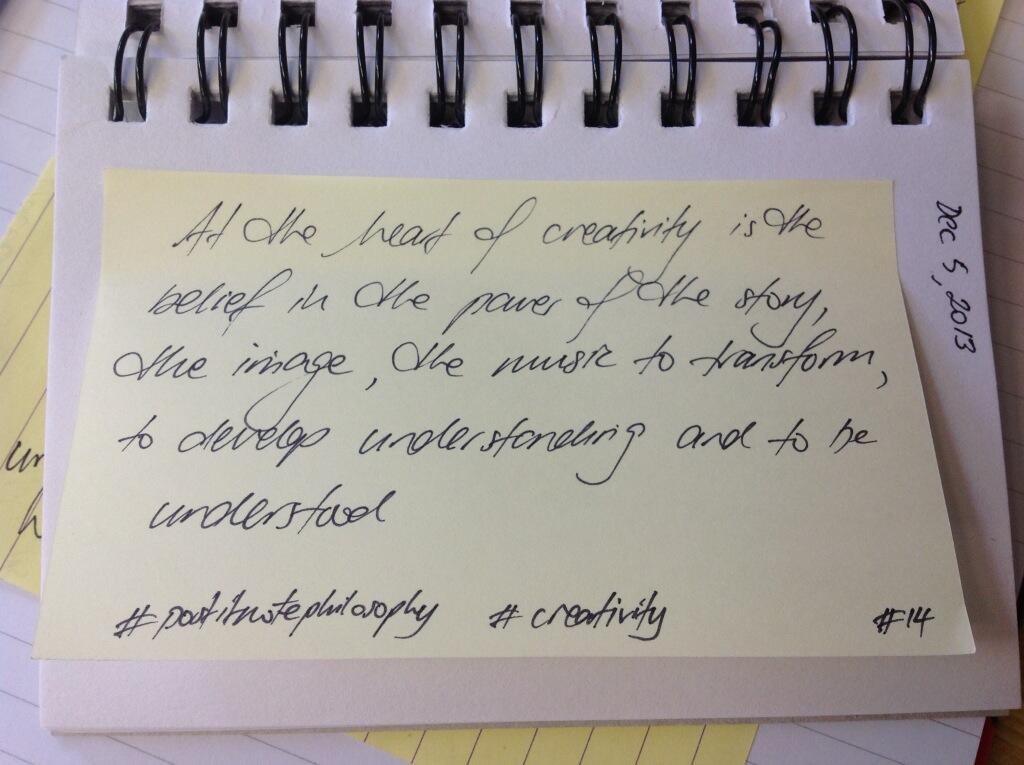
At the heart of creativity is the belief in the power of the story, the image, the music to transform, to develop understanding and to be understood.
Posted in Creativity, Post It Note Philosophy
Tagged art, creativity, life in general, music, post it note, post it note philosophy, reflection, slice of life, writers, writing
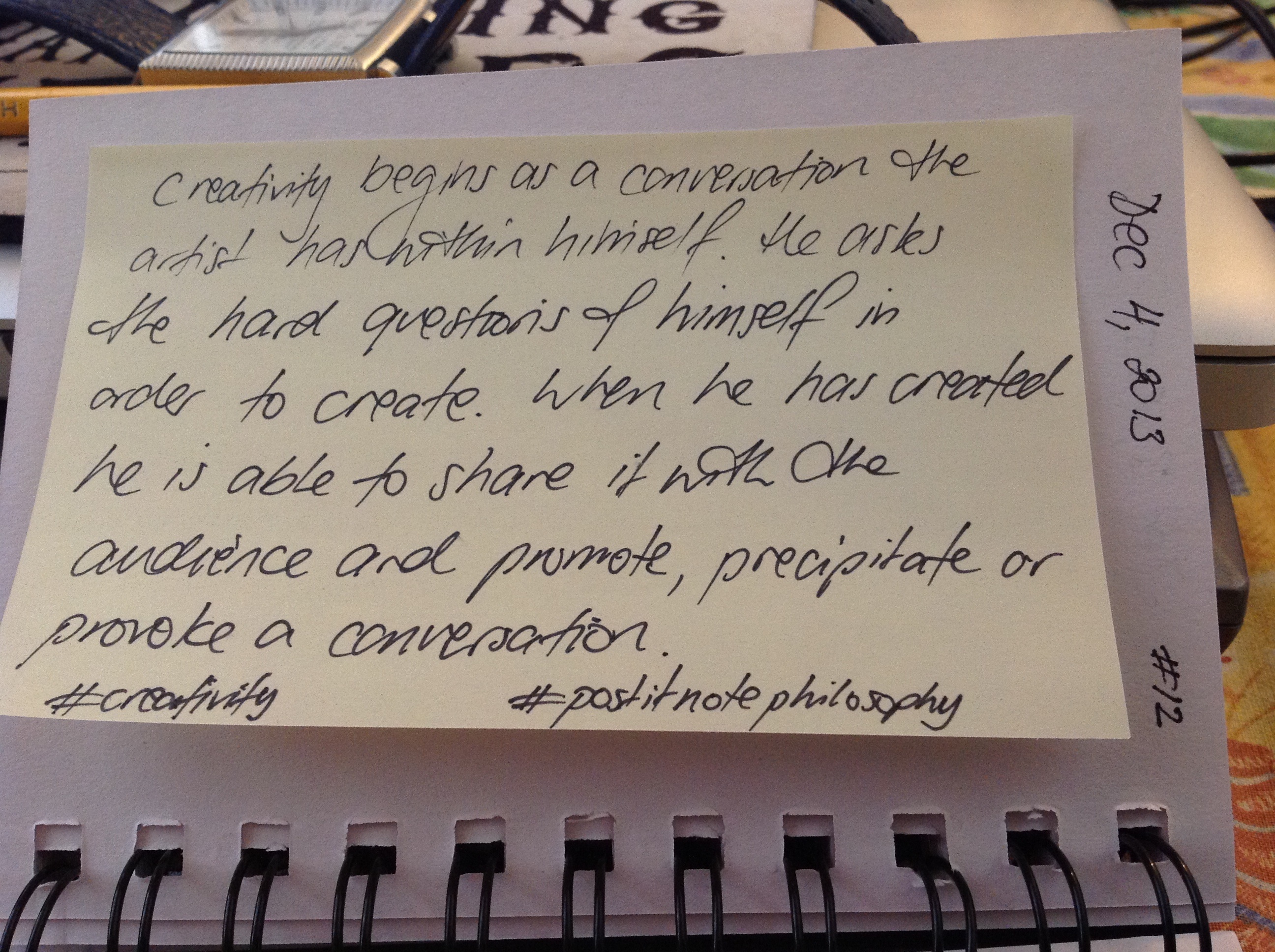
Creativity begins as a conversation the artist has within himself. He asks the hard questions of himself in order to create. When he has created he is able to share it with the audience and promote, precipitate or provoke a conversation.
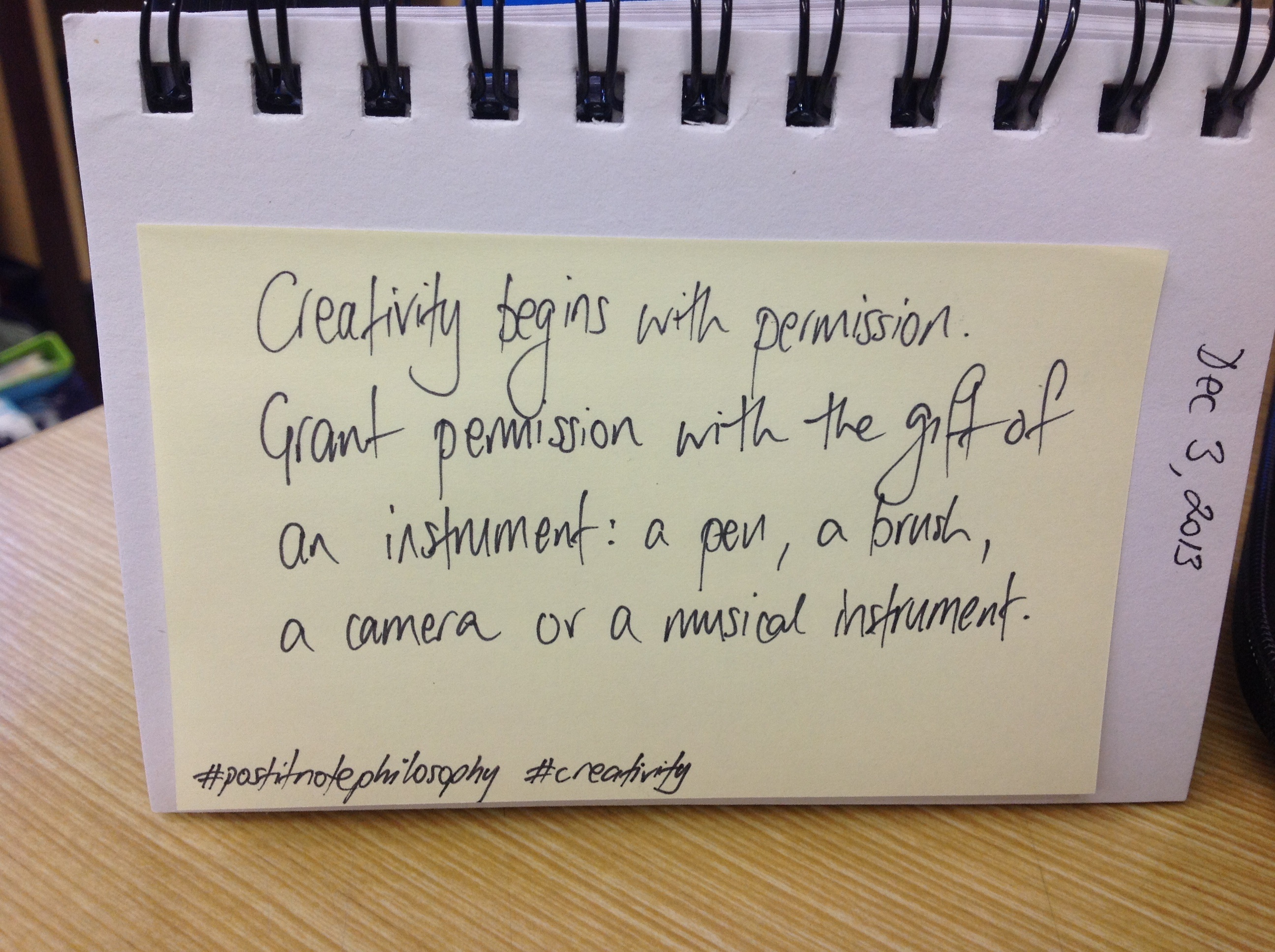
Creativity begins with permission. Grant permission with the gift of an instrument: a pen, a brush, a camera or a musical instrument.
Posted in Creativity, Post It Note Philosophy
Tagged creativity, post it note philosophy, reflection, slice of life, writers, writing
Pick your label:
Downs Syndrome.
Asperger’s Syndrome.
Autism.
Cerebral palsy.
Bipolar.
Schizophrenia.
Paraplegia.
Quadriplegia.
Blind.
Deaf.
All of the above.
Any I may have missed?
When used in relation to people with a disability we use distinctions and nomenclature to quantify who someone is, something other than “normal.”
To pacify our guilt and discomfort at a person’s lack of physical or intellectual ability we offer art and music as a remedial activity. It is put forward as a pastime to keep someone occupied, a way of staving off boredom.
Why do we relegate arts and creativity as a remedial activity; as something to amuse or fill in time?
To do so is to mute the voice of those who have none and to disempower the individual.
When a person with a physical, mental or intellectual disability is given the opportunity to speak in another voice, they are empowered.
Creativity (art, music, literature) is a voice for those who do not have one.
Don’t dis my ability. Not disabled.
Differently abled.
We disempower them because we refuse to listen to their voice; we believe they have nothing of value to say. We are sanctimonious and privileged in our opinion that a person with a disability cannot be creative.
I believe in the power of creativity to tell your story, using your own voice, your own expression, your own understanding and your own perception of the world.
When we relegate creativity to a remedial activity, a pastime to occupy and amuse, we diminish the role of the creative arts and silence the voice of the individual.
Creativity is a voice with which to speak. Voices with unique timbre and quality, even if the words are not easy to understand.
Hear my voice regardless of how I speak. Don’t view me as disabled or look at me through my disability; listen to what I have to say.
Yet sometimes, art and creativity is the only voice with which someone has to speak.
We ostracise the artistic rather than balancing it against the academic and logical, the scientific and practical. Even in these areas there is great creativity.
Can we help tell their story? Give them the skills and techniques to create their own works of art? I believe in the dignity of the humanity of each person and it should be respected.
Allow each person to find their voice. Give each person permission to speak.
We must move beyond treating people with a physical, intellectual or mental disability as incapable of having a voice.
The ad promoting the London Paralympics Games in 2012 gives me goose bumps every time because it is a powerful statement of voice. You can watch it here.
Art, like sport, is transcendent of language. The coded symbolism is independent of the alpha-numeric symbolism of codified spoken and written language. Culture and knowledge informs the construction of the work of art; we may not speak English or French or Spanish or Mandarin or Afrikaans but we understand the message coded in the art.
When we speak with and through art, we use a commonality of language that gives voice. When I look at and appreciate a piece of art, I do not need to know the background of the artist, their ability or disability. I hear their voice in their work. Knowledge of their background enhances and brings clarity of understanding to their message, but it is not essential.
There are many great organizations giving voice to people with disabilities. One of them is Studio ARTES (They are also on Facebook) – a facility for people with a range of physical and intellectual disabilities, for life skills training, art training and socialization. It has been something I’ve encountered for many years because my mother was one of the founding members. She was working as an occupational therapist at a school for students with specific needs and her creative partner, Wendy, was the art teacher. Their vision was to extend the opportunities for people with specific needs post school.
I have seen the power of art when people are given a voice to express themselves. Lars was a young man with an intellectual disability who gained a remarkable voice through the nurturing of his artistic talent. His art was bought by members of parliament and hung in the foyers of well-known companies. He had a droll, dry wit and was a remarkable talent.
On the occasion of his passing, Member of Parliament, Judy Hopwood, had this to say. Hansart Transcript
You can see retrospective collection of some of his works on Facebook.
Besides painting at Studio ARTES, many are involved in the practice of Saori weaving (‘sa’ = difference; ‘ori’ = weaving), a Japanese art form that has come to represent the ability of all to be creative without preconceived notions of correctness.
The beginnings of Saori start with Misao Jo who wove a cloth but because of a missing warp thread it was perceived as flawed. Undeterred, she wove more cloths with ‘flaws’ and ‘faults’ and produced beautiful cloths, praised by a high-end cloth merchant. Read about the philosophy of Saori here.
When teaching her students, Misao taught them the basics of weaving and left them to do as they pleased; an opportunity to discover their true self. My mother has had the pleasure of meeting Misao Jo on occasions when she has visited Japan.
Hence the application for people with disabilities is inexhaustible because there are no preconceived rules and boundaries; it is the individual who creates. Carmel, a client of Studio ARTES, is deaf and blind and spends hours at the loom using the texture of wools, twigs, feathers, ribbons etc to create beautiful works of art.
It removes the pretence of ‘correct’ and gives power to speak.
When will we let go of the idea that people with disabilities have no need to be creative? To let go of the notion that they cannot be creative? That art and music is only remedial and a pastime to stave off boredom? When will we allow them to speak with their own voice instead of presuming we know how to speak for them?
We must stop treating creative arts as a sidelined respite and return it to the centre of our cultural heritage alongside mathematics, science and the humanities. Creativity inhabits the spectrum of cognitive disciplines; it is not the domain of one and nor is it limited to those considered “normal.”
If you are without a voice, borrow someone else’s until you find your own.
I want to spend some more time amongst the people of Studio ARTES, to hear their stories, to be their hands to write when they cannot and project their story when and where I can. There is a beautiful lack of inhibition in many of the people who attend the studio, and a great deal of candor; they will tell you how they feel, direct and to the point. It’s a voice I want to hear more of.
I know that we won’t truly learn to love our neighbour as ourselves if we do not hear their story. Not for the sake of pity or sympathy, but for the dignity of the individual.
I have written before that everyone needs a creative manifesto, a reason why they create. I have also spoken about creating from a place of pain (and it has relevance to people with mental illness like depression or anxiety or bipolar) and I believe it is appropriate for a person with a physical or intellectual disability to have the same belief in their creativity.
I had a couple of responses when I put the idea of creativity and disability out there on Facebook one day.
Writer Marc Nash (@21stCscribe), put forward this point, “The people who can’t speak for themselves or can’t be heard, are unlikely to be able to read the words of those who want to help amplify them. That is an inherently political act of writing, which is how I regard my own approach, but it still is one based on certain privileges: – literacy, education, technology (e-readers) and the free time to write. These I find are paradoxes as much as inspirations.”
It is a paradox and a dichotomy but I want to stand for those who are marginalised and to help speak for them.
Two others commented:
“I had never given it a thought until a heard an interview on Radio National a fortnight ago with a burlesque teacher who was given the privilege of teaching a young woman with Down syndrome. At first I thought it sounded exploitative, but it gave the young woman so much joy and made her feel like a regular woman.”
“A friend of ours has a son with Down Syndrome who has been a regular at our local Uniting Care. They have really done wonderful things with him (and others apparently), introducing him to art (painting, sculpture etc) and music. He has since taken to painting like a duck to water (even selling some of them through his parents business) and has recently taken up music lessons. Uniting Care need to be commended for both developing a sense of worth for this boy but also for their commitment to more than just paint-by-numbers in their approach.”
Tangential Question: what other avenues do the disempowered and marginalised have for speaking? Rap? Hip hop? Graffiti? Heavy metal? Poetry? Painting? Sculpture? Photography?
Are we listening to the marginalised and disempowered?
Let me hear your voice without words.
Let me hear your voice through the images you paint.
Let me hear your voice through the music you play.
Let me hear your voice through your hands, your heart, your mind.
Speak, and I will listen.
Posted in Creativity, The Writer's Life
Tagged art, creativity, disability, fiction, music, painting, reflection, slice of life, writers, writing
After my post on Tuesday, Is Comparison Killing Your Creativity? a good friend of mine, Deane, sent me a lengthy response.
I have his permission to reproduce it here because it dovetails nicely with Tuesday’s post.
Deane has been a creative inspiration to me, even before I applied myself to writing, music and teaching. He’s the kind of guy whose artistic vision and creative endeavours leaves you slavering for more. When he talks about the things he wants to do, intends to do, gets around to doing, you want to go there with him and see it all happen.
Tuesday’s post dealt with the danger of comparing yourself to others and how it kills your creativity. Deane discusses the effect of slavish devotion and imitation of your creative heroes. And it comes with a warning.
DEANE PATTERSON
Even the most ardent and individual creator needs input to learn, excel and eventually dominate their field. We all want to be like the giants of our chosen art form, and we read their books, blogs and imbibe their art as part of the process of learning to bring our own endeavours to life.
I recently read the first chapter of a book created by a personal inspiration: photographer Gregory Heisler. The book delves more into the mind-set rather than the technical approach of a man who has shot more than 70 Time Magazine covers.
I have wanted to expand my photography. I have one light. I have one short lens. The only thing smaller would be a body cap with a hole drilled in it as a pinhole camera. I usually have 5 minutes or less to craft a portrait that is intended for a wall sized print.
But in the first few pages, the master suggests that he too wished that he had more than 5 minutes to take a picture. He emoted his desire to just travel with one light. His description of the need to keep a certain distance (not to close, not to far) suggested I had the perfect lens.
I was looking for the magic beans, the formula. Perhaps, dare I utter the words, a reproducible technique?
Heisler said in a recent interview, “You can learn a technique, but the first time you get in a situation where it doesn’t work, you’re done.”
As artists, we look up to the pantheon of heroes who have gone before us. Prize winners. Gallery wall limpets. Best sellers. Icons of cool.
We wonder if we need to have the same tools. Perhaps a Moleskine, or a Mont Blanc. An original Les Paul or a Steinway. Leica or Hasselblad.
When we grow up, or at least reach the understanding some tools are too expensive for mere noob mortals, we try and ape technique.
Portraiture is based on trust.
Everyone who has every written about Mr Heisler mentions how he gains the trust of his subjects – forging a quick but mutually respectful relationship. To him, trust outweighs any equipment, because his photos depend on a connection with the person (not merely a talking meat puppet) he is engaged with.
That’s who I need to become in order to approach that level of work in my field. That’s character, not technique. You don’t learn character in an ‘Idiot’s Guide to Legendary Artistic Achievement.’
I am all for learning the basics – and certainly practicing till your fingers or your neighbour’s ears bleed. But art is not a mechanical achievement. The mechanics are necessary, but they don’t put words in your head, a song in your heart or an image in your eye.
You must learn the heart of those who have gone before you. You must partake of their motives, their emotion and their reason. This is why you must choose your inspirations carefully.
Better to choose Christopher Nolan (Inception) than Lloyd Kauffman (The Toxic Avenger).
When selecting a role model, look at who they are – because that’s the direction your life is headed for at least the next few months or years. It’s who they are, their character, that truly informs their art.
This means you are free to be inspired by many people outside the narrow confines of your niche or genre. You can revel in the creativity of a wide range of very original individuals – and you (and your speciality) will be richer for it.
You are what you eat – and you will consume your role models. You will forage the interwebs for every morsel from their mouths and every project they every let loose in the public domain.
When you are ready to learn from a master, take a good long look at who they are and ask yourself: would I put that in my mouth?
Deane Patterson is a portrait photographer and sometimes composer and filmmaker living in rural New Zealand.
Visit him at http://itellstories.co.nz/
Find his work on flickr and National Geographic Your Shot.
Posted in The Writer's Life
Tagged art, creativity, culture, imitation, just because of thoughtfulness, music, photography, portraiture, reflection, relationships, writers, writing
How do you feel when someone says, “I wrote 5000 words today” when all you managed was 500 or 50 or only 5?
What is your response when you see someone produce a new story every week and you struggle to write a new story once a month, or even once a year?
Do you feel discouraged when you see someone produce new art works when you’re still stuck on your first?
Do you want to give up when you can’t practice your instrument as often as you like and you see your skills slipping behind in comparison to another player?
I’ve seen people excel in word counts, submissions, practice routines and regimes, art works. I’ve compared myself to others in what I haven’t done. I have flagellated myself with,
“What if…?”
“Why haven’t you…?”
“If you’d only…”
With the beginning of National Novel Writing Month (NaNoWriMo) I am seeing writers post their spectacular word counts over the early days: two or three thousand words, up to five thousand words in a few sittings.
I am not participating in NaNoWriMo. Instead, I am working on a novella. Because I am a teacher, time is precious, so I have committed to writing a minimum of 100 words, five days a week. Since the start of Term 4 I have managed 3,500 words.
In comparison, my word count is paltry, pitiful, execrable, measly and *feel free to insert your own choice words here*
Comparison will kill your creativity.
It will stifle your ambition and plans until your dreams and visions are merely dried out husks, rotting in the back of the fridge like forgotten leftovers.
When you compare yourself with others, you kill any opportunity of developing your creativity. Comparison against others is measuring yourself against another person’s set of values, attitudes, structures, plans, visions. They are not your values, attitudes, structures, plans, visions.
If I compare myself to what others are achieving in NaNoWriMo, I will feel less than the scrapings from the bottom of student’s school bag. I will not compare myself with others and regret what I haven’t done but celebrate what I have achieved.
You have your own race to run. You have your own values, attitudes, structures, plans and visions to fulfil.
You can use others as inspiration, just not as a comparison.
How do you avoid the demoralising impact of comparing yourself with others and maintain creative integrity?
Creativity is about:
Connection
Conversation
Community
Connection brings you into contact with other like-minded people. Finding a shared connection in creative pursuits leads to conversation.
Conversation is the opportunity to discuss ideas, habits, routines, progress. We engage with one another in conversation, to share our individual journeys and encourage one another to continue. We celebrate the victories with each other, encourage those who have fallen behind by attending to their blistered heels and untied shoelaces. By doing so, we develop community.
Community is about serving one another in love, developing and building each others’ creative skills. Community builds character not comparison. Community builds creativity because it empowers the individual to fulfil their plans and visions and dreams.
Comparison creates a sense of inferiority causing you to change your view of your goals and visions. It drains you of your creative vitality. You see other’s creative triumphs and victories but not your own. Ultimately, you lose your creative vision.
Instead, find a connection with creative people. Engage in conversation with them and develop a community.
“Life is pain, Highness. Anyone who says otherwise is selling something.”
The Dread Pirate Roberts (The Princess Bride)
Society doesn’t teach you to accept pain. It teaches you to look for wish fulfilment, constant euphoria and ecstasy; to be continuously and deliriously happy like a child drinking red cordial straight from the bottle.
We are the inhabitants of Brave New World who take their soma and remain blissfully unaware of the full breadth of human emotion while frolicking naked down the slippery dip of self-absorbed instant gratification. Pass the microwave dinner, please.
We must become like John the Savage and question our world about the spectacular depth of emotion garnered and expressed in poetry, film, song, literature, dance and music.
We need to know what it’s like to have Dettol applied to our gravel-grazed knee; to know the pain of heartache from our first break up (and then write bad poetry to immortalise the event), the gut-wrenching sorrow of losing a loved one and every other expression of pain and suffering capable in our experience.
Pain is often a stimulant for creativity; a genesis for a piece of writing, a song, developing a dance or striking a canvas with paint.
Acts of creativity brought about by pain and trauma have three expressions for the creative person:
1. Catharsis
In order to understand pain and suffering there needs to be a release, a purging of the emotions, resulting in the renewal of heart and mind. One of the ways we do this is to tell stories.
Physical scars become stories and shared experiences
Our childhood is characterised by physical scars; I have one just below my knee where I met with the corner of a fish tank and another in the middle of my back from a staff Christmas party. My brother, the carpenter, is a museum of scars and stories (and it is nothing short of a miracle he still has all fingers, toes and limbs).
Yet we often repress those experiences that have caused us to experience emotional and mental pain.
Emotional scars become silent considerations and isolating experiences.
As children we find it difficult to understand the emotional and mental scars from the trauma we experience. I remember the passing of my paternal grandmother when I was 13 and not having the emotional maturity to understand and comprehend the enormity of it. After recently attending the funeral of my best friend’s father who died of cancer, I doubt I have the emotional maturity even now.
The catharsis of emotions allows for a creative act to be expressed in its most primeval and unformed way; a raw, uncensored, unchecked and deliberate action to release the pressure of the pain.
And the creative act may go no further than the initial purge; allowing the vented emotions to dissipate on the wind and be no more.
Sometimes, though, we need more.
2. Reflection
The painful and traumatic experiences of our lives can find expression in acts of creativity as we come to understand the complexity of our emotional scars and through the maturation of our emotional wounds. Severe trauma can cause a blockage in our creativity and cause our expression and understanding to stop.
Yet it is pain that is often the trigger for creativity as we reflect on our experiences – as catharsis, inspiration, questioning, understanding.
Understand your pain; know what causes it. Learn from it. Keep a journal. Paint. Draw. Write music. Write a story. Create something from it, even if it’s only a piece of paper entirely coloured in with a black texta.
Tell others about your pain through your creativity. It may resonate with them and speak to them.
A friend, Janetta, who has worked with people using art as therapy, explained it this way:
“From what I’ve seen working with people in art therapy, using art making to creatively process trauma gives people the ability to express the inexpressible and help them tell their story.
“Trauma is non-verbal (stored in the subcortical, non-verbal parts of the brain), so making art can allow the person to explore the non-verbal traumatic memory/experience and externalise it, so it can be processed with the verbal parts of the brain.”
3. Teaching and Learning
Creativity teaches you to express your pain and come to an understanding of the experience
Janetta continues:
“Suddenly you can speak and talk about something that was too much to cope with. This makes the issue more manageable & less overwhelming and restores the person’s sense of control, all of which are lost through traumatic experiences, which primarily are beyond our ability to cope & make us feel overwhelmed & out of control.
“Some of my clients have also reported feeling understood when they can finally talk about it and when I can see what they were dealing with on the inside.
“For the mental health patients and dementia residents I work with, creativity, especially in group settings, offers an opportunity to connect with others and gives people relatively safe things to talk about, which is great for healing loneliness, isolation and dealing with loss of independence.”
A creative act is a teaching and learning moment for the creator and a teaching and learning moment for the reader/viewer/listener. It is a shared moment.
In my collaborative novel, Post Marked: Piper’s Reach (currently being edited), is it the emotional resonance of the past, a form of trauma, which defines the protagonists, Ella-Louise and Jude. As an author I explore how the past defines and influences the present, how the trauma affects the characters. Without pain, a story has no momentum, no movement forward. A story with no pain or conflict is no story at all.
Final Notes
To focus on pain alone, in all its manifestations, in the composition of a creative piece, to the exclusion of other emotions, is limiting. Creativity is about expressing the breadth and depth of human emotional experience.
We create with pain as the focus to understand ourselves and our relationship to the experience.
We read stories or watch films or listen to music about pain to understand that our experiences are not individual to us alone; to know someone else shares what we have gone through and to seek redemption in the hope of their success.
To express our pain we write stories, compose music, draw, paint, dance, sculpt. We find a creative outlet to deal with the pain.
We create firstly to understand our experiences, and secondly to share those experiences as the connection of our humanity.
How has creativity helped you through the painful times in your life?
Posted in The Writer's Life
Tagged creative arts, creativity, pain, perspective, reflection, slice of life, suffering, writers, writing
Yesterday my collaborative writing partner, Jodi, gave her first pitch for our novel, Post Marked: Piper’s Reach before the commissioning editor of a large publishing house.
I was not able to be there because the pitch was in Brisbane and I live in Sydney. I posted this comment on Facebook yesterday:
In a little under an hour Jodi will have pitched our collaborative novel Post Marked: Piper’s Reach before a commissioning editor. Feeling nervous and anxious and excited for her. Wish I could have been there. Will see what happens.
Jodi responded:
Sitting in a character arc workshop feeling horribly nervous. Might vomit!!
But after it all went down Jodi’s reflected:
Update. I did not vomit on the commissioning editor from ******** (company name redacted). I was however terribly nervous. I wasn’t asked for the first 50 pages but ****** (name redacted) took down the website address to look at it further and my email address to contact me if he was interested.
Regardless of the outcome I am glad for the experience and what it adds to what we need to do next.
I don’t know how I would have performed if it was me having to pitch but I’m sure the time will come.
While at the con, a reader of Piper’s Reach found Jodi, and expressed what a lot of readers have intimated when they get to the end of Ella-Louise’s and Jude’s letters:
I had a random reader moment where I got my first good natured: ‘I hate you! I can’t believe you did that!’
We’re going out for a beer later to talk about it. Very excited.
We are very close to finalising edits on Season 3 of Piper’s Reach and waiting on return edits from our editor on Season 2.
From here it’s a case of developing our queries, synopsis information, character arcs and work out where we pitch next. It’s a very exciting time as we see the fruits of our writing building momentum.
What started out as a fun collaborative writing project has become the vehicle for pushing our writing forward, individually and collaboratively, and seeking publication for a story we have faith and belief in.
Posted in The Writer's Life
Tagged adam byatt, jodi cleghorn, piper's reach, pitch, reflection, writers, writing
I am an English teacher and drummer/percussionist with an interest in literary pursuits, creative endeavours, rhythmic permutations, theological amplifications and comedic outbursts.
Here you will find my creative detritus: articles on living a creative life and writing explorations.
And other ideas I have snaffled from the papers stuck on the fridge door.
Twitter: @RevHappiness
Instagram: @handwrittenpages
My collaborative epistolary novel, "Post Marked: Piper's Reach," written with Jodi Cleghorn (@JodiCleghorn) out now via Vine Leaves Press.
Come and browse through the library; there is no need to be silent.

 A Fullness in Brevity - Adam Byatt