Tag Archives: post it note poetry

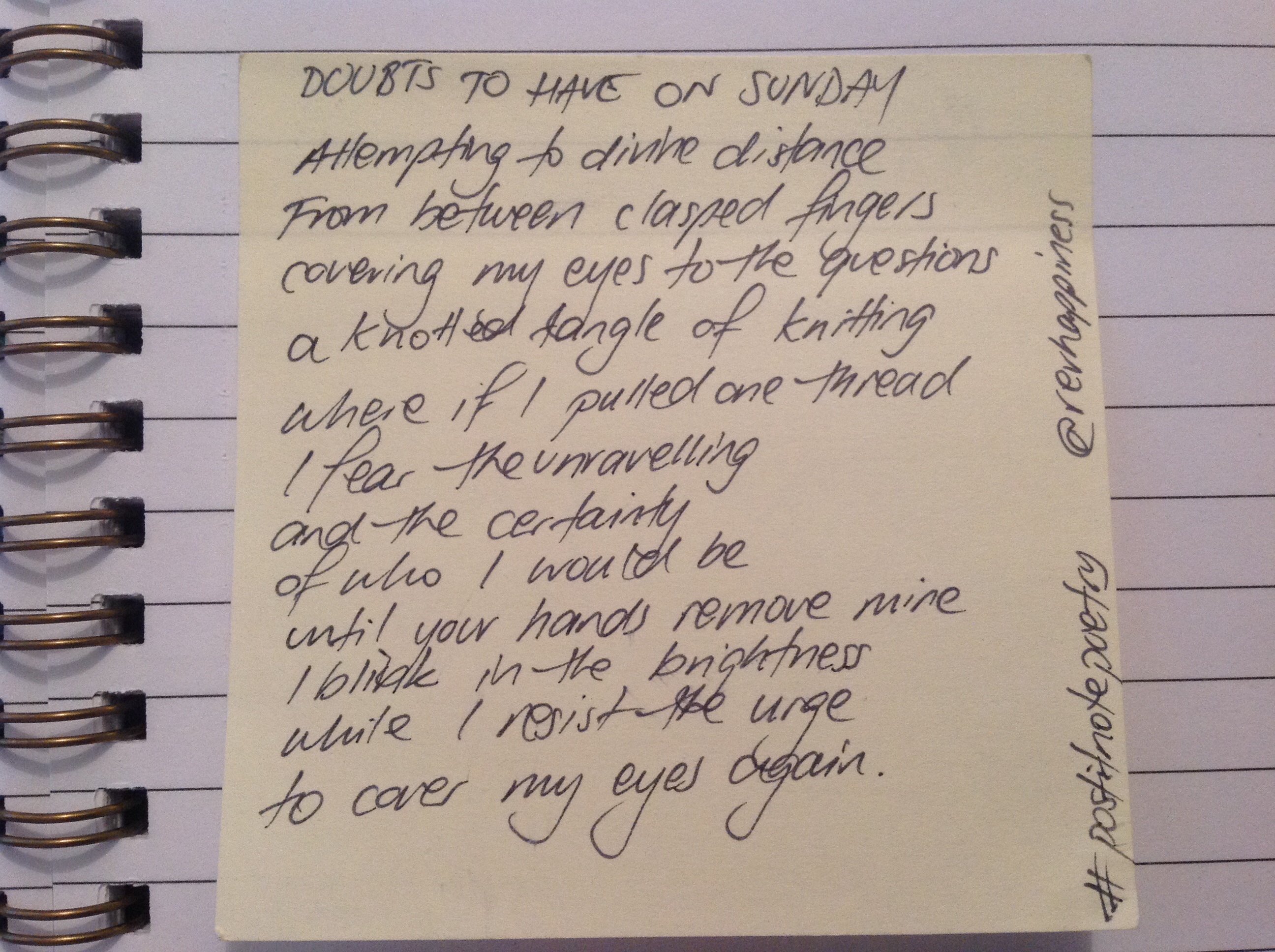
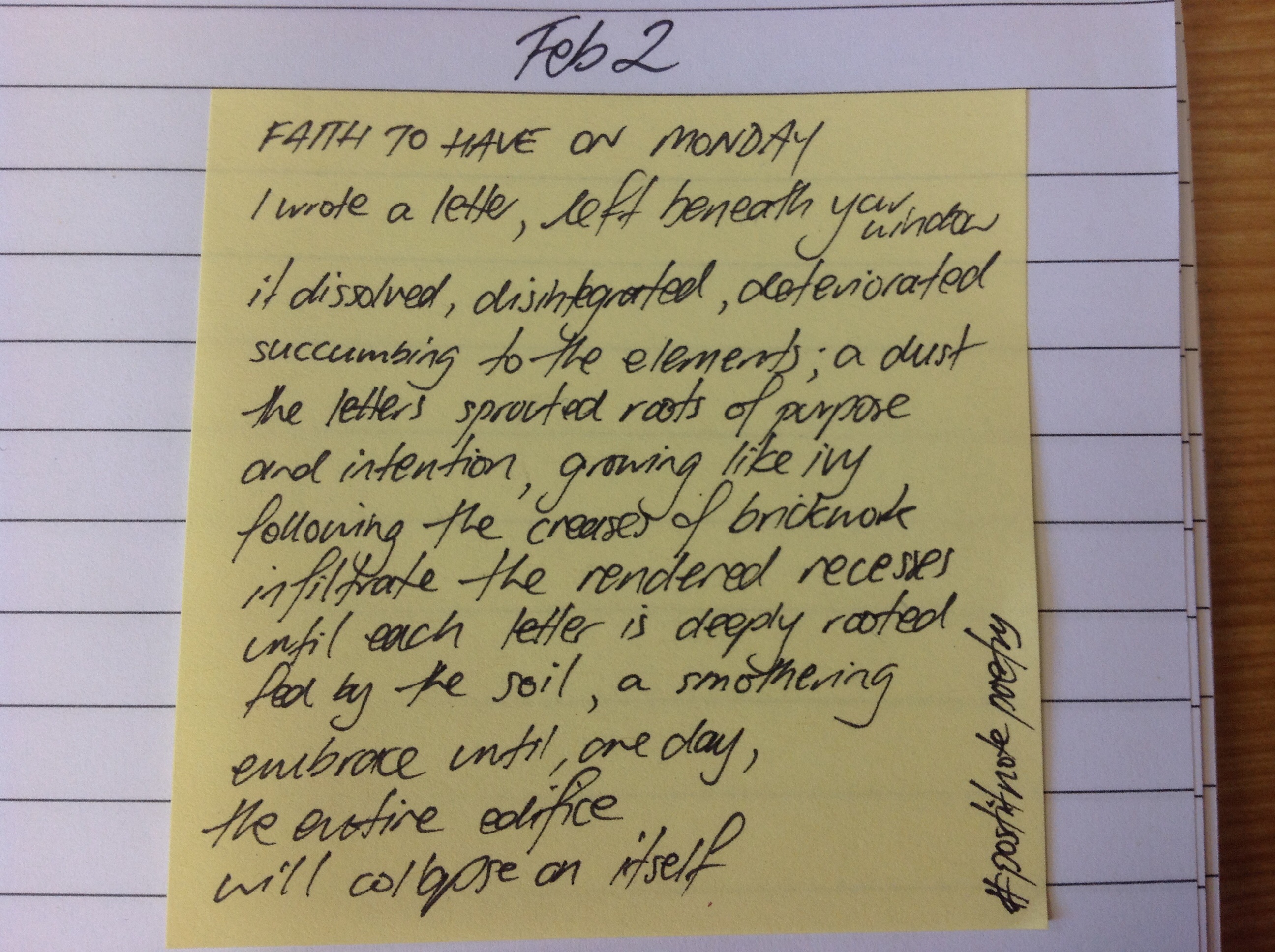
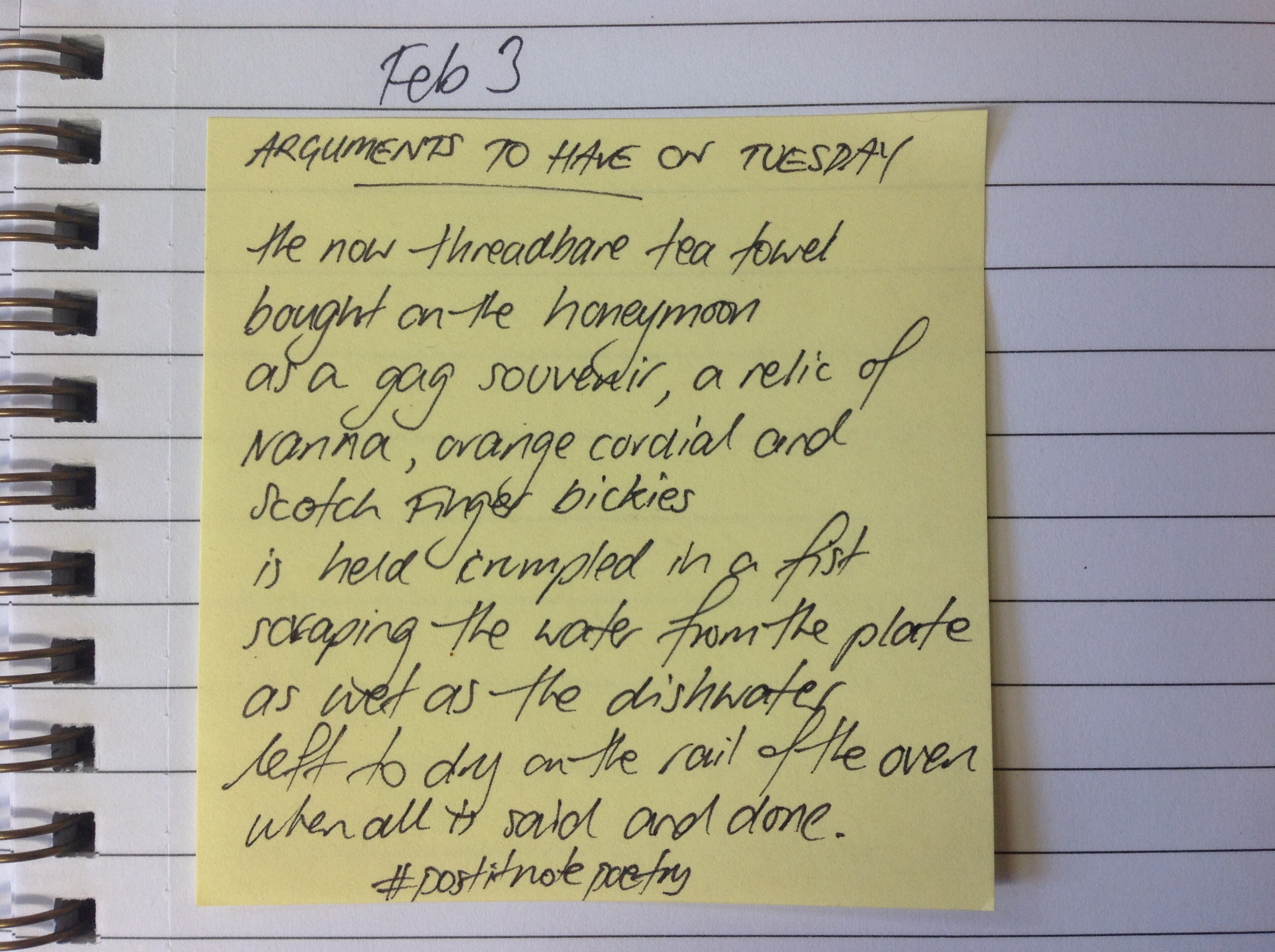
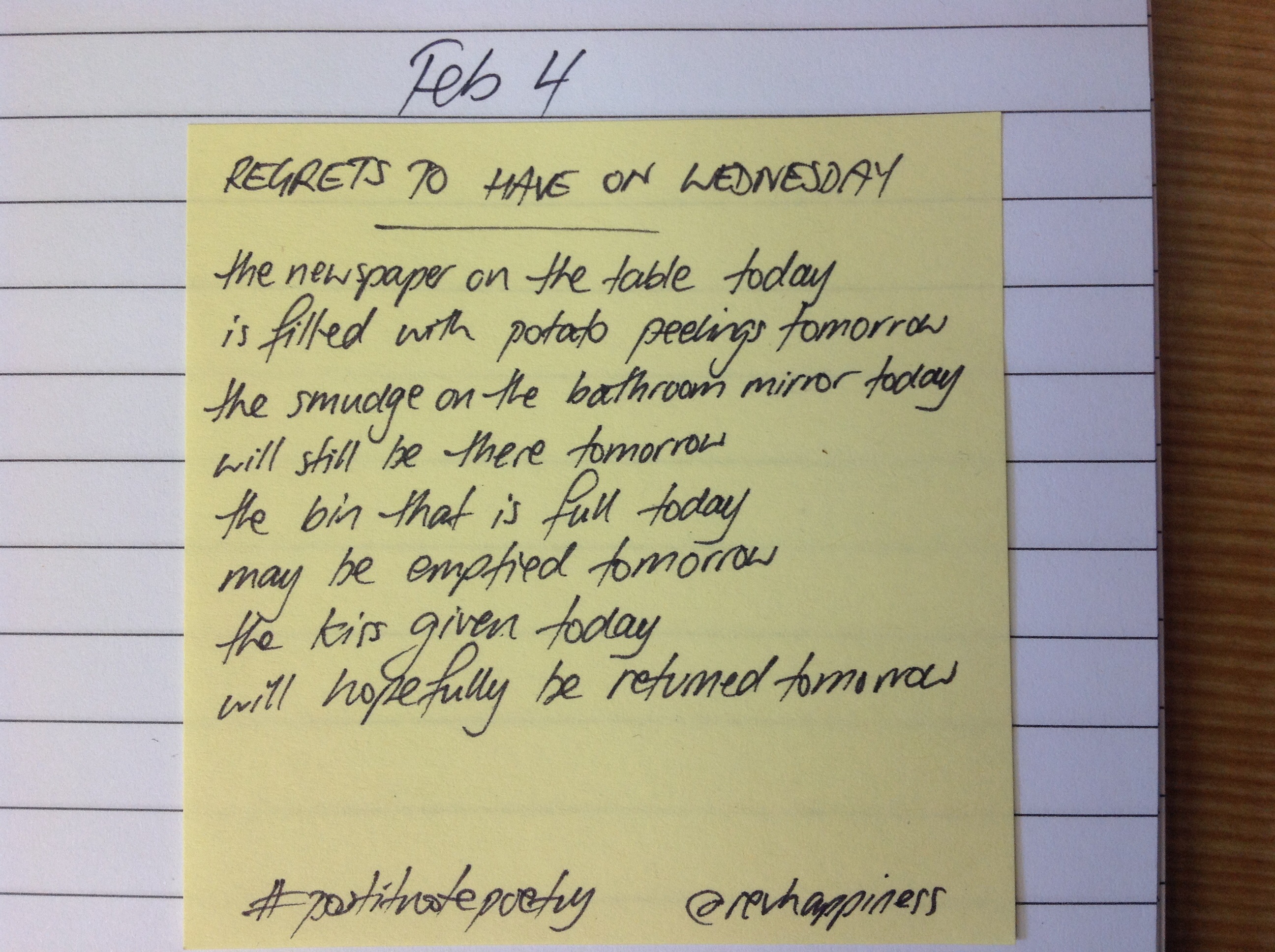
Post It Note Poetry 2015 Recap Week 1

It is the end of the first week of #postitnotepoetry.

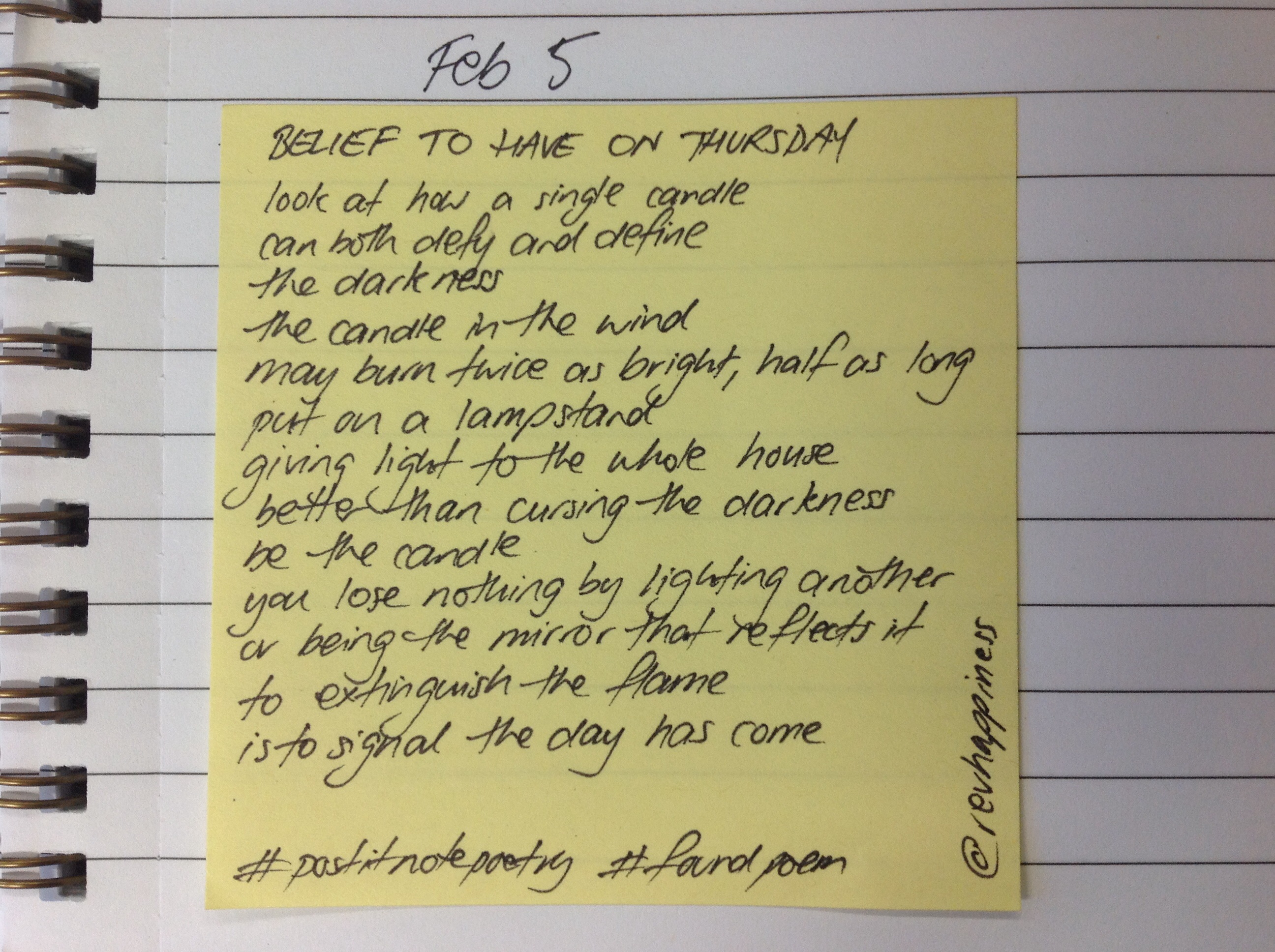
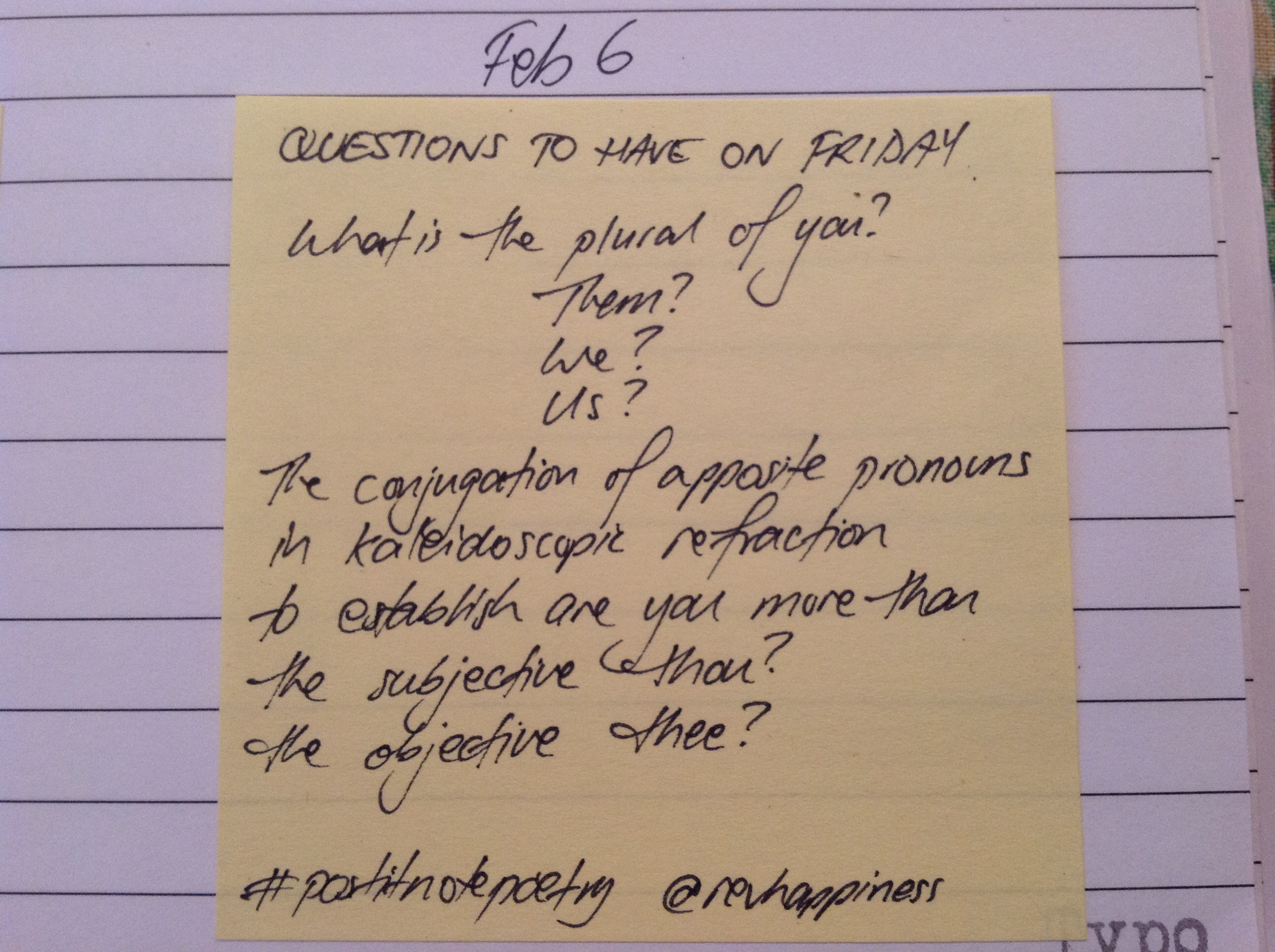
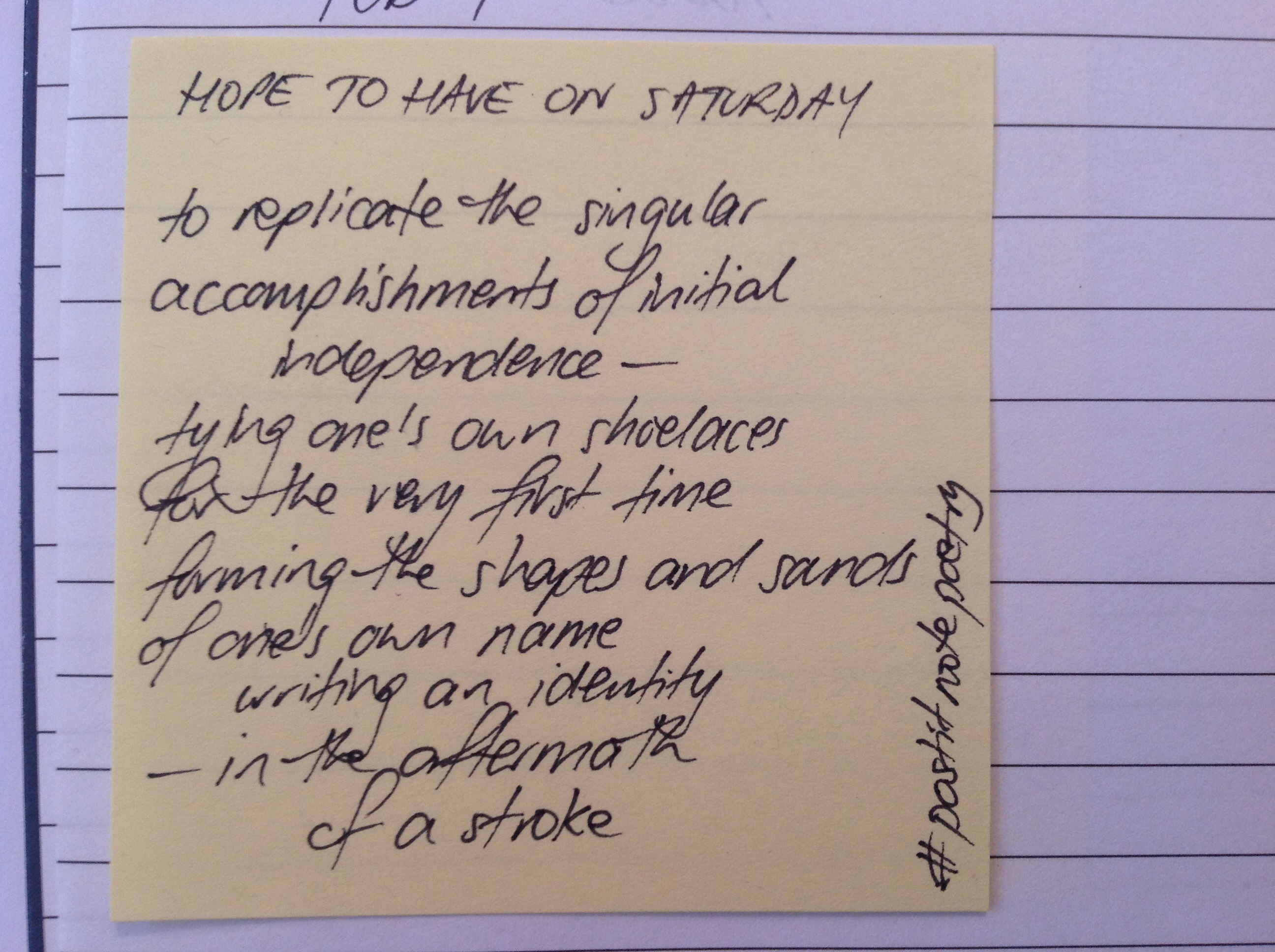
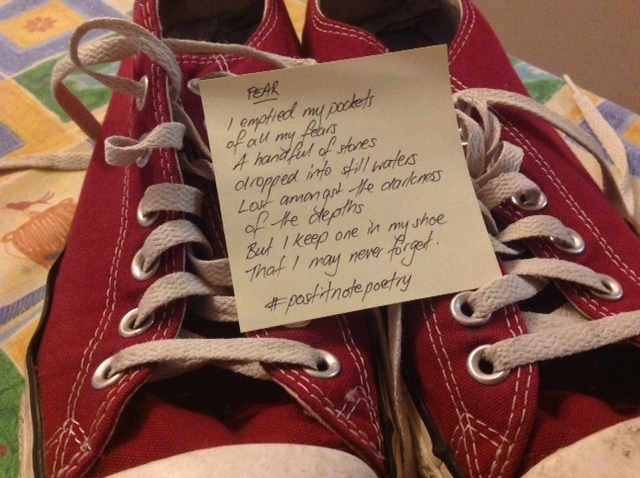
I have collated here the first seven poems. This series of poems began after I heard a song titled, “Things To Do In Winter” and it inspired the idea of a loosely linked thematic suite.

Instead of seasons, I chose days of the week. Each day of the week was prefaced with an idea. In my notebook I hastily scribbled down a list of potential ideas and throughout the course of the week amended, deleted or built upon the idea for the day. 

Some poems were easier to write, others took longer to compost and come to fruition. I was surprised at the thematic darkness of some of the poems as it was not the initial intention; only in the repeated readings did the layers of darker interpretation emerge.

It made me wonder whether I was subconsciously channeling a darker theme, or purging the darkness within. I think that’s another blog post/poem in itself.

image

image

image
image

image
image

image

If you want to join in the fun of #postitnotepoetry, grab a pen, a wad of Post It Notes and write. Take a photo it and upload it to twitter with the hashtag #postitnotepoetry

Post It Note Poetry 2015

It has begun!

I am collating all my poems to a separate page, Post It Note Poetry 2015.

Drop in each day for a new poem. The new poem will be posted at the top of the page each day.

Here is today’s poem.

image

Post It Note Poetry – Permission To Write (Badly)

February marks the beginning of Post It Note Poetry month. It began 3 years ago as a challenge between myself and my writing partner at the time, Jodi Cleghorn – a month of bad poetry, written on a Post It Note.

You can find my collection of Post It Note Poetry over on tumblr as well as some other poetry including blackout/erasure poetry. 

My first Post It Note poem written on February 1, 2013.

My first Post It Note poem written on February 1, 2013.

I will be posting a new poem daily in February #postitnotepoetry and will also curate the poems here each week.

But here’s the challenge: why don’t you have a go? Grab a packet of Post It Notes (any colour will do) and write a poem each day. Post it to twitter and include the hashtag. Include me too (@revhappiness) so I can see what’s going on.

If you can’t do it every day, no stress. Do what you can. Don’t censor. Write with both heart and mind.

Sunday marks the First of February and a month of writing poetry on Post It Notes. Have at it!

Blackout Poetry – Another Questionable Attempt

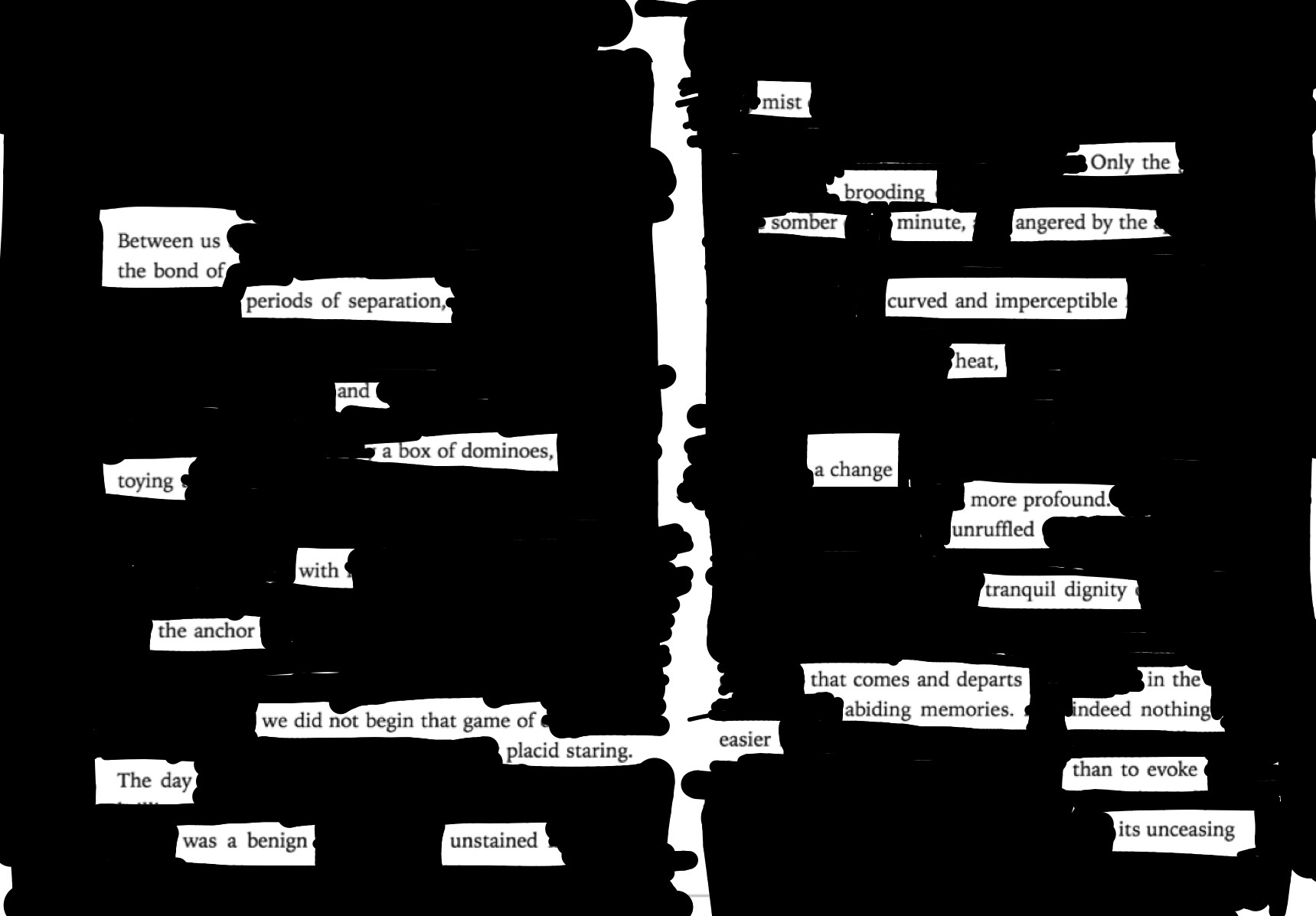
image


Between us
the bond of
periods of separation
and
a box of dominoes
toying 
with 
the anchor
we did not begin that game of
placid staring
The day 
was a benign unstained
mist
Only the 
brooding
somber minute
angered by the
curved and imperceptible
heat
a change
more profound
unruffled dignity
that comes and departs in the
abiding memories. Indeed nothing’s
easier
than to evoke
its unceasing

After yesterday’s modicum of success with blackout poetry, I tried my hand at another (need to do something creative at the moment while I get my head back into shape to tackle some significant writing projects in January).

This page comes from Joseph Conrad’s “Heart of Darkness.” I studied this text in high school last century and thoroughly enjoyed it. Admitting at the time I didn’t quite understand the colonialism and inherent racism, it still holds as a powerful metaphor. Tie it with Francis Ford Coppola’s “Apocalypse Now” and you have a teenager’s existential orgasm. 

So, with that in mind, I wanted explored the idea of relationships through the text.

It’s a diversion from writing Post It Note Poetry (and a couple of other major works in progress) but I posit that flogging someone else’s idea to pursue something creative is better than nothing. Blackout, or erasure, poetry makes you look at words, their order and the meaning created. It opens your mind to see other possibilities, limited as it is by the choice of text, to create something new.

I encourage you to try it yourself. Or buy a colouring book and pencils. Do something to stimulate your brain. 

Where I Find My Poetry…

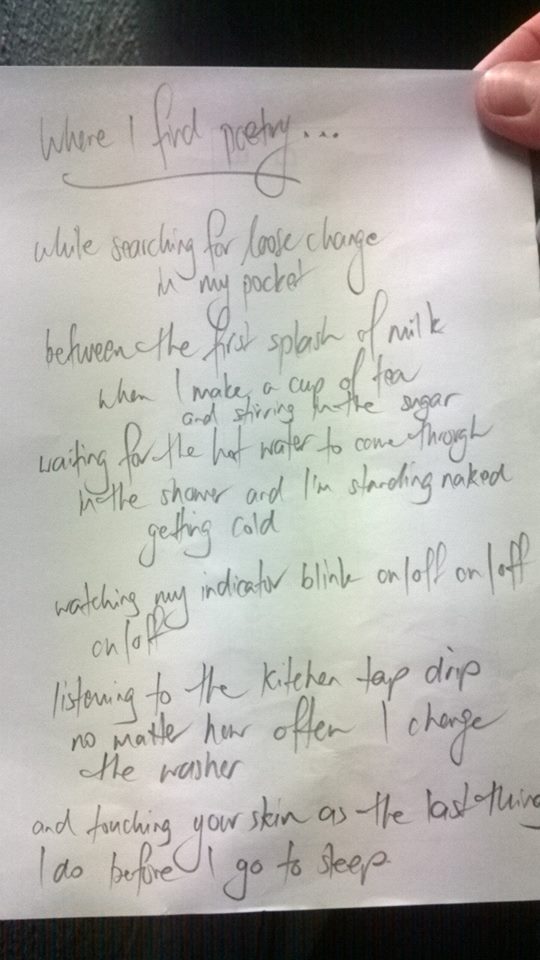
At band rehearsal this week (I play in a covers band for weddings and corporate functions) I scribbled this onto a scrap of paper between songs as the band rehearsed with a drummer who is filling in for me for an upcoming gig.

I’d had the title floating in my head for about a week and an idea of what I wanted to write. Originally I intended it to be a simple blog post about how I, as a writer and poet, find my inspiration and ideas. 

The idea was composting in my head and while I lounged behind the sound desk I scribbled this out.

Where I Find Poetry

Where I Find Poetry

while searching for loose change in my pocket
between the first splash of milk
when I make a cup of tea
and stir in the sugar
waiting for the hot water to come through
in the shower and I’m standing naked
getting cold
watching my indicator blink on/off on/off on/off
listening to the kitchen tap drip
no matter how often I change 
the washer
and touching your skin as the last thing
I do before I go to sleep.

What becomes more interesting is I took a photo and posted it to Facebook, rough and ready as it was. A good creative friend of mine made this comment: “This reminds my (in style) of Leunig, but I do that in praise of such an original piece. This needs to be a poster.” (Leunig is a well known and highly respected Australian cartoonist and writer)

Once it is published it is out of my hands. It is what it is to the reader and viewer. I see its faults and insecurities, the line breaks that don’t quite fit or the meter or rhythm of lines that are inconsistent, the ideas for improvement. 

But the reader and viewer engage with it as it is, seeing it as a finished product for him or her. It either resonates and connects or fails to spark and is ignored. And that’s fine.

It’s also, upon reflection, an accurate understanding of the focus of what I write about. I like the minutiae, ennui and detritus of the day-to-day because these actions, objects or circumstances have significance and meaning to a person. We are inspired and captivated by the videos flowing through social media of spectacular acts of heroism, generosity and compassion but it’s often the short videos of people doing simple, routine acts that bring us to tears because it reminds us we can make a difference. 

The seemingly insignificant has meaning and purpose to the individual and I want to explore what it means for the character and his or her life because it often reveals significant meaning and purpose.

I Found More Poetry Under The Lounge

 I find poetry in all kinds of places, often under the lounge and I found some more there recently.

Right now the end of winter is approaching here in the southern hemisphere (not that we had much of a winter where I live – what happened to those good old fashioned frosts we had as kids?) and with it the promise of hay fever, runny noses, itchy eyes and a cursing of all things frolicking. The first and last poems assembled here, Magnolias and Windy Days, are inspired by the wintery season.

Magnolias

As I drive past
The magnolia blooms
A thousand sunrises
Of pink to white and
A thousand sunsets
Of white to pink
Simultaneously

Standing By

I stand in the longest corridor
possible, pretending I’m Red 5
barrelling down the trench
avoiding laser blasts
to my office door

The Last Page

When you close a book
Do you think it will be
The final time?
Never to peer
Between the pages and
Read the tongues of men
Again

My Companion

I walked in darkness
But was never afraid
For I felt your hand
In mine, or around
my waist, looped over
my shoulder as my light

Generations

She watches
grandmother’s knitting
learns the art of rhythm
the pulse of long thin bones
curses the dropped stitch
like her grandmother

Windy Days

I imagine with each 
breath of wind
the trees ask
for our silence
a gentle ‘Shhhh’
simply to listen
to our own
heartbeat
Which poem resonates with you?

More Loose Scraps of Paper – Further Collected Micropoetry

Looking back through my posts I have collated more of the #micropoetry posted on twitter and posted here.

Stay tuned in the future for a book of micropoetry.

Outside

when did Outside
become an
undiscovered country?
whose unfenced boundaries
spark greater imagination
than the couch’s confines

Mandala

She draws on the concrete
a chalk mandala
of wonky butterflies,
stick-figure people.
Tomorrow she will
draw another
cycle.

Training Wheels

 I’m too old for these
she said
pointing to
the training wheels
He prays she will
never be too old
to trust
and hold
his hand

Knowledge

The gaining of knowledge
deteriorates with age
because we know
everything at 18
and realise
we know nothing
the older
we become

Toilet Seat

Sometimes
I deliberately
Use the bathroom
After you
And absorb the warmth
Of the toilet seat
To believe you
Still care

It Is Written

It is said,
“It is written”
The oral tradition
Of received wisdom
In a fortune cookie
Platitude while we
Forget to read
The written truth

Any favourites?

Understanding Alchemy – My Writing Process

I suspect many readers, and indeed if conference questions are anything to go by, are mystified by the process writers have of hunting down, killing and skinning an idea and presenting it as a story. It’s like the medieval alchemists who attempted to combine elements and transform it into gold.

I was reluctant to write this post, tagged by another writer, my collaborative writing partner Jodi, but realised if I believe everyone can be creative then it behooves me to explain the process and guide new writers into the mystery.

Please don your robes and grab a doughnut; the initiation is about to begin.

There are many pithy quotes by writers about how to write but they are only relevant if you have immersed yourself in the craft of writing. Experienced writers nod sagely and ironically at the pithy wit and wisdom of those they admire but it doesn’t let the novice into an understanding.

The focus of the My Writing Process tagalong was to ask writers 4 questions. Here are the 4 questions asked and my attempt at an answer. Particularly #4 where I will attempt to show how I work and see if it helps novice writers on their journey.

1. What are you working on at the moment?

Too many things. Here are the most significant projects.

a. Post Marked: Piper’s Reach is a collaborate epistolary novel written with Jodi Cleghorn. It was hand written in real time and sent through the mail.
We are now at the stage of finalising our synopsis and getting it ready to submit to a variety of avenues.

b. The Java Finch (novella – working title) This is the logline I developed in my planning:
When Jack displays his finches at a bird breeding convention he meets Takashi who is painting the birds. They form an unlikely friendship and begin to come to terms with their experiences of World War 2 that shaped their lives, discovering that the very things that trap them are the things that give them the most freedom.

c. The Broken Chord (YA verse novel – working title) The (very rough) logline: Caitlyn-Rose is a gifted musician in her final year of high school, and having lost her mother in her first year of high school, struggles with her identity and purpose on the verge of graduating, afraid of the future and who she is.

d. I am also working on Degenerate Dictionary, Post It Note Poetry and a non-fiction book on creativity.

2. How do you think your writing differs from that of other writers in your genre?

I honestly have no idea. I am a newbie author so comparisons to other writers is unfounded.I do not have a substantial body of work to hold up for scrutiny. What I do have is an interest in authors who writing I admire: Tim Winton, Marcus Zusak, Craig Silvey. It is from these writers that I take inspiration in terms of style. I like Winton’s poetic prose, Zusak’s voice and Silvey’s humour.
My own writing infuses elements of all three, but it is my voice. I do not intend to be a slavish copyist but to speak articulately in my own voice. I love how the minutiae of life is a smaller version of the bigger thematic concerns of a work.

3. Why do you write what you do?

I remember watching an indie film with an old friend when we were growing up called ‘The Saint of Fort Washington’ and it was a couple of lines of dialogue that stuck with me.
“What’s your story?”
“I haven’t got one.”
“Everybody got a story.”
At the heart of it is a desire to know people’s story; how often do you hear someone say, “My life is uninteresting” or “I’m so boring” but that is the point of intersection where I want to ask the person about his or her life and listen to the stories that are important to them (I have plans for a project to take this idea a step further).
I write what I do because it’s the little things in life that interest me. For example:
* who decided it was a good idea to share a bed with someone?
* why does it take so long to hang out socks and underpants on the washing line?
* how long should you let someone walk around with their fly unzipped?
* is falling in love better or worse than getting gravel rash when you fall off your skateboard?
I wrote a manifesto some time ago, to articulate my vision for why I write.

I am a writer.

I write because I want to tell a story, but not just any story.

I write because I want to tell the story of those who are not heard.

I write because I want to tell the story of those who cannot speak.

I write because I want to tell the story of those who are disempowered.

I write because I want to tell the story for those who cannot.

I write because I believe that telling a person’s story is integral in understanding who they are.

I create art to speak into the darkness, that I may be a light for others to ignite their own flame and walk clearly.

People’s lives are not boring; writing is an exploration of how and why the everyday variables and events impact a person.

4. What’s your writing process, and how does it work?

Process assumes a regularity of work habit. Yeah, about that. Nope. Doesn’t work for me.
I know writers who can park their backside in a seat for an entire day and churn out 2000 words, 5000 words or even 10,000 words. Others I know work in small chunks of time, half an hour or an hour while others write until they have 1000 words.
For me, I work in bite-sized portions of time, snatching words in paragraph fashion. I have, in the past, written in chunks of time and written to 1000 words. It is always dependent on the workload of my day job.
I can go days or weeks without substantial writing yet still manage to scrawl words here and there. And I write slowly.
I also don’t have a regular process because I also write poetry and short stories. What I am working towards is a more consistent pattern, say 2-3 times a week of set aside time to write.
There is no formula to writing; you simply write.

How you create stories is another matter.

When I first started writing I knew a story needed a beginning, a middle and an end; a complication, a series of events, a resolution. But how to put these into a cohesive piece was what I needed to learn. I read as many blogs as I could about the writing process and how to craft a good story. I wrote 1000 word pieces of flash fiction and posted them to my blog, linked them to others and sought feedback to improve my work.

You learn to write by writing and reading. A writer is the sum of their reading influences and their vision and perspective on the world. You tell stories for myriad reasons but at the heart of it for me is the power of story to transform the individual and also a love of words and language.

Find a pen, a piece of paper, and write a story. Find your voice.

A Windowed Existence – Micropoetry

A Windowed Existence

the existence of life
prelude to dying
narrows its vision
as death draws
the curtains
against the limited view
remaining through
the window

Lessons Learned From Post It Note Poetry

A month of #postitnotepoetry has elapsed and 28 poems have been written and posted.

It started in 2013 when Jodi Cleghorn and I threw out some whimsical ideas with definite boundaries: write a poem to fit on a Post It Note.

It was permission to write; write dreadfully, write with abandon, write without caring what the poetry sounded like. It was permission to be creative and spontaneous; limited and restrictive in a positive way.

And we did it. We gathered adherents and spawned a community. We wrote poems and posted them. And some of them were quite good.

And we did it again this year.

I wrote 28 poems in 29 days (the last week of February was a cracker for me so I missed a day or two, posted late, crammed a few into one day and wrote the last on March 1 after half writing it the night before).

Time to reflect, look into the Navel of Introspection and see if I can find a gem to inspire you. At the very least you’ll have some blue-grey lint to take home.

1. I can write every day (but it wears me down)

Some writers pursue the notion that they must write every day. It is an adage recounted by many writers via social media, and it has validity. I like the Jerry Seinfeld approach of ticking off each day I write or meet a quota, forming an unbroken chain.

But it doesn’t work for me. My day job and other commitments do not allow an unbroken chain. I prefer to work in short bursts rather than long periods of focused attention.

Every creative person has their own cycles of inspiration, creation, recreation, restoration, production. Rinse and repeat.

Find your own rhythm and know your cycles.

2. I can think of a new idea every day (but some need more time to develop)

Finding a new idea each day was in turns easy and difficult. It was in the news, something I read, an emotional response to a situation, daily chores or activities.

The execution of the idea was also in turns easy and difficult. The easy idea was sometimes difficult to write while the difficult idea sometimes can easy in the writing.

No method, often madness; always an idea.

Exhaustion, physical and mental, made developing an idea hard. Some ideas needed more time for composting (what I mean when an ideas sits in the back of your head for a while). For example, the last poem, Frankenstein’s Classroom, needed more time for refinement.

However, that runs contrary to the spirit of Post It Note Poetry.

Pushing an idea that is not fully formed may result in a piece of work that is substandard and editing will only highlight its weaknesses. Letting an idea form over time may mean the editing is easier. Your mileage may vary.

There are plenty of ideas out there for you to catch. Know your methods for trapping them in the pages of your notebook (physical or digital).

3. It’s a whole lot of fun to do (but it detracts from my main purpose)

Creativity is meant to be fun; that was the point initially. There is fun in the hunting down of ideas, capturing the thoughts and emotional response in words, and satisfaction in the completion.

And in doing something fun, I have found a new appreciation for poetry and I like writing it. I like the framework and boundaries a Post It Note provides, similar to the framework and limitations on twitter where I also post short poetry.

However, focused for a month on writing poetry has taken me away from my main purpose of writing my novella. The timing of #postitnotepoetry coincides with the beginning of the school year (I am a high school English teacher) and it is something short I can do during the busyness of the opening of the school year.

I want to return to my novella, which is happily composting in the back of my head while I make updated notes in my notebook. I’m also in the last stages of edits for my collaborative novel.

The brevity of Post It Note Poetry is something I will continue to do throughout the year because I believe in developing my creativity; I am undecided if I will return in 2015 for the trifecta.

Have fun with your creative acts.

That’s it from me for #postitnotepoetry 2014.

Time to buy shares in the company that makes Post It Notes or see if I can get a sponsorship from them and turn it all into a book deal.