Tag Archives: poetry

Faithfull(less) – Micropoetry

He flicks the lightswitch
on/off on/off on/off
Exploding new stars
Birth universes
Until the filament cracks
Trouble from Mum

Communion Of Silence – Micropoetry

The briefest of silences
In the collective inhalation
Before the guitars conduct
A communion of celestial
cheers and whistles

Life In A Sandwich – Micropoetry

A sandwich cut into triangles

Reflective symmetry of order

Yet between the layers

A disordered concoction

But it’s how he liked his life


Spinning Silken Answers – Micro Poetry

I have always loved the creative marvel that is a spider’s web; intricate and delicate, while strong and resilient. It is easily broken, and easily repaired, yet not without cost to the spider. It is a wonderful construction and a sign of decay and decrepitude.

These ideas sparked this poem.

Plucking at the spider’s web

Of silken strength

Elegant engineering

A sign of abandonment

And decay

She walks home with answers

Glass Jar of Tadpoles – Micropoetry

Glass jar of tadpoles
Wriggling and writhing
Curiosity’s metamorphosis
Into nomenclature and sequence
Losing the art of play

Sometimes prose is limiting, even more limited by 140 characters, but poetry can open up the ideas with fewer words and more imagery. I began this as a Very Short Story on twitter but modified it to a poem to get my idea across.

Everything Is Interesting

Everything Is Interesting

For the creative person, everything is interesting.

Everything.

Every thing.

Every natural wonder, every man-made phenomenon, every moment of human interaction no matter how small or insignificant or significant or world-changing or spontaneous or planned or tragic or brutal, every design or act of chaos is a fascinating study of “Why?”

Every thing is the spark for an opportunity to create.

Every surface is a medium for the intended message.

Every person is a character study for a writer: facial response to sucking a lemon; every mannerism, action, the way the old man eats cake with a knife and fork in a cafe; the way a girl rummages through her backpack; the way pigeons scatter when a child runs through them.

Every sound is a potential sample for a musician: the rattle of a stick down a fence; the clack of a typewriter hammer; the echo in a public toilet, the note of a truck’s horn in traffic; the tempo of the indicator light in the car.

Every colour and shade is an inspiration for a painter: the tomato sauce squeezed from a sachet; the blue of a new born’s eyes; the chocolate smeared face of a toddler; the crisp whiteness of a piece of paper; the triple stripe colour of toothpaste.

Every smell is an olfactory repository for the chef contemplating new flavour combinations: barbequed sausages and onions; the tang of salt on hot chips and the bizarre smell of the pitch-like viscosity of Vegemite.

Every touch is a tangible representation of sensory interaction: the cold metal of a handrail in winter; the stubbly roughness of a three-day growth; the warm sticky flakiness of a freshly cooked cinnamon doughnut.

The mundane is interesting because it allows time to reflect and rejuvenate.

The boring is interesting because it allows your mind and body to rest and let the subconscious sift through the noise of the day.

The spectacular is interesting because we get to see the ingenuity of humanity’s thinking and the testing of the limits of physical, mental and emotional endurance.

And it spurs us, pricks the sides of our intellect, pushes us to create, to stretch our boundaries and create.

For the creative person, every thing is interesting.

Walking Lonely

The walk of the lonely brushes
shoulders with the multitudes
contact without connection
as silence walks besides
hand on shoulder

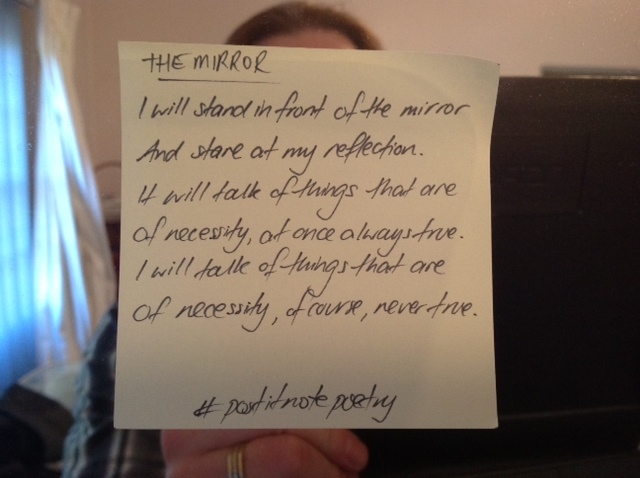
The Mirror

The Mirror

I will stand in front of the mirror

And stare at my reflection.

It will talk of things that are

Of necessity, at once always true.

I will talk of things that are

Of necessity, of course, never true.

The Mirror

Inspired by a quote from Bas Jan Ader, Dutch performance and conceptual artist, when reading James Roy’s blog, “Head Vs Desk.”

Folded Peace – A Poem

Folded Peace

Folded Peace

Were I to fold one thousand pages

Into one thousand cranes

Will I have erased enough

Print onto my fingers

That I may wash it away?


I fold despair into wings


Each page I fold

Is a prayer for peace

A flock tied like a kite’s tail

To let serenity slipstream

Over a tattered fringe of feathers


And give flight to hope

Create Because It Counts

We create not for fame.

Not for money.

Not for recognition.

Not for glory.

Not for the praise of others.

We create because it counts.

This principle came out of an article on pianist James Rhoades, “Find What You Love and Let It Kill You” from The Guardian newspaper in the UK.

Create because it counts.

James put himself through an extreme, almost ascetic regime: “no income for five years, six hours a day of intense practice, monthly four-day long lessons with a brilliant and psychopathic teacher in Verona, a hunger for something that was so necessary it cost me my marriage, nine months in a mental hospital, most of my dignity and about 35lbs in weight.”

I do not connect with the extremism (yet I can see the validity in it if you want to take something as far as you can go) but I do connect with the emotional response he has when he has put in the time and practice to learn and master a new piece of music; I apply it to writing.

“And yet. The indescribable reward of taking a bunch of ink on paper from the shelf … Tubing it home, setting the score, pencil, coffee and ashtray on the piano and emerging a few days, weeks or months later able to perform something … A piece of music that will always baffle the greatest minds in the world, that simply cannot be made sense of, that is still living and floating in the ether and will do so for yet more centuries to come. That is extraordinary. And I did that. I do it, to my continual astonishment, all the time.”

This is what counts: the emotional connection in creating, and in mastering a skill.

It is about the experience of joy in any creative endeavour. The joy in folding an origami crane for the first time; completing a short story; learning a new chord for guitar; finishing a water colour painting.

Doing it because it brings you a sense of completeness and wholeness as a person.

We do not have to go to the same extremities as James but his encouragement goes further to explore the “What if’s…?”

What if we used our time more wisely? Spent less time wasted on social media and engage in a creative activity? Spent a little bit of money to start a creative pastime like painting or photography? Knit? Crochet? Took our phone, shot some footage and made a short film? Used our time to engage with others in a writers’ circle? Wrote the story or novel we have been aching to tell for decades?

What if…?

So many possibilities. So many options.

And we create because it counts for something.

It counts for the children whose father draws a new picture on their lunch bag EVERY SINGLE DAY.

It counts for the short story writer, novelist or picture book writer creating worlds for others to inhabit.

It counts for the musician sitting in a cafe playing her guitar to six people.

It counts for the grandmother making a quilt as an heirloom for her grandchild.

It counts for the child who discovers the joy of the world through the lens of a camera and documents his journey to and from school every day.

It counts for the dancer at the bar, perfecting a pirouette.

It counts because we need stories and art and music and film and theatre and dance.

Creativity liberates your spirit. It enriches who you are, and the people who engage with your work.

Creativity is a mentality of giving; giving to yourself and others.

Creativity costs in terms of commitment, of sacrifice, of dedication.

You create because it counts.