Tag Archives: poetry

Where I Find My Poetry…

At band rehearsal this week (I play in a covers band for weddings and corporate functions) I scribbled this onto a scrap of paper between songs as the band rehearsed with a drummer who is filling in for me for an upcoming gig.

I’d had the title floating in my head for about a week and an idea of what I wanted to write. Originally I intended it to be a simple blog post about how I, as a writer and poet, find my inspiration and ideas. 

The idea was composting in my head and while I lounged behind the sound desk I scribbled this out.
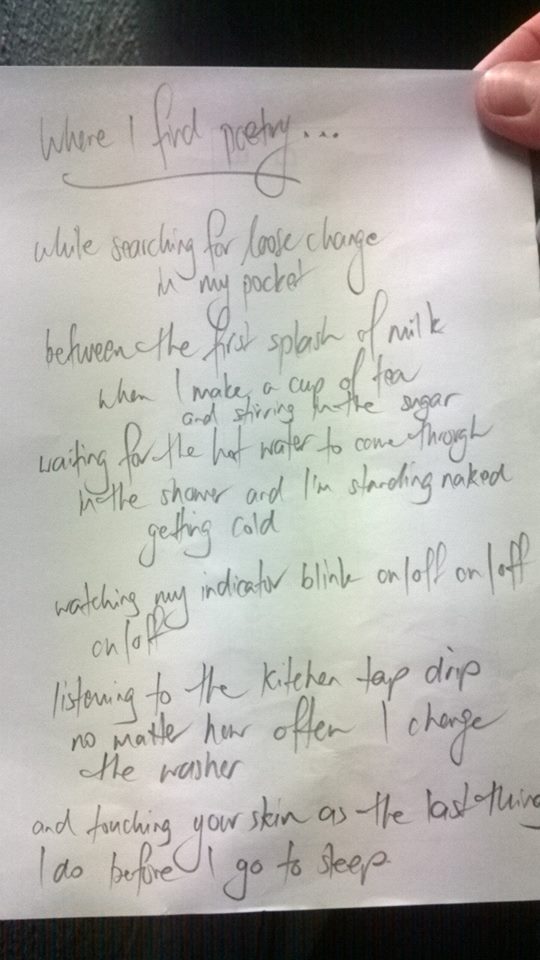
Where I Find Poetry

Where I Find Poetry

while searching for loose change in my pocket
between the first splash of milk
when I make a cup of tea
and stir in the sugar
waiting for the hot water to come through
in the shower and I’m standing naked
getting cold
watching my indicator blink on/off on/off on/off
listening to the kitchen tap drip
no matter how often I change 
the washer
and touching your skin as the last thing
I do before I go to sleep.

What becomes more interesting is I took a photo and posted it to Facebook, rough and ready as it was. A good creative friend of mine made this comment: “This reminds my (in style) of Leunig, but I do that in praise of such an original piece. This needs to be a poster.” (Leunig is a well known and highly respected Australian cartoonist and writer)

Once it is published it is out of my hands. It is what it is to the reader and viewer. I see its faults and insecurities, the line breaks that don’t quite fit or the meter or rhythm of lines that are inconsistent, the ideas for improvement. 

But the reader and viewer engage with it as it is, seeing it as a finished product for him or her. It either resonates and connects or fails to spark and is ignored. And that’s fine.

It’s also, upon reflection, an accurate understanding of the focus of what I write about. I like the minutiae, ennui and detritus of the day-to-day because these actions, objects or circumstances have significance and meaning to a person. We are inspired and captivated by the videos flowing through social media of spectacular acts of heroism, generosity and compassion but it’s often the short videos of people doing simple, routine acts that bring us to tears because it reminds us we can make a difference. 

The seemingly insignificant has meaning and purpose to the individual and I want to explore what it means for the character and his or her life because it often reveals significant meaning and purpose.
Throw Out Thursday – Changing Form

During the week I was sifting through old poems on my hard drive looking for possible works to submit to an anthology a friend worded me up to (didn’t find anything of note although I did find a younger version of me writing complete tripe).

I came across two half-finished pieces and combined some stanzas to make a relatively cohesive whole.

The starry satellites stand sentinel
over silent musings while an observer
of a different reality speculates on the starry host
these pinpoints of silver across the velvety blanket
blink without recognisance
Looking towards the blanket of the night sky
He sees a thousand times a thousand times a thousand
pinpoints of light and asks
“Does God shine a torch at night through the little holes?”

Posting it to my crit group for giggles brought one of the group to suggest it would work as a tanka. No, not a tank top.

What is tanka? Think of it as an extended haiku.

It has a 5-7-5-7-7 syllable count, as per the Japanese guidelines (not necessarily the same in English when translated but English writers use this basic format when starting out).

Go here for an introduction: http://www.ahapoetry.com/Bare%20Bones/wfftocintro.html (with thanks to my crit member, Sean for the link. There are some wonderful examples to read.)

A quick check with my copy of Stephen Fry’s ‘The Ode Less Travelled’ and the link above, I had a grasp of the basics of tanka. And by grip I mean a loose hold. And by loose, barely touching.

And this is what I came up with:

pinpoints of silver
against the velvety black
a blanket of stars
“Does God shine a torch at night
through the little holes?” he asks

I now have a new understanding of how form can affect and benefit a piece of writing. Changing form, in this case, forced me to focus on what were the significant images I wanted to convey in the poem, leading to the final line. Sometimes it could be as simple as breaking the line or stanza arrangement. Sometimes less is more.

But changes to a piece could be in the form of changing point of view, turning a story into a poem or a poem into a short story.

Has changing form helped you with a piece of writing?

I Found More Poetry Under The Lounge

 I find poetry in all kinds of places, often under the lounge and I found some more there recently.

Right now the end of winter is approaching here in the southern hemisphere (not that we had much of a winter where I live – what happened to those good old fashioned frosts we had as kids?) and with it the promise of hay fever, runny noses, itchy eyes and a cursing of all things frolicking. The first and last poems assembled here, Magnolias and Windy Days, are inspired by the wintery season.

Magnolias

As I drive past
The magnolia blooms
A thousand sunrises
Of pink to white and
A thousand sunsets
Of white to pink
Simultaneously

Standing By

I stand in the longest corridor
possible, pretending I’m Red 5
barrelling down the trench
avoiding laser blasts
to my office door

The Last Page

When you close a book
Do you think it will be
The final time?
Never to peer
Between the pages and
Read the tongues of men
Again

My Companion

I walked in darkness
But was never afraid
For I felt your hand
In mine, or around
my waist, looped over
my shoulder as my light

Generations

She watches
grandmother’s knitting
learns the art of rhythm
the pulse of long thin bones
curses the dropped stitch
like her grandmother

Windy Days

I imagine with each 
breath of wind
the trees ask
for our silence
a gentle ‘Shhhh’
simply to listen
to our own
heartbeat
Which poem resonates with you?

Throw Out Thursday – Showing Your Work

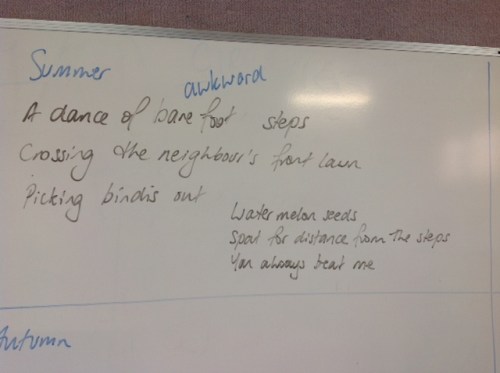
For this week’s Throw Out Thursday, I’ve collected the random poetry I wrote with Year 8 last term. The focus was on haiku.

It’s a great way of introducing students to a poetic form and while there is a beautiful simplicity to haiku, there is also great depth and complexity in the form when explored.

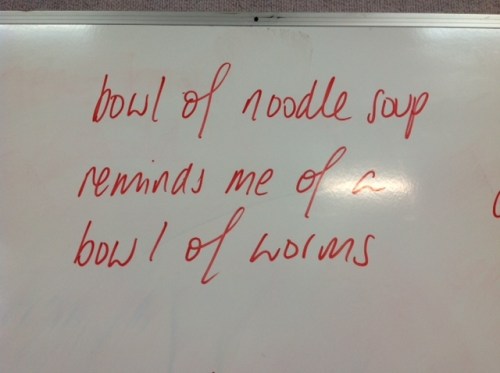
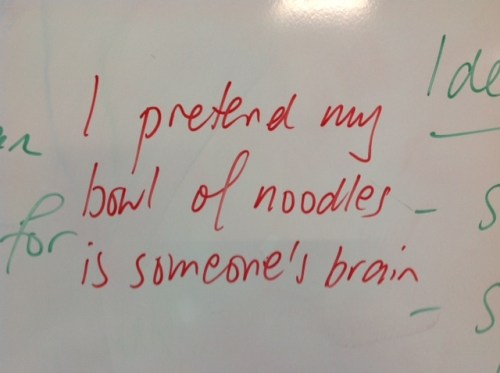
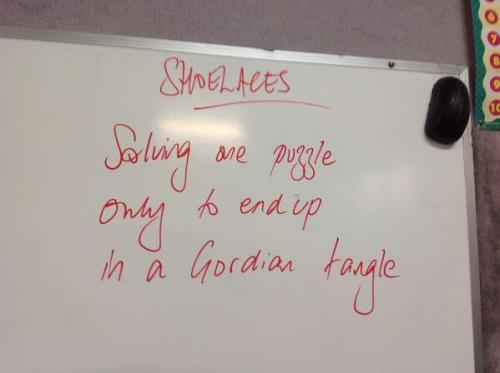
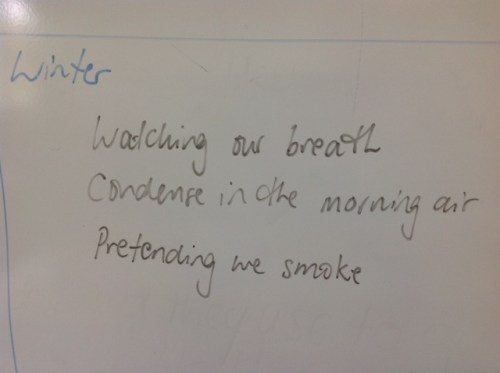
But this is about throwing stuff out. And these are haiku I wrote on the board while my class was working. I believe it’s important for my students to see my writing, correcting, experimenting and exploring creatively.

Haiku with Year 8

Haiku with Year 8

Winter Haiku

Winter Haiku

Summer Haiku

Summer Haiku


Noodle Worms

Noodle Worms

Noodle Brain

Noodle Brain

Creativity is about experimenting, exploring, examining, and having a whole lot of fun.

These are brief experiments and part of the process of improving my writing craft. As Austin Kleon says, “Show your work.” You get to see a little of the word wrangling I do to.

Dare you to have a go at something creative.

Scraps of Paper Under the Lounge

Another set of #micropoetry gleaned from my twitter stream, collected here for your reading pleasure and deconstruction.

I like writing them because they are often quick, spur of the moment ideas, thrown down on my Ipad and sent out into the nebulous ether of the interwebz.

It’s a form of disposable creativity, like Hansel and Gretel leaving breadcrumbs behind for others to follow my example. Later this year I will be relaunching posts on creativity and why I think EVERYONE should be creative.

I hope something like this inspires you to do something creative.

Cameras For Eyes

The camera downloads
Our memories
Stored in another brain
So we can promptly
Forget
And cannot prove
We ever existed

Boredom

Bored, he watched sands
Trickle through the waist
Of the egg timer. Paused
Between starting anew
And waiting for it to finish

Making It Better

But a Band Aid makes
everything better, he cries
offering up the token.
I’m sorry, says his father
But Nanna has died

Musical Mayhem

In her hands
A wooden spoon
and metal mixing bowl
struck together
a ringing, pleasing tone
striking again
she discovers music

Burning Bridges

He flicked the switch
Burned the bridge
Op’ed a gaping chasm
Then offered tools
To build a better bridge
Than the one before

I Give You My Heart

I handed over my heart
To my beloved
In the most convenient package
A plastic bag
Grabbed from the pile
Behind the kitchen door

The Journey

The journey
Of a thousand miles
Begins not
With the first step
But in firstly
Packing a pair
Of clean undies


Do you have a favourite, or if you were to rewrite one, how would you do it?


More Loose Scraps of Paper – Further Collected Micropoetry

Looking back through my posts I have collated more of the #micropoetry posted on twitter and posted here.

Stay tuned in the future for a book of micropoetry.

Outside

when did Outside
become an
undiscovered country?
whose unfenced boundaries
spark greater imagination
than the couch’s confines

Mandala

She draws on the concrete
a chalk mandala
of wonky butterflies,
stick-figure people.
Tomorrow she will
draw another
cycle.

Training Wheels

 I’m too old for these
she said
pointing to
the training wheels
He prays she will
never be too old
to trust
and hold
his hand

Knowledge

The gaining of knowledge
deteriorates with age
because we know
everything at 18
and realise
we know nothing
the older
we become

Toilet Seat

Sometimes
I deliberately
Use the bathroom
After you
And absorb the warmth
Of the toilet seat
To believe you
Still care

It Is Written

It is said,
“It is written”
The oral tradition
Of received wisdom
In a fortune cookie
Platitude while we
Forget to read
The written truth

Any favourites?

Loose Scraps of Paper – Gathered Micropoetry

Another collated exhibition of #micropoetry I have posted to twitter and also posted here.

Plans are afoot for later in the year to publish a book of micropoetry. Anyone interested?

Footfalls and Shadows

My shadow hides
The path’s pitfalls
Hollows and
Stones to trip
Because I walk
Not into the sun
But away from it

Light A Match

our words fell
like leaves in autumn
and drifted into piles
the colour faded
the moisture evaporated
waiting for conflagration

Animal Playground

Some pigeons peck
At scraps in the playground
While others engage
In elaborate courtship rituals
Just like students 

Television Conversations
The television speaks

As a third participant talking
Over, under, through.
An unsolvable knot
Of miscommunication
Until the remote is found

Checkout Manga

In between customers
She draws manga
On the back of receipts
Slips them into groceries
And wonders if Godzilla
Eats breakfast cereal

A Windowed Existence

the existence of life
prelude to dying
narrows its vision
as death draws
the curtains
against the limited view
remaining through
the window

The Truest Hero

The truest hero
is seldom seen
in cape nor undies
on the outside
But in those
whose daily
actions make
the stranger
a welcome guest


Any particular poem take your fancy?

Kintsukuroi – Micropoetry

In my brokenness
I am made beautiful
You collected
the broken pieces
Sealed fleshly wounds
With golden scars
I wear as triumph


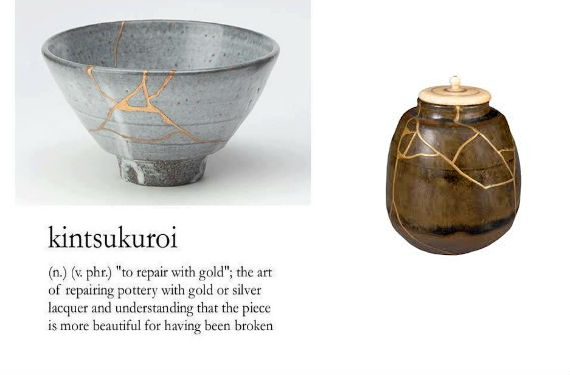
This poem was inspired by the Japanese art form of kintsukuroi

Kintsukuroi


I see creativity as an act of creation and as an act of repair. Sometimes it is in the act of creating that a person finds wholeness by putting their emotional and mental trauma and experiences into a work of art. It may be a difficult and draining but it can also be a catharsis, a release, a giving away of the issues and experiences held onto like removing a splinter from under the skin.

Sometimes we need to understand we are broken so we can be repaired and made beautiful again. Creativity is the medium through which it can happen.

What can you make beautiful again?

Antidisestablishmentarianism – A Haiku

I set my Year 8 class a writing task today, 10 Things I Know to be True, or 10 Things I Should Know By Now (taken from Sarah Kay’s TED talk – it’s brilliant. Go watch it).

One of my students wrote, “I know ‘antidisestablishmentarianism’ is the longest word I know.”

We joked it was almost a haiku in itself. So I thought I’d make one. I know it’s not a correct or proper haiku but it’s a fun form to play with.

An-ti-dis-es-tab-
lish-ment-ar-i-an-ism
Longest word I know

What creative act have you done today?

Random Creativity (And Why It’s Important)

On Friday my Year 8 class were set the task of writing haiku.

The English approximation of a beautiful Japanese art form is known to most, if not all, primary school children. They learn it is a poem of 17 syllables broken into 3 lines (5, 7, 5) and it is about nature (or something…).

It is taught because it is easy and accessible for students. It gives definite boundaries and restrictions, confinements for words and their interplay of meaning.

But writing great haiku is difficult.

I told my students I wanted them to experiment and play with language. I encouraged them to enjoy the process, to have fun with language. And so I had a go at writing a couple myself.

Summer Haiku

Summer Haiku

A dance of barefoot (awkward) steps
Crossing the neighbour’s front lawn
Picking bindis out

Watermelon seeds
Spat for distance from the steps
You always beat me

Winter Haiku

Winter Haiku

Watching our breath
Condense in the morning air
Pretending we smoke

Are they any good? Probably not.

Why is random creativity important?

It can be done quickly and in spare moments, disposable as an empty soft drink container or laboured over and agonised and deliberated for each and every syllable.

This is why creativity is important.