
I’ve seen this image floating around the interwebz lately and initially agreed with it.
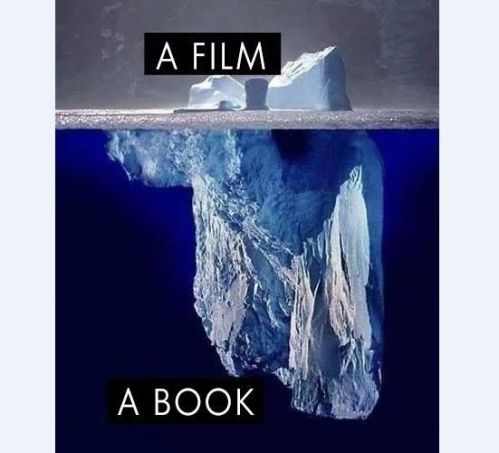
The obvious suggestion is that a book offers the reader more complexity and depth than a movie; that a movie is a passive activity without detailed narrative, skipping over the juiciest and meatiest parts of a novel.
However, the more I saw it popping up in my social media feeds the more I questioned it.
The image implies a superiority of the printed word over the celluloid film, that a novel trumps film for storytelling and attention to detail. It’s a simplistic interpretation; it’s elitist and fails to embrace the complexity of film as art.
I, for one, have been disappointed in book-to-film adaptations (The Hobbit) yet also greatly impressed by book-to-film adaptations (The Lord of the Rings). I read intently the hue and cry from LOTR fans who bemoaned the excising of large swathes of narrative e.g. Tom Bombadil for the movie adaptation. Peter Jackson’s reasoning was simple: does this section move Frodo closer to Mount Doom or take him away from it?
I tell my students that film narrative is different to book narrative; each has their own language and vocabulary required to tell the story. Great film making is an art requiring a control of language more than simply words: framing, movement, lighting, sound, music, symbolism, colour, allusions, editing.
We learn to read the shorthand of film to understand the emotional depth conveyed (dialogue, camera angles, music, sound etc) whereas in the novel we rely on the author’s words to bring us into the interior world of the character or situation.
Auteurs are adept at constructing a narrative for the audience that doesn’t rely on words alone, building their narrative through their medium. This does not make it inferior to a novel. Nor is a novel superior to a film because it requires only the imagination to create a world for the reader.
There are great novels and great films. There are rubbish novels and rubbish films. There are flaws and weaknesses in each when it comes to the power of the narrative arc but we must learn to read them differently, with a different eye and ear, with a different vocabulary and language. We must be conversant with both.
We cannot be snobbish and declare, “The book was better” if we are not conversant with the language of the other medium. True communication comes through understanding and appreciation.

 A Fullness in Brevity - Adam Byatt