Tag Archives: music

Everything Is Interesting

Everything Is Interesting

For the creative person, everything is interesting.

Everything.

Every thing.

Every natural wonder, every man-made phenomenon, every moment of human interaction no matter how small or insignificant or significant or world-changing or spontaneous or planned or tragic or brutal, every design or act of chaos is a fascinating study of “Why?”

Every thing is the spark for an opportunity to create.

Every surface is a medium for the intended message.

Every person is a character study for a writer: facial response to sucking a lemon; every mannerism, action, the way the old man eats cake with a knife and fork in a cafe; the way a girl rummages through her backpack; the way pigeons scatter when a child runs through them.

Every sound is a potential sample for a musician: the rattle of a stick down a fence; the clack of a typewriter hammer; the echo in a public toilet, the note of a truck’s horn in traffic; the tempo of the indicator light in the car.

Every colour and shade is an inspiration for a painter: the tomato sauce squeezed from a sachet; the blue of a new born’s eyes; the chocolate smeared face of a toddler; the crisp whiteness of a piece of paper; the triple stripe colour of toothpaste.

Every smell is an olfactory repository for the chef contemplating new flavour combinations: barbequed sausages and onions; the tang of salt on hot chips and the bizarre smell of the pitch-like viscosity of Vegemite.

Every touch is a tangible representation of sensory interaction: the cold metal of a handrail in winter; the stubbly roughness of a three-day growth; the warm sticky flakiness of a freshly cooked cinnamon doughnut.

The mundane is interesting because it allows time to reflect and rejuvenate.

The boring is interesting because it allows your mind and body to rest and let the subconscious sift through the noise of the day.

The spectacular is interesting because we get to see the ingenuity of humanity’s thinking and the testing of the limits of physical, mental and emotional endurance.

And it spurs us, pricks the sides of our intellect, pushes us to create, to stretch our boundaries and create.

For the creative person, every thing is interesting.

Colouring Outside The Lines

As a child, colouring outside the lines was the mark of a juvenile understanding of boundaries and parameters: they were ignored.

You were handed a pencil or crayon and a colouring book and told to have fun. And fun was most definitely had. Scratched lines of pencil or crayon all over the page. There was fun simply in the act of creating marks on the page.

Yet gentle adult encouragement made you aware of the lines of the picture; the boundaries drawn to keep the colours within.

So you took extra care and effort to colour within the lines and make the picture look special. You were disappointed if your pencil or crayon slipped over the line, extending the colour beyond its prearranged designation.

And so it is with any creative endeavour. Initial enthusiasm and fun is gradually replaced with awareness of the skills, parameters and boundaries of your chosen creative medium. You become a skilled practitioner of your creative art and can produce good work.

So, how do you extend your creative skills? How do you extend your knowledge and understanding of your medium? When you are entrenched in your chosen creative medium, whether it’s art, literature, film, painting or music, how do you extend the boundaries and parameters?

You learn to colour outside the lines again.

As a drummer playing contemporary music and musical theatre, I am used to the drums forming a rhythmic foundation, providing timbre, dynamics and tone colour, the beat and rhythm.

The other day I had the opportunity to meet up with Adrian, an old teaching colleague of mine who is an art teacher, musician, boutique record label owner and producer, and a mutual friend and drummer, Costa.

P1010973

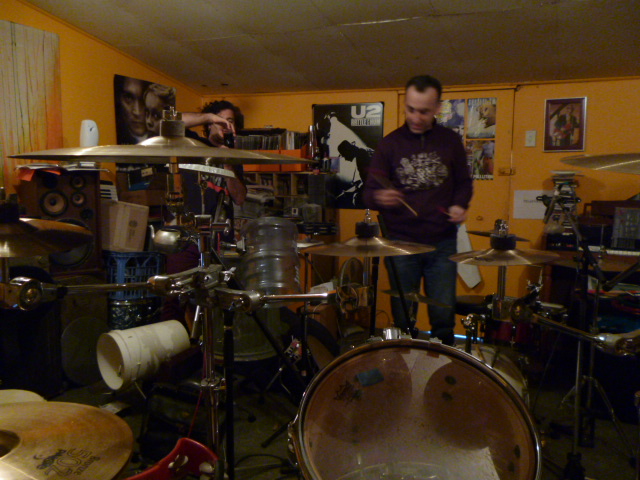
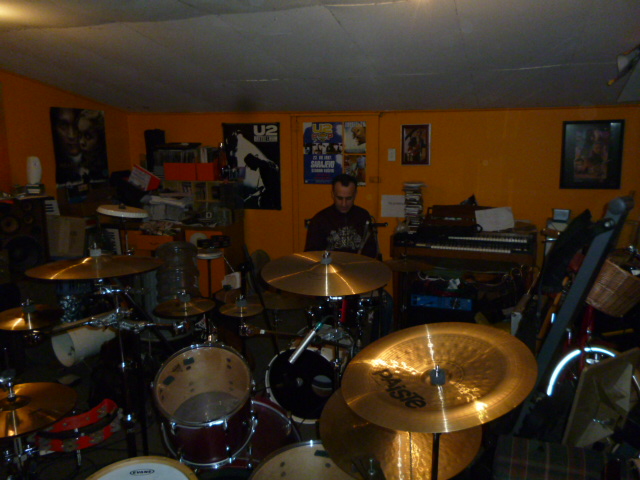
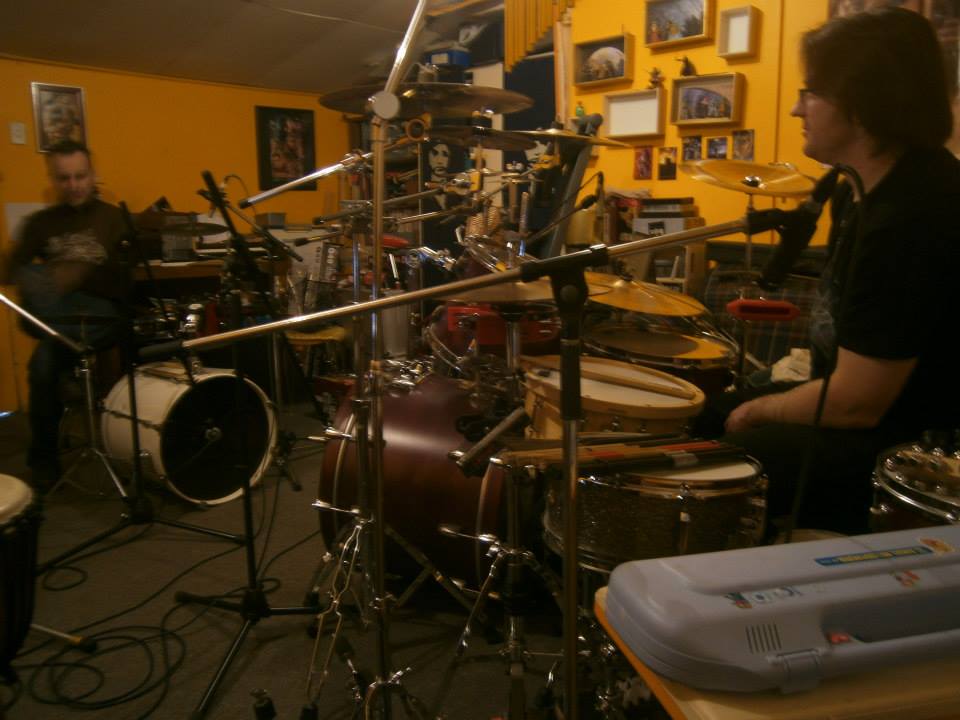
The three of us convened in a small home studio out the back of Adrian’s house. We lugged gear in and set up while Adrian placed mics.

There was no preconceived ideas as to what we were going to play and record, except for some youtube clips we had looked at earlier. There were no lines to demarcate the boundaries of our creativity.

Yet how easy it is to rely on the boundaries of what we know. As drummers Costa and I fell into an improvised jam in 6/8, using a form that was familiar to us, creating a beat and rhythm. As we played we listened to each other, playing around each other’s grooves and timbres, sometimes playing with the groove, sometimes playing against it.

We were colouring within the lines.

P1010968

I learned to colour outside the lines because of Adrian’s artistic vision and creativity.

Adrian suggested for the second jam an experimental form playing in different time signatures: Costa played in 4/4, I played in 5/4 and Adrian played in 7/4. It sounded gloriously messy as we experimented within the constraints of the time signature allocated while listening to what the others were playing.

The Junk Collective 3

The last jam was truly a learning experience of colouring outside the lines. Adrian suggested we play not rhythms or beats, but focus on the sounds produced from each part of our instrument.

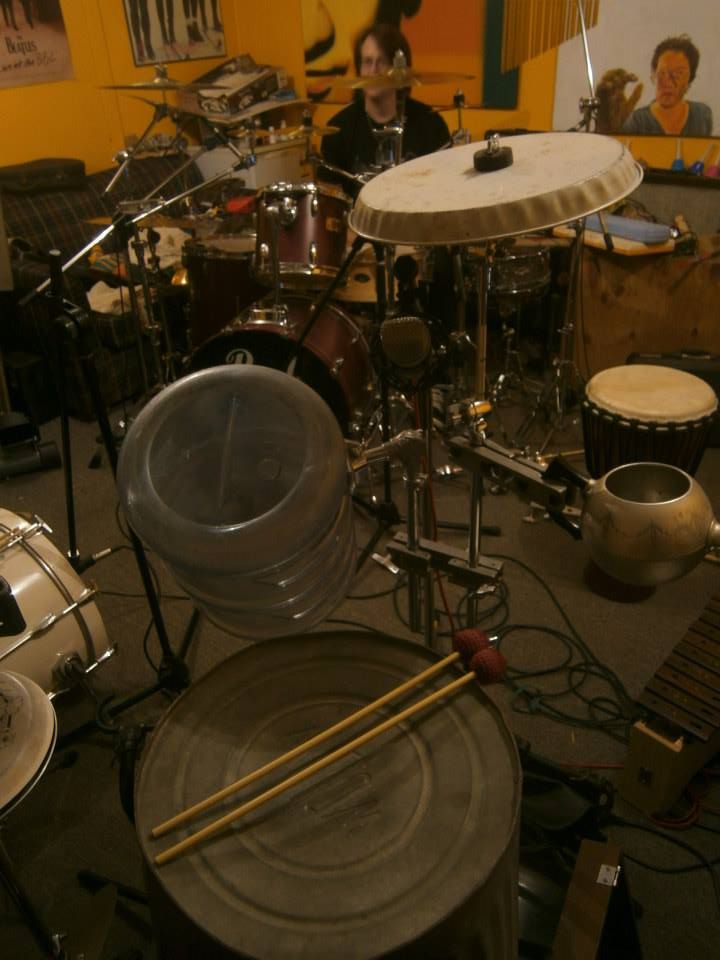
We used sticks, mallets, brushes, rods, plastic rods on all parts of the drums and cymbals including the rims and stands. I threw a handful of sticks into the air and let them fall where they may. I bounced sticks, mallets and rods off my snare to see where they landed. Adrian used a violin bow on cymbals and played mallets on my kit, Costa’s kit and their “junk” drum kit which consisted of a metal garbage bin, water bottles, saucepan lids made into hi-hats and a metal tea pot.

The Junk Collective 2

It was this last improvisational jam that really expanded my understanding of rhythm, drums and music in terms of creativity. It allowed me to colour outside the lines as I was not focused on the traditional parameters of my instrument, rather learning to see outside the lines and create accordingly.

Artists talk about the ‘negative space’ on the page; what is not there is as important as what is there.

My next step is to apply this principle to my writing.

Whatever creative medium you are engaged in, whether it’s writing, music, art, have you learned to colour outside the lines again?

Creativity Week Wrap Up

Each day this week I posted a new idea on aspects of creativity.

I have gathered all the links for you in one easy place for you to catch up. I would love to hear what you have to say on creativity.

Monday – Create Useless Beauty

“Create a piece of art because it has no other function than to beautify your presence, illuminate your thoughts, elevate your attitude, satisfy your creativity, to please only yourself.”

Tuesday – Creative Dichotomy

“Make art from the beautiful and the ugly;

From the joyful events of life and from the circumstances marked by sorrow.”

Wednesday – The Bridge Between Imagination and Reality

“Creativity is the bridge between imagination and reality. We live in a divided state of how we see the world as it is and the vision of how we see the world as we want it to be.”

Thursday – Birth and Death in Creativity

“Creativity is a birthing act. Its genesis lies in the conception of an idea and by a word it is spoken into being.

And in the end we see that it is good.”

Friday – Creativity is the Mother Tongue

“We speak our mother tongue verbally and artistically. For some, we need to find our voice again. For others, it is strengthening their voice. Creativity is our mother tongue. Let people hear your voice.”

Have  a creative weekend.

Creativity is the Mother Tongue

Victor Wooten delivered this talk to TEDx Gabriola Island. He is a remarkable musician, master of the bass and a genuine and erudite educator.

The focus of his talk is music as a language. Listen carefully and you will learn.

I want to take his words and comment on them as they apply to other creative arts: writing and art.

Creativity (writing, art, film and music) is a language. Learn to speak a different tongue. Or in some cases, we need to relearn to speak our mother tongue.

Victor Wooten – Music as a Language (click link to view the talk)

I have taken excerpts from his talk, either quoted directly or paraphrased, and extrapolated their application to other artistic endeavours such as writing and art.

Your first language is not taught. People spoke to you. You were allowed to speak back – creativity should be learned with your mother tongue. Give children pencils and paper and allow them to speak in their own way. Give yourself pencils and paper and find your mother tongue again.

Beginners are not allowed to play with the masters – in music, the beginner and the amateur are separated from the genius of the master, able to watch but not participate. In all aspects of creativity we should learn from and participate alongside the masters.

As a baby, you’re jamming with language. Not made to sit in a corner and practice; not corrected when you’re wrong. Even to the point your parents learn the new way of speaking. You remain free in how you talk. When you could hear it (language), you started learning – Language is a freedom we have, a freedom of expression. Creativity is another freedom of expression. Learning language is immersive; we are around it all the time and learn the nuances from what we hear.

Growing up in Hawaii, Victor learned to play not by being given an instrument, but by being played to. A plastic stool was there for him to sit on and so he sat and listened. When older he was given something to hold – even before we understand what creativity is, how we should hold a pencil or a paintbrush, we must immerse ourselves in creativity activities and involve our children so they too, learn the language. When we surround ourselves with creativity we internalise the language.

Music is a pure voice. We want to teach the rules and the instrument first. We teach to play the instrument before they understand music. Learning to play music, not the instrument. Knowing the phrases, tones etc, learning – when we instigate boundaries and restrictions, demonstrate how-to or chastise for what we perceive as incorrect, we must stop and let the creativity flow from within. When our children see, and when we see, the joy flowing from the creativity within, we understand the process. The rules and techniques are there to serve as a creative conduit, not the tool itself.

When he was finally given a bass to play, Victor was playing to songs he already knew. He has listened and internalised the music. Therefore music flowed through the instrument. He was musical first, learning to talk not about learning the instrument first. It’s about what you have to say. He learned how to speak through his instrument – when our children have been given opportunity to be creative with great freedom, given the chance to express themselves, they will find their voice to speak clearly.

Practicing works but it is a slow process – practice alone for the sake of practice will develop skills but we will learn more when we participate in community and learn to speak with our own voice.

Children are born with freedom. A lot of us are taught out of our musical freedom when we’re first given a lesson because a teacher rarely finds out why we’re there in the first place. Playing air guitar where there’s no right and wrong. It’s not about right and wrong notes; they’re playing because it feels right

A woman said to me, “I’m Ella Fitzgerald when I’m in the shower.” And she’s right. The freedom we have a child is grown out of us, but we need to find a way to keep the freedom. Approach music like a language and allow it to keep that freedom, to keep the smile on the face, and not taken away by lessons – Creativity is expressive freedom and we would do well to instil into our children the freedom of creativity.

What does the world need with another good musician? *insert own creative choice here* It has become a lifestyle. To be a good musician, you have to be a good listener – this is good life advice. Choose your words wisely before you speak, or better still, saying nothing at all. It’s not all about you, or me; it’s about the people around us.

If you want music to come out of you, out of your instrument, you have to put it into you – do not let the well run dry. Fill it at every opportunity from whatever source.

If I use my greatness in the right way, it can help others rise up. If you’re on a pedastal, don’t come down, bring them up so they can see and they’ll grow faster – help others to find their creative voice if they have lost it. Create community to help others grow. Better still teach your children to be creative so they never lose their voice.

We speak our mother tongue verbally and artistically.

For some, we need to find our voice again.

For others, it is strengthening their voice.

Creativity is our mother tongue. Let people hear your voice.

Create Because It Counts

We create not for fame.

Not for money.

Not for recognition.

Not for glory.

Not for the praise of others.

We create because it counts.

This principle came out of an article on pianist James Rhoades, “Find What You Love and Let It Kill You” from The Guardian newspaper in the UK.

Create because it counts.

James put himself through an extreme, almost ascetic regime: “no income for five years, six hours a day of intense practice, monthly four-day long lessons with a brilliant and psychopathic teacher in Verona, a hunger for something that was so necessary it cost me my marriage, nine months in a mental hospital, most of my dignity and about 35lbs in weight.”

I do not connect with the extremism (yet I can see the validity in it if you want to take something as far as you can go) but I do connect with the emotional response he has when he has put in the time and practice to learn and master a new piece of music; I apply it to writing.

“And yet. The indescribable reward of taking a bunch of ink on paper from the shelf … Tubing it home, setting the score, pencil, coffee and ashtray on the piano and emerging a few days, weeks or months later able to perform something … A piece of music that will always baffle the greatest minds in the world, that simply cannot be made sense of, that is still living and floating in the ether and will do so for yet more centuries to come. That is extraordinary. And I did that. I do it, to my continual astonishment, all the time.”

This is what counts: the emotional connection in creating, and in mastering a skill.

It is about the experience of joy in any creative endeavour. The joy in folding an origami crane for the first time; completing a short story; learning a new chord for guitar; finishing a water colour painting.

Doing it because it brings you a sense of completeness and wholeness as a person.

We do not have to go to the same extremities as James but his encouragement goes further to explore the “What if’s…?”

What if we used our time more wisely? Spent less time wasted on social media and engage in a creative activity? Spent a little bit of money to start a creative pastime like painting or photography? Knit? Crochet? Took our phone, shot some footage and made a short film? Used our time to engage with others in a writers’ circle? Wrote the story or novel we have been aching to tell for decades?

What if…?

So many possibilities. So many options.

And we create because it counts for something.

It counts for the children whose father draws a new picture on their lunch bag EVERY SINGLE DAY.

It counts for the short story writer, novelist or picture book writer creating worlds for others to inhabit.

It counts for the musician sitting in a cafe playing her guitar to six people.

It counts for the grandmother making a quilt as an heirloom for her grandchild.

It counts for the child who discovers the joy of the world through the lens of a camera and documents his journey to and from school every day.

It counts for the dancer at the bar, perfecting a pirouette.

It counts because we need stories and art and music and film and theatre and dance.

Creativity liberates your spirit. It enriches who you are, and the people who engage with your work.

Creativity is a mentality of giving; giving to yourself and others.

Creativity costs in terms of commitment, of sacrifice, of dedication.

You create because it counts.

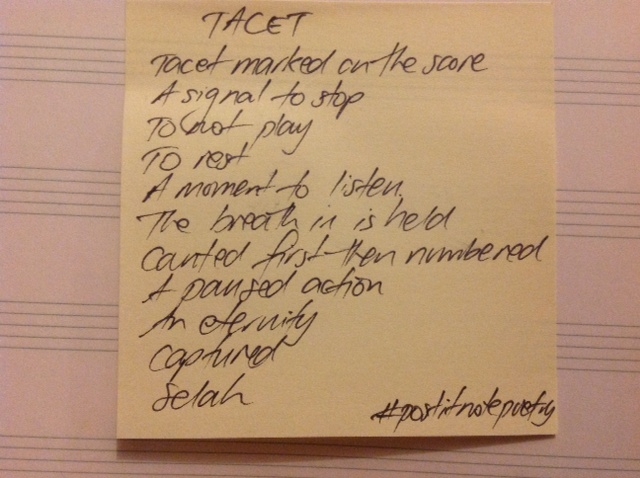
Post It Note Poetry February 22

February 22 – Tacet

Post It Note Poetry Feb 22

Tacet marked on the score

A signal to stop

To not play

To rest

A moment to listen.

The breath in is held

Counted first then numbered

A paused action

An eternity

Captured

Selah

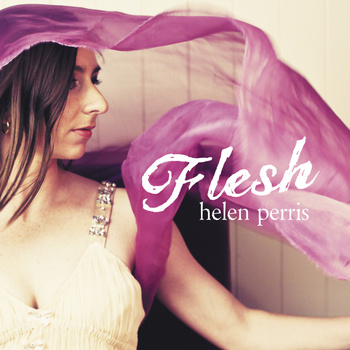
On The Creative Couch: Helen Perris

On the creative couch today is Sydney-based musician Helen Perris.

How do you define yourself as a creative person?

Well I guess at the moment I’m defined as a singer-songwriter, children’s entertainer and character actress, but I have always been a creative person. As a child I performed, singing and dancing in front of any audience that would watch; writing plays and musicals for my peers to perform in front of the class; choreographing dances, composing music, writing poetry and stories, playing many instruments… the list goes on. I never STOPPED being creative. I think that people are inherently creative and it gets beaten out of them by the school system and adults who don’t know any better. Even in my admin work (I work part time for a music venue), I’m coming up with creative solutions to problems, so creativity isn’t necessarily limited to the Arts, though in me, that’s the most obvious way to define what I do.

What is your chosen creative medium and how does it allow you to express your creativity?

At the moment, my chosen creative medium is songwriting. I don’t agree that I’m using it to express my creativity though. I’m creative anyway, by my mere existence. I use songwriting to express myself.

Can you explain your creative process.

I’ll talk about my process of writing a song because that’s probably the easiest to explain. It depends on the seed. The process differs depending on what form the seed takes. It might be a melodic fragment (e.g. Demophobia) or a lyrical idea (e.g. Rainbows & Thunder). It might be a current or recent event and my constant dwelling on it (e.g. Headlights) or in response to my needing to let go of a problem (e.g. Palace in Suburbia). The seed is the inspiration. Making that seed into a song is the perspiration. The grunt work sometimes takes months and sometimes I feel like I’m not the one writing at all, but that I’m just the channel for it. When songs are written especially quickly, with very little editing, that’s how it feels. I usually write all of the lyrics first and then set them to music, but that’s not a hard and fast rule. Sometimes I write lyrics sitting at the piano, sometimes at a piece of paper, sometimes at a computer. The music generally gets written at the piano, though I have been known to write the bulk of a melody and harmony part in the car, while driving. I work in a very solitary way, even when I collaborate. When I collaborate, my lyricist will send me complete or draft lyrics. If they’re complete, I’ll set them to music, messing about with keys and melodic ideas until I get the basic structure happening. If they aren’t complete, I’ll to and fro over email with the lyricist with changes until they are complete, then I’ll follow the same process. I haven’t (yet) sat down in the same room with another person and written a song together. That would be an interesting experiment.

Who or what gives your creativity impetus and direction?

I can’t really answer that. I can tell you what gave my career direction. My creative streak wants to dabble in everything and has no direction. I am goal-oriented and I like making my own creative opportunities. I chose this current direction because I was presented with an opportunity, which could have just ended there if I didn’t choose to take it further. But I was also simultaneously disenchanted with acting because of all the waiting around for opportunities and the constant rejection. I found it difficult to create my own acting work because I didn’t feel my script-writing abilities were strong enough and I felt a lack of community with fellow artists. Living in Western Sydney definitely made it harder to collaborate on theatre or film projects. So I took the positive response to my music as a sign and ran with it.

Who has inspired you in your creative journey?

Too many to list. Anyone who can survive the entertainment industry with their sanity and sense of humour intact is worthy of being a role model.

What are you currently working on?

I’m currently working on creating a human being. After it’s born and I recover, I’m starting the planning, fundraising and pre-production work for my second EP.

What is your “go to” piece to inspire you?

I find inspiration everywhere and I don’t stick to one thing to find inspiration or motivation. If I did, I think all my creative output would be the same.

How do you see technology impacting or affecting people’s ability to be creative?

I think technology opens up new creative pathways. It definitely makes it easier to connect with creative people.

What is a piece that is representative of your creative purpose?

Hmmmmm…

Do you mean a piece I’ve created or a piece by somebody else?

I don’t really know. I still don’t know if I have a purpose, let alone a creative one. I like to help people understand themselves and each other better. That’s why I teach, too. If there’s anything I leave behind as my legacy, it’s that there are a bunch of people who stopped hating themselves and started accepting and liking themselves because I understood them and helped them to feel they weren’t alone.

Many thanks for your time, Helen.

Check out the links to Helen’s music.

You can listen to (and buy) her music via her bandcamp site and connect with her via facebook (Helen Perris Music) and twitter (@helenperris)

She also blogs at http://helenperrismusic.com/

You can also listen to her recordings on SoundCloud.

In 2012, Helen was invited to perform at TedX Canberra. Check out her bio and performance.

If you want to be a part of the On The Creative Couch series, drop me a line in the comments or via twitter (@revhappiness)

On the Creative Couch: Deane Patterson

Welcome to the first interview for “On the Creative Couch.” This is my opportunity to ask a range of creative people from different creative fields about what they do, how they do it and how they understand the creative process.

The first guest to the couch is Deane Patterson (@ReceiverITW); film maker, musician, writer, bibliophile and someone who has inspired me for many years.

How do you define yourself as a creative person?

Well, you got it in one. I’ve struggled since my early 20s to put a label on what I do. I have to write something on my tax return, business card, Facebook bio – but lately I’ve given up and tell people I make things up. I don’t get any respect for that, but it’s the truth. I’ve owned “Creative Guys” as a business name for well over a decade now, and while I might not always use it publicly, it is a reminder to me that it’s just about being creative.

The struggle really comes from trying to define myself by what I do, when really it should be about who ‘I AM’ is in my life. What I do should come from who I am – not the other way around, because circumstances, passions and jobs change, but you as a person need to be the anchor point, the launch pad of your ideas.

If all you have is what you do, and that gets taken away from you, you can get really depressed, angry or just plain unproductive really quick.

I have an expression that’s all but tattooed on my heart (I should do it on my hand so I see it more frequently): Reveal The Kingdom. Everything I do is filtered through that. If it doesn’t fit through there, I’m in trouble, as I’ve strayed from my true love’s purpose, and my own heart’s desire.

I spent a year and a bit trying to be a commercial photographer, and one day I woke up and realized I was just in it for the money. I’m still recovering from that nearly a year later, and I’m still a little wobbly – but you have to forget the money and love the people – then you’ll touch lives (and get the support you need to carry on).

All I know is to tell stories and do that through music and video – it’s great that they go together so well – but within that is an infinite scope of possibilities from just 2 ingredients of making a story. And there are a ton of sub skills like writing, sound engineering, lighting, editing, design, publishing (the list goes on) that you work your way through just trying to tell the simplest story with music and moving pictures.

What is your chosen creative medium and how does it allow you to express your creativity?

I shoot stills, motion picture (video if you want to dumb it down), write and record music, write stories and advertising, I’m frequently designing things in Photoshop. I love music and would choose that if I really had to pick one, but I’ll do that when I’m grown up, and for now I enjoy stories and words, particularly as it applies to film.

Can you explain your creative process.

Immersive. Method. Obsessive. Frequently splintered and distracted. I struggle with focus and finishing the most because everything is damned interesting and I keep exploring the tributaries. It’s hard to remember: be the river, not the swamp.

Who or what gives your creativity impetus and direction?

Is this a thinly veiled question about God?

Who has inspired you in your creative journey?

Community. I care more about the encouragement of my family, especially my wife, and friends than a paycheck. My wife is encouraged by the paycheck too – so please, give generously.

What are you currently working on?

A screenplay for a creature feature (giant bugs), short orchestral music compositions (moving out of ambient and into a more symphonic vibe), some short story comps and a couple of submission offers, building a film/music production studio in the new house, a short film with a script based on an award winning stage play.

Long term, I’m hoping to get a timeline of 3 or 4 indie movies underway. Each project is more elaborate than the last so I can get the most experience with the lowest risk. The first film is 4 actors and someone else’s play that I’ve adapted for screen. The next is 4 actors and my script in one location. The one after that is 4 main characters and a lot of bit parts on a lot of locations. And then I’ve got a story with 7 main characters, but back to mostly one location – that project’s really about learning to work with actors more than film production issues – so you can see there is a long term plan there to grow into.

I’m also really into creating music, and sometimes I wonder if the music should come first – you know, which one is the driving force is, and which is the vehicle? I could just make music videos for my compositions and film school would have been worth it. But I really enjoy story telling in all forms, and film seems to put a bunch of things I do in a powerful mix where the sum is greater than the parts.

I once read a publisher being quoted, “Never believe what a creative person tells you what they’re working on. Just believe what they’ve finished.” So I use that as my escape clause.

What I plan, and God enables (because it’s totally dependant on Him) may change as I follow His lead – but that’s kinda the plan. If I change my mind, it’s because I wasn’t’ listening and wandered from the path. It’s been known to happen to creative people.

I’m a wanderer.

How do you see technology impacting or affecting people’s ability to be creative?

It makes it easier for people to get published, distributed, and easier to create stuff. But people are consequently making easier choices and not putting the same level of effort and expertise in.

Any idiot can use technology to get a result – and all their sycophantic facebook friends might even ‘like’ it – but much of what I see in terms of film/video production, photography, music and even writing is crap. And I include a lot of what I’m doing in the crap pile.

My only defense is that I’m learning. Failing forward. Getting better. You should be too. Get better, damn it. When I started in film, you shot film, and it cost literally hundreds of dollars to buy the freaking film, let alone process it. I learned photography the same way – you shot very limited numbers of stills, and didn’t know if you had until it came out of the lab days later, and then you had to print it.

No one got their book published.

If your band had a 4 track recording on cassette, you were awesome – forget making your own CDs, or even being able to record yourself on anything other than cassette.

This has turned into a full on rant – but when we took away all the barriers to entry, and technology made it easy, we slumped back to the lowest forms of using those opportunities.

Those barriers meant you had to work hard for the opportunity to work hard on making something. And it forced the cream to rise.

Work harder, dammit! And learn your craft. Make the effort to improve.

If you are totally dependent on technology as a crutch, then at least pay attention when the little red and green lines start breeding like nymphomaniac rats on your screen. You at least learned spelling and grammar at school you lazy sons of motherless idioms!

What is a piece of yours that is representative of your creative purpose?

I once read a publisher being quoted, “Never believe what a creative person tells you what they’re working on. Just believe what they’ve finished. So I use that as my escape clause.

I have a children’s book published called “The Purple Pirate Pants of Peril” that I’m extremely proud of, and if I could find where it is on my hard drive, I will re-publish. But that’s something that sold well and the target audience raved about.

I get paid for my music, but never get told where it’s being used, and I get very little feedback, so at this point, I’m still developing that. But I do have some music online (http://receiverinthewild.bandcamp.com/ ) that represents what I like to do musically. I find the money keeps the wolves from the door, but it’s feedback that really rewards my ego. And I like my ego. I like to have it stroked.

I’ve not released any of my personal video work that really says what I’m about yet – my best work is so far on other people’s projects – but it’s my goal to address this before I’m too far gone. How about February next year? Maybe.

Anything else to add?

Only God knows who you really are, and if you really want to know, He’s waiting to tell you. And then you’ll know what to do next.

Find Deane on Twitter @ReceiverITW

Blog: http://www.dcpatterson.com/

Bandcamp: http://receiverinthewild.bandcamp.com/

If you want to be a part of “On The Creative Couch” get in touch with me via twitter @revhappiness or leave a message in the comments below.

Words and Music

When putting together a series of ideas for Write Anything’s weekly PROMPTed post, I realised how much I focus on music as a source for understanding an emotional state when writing. When compiling the sets of prompts I began each one with a piece of music. Some of them are well known songs (Pink Floyd – On the Turning Away, Suzanne Vega – Tom’s Diner) and others more relatively obscure such as Hilltop Hoods – Chase That Feeling (an Australian hip hop group) and Primitive Radio Gods – Standing Outside a Broken Phone Box (more of a one hit wonder from the 90s). The first song is a current track by Kate Miller-Heidke – The Tiger Inside Will Eat the Child.

They were seemingly random selections taken from my memory or from play lists on my computer. Despite the diversity of genres and the different eras of music represented, each song has an emotional connection to me. Nothing world shattering or significant but a connection to the groove, the lyrics or the overall feeling of the song.

I love my music and play drums (not a bad level of playing suckage). I listen to a broad range of genres (rock, pop, jazz, whatever), but particularly like heavy metal. Engaging with the music I listen to, there is an emotional or spiritual connection with the music.

Let me talk drums for a minute. The essence of drumming is rhythm and the focus of rhythm is the pulse.  The earliest pulse we hear, but more accurately feel, is the pulse of the human heartbeat within the womb. 

Drumming is physical, spiritual, ethereal, primeval, tribal, conscious, unconscious and subconscious.  It moves your feet and taps your hands.  It provides a rhythm for the cycles of everyday living.  Relaxes the soul and hastens the heart. Drumming is sensual and visceral.

Drumming drives the rhythm.  Even in the absence of a played drum groove, the beat and rhythm are implied. Time can waver, become loose or tight depending on the emotional moment, but the pulse is never lost. 

There is a spiritual element to drumming and rhythm.  The pulse and the heartbeat of music is the driving force.  The pulse and heartbeat of rhythm can be found in the cycles of life; from the measured ritual of a cup of tea to the flow and movement of words across the page. 

As a musician, alright a drummer, I want people to engage with the music. As a writer I want the reader to engage with the words I have written, to find an emotional connection, a similar spiritual experience.

When writing I use music as a background soundtrack to either create a mood, a head space for writing or to suit the mood of the scene I’m writing. Some writers prefer the sound of silence when writing while others prefer a specific genre, band or song to help create the mood or atmosphere. Of late I have preferred instrumental music (sleepmakeswaves, Steve Lawson, Meniscus).

In Post Marked: Piper’s Reach, my character Jude, uses music as a reflection on his head space, or as a link to the past with Ella-Louise. If the reader is familiar with the music referenced, it creates a connection between the reader and the character whereby the reader is able to inhabit a similar emotional space because of the music.

Music is a conduit between the reader and the text; a pathetic fallacy to represent a character’s emotional or mental state, a reflection on their culture or the zeitgeist, or just because they’re really hip and are listening to bands you’ve never heard of. It’s another tool to draw your reader into the world of the narrative. In the novel I’m working on the main characters, both of whom play an instrument, music creates another level of characterisation.

I could fill post after post of music and musicians that inspire me, but here are a few that have inspired me of late.

Imogen Heap – Just for Now I love this song because of the live looping Imogen performs. Brilliant.

Steve Lawson Don’t Stop Believin’ 

Steve is a solo bass player who loops his instrument live. I often use his music as the background music when writing. Beautiful atmospheric and melodic playing.

Meniscus and sleepmakeswaves – Two Sydney (my home town) based post-rock instrumental bands. Brilliant live acts and wonderfully complex music. Never far off rotation on my player when writing.

A couple of other Aussie artists worth checking out: Andrew Drummond, Helen Perris, Emmy Bryce, Lissa, Telefonica. I’m pushing my hometown here, and if I could get my best mate, Steve, to hurry up and finish his album I’d promote it here, too.

I’ll have another post where I go \m/ >.< \m/ heavy metal crazy.

What music do you listen to when you write?

[FGC #2] The Photographer’s Concerto

[FGC #2] The Photographer’s Concerto

 “Charlotte,” she said, extending a hand. “Charlotte MacKay. I’m the photographer.”

A figure in black extended his hand. It was sweaty but cold and the reek of curry wafted over her. “Michael Bailey, band manager. Knock yourself out.” He stepped to one side allowing her through to the side of the stage. Around her black figures unwound mic cables, tuned guitars and placed various bottles around the stage. The crowd congregated at the other end of the room, sipping beers and drawing on cigarettes.

The thud of a kick drum felt like a punch to the stomach as the drummer ran through a sound check. From the side of stage, Charlotte watched the lean musculature of the drummer’s left arm as it raised and lowered like a pendulum, cracking the snare. Through the viewfinder of her camera she reeled off a few shots.

With the sound check over, the crowd pressed forward to the barrier, drinks abandoned at the bar. The lights dimmed and the crowd gave its approval: whistling and yelling, their voices tearing apart the darkness. Four shadows crossed the stage, fine-tuning, swigging from bottles, turning volume knobs. At the crescendo of the crowd’s voice the lights exploded like a thousand suns and the band struck the opening chords.

Across her line of sight past the bass player and lead singer, Charlotte glimpsed the guitarist. He wore an unbuttoned paisley vest, no t-shirt and long shorts with his guitar sitting slightly high. His hair danced around his shoulders and the guitar was an extension of his arms. Moving from the side Charlotte dropped between the barrier and the stage. Squeezing past the bouncers she stood before the guitarist, a worshipper before the shrine. Putting the viewfinder to her eye she sought the soul of this man.

Behind her the crowd pulsed in an orgiastic cycle of adoration, worship and dancing. Charlotte’s heart quickened, racing in concert with the shutter. Each frame captured a little of his essence, a relic to be fingered in quiet moments of prayer and contemplation.

The set finished and the house lights raised but the crowd lingered, unwilling to let go just yet, savouring the rapture of the music. Charlotte squeezed past security, back to her camera bag. From the corridor leading off stage a figure emerged, his head wrapped in a towel. His chest gleamed with sweat as he towelled off his head, drying his hands before offering one to Charlotte.

“Jake de Brito.”

His voice was softer than she imagined, and she noted a slight fragility in his frame, obscured by the stage lights. Bereft of his guitar he stood before her, a mere mortal. She watched his fingers move involuntarily, forming shapes and patterns in the air like a secret language; the fingers invoking sounds from the darkness of the void.

“Thanks for, like, coming to take photos of the band.”

“No, it was fantastic. I haven’t done a band shoot for ages and this was an awesome gig. What the street press are writing about you guys is spot on.”

He shrugged. “Did Michael, like, look after you?”

“Yes, thank you.”

A voice called from the corridor leading back stage. “Jake, you comin’ man?”

“Yeah. Hang on,” he yelled back. “Might see you soon, yeah?”

“Sure.”

Charlotte watched Jake disappear into the black. The persona captured on film was powerful and articulate; a shaman who summoned life and let it explode through his guitar. Without it, he was human but the magic boiled away at his fingertips.

“Hey, MacKay.” The waft of curry shot through with beer and cigarettes announced Michael Bailey’s arrival behind her. “Thanks for shooting. Send your invoice to my office.” He handed over a business card. “If you want, you’re invited to the post-gig party. Address is on the back.”

Charlotte scanned the address and pocketed it like an Access All Areas back stage pass.

Killing the engine of her Datsun 180 she flicked on the interior light and rummaged amongst the loose papers and film canisters on the floor of the passenger side. Finding an old lipstick she applied it while looking in the rear vision mirror. Pocketing another full roll of film she made her up the driveway to a broad fronted house.

At the end of a long corridor a second-hand clothes store explosion of flannelette, torn denim, scuffed boots lounged on chairs, stood in doorways and congregated in every spare area of the huge lounge room. The stereo cranked out late night radio through the haze of cigarette smoke. Adjusting her leather mini skirt Charlotte felt more glam metal than grunge, the bulkiness of her camera bag against her thigh an added layer of self-consciousness.

She lent against the doorframe, scanning the room unsure of where to go.

“Hey, you’re the photographer from the gig.”

“And you’re the drummer.”

“Mitch. Come in and grab a beer.”

Following through the house Mitch took her to the kitchen and grabbed a beer from the fridge.

“Let me introduce you around,” said Mitch.

Mitch lead her through the lounge, the only name Charlotte remembered was a girl’s with a towering teased and tasselled fringe in need of a structural engineer to code it for safety.

In the kitchen a group of guys gathered around the table, populated with loose cards, a bottle of Jack, cans of beer and bottle tops, and loose change. She recognised Michael Bailey, the bass player and singer but her eye fell onto Jake.

“I suck. That’s why I’m not invited to play,” said Mitch.

“Mind if I take some photos?”

Through the lens she snapped Jake’s fingers as they tapped the back of the cards. His hair was tied back into a ponytail and Charlotte noticed again the fragility. Not as a weakness, more a humility of character.

The radio cranked another tune. At the sound of a cello Jake inclined his ear to the sound and mimicked the song.

“Nice work cello boy,” said Michael.

Jake shrugged the insult and caught Charlotte’s eye as she moved the camera from her face. A brief smile formed on his lips as the opening lyrics invaded the smoky haze.

“I just died in your arms tonight.”

There was a chorus of disapproval from the flannelette wearing crowd but enough supporters to form a sing along.

“Mitch, take my place,” said Jake holding up his hand of cards. Moving from his seat Jake came to Charlotte.
“I’m seeing you sooner than I, like, thought.”

He led her out onto a concrete verandah, a rusted Hills Hoist rearing up from an overgrown lawn. They tossed musical preferences back and forth until they found a common ground.

“You remind me of the drummer in my first band,” he said after half an hour of false starts and half-finished sentences. “His time was, like, more fluid than water and he often didn’t know where the ‘1’ was. We were playing rock’n’roll, meat and potatoes music, not some Billy Cobham fusion piece from Mahavishnu Orchestra.”

“Sorry I’m so awkward,” said Charlotte, pulling on the strap of her camera bag. “I’m usually more… articulate.”

“I find music, like, easier. Notes, arpeggios, solos. Words are clumsy in comparison.”

“Next time I’ll be less like your first drummer. Promise.”

“I’ll get your number from Michael.”

****

Tucking the photo portfolio under her arm to avoid the rain, Charlotte dashed from the taxi to the restaurant awning. In her mind she replayed Jake’s message from earlier in the week.

“Hi Charlotte, it’s Jake de Brito. I was wondering, if you had your photos ready you could, like, join us for dinner on Saturday night. We’re at Belafonte’s, say seven-thirty. See you then.” Even through the tinny machine speakers his voice sounded musical.

She had spent the week arranging the shots from the gig and after party, agonising over which shot and in which order to present them.

Shaking off the rain she stepped inside and the raucous laughter from the table at the rear pointed her in the right direction. Jake stood and kissed her politely on the cheek and introduced her to the rest of the table. The band was there, Michael, and a girlfriend or two.

“Would you like something to drink?” he asked.

“Red wine, please.”

Charlotte sat down in the vacant chair, still awkward around these new people. She’d made a habit of existing on the periphery, invisible behind the camera. Putting the portfolio on the table, the girl to her left quickly snapped it up.

“These are brilliant,” she cried and the table turned its attention to Charlotte’s photography. “Oh my God, Mitch. Look at your arm!”

Blushing at the adulation she fielded questions from the girl to her left, identifying herself as an artist. A familiar topic allowed her to proceed smoothly, unaware Jake had returned. She sensed the quietness beside her, a reserved figure simply observing.

For the remainder of the evening her attention was divided between commentary on her portfolio and Jake. It pulled at her; she revelled in the attention her work received but it didn’t allow her to focus her attention on Jake. He politely deferred to the table, not offended by the interruptions. She wanted to drink from his presence, bathe in it. The continual movement of his fingers, playing imaginary songs, created gossamer strands around her heart.

Back at his place, she was surprised to see a cello positioned in the corner of the lounge room.

“I was classically trained from an early age. I wanted to learn guitar but my folks were classical musos. The guitar was, like, beneath them. Had they never heard of Slava Grigoryan?But it was Eddie Van Halen I idolised. I learnt cello as a concession in order to play the guitar. I even learned a bit of piano until they were convinced guitar wasn’t a passing phase.”

He poured two glasses of wine, offering her a seat on the lounge. “Besides, playing cello doesn’t get you the chicks.”

“Do you still play?”

“All the time. It’s different to guitar. Feel. Tone. Pitch. Sound.”

“Would you please show me?”

Setting his wine on the low bookshelf Jake placed the cello between his legs, resting it against his shoulder, tightening the tension in the bow. With a light finger he plucked the strings, his ear held close to the strings as if he were listening for a heartbeat. Charlotte watched the tattooed arm adjust the tuning pegs.

Satisfied with the tuning Jake drew the bow across the strings, pulling out long notes, full of longing, resonating deep in Charlotte’s chest. She pulled a camera from her handbag and a roll of film. Careful not to interrupt the virtuoso she adjusted the camera’s settings and closed her eyes for a moment, carried by the music. Opening her eyes Charlotte moved between notes and passages with the rhythm, pressing the shutter in time with the music. Through the view finder her eye caught the lines of the bow perpendicular to the strings; Jake’s arched fingers against the neck, his knee hooked into the curve of the cello’s body.

Jake grinned at her once, changing the tune to a quicker, lighter pace before the sonorous tones emerged again. Charlotte crossed her arms and held her camera to the right of her chin, studying her subject. Moving back to the couch she wound off the film and began to reload.

“The sound is sensuous, almost melancholic, yet beautiful,” she said.

“Playing cello is like making love to a woman,” said Jake, his legs straddling the dark stained wood. His fingers rested lightly on the body of the cello, the bow waiting for the invocation of music, the horsehair tickling the strings above the bridge.

“And like all guitarists, you name your instrument.”

Charlotte crossed her legs on the couch and sipped at her wine.

“What’s her name?” she asked.

“Celie.”

The woman frowned, no knowledge forthcoming.

“From The Color Purple,” he said.

“The movie with Oprah in it. I’ve seen it. But isn’t Celie raped by her father and beaten by her husband?”

“I read the novel. It’s the redemption found in love. And you can’t treat a cello like a loose woman. That’s what guitars are for.”

Returning his focus he looked at the woman seated on his couch. She leaned back into the furnishings, her feet crossed beneath her.

“If this is your lover,” Charlotte said indicating the cello with her wine glass, “how do you make love to her?”

Jake adjusted his legs around the cello. “You embrace her. Find the position where she is resting against you, comfortable and intimate. The body of the cello has the shape of a woman, curved and full.” Jake ran his hand down its body as if he were feeling a woman’s breast or the curvature of her thigh. Taking up the bow he began to play.

The cello’s notes, full of anticipation, took up the melody. “Each note made up here on the neck is her breasts: sensuous, ripe, engorged. With each touch you develop the song. You caress, press, touch.”

Jake saw Charlotte glance down at her own breasts, the fingers of her hand fiddling with the shirt button, perhaps conscious of their small size. He hesitated to make eye contact and let the music weave throughout the room, passionate incense perfuming the room.

“When you make love, you must remember all parts of a woman’s body. You embrace her to feel the softness of her skin, to inhale her fragrance, to consume her. But her breasts are but one part of the symphony.”

The bow arched and fell as Jake pulled and pushed it across the strings watching flakes of resin disintegrate from the hair and float under the light. The strokes gained intensity, no longer pushing and pulling, but thrusting with controlled ferocity. The music reached a crescendo, held sustained but not resolved. Jake plucked at the strings, a quick pizzicato, holding the tension. Attacking with the bow, the notes were drawn out in a hasty flight up and down the neck of the cello. An improvised solo, pushing, pulling, thrusting.

The bow arched sharply, the final note held in a vibrato by his fingers on the neck. Jake felt his breathing slow and become deeper. He rested his hands on his knees, touching the body of the cello, a light intimacy, with the headstock leaning into his shoulder.

Charlotte, the raven-haired woman with the camera for eyes, placed her empty glass on the table. Crossing the floor she felt Jake’s arm curve around her waist, pulling her into his lap. Positioning the cello between her thighs, her hands shadowed his fingers. The bow moved arched slowly over the strings and her fingers followed his like a spider on the neck. Even now she could feel the vibration through the bow moving up his hand and into hers.

Turning her head, her mouth brushed against his ear.

“Play me.”

I must thank Jodi Cleghorn for giving me permission to use her characters, writing the beginning of their relationship. Thank you for the trust in staying faithful to the characters you created.

You can read the story that inspired it, and what happens to them here: What I Left to Forget

Word Count: 2500