Tag Archives: microfiction

Loose Scraps of Paper – Gathered Micropoetry

Another collated exhibition of #micropoetry I have posted to twitter and also posted here.

Plans are afoot for later in the year to publish a book of micropoetry. Anyone interested?

Footfalls and Shadows

My shadow hides
The path’s pitfalls
Hollows and
Stones to trip
Because I walk
Not into the sun
But away from it

Light A Match

our words fell
like leaves in autumn
and drifted into piles
the colour faded
the moisture evaporated
waiting for conflagration

Animal Playground

Some pigeons peck
At scraps in the playground
While others engage
In elaborate courtship rituals
Just like students 

Television Conversations
The television speaks

As a third participant talking
Over, under, through.
An unsolvable knot
Of miscommunication
Until the remote is found

Checkout Manga

In between customers
She draws manga
On the back of receipts
Slips them into groceries
And wonders if Godzilla
Eats breakfast cereal

A Windowed Existence

the existence of life
prelude to dying
narrows its vision
as death draws
the curtains
against the limited view
remaining through
the window

The Truest Hero

The truest hero
is seldom seen
in cape nor undies
on the outside
But in those
whose daily
actions make
the stranger
a welcome guest


Any particular poem take your fancy?

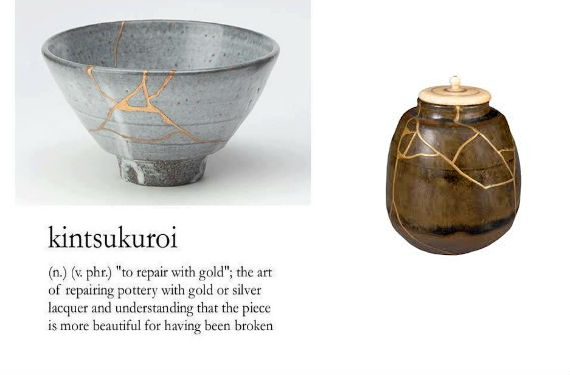
Kintsukuroi – Micropoetry

In my brokenness
I am made beautiful
You collected
the broken pieces
Sealed fleshly wounds
With golden scars
I wear as triumph


This poem was inspired by the Japanese art form of kintsukuroi

Kintsukuroi


I see creativity as an act of creation and as an act of repair. Sometimes it is in the act of creating that a person finds wholeness by putting their emotional and mental trauma and experiences into a work of art. It may be a difficult and draining but it can also be a catharsis, a release, a giving away of the issues and experiences held onto like removing a splinter from under the skin.

Sometimes we need to understand we are broken so we can be repaired and made beautiful again. Creativity is the medium through which it can happen.

What can you make beautiful again?

Antidisestablishmentarianism – A Haiku

I set my Year 8 class a writing task today, 10 Things I Know to be True, or 10 Things I Should Know By Now (taken from Sarah Kay’s TED talk – it’s brilliant. Go watch it).

One of my students wrote, “I know ‘antidisestablishmentarianism’ is the longest word I know.”

We joked it was almost a haiku in itself. So I thought I’d make one. I know it’s not a correct or proper haiku but it’s a fun form to play with.

An-ti-dis-es-tab-
lish-ment-ar-i-an-ism
Longest word I know

What creative act have you done today?

Random Creativity (And Why It’s Important)

On Friday my Year 8 class were set the task of writing haiku.

The English approximation of a beautiful Japanese art form is known to most, if not all, primary school children. They learn it is a poem of 17 syllables broken into 3 lines (5, 7, 5) and it is about nature (or something…).

It is taught because it is easy and accessible for students. It gives definite boundaries and restrictions, confinements for words and their interplay of meaning.

But writing great haiku is difficult.

I told my students I wanted them to experiment and play with language. I encouraged them to enjoy the process, to have fun with language. And so I had a go at writing a couple myself.

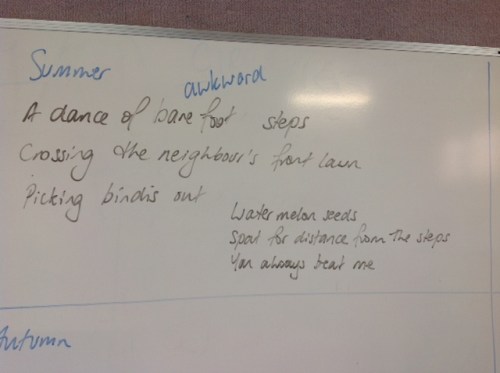
Summer Haiku

Summer Haiku

A dance of barefoot (awkward) steps
Crossing the neighbour’s front lawn
Picking bindis out

Watermelon seeds
Spat for distance from the steps
You always beat me

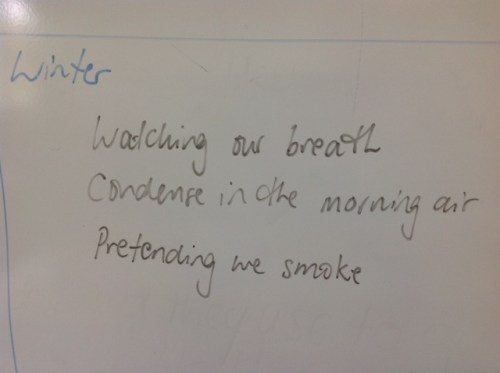
Winter Haiku

Winter Haiku

Watching our breath
Condense in the morning air
Pretending we smoke

Are they any good? Probably not.

Why is random creativity important?

It can be done quickly and in spare moments, disposable as an empty soft drink container or laboured over and agonised and deliberated for each and every syllable.

This is why creativity is important. 


Understanding Alchemy – My Writing Process

I suspect many readers, and indeed if conference questions are anything to go by, are mystified by the process writers have of hunting down, killing and skinning an idea and presenting it as a story. It’s like the medieval alchemists who attempted to combine elements and transform it into gold.

I was reluctant to write this post, tagged by another writer, my collaborative writing partner Jodi, but realised if I believe everyone can be creative then it behooves me to explain the process and guide new writers into the mystery.

Please don your robes and grab a doughnut; the initiation is about to begin.

There are many pithy quotes by writers about how to write but they are only relevant if you have immersed yourself in the craft of writing. Experienced writers nod sagely and ironically at the pithy wit and wisdom of those they admire but it doesn’t let the novice into an understanding.

The focus of the My Writing Process tagalong was to ask writers 4 questions. Here are the 4 questions asked and my attempt at an answer. Particularly #4 where I will attempt to show how I work and see if it helps novice writers on their journey.

1. What are you working on at the moment?

Too many things. Here are the most significant projects.

a. Post Marked: Piper’s Reach is a collaborate epistolary novel written with Jodi Cleghorn. It was hand written in real time and sent through the mail.
We are now at the stage of finalising our synopsis and getting it ready to submit to a variety of avenues.

b. The Java Finch (novella – working title) This is the logline I developed in my planning:
When Jack displays his finches at a bird breeding convention he meets Takashi who is painting the birds. They form an unlikely friendship and begin to come to terms with their experiences of World War 2 that shaped their lives, discovering that the very things that trap them are the things that give them the most freedom.

c. The Broken Chord (YA verse novel – working title) The (very rough) logline: Caitlyn-Rose is a gifted musician in her final year of high school, and having lost her mother in her first year of high school, struggles with her identity and purpose on the verge of graduating, afraid of the future and who she is.

d. I am also working on Degenerate Dictionary, Post It Note Poetry and a non-fiction book on creativity.

2. How do you think your writing differs from that of other writers in your genre?

I honestly have no idea. I am a newbie author so comparisons to other writers is unfounded.I do not have a substantial body of work to hold up for scrutiny. What I do have is an interest in authors who writing I admire: Tim Winton, Marcus Zusak, Craig Silvey. It is from these writers that I take inspiration in terms of style. I like Winton’s poetic prose, Zusak’s voice and Silvey’s humour.
My own writing infuses elements of all three, but it is my voice. I do not intend to be a slavish copyist but to speak articulately in my own voice. I love how the minutiae of life is a smaller version of the bigger thematic concerns of a work.

3. Why do you write what you do?

I remember watching an indie film with an old friend when we were growing up called ‘The Saint of Fort Washington’ and it was a couple of lines of dialogue that stuck with me.
“What’s your story?”
“I haven’t got one.”
“Everybody got a story.”
At the heart of it is a desire to know people’s story; how often do you hear someone say, “My life is uninteresting” or “I’m so boring” but that is the point of intersection where I want to ask the person about his or her life and listen to the stories that are important to them (I have plans for a project to take this idea a step further).
I write what I do because it’s the little things in life that interest me. For example:
* who decided it was a good idea to share a bed with someone?
* why does it take so long to hang out socks and underpants on the washing line?
* how long should you let someone walk around with their fly unzipped?
* is falling in love better or worse than getting gravel rash when you fall off your skateboard?
I wrote a manifesto some time ago, to articulate my vision for why I write.

I am a writer.

I write because I want to tell a story, but not just any story.

I write because I want to tell the story of those who are not heard.

I write because I want to tell the story of those who cannot speak.

I write because I want to tell the story of those who are disempowered.

I write because I want to tell the story for those who cannot.

I write because I believe that telling a person’s story is integral in understanding who they are.

I create art to speak into the darkness, that I may be a light for others to ignite their own flame and walk clearly.

People’s lives are not boring; writing is an exploration of how and why the everyday variables and events impact a person.

4. What’s your writing process, and how does it work?

Process assumes a regularity of work habit. Yeah, about that. Nope. Doesn’t work for me.
I know writers who can park their backside in a seat for an entire day and churn out 2000 words, 5000 words or even 10,000 words. Others I know work in small chunks of time, half an hour or an hour while others write until they have 1000 words.
For me, I work in bite-sized portions of time, snatching words in paragraph fashion. I have, in the past, written in chunks of time and written to 1000 words. It is always dependent on the workload of my day job.
I can go days or weeks without substantial writing yet still manage to scrawl words here and there. And I write slowly.
I also don’t have a regular process because I also write poetry and short stories. What I am working towards is a more consistent pattern, say 2-3 times a week of set aside time to write.
There is no formula to writing; you simply write.

How you create stories is another matter.

When I first started writing I knew a story needed a beginning, a middle and an end; a complication, a series of events, a resolution. But how to put these into a cohesive piece was what I needed to learn. I read as many blogs as I could about the writing process and how to craft a good story. I wrote 1000 word pieces of flash fiction and posted them to my blog, linked them to others and sought feedback to improve my work.

You learn to write by writing and reading. A writer is the sum of their reading influences and their vision and perspective on the world. You tell stories for myriad reasons but at the heart of it for me is the power of story to transform the individual and also a love of words and language.

Find a pen, a piece of paper, and write a story. Find your voice.

Writing Is Like A Roll Of Toilet Paper… A Little Cleaning Music, Please Maestro

…there’s a big, brown stain no one wants to clean up.

Remember the last time the toilet roll spun off and collected in a pile on the floor? Rolling it back on made it look like a cack-handed attempt to restore order in the universe.

Let’s leave this mess, shall we?

It has been a while since we have sat down to have a chat and catch up; we have seen so little of each other lately, for which I sincerely apologise. Let me fill you in on the changes happening.

While the monkey butler winds the gramophone and sets the record playing, take a seat in the comfy chair.

Would you like tea, coffee, Gravox? Please, help yourself. Milk and sugar to the left.

Let me begin…

I took a bit of time off from writing here on the blog about my writing and creativity, from writing Post It Note Poetry and micropoetry, even from my current works in progress, as it all appeared to be one glorious mess of paper strewn across my desk utilising a filing system dependent on an understanding of Base 6 and Kermit the Frog’s rendition of “The Rainbow Connection.”

I knew where everything was, and is, but the boundaries were beginning to blur and it meant losing focus on the bigger picture I have in mind for my writing. I had too many projects on the To Do list and I was losing focus, impetus and momentum.

In order to separate the strands of my writing I am having a cleaning out of the blog. Some things will disappear, others will stay the same. It means a clearer delineation of my writing projects, my writing life and your connection as a reader.

In the middle of May I decided to take a writing sabbatical until the beginning of June to enable myself to think through what it was I really wanted to do. It was the culmination of a sense of failure I felt earlier in the year, and something I raised with my online writing group. I had a sense of dissatisfaction and felt like I was wading through a pile of dirty washing with no map and coming out the other side with a pair of dirty underpants on my head.

I broke my writing sabbatical (I makes the rules; I gets to breaks the rules) with upwards of 500 words towards my verse novel. However, the small break gave me permission to not write, to take the pressure off. It helped clear the foggy windscreen, replace the toilet roll and consume an unhealthy amount of doughnuts.

What’s on the “Assault on the Literary World” agenda/game plan?

Firstly, changes to this blog:

A Fullness In Brevity – Blog posts on what is happening in my writing and other nonsensical wonderments will continue to appear here.

Post It Note Poetry and Micropoetry will be moving to tumblr where I will repost my old works and continue with new ones. The link is here (please note the name change to Post It Notes and Poetry – someone already had “Post It Note Poetry”).

I am fond of writing micro poetry on twitter but want to consolidate my poetic scribblings into one place. I intend to release an anthology of Post It Note Poetry and micropoetry once I have sufficient works of quality.
Expected Completion of Draft: ongoing but aiming for 2015 ebook release.

Creativity for the Uncreative – here on the blog I have been writing about creativity and sincerely believe everyone can be creative. I intend to relaunch my blog with this focus in July/August (potentially on a new site), revamping older articles and writing new ones with a definite plan in place for an ebook version when it is completed.
Expected Completion of Draft: ongoing but aiming for 2015 ebook release.

Secondly, what am I working on?

Post Marked: Piper’s Reach – my collaborative epistolary novel with Jodi Cleghorn is edited, finalised and ready for submission to the portals of bookdom once we have written a synopsis *insert curse words here*
This is a project I have a very strong belief in; it’s powerful, poetic, brutal, beautiful and it made me cry.

Novella – The Java Finch (working title)
I have approximately 7.5K words down but am fiddling with the structure and plot of the narrative. I fear it may blow out to a novel but I want to restrain it to 30-35K and write it as a literary novella.
Expected Completion of Draft: end of the year.

Verse Novel – The Broken Chord (working title)
This is a YA WIP inspired by Australian poet Steven Herrick’s verse novel, The Simple Gift and Peter Goldsworthy’s classic, Maestro. With both texts there is a remarkable simplicity of language yet stunning depth of ideas. My story will have a rawness to the poetry, to fit the voice of the protagonist. I am 3.5K words in to a projected target of 15-18K.
Expected Completion of Draft: end of the year.

Degenerate Dictionary – another collaboration, this time with author Jessica Bell. It is an opportunity to play with language, have a bit of fun and put it out as a book when we have enough words and definitions.
Expected Completion of Draft: ongoing.

Poetry and Short Stories – I have a note book of potential story and poem ideas; some are half written and baking in the sun. Others are skid marks at the bottom of the toilet bowl waiting to be flushed. I intend to balance out work on my novella and verse novel with shorter works intended for publication.

It’s a lot of balls floating in the bowl but I now feel clearer in my head regarding the direction I want my writing to go. There are a couple more projects on the horizon waiting for the correct time frame to present itself.

It’s diversifying to other places but simplifying it for you the reader to enable you to get the most out of this.

I will leave the past on the blog, a scrapbook of my beginnings, kind of like reading my teenage journals (which reminds me, I’d better burn those).

Now, if you’ll excuse me, I need to splash out and buy some luxury in the form of 3-ply toilet paper.

Checkout Manga – Micropoetry

Checkout Manga

In between customers
She draws manga
On the back of receipts
Slips them into groceries
And wonders if Godzilla
Eats breakfast cereal

Author’s Note: I don’t comment on why I write, the reasons behind a poem or its meaning. But today is different.

I was going through the checkout at Woolworth’s tonight, buying milk. The girl at the checkout, while waiting for customers, was writing on the back of a discarded receipt.

There was Japanese writing and a little manga-style cartoon. I said, “Cool drawing” and she was a little embarrassed.

Quick transaction and I was on my way. It was the little drawing I found intriguing; an insight into another person’s life. It inspired the first half of the poem and I turned the second half into a little whimsy.

The power of story from someone’s life. Look for the moments.

A Windowed Existence – Micropoetry

A Windowed Existence

the existence of life
prelude to dying
narrows its vision
as death draws
the curtains
against the limited view
remaining through
the window

The Truest Hero – Micropoetry

The Truest Hero

The truest hero
is seldom seen
in cape nor undies
on the outside
But in those
whose daily
actions make
the stranger
a welcome guest

A Way With Words – Micropoetry

A Way With Words

In your question
Is not a search
For an answer
But an argument.
You speak bitterly
Not for betterment
Will these be
The last
Standing words?

This was today’s piece of micropoetry.

I started it yesterday, writing it into twitter and saving it as a draft. All of my micropoetry fits into the 140 character space of twitter. Most of the time it includes the hashtag #micropoetry.

For this poem I used all the available space.

This morning I did a little rearranging before posting it.

It popped up on my Facebook page also and two friends from my writing group made some suggestions for rearranging.

Let’s play a game: How would YOU rearrange the poem? I fiddled with two variations, but how would you play with the form?

Rules
You can:

  • add punctuation
  • change the order of lines
  • rearrange word order

You cannot add or remove words.

Put your version in the comments below. Best entry wins 100,000,000 Internet Points to be used in raising the general intelligence of YouTube comments.

And I’ll send you a handwritten copy of your version!

Have at it!