Tag Archives: life in general

Moving Forward When You’re Stuck Looking Behind You

How do you move forward creatively when you feel like you’re stuck looking back?

In the last couple of weeks I have been re-reading the collaborative epistolary novel, Post Marked: Piper’s Reach, I wrote with Jodi Cleghorn between January 2012 and April 2013. 

The novel has been thoroughly edited and we are now at the place of writing the synopsis. Late last year we began the process but due to a range of metaphysical circumstances it had been put on hold. 

For me, because I cannot speak on behalf of Jodi, the latter half of last year burned me out creatively. The pressure of my job (high school English teacher) and other external pressures saw me roll into January hoping for a recovery. But it never happened.

Putting this out there and waving it around with abandon: Writing a synopsis sucks.

It’s the Pit Of Despair from The Princess Bride coupled with the Pit of the Almighty Sarlac from Star Wars topped off by The Buzz Cut from Wayne’s World (Boy, it really does suck). As we wrote it, we felt the summary sucking the life away from the narrative we had created.

On top of the synopsis situation, other projects lay scattered like discarded underpants and it was killing me that they were unfinished. My sense of self in regard to my creativity and writing had disintegrated. I doubted my writing skills and wondered if it was worth continuing. Doubt is insidious, and lethal, to a creative life. 

But I am not one to go quietly into the night for a bag of doughnuts and never return. I used February and Post It Note Poetry to begin the rebuilding process. I gave myself permission to put projects on hold, think them through again.

Now that it is March, I returned to the first project on the list: the Post Marked: Piper’s Reach synopsis. I opened up the final document and began reading, familiarising myself with the story again. It was nice to come at it again with new and fresh eyes, delving into other aspects of the characters again and their development, marking up plot points and knowing I’ll probably cry at the end. Again. (And, yes, I did cry).

While doing this I went back to other pieces written in the Piper’s Reach world. The stories precede the events of the novel in that they are about the lives of Jude and Ella-Louise in their youth and in their adult life. They were done as an indulgent exploration of our characters from different perspectives (letters have a very limited frame of reference when writing).

The first is the Christmas Special Jodi and I wrote at the end of 2012. It recounts the events of the Surf Club Christmas party (mentioned in the novel) when Jude and Ella-Louise were in Year 11 (their second last year of high school). It introduces the main characters from a different perspective as each character had the opportunity to speak in their own voice, not limited to the first person recounting of Jude or Ella-Louise. You can read the Christmas Special here.

The second story is from Jodi. “What I Left To Forget” tells the story of Charlotte MacKay and Jake de Britto and is told from the 3rd person, a departure from the narrow focus of a personal letter.

I wrote a companion piece to it, which precedes it chronologically, but was written after a comment I left on Jodi’s blog where I riffed an idea. Jodi dared me to write a romance from the perspective of Jake. The resultant piece was The Photographer’s Concerto.

Any of the pieces can be read without knowledge of Piper’s Reach, and you can read the first letter from Ella-Louise here.

How did this help me move forward? 

Up until the reread, I doubted I could write well again. I hated what scrawl occupied my notebooks. Even when writing Post It Note poetry I felt hesitant and uncertain.

By going back into the past, I could see the progression of my writing skills. What I wrote 3 years ago is still good. Sometimes I wonder if it was really me who wrote the passage. It has been an encouragement to see that I can write. I am proud of those stories, the world that was created. Yes, it’s hard work, but rewarding when you see readers gain a connection. That was one of the most rewarding aspects of writing “Piper’s Reach” and releasing a letter a week to our small, but faithful, following who shared their love of the series and the characters.

Taking pause to reflect has allowed me to refocus my creativity and move forward.

If you’re stuck, unsure of the direction, pause, reflect, give yourself permission to stop for a time and look back as a way of seeing progression. It may help you move forward. 

Are you stuck? Feeling like momentum has stopped? Would looking back work for you to help you move forward?
Failure Is Always An Option

Why is failure a negative response?

Well, yes, failing attempts at flying, playing with power points, or gaining your friends’ attention with the exclamation, “Hey, check this out!” can have negative consequences resulting in death, bloody maiming or a great story to tell.

Failure is couched in terms of shame, of disappointment, of not being successful, of letting people down, of not living up to a set of standards, morals or values. To fail, therefore, is to be less than, to be inferior, to be forgettable and forgotten. 

So when it comes to beginning a creative project, or learning a new creative art, skill or craft, we are programmed to think of our early efforts as failures. They do not meet up to our expectations of what it should be (and yes, there is a disconnect between what we create and produce, and the expectations we have set for ourselves in the production of our work but that’s another blog post). 

But as creative people, failure should not be considered a negative response to a project.

Failure does not define who we are as creative people.

Failure is not a measure of our worth.

Failure is a part of the creative learning process.

Every creative project we start is an experiment. It may or may not work. But that’s the beauty. When I am beginning a new story I am unsure if it will work. I write the first draft, let it sit, return to it and look for what needs to be improved (often, a lot of things). Whether it’s point of view, too florid in expression, characterisation or character development, dialogue or imagery.

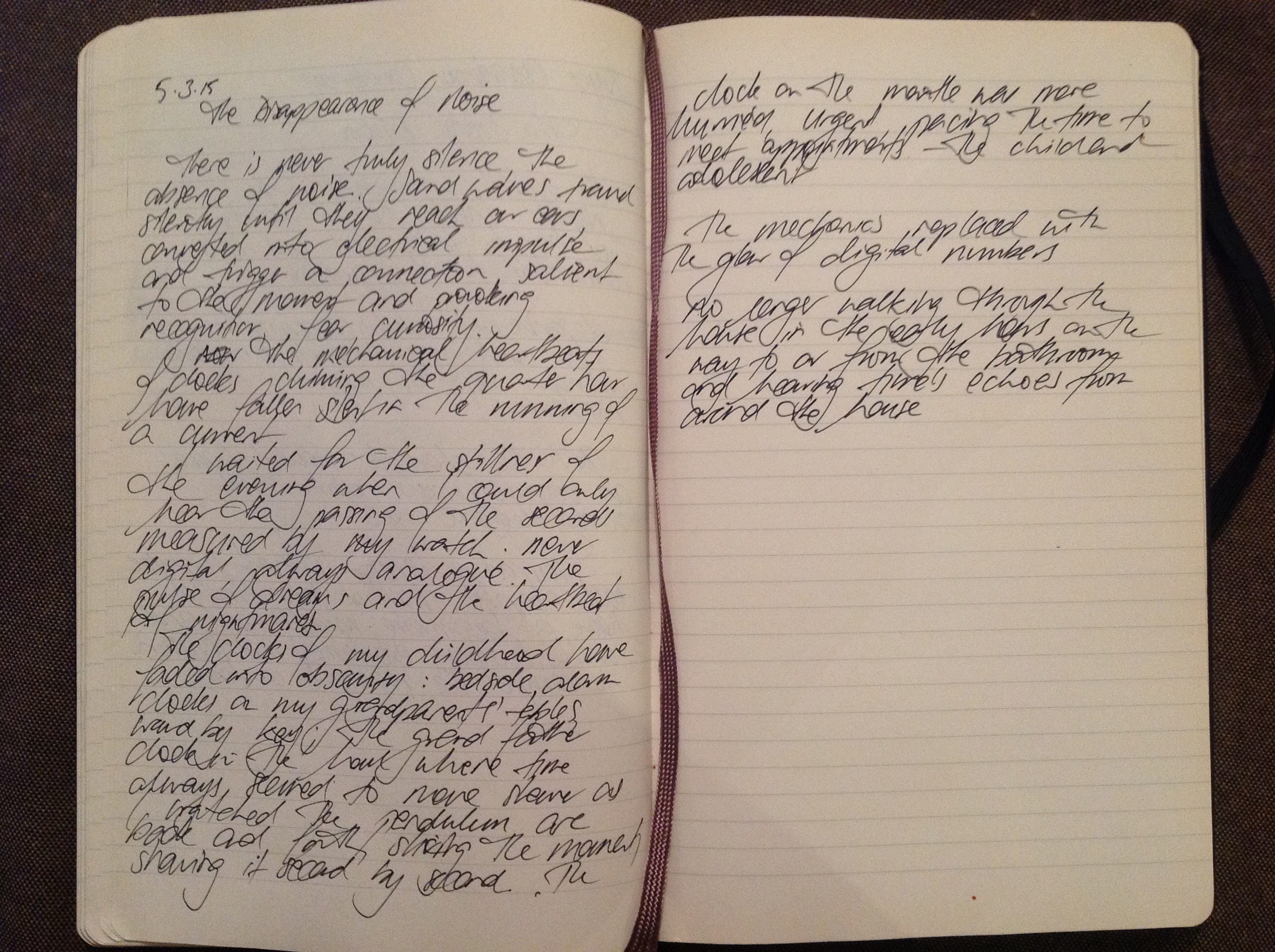
A recent idea in its genesis. Pure unadulterated nonsense.

A recent idea taken from my notebook in its genesis of pure unadulterated nonsense. It’s all part of the failure.

Don’t be afraid to put in the hours of practice required. I think it’s where a lot of fledgling creatives stumble. They want the accolades but haven’t put in the necessary hours. The Mythbusters make it a part of their show: failure is always an option. It shows you one way it didn’t work. Repeat the experiment until you find the solution.

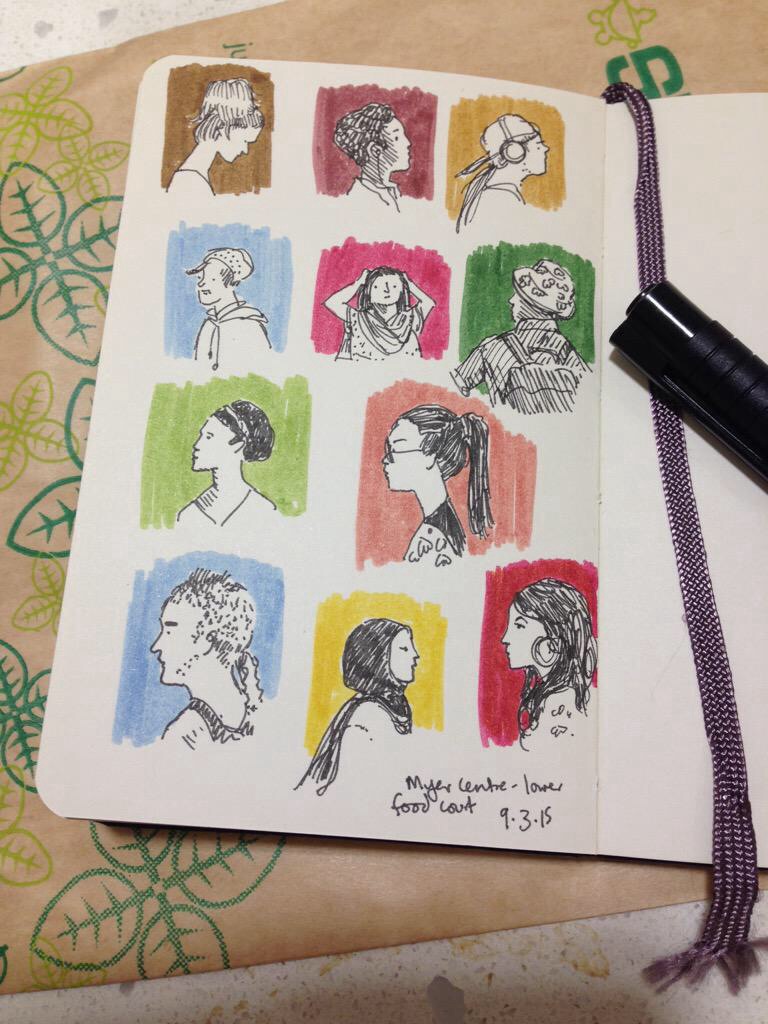
I love seeing Kathleen Jennings (@tanaudel) put up images of her sketch books, her practice pages, on twitter. She sits in public transport terminals, shopping centres, food courts and sketches people. Please check out her awesome work via her blog: Tanaudel.

I am very grateful for her permission to reproduce one of her images. I love how the colour frames a distinct individual. She had this to say about her process.

“They are part of my practice. I’m fairly timid drawing naturally. So I made myself use markers, limited colours, and draw people as they walked past. It made me commit, be bold, be confident and develop a visual shorthand.”

image

(c) Kathleen Jennings @tanaudel Used with permission.

Practice. Practice. Practice. 

I know I have not spent enough time behind my drum kit practicing rudiments, beats, fills. I have not practiced enough. The same applies to my writing; I need to spend more time with pen and paper scratching out paragraphs, lines, half sentences.

I have many documents of half started stories, poems, scripts and the like sitting on my computer hard drive as well as in multiple notebooks. This is the practice time spent conditioning my mind and perspective like an athlete to achieve the goals I have set.

Practice is repetitive. 

Practice is boring.

Practice develops a discipline.

Practice is extending the boundaries of your skills, extending the place of your tent (to borrow a biblical phrase).

And, yes, there will be failures. Days when you feel like you’ve been given a fork to eat a bowl of clear soup. Days when you feel like there’s a hole in your shoe (and it’s raining), sit in gum, forget your lunch and suffer the ignominy of a nasty paper cut.

This is failure. And it sucks. 

Keep practicing.

Write a paragraph a day. Sketch on the back of a shopping receipt. Doodle in the margin of the newspaper. Practice rudiments or scales for 5 minutes a day.

Keep failing.

Failure is always an option because it is a learning opportunity. Failure is necessary to grow and develop in our chosen creative field.

The path behind you is not littered with the carcasses of failed projects but the evidence that you have trained and practiced.


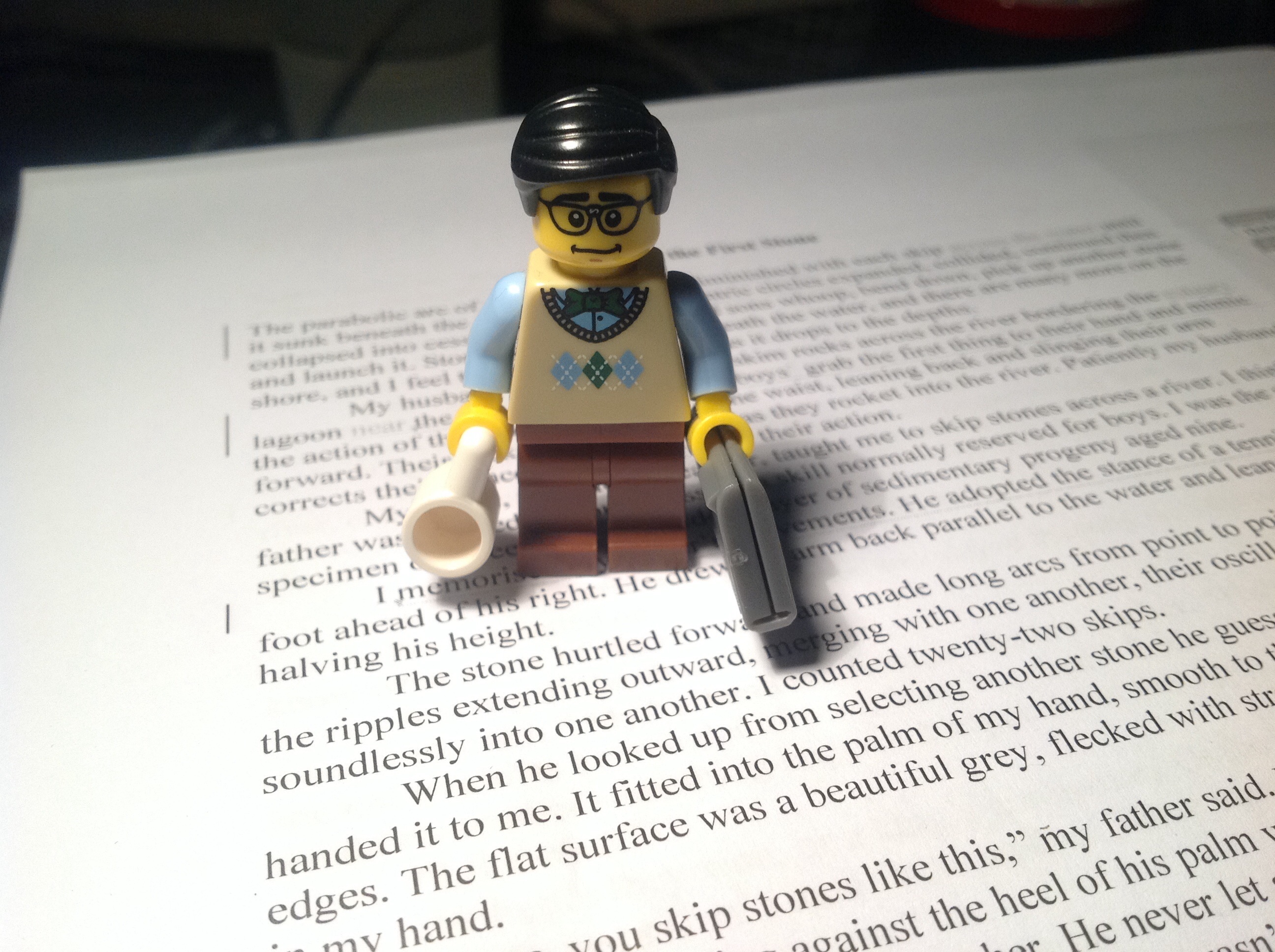
Adventures of Lego Writer Man

Last year a friend of mine, amongst other people I know, maintained a Thankfulness theme on Facebook. Every day for an entire year, 365 days’ worth, he posted a new thing to be thankful for. It was an encouraging read and made my realise how blessed I am when I consider the breadth and depth of things I can be thankful for.

However, it spurred a new idea: the daily adventures of a Lego figurine, in particular, a Lego figure who was a writer.

So, Adventures of Lego Writer Man was created. Armed with his cup (for tea) and laptop (to write on), he embarks on a literary journey. Each day I post a photo on Twitter of Lego Writer Man and his adventures. Follow me (@revhappiness) or the hashtag #AofLWM.

image

Friday Flash Fiction – Indentation

Welcome to another Friday Flash Fiction.

This piece was the development of a very short piece (sub-200 words) I had submitted for a competition. I wanted to explore the idea a little further and see what happened. 

I toyed with the idea of subbing it out again but am leaving it on the digital practice pile. 

Indentation

I dislodged your glasses the first time we kissed, tripping over the hidden arms of the frames as I ran my hands through your hair. Unseated physically and linguistically, I fumbled an apology.

“Romance inhibitors,” you said pushing the glasses over your forehead, collecting your fringe, before taking them off.

The kiss interrupted we drew away from each other. You felt behind your ears the indent of a new paragraph.

“I’ve worn glasses for years,” you said. “Never really noticed it before.”

You drew me in again and before our lips cautiously brushed, I wondered how you could see without your glasses; a stupid thing to think because our eyes were closed. My fingers returned to the place behind your ear and traced the indentation, a small eroded furrow, and I stopped, retreating my lips from yours.

Your face, now naked without adornment, I saw two more dents, small and red, on either side of your nose. The slight weight of pressure bridging your face giving you the chance to see.

Over the years I watched the indentations change shape with each new pair of glasses, watch you adjust to how the new frames sat on your nose and behind the ears. You pinch your nose when you buy new frames, adjusting to a new bridge; push them back up your nose when you’re sweaty and they slip down when you lean forward. You push them onto your head when you read a book.

You never really get to see it, except when you look in the mirror, but with each new pair of glasses I create a new character: the bookish librarian, a 50s executive, the hipster folk musician. Only when we retire to bed do I see the character removed when you put your glasses beside the clock radio on your bedside table. Your face is no longer framed by what I impose upon it; the only evidence the two small, red indentations on your nose.

 On the couch I slip under your arm, fit into the shape of your body, perhaps worn as smooth as the spot behind your ears and wonder if we have worn a furrow between my legs each time we make love. I feel the shape of you within me, the pacing of your movement when you’re above me and I focus on the bridge of your nose. Or when I sit astride you and move with my own rhythm. Have I worn you down through the repetition of our lovemaking?

Now I turn the wedding band around my finger, notice the furrowed shape encircling, evidence of the presence of you in my life.

I still run my finger along the indentation behind your ear, searching for that first kiss. But you hate it when I dislodge your glasses, especially while you’re watching TV.

I’ve learned to wait until the ad breaks.


Is There A Right Time To Read A Book?

Is there a right time to read a book?

No, it’s not a rhetorical question because it’s always the right time to read a book.

What I am asking is do some books resonate with you at a certain age? Can you miss that opportunity and not have the book make the same impact as those who read it at the “appropriate age”?

For example, some years ago, a student of mine was reading J. D. Salinger’s Catcher in the Rye for her English Extension 2 Major Work, comparing the protagonist Holden Caulfield with the modern equivalent of the bad boy, Bart Simpson.

I read the novel to understand her thesis and I knew it was a celebrated text but it left me cold and unengaged. Since then I’ve tried to work out why. Perhaps I simply missed the phase during my adolescence when it would have taken on greater resonance.

In a similar way, I recently read Kurt Vonnegut’s Slaughterhouse Five and Cat’s Cradle and I learned much about writing from them, but they didn’t have the “wow factor” for me. Would I have gained more if I was younger? Had a different mindset?

In comparison, reading Joseph Conrad’s Heart of Darkness in high school blew my mind, while Mark Twain’s Huckleberry Finn left me cold. Don’t even get me started on Dickens’ Great Expectations.

I’m in the middle of Paul Coelho’s The Alchemist and again, it is touted as “one of the best books of all time” according to the sticker on the front cover. I am liking it as a fable but I am not “getting it.”

I’m not referring to the style or language of a text, but its engagement with a culture or generation. Context may play a significant part in a understanding a text’s reception and its reimagining in later eras through its thematic concerns keeps it relevant. Think Shakespeare and the various recreations of his texts.

But there are books, and plays, that I love. Sometimes a book speaks to right where you are, at a specific time in your life, addressing a particular issue or providing a revelation.

I love Shakespeare, ancient Greek tragedies, Homer’s epic poems, Milton’s Paradise Lost, anything by Tim Winton and Markus Zusak, Enid Blyton and Judy Blume when I was growing up, Tolkien in my teenage years (and more so now I’m older). Even the classics: Frankenstein, Jane Eyre, but not Wuthering Heights.

What books have you read that hit the right spot at the right time for you?
What books have you read that you felt were not the right time for you?

The A-Z of Suggestions for Creative People

To misquote Captain Barbossa says, “They’re not so much rules, as guidelines.”

There are multiple permutations of a creative alphabet; your ideas will probably be better than mine. But that’s kinda the point. Listen to the advice, apply it to your work and do it better. Then teach someone else to do it. Pass the knowledge on.

Appreciate new ideas.

Build a body of work.

Collaborate. Cooperate. Coordinate. Critique. Vanilla Ice has wise words when he says, “Stop, collaborate and listen.”

Define your goals as a creative person. Revisit them weekly, monthly, yearly.

Explore what you’re passionate about. And maybe what scares you. You know, for balance.

Foster creative relationships for collaboration, networking and developing the next generation of new artists.

Grow as an artist. Stagnation is for ponds and mosquitoes.

Hunger for the development of your craft and the improvement of your skills.

Inspire others to create because the world needs useless beauty; it is there because it is, and it exists and it is uniquely you.

Jump into new opportunities. But check the depth first.

Kill what distracts you: procrastination, doubt, fear, comparison, jealousy.

Listen at every opportunity. Gather wise counsel and feed your soul.

Meditate on your work, why you do it and write a manifesto.

Network because it’s dangerous to go alone.

Occupy a creative space and protect it.

Publish your work. Whether it’s through your blog when you’re starting out or selling it via Etsy, Ebay or e-commerce.

Query why you are creating. Have you lost sight of your purpose?

Rush a new piece of work and enjoy the frenzy of ideas splashed down like a sudden summer storm.

Spend your time wisely.

Trust in your teachers and mentors.

Understand you are not your creative project; it is an expression of how you see and understand the world.

Vanquish your fears and validate how you feel about what you create.

Welcome feedback, critique, commentary that will help you grow as a creative person.

Xerox another artist’s work to learn how it is created. But show no one else. Learn how to apply it to your own work.

Yoke yourself to an artist further along the road than you. Learn from their guidance that one day you may be yoked to a new artist to teach them.

Zealously demand your need to create; creativity is oxygen to you. Without it you would suffocate.

What would your alphabet of suggestions for creative people be? Write a list, post it to your blog and link back here for everyone to read.

I Found More Poetry Under The Lounge

 I find poetry in all kinds of places, often under the lounge and I found some more there recently.

Right now the end of winter is approaching here in the southern hemisphere (not that we had much of a winter where I live – what happened to those good old fashioned frosts we had as kids?) and with it the promise of hay fever, runny noses, itchy eyes and a cursing of all things frolicking. The first and last poems assembled here, Magnolias and Windy Days, are inspired by the wintery season.

Magnolias

As I drive past
The magnolia blooms
A thousand sunrises
Of pink to white and
A thousand sunsets
Of white to pink
Simultaneously

Standing By

I stand in the longest corridor
possible, pretending I’m Red 5
barrelling down the trench
avoiding laser blasts
to my office door

The Last Page

When you close a book
Do you think it will be
The final time?
Never to peer
Between the pages and
Read the tongues of men
Again

My Companion

I walked in darkness
But was never afraid
For I felt your hand
In mine, or around
my waist, looped over
my shoulder as my light

Generations

She watches
grandmother’s knitting
learns the art of rhythm
the pulse of long thin bones
curses the dropped stitch
like her grandmother

Windy Days

I imagine with each 
breath of wind
the trees ask
for our silence
a gentle ‘Shhhh’
simply to listen
to our own
heartbeat
Which poem resonates with you?

Breaking the Drought

Today marks the end of the rather intense Chaotic Marking and Editing month  for work: Trial HSC marking and 6 Major Works for my Extension 2 students. I can, if I want to, break the writing drought. And there’s a couple of lessons to share.

Firstly, returning to projects after the drought. I said a few weeks back I would be absent, and for the most part I was. My works in progress were put on hold and I can now return to them.

But not yet. Why?

Because I am absolutely knackered mentally, emotionally and physically. Today is a day of rest. Well, sort of. Washing done, biscuits made with Miss #2, couch time watching footy with Miss #1 and a gig to play tonight.

The adage, often said in all caps and repeated as a mantra, YOU MUST WRITE EVERY DAY, is in my mind, piffley twaddle. It would be ideal to write every day but the caveat is that every person is different, their schedules are different and you work out when and how you fit writing, or any creative activity, into your schedule.

During this last month, I gave myself permission not to write because I knew when the time was done I could return to it. It has been a writing drought. However, while washing up last night I had another idea for a poem to include in my verse novel, The Broken Chord. I found my notebook, scribbled the idea and returned to washing up. This is still writing. 

Secondly, the month of Chaotic Marking and Editing abated, I began to reflect on the work of my students. I posted this to Facebook and I’ll reproduce it here.

As I prepare for my Extension 2 English students to hand in their Major Works on Friday, I have a new credo as a teacher. And it comes (with a slight adaptation) from Doctor Who.

Great men (and women) are forged in fire. It is the privilege of lesser men to light the flame.

To completely misappropriate the quote and apply it to teaching, I am very proud of the work my students have produced. I am proud because they took on a challenge some of them were unsure they could tackle, and they have known what it is to work hard. And succeed.

As a teacher, I get to light the flame in my students. I want to instil in them a love of learning, not just my subject.
Sometimes that flame is encouragement, words of praise and congratulations.
Sometimes it’s telling the student the hard truth.
Sometimes it’s confronting their attitude, beliefs, values, and sometimes it’s supporting them.
Sometimes it’s asking them how they are, acknowledging their presence, saying hello as they enter the classroom and wishing them a good day as they leave.

To light the flame is to wish my students the very best in their endeavours and to do things better than I ever could.

I hope I never run out of matches.

I still need some rest before I tackle my WIP. No rush. It is knowing your creative cycle and how to ride it. It will take a little while to break the drought and gain momentum in my writing but that is fine.

How do you break the creative drought?

This Is How We Should Make New Friends

How should we make new friends?

I am a shy individual who masks it with bravado and a quip. New social situations makes my underpants an uncomfortable shade of brown. But it’s good to make connections with new people. Makes the village more welcoming and hospitable.

Here’s how I propose to do it: Everyone needs to carry a novel.

In a new social situation the novel is a means of beginning a conversation. We can talk about the book, what we liked, didn’t like, read aloud our favourite passages.

And when we’re finished, we can swap the book with the person we are talking with, read it and return it when done, or pass it on to the next new person we meet.

And it would be even better if it’s our own story in the book we give away. That way we must trust the other person to treat our book with respect and kindness.

And there should be blank pages for the new person to add in how we met, what we talked about, what the day was like. Then we can pass it on, receive the new person’s book and add our own details. If we happen to cross paths again, we can catchup on what has happened.

Imagine all the people’s stories we could read.

This is how we should make new friends. What do you reckon?


Throw Out Thursday – Showing Your Work

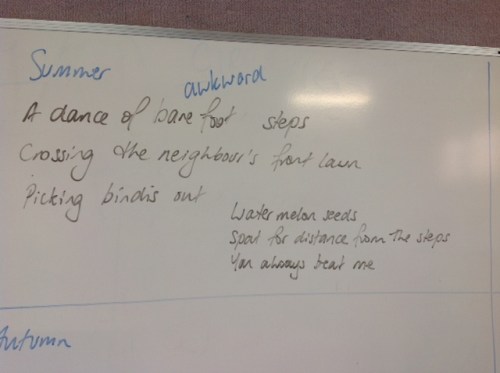
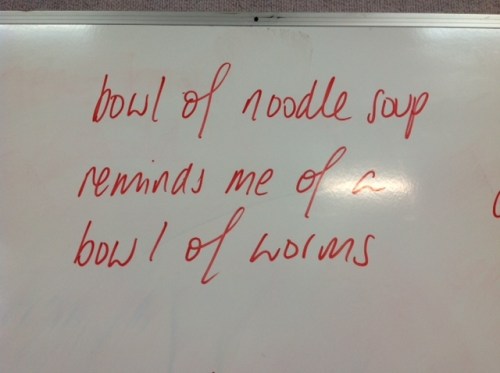
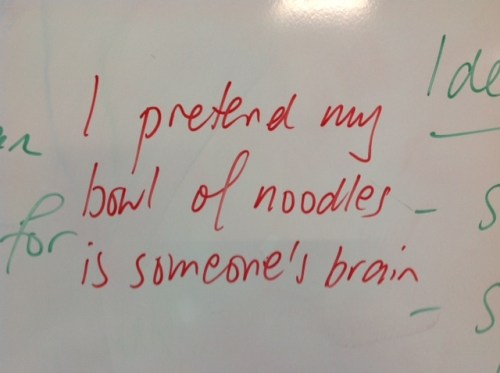
For this week’s Throw Out Thursday, I’ve collected the random poetry I wrote with Year 8 last term. The focus was on haiku.

It’s a great way of introducing students to a poetic form and while there is a beautiful simplicity to haiku, there is also great depth and complexity in the form when explored.

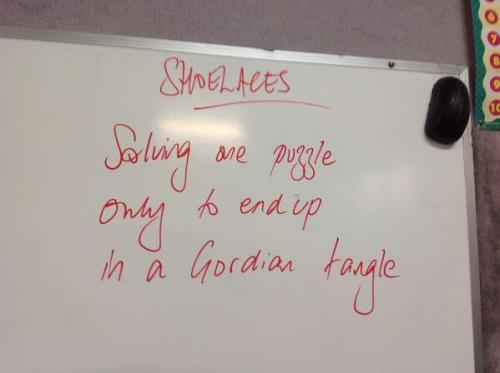
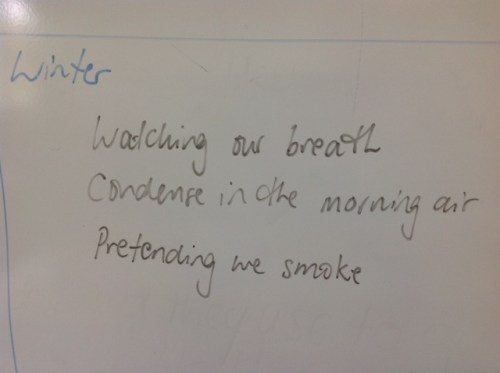
But this is about throwing stuff out. And these are haiku I wrote on the board while my class was working. I believe it’s important for my students to see my writing, correcting, experimenting and exploring creatively.

Haiku with Year 8

Haiku with Year 8

Winter Haiku

Winter Haiku

Summer Haiku

Summer Haiku


Noodle Worms

Noodle Worms

Noodle Brain

Noodle Brain

Creativity is about experimenting, exploring, examining, and having a whole lot of fun.

These are brief experiments and part of the process of improving my writing craft. As Austin Kleon says, “Show your work.” You get to see a little of the word wrangling I do to.

Dare you to have a go at something creative.