
What is the parallel between writing and drumming?
The TL;DR version: vocabulary is essential for writer and drummer. Read widely, listen carefully, & choose the right word for the sentence.
For a fuller explanation, read on.
The parallels between writing and drumming become clearer each time I pick up a pen or a set of sticks.
Writing fiction consists of ordering letters into words, words into sentences, sentences into paragraphs, paragraphs into a completed narrative, whether it is a short story, novella or novel.
Drumming consists of ordering strokes into patterns, patterns into grooves, and patterns into fills.
Drumming is made up of 3 basic sticking combinations:
– the single stroke roll RLRL RLRL*
* R = right hand L = left hand
 – the double stroke roll RRLL RRLL
 – flams

Everything is then a combination of these basic sticking patterns. For example, the paradiddle RLRR LRLL combines the single stroke and the double stroke

Other rudiments include the 5-, 7-, 9-, 11- and 13-stroke roll; flam paradiddles, triplets etc. All in all, there are 40 recognised basic rudiments to master.
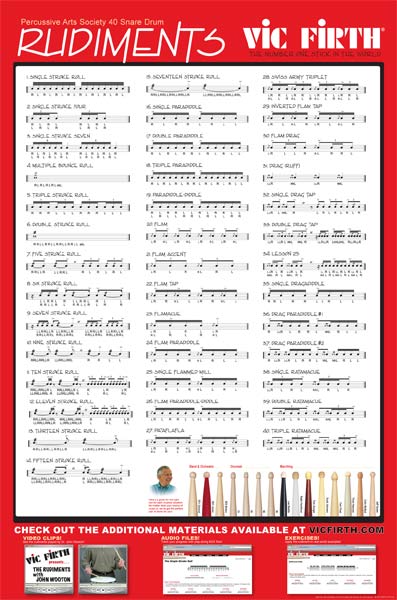
This forms the vocabulary of the drumset, starting with the snare drum then expanding the rudiment to be played on other surfaces of the drumset from toms to bass drum to cymbals or other sound sources.
Knowledge, and mastery, of the rudiments gives a drummer a vocabulary to draw from when playing. At times it can be as simple as this:
to the complexity of this: (it is well worth the time to listen to the introduction to understand why this piece came into being)
And then this because it is just so cool:
Being literate is the fundamental key for both writing and drumming. A limited vocabulary limits the power and extension of what you are trying to say.
Profound thoughts are often expressed with the simplest of words.
When I was studying New Testament Greek, at the first class, our lecturer had us turn to the Gospel of John and read the first few verses, in Greek. We were novices, had no idea, but with a few helpful hints we garbled our way through. The lecturer’s response was to comment that it was very simple Greek, yet contained much that was deep and profound.
Similarly, when I was reading Cormac McCarthy’s “The Road,” I was struck by the simplicity of the language; very understated without frivolous embellishment. Yet it was in the simplicity of the language that the depths of the horrors of the world he was describing were manifest.
And complex ideas are also expressed in language so dense you need to be initiated to understand it. I have tried to read A.S. Byatt’s “Possession” but couldn’t get past the first page.
The hardest part is knowing when you use the vocabulary you have at hand: either the simple or the complex. Both serve a purpose.
The Takeaway
Mastery of vocabulary is paramount for both writing and drumming. Expanding your own vocabulary and voice is essential to tell the narrative you want to tell, to communicate the emotions you want the reader or listener to engage with.
Master the language by
* Reading widely
* Listening carefully.
* Experimenting with voice.
* Choosing the right word for the sentence.

 A Fullness in Brevity - Adam Byatt