It has been 2 years this month since Piper’s Reach (an epistolary novel hand-written and posted in real time) was conceived, written, finished, and now, the end of the editing process.
And I am emotionally spent.
Here is the premise:
In December 1992 Ella-Louise Wilson boarded the Greyhound Coach for Sydney leaving behind the small coastal town of Piper’s Reach and her best friend and soulmate, Jude Smith. After twenty years of silence, a letter arrives at Piper’s Reach reopening wounds that never really healed.
When the past reaches into the future, is it worth risking a second chance?
How We Edited Collaboratively Via Distance
Last night my collaborative writing partner, Jodi Cleghorn, and I sat down via Skype to put the final pages of our novel, Post Marked: Piper’s Reach through the edits.
As we live in different cities in Australia (I live in Sydney, Jodi lives in Brisbane) the process of editing involved reading through the document and making changes, and posting the main document to Dropbox for the other to work on. Track changes is an awesome function.
The novel was divided into 3 ‘seasons,’ natural climaxes in the story’s developing plot, each approximately one third of the novel’s length. At the end of editing each season we forwarded it on to our friend Toni, who gratefully offered to edit for us.
We then sat down via Skype and read each of the letters aloud to the other, taking on the persona of the character we wrote (I wrote the character of Jude, Jodi wrote Ella-Louise) while accepting or rejecting edits.
Editing is, by and large, a clinical process where as the writer, you are looking for inconsistencies, errors, character motivation and analysis. You are not looking to be engaged by the story although you are aware it’s there.
However, during our various editing sessions throughout the latter half of 2013 we found we became entangled in the story again, its emotional push and pull, often stopping after a letter to talk about it, or even pausing at the end of a paragraph mid-letter to comment on how we felt the characters were reacting, or our reaction to a particularly visceral and emotional paragraph.
Along the way we overcame our fear of reading aloud. By reading it aloud as we edited, we were coming to the story as writers, and as readers. There was laughter, titters, nervous giggles as we read certain parts, and there was uncomfortable silence while we read others when the tone of the letters was angry and aggressive.
At the beginning of Season 2 there is a section of juicy, saucy letters but we read through them with nary a titter or giggle or sense of awkwardness (there’s no way my Mum is reading what I wrote). What gutted, and surprised, us more was the letters that followed where the characters’ anger was evident and pronounced after we rearranged some paragraphs. There were moments of quietness as we contemplated the passion and aggression our characters had found in their words.
We posted hash tags via twitter during our Skype editing sessions. For example, there was a time back when we were editing Season 2 when the content of the letters was a little bit racy so we called it #cigarettesession. Which leads into last night’s final editing session and the accompanying hash tag.
Jodi put the call out early and I suggested #iamnotcrying. It was a little tongue in cheek as firstly it was the ending of the editing sessions, the ending of the novel (a grieving process in itself) and because we knew how the story finished.
Throughout the writing process Jodi was determined to make me cry as I had made her dissolve into tears on a number of occasions. She texted me one afternoon after a specific letter I wrote: “That was one f**king awesome letter. Have read it four times now and I cry and shake and the whole full body emotive experience.”
I can’t remember which letter it was now, but I loved the reaction. There had been moments when I *almost* cried, but had yet to succumb to full on tears. Even at the end of the writing process when I was reading the final letter, I did not cry, which upset and confused Jodi.
Fortuitously we ended up writing the final letters across my dining room table during Easter 2013 after having spent the previous 16 months sending the letters via Australia Post. I was blindsided by the ending that I laughed, somewhat nervously. I couldn’t comprehend what Jodi had done; I hadn’t seen it coming. I was gobsmacked at how it ended (it would be another 3 months before our online readership experienced the emotional roller coaster).
Admittedly, I approached each letter as if I was the character, not trying to predict the development of the plot. And in conjunction with the No Spoiler Policy (meaning we didn’t discuss potential plot ideas), neither of us knew how it would all end, nor where the plot would take us.
In the mean time, she’s at the other end of the table blubbering as she reads Jude’s last letter knowing what she has written and paired with what she was reading from Jude.
It took me a while to come to terms with how it all ended and its emotional impact on me.
But last night was something different.
It had been almost 3 months since our last editing session (due to life’s constraints) and we were approaching the last 50 pages of our manuscript with a little mix of trepidation and hesitation. We knew, as writers, how our story ended; that wasn’t a problem. It was knowing we had to come to The End.
The hash tag #iamnotcrying was good to go and off we went.
And there were certainly tears.
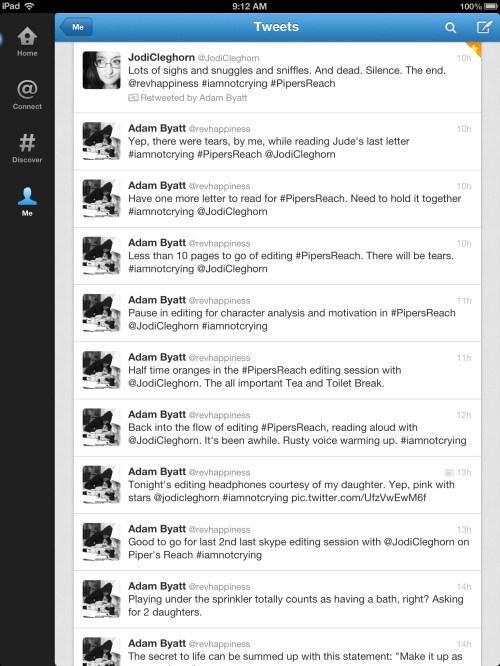
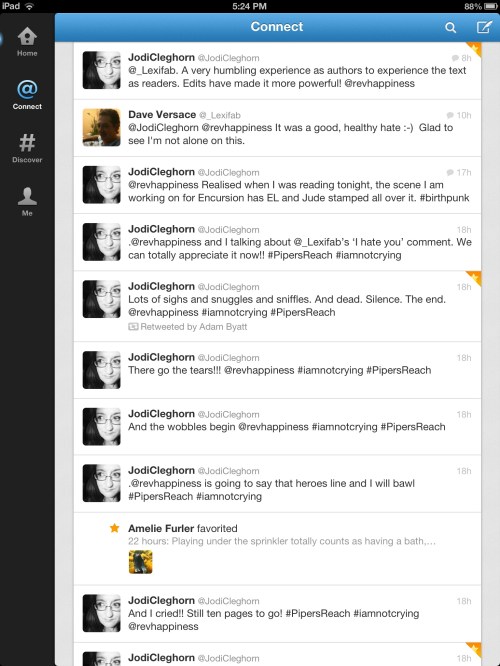
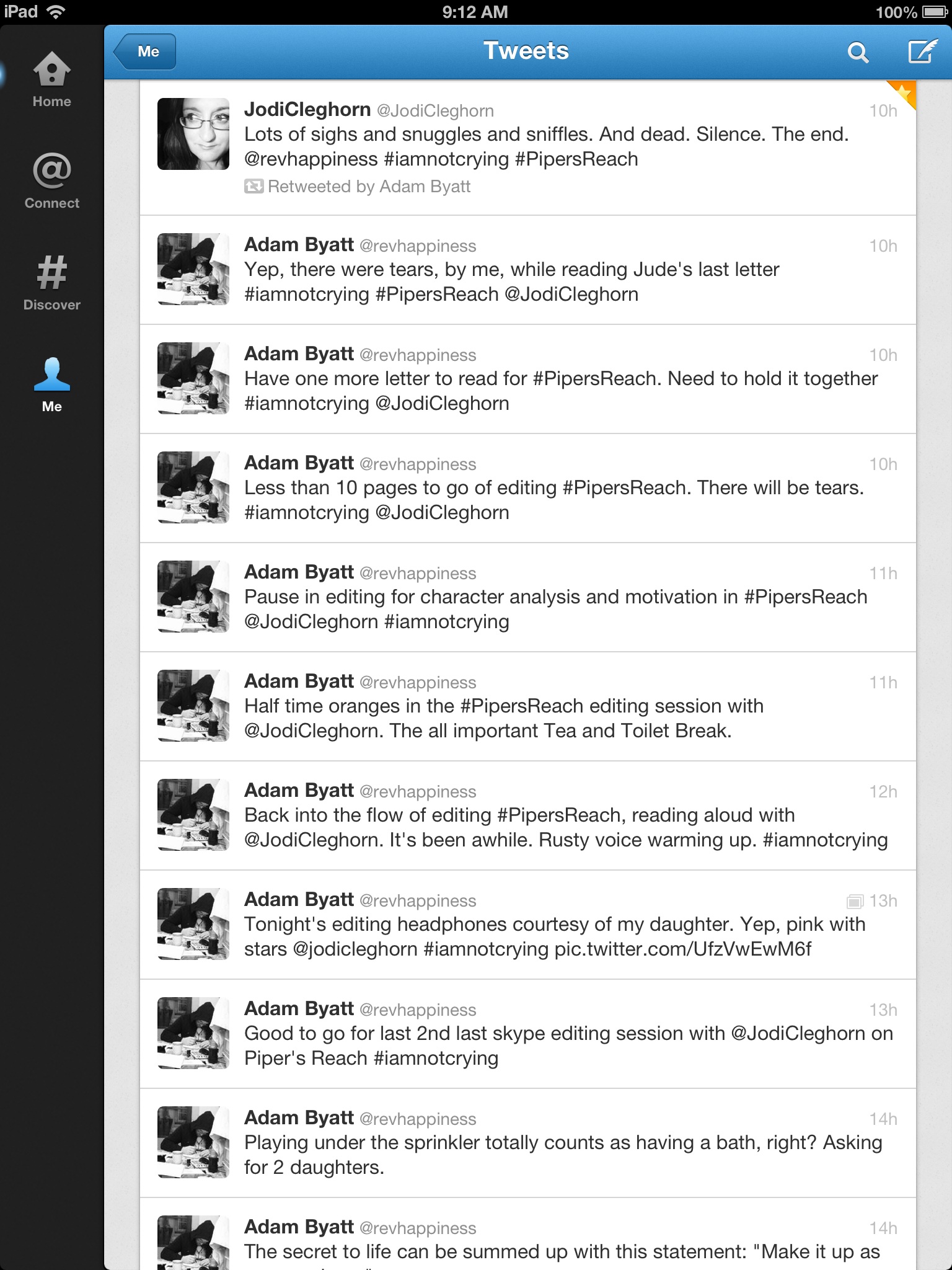
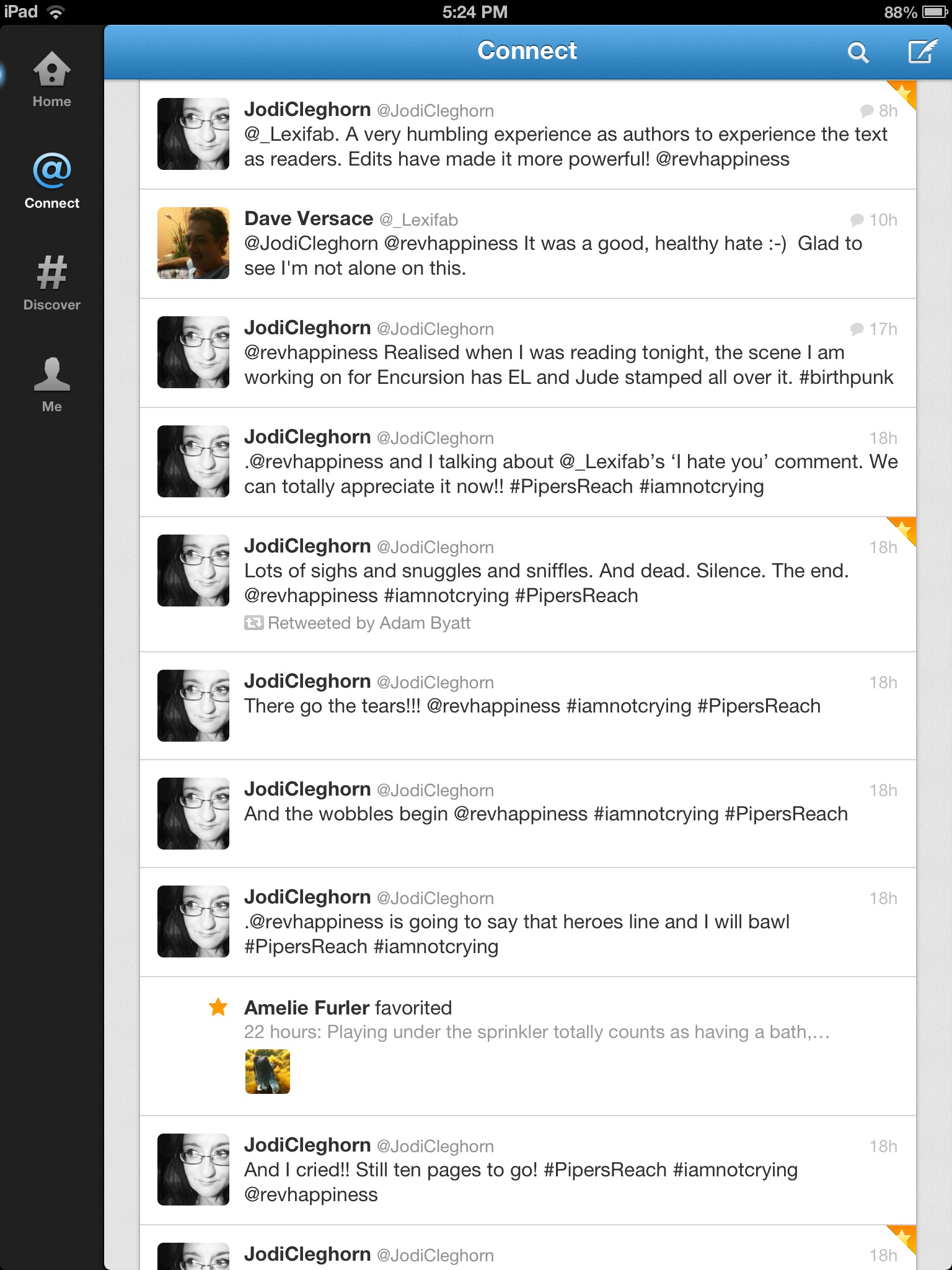
Below is a couple of screen shots from my twitter feed (you will need to read the feed from the bottom up). You can see I was beginning to lose it when I said there were 10 pages to go. The emotion was threatening to overflow and I could hear Jodi begin to lose it a little.
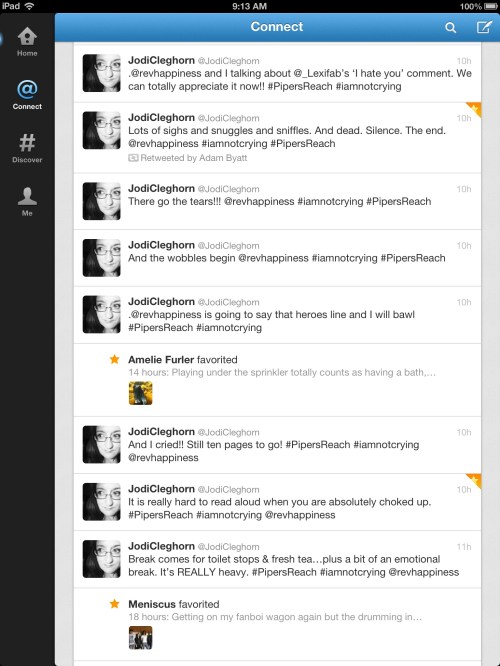
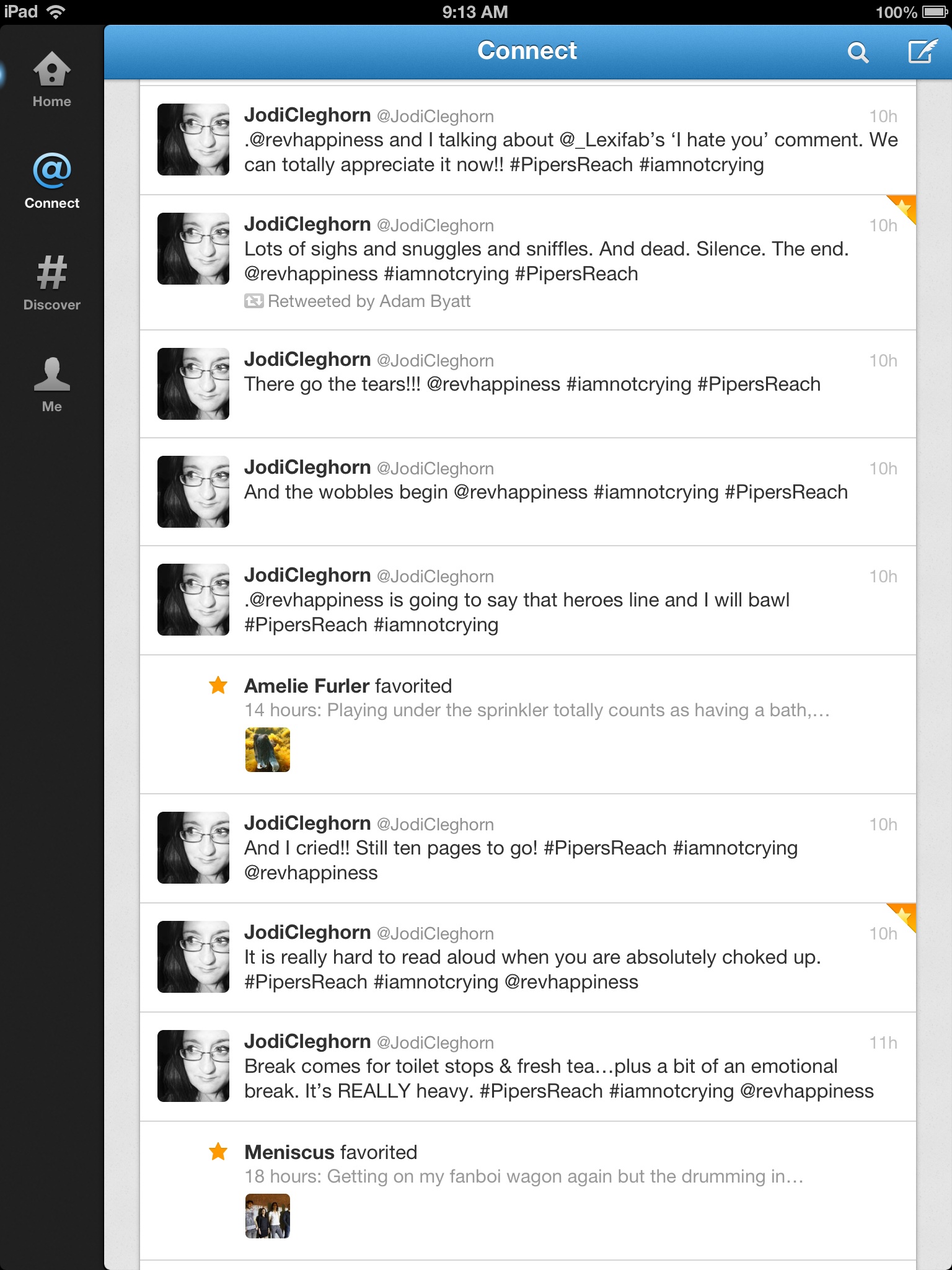
I’ve included Jodi’s stream via my Connect screen. There’s a line in Jude’s last letter where he mentions David Bowie’s song, “Heroes,” and I knew that was going to be the line to make me lose it. Jodi referenced it below.
In the lead up to the last letters, we could both feel the surge of sadness threaten to overwhelm.
As I read Jude’s last letter it became harder and harder, and when I hit the Bowie line, the pauses between sentences became longer, the silence more weighty and the voice cracking. Even now it still has an impact just thinking about it.
There were a few more letters to read, and during the very last one, read by Jodi, there was no clicking of the mouse as changes were accepted or rejected. It was simply read aloud.
And it was bloody hard to listen to. I can only imagine how hard it was for Jodi to read it. I was crying, Jodi was crying and when we reached The End, there was only silence save for the sniffling of noses and scrunching of tissues.
By way of conclusion, Jodi was triumphant in that she had made me cry. We were both mentally and emotionally spent; the investment in our characters over the past two years coming to fruition.
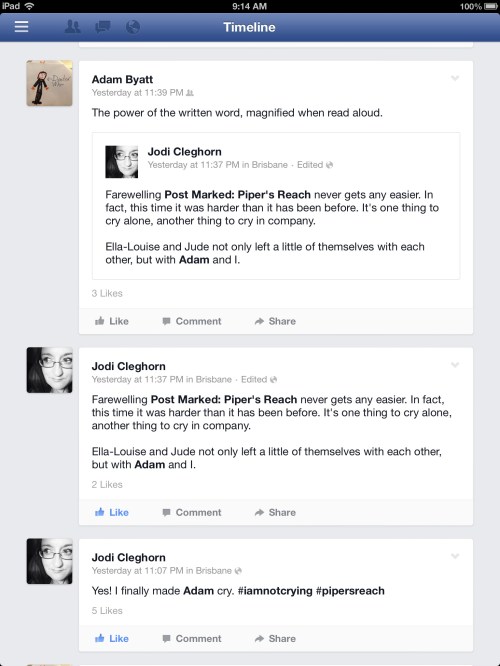
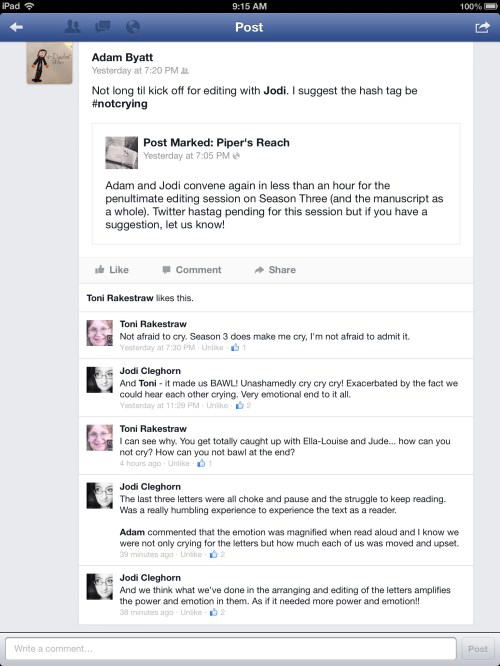
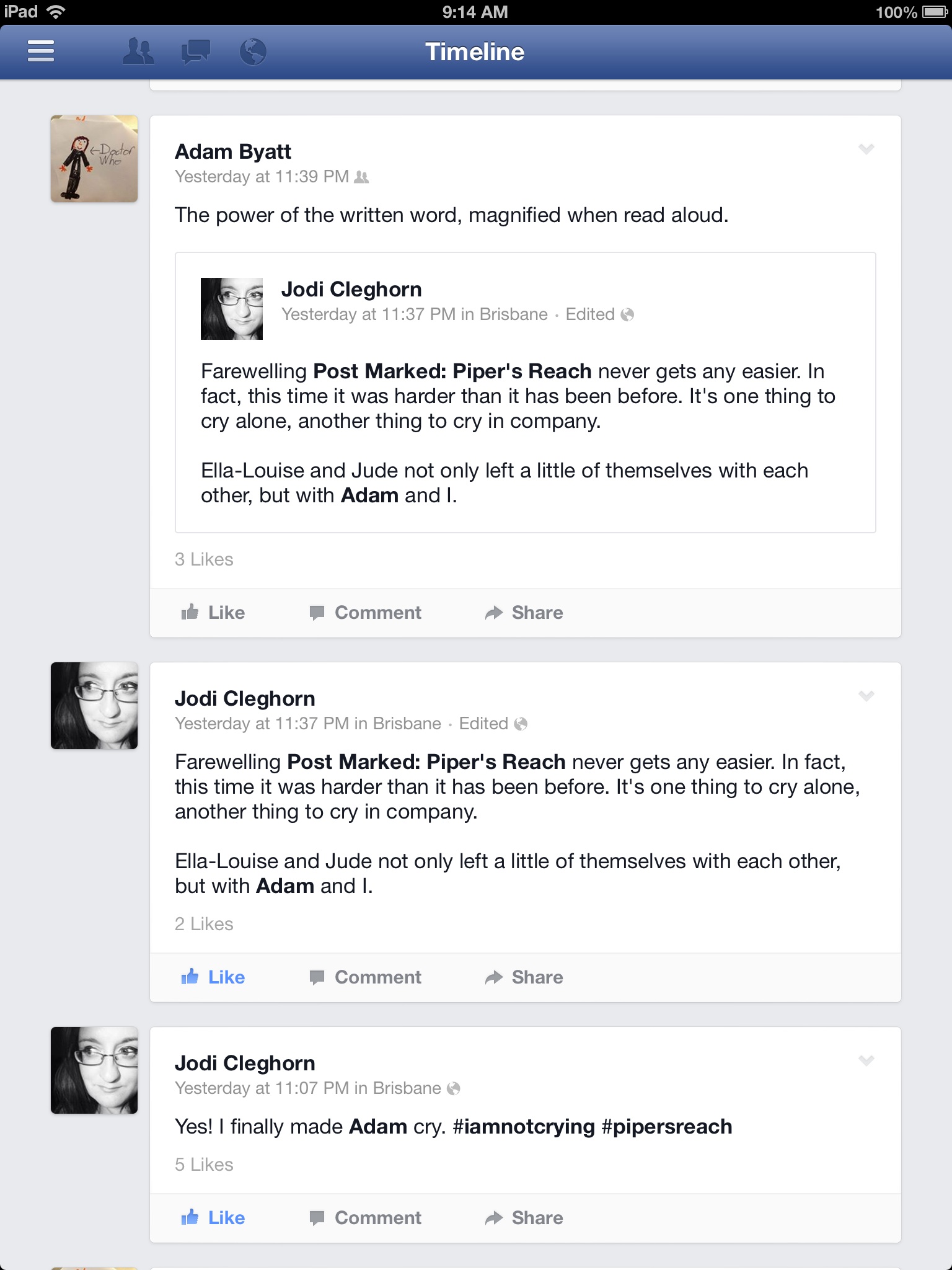
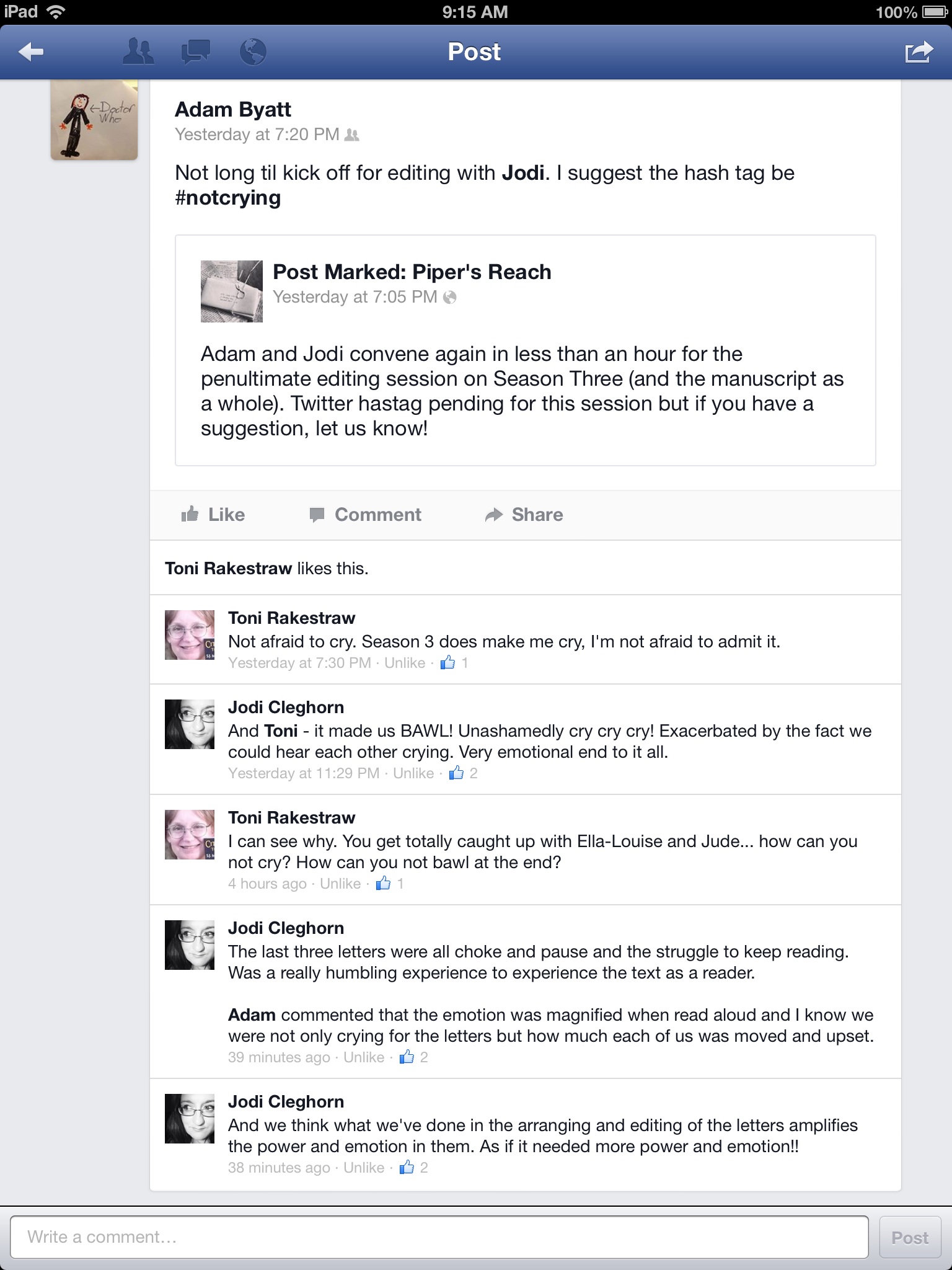
The adage of “tears in the writer, tears in the reader” was true last night. As Jodi says below, the last three letters were all choke and pause and the struggle to keep reading. It was a really humbling experience to experience the text as a reader. I commented below that the emotion was magnified when read aloud (maybe we’ll do an audio version of the book).
While we were editing, Toni our awesome editor chimed in.
And speaking reactions, a friend of Jodi’s read the online version before we took it down for editing last July. When he met up with her at conference, he said, “I hate you.” It was done playfully and without malice but in response to his reaction to the end of the book.
Read the texts referencing @_Lexifab
You can read Jodi’s reflection on last night’s editing on her website 1000 Pieces of Blue Sky and follow her on twitter @JodiCleghorn
Jude and Ella-Louise had the lighthouse at The Point as the focal point for understanding their relationship. It served as invitation, warning, refuge, security. I feel like I am there, under the lighthouse, watching the light sweep out over the ocean, waiting for the return of our characters.
We can’t wait until we can get this story into the hands of readers because we think we have a powerful story.

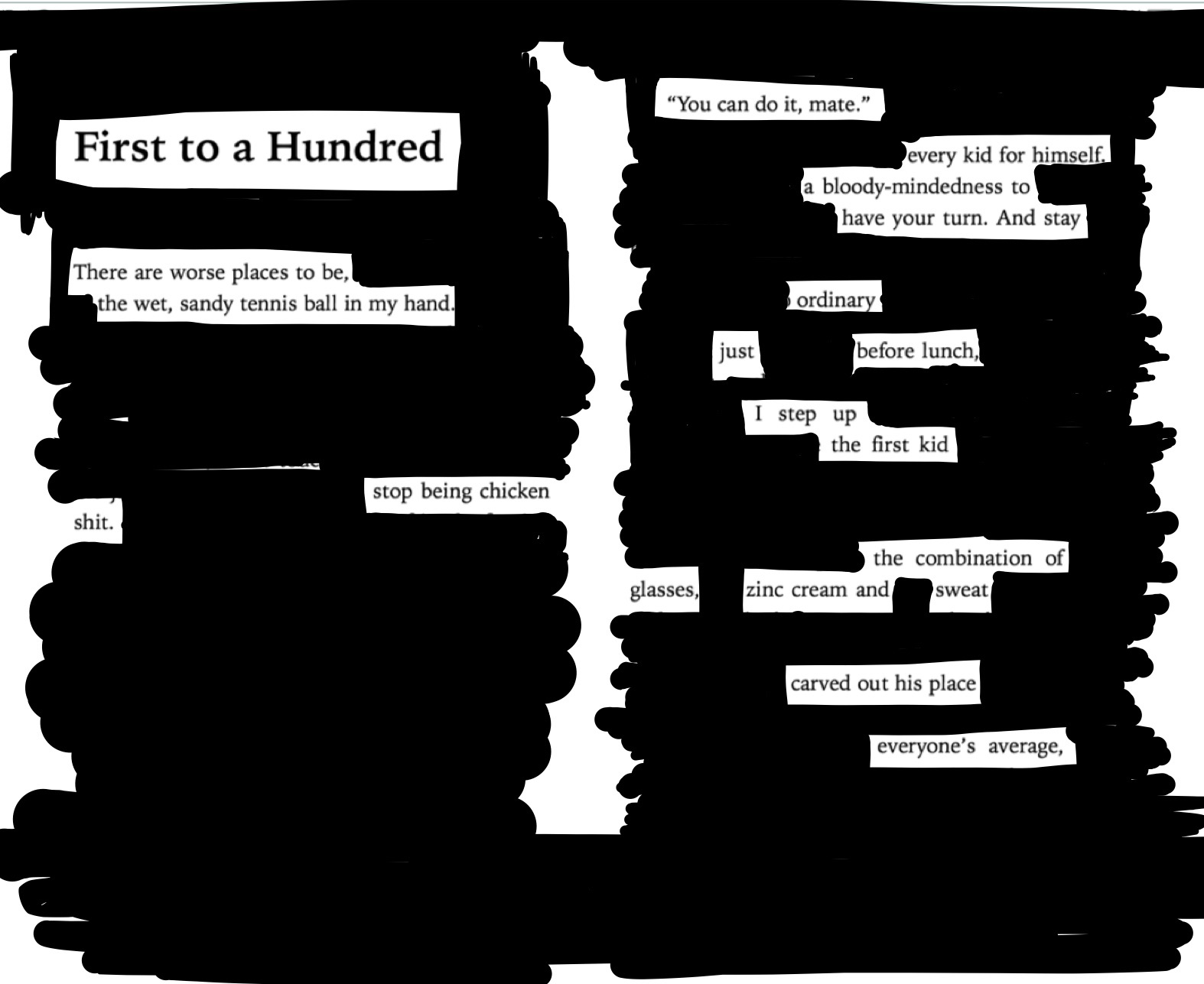
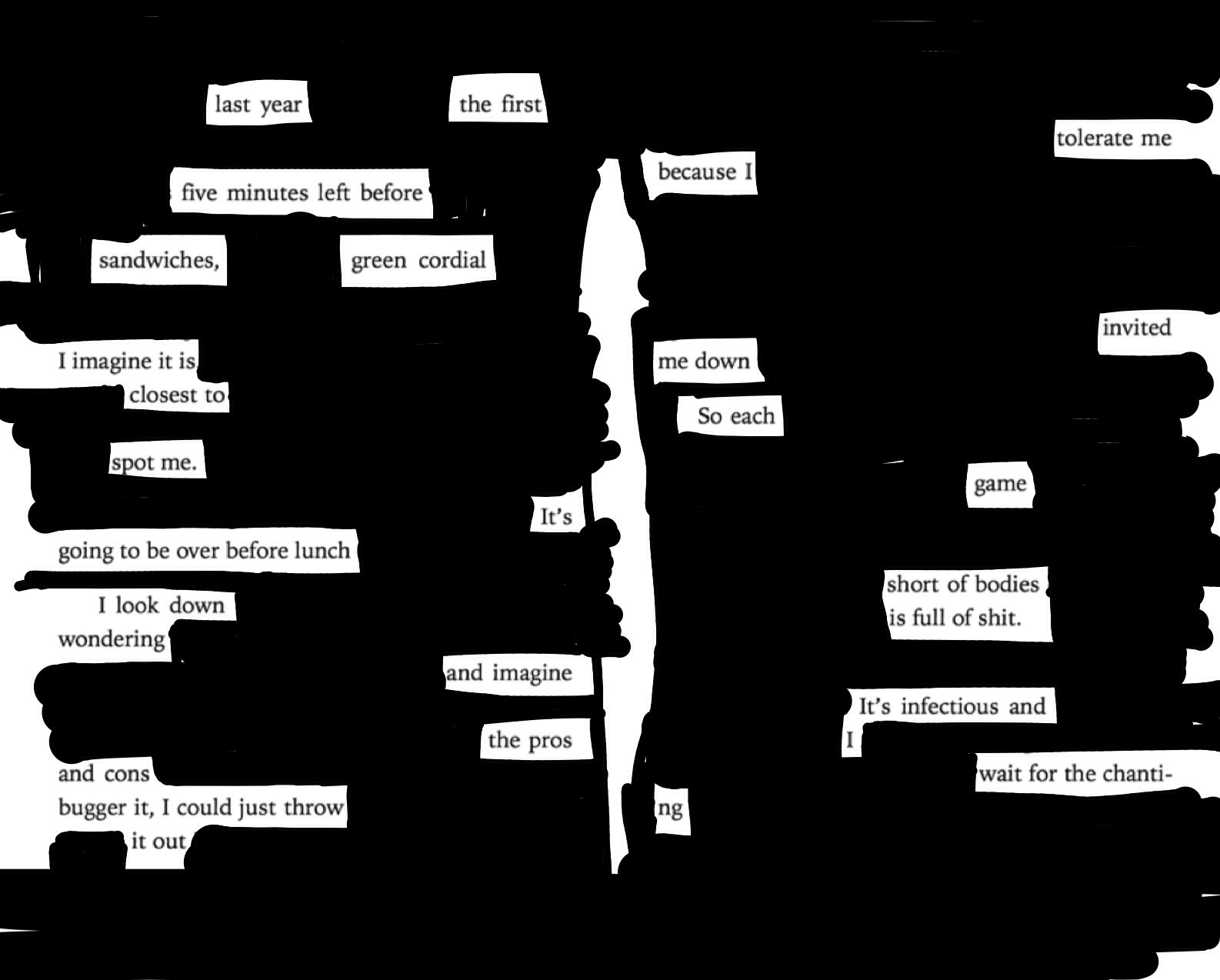
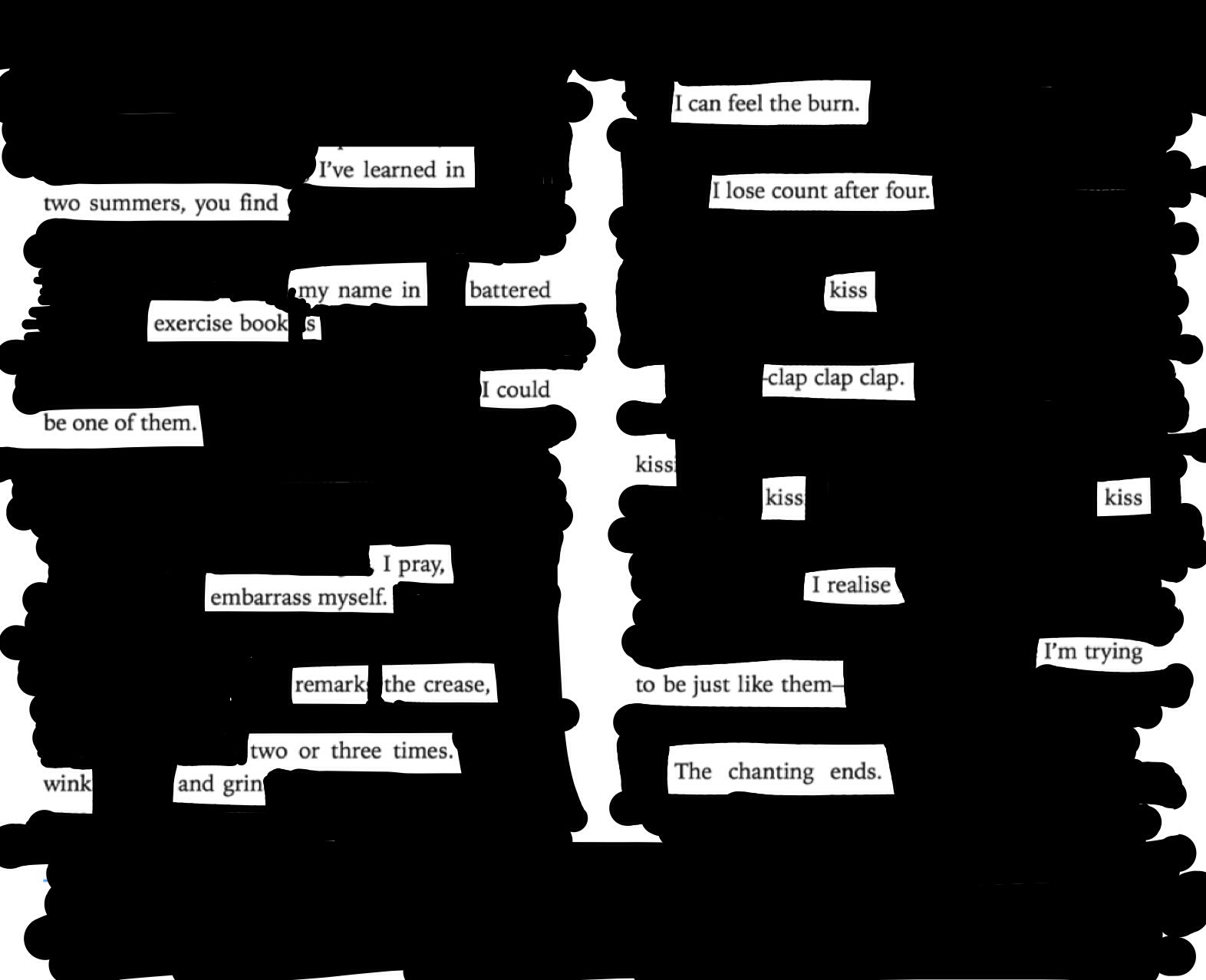
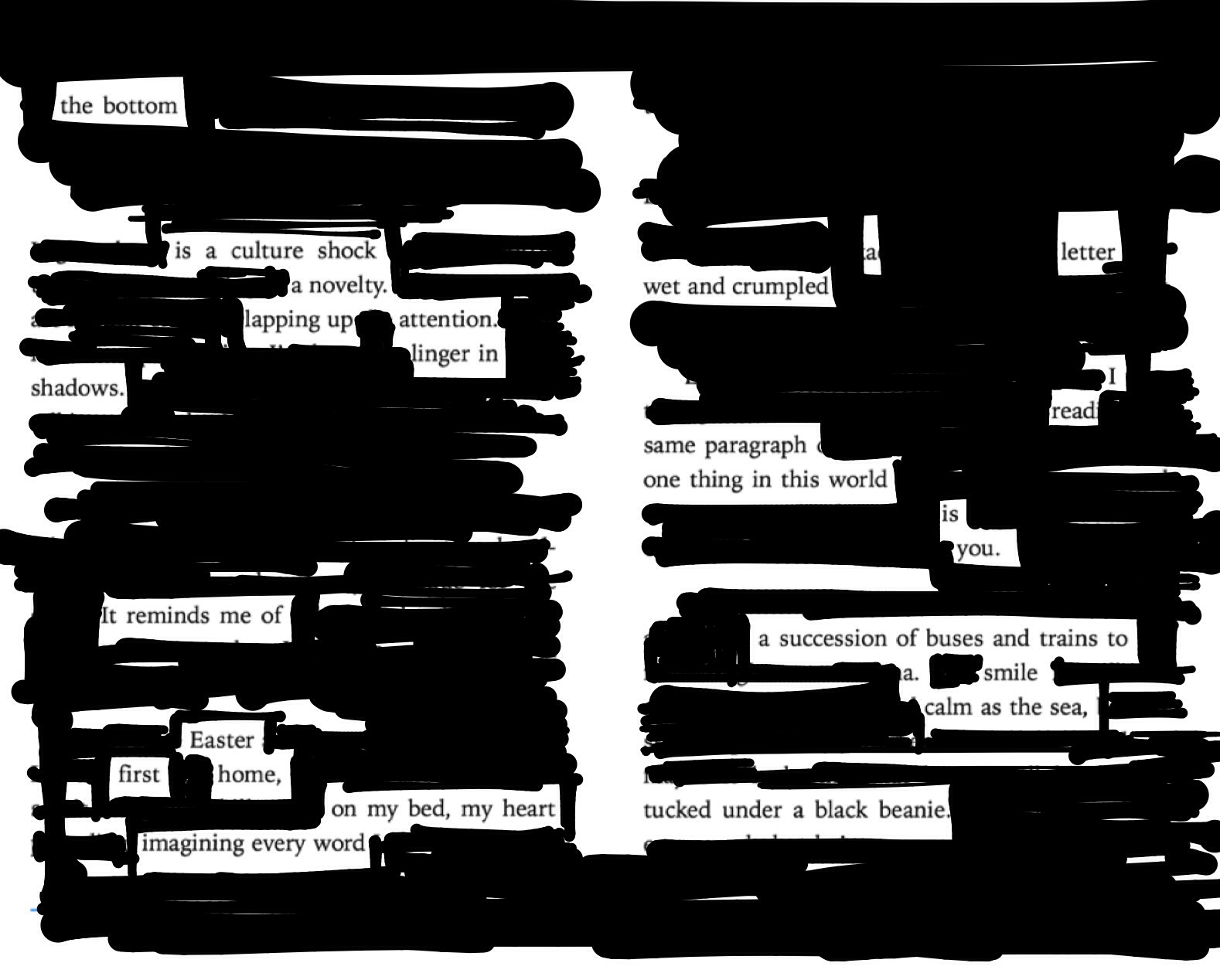
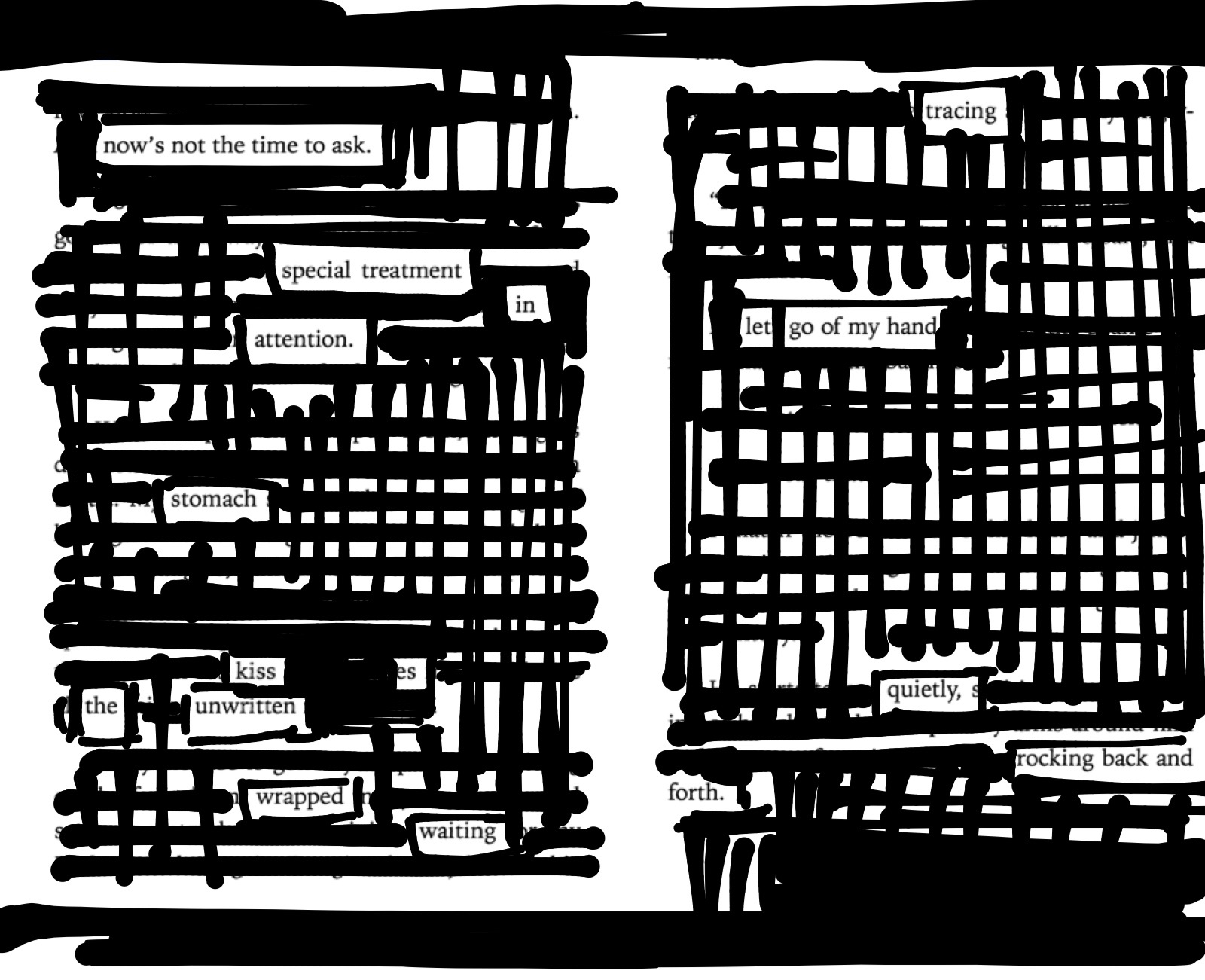
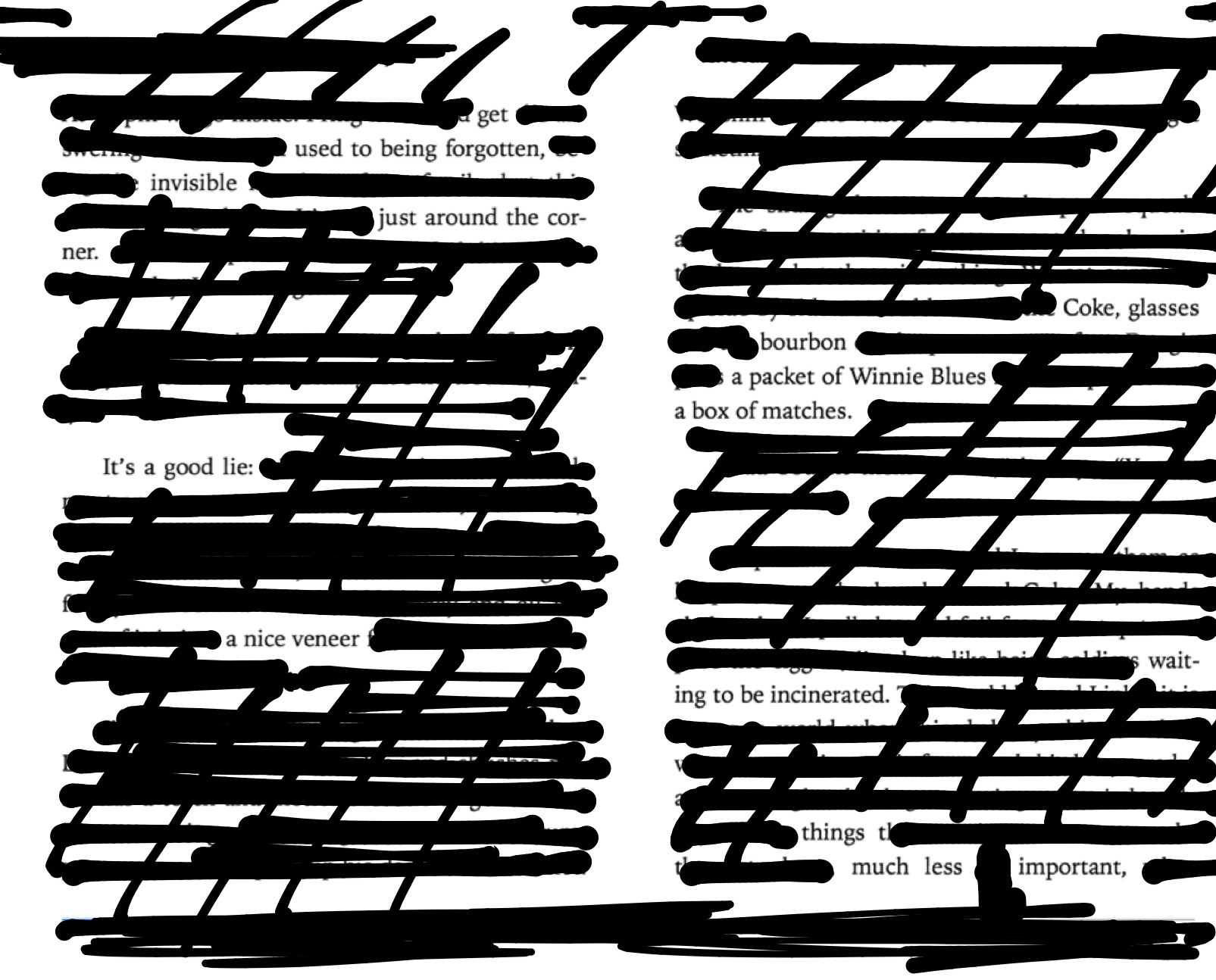
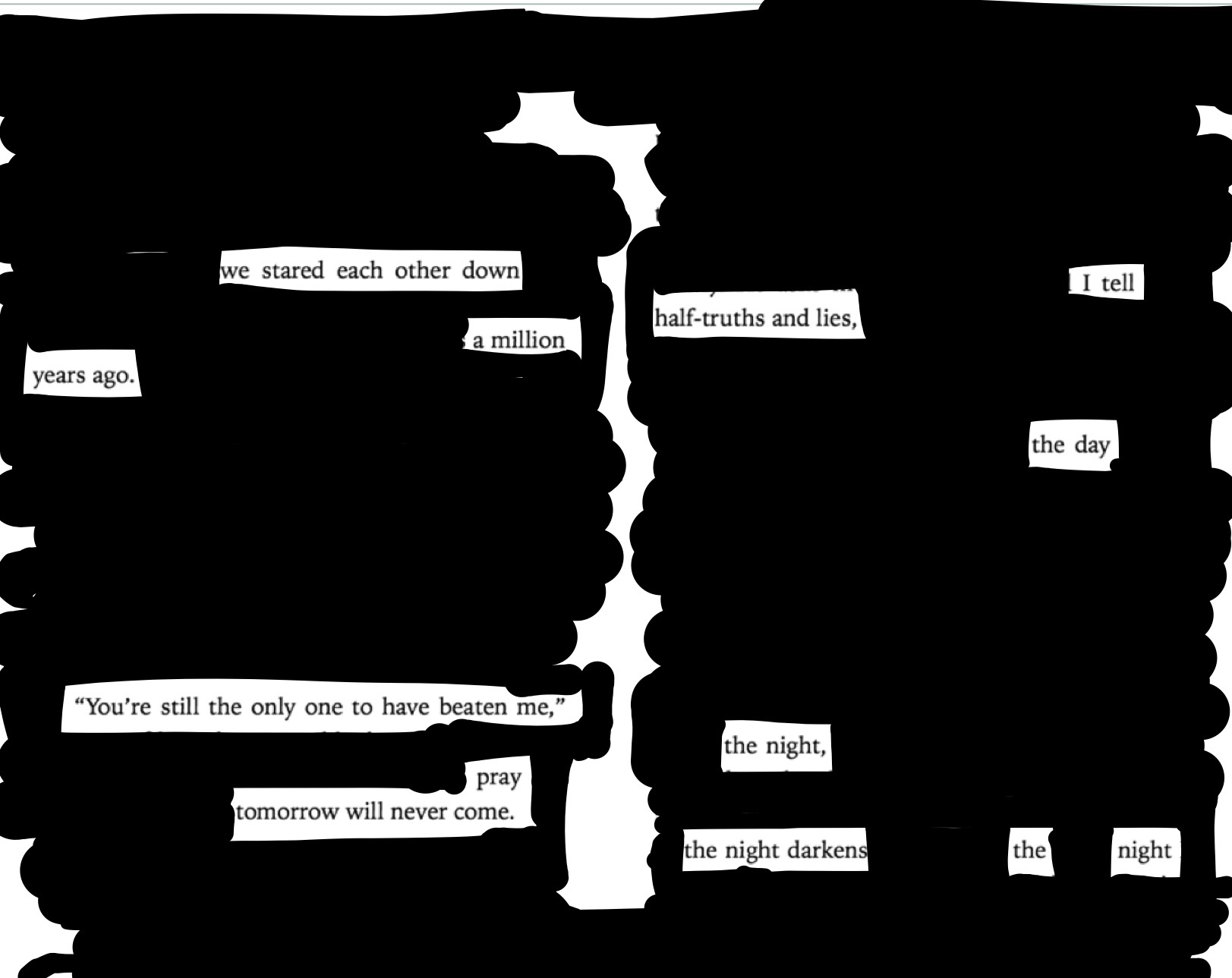
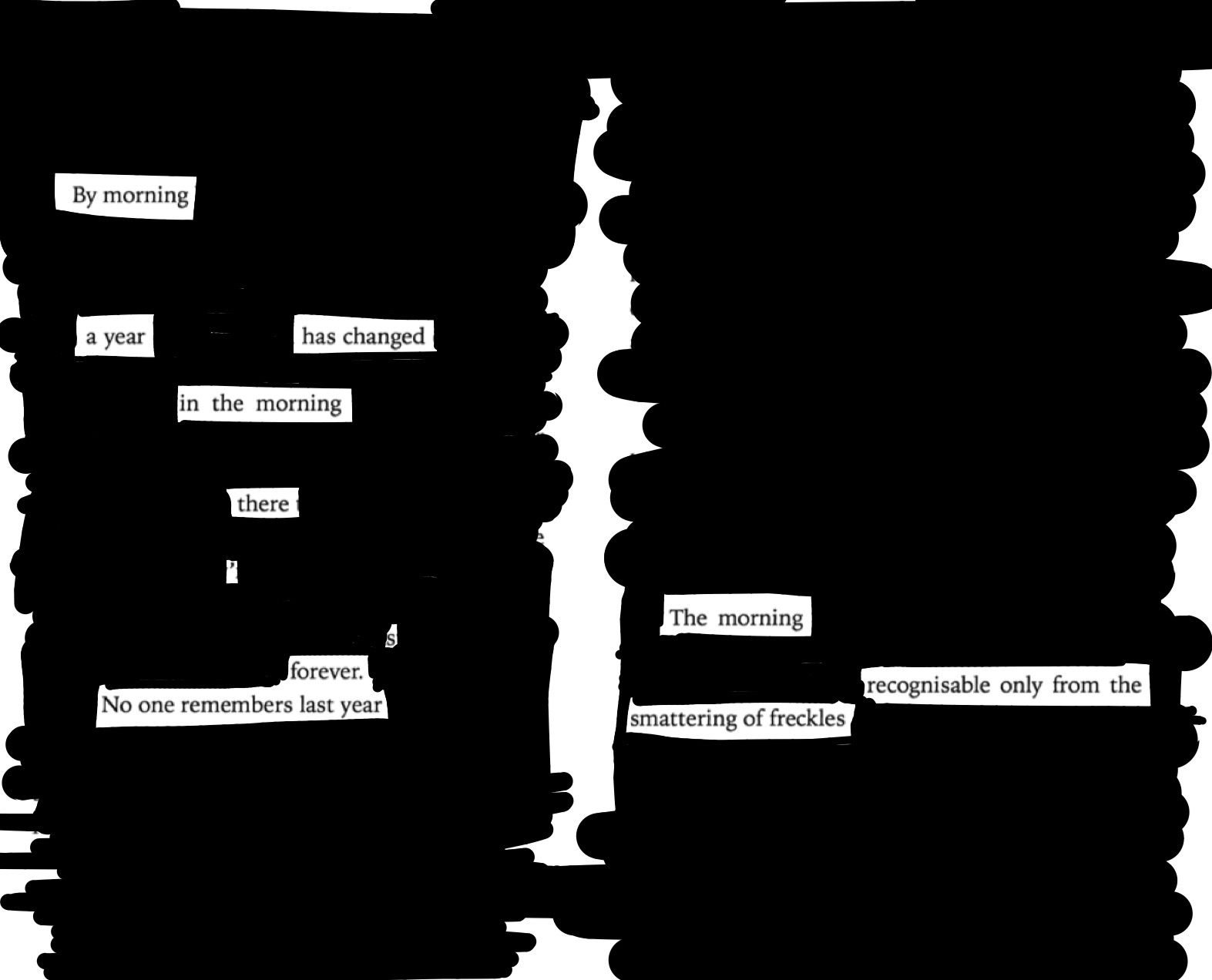
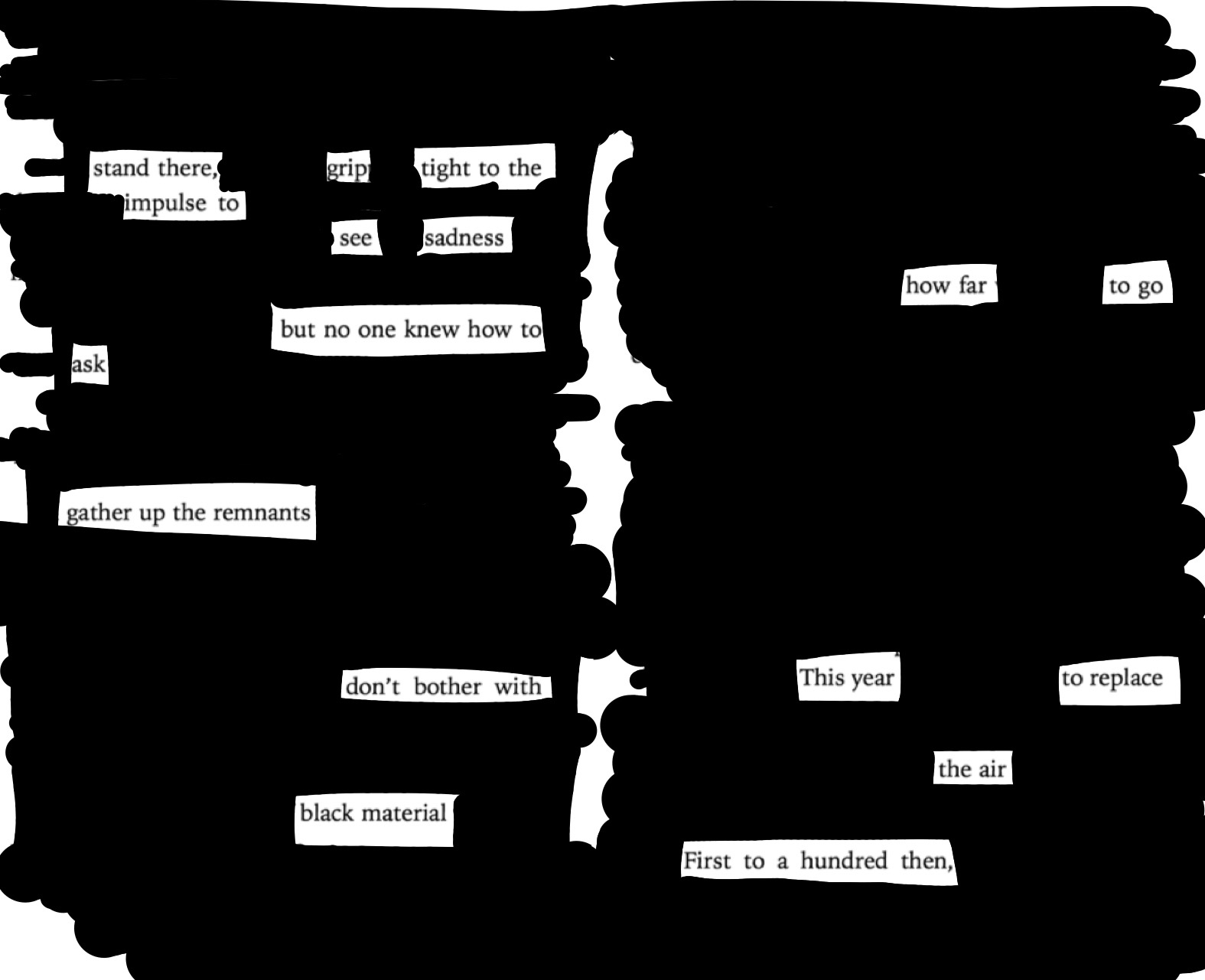
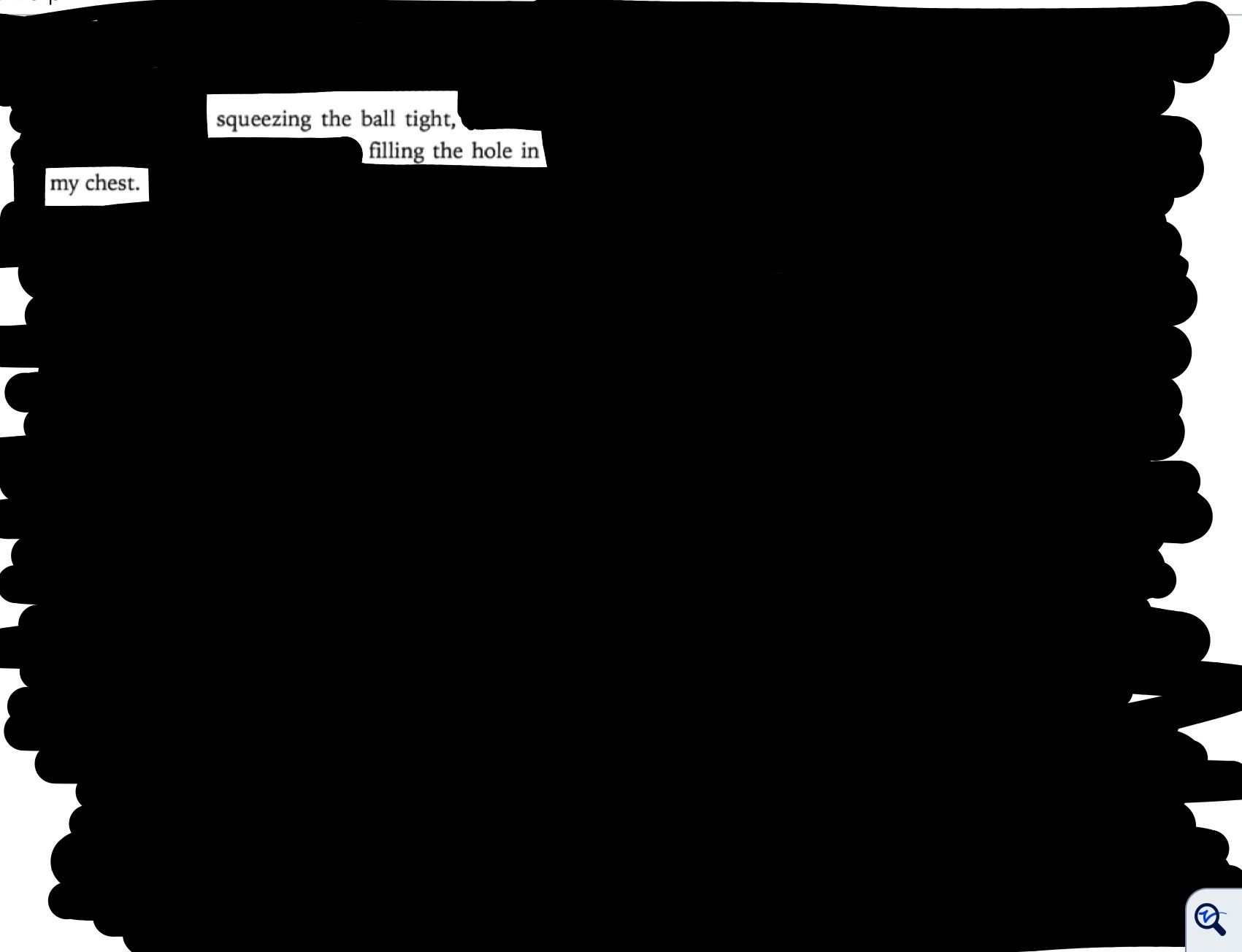

 A Fullness in Brevity - Adam Byatt
How Do You Write An Epistolary Novel?
How do you write an epistolary novel?
Easy. Follow these simple steps:
I co-wrote Post Marked: Piper’s Reach with Jodi Cleghorn (@JodiCleghorn) and we are now in the middle of editing the story.
Of course, you could write the letters yourself from the perspective of different characters but you don’t get the anticipatory Pavlovian response when you’re waiting for the sound of the postman’s motorbike (as they use on my street). Delayed gratification was something we had to deal with as we waited for each letter to arrive; 2 or 3 days can be an agonising wait.
You’re waiting on the newest letter to reveal the next part in the narrative, to learn more about the other character, and learn about your own character too (we both dropped in parts of each other’s character’s history – it’s how I found out Jude busted his knee skateboarding prior to Ella-Louise’s stage debut in “West Side Story”).
We wrote it for fun with no pressure, no constraint, no limitations or time frame. It was for us; writing for the pure enjoyment of it, and indulging in the lost art of letter writing we both had long since neglected.
For the first 3 months we wrote for ourselves yet knowing we would post them online eventually. Once it started online we began to gain a following. It grew to a small, but core, audience we dubbed the “Posties.”
Something positive changed. I realised I was writing for more than an audience of one. No longer was I writing with Jodi in mind (she was always my primary audience as the writer of Ella-Louise), but a wider readership who were invested in the lives of Ella-Louise and Jude. It gained traction and I saw the potential for this beyond the online community we had established.
After 16 months of writing, 52 letters and 85,500 words we wrote “The End.” It has only been in recent months that I realised I have written a novel. Surprising, really. Still shocked by it. Happy, certainly, but quite pleasantly surprised we did it (Jodi said she could never write a novel and I never thought I’d manage to write one – experience has made liars of us both).
This is what I wrote as a reflection when we had finished: What Happens When You Reach ‘The End’?
And now we ask the big questions and dream the big dreams.
How far can we take this epistolary narrative?
It is a question yet to be answered; in due time it will come to fruition.
While we wait for that day to come, we are hard at work editing the letters and smoothing out the roughness. Writing a web serial can allow for minor discrepancies and inconsistencies but a novel cannot.
For example, the character of Marion, Jude’s mother, became a very different character than when she started. This is the down side of the No Spoiler policy meaning we didn’t talk plot – originally Jodi’s suggestion was a character who was suffering from early onset dementia, but I missed the clue. Instead she became a far more complex character. It meant retconning the opening letters to reflect who she had become.
We have edited Season 1 and sent it off to our editor, Toni. Meanwhile we plough on through edits on Season 2.
Does this narrative have an audience beyond the core readership? I wrote back in July about the relationship between writer and reader: Piper’s Reach – The Writer and the Reader.
Jodi came across a site, First Impressions, hosted by Marcy Hatch and Dianne Salerni, offering a critique on the first 350-400 words. We bounced around the idea and decided to give Piper’s Reach a road test with an unknown audience to see if it engaged them and what reaction we’d get.
We spent a week or so writing and rewriting Ella-Louie’s first letter. Jodi wrote about her experience here: How Do I Love Thee? Let Me Count The Ways.
I was too caught up in school work to stress about it all but I was very keen and a little anxious to see what other people thought about a project I have invested very heavily into. Even though the opening words are not mine, they are Jodi’s; we had input into each letter in the editing phase so they become our words to an extent.
The first letter is critical to engage the reader and make them want to read on.
So, how did we do?
You can read the critiques and comments here:
Dianne Salerni and Marcy Hatch
They both praised the opening letter highly.
Marcy said, “This is an interesting beginning. I don’t think I’ve ever read an adult epistolary novel and I’m curious to see where this goes. This first page/first letter tells me quite a bit. Like the fact that Jude and whoever is writing the letter were probably once lovers, that they were close but that for some reason Jude didn’t come to see our narrator off, and that Piper’s Reach has some shared meaning for them. What’s great about this first page is that it sets up lots of questions about the past between these two people but also suggests a question about the future. Why is the narrator writing to Jude now, twenty years later? I want to know what happens next!“
Dianne commented: “First of all, I have to say that I’ve never heard of a novel being written this way before, especially in today’s world of instant communication. It’s quite original – and because I’m a pantster who also lets stories develop organically, I’m intrigued! The voice of the first letter writer (Ella-Louise) comes through strongly in this opening, and the premise is clear: She is trying to re-connect with a close friend (possibly a lover) whom she hasn’t spoken to in twenty years via the medium they used in the past. Letters.
What did readers have to say about Post Marked: Piper’s Reach?
A couple of readers stumbled on the colloquialism “pashed,” an Australian term for kissing, but other than that, the response was overwhelmingly positive.
Farawayeyes: “I’m intrigued, and completely hooked. I love the idea. It’s so different and refreshing. I will certainly read on.”
Kittie: “There’s no middle ground with epistolary writing. It either hits or misses. This one hits!”
Liz: “I love all of the little hooks and mysteries you managed to get in just one short letter. I was worried you were going to answer all of my questions too fast, but you didn’t – you held back and gave me a taste of an answer and then more questions, which is perfect. Great start :)”
Alex: “That simple letter says a lot. The authors nailed so much in just a few paragraphs.”
Jodi has a great write up on her blog: First Impressions for Post Marked: Piper’s Reach
For me, it shows we have an engaging narrative. We are on to something. Let’s see how the rest of it bears out.
Meanwhile, back to the edits.
Leave a comment
Posted in The Writer's Life
Tagged audience, comments, critique, feedback, jodi cleghorn, piper's reach, writers, writing