
Tag Archives: irony

Why Writing is Like Building Furniture from Ikea

Pick up the novel nearest to your hand you have read. Flick through it. You understand the plot, the characters, thematic concerns and the nuances of the language used by the author. It is said that everyone has a novel in them. Then you think, “I can give one of these novel things a crack. Doesn’t seem too hard.”

In your hand you hold a pen, ready to scribe your first novel. You know your story will unfold like a fresh bed sheet snapped out, floating down with delicate grace. The characters are complex individuals; the dialogue witty and full of sly observations; the plot is fresh and modern; the thematic concern touches on the toughest questions of life (but you have all the answers).

Sitting down you aim to start, but suddenly you are verbally constipated, stuck with the result of too much cheese and crackers. There are brief starts and squeezing out paragraphs with such force you could turn coal into a diamond.

So while it is said there is a novel in everyone, it is also said that no man is an island or that, all in all, we’re just another brick in the wall. And maybe that novel inside you should stay there because not everyone is called to be a novelist in the same way I am not called to be the Prime Minister of Australia (it would be a benevolent dictatorship, I assure you).

And it is because writing is difficult. It is hard. It is brutal at times. To understand how hard writing is, let me write you a simile.

Writing is like building furniture from Ikea.

In your hands you hold the instruction manual and emblazoned on the front is a catalogue image of what the finished product should look like. Caveat Addendum: power tools and me are mutually exclusive entities. I am useless with things that would validate my Man Card for all eternity.

Turning to the first page, the opening declaration states: “You must be two people to assemble this item.” (True story – was in the instructional leaflet for a lamp my wife and I received as a wedding gift).

So you lay out on the ground all the component pieces, checking you have everything you need. Then there’s the Allen key, the hexagonal tool of mystery. It is the key to success but lose it and you’re doomed to a lifetime of failure if you cannot wield it’s magical properties.

And so you begin. The instructions make no sense, you need the input of 6 people and certain words fly out of your mouth that would cause your mother to wash your mouth out with a wire brush and Dettol if she heard you.

People know to stand clear because the vein in your temple is throbbing and pulsating like a death metal blast beat, and one more inconvenient dropped screw or slipped piece of timber will cause your frustration level to become cataclysmic.
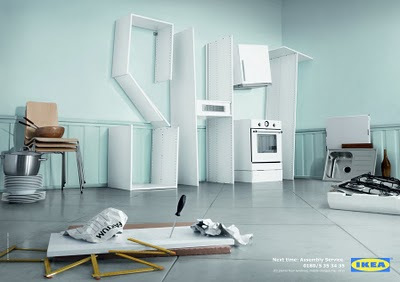
I am not usually a swear-y person, but this ad was too good not to include. Please excuse me.
http://madisonadblog.wordpress.com/2011/05/05/oh-sht/

The object before you takes on the appearance of Frankenstein’s monster; it is ugly, gangly, obtuse, imperfect, but dammit, you’re making it!

And yet you persevere; this thing will not beat you. Your aim is to give it life, and LIFE IT SHALL HAVE!

Finally, after hours of building, cursing, swearing, begging, pleading and grovelling, IT IS FINISHED. All the lines and angles are straight. Its beauty and function are unparalleled.

You did it!! (with a little help from your friends) And you don’t have a piece missing or a leftover screw.

And then someone asks why couldn’t have just bought one that was already put together.

This is why writing is like building furniture from Ikea.

With thanks to Jodi Cleghorn (@JodiCleghorn) and Monica Marier (@lil-monmon) whose comments I have appropriated.

Add your own additions to this idea in the comments below.

Baa Baa “Adjectival Colour Nomenclature” Sheep

The Committee members shuffled papers and snapped locks on briefcases. Coffee orders were taken and promptly delivered before withdrawal symptoms set in. The small bowls of lollies were passed from hand to hand and rapidly emptied. The cream biscuits were always popular comestibles, except for those who believed in the fattening effects of dairy-based products. Otherwise they were simply scoffed down with slurps of tea or coffee. Chocolate biscuits had been banned after an unfortunate incident involving The Chocolate Orgasm, otherwise known as The Tim Tam Slam, the Heimlich manoeuvre and an emergency clean up response crew from Domestic Hygiene.

The Chair of Non-specific Gender motioned for the meeting to start.

“First order of business: Inappropriate Adjectival Colour Nomenclature in the emergent adult nursery rhyme Baa Baa Black Sheep.”

Mutters of consternation rippled along the table. Tortoise shell spectacles and twin set cardigans were shuffled back into place. Spectacle chains rattled on pearl necklaces.

The Chair raised his hand and the murmurs ceased. “It is clearly understood that ‘black’ as a colour nomenclature is not appropriate. While as a colour designation it allows for a stunning example of alliteration in conjunction with onomatopoeia for pre-educational individuals, it has been suggested the adjectival colour nomenclature of the sheep contains racial overtones derogatory to the descendants of African origin. It is out task to determine another adjectival colour nomenclature. What other colours can we propose?”

“How about ‘Baa baa blue sheep? It maintains the alliterative structure of the nursery rhyme and has no apparent discriminatory overtones.”

From the other end of the desk came a response. “Blue is a stereotypical boys’ colour and we’d only be reinforcing the inherent patriarchal notions of gender, subjugating the feminine and universal womanhood.”

“What about pink, then?”

“Then you’re espousing matriarchal hegemony, which while brings a measure of equality back into society, only serves to reinforce the stereotypical colour of femininity for girls.”

“Baa baa red sheep?” someone else volunteered.

“It will give you the socialist vote, however I don’t see them reciting a chant that programs an economic model of the mode and means of production where the sheep has to give up its hard grown wool for the sake of a snotty young capitalist.”

A snort of muted laughter drew attention. “Three words: feminine hygiene product. I wonder if there’s a commercial featuring sheep playing tennis, running along beaches and generally being carefree?”

“And you can discount the colour grey as a monotonous capitalist framework for serving the system.”

“What about purple?”

“Historically it’s the colour of royalty. The monarchists would be saluting with Earl Grey Tea from their Wedgewood china cups. Especially with a royal wedding front and centre of the public eye at the moment. However, the republicans wouldn’t stand for it.”

“White?”

“Too many colonial and imperialist overtones. And besides, it’s too bland. It’s like vanilla ice cream; everyone eats it, but no one really enjoys it.”

“Yellow?”

“Well, sheep aren’t really an Asian thing are they?”

“Green?”

“It gives you the environmental vote, but then you’ve lost the capitalist community.”

“Orange?”

“Too Dutch. Have you ever watched a sporting event where they are playing? It’s an eye sore seeing a wall of orange.”

“Can I suggest ‘Baa Baa Rainbow Sheep’?”

“The rainbow has been appropriated by the GLBT community so come Mardi Gras time you could sing about sheep all you want. But then you’ve marginalised the heterosexual community and let’s face it, they are the ones currently filling the majority of vacancies in formative adult nurturing centres and pre-educational institutions.”

There was a pause as the committee stalled at the lack of remaining colours. An impasse looked inevitable. A voice broke their ruminations.

“I think we are overlooking a very important part of this nursery rhyme.”

The committee looked towards the member.

“Well, if you ask me, isn’t this little ditty a little bit species-ist? Why does it have to be a sheep? What about other wool-bearing animals: llamas, alpacas, goats? Shouldn’t they have a say in all of this?”