Tag Archives: haiku

Can I Get A Haibun Over Here?

Thanks to my pet friend, Sean Wright, I have been experimenting with haibun. It is a Japanese form utilising haiku and prose. The haiku is meant to be stand alone as well as illuminating aspects of the prose. They are brief and focused.

I wrote a few to play with the form, a way of practising. 

I have included two of them here. I used a third on Storybird as a picture book experiment and have had some good response to it. You can read it here: Pendulum

Exhalation

In the silent moment before the alarm makes its declaration of the birth of the day, I wait, awake. Outside my window the main road is silent, a petulant child trying to see how long she can hold her breath as if it can stop the day from starting.

spark of life
measured in two movements
light follows dark

The fanfare of the hourly news is followed by the burst of exhalation: the rapid, rasping, laboured breath of rubber on bitumen. It is a too-quick heartbeat, and if I lie here long enough I hear the rise and fall of cars. They lumber away, wheezing their way up the hill hoping the lights turn red to catch their breath again.

If I hit the ‘snooze’ button, I can pretend the news never happened and the breaths taken outside my window are nothing more than the wind playing with the trees shaking their thoughts onto the ground.

I want to see how long I can hold my breath until I find a pencil and a scrap of paper to keep tally. They will be filed in pockets of jeans, jackets and shirts, ensuring the stipend is not exhausted, and hoping the remainder can be carried over to the following day.

receipts kept in pockets
fall with autumn’s grace
kindling for the fire

Gunning Station

I only met you once in real life, officially, when I stood on your platform, my toes deliberately hanging over the edge, uncertain if a train was due to arrive.

Our first, formal introduction, where the firm handshake betrayed the frailty of the weatherboard spruced with a fresh coat of beige and capped with terracotta coloured corrugated iron. The blue Countrylink sign on each of the matching seats announced your name.

I felt the awkward familiarity of meeting a robust memory known only from photographs and second hand reminisces, seeing the aged decrepitude beyond. A faded discolouration, a tea-soaked sepia superimposed over the glare of a late winter’s afternoon.

shadow obscures
the printed timetable
a faded memory

A place as familiar as a Sunday lunch of roast lamb and vegetables, gravy thickened from the pan, linen napkins, silver cutlery and the lingering scent of tobacco rolled through your fingers. The smoke drifts up in curls like the steam engines who once waited on shunting lines now no longer connected.

Five generations of my wife’s family including her lived at some point in the stationmaster’s house on the hill overlooking the station. I look at the corrugated iron, rusting in the silence while paint peels off stone walls in a town redefining its face with brick veneer, upmarket cafes and gentrified real estate.

I walk the length of one platform, descend the ramp to cross the tracks and feel the rebellious rush of stepping over the rails. I half expect, even want, a passenger train or freight train to crest the curve and suggest that the pulse, however thready, exists for at least one more day. But none come.

I walk the length of the other platform and reach the boundaries of a circumscribed world defined by memories that are not my own.
More Collaborative Poetry

I wrote another haiku yesterday, posted it to twitter and copied in Sean (@SeanBlogonaut) to see what he could add to form a tanka.

fading amber leaves
blown into the courtyard corner
lovers’ forgotten kisses

Sean added the final lines:

fading amber leaves
blown into the courtyard corner
lovers’ forgotten kisses
would that my love return
like the green leaves of spring

He also played with the second last line

fading amber leaves
blown into the courtyard corner
lovers’ forgotten kisses
how I wish my lover would return
like the green leaves of spring

We were playing around with this on Facebook, on a private page for our small group of writers, and after reading through Sean’s ideas, I added my own versions.

fading amber leaves
blown into the courtyard corner
lovers’ forgotten kisses
I wait for my love’s return
with the green shoots of spring

*****

fading amber leaves
blown into the courtyard corner
lovers’ forgotten kisses
I wait for my heart’s return
with the green shoots of spring

This is the fun of collaboration, learning with each other the intricacies of a new art form.

Into the mix Jodi Cleghorn (@JodiCleghorn) added her own version using my original haiku and added her own final lines to form another tanka.

fading amber leaves
blown into the courtyard corner
lovers’ forgotten kisses
left to decay
with the memory of you

As she said, “Thank you for new ways to play and collaborate.” 

Ultimately, this is what it is all about: new ways to play and collaborate. The apparent simplicity of haiku and tanka reveals a deeper, more sophisticated art form that while simple to learn is difficult to execute and takes years to master.

But the evening’s fun continued. Jodi wrote two haiku while out at the shops and posted them for us to add two final lines to form a tanka.

an autumnal drift
shedding selves compost
buried beneath

*****

frost-bitten feet
walk from the place
I forgot to leave

I took the haiku and added my own final couplet

an autumnal drift
shedding selves compost
buried beneath
resurrection of the dead
in someone else’s life

*****

frost-bitten feet
walk from the place
I forgot to leave
in the hope
your heart will thaw

frost-bitten feet
walk from the place
I forgot to leave
in the hope
your heart would thaw

In the last two, the change of a single word, “would” for “will” creates two very different meanings and both a valid.

Here’s a challenge: take my haiku and write two final lines to form a tanka.

fading amber leaves
blown into the courtyard corner
lovers’ forgotten kisses

Collaborative Poetry

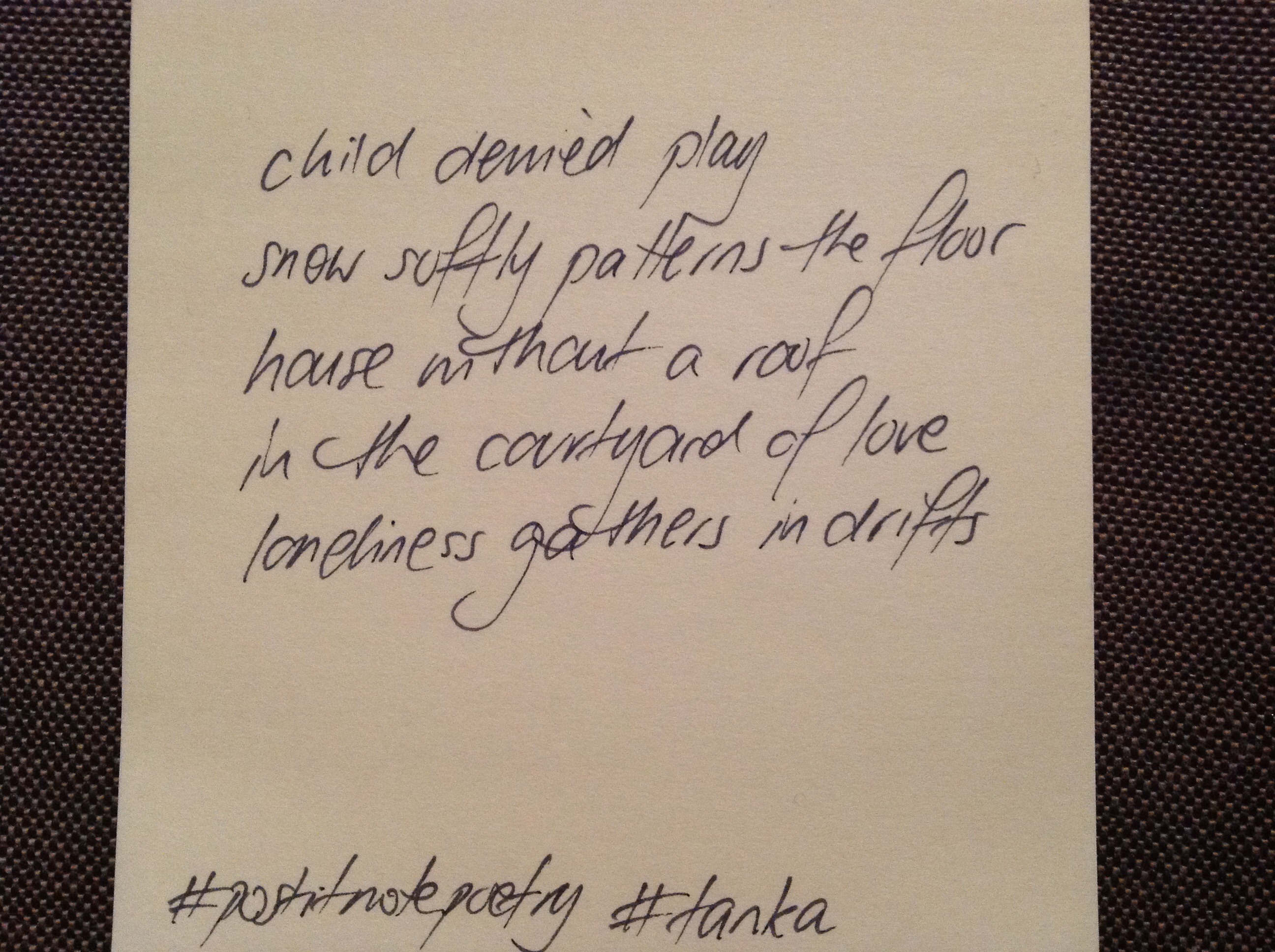
Recently I tweeted the following haiku:

child denied play
snow softly patterns the floor
house without a roof

and tagged a friend, Sean (@SeanBlogonaut) who is another poet and writer. He is particularly fond of haiku, tanka and renga. He has given my wonderful insight into how haiku should be written in English (focus more on the imagery, the phrase and the fragment, rather than the counting of syllables. It is one of the vagaries of using a poetic form which has its origins in another language; the Japanese use sound units which are different to English syllables).

He added the following two lines to form a tanka:

in the courtyard of love
loneliness gathers in drifts

Creating a new poem

child denied play
snow softly patterns the floor
house without a roof
in the courtyard of love
loneliness gathers in drifts

I am used to collaborative writing and I want to further explore it with Sean, particularly as he raised the idea with me a couple of weeks back but we haven’t been able to catch up yet to write renga.

Collaborating with a new writing partner has benefits:

1. You learn new skills

A collaboration can be of equals, or a master and novice. In the case of writing renga with Sean, I would be the novice. But the collaboration is one of exploring a poetic form and learning more from each other.

2. The sum is greater than its parts

Or, two heads are better than one. New eyes, old heads, different perspectives, new ways of writing. You learn from another about your own writing from the writing of others. You learn how the other person constructs a phrase, sentence or image, and you get to explore why. It’s another skill/technique you can add to your own writer’s toolbox.

3. It’s fun

Yep. It’s fun. Creating a piece of work should be fun. It’s also hard work but the fun of creating something together, a shared community and body of work is a fantastic feeling.

image

Find a creative partner and create something new. It may only be a one-off piece of work or it may lead to a long term collaboration. Try it. Invite someone to participate.

Antidisestablishmentarianism – A Haiku

I set my Year 8 class a writing task today, 10 Things I Know to be True, or 10 Things I Should Know By Now (taken from Sarah Kay’s TED talk – it’s brilliant. Go watch it).

One of my students wrote, “I know ‘antidisestablishmentarianism’ is the longest word I know.”

We joked it was almost a haiku in itself. So I thought I’d make one. I know it’s not a correct or proper haiku but it’s a fun form to play with.

An-ti-dis-es-tab-
lish-ment-ar-i-an-ism
Longest word I know

What creative act have you done today?

Random Creativity (And Why It’s Important)

On Friday my Year 8 class were set the task of writing haiku.

The English approximation of a beautiful Japanese art form is known to most, if not all, primary school children. They learn it is a poem of 17 syllables broken into 3 lines (5, 7, 5) and it is about nature (or something…).

It is taught because it is easy and accessible for students. It gives definite boundaries and restrictions, confinements for words and their interplay of meaning.

But writing great haiku is difficult.

I told my students I wanted them to experiment and play with language. I encouraged them to enjoy the process, to have fun with language. And so I had a go at writing a couple myself.

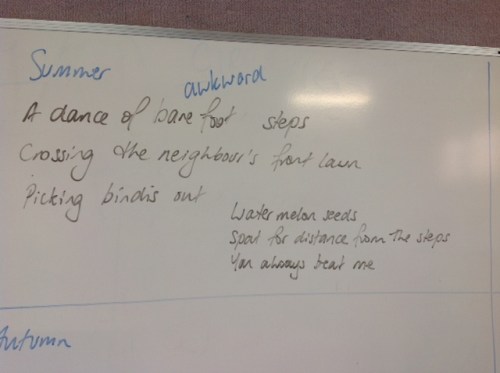
Summer Haiku

Summer Haiku

A dance of barefoot (awkward) steps
Crossing the neighbour’s front lawn
Picking bindis out

Watermelon seeds
Spat for distance from the steps
You always beat me

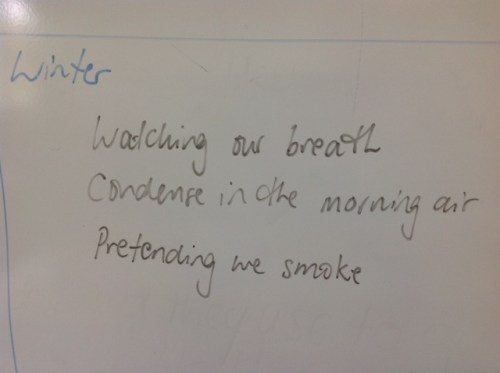
Winter Haiku

Winter Haiku

Watching our breath
Condense in the morning air
Pretending we smoke

Are they any good? Probably not.

Why is random creativity important?

It can be done quickly and in spare moments, disposable as an empty soft drink container or laboured over and agonised and deliberated for each and every syllable.

This is why creativity is important.