Tag Archives: fiction

A Museum of Domesticity’s Austerity – Micropoetry

a single white orchid
in a glass vase
on a glass coffee table
I press my thumb
onto the glass
to humanise austerity

Pulling At Threads – Micropoetry

I want to pull
at this loose thread
but…
I dare not pull it
lest I unravel completely
and reveal the emperor’s
new clothes

Miscellaneous Objects – Micropoetry

I pick up
what you
deliberately dropped;
the broken
object discarded.
Yet its
brokenness remains
in you.
Is this
your healing?

In Common Union – Micropoetry

When I share the table
With you and we eat
Together in communion
We cast off our fears
And we find strength
In common union

I Would Like To Send You A Memory – Micropoetry

I would like to send you a memory

But I can’t get it quite right

I want this to be perfect

So you’ll never forget

…Never mind

7 Reasons to Abandon The Myth of the Muse

I’m calling it now.

I’m calling shenanigans on the whole Muse thing.

The anthropomorphic representation of the creative inspiration is a romantic notion, used as a mythologising factor of and for the creative life. The Ancient Greeks had 9 anthropomorphised Muses (Epic poetry, History, Lyric poetry, Elegiac poetry, Hymns, Tragedy, Comedy, Astronomy and Dance) so you can appeal to any number of them. Heaven help you if you want to write YA or Gothic romance.

There have been a fair number of creative people over the years, be they writers, artists, painters, who sprouted the notion they cannot create with the inspiration of their Muse (who was probably a prostitute or mistress or as a result of drug and/or alcohol abuse, or all of the above).

And yes, they have produced some brilliant works of art in literature, painting, music or film. But if we didn’t tacitly approve of their illegal and/or immoral mores, would we look on their work any different? Or do we say they were screwed in the head and needed a good paddling? Perhaps they could have produced the same work of genius WITHOUT the chemical alterations?

All that aside *sweeps table clean*

I think the concept of a Muse is a load of rubbishy bollocks.

 I believe we can all be creative to some degree. It can be as simple as taking a photo a day on your phone and whacking it on Instagram (Note: food and selfies are long gone; try combining the two for something different) or writing a piece of bad poetry to fit on twitter or doodling in the margins of the newspaper on the way to work.

IT DOESN’T MATTER WHAT YOU DO, AS LONG AS YOU ARE DOING SOMETHING CREATIVE.

Make a cake, sew a quilt, tend a garden, write a story, learn an instrument, paint a picture.

FOR THE LOVE OF ALL THINGS HOLY, CREATE SOMETHING. AND CREATE REGULARLY.

Then we can get to this finnicky point about having a Muse. You do not require the assistance of an anthropmorphised idea to create, or to inspire you to create, or to keep you creating.

Here are 7 reasons why I don’t believe in the Muse an an anthropomorphised notion to inspire, or be the main reason for, your creativity.

1. I don’t believe in the Muse as inspiration because it’s an excuse

“I didn’t feel the presence of the Muse today.”

“I’m waiting for the Muse to inspire me.”

“My Muse hasn’t shown up today.”

“My Muse abandoned me in the middle of my writing session.”

No, no, no and just to be different, NO.

There are many, many different reasons why you are not creating but if it is not due to the presence or absence of a Muse, it’s an EXCUSE.

When you’re procrastinating from creating, know WHY. Are you being lazy? Too easily distracted? Emotionally unbalanced by something unrelated? Life happens and disrupts your creative flow: work stress, family stress, tired from being so busy. And the list could go on.

No more excuses!

2. I don’t believe in the Muse as inspiration because it undermines a positive work ethic.

If you are continually waiting for the (non-existent) Muse to arrive, you will NEVER get anything done. You wouldn’t show up to a professional level sport match and expect to play without the prerequisite years of training and discipline.

Neither should you turn up to your creative life without having done the background work.

If you’re a creative person you turn up each time prepared to work. You invest time and energy into what you do; you sacrifice time with friends, family, leisure to pursue what you are passionate about.

You don’t write a best selling novel on your very first attempt. Before you have ever set down the first word you have spent time preparing yourself for it. I have heard many authors speak of “practice novels” sitting in the bottom drawer of their desk or filed away on their computer. They put in the hours of work to write it but learned along the way of what worked and what did not.

Don’t wait. Do the work.

3. I don’t believe in the Muse as inspiration because instantaneous rewards does not bring long term benefit

Instant success can be a curse as it artificially inflates your sense of achievement. It is of greater benefit to spend time slogging it out in obscurity, honing your craft, developing the skills you need to master your choice of creative pursuit.

I have spent four years serving a writing apprenticeship so I can have the basic skills required to produce good art. And I still have a long way to go. I am nowhere near the end of my writing apprenticeship, but I have learned enough to feel confident to write a novel.

I spent a couple of years writing flash fiction and short pieces to understand story craft and structure. I read blogs, articles, received feedback on my own stories to learn more.

I will always be a learner of the craft.

Commit to the long term.

4. I don’t believe in the Muse as inspiration because it negates personal responsibility

As a teacher I see students who have not learned what it means to put in the time and effort on a piece of work. They would rather do nothing and fail, than to try and put some effort and possibly fail. And their parents often bail them out of trouble when their student is challenged on his/her lack of performance.

The percentage of people who say they want to write a novel is significant (somewhere around the 80% mark) but how many of them will actually start (not many), and how many of them will actually finish (even fewer)?

If you want to be creative, you have to do the work. No ‘ifs.’ No ‘buts.’ No excuses.

Take responsibility. If you want to create, CREATE. You cannot wait for someone else to get you to do it.

5. I don’t believe in the Muse as inspiration because it romanticises a short cut process, not a long term commitment

As a creative person, you’re in this for the long haul, not as a short fad or craze (think how fast the Harlem Shake or twerking or MC Hammer pants died out).

You create through all the cycles of life because it gives you meaning. You create when you’re happy. You create when you’re sad. When you’re curious, adventurous, melancholic, introspective, cautious, rebellious. Not because you’re at the whim of a capricious Muse who doles out ideas like rewards if you’ve been extra special today.

6. I don’t believe in the Muse as inspiration because creativity will not be handed to you without some work

The more you create, the more you look for ideas and inspiration, the more you find them. The Muse is not hoarding a treasure trove of delicious and vision-inspiring ideas, waiting for the most opportune (or inopportune) time to leave them like a trail of bread crumbs in the forest.

There are times when ideas are rare; you’re looking for canned unicorn and all you get is Spam. But to reinforce a previous note above, ask what’s going on in your life that make be cutting into your creativity? Tiredness, laziness, stress from work or family, bereavement, financial worries, commitments to family and friends.

Do the work. It will happen. Write ideas down and let them sit in the back of your mind (I call it composting – you can call it gestating, stewing over, masticating, growing flowers in the attic). Inertia and apathy are the greatest killers to your creativity.

Do the work. Read books. Watch films. Visit art galleries. Walk outside. Exercise. Talk to other creative people and brainstorm.

Feed your mind so you have ideas to draw on.

7. I don’t believe in the Muse as inspiration because you need to understand your own creative cycles

When do you work best? Is it in the early hours of the morning before everyone else wakes up? During the afternoon? In the evening? In the later hours of night after everyone else has gone to bed?

How often do you want or need to be creative? Once a week? Every third day? Every day?

You need to know how you work best to achieve maximum achievement from your effort.

Also know when you are creatively dry and in need of refilling your creative well. To quote a breakfast cereal commercial, “You only get out what you put in.”

When you know how you work, and when it is best to work, you are not at the beck and call of the Muse to create. I know someone who works best in focused, manic cycles of creativity, producing a fair amount of work in a short period of time, be it weeks or months. Conversely, there is an almost equivalent down time when work is not being produced.

Other people prefer to work in small, consistent pieces of time and produce work on a regular basis.

Is your creative locus internal or external? Where do you find your best ideas? From working alone or working with other people?

Give yourself permission to stop if you need to because life is chaotic and you need some rest but give yourself a specific date when you will return to it.

Know your creative cycle.

Final Thoughts.

I believe inspiration and creativity are two different aspects. Inspiration feeds into the creative process, but you cannot wait for inspiration. Creativity is a continual thought process. Inspiration taps into areas of thinking in order to create.

Sacrifice the idea of the Muse as archaic and unhelpful. Call shenanigans on it and do the work. Turn up when you’ve said you’ll turn up. Put your bum in the chair and create.

Tears in the Writer, Tears in the Reader

It has been 2 years this month since Piper’s Reach (an epistolary novel hand-written and posted in real time) was conceived, written, finished, and now, the end of the editing process.

And I am emotionally spent.

Here is the premise: 

In December 1992 Ella-Louise Wilson boarded the Greyhound Coach for Sydney leaving behind the small coastal town of Piper’s Reach and her best friend and soulmate, Jude Smith. After twenty years of silence, a letter arrives at Piper’s Reach reopening wounds that never really healed.

When the past reaches into the future, is it worth risking a second chance?

How We Edited Collaboratively Via Distance

Last night my collaborative writing partner, Jodi Cleghorn, and I sat down via Skype to put the final pages of our novel, Post Marked: Piper’s Reach through the edits.

As we live in different cities in Australia (I live in Sydney, Jodi lives in Brisbane) the process of editing involved reading through the document and making changes, and posting the main document to Dropbox for the other to work on. Track changes is an awesome function.

The novel was divided into 3 ‘seasons,’ natural climaxes in the story’s developing plot, each approximately one third of the novel’s length. At the end of editing each season we forwarded it on to our friend Toni, who gratefully offered to edit for us.

We then sat down via Skype and read each of the letters aloud to the other, taking on the persona of the character we wrote (I wrote the character of Jude, Jodi wrote Ella-Louise) while accepting or rejecting edits.

Editing is, by and large, a clinical process where as the writer, you are looking for inconsistencies, errors, character motivation and analysis. You are not looking to be engaged by the story although you are aware it’s there.

However, during our various editing sessions throughout the latter half of 2013 we found we became entangled in the story again, its emotional push and pull, often stopping after a letter to talk about it, or even pausing at the end of a paragraph mid-letter to comment on how we felt the characters were reacting, or our reaction to a particularly visceral and emotional paragraph.

Along the way we overcame our fear of reading aloud. By reading it aloud as we edited, we were coming to the story as writers, and as readers. There was laughter, titters, nervous giggles as we read certain parts, and there was uncomfortable silence while we read others when the tone of the letters was angry and aggressive. 

At the beginning of Season 2 there is a section of juicy, saucy letters  but we read through them with nary a titter or giggle or sense of awkwardness (there’s no way my Mum is reading what I wrote). What gutted, and surprised, us more was the letters that followed where the characters’ anger was evident and pronounced after we rearranged some paragraphs. There were moments of quietness as we contemplated the passion and aggression our characters had found in their words.

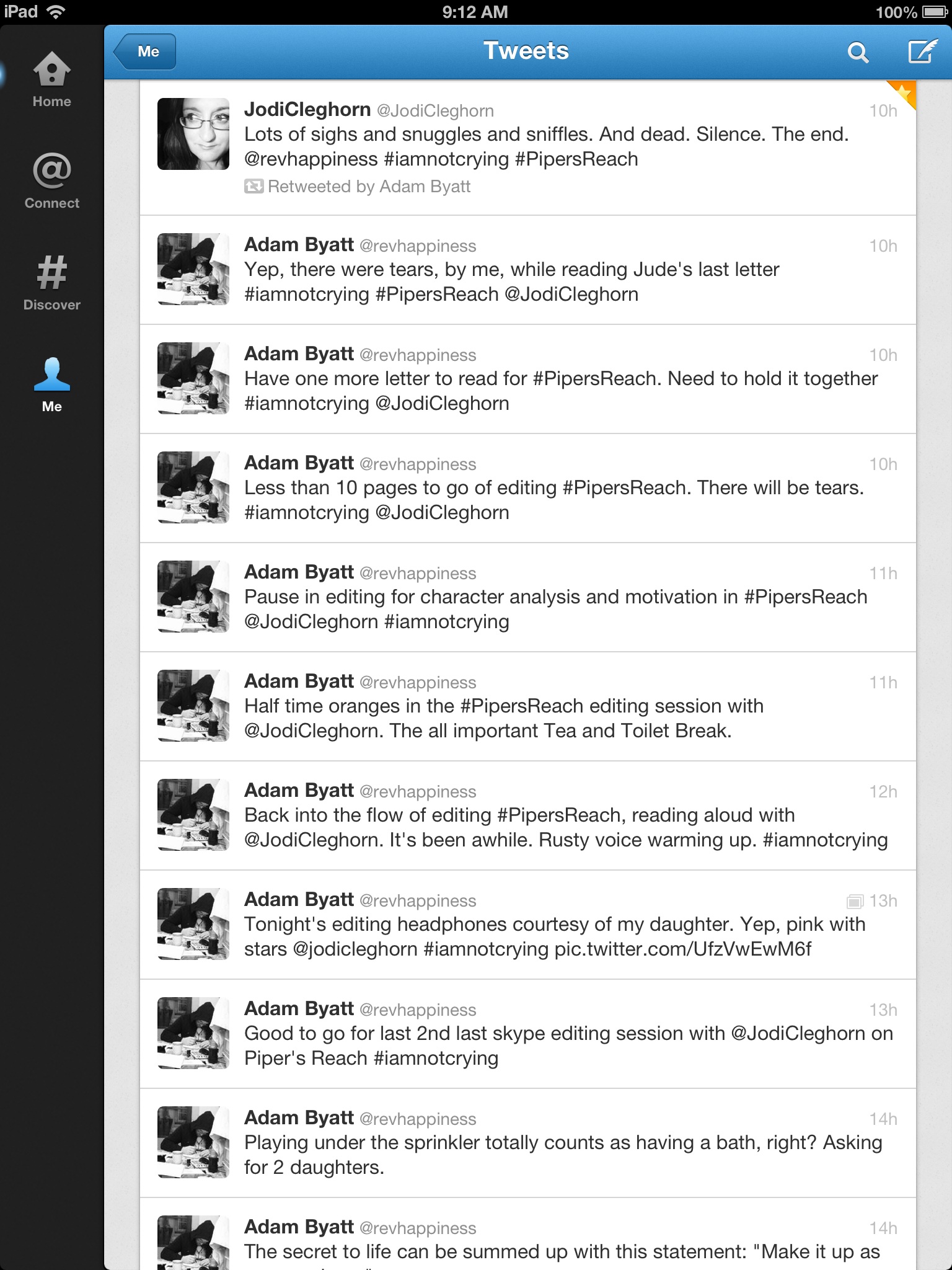
We posted hash tags via twitter during our Skype editing sessions. For example, there was a time back when we were editing Season 2 when the content of the letters was a little bit racy so we called it #cigarettesession. Which leads into last night’s final editing session and the accompanying hash tag.

Jodi put the call out early and I suggested #iamnotcrying. It was a little tongue in cheek as firstly it was the ending of the editing sessions, the ending of the novel (a grieving process in itself) and because we knew how the story finished.

Throughout the writing process Jodi was determined to make me cry as I had made her dissolve into tears on a number of occasions. She texted me one afternoon after a specific letter I wrote: “That was one f**king awesome letter. Have read it four times now and I cry and shake and the whole full body emotive experience.”

I can’t remember which letter it was now, but I loved the reaction. There had been moments when I *almost* cried, but had yet to succumb to full on tears. Even at the end of the writing process when I was reading the final letter, I did not cry, which upset and confused Jodi. 

Fortuitously we ended up writing the final letters across my dining room table during Easter 2013 after having spent the previous 16 months sending the letters via Australia Post. I was blindsided by the ending that I laughed, somewhat nervously. I couldn’t comprehend what Jodi had done; I hadn’t seen it coming. I was gobsmacked at how it ended (it would be another 3 months before our online readership experienced the emotional roller coaster). 

Admittedly, I approached each letter as if I was the character, not trying to predict the development of the plot. And in conjunction with the No Spoiler Policy (meaning we didn’t discuss potential plot ideas), neither of us knew how it would all end, nor where the plot would take us.

In the mean time, she’s at the other end of the table blubbering as she reads Jude’s last letter knowing what she has written and paired with what she was reading from Jude.

It took me a while to come to terms with how it all ended and its emotional impact on me. 

But last night was something different.

It had been almost 3 months since our last editing session (due to life’s constraints) and we were approaching the last 50 pages of our manuscript with a little mix of trepidation and hesitation. We knew, as writers, how our story ended; that wasn’t a problem. It was knowing we had to come to The End.

The hash tag #iamnotcrying was good to go and off we went.

And there were certainly tears.

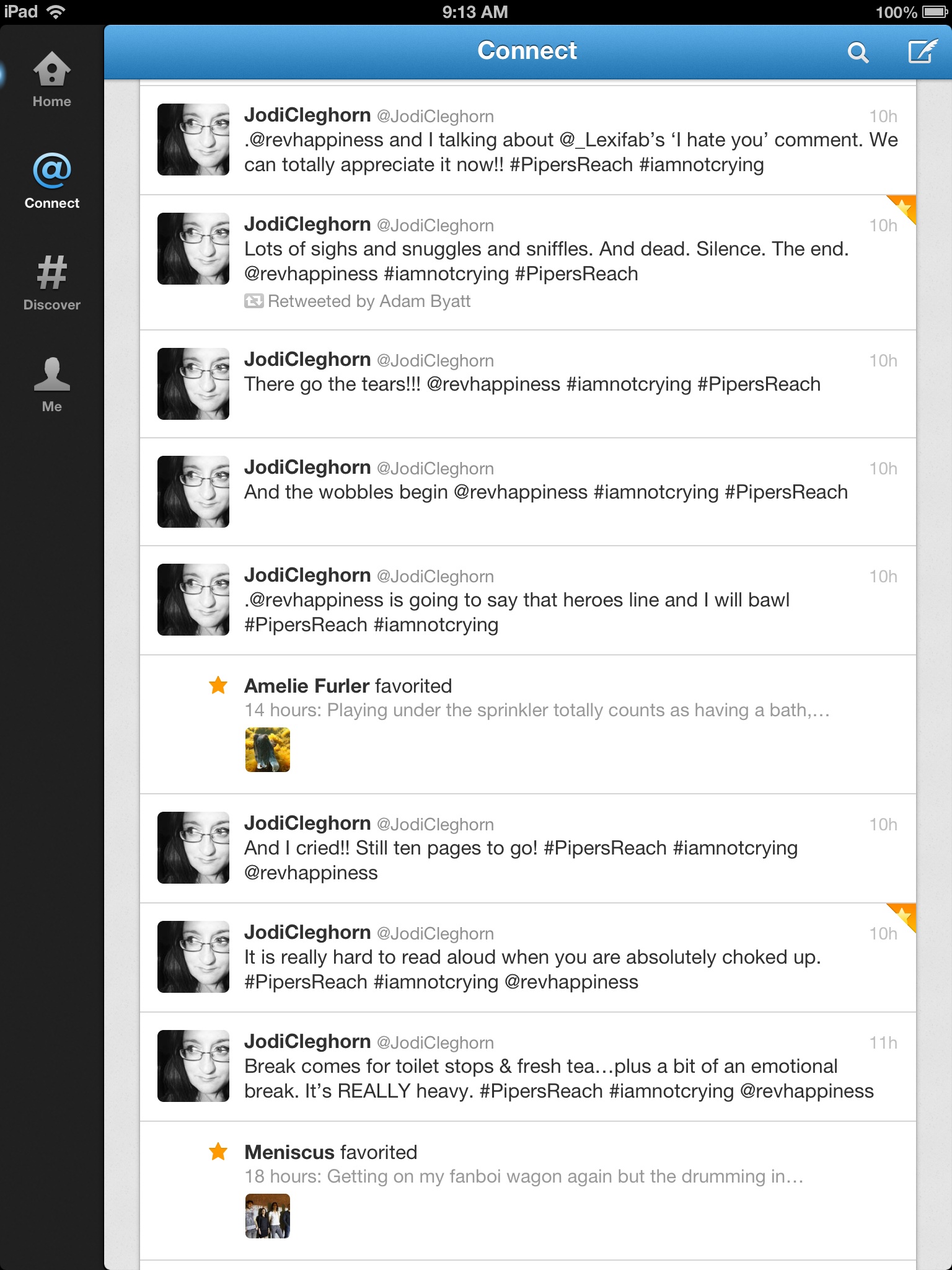
Below is a couple of screen shots from my twitter feed (you will need to read the  feed from the bottom up). You can see I was beginning to lose it when I said there were 10 pages to go. The emotion was threatening to overflow and I could hear Jodi begin to lose it a little.

image

I’ve included Jodi’s stream via my Connect screen. There’s a line in Jude’s last letter where he mentions David Bowie’s song, “Heroes,” and I knew that was going to be the line to make me lose it. Jodi referenced it below. 

In the lead up to the last letters, we could both feel the surge of sadness threaten to overwhelm. 

As I read Jude’s last letter it became harder and harder, and when I hit the Bowie line, the pauses between sentences became longer, the silence more weighty and the voice cracking. Even now it still has an impact just thinking about it.

image

There were a few more letters to read, and during the very last one, read by Jodi, there was no clicking of the mouse as changes were accepted or rejected. It was simply read aloud.

And it was bloody hard to listen to. I can only imagine how hard it was for Jodi to read it. I was crying, Jodi was crying and when we reached The End, there was only silence save for the sniffling of noses and scrunching of tissues.

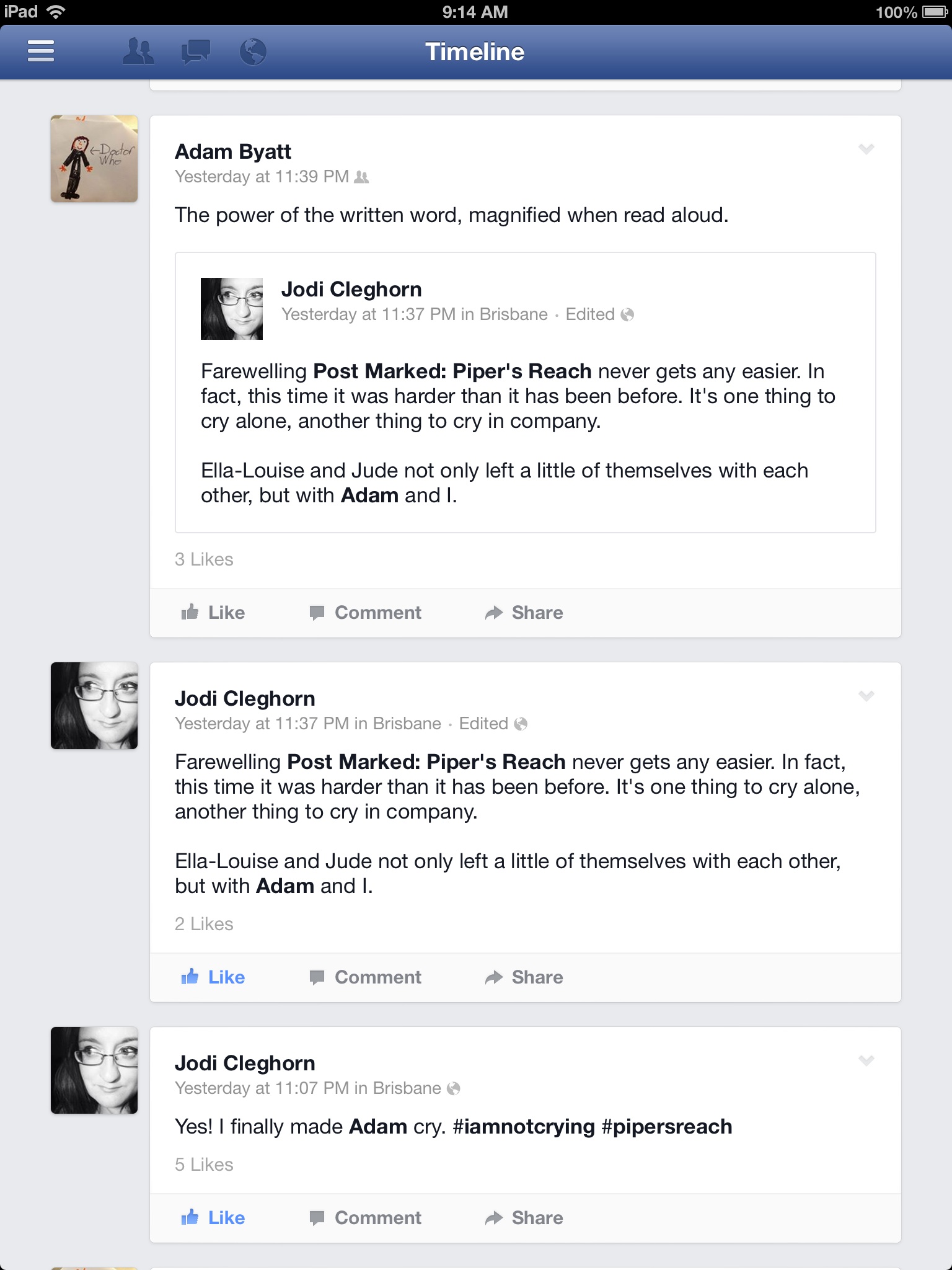
By way of conclusion, Jodi was triumphant in that she had made me cry. We were both mentally and emotionally spent; the investment in our characters over the past two years coming to fruition.

image

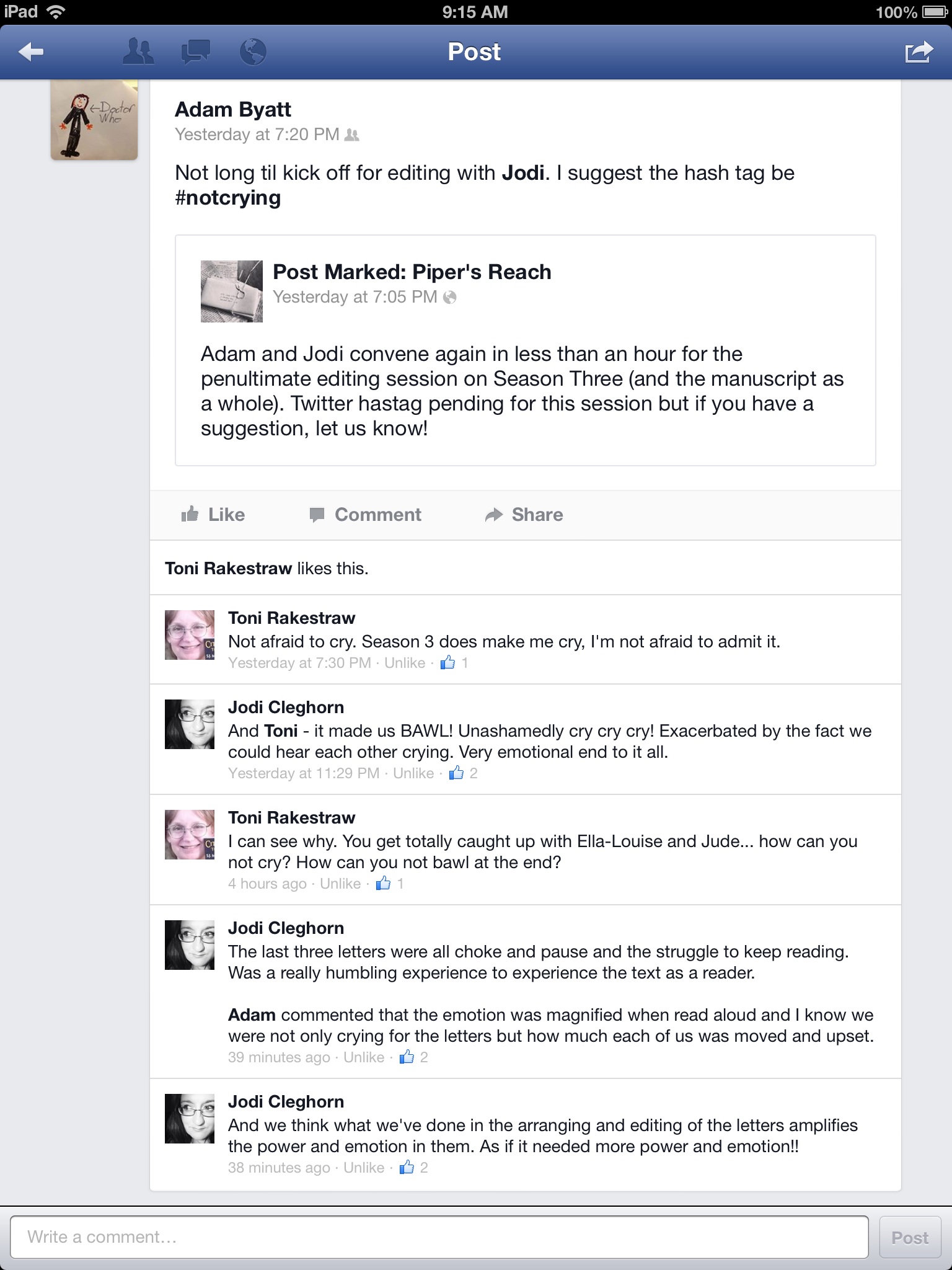
The adage of “tears in the writer, tears in the reader” was true last night. As Jodi says below,  the last three letters were all choke and pause and the struggle to keep reading. It was a really humbling experience to experience the text as a reader. I commented below that the emotion was magnified when read aloud (maybe we’ll do an audio version of the book).

While we were editing, Toni our awesome editor chimed in.

image

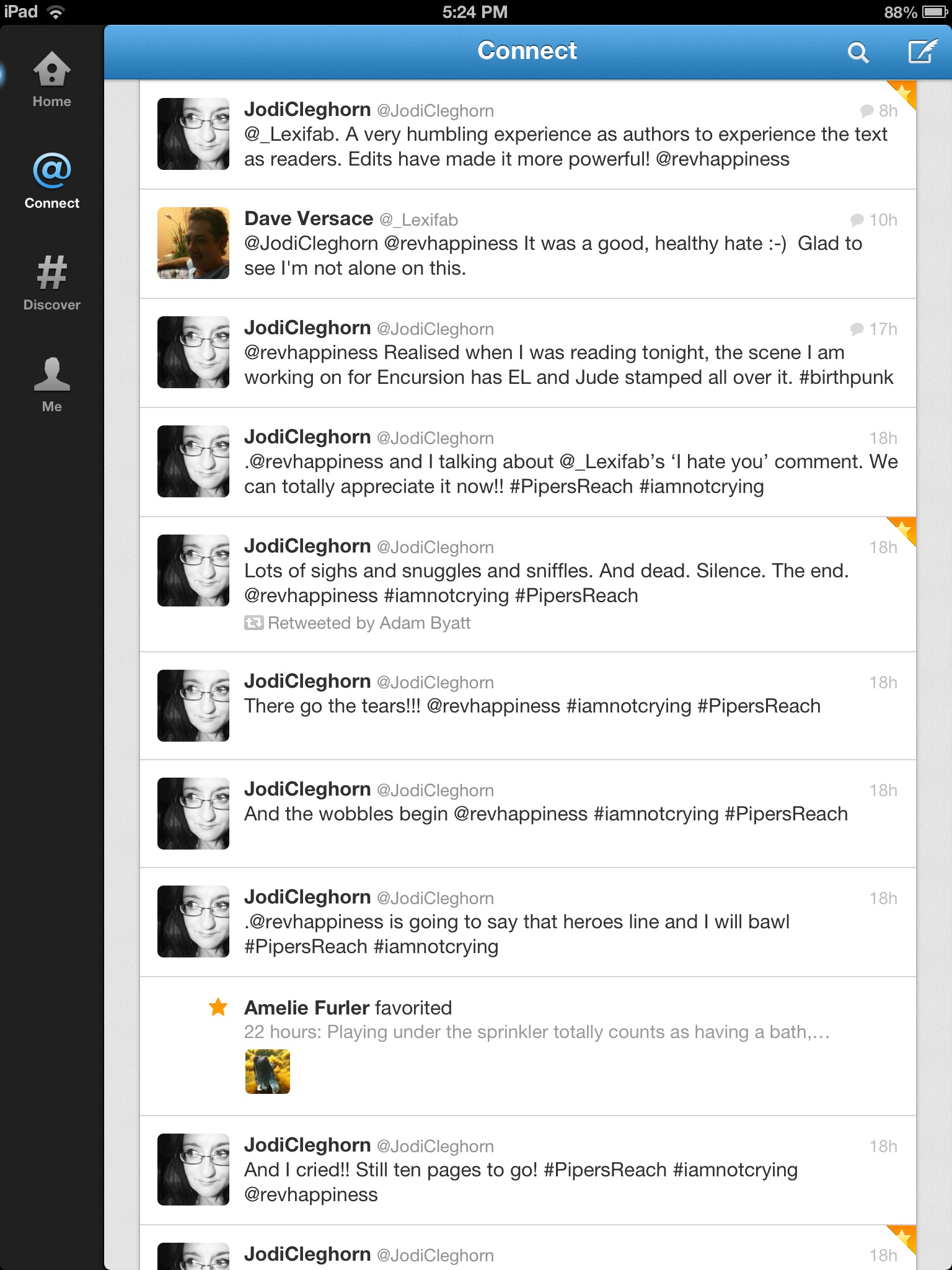
And speaking reactions, a friend of Jodi’s read the online version before we took it down for editing last July. When he met up with her at conference, he said, “I hate you.” It was done playfully and without malice but in response to his reaction to the end of the book. 

Read the texts referencing @_Lexifab

image

You can read Jodi’s reflection on last night’s editing on her website 1000 Pieces of Blue Sky and follow her on twitter @JodiCleghorn

Jude and Ella-Louise had the lighthouse at The Point as the focal point for understanding their relationship. It served as invitation, warning, refuge, security. I feel like I am there, under the lighthouse, watching the light sweep out over the ocean, waiting for the return of our characters.

We can’t wait until we can get this story into the hands of readers because we think we have a powerful story.

The Communion of Saints – TwitFic

This collection of twitfic came out of sitting in church during Communion (or Eucharist, depending on your denominational preference). In  the book of Hebrews, the writer says “we are surrounded by such a great cloud of witnesses…” (12:1) and in the Orthodox churches, there are often depictions of saints and regular people painted in the frescoes and iconography, as representatives of the witnesses.

Communion (Eucharist) is a significant aspect of the liturgical service and is a time for reflection on the sacrifice of Jesus. I wanted to extend the idea of the communion of saints into aspects of the everyday; times, places and situations where the extended kindness of humanity is shown in ways that best represent the ideal to “love thy neighbour” in a way that demonstrates an understanding that we do these things “for the least of these.” Most involve food and/or drink; a fitting reminder of the simple elements on the table used during the Last Supper.

Note: some of these are shorter than my normal twitfic because I used the hashtag #communionofsaints which takes up a large portion of 140 characters so I have edited some in places for clarity.

And as usual, I am keeping with my tally of seven twitfic.

The Communion of Saints

I.
“We have the same lunch box.”
“What’s in yours?”
“Vegemite sandwich. Yours?”
“Falafel roll.”
“Go halvesies?
“Yeah.”

II.
He balances two takeaway cups and two paper bags while shuffling back into the passenger’s seat.
“Got you a sausage roll and sauce.”
“Cool, thanks.”

III.

The abrupt call of the telephone.
You ok?
Honestly?
Honestly.
A pause.
Honestly shithouse.
Meet you for coffee.

IV.

While balancing her handbag, schoolbags, and thumbing for the key, the gift of bags of groceries on the back step give her pause.

V.

The froth slid down the inside of two empty schooners. Each man held the base of the glass, thinking.

Another?

Yep.

VI.

The rhythm section locked in, punctuating the horns, dancing around the guitar lines, watching the front row pulsate.

VII.

Twenty years of correspondence collected in a single embrace after having never spoken. Neither wanted to let go.

Creativity and Disability – Will You Listen?

Pick your label:

Downs Syndrome.

Asperger’s Syndrome.

Autism.

Cerebral palsy.

Bipolar.

Schizophrenia.

Paraplegia.

Quadriplegia.

Blind.

Deaf.

All of the above.

Any I may have missed?

When used in relation to people with a disability we use distinctions and nomenclature to quantify who someone is, something other than “normal.”

To pacify our guilt and discomfort at a person’s lack of physical or intellectual ability we offer art and music as a remedial activity. It is put forward as a pastime to keep someone occupied, a way of staving off boredom.

Why do we relegate arts and creativity as a remedial activity; as something to amuse or fill in time?

To do so is to mute the voice of those who have none and to disempower the individual. 

When a person with a physical, mental or intellectual disability is given the opportunity to speak in another voice, they are empowered.

Creativity (art, music, literature) is a voice for those who do not have one.

Don’t dis my ability. Not disabled.

Differently abled.

We disempower them because we refuse to listen to their voice; we believe they have nothing of value to say. We are sanctimonious and privileged in our opinion that a person with a disability cannot be creative.

I believe in the power of creativity to tell your story, using your own voice, your own expression, your own understanding and your own perception of the world.

When we relegate creativity to a remedial activity, a pastime to occupy and amuse, we diminish the role of the creative arts and silence the voice of the individual.

Creativity is a voice with which to speak. Voices with unique timbre and quality, even if the words are not easy to understand.

Hear my voice regardless of how I speak. Don’t view me as disabled or look at me through my disability; listen to what I have to say. 

Yet sometimes, art and creativity is the only voice with which someone has to speak.

We ostracise the artistic rather than balancing it against the academic and logical, the scientific and practical. Even in these areas there is great creativity.

Can we help tell their story? Give them the skills and techniques to create their own works of art? I believe in the dignity of the humanity of each person and it should be respected. 

Allow each person to find their voice. Give each person permission to speak.

We must move beyond treating people with a physical, intellectual or mental disability as incapable of having a voice.

The ad promoting the London Paralympics Games in 2012 gives me goose bumps every time because it is a powerful statement of voice. You can watch it here.

Art, like sport, is transcendent of language. The coded symbolism is independent of the alpha-numeric symbolism of codified spoken and written language. Culture and knowledge informs the construction of the work of art; we may not speak English or French or Spanish or Mandarin or Afrikaans but we understand the message coded in the art.

When we speak with and through art, we use a commonality of language that gives voice. When I look at and appreciate a piece of art, I do not need to know the background of the artist, their ability or disability. I hear their voice in their work. Knowledge of their background enhances and brings clarity of understanding to their message, but it is not essential.

There are many great organizations giving voice to people with disabilities. One of them is Studio ARTES  (They are also on Facebook) – a facility for people with a range of physical and intellectual disabilities, for life skills training, art training and socialization. It has been something I’ve encountered for many years because my mother was one of the founding members. She was working as an occupational therapist at a school for students with specific needs and her creative partner, Wendy, was the art teacher. Their vision was to extend the opportunities for people with specific needs post school.

I have seen the power of art when people are given a voice to express themselves. Lars was a young man with an intellectual disability who gained a remarkable voice through the nurturing of his artistic talent. His art was bought by members of parliament and hung in the foyers of well-known companies. He had a droll, dry wit and was a remarkable talent. 

On the occasion of his passing, Member of Parliament, Judy Hopwood, had this to say. Hansart Transcript 

You can see retrospective collection of some of his works on Facebook

Besides painting at Studio ARTES, many are involved in the practice of Saori weaving (‘sa’ = difference; ‘ori’ = weaving), a Japanese art form that has come to represent the ability of all to be creative without preconceived notions of correctness.

The beginnings of Saori start with Misao Jo who wove a cloth but because of a missing warp thread it was perceived as flawed. Undeterred, she wove more cloths with ‘flaws’ and ‘faults’ and produced beautiful cloths, praised by a high-end cloth merchant. Read about the philosophy of Saori here.

When teaching her students, Misao taught them the basics of weaving and left them to do as they pleased; an opportunity to discover their true self. My mother has had the pleasure of meeting Misao Jo on occasions when she has visited Japan.

Hence the application for people with disabilities is inexhaustible because there are no preconceived rules and boundaries; it is the individual who creates. Carmel, a client of Studio ARTES, is deaf and blind and spends hours at the loom using the texture of wools, twigs, feathers, ribbons etc to create beautiful works of art.

It removes the pretence of ‘correct’ and gives power to speak.

When will we let go of the idea that people with disabilities have no need to be creative? To let go of the notion that they cannot be creative? That art and music is only remedial and a pastime to stave off boredom? When will we allow them to speak with their own voice instead of presuming we know how to speak for them?

We must stop treating creative arts as a sidelined respite and return it to the centre of our cultural heritage alongside mathematics, science and the humanities. Creativity inhabits the spectrum of cognitive disciplines; it is not the domain of one and nor is it limited to those considered “normal.”

If you are without a voice, borrow someone else’s until you find your own.

I want to spend some more time amongst the people of Studio ARTES, to hear their stories, to be their hands to write when they cannot and project their story when and where I can. There is a beautiful lack of inhibition in many of the people who attend the studio, and a great deal of candor; they will tell you how they feel, direct and to the point. It’s a voice I want to hear more of.

I know that we won’t truly learn to love our neighbour as ourselves if we do not hear their story. Not for the sake of pity or sympathy, but for the dignity of the individual.

I have written before that everyone needs a creative manifesto, a reason why they create. I have also spoken about creating from a place of pain (and it has relevance to people with mental illness like depression or anxiety or bipolar) and I believe it is appropriate for a person with a physical or intellectual disability to have the same belief in their creativity.

I had a couple of responses when I put the idea of creativity and disability out there on Facebook one day.

Writer Marc Nash (@21stCscribe), put forward this point, “The people who can’t speak for themselves or can’t be heard, are unlikely to be able to read the words of those who want to help amplify them. That is an inherently political act of writing, which is how I regard my own approach, but it still is one based on certain privileges: – literacy, education, technology (e-readers) and the free time to write. These I find are paradoxes as much as inspirations.”

It is a paradox and a dichotomy but I want to stand for those who are marginalised and to help speak for them.

Two others commented:

“I had never given it a thought until a heard an interview on Radio National a fortnight ago with a burlesque teacher who was given the privilege of teaching a young woman with Down syndrome. At first I thought it sounded exploitative, but it gave the young woman so much joy and made her feel like a regular woman.” 

“A friend of ours has a son with Down Syndrome who has been a regular at our local Uniting Care. They have really done wonderful things with him (and others apparently), introducing him to art (painting, sculpture etc) and music. He has since taken to painting like a duck to water (even selling some of them through his parents business) and has recently taken up music lessons. Uniting Care need to be commended for both developing a sense of worth for this boy but also for their commitment to more than just paint-by-numbers in their approach.”

Tangential Question: what other avenues do the disempowered and marginalised have for speaking? Rap? Hip hop? Graffiti? Heavy metal? Poetry? Painting? Sculpture? Photography?

Are we listening to the marginalised and disempowered?


Let me hear your voice without words.

Let me hear your voice through the images you paint.

Let me hear your voice through the music you play.

Let me hear your voice through your hands, your heart, your mind.

Speak, and I will listen.


Light My Way – 7 Very Short Stories

Creativity is a significant part of my life, and I hope to encourage others to pursue creativity in their own way (there are lots of posts here on the site to read about the creative life). 

My creative life is focused on writing: novels, novella, short stories, bad poetry, and twitfic. Currently I have had to put my WIPs: a collaborative epistolary novel (edits almost complete) and a novella (first 4K is down), on hold due to work commitments.

But I can spare brief moments to compose short pieces of twitter fiction to keep my creative well filled and enjoy playing with language. 

These seven pieces of twit fic were inspired by a radio interview where the interviewee, an actor, talked about the presence of cameras and flashes. I wanted to explore different ways of seeing light, from the whimsical and playful to existential and reflective but based on my focus on the ennui and minutiae of life as the basis for my stories. See if you can spot the Star Wars reference (it’s pretty obvious). The last piece is a nod to my collaborative epistolary novel, Post Marked: Piper’s Reach.

There is no narrative thread here, unlike other twitfic series Polaroid Memories and A Thought’s Reliquary (I like the number 7 as  a form, like Jacques speech from “As You Like It”). They are lights strung in a sequence like lights on a Christmas tree.

I hope you enjoy it.

Light My Way

I.

“Let there be light,” he said flicking the switch.

“Daaaad,” was the groaned reply.

The Christmas tree exploded in colour, their groans silenced.

II.

As the camera flashed she closed her eyes.

“Stop ruining the photo,” yelled Mum.

She wondered how many pieces of her soul remained.

III.

The dust motes floated in the tractor-beam like shaft of light on the desk. She splayed her fingers and wished, “Teleport me off this rock.”

IV.

Beside the pillar of empty milk crates, he studied the shadow’s patterns; his own stained glass windows. He went inside the milk bar to worship.

V.

His first digital watch enthralled him but it was the ability to see the numbers in the dark kept him awake at night. It deterred the monsters.

VI.

Each boy shone his torch through the smoke of the bonfire.

“Light sabres!” one yelled.

The melee started, dying with the fading smoke.

VII.

He held the mirror fragment and reflected the beam from the lighthouse across the bay onto the notepad on his knees.

“I will light your way.”