Mandala
She draws on the concrete
a chalk mandala
of wonky butterflies,
stick-figure people.
Tomorrow she will
draw another
cycle.

Outside
when did Outside
become an
undiscovered country?
whose unfenced boundaries
spark greater imagination
than the couch’s confines
Posted in Ars Poetica, Creativity
Tagged creativity, experimental, fiction, flash fiction, microfiction, micropoetry, poetry, slice of life, writers, writing
What Makes Your Life Extraordinary?
In Dead Poet’s Society, Mr Keating takes the boys to the hallway to see the photos of past students and whispers the immortal lines, “Carpe diem. Seize the days, boys. Makes your lives extraordinary.”
A current television commercial runs the slogan, “Escape ordinary.”
What makes a life extraordinary?
People buy into this idea of your life having to be a Broadway extravaganza or a Hollywood blockbuster ALL. THE. TIME.
We are presented with hyper-idealised notions of reality. Do life BIGGER, BETTER, FASTER, LOUDER, MORE DEMONSTRATIVE, IN YOUR FACE and (dare I use it because I hate the acronym) YOLO! It’s perfectly captured in the Selfie Generation: LOOK AT ME, I’M IMPORTANT AND I DESERVE YOUR ATTENTION.
It is the wrong perspective.*adjusts cardigan and puts on slippers*
What’s wrong with ordinary? Ordinary is where I live and find my inspiration. I joke my life is coloured beige for boring, making my life extra ordinary.
For the creative person, extraordinary is a way to burn out because it demands you give out so much more of yourself than is returning to you.
“The candle that burns twice as bright burns half as long.”
For me as a writer, the greatest stories are not the ones we see in films, the lives of movie stars, but in the embarrassing ordinariness of people doing things in their every day lives that benefits others. The ones who don’t see their work as anything important; they are filling a need, taking care of their community, advocating for the poor and disadvantaged. Living an extraordinary life is one lived in service of others and pursing your own dreams. Balancing the self with the care of others. Telling their story is an extraordinary privilege.
I like to think of the word as “extra-ordinary.” The one thing that defines the ordinary from the extraordinary is passion. Mr Keating exhorted his young charges to engage with the aspects of life that they were passionate about.
For the creative person, the passion manifests itself in the choice of medium whether it’s writing, art or music.
As it relates to creativity, to continually produce great art, to live an extra ordinary life, requires repetition, ritual and reflection.
Not once, not twice, not even thrice but continually and habitually. Continue to produce art: write regularly; sketch, doodle, scribble whenever possible; practice scale and rudiments.
Repetition can become staid and uninspiring so it requires a dedication and committed work ethic to maintain your focus on being creative.
Early efforts will be complete and utter rubbish. But that’s the point of repetition: you do it until you get better.
Setting aside an assigned time to work on your creative project is like attending church or settling onto the couch to watch your favourite television show or sport team compete. Like repetition, it is a repeated event but the goal is one of individual development.
Ritual provides structure and is an active reminder to develop a disciplined approach to our creativity.
Movement without reflection will only end up with you moving in a circular fashion, only ever returning to the starting point without having learned or progressed.
Every once in a while it is important to reflect on your goals, your progress in terms of work produced and skills developed. Are you improving? Has anything weakened? What else do you need to know?
Creativity makes your life extraordinary because you have embraced repetition, ritual and reflection. You are taking the ordinariness of life and giving it meaning through creating great art.
This makes you extraordinary.
Addendum: This morning in the shower (place of many great epiphanies along with the kitchen sink while washing up) I had another idea to add. It was the one thing that makes a life extraordinary: Relationship.
Without relationship, we are merely individuals without community and connection. In relationship with other creative people we make our lives extraordinary because we have companionship, connection and community. We are no longer alone. This is fundamental in making our lives extraordinary.
Posted in Creativity, The Writer's Life
Tagged art, creativity, extraordinary, fiction, just because of thoughtfulness, life in general, music, poetry, slice of life, writers, writing, writing tips
When I was a child I devoured the books of Adrian Plass (The Sacred Diary of Adrian Plass Aged 37 /4, The Horizontal Epistles of Andromeda Veal, Stress Family Robinson, View From A Bouncy Castle, Cabbages for the King, The Theatrical Tapes of Leonard Thynn, to name a few). I haven’t read his later works, though not for lack of wanting.
What engaged me was the nature of his story telling. In his novels it was the humanity and humility of people that I engaged with, seeing the everyday flaws and faults, while coming to a greater understanding of people and their idiosyncracies. The people were real yet revealed to me an understanding of a greater truth or moral behind the story.
They were extended parables, stories that taught you something about yourself, about humanity as a greater whole. And I’ve come to realise lately that this parabolic structure has influenced and informed why I tell stories and my interest in writing, leading to defining my writing as “suburban realism.”
Parables
We are most familiar with parables from the Gospels as spoken by Jesus: The Prodigal Son, The Lost Sheep, The Mustard Seed. They often began, “The Kingdom of God is like…” and used images and illustrations familiar to the people as a way of explaining a greater moral principle or spiritual truth.
But should all stories be parables, demonstration lessons or didactic tools? I don’t think so.
We spruik modern parables today via social media; those feel good stories people post that go viral. For example, the Washington Post experiment featuring violin virtuoso Joshua Bell (I think the experiment has many flaws, but that’s for another time).
We watch it cycle through our feeds, read it story, understand the point it is making but are quick to click through and move on through our timelines.
We baulk when stories such as these, and by extension, a short story or novel, film or documentary, comes across as obvious preaching or didactic. However we understand in certain circumstances and settings, a parable is appropriate.
A parable helps us to understand something greater than the immediate world of the story. Yet it is a fallacy to see all stories as parables, as analogies of greater truths unless specifically intended by the author.
Parables serve a purpose but can be a limiting form and structure for a writer.
Parallels
I also see stories as parallels. Within the form of a short story, a novella or a novel, we see the life of a character transcribed and transformed before us. As we read, we walk alongside the character and watch the emotional ebbs and flows. At times we want to reach out our hand and hold theirs, laugh with them, embrace them in their sorrow or hold them at arm’s length in disgust.
As we parallel the character, we turn a mirror onto ourselves and perhaps see traits of the character we wished we had, or wished we could hide from others.
One purpose of fiction is to tell an engaging story, connecting them with the reader, transporting them into another world, another reality, and to perhaps learn from the experience; to ask the hard questions, even if we end up with more questions and fewer answers; to extrapolate possibilities and infer consequences.
Is all writing an attempt to write a parable, to tell a greater truth or are we writing stories to parallel our existence? The idea that it can be simultaneously a parable and a parallel excites me.
Posted in Creativity, The Writer's Life
Tagged creativity, fiction, parables, parallel, writers, writing
Creative people are afraid of failure, and too often we fear our creative process and creative ability. In the last two weeks I’ve explored this in: Why Are Creative People Afraid of Failure and Creative People: Fear Not.
In the words of Inigo Montoya, “Let me explain. There is too much; let me sum up.”
Every writer and creative person will define it differently, but at the core, failure is a sense of inability to reconcile the imagined world and the real world, seeing the shortfall between the expectation and reality.
Failure is not an absolute. It is teaching and learning process, and a creative tool.
When we are afraid, fearful of creating, we need to trust in our abilities and skills, our planning and the quality of work.
Turn the fear into a motivating factor. Let it become a driving force.
Turn your fear into excitement. It’s the same chemical in the brain; different interpretation.
Don’t let the fear defeat you.
Summary completed, let’s move on.
When we create we are afraid of failure.
When we create we are afraid of rejection.
If we let the fear of failure consume our creative lives, we become hollow, desolate shells.
Creating anything artistic has within in it a risk of rejection; it is inevitable. It is another aspect of feeling like a failure when a story does not find a publisher, an artwork is rejected for an exhibition or a film is poorly received.
As creative people we feel the emotional knock down of rejection particularly hard. It undermines our ability to create and produce, makes us question our vision and belief in our abilities. Rejection can compound the feeling of failure, a double dose of sucker-punch. Rejection can be demoralising and quench the creative spark that burns within you.
Rejection will happen. It’s how we cope with rejection that will define our creativity. In the face of fear, failure and rejection it is our ability to be resilient, the ability to “bounce back” from adversity and stress.
My writing partner, Jodi Cleghorn, pointed me to this article from The Huffington Post:
“Resilience is practically a prerequisite for creative success, says Kaufman. Doing creative work is often described as a process of failing repeatedly until you find something that sticks, and creatives — at least the successful ones — learn not to take failure so personally.
“Creatives fail and the really good ones fail often,” Forbes contributor Steven Kotler.”
We know we are going to fail and have our work rejected. When we are resilient in the face of failure and rejection we will produce creative works that are more in balance with our ideal world and the real world, closing the gap between expectation and reality.
How can a creative person build resilience in their creative life in the face of fear, failure and rejection?
1. Believe in the skills and talents you have
If you have invested the time into developing, refining and improving your creative skills, trust that you will continue to create good art.
Always be a learner of your craft. Continually seek ways to improve your writing by writing in a different genre or painting in a different medium. Get feedback from trusted people.
2. Know the vision you have for your creative work
I created a manifesto to give me vision for the type of stories I want to tell. I revisit it from time to time as a reminder. One day I will perhaps amend it as my creative journey continues, to reflect the change and development of my work.
3. Set regular goals
The SMART Plan (Specific, Measurable, Achievable, Realistic, Time-framed) is a great way of tracking your progress regardless of rejection. It keeps you focused on producing, not being bogged down by rejection. Every piece of new work is a step closer to achieving and fulfilling your goals.
My goals are worked out month to month. It’s short and specific and allows me flexibility with the demands of my day job. I have a big picture of the next few years of where I want to go and what I want to do, but I allow enough flexibility for change.
4. Develop a strong creative network
Everyone needs a cheer squad; someone to put on the rah-rah skirt and wave the pom poms when you’re feeling flat, dejected and uninspired.
I have a small, closed group on Facebook, made up of writers of different shapes and forms and it is a positive environment to seek feedback, preview new work or have a whinge. We live in different parts of Australia but the online connection means we champion each others’ causes.
5. Look for the positives
Whack on a pair rosy coloured glasses, preferably with a Dame Edna vibe to it, and look at your work in a positive light. As a writer it is too easy to look at all the errors when editing rather than see the fantastic sentences or paragraphs surrounding the small errors.
Fear is natural when we are uncertain, in doubt or under stress.
Failure is not a negative experience but a teaching tool.
Rejection comes with the creative territory if we are putting our work out there for our audience.
Resilience says, “You are a creative individual” and tells you, “You can do it.” It picks you up, often by the scruff of the neck, dusts you off, smacks you on the bum and tells you to, “Get out there and try again.”
How do you develop resilience as a creative person?
Posted in Creativity, The Writer's Life
Tagged creating, creativity, failure, fear, fiction, just because of thoughtfulness, life in general, rejection, resilience, slice of life, writers, writing
 Degenerate Dictionary stemmed from a party game Jessica Bell’s parents used to play when she was a kid. Her mother and her best friend had so much fun thinking of funny definitions to regular words that they began to write them down. Unfortunately, that little maroon notebook got lost.
But Jessica remembered a couple:
ARSENIC: A cut on the bum.
PROPAGANDA: Having a good look.
In 2013, she began posting these quirky, idiosyncratic, new definitions of familiar words on Twitter and Facebook with the hash tag #Jessicasdictionary.
I soon chimed in with some of my own:
QUOTIDIAN: one who exclusively uses sayings, proverbs & maxims to update social media status
DIPTHONG: putting your toe into a pool or other body of water to test its temperature
The exchange went back and forth over a few days until Jessica emailed me. The gist of the message was: Would you like to write a dictionary with me?
Me: *brief pause* Yeah!
And so, what once was a party game played by Jessica’s muso parents in the 80s, then became #Jessicasdictionary almost 35 years later, and is now called Degenerate Dictionary and will soon become a BOOK.
Perfect for every school *cough* classroom *cough*. (I am so giving away a class set to my senior English class).
So what’s the GIVEAWAY?
The launch of this project is going great. So Jessica Bell and I are celebrating the speedy progress of Degenerate Dictionary. And we are giving away TWO $20 Amazon gift cards.
CLICK HERE TO ENTER THE RAFFLECOPTER.
Good luck! Please spread the word!
Posted in Creativity, Degenerate DIctionary, The Writer's Life
Tagged creativity, degenerate dictionary, experimental, fiction, giveaway, Jessica Bell, writers, writing
Yesterday I was teaching my Year 7s (the first year of high school in Australia) Creative Writing. They are a learning enhanced class which means there are a range of intellectual and learning disabilities.
We were learning the structure of a story, using the primary school method of Orientation, Complication, Events and Resolution (O.C.E.R.). It works for any writer really; it’s the fundamental structure to any scene whether it’s for a short story or a novel.
I gave them an opening line, “I had my costume all planned out; I was going to be a superhero” and after a brief planning session, they were set to work. While they wrote theirs, I plugged my laptop into the data projector and wrote my own. It’s best practice to model what you’re after.
It’s far from perfect but it showed my students what to do.
So here it is for your… pleasure… or interest… or something.
SUPERHERO SATURDAY
I had my costume all planned out; I was going to be a superhero. Sitting on my bed I could see it hanging from the wardrobe door. It was a spectacular outfit: black tights with red lightning bolts down the outside of the legs, a red t-shirt with a black lightning bolt on the front and the bestest cape ever. My Mum made it for me.
I am Super B. I seek to right the wrongs, make this world a safer place, and have doughnuts for afternoon tea.
Once Mum let me outside to play, I put on my costume and hit the streets of our cul-de-sac, ready to be the hero. It was a quiet afternoon; only the neighbour’s dog, Scruffy, was outside the fence so I put him back.
I felt pretty good having done my helpful deed for the day. Standing on the footpath I put my hands on my hips and held my best superhero pose. But there was no wind to make my cape fly out behind me so I felt a bit silly.
Was there no other good deed to do today? Not much of a superhero if you only get to do one good deed.
There was a squeal from up the street and the rattle of plastic trike tyres on the footpath. Mrs Jenkins from Number 96 was yelling as her little Patty went hurtling down the footpath on her runaway tricycle.
Patty’s feet were blurry circles as the pedals span faster and faster, threatening to throw her off. Her tiny mouth formed the biggest “O” I’d ever seen and from it came the loudest scream, enough to scare the cat!
This is my chance, I thought. I can be the hero!
I twirled my cape and ran towards little Patty, before she became patty-cake all over the footpath. Putting my feet in the brace position and crouching down I readied myself for impact. Patty came closer, the screaming louder and louder. She was almost on top of me when I stepped to the side, swung my arm around Patty’s waist and lifted her to safety. The tricycle careened off the footpath and into the gum tree outside my house. I expected the tricycle to burst into flames. But it didn’t.
Mrs Jenkins stopped right in front of me, gasping for air.
“Thank you so much,” she said as Patty jumped into her open arms. “You’re such a hero for saving my little Patty Cake.”
“The pleasure is all mine,” I said.
“Come inside and have a biscuit,” Mrs Jenkins said. “You deserve something for your brave actions.”
“Thank you, Mrs Jenkins,” I said. A superhero always remembers his manners.
Mrs Jenkins fed me choc chip biscuits. She insisted I have two, and on my way out the door, she gave me one more.
Walking home I felt pretty darn good. I wiped the biscuit crumbs from my mouth, I didn’t want Mum to think I’d filled my tummy before dinner, and wondered what adventures Super B might have tomorrow.
I stood in our driveway, struck a superhero pose and thankfully there was a breeze to make my cape billow out. I surveyed the cul-de-sac and knew it was safe. It was good to be a superhero.
Posted in Creativity, The Writer's Life
Tagged comedy, comic superhero, creativity, fiction, flash fiction, slice of life, writers, writing
A month of #postitnotepoetry has elapsed and 28 poems have been written and posted.
It started in 2013 when Jodi Cleghorn and I threw out some whimsical ideas with definite boundaries: write a poem to fit on a Post It Note.
It was permission to write; write dreadfully, write with abandon, write without caring what the poetry sounded like. It was permission to be creative and spontaneous; limited and restrictive in a positive way.
And we did it. We gathered adherents and spawned a community. We wrote poems and posted them. And some of them were quite good.
And we did it again this year.
I wrote 28 poems in 29 days (the last week of February was a cracker for me so I missed a day or two, posted late, crammed a few into one day and wrote the last on March 1 after half writing it the night before).
Time to reflect, look into the Navel of Introspection and see if I can find a gem to inspire you. At the very least you’ll have some blue-grey lint to take home.
Some writers pursue the notion that they must write every day. It is an adage recounted by many writers via social media, and it has validity. I like the Jerry Seinfeld approach of ticking off each day I write or meet a quota, forming an unbroken chain.
But it doesn’t work for me. My day job and other commitments do not allow an unbroken chain. I prefer to work in short bursts rather than long periods of focused attention.
Every creative person has their own cycles of inspiration, creation, recreation, restoration, production. Rinse and repeat.
Find your own rhythm and know your cycles.
Finding a new idea each day was in turns easy and difficult. It was in the news, something I read, an emotional response to a situation, daily chores or activities.
The execution of the idea was also in turns easy and difficult. The easy idea was sometimes difficult to write while the difficult idea sometimes can easy in the writing.
No method, often madness; always an idea.
Exhaustion, physical and mental, made developing an idea hard. Some ideas needed more time for composting (what I mean when an ideas sits in the back of your head for a while). For example, the last poem, Frankenstein’s Classroom, needed more time for refinement.
However, that runs contrary to the spirit of Post It Note Poetry.
Pushing an idea that is not fully formed may result in a piece of work that is substandard and editing will only highlight its weaknesses. Letting an idea form over time may mean the editing is easier. Your mileage may vary.
There are plenty of ideas out there for you to catch. Know your methods for trapping them in the pages of your notebook (physical or digital).
Creativity is meant to be fun; that was the point initially. There is fun in the hunting down of ideas, capturing the thoughts and emotional response in words, and satisfaction in the completion.
And in doing something fun, I have found a new appreciation for poetry and I like writing it. I like the framework and boundaries a Post It Note provides, similar to the framework and limitations on twitter where I also post short poetry.
However, focused for a month on writing poetry has taken me away from my main purpose of writing my novella. The timing of #postitnotepoetry coincides with the beginning of the school year (I am a high school English teacher) and it is something short I can do during the busyness of the opening of the school year.
I want to return to my novella, which is happily composting in the back of my head while I make updated notes in my notebook. I’m also in the last stages of edits for my collaborative novel.
The brevity of Post It Note Poetry is something I will continue to do throughout the year because I believe in developing my creativity; I am undecided if I will return in 2015 for the trifecta.
Have fun with your creative acts.
That’s it from me for #postitnotepoetry 2014.
Time to buy shares in the company that makes Post It Notes or see if I can get a sponsorship from them and turn it all into a book deal.
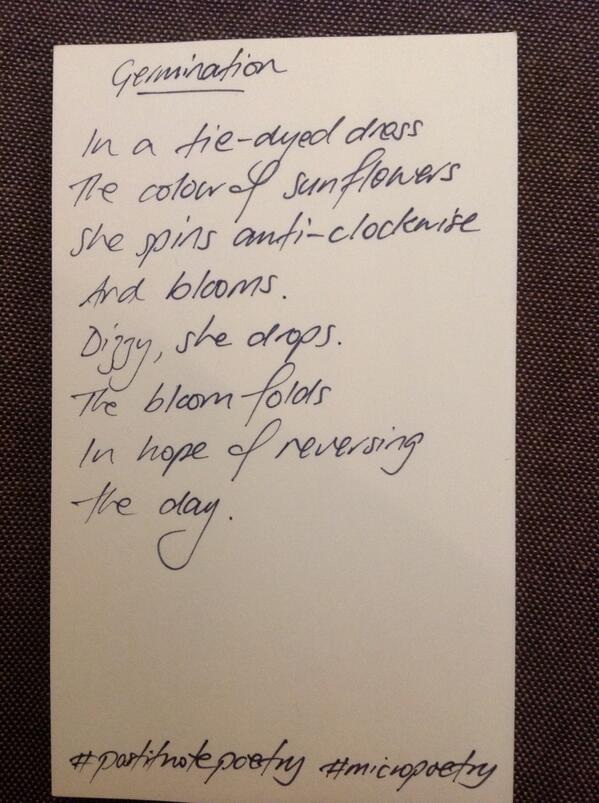
Germination
In a tie-dyed dress
The colour of sunflowers
She spins anti-clockwise
and blooms.
Dizzy, she drops.
The bloom folds
In hope of reversing
the day.
I am an English teacher and drummer/percussionist with an interest in literary pursuits, creative endeavours, rhythmic permutations, theological amplifications and comedic outbursts.
Here you will find my creative detritus: articles on living a creative life and writing explorations.
And other ideas I have snaffled from the papers stuck on the fridge door.
Twitter: @RevHappiness
Instagram: @handwrittenpages
My collaborative epistolary novel, "Post Marked: Piper's Reach," written with Jodi Cleghorn (@JodiCleghorn) out now via Vine Leaves Press.
Come and browse through the library; there is no need to be silent.

 A Fullness in Brevity - Adam Byatt