Tag Archives: fiction

Life Doesn’t Follow the Archetypal Structure

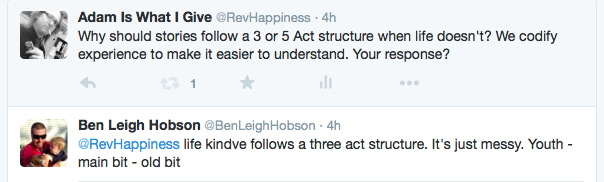
Why should stories follow a 3 or 5 Act structure when life doesn’t?

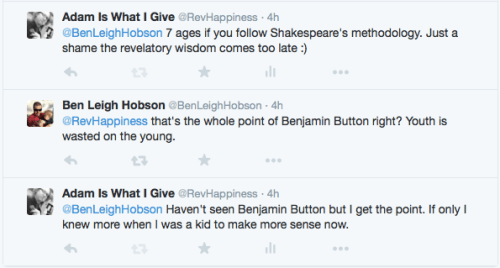
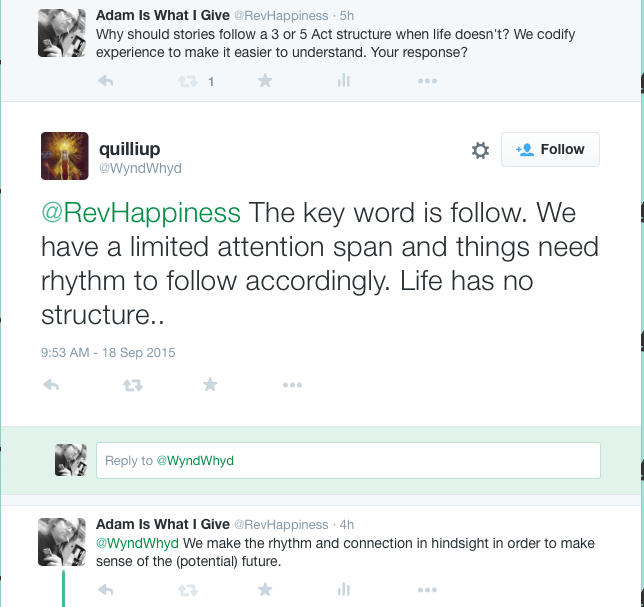
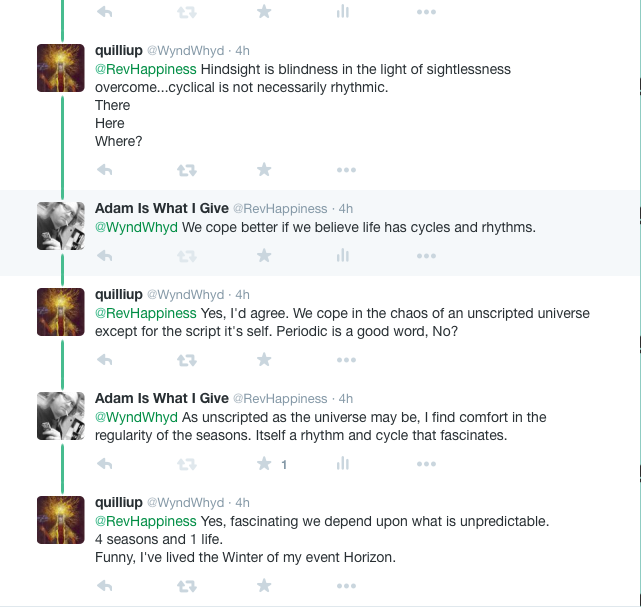
I posed the question on Twitter to see what responses might be generated. I received a couple. One went off on a philosophical tangent. And my answer is already given.

Screen Shot 2015-09-18 at 2.14.26 pm

Screen Shot 2015-09-18 at 2.14.58 pm

Screen Shot 2015-09-18 at 2.17.30 pm

Screen Shot 2015-09-18 at 2.17.45 pm

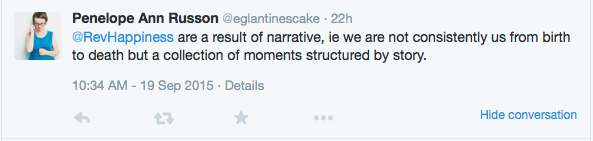
I suspect there is a field of narrative sociology (now there’s topic for a PhD) where this might apply and I remembered one of my twitter connections who is doing something like this.

Screen Shot 2015-09-20 at 8.38.56 am Screen Shot 2015-09-20 at 8.39.16 am Screen Shot 2015-09-20 at 8.39.23 am Screen Shot 2015-09-20 at 8.39.29 am Screen Shot 2015-09-20 at 8.39.37 am Screen Shot 2015-09-20 at 8.39.46 am Screen Shot 2015-09-20 at 8.39.53 am

I write stories where I follow the practiced methodology of the 3- or 5- Act structure, following the characters’ development and complications. It is the fundamental aspect of story telling you can find on most writing blogs. Other experimental forms still adhere to this idea in some tangential form or another.

You can start the Ira Glass research here.

Life is chaotic, messy, rhythmic, cyclical, disorganised, organised, coincidental, planned.

The takeaway is this: we codify experience to make it easier to understand.

Your response?

The (Auto)Biographical Act of Story Telling

There is an adage used to help novice and beginning writers to “write what you know.” It is a helpful piece of advice to assist new writers to tap into personal experience to develop an emotional, spiritual, physical authenticity to their writing. It helps to frame the emotional resonance of story that makes a reader want to continue, tapping into the shared emotional journey we all face.

At some point a new writer needs to move beyond this adage and into the broader realms of imagination. Once you understand the emotional focus of the story you are telling, the characters take on a life of their own.

The emotional repertoire at your disposal is based on your own life experiences, stories you’ve heard, read or seen.

But at what point does the author separate herself/himself from the character of the story? How much of a character is a reflection of the author? What is deliberately included or excluded.

The answer to that is up to the individual author to decide. Some authors may make a character a thinly veiled version of themselves or a direct parody. It may even be an autobiographical version in a fictional universe.

For me it is the engagement with the character as presented on the page, their trials, tribulations and triumphs; engaging with the emotional core of who the character is and how I see myself within, or influenced by, the character.

Poetry is perhaps more problematic when using the first person pronoun as it is, I suspect, interpreted by the reader as the persona of the author. This may be true in some cases but what if it is not?

I posted this poem to Twitter recently and use the first person pronouns yet it is not autobiographical, nor is it based on the experience of another.

our intimacy is found 
in the peeling of a mandarin 
damaging the skin to eat 
the flesh inside 
uncertain of a bitterness 
or sweetness

It is drawn from my emotional repertoire, an understanding of human relationships. Is there a part of me in this poem? Perhaps. But it was not written from my perspective. You, as the reader, will not know my intention or purpose; you read the poem as it is and respond to it from your own experiences and perspectives.

Within the act of reading poetry I think we internalise the focus of the poem if it is written in first person, taking on a new perspective and seeing the world as presented through the poem. It is an intimate connection with a text separate from the persona presented or the author’s intent behind the construction.

All of this is academic meanderings, like searching through your underwear drawer for the odd sock to make a pair.

Do you read a story differently to a poem? Why?

On Fear and Its Perception

“I write in order that I may travel with my soul into the places I fear and I may have a friend to share the journey.”

I wrote and posted this on Twitter the other day and very soon after clicking the “Tweet” button I questioned and doubted the validity and veracity of my statement.

I have written before about how I believe fear holds me back from exploring the creative life I want. The above statement is in contradiction to my manifesto and vision for why I write.

Or is it?

I have no clear answer; more a series of random reflections which may or may not lead to a clear answer. It’s like cleaning your glasses only to have them dirtier than when you started.

What follows is simply scraps of thoughts about what I wrote and differing perceptions of it. I am not sure I am right; nor am I sure I am wrong. I will contradict myself, provoke myself, push and question myself. And you can have your addition in the comments.

  • Writing is about exploring your own fears; the fears you have of yourself and of the facets of life you find frightening.
  • Fear is lacking an understanding of the unknown, the different, the obtuse, the unfathomable. To understand is to give a name to the fear; to know its place and its where it resides.
  • My reader is the companion on the journey. They travel with me through the words on the page. At some time in their life they may, or may not, have experienced the same fear.
  • What I write may bring comfort to know someone else has experienced the same fear; it may trigger a response; it may have no effect because the experience related in the story is not connected to their own life experiences.
  • The opposite of fear is… what? Hope? Vision? Clarity? Discipline?
  • The same chemical that is the basis for fear, adrenaline, is the same chemical that is the basis for excitement. Is fear the way our bodies tell us something new and exciting is about to happen?
  • Defining fear as it relates specifically to yourself is the first step. What am I afraid of? Is it personal fear, an internal dialogue, or an external fear of something random outside your control? Is there a topic or issue you do not want to explore because of the fear it generates for yourself or fearful of the consequences of exposing it?

So, no answers. Definitely more questions but I know where my thinking is leading me.

If I rewrote my tweet, I would explore another aspect of why I write, another permutation of thinking about creativity and its purposes.

“I write in order that I may travel with my soul into the places I seek to understand and I may have a friend to share the journey.”

“I write in order that I may travel with my soul into the places I find comfort in and I may have a friend to share the journey.”

“I write in order that I may travel with my soul into the places I want to light a flame of light and life and I may have a friend to share the journey.”


What would you say?

Slogans for Poetry – A Poem

This excerpt was the inspiration for another twitter poem. 

Tomorrowland, directed by Brad Bird, was a box office disappointment and has been poorly received by critics. It has a 49% on Rotten Tomatoes. A. O. Scott of the New York Times wrote that the film, “searching for incitements to dream, finds slogans and mistakes them for poetry.”
The full article is here on Buzzfeed.

our poetic voice
of heart’s passion
mind’s emotion
is reduced to
soundbite
slogan
sycophancy
slowing the heart
until the pulse
peters
out

To be honest, I’m not happy with the result because A. O. Scott says it so much better. There’s such poetry in his statement that my attempt to remix his words into something new seems feeble.

It’s a sentiment I like and one I will return to after it has composted in my head for a while longer.

What do you think of it? In the words of Count Rugen, “Remember, this is for posterity, so please, be honest.”

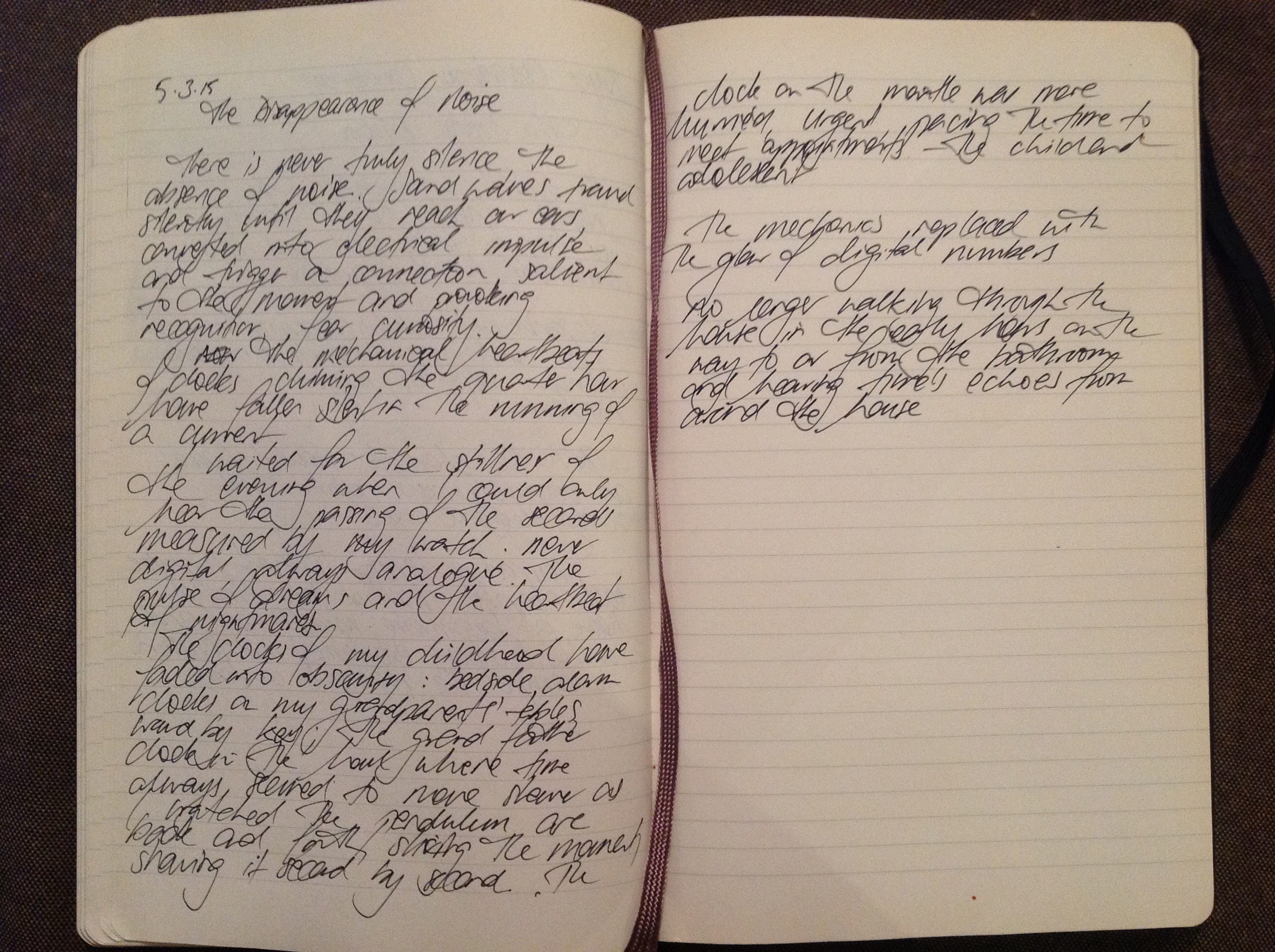
Practice Pages – The Disappearance of Noise

As drills are to an athlete, or scales to a musician, practice paragraphs are to a writer.
Here’s a little sample of an idea I foraged from my notebook.
Feel free to remix it in the comments section.

The Disappearance of Noise

All of the clocks of my childhood are silenced into obscurity:

– the bedside alarm clocks in my grandparents’ bedroom, wound at the back

– the grandfather clock in the hall where time always seemed to move slower as I watched the pendulum arc back and forth, slicing the moment, shaving it second by second. The inscription, tempus fugit, the first Latin I learned, and didn’t understand the irony until I stood thirty years in the future.

– the clock on the mantle in Nanna and Grandpa’s house was more hurried, urgent, pacing the time to meet appointments, chiming the quarter hour in mimicry of Big Ben.

All of these sounds, the midnight soundtrack to treading the hallway carpet barefoot, its texture a fresh cut lawn, skipping to the cold tiles of the bathroom. And back again.

Now I lie awake and listen, in between the passing of cars at two o’clock in the morning, for the ticking of my watch. I know it’s battery operated, no longer the wind up mechanism of the watch of my youth. Finding it wound down to silence, bringing it back to life, then placing it to my ear to hear the cogs pushing and pulling.

It was the mechanical rhythm, a lullaby of space. The tut-tutting of disapproval for wasted time, the snap of Lego connecting and the skipping of Nan’s knitting needles.

The digital age has created silence.

The Significance of Creativity

The Significance of Creativity, or to put it another way, creativity creates significance (the noun/verb, subject/verb is a little awkward, not to mention the repetition. Oh, the vagaries of the English language).

Creativity is an act that begins with you, as an internal locus of control. It is inwardly focused, a way of understanding who you are, what you stand for and what you believe in. 

What Does Creativity Create in You?

Whether you’re at the start of your creative journey, been at it for a little while or have carved highways for others to follow, creativity creates four things within an individual: significance, community, conversation and legacy.

Significance

* Creativity creates an understanding of who you are.

Perhaps you started creating to work out the impact of a significantly emotional event in your life or as a way of exploring new ideas. 

Whatever the reason, it forms a significant part of who you are, what you identify with and how it is manifested in your creativity.

It is intensely personal, even private, and may never be shared with anyone else. It does not negate the significance of who you are. As intensely personal as creativity is, when shared with others, it gives them an insight into who you are. You have purpose and meaning, a spiritual dimension to your life.

Community

* Creativity is not a field limited to the individual.

It is often done as an individual but you should not be without a community.

Finding like-minded people as a support helps you continue what you are doing. They are a back up for when life is brutal and you want to chuck it all away. They are your confidantes and encouragers. They are also those who will love you deeply and tell you the truth about your work, especially when it sucks and needs more work.

In turn, you can teach others and expand the creative community.

Conversation

* talk to people about what you do and why.

You have a cause to champion, a positive reason to speak into people’s lives. It’s not all about you, dominating the conversation about your most recent creative project or endeavour. If people are willing to listen, speak. 

However, can you steer the conversation around to what makes your listener creative? Can you open up their mind to the possibilities of a creative project? Can you encourage them to take up an old hobby, long neglected, or aim for something new, something they have always wanted to do?

Legacy

* your work is a testament to others.

It is your character imprinted onto your creative work like children; lived, learned and loved, cherished as valuable and positive traits to have. Your commitment to others as teacher, or encourager, facilitator, supporter, collaborator.

Contribute your verse and know the significance creativity plays in your life and potentially in the life of others.

Mending the War – Flash Fiction

This was a piece I submitted last year to a competition. No result. Another piece to help me practice. 

But I’d like you to have a read and tell me what you think.

She looked up from the sock she was darning, needle paused mid-stitch, and watched the missile burn across the blank expanse of blue sky, rending it in two.

“Where is it going?” asked her granddaughter.

“To war.”

The smoke trail began as a small tear, slowly expanding, making the rift wider, ragged. Slowly, imperceptibly at first, the blue pushed through the vapour trail, dissipating the smoke.

“There will be another,” said the grandmother.

“When will we have peace?”

The needle wound through the fabric and pulled the two halves together.

“When we have learned to mend our hearts.”

Moving Forward When You’re Stuck Looking Behind You

How do you move forward creatively when you feel like you’re stuck looking back?

In the last couple of weeks I have been re-reading the collaborative epistolary novel, Post Marked: Piper’s Reach, I wrote with Jodi Cleghorn between January 2012 and April 2013. 

The novel has been thoroughly edited and we are now at the place of writing the synopsis. Late last year we began the process but due to a range of metaphysical circumstances it had been put on hold. 

For me, because I cannot speak on behalf of Jodi, the latter half of last year burned me out creatively. The pressure of my job (high school English teacher) and other external pressures saw me roll into January hoping for a recovery. But it never happened.

Putting this out there and waving it around with abandon: Writing a synopsis sucks.

It’s the Pit Of Despair from The Princess Bride coupled with the Pit of the Almighty Sarlac from Star Wars topped off by The Buzz Cut from Wayne’s World (Boy, it really does suck). As we wrote it, we felt the summary sucking the life away from the narrative we had created.

On top of the synopsis situation, other projects lay scattered like discarded underpants and it was killing me that they were unfinished. My sense of self in regard to my creativity and writing had disintegrated. I doubted my writing skills and wondered if it was worth continuing. Doubt is insidious, and lethal, to a creative life. 

But I am not one to go quietly into the night for a bag of doughnuts and never return. I used February and Post It Note Poetry to begin the rebuilding process. I gave myself permission to put projects on hold, think them through again.

Now that it is March, I returned to the first project on the list: the Post Marked: Piper’s Reach synopsis. I opened up the final document and began reading, familiarising myself with the story again. It was nice to come at it again with new and fresh eyes, delving into other aspects of the characters again and their development, marking up plot points and knowing I’ll probably cry at the end. Again. (And, yes, I did cry).

While doing this I went back to other pieces written in the Piper’s Reach world. The stories precede the events of the novel in that they are about the lives of Jude and Ella-Louise in their youth and in their adult life. They were done as an indulgent exploration of our characters from different perspectives (letters have a very limited frame of reference when writing).

The first is the Christmas Special Jodi and I wrote at the end of 2012. It recounts the events of the Surf Club Christmas party (mentioned in the novel) when Jude and Ella-Louise were in Year 11 (their second last year of high school). It introduces the main characters from a different perspective as each character had the opportunity to speak in their own voice, not limited to the first person recounting of Jude or Ella-Louise. You can read the Christmas Special here.

The second story is from Jodi. “What I Left To Forget” tells the story of Charlotte MacKay and Jake de Britto and is told from the 3rd person, a departure from the narrow focus of a personal letter.

I wrote a companion piece to it, which precedes it chronologically, but was written after a comment I left on Jodi’s blog where I riffed an idea. Jodi dared me to write a romance from the perspective of Jake. The resultant piece was The Photographer’s Concerto.

Any of the pieces can be read without knowledge of Piper’s Reach, and you can read the first letter from Ella-Louise here.

How did this help me move forward? 

Up until the reread, I doubted I could write well again. I hated what scrawl occupied my notebooks. Even when writing Post It Note poetry I felt hesitant and uncertain.

By going back into the past, I could see the progression of my writing skills. What I wrote 3 years ago is still good. Sometimes I wonder if it was really me who wrote the passage. It has been an encouragement to see that I can write. I am proud of those stories, the world that was created. Yes, it’s hard work, but rewarding when you see readers gain a connection. That was one of the most rewarding aspects of writing “Piper’s Reach” and releasing a letter a week to our small, but faithful, following who shared their love of the series and the characters.

Taking pause to reflect has allowed me to refocus my creativity and move forward.

If you’re stuck, unsure of the direction, pause, reflect, give yourself permission to stop for a time and look back as a way of seeing progression. It may help you move forward. 

Are you stuck? Feeling like momentum has stopped? Would looking back work for you to help you move forward?

Failure Is Always An Option

Why is failure a negative response?

Well, yes, failing attempts at flying, playing with power points, or gaining your friends’ attention with the exclamation, “Hey, check this out!” can have negative consequences resulting in death, bloody maiming or a great story to tell.

Failure is couched in terms of shame, of disappointment, of not being successful, of letting people down, of not living up to a set of standards, morals or values. To fail, therefore, is to be less than, to be inferior, to be forgettable and forgotten. 

So when it comes to beginning a creative project, or learning a new creative art, skill or craft, we are programmed to think of our early efforts as failures. They do not meet up to our expectations of what it should be (and yes, there is a disconnect between what we create and produce, and the expectations we have set for ourselves in the production of our work but that’s another blog post). 

But as creative people, failure should not be considered a negative response to a project.

Failure does not define who we are as creative people.

Failure is not a measure of our worth.

Failure is a part of the creative learning process.

Every creative project we start is an experiment. It may or may not work. But that’s the beauty. When I am beginning a new story I am unsure if it will work. I write the first draft, let it sit, return to it and look for what needs to be improved (often, a lot of things). Whether it’s point of view, too florid in expression, characterisation or character development, dialogue or imagery.
A recent idea in its genesis. Pure unadulterated nonsense.

A recent idea taken from my notebook in its genesis of pure unadulterated nonsense. It’s all part of the failure.

Don’t be afraid to put in the hours of practice required. I think it’s where a lot of fledgling creatives stumble. They want the accolades but haven’t put in the necessary hours. The Mythbusters make it a part of their show: failure is always an option. It shows you one way it didn’t work. Repeat the experiment until you find the solution.

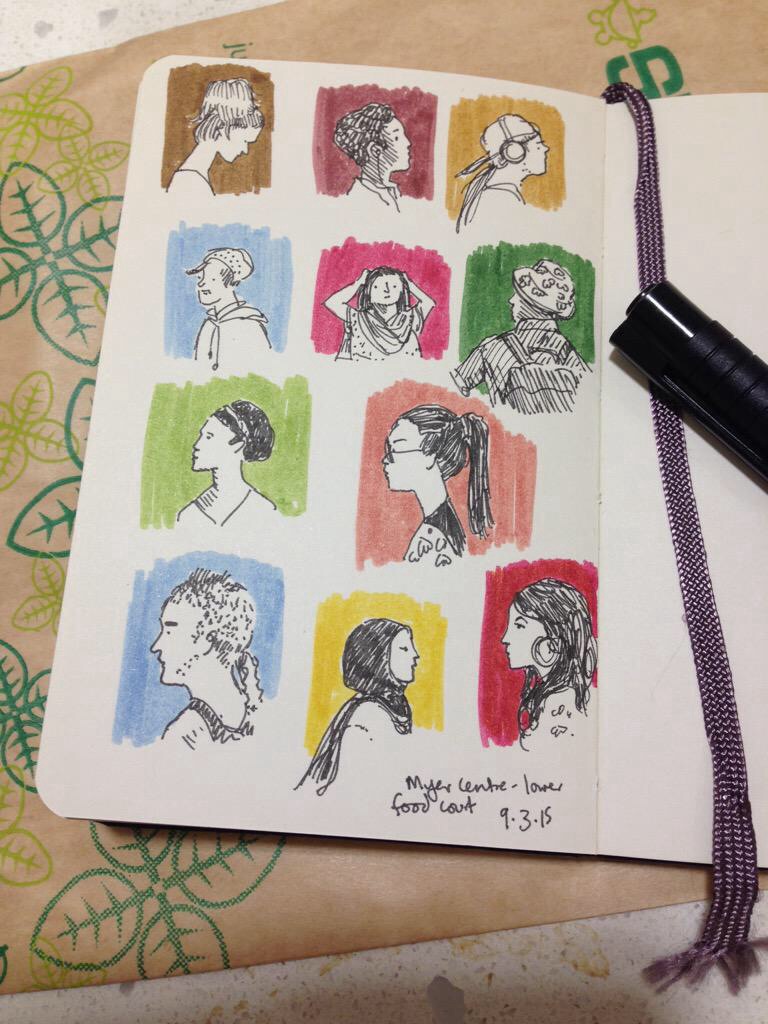
I love seeing Kathleen Jennings (@tanaudel) put up images of her sketch books, her practice pages, on twitter. She sits in public transport terminals, shopping centres, food courts and sketches people. Please check out her awesome work via her blog: Tanaudel.

I am very grateful for her permission to reproduce one of her images. I love how the colour frames a distinct individual. She had this to say about her process.
“They are part of my practice. I’m fairly timid drawing naturally. So I made myself use markers, limited colours, and draw people as they walked past. It made me commit, be bold, be confident and develop a visual shorthand.”

image

(c) Kathleen Jennings @tanaudel Used with permission.

Practice. Practice. Practice. 

I know I have not spent enough time behind my drum kit practicing rudiments, beats, fills. I have not practiced enough. The same applies to my writing; I need to spend more time with pen and paper scratching out paragraphs, lines, half sentences.

I have many documents of half started stories, poems, scripts and the like sitting on my computer hard drive as well as in multiple notebooks. This is the practice time spent conditioning my mind and perspective like an athlete to achieve the goals I have set.

Practice is repetitive. 

Practice is boring.

Practice develops a discipline.

Practice is extending the boundaries of your skills, extending the place of your tent (to borrow a biblical phrase).

And, yes, there will be failures. Days when you feel like you’ve been given a fork to eat a bowl of clear soup. Days when you feel like there’s a hole in your shoe (and it’s raining), sit in gum, forget your lunch and suffer the ignominy of a nasty paper cut.

This is failure. And it sucks. 

Keep practicing.

Write a paragraph a day. Sketch on the back of a shopping receipt. Doodle in the margin of the newspaper. Practice rudiments or scales for 5 minutes a day.

Keep failing.

Failure is always an option because it is a learning opportunity. Failure is necessary to grow and develop in our chosen creative field.

The path behind you is not littered with the carcasses of failed projects but the evidence that you have trained and practiced.

 

A Little Prompting #5

A Little Prompting

How have you been doing? What have you been creating? I would love to hear if anything has transpired.

Here is this week’s set of prompts.

THEME Reconnection
RANDOM LINE PROMPT The telephone wires kept pace with the road; long tendrils connecting the lover and the loved as a physical symbol of their connection
PHOTOGRAPH RetroTelephone_01_640x-thumb-520x390

http://gadgets.boingboing.net/2008/12/04/a-perfect-nobullshit.html

SONG/MUSIC VIDEO Primitive Radio Gods – Standing Outside A Broken Phone Box
SENSORY SUGGESTION The pulse of the dial tone before you hit the buttons
QUOTE You can discover more about a person in an hour of play than in a year of conversation – Plato