Tag Archives: experimental

Fiction Friday – Cardboard Box

Cardboard Box

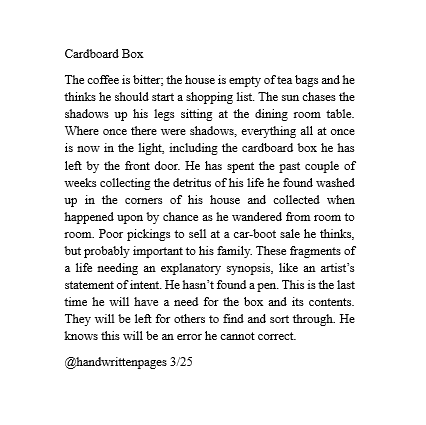
The coffee is bitter; the house is empty of tea bags and he thinks he should start a shopping list. The sun chases the shadows up his legs sitting at the dining room table. Where once there were shadows, everything all at once is now in the light, including the cardboard box he has left by the front door. He has spent the past couple of weeks collecting the detritus of his life he found washed up in the corners of his house and collected when happened upon by chance as he wandered from room to room. Poor pickings to sell at a car-boot sale he thinks, but probably important to his family. These fragments of a life needing an explanatory synopsis, like an artist’s statement of intent. He hasn’t found a pen. This is the last time he will have a need for the box and its contents. They will be left for others to find and sort through. He knows this will be an error he cannot correct.

The Dead Letter Office – A Pome

Author’s Note: Sometimes a random reading will lead to random inspiration and a random result. I like this way.

Create an imaginary friend.

Find a newsagent and buy a postcard. Send it to them.

Whenever the fancy takes you, you buy another postcard from a local convenience store or tourist shop and tell your imaginary friend you were thinking of them and hope they are well.

On a holiday to the beach up the coast, you buy a postcard each morning and tell your imaginary friend the ins and outs of work, the minor procedure you had last autumn and that you’ve taken up running. Each evening you post it.

One day you find a postcard that is a little suggestive, perhaps raunchy, and with trembling hand you write to your imaginary friend that you’ve been thinking of them. You’ll let yourself imagine they are your lover, and fantasise, and then consummate the idea at home. Later you’ll write a breakup postcard but you say you’ll hope to remain friends.

A few years will go by and the urge to write to your imaginary friend will pierce your stomach as you watch a gig at a local café. You write a note on a serviette as an apology.

The distance between postcards lengthens, stretching out to fathoms, and finding a working pen in the house is a miracle.

One day, you will realise you stopped writing to your friend. Regrets hurt.

Finally, as a salve, you will sit down and write a lengthy letter to your friend, taking the thoughts  from the shelves of your mind, and cataloguing them as museum pieces for an audience of one because it will help if someone knows the truth.

Set aside packs of postcards and pens for your funeral.

A Christmas Wishlist

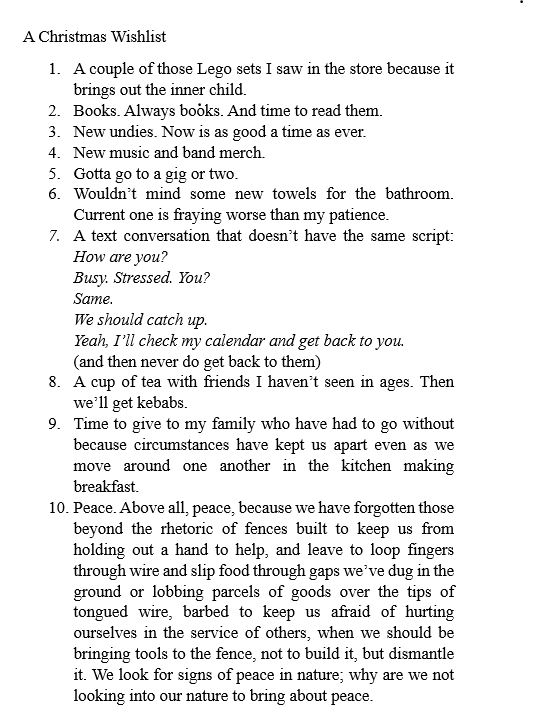
Random list poem inspired by something I saw about all of us being the same.

Things to do While Waiting for Life to Resume

After you read the doctor’s letter, pretend it is a breakup letter to the illness ravaging your body and not a statement of irrefutable facts. The white envelope is a dove, torn to pieces, lying at your feet.

At sunset stand against the west wall of the house to feel the heat baked into the bricks warming your back as your face cools. At sunrise, stand against the wall and absorb the coldness into your back as your face warms. When you stand against the bricks, listen to the sound of your breathing in through your nose then out through your mouth. Clench your fists breathing in. Release them breathing out.

Sorrow is not unlike this.

Go into the garden and look for ladybugs. Search around the lemon tree behind the kids’ trampoline and around the garden shed where the parsley self-seeded and flourishes. You will find a stick insect instead.

Uncertainty is not unlike this.

Watch the bees in the flowers. Listen to them. See that the snails have climbed up the fence because rain is coming. When it does rain, count the drops of rain falling from the eaves and see if you can make it to one thousand.

Send a text to your best friend asking how he’s doing at the moment because you haven’t spoken in a while. Send a text to your sister for the same reason. Water the plants when you’re thirsty.

Go back inside and write out a shopping list of what you will need for the week and make it a hymn to the mundane. Include a treat for yourself. Respond to your best friend’s text and invite him over for dinner and ask him what his favourite food is and plan to make it. Add the ingredients to the shopping list you started.

Expectation is not unlike this.

When you go to the shops with your shopping list, tie your shoelaces with the perfect tightness you like. Let the swallows in the underground car park remind you of people scurrying about as the parentheses of your day because prophets have not forgotten how to read the signs.

On the way home from the shops, go to McDonald’s, and while waiting in the drive-thru, decide to order the burger you have never tried (the Filet-o-Fish) and know that this is what disappointment will taste like as you sit in the carpark, rinsing your mouth out with fries. This will remind you that breadcrumbs are for cooking, not for leaving a trail.

Read a book once you’ve unpacked the groceries; the one you said you always would but never get around to. Then read Hamlet and be certain you don’t know the way forward. Read The Road as the antidote.

Draw the flowers in the vase, a daguerreotype of death. Draw them after they have wilted as an act of preservation. Remember your first kiss and why it stays in your memory and not the last kiss you gave or received. Wait for the echo. As the sun sets, measure the distance the shadow travels in an hour as it pushes in like the rising tide. Create a playlist for your wake and make mixtapes to give to people now. Sort through your sock drawer and throw out the old pairs and the holey ones. Make pairs of mismatched socks. Later, consider learning macrame and wonder, when you’re done tying yourself in knots, will you have made something beautiful?

Clarity is not unlike this.

When you read the instructions, “Open Other End,” on the box, you know for certain you will flip the box over but you won’t trust yourself to follow your heart.

Regret is not unlike this.

Learn why the rod and staff were the shepherd’s tools. Wield them and master them for, and over, yourself.

Boundaries are not unlike this.

At dinner, light a candle (one of the good ones, the smelly ones you saved for special occasions) to see how far light travels in the dark because the night is a drawn curtain and limits your view. This is the measure of where you feel safe because of what you can see. You know what lies in the shadows behind the lemon tree and the garden shed: leftover bricks, roofing tiles and black plastic pots. The garden shed is a mausoleum of the lawnmower and garden tools, sundry odds and sods, bags of potting mix and stakes for the tomatoes you’ve been meaning to plant each season. The lemon tree produces fruit whether you tend to it or not. Befriend the certainty of doubt.

Let the shadow’s long fingers collect the cobwebs from the cornice in the ceiling and make fairy floss from it. The shadow offers it to you. You eat it.

Disappointment is not unlike this.

One day you will make friends with the weight of fear to step out the back door and turn on the light. Wait for the possum with its baby to scurry across the top of the fence.

Perception is not unlike this.

Finally, take a shower to experience baptism in the ordinary act of bathing. You will remember the valley and the mountain top are both places of vision. One is a mirror. The other is a lens. Circumstances will teach you how and when to apply the lens, and when and how to use the mirror in order to see clearly. Clarity will come through seeing yourself correctly.

Death is not unlike this.

This is a reworking of a couple of pieces from earlier in the year. Using second person perspective is a very hard sell to market so I am putting it up here for you. I hope you enjoy it.

A Late-Night Internet Search. And Some Answers.


How many Post It Notes will it take to cover a square kilometre?
– 13,157,894 (or 31,328 packets of 6×70 pieces of the 76x76mm)
How much will it cost to do it?
– A packet of 6×70 is $16.98 from Officeworks.
– Total is $531,949.44
How many memories can I fit on a Post It Note if I write really small?
– As many angels as fit on the head of a pin.
If I write one memory a day on a Post It Note, how long would it take to cover a square kilometre?
– 36,049 years.
Does the act of writing the memory allow you to forget or remember more clearly?
Does the act of writing the memory mean alternate narratives are anathema?
How many embarrassing memories does it take to form your character?
Can you die from too many embarrassing memories?
How many papercuts will make you bleed to death and can I use Post It Notes?
– One. If you cut in the right place.
I think I have enough Post It Notes.

Mount Pleasant – Prologue

As you will now no doubt be reminded that Solkyri’s new album, Mount Pleasant, launches on March 6, 2020, and I am in the process of writing a piece of flash fiction for each track. Grab it, have a listen.

You can read Holding Pattern, and Pendock and Progress, the first two pieces.

The band is hosting an album launch on March 28, 2020 (if you’re in Sydney, Australia).

I am launching one more piece, a prologue to the album. After this I am setting out to write six more pieces for the other tracks and will launch the collection as a chapbook later in the year, probably before June (to allow for typesetting, set up, ordering copies and the like – stay tuned).

The prologue sets the scene for the thematic focus of the album: deception, decait and false facades. The stories are based on the inspiration behind each track, and interpreted in my own way, and my response to the music.

Mount Pleasant

Prologue

Four boys pulled up on their BMX bikes at the sign declaring the name of their suburb, dismounted and dropped their bikes just off the footpath in the unmown grass and collected rocks from the broken edging of the bitumen where it crumbled and exposed the road base.

The white reflective background of the sign mimicked a rainbow from the right angle as the boys took aim at the black and faded capital letters. This invisible line of demarcation creating a boundary of narrowed expectations as thin and carcinogenic as a cigarette. Scratched and pockmarked with its own acne.

The boys threw their rocks with no other intention than to score a hit, celebrating the ping as each rock struck. One of them drifted away, found a length of stick and started swinging through the heads of grass and weeds. He flung the stick towards his mates, skittering it along the footpath as it twisted and jumped, hitting one of them in the back of the legs. It was thrown back with greater force, catching him across the shins.

“Shithead.”

“Arsehole.” A smirk at having drawn spots of blood.

The honk of a horn and the rattle of ute pulling over onto the crumbled verge, tyres coughing through the gravel, passing the boys and pulling up just beyond the sign. Two council workers hopped out and began setting up tools at the base of the sign. The boys watched, ignored by the council workers. One of them pulled a packet of Burger Rings from under his t-shirt, filched from the servo where they’d pumped up their bike tyres. Another one passed around a packet of chewie.

A piece of gravel taken from the footpath and chucked it at the sign. It pinged and the council workers flinched and retorted, “Piss off!”

“What ya doing? Having smoko?”

“Changing the sign; what does it bloody look like?”

“Why?”

“Suburb’s getting a name change.”

“What for?”

“Because of hooligans like you, that’s what’s for.”

The four stood around as the council workers set up two step ladders behind the sign, climbed up and began loosening nuts. The spanner slipped from the hand of one of the workers and clattered in the gravel and dirt. The boys raised a mocking chorus of approval. They watched the name of their suburb come down, thrown into the back of the ute tray before the new sign was pulled from a cardboard sheath.

Within a few minutes the new sign was in place instantly changing the name of the suburb. The new sign gleamed pristine and fresh.

“Dad reckons changing the name of the suburb is like wearing a suit to the pub.”

“Yeah but your dad’s full of shit, too.”

Beyond the sign the suburb looked exactly the same, unaware of the name change and probably wouldn’t have cared for it anyway.

One of boys picked up another piece of gravel and chucked it at the sign, the ping ricocheting into the traffic noise.

“Different name. Same shithole.”

They spat their chewing gum at the sign, picked up their bikes, rode under the sign and headed home.

Pendock and Progress – A Short Story

“Pendock and Progress” is the second track released from Solkyri’s forthcoming album, Mount Pleasant.

Pendock and Progress (Track 3)

Circling Pendock Close with a bloodied nose. Dripping on to his t-shirt and caking above his lip. Pedalling hard to take the sting out of the pain. Up to the end of the street to the intersection and hanging a left. Barrelling down the footpath to the next intersection, turning around, and coming back. Looping through the cul-de-sac and up the other side, hanging a right and repeating the pattern.

He wiped his nose tentatively with the back of his hand and it came away with claret. Still. Caught stealing ciggies from his dad to give to older mates at school in exchange for pieces of silver and gold. Canteen money for a packet of Twisties. His dad clipped him with a backhander. Shouted how hard he had worked for something he enjoyed and the little bastard was depriving him of that pleasure.

He cleaned his hand on the back of his shorts. Kept riding laps of the cul-de-sac. The bike was a pick-up from the local hard rubbish clean up. Driving home after the nightshift his dad spotted it and lobbed it into the back of the car after giving it the once over and deciding he could get it up and running. Dad lapped the neighbourhood looking for other bikes for the parts he needed. It was one thing he was proud of. A labourer’s hands that fixed something. Made something good. Most of the time it was fabricating houses for posh fucks to inhabit. Other times it was demolishing houses for posh fucks to build another, larger house.

“Here you go, have a ride.” That’s all he said. It was mismatched, given a once over with spray paint to cover the rusted parts but fully functional and solid. His dad had made it. Respect born out of initiative.

But initiative that didn’t know how to move beyond the curvature of the street. The boy understood when a labourer’s hands became idle from a lack of work, they became hands of construction and deconstruction of the family and its relationships. Casual labour and seasonal work, packing shelves or running registers. An array of King Gee, flannies and singlets on the washing line in each neighbouring yard. A system that violently protected itself by keeping people on minimum wage. Keeping the idea of education at the forefront of their minds but at the back end of budgeting.

The blast of a car horn and a wave from an old man at the wheel turning into the cul-de-sac. The boy waved back and watched as the car pulled into his driveway. He rode down the street and pulled up as Grandad stepped out. A firm and static handshake exchanged. Grandad was a bastard of a brute. Nanna had died when he was little. Probably to escape Grandad. Nanna was orange cordial and Scotch Finger biscuits. Grandad was Reader’s Digest condensed books and talkback radio.

“Where’s your dad?”

“Inside.”

“Your mum home?”

“At work.”

“Your nose,” he pointed.

The boy shamefully wiped at the dried blood.

“My dad gave it to me worse.” A declarative comparison indicating the softening of generations.

The car door closed, and Grandad’s shadow lengthened towards the house.

Even though Grandad no longer struck his father, the boy could see how the generations measured up. Toughness was measured in how close you could get to the line of confrontation, prodding, goading, pricking, without copping a smack in the mouth from a backhanded swing. But that line was movable. He could stand his ground. Fight for what he wanted, even if it was only to piss the old man off. But always knowing who had the upper hand.

A genealogy of violence so circuitous and labyrinthine the boy wondered if he was the Minotaur at its centre, or simply the progeny of what was monstrous lusting after flesh and attacking people the way his Grandad had attacked his father, who attacked him and his mum and siblings. The fact a penis swung between your legs meant power and authority through the erect salute made between the pages of Penthouse magazine, and the flaccid outcome of making a mess in your own hands and wiping it away with wads of toilet paper.

The boy kneeled down at the front tap next to the letterbox and turned it on, letting the water run through his hand until it became cool. Splashing his face to clean the blood off, watching the red stain fade through his fingers. Slurping at the water cupped at his chin and feeling it run off the end of his nose, like blood. His hand shot up to check. Finding it clean he wiped his hand across his face. He looked down and began rubbing the spots of blood between his fingers. His mum would be angry he had stained his clothes but if he kept out of her way, he thought he could avoid the sideways glances. On his bike he could avoid the sideways glances of his dad and grandad.

The boy picked up his bike from the footpath and took off up the street. Each house he passed was a photocopied mimicry of an original that once had purpose. Untamed lawn edges or attempted front yard gardens of roses or murraya hedges. Kids’ plastic trikes next to Ford Lasers and Mitsubishi Colts. Fibro walls were good for fuck-all. Fabrication of pretence and a façade of neighbourliness as dog shit was tossed over the nearest backyard fence.

On his next lap around the cul-de-sac his younger brother came out the front door, probably told to piss off outside, and sat on the concrete verandah with a fistful of Hot Wheels cars. Lined them up along the top step and took turns pushing them off, one by one, down the three steps. The clatter of metal on concrete.

The boy felt the distance between himself and his brother, between himself and his father. Absence and ignorance stung like a father’s fist and blossomed into plum-coloured bruises. When they were visible, he learned to use mum’s concealer to hide them. Like she does.

He remembered lining up with his classmates, dressed in the category of ‘normal’ in their uniforms. On the surface it looked the same: blue shirt, grey shorts, white socks and sneakers. Or leather shoes if they could be afforded. But it was the idiosyncratic differences of how someone wore their shirt tucked out, longer socks or all the buttons done up to the very top he noticed as normal, too. Normal was having the shit kicked out of you at regular intervals by your father and turning up to school in the same uniform as everyone else thinking they too had the shit kicked out of them by their fathers on a regular basis. It was never said but always understood, as if bruises had their own telepathy to communicate with other bruises and share the pain as a salve of solidarity as the colours faded like the clouds of a summer storm.

He felt an underlying prickliness in his stomach when he looked at someone and they knew, too. Pendock Close had many faces, poverty being the most obvious. Yet poverty of affection, poverty of acknowledgement, poverty of awareness meant the boy let the prickliness tumble through his stomach, pass some of it out like runny shit to alleviate the stabbing for a brief time. But it was always there.

The desire to be seen, and noticed, not as a meat bag, a human sausage to be pricked and tossed; the fragile skin casing threatening to burst at the impact of a pellet spray of words shot from an arse.

And the boy continued on for another lap of Pendock Close.

* * * * *

The song is based on systematic violence and cycles of poverty named after two streets where the band grew up. I took inspiration from the accompanying artwork to develop the concept of the cul-de-sac, a closed road, a dead end, a place of going nowhere as a sustained metaphor throughout the piece. 

The plan is to have a collection of flash pieces written, one for each track on the album, by the middle of the year after the album is released in March as a download. Stay tuned for details.

You can read the first story, “Holding Pattern.”

 

Post It Note Poetry 2020

2020 is the 8th year of Post-It Note Poetry. Not bad for something that started as a dare to write bad poetry on Post-it notes between two friends.

The JAR Writers’ Collective will host the month-long poetry event this year, co-ordinated by Jodi CLeghorn, in league with fellow Collective members myself and Rus VanWestervelt, and ably supported by eight brilliant Post-It Note Poetry Ambassadors.

𝗔𝗕𝗢𝗨𝗧 𝗣𝗢𝗦𝗧-𝗜𝗧 𝗡𝗢𝗧𝗘 𝗣𝗢𝗘𝗧𝗥𝗬

Post-It Note Poetry runs every day in February and is designed with two broad aims in mind:

1. To encourage people of all skills sets and persuasions to explore and have fun with poetry – whether they are seasoned poets or curious souls attempting poetry for the first time since their teenage years.

2. To create within a confined physical space (the size of a post-it note) as a positive limitation. It is also a way of making poetry composition possible for 29 consecutive days.

“𝗧𝗛𝗘 𝗥𝗨𝗟𝗘𝗦”

The rules are simple for those who’d like to play along at home (at work, on the bus or in any of those in between places perfect for scribbling poetic words on small squares of sticky paper).

🖊 Write/build/create a poem every day of February.

🖊 Poems must fit on a post-it note (or be an equivalent sized poem – ie. no more than 8 lines on a larger backing).

🖊Poems must adhere to the original light-hearted spirit of permission to write badly – in which poems can tackle serious content, but internal editors/critics all get a break over February.

🖊Post poems to social media with the hashtag #pinp20.

🖊Follow the hashtag and enjoy what others are creating.

We look forward to introducing our ambassadors in the coming days.

All questions or inquiries can be directed to me!!

If you’d like to join the Facebook group – you can do so here.

https://www.facebook.com/groups/460406284024429/

The JAR Writers’ Collective

I am very pleased to announce the launch of a new writing initiative I am involved in, The Jar Writers’ Collective.

It is the culmination of some thinking and brainstorming between myself, my collaborative co-conspirator, Jodi Cleghorn and another collaborative co-conspirator, Rus VanWestervelt.

Together, we are The Jar Writers’ Collective.

The three of us have been working together in some way, shape or form, for some years now, and its was decided to formalise our collaborative efforts, and individual works-in-progress, in a new writing venture. 

Our work ranges from novel, to novella, poetry, script, art and combinations of any of the above, and it excites us as to what we can produce individually and collectively.

This collaboration allows us to champion our own work, the work of our collaborators, and the work we do together. We are free from restrictions about what we publish, and how we publish it. We are treading a fine line between indie press and indie authors. Our first release is slated for June, 2019.

Our first post, Opening The Jar, lets you in to see who we are, what we are about and what we hope to achieve.

It’s not just about us as creatives; it’s also about giving permission and tools to others to explore their own creative practices.

Drop in to have a read, subscribe to our monthly newsletter, or our weekly blog posts and prompts.

You’ll also find us on Facebook (click on through and Like our page), Twitter and Instagram.

We’d love to hear from you and get to know you as part of the community.


Inktober

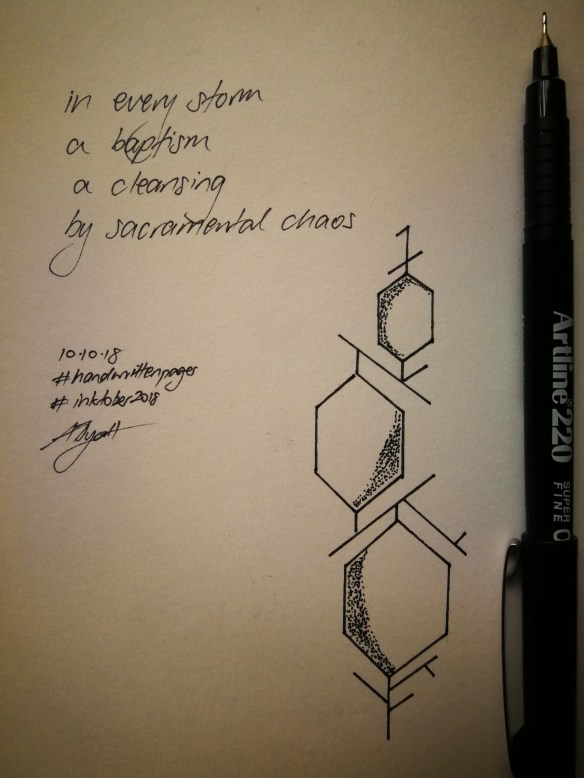
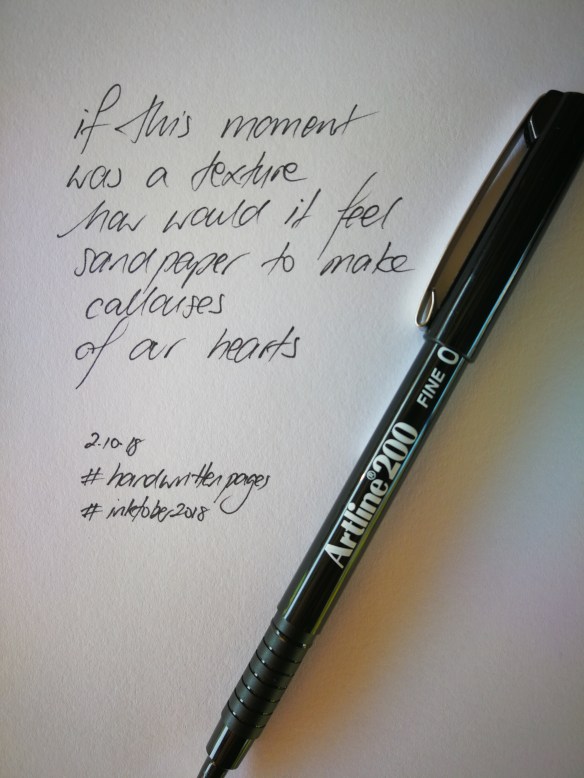
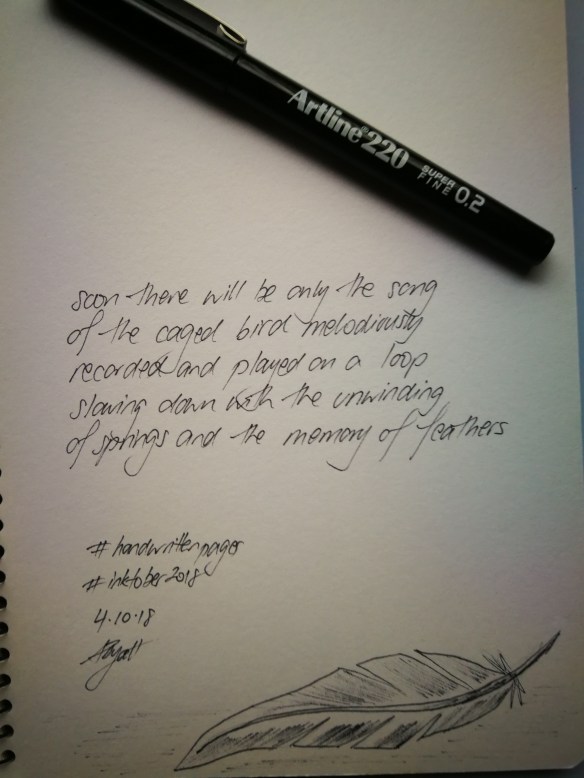
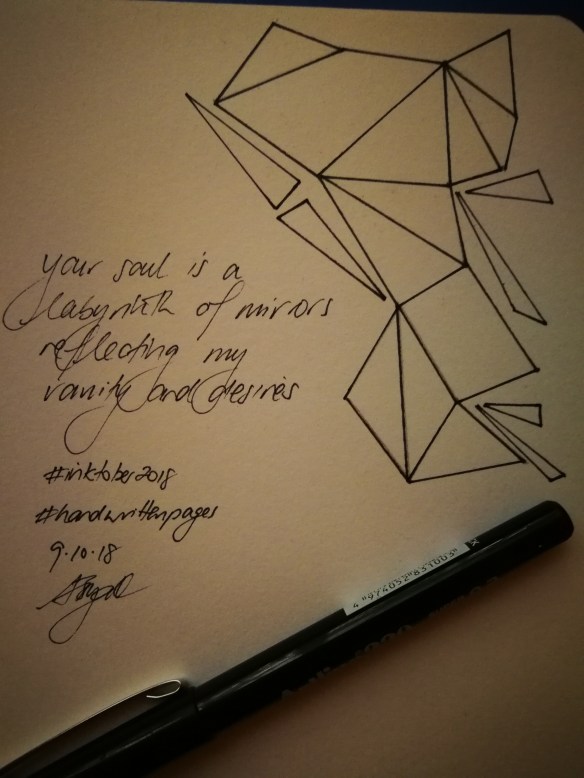
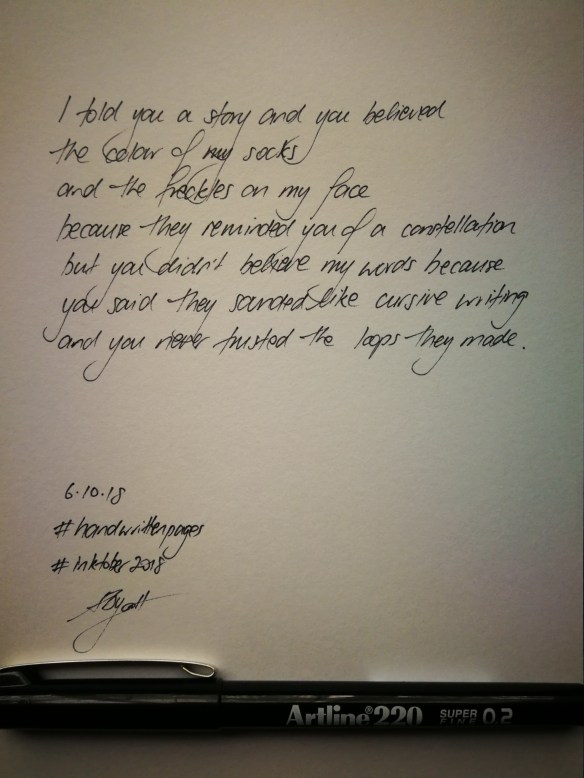
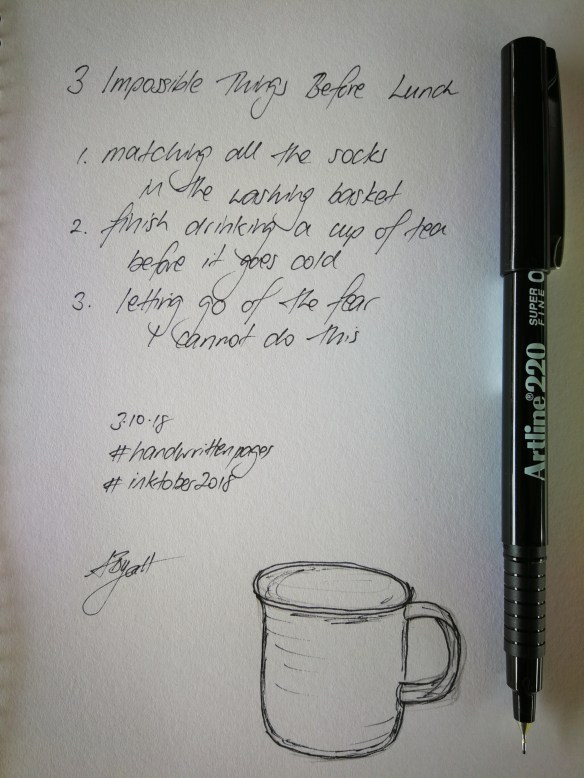
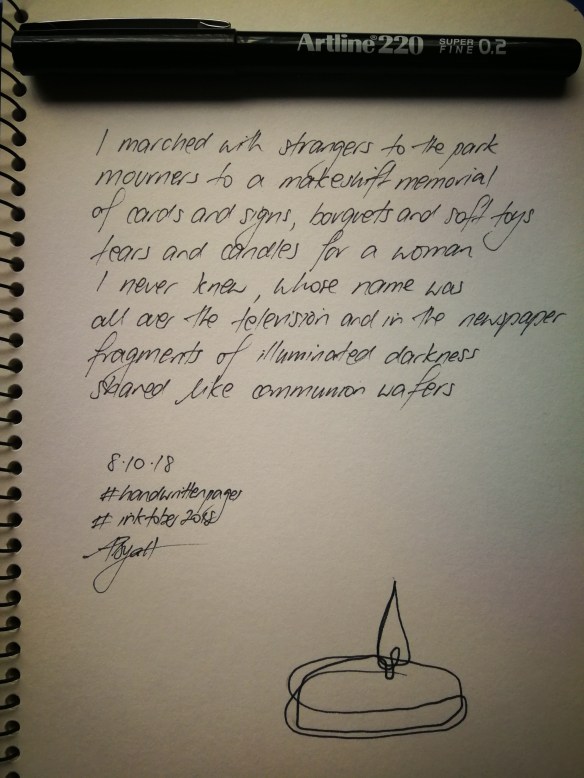
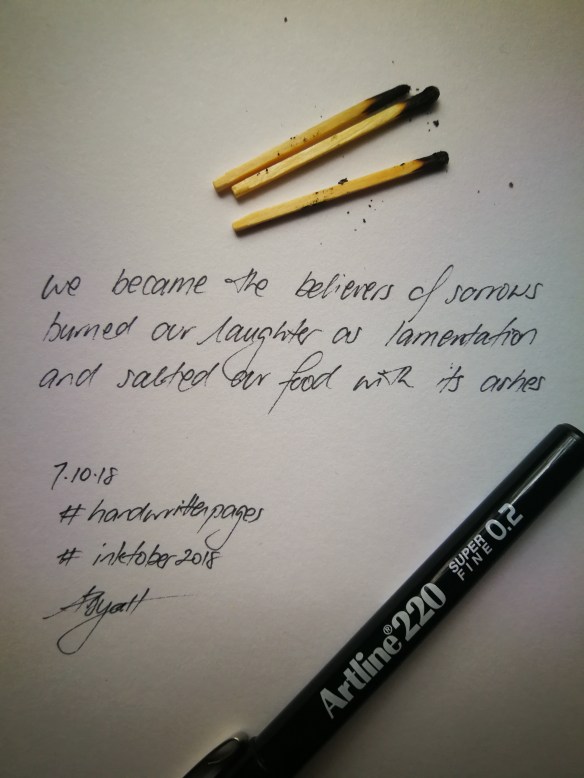
For the month of October, participants engage in a drawing frenzy #inktober, drawing and posting one of their creations each day of the month.

My artistic skills are amateur at best. It’s a skill. One I have not developed or invested time into. 

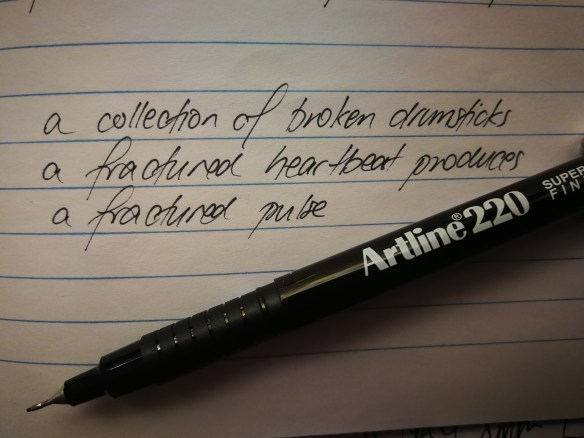
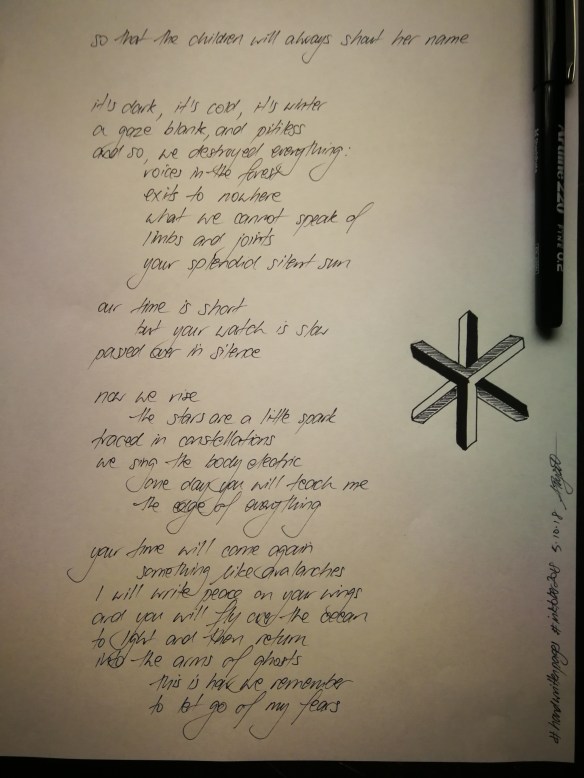
Therefore, instead of drawing, I’m posting a hand-written piece per day. It’s what I normally do over on Instagram (@handwrittenpages) but adding in the challenge of doing it daily. 

Here is the first week’s worth of writing.