Tag Archives: experimental

This Is How We Should Make New Friends

How should we make new friends?

I am a shy individual who masks it with bravado and a quip. New social situations makes my underpants an uncomfortable shade of brown. But it’s good to make connections with new people. Makes the village more welcoming and hospitable.

Here’s how I propose to do it: Everyone needs to carry a novel.

In a new social situation the novel is a means of beginning a conversation. We can talk about the book, what we liked, didn’t like, read aloud our favourite passages.

And when we’re finished, we can swap the book with the person we are talking with, read it and return it when done, or pass it on to the next new person we meet.

And it would be even better if it’s our own story in the book we give away. That way we must trust the other person to treat our book with respect and kindness.

And there should be blank pages for the new person to add in how we met, what we talked about, what the day was like. Then we can pass it on, receive the new person’s book and add our own details. If we happen to cross paths again, we can catchup on what has happened.

Imagine all the people’s stories we could read.

This is how we should make new friends. What do you reckon?


How Do You Make Something Creative and Cool?

How do you make something creative and cool?

I like seeing what people are doing with their creativity. Sites like This Is Colossal are a constant inspiration for what people can do. I love watching my mates Deane and Gary post their photos on Facebook, and through my twitter feed I see some very creative ideas.

I’ve seen cartoons drawn on Post It Notes, drawings scribbled on plastic lunch bags, bird cages suspended above a narrow laneway, umbrellas suspended in a similar way like a hundred invisible Mary Poppins.

And it’s brilliant. And so very cool.

So when I came across next earth is now on tumblr, I was intrigued. And even more surprised when I found out it was a writing friend, Daniel Ritter. I only made the connection when I saw it linked via his Facebook page. So I asked him about it.

In Daniel’s words, “(It’s) sort of an alternate reality experiment. Approaching it as if the photo/narrator is experiencing delusions that aliens or some other unknown agency has taken over the world, but he’s the only one that has noticed.

So far, this has been random, pants, discovery, stack-on-the-weirdness approach. Names have been named, rules have been established, so, it could be developed.”

They fill their zoos with us. Their zoos overcrowd with halfbreed children. They refuse to euthanize. They install …buttons under our feet. We do the dirty work, step by step. They’re absolved of murder.

They fill their zoos with us. Their zoos overcrowd with halfbreed children. They refuse to euthanize. They install …buttons under our feet. We do the dirty work, step by step. They’re absolved of murder.

You make something creative by experimenting, and Daniel has done this so well, playfully taking a foray into an idea and seeing where is goes.

And this is what makes creativity so very cool.

Follow next earth is now on tumblr
See what Daniel is up to on twitter @ReginaldGolding
And go have a sticky beak at his blog, Grounded Stories


Throw Out Thursday – Showing Your Work

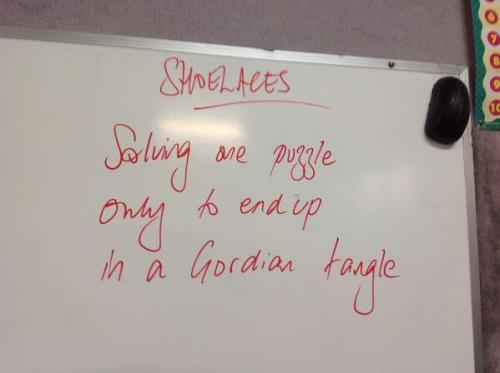
For this week’s Throw Out Thursday, I’ve collected the random poetry I wrote with Year 8 last term. The focus was on haiku.

It’s a great way of introducing students to a poetic form and while there is a beautiful simplicity to haiku, there is also great depth and complexity in the form when explored.

But this is about throwing stuff out. And these are haiku I wrote on the board while my class was working. I believe it’s important for my students to see my writing, correcting, experimenting and exploring creatively.

Haiku with Year 8

Haiku with Year 8

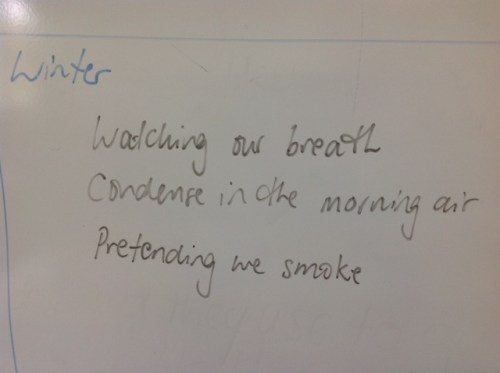
Winter Haiku

Winter Haiku

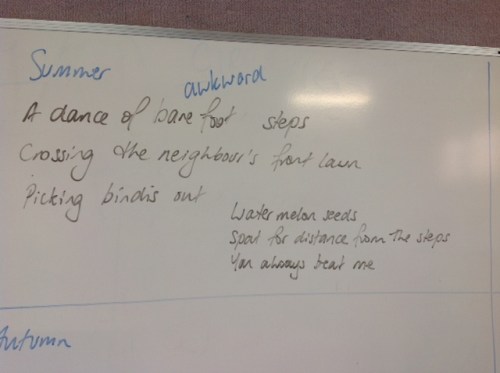
Summer Haiku

Summer Haiku


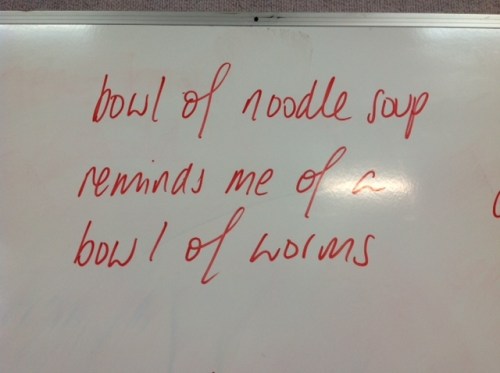
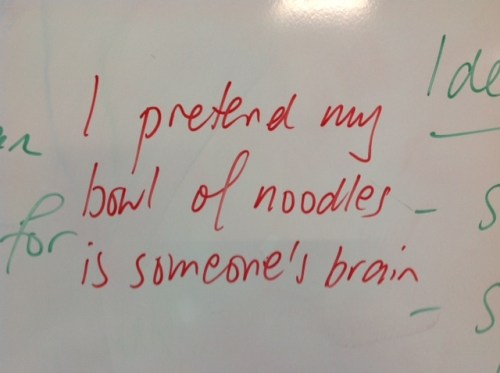
Noodle Worms

Noodle Worms

Noodle Brain

Noodle Brain

Creativity is about experimenting, exploring, examining, and having a whole lot of fun.

These are brief experiments and part of the process of improving my writing craft. As Austin Kleon says, “Show your work.” You get to see a little of the word wrangling I do to.

Dare you to have a go at something creative.

Scraps of Paper Under the Lounge

Another set of #micropoetry gleaned from my twitter stream, collected here for your reading pleasure and deconstruction.

I like writing them because they are often quick, spur of the moment ideas, thrown down on my Ipad and sent out into the nebulous ether of the interwebz.

It’s a form of disposable creativity, like Hansel and Gretel leaving breadcrumbs behind for others to follow my example. Later this year I will be relaunching posts on creativity and why I think EVERYONE should be creative.

I hope something like this inspires you to do something creative.

Cameras For Eyes

The camera downloads
Our memories
Stored in another brain
So we can promptly
Forget
And cannot prove
We ever existed

Boredom

Bored, he watched sands
Trickle through the waist
Of the egg timer. Paused
Between starting anew
And waiting for it to finish

Making It Better

But a Band Aid makes
everything better, he cries
offering up the token.
I’m sorry, says his father
But Nanna has died

Musical Mayhem

In her hands
A wooden spoon
and metal mixing bowl
struck together
a ringing, pleasing tone
striking again
she discovers music

Burning Bridges

He flicked the switch
Burned the bridge
Op’ed a gaping chasm
Then offered tools
To build a better bridge
Than the one before

I Give You My Heart

I handed over my heart
To my beloved
In the most convenient package
A plastic bag
Grabbed from the pile
Behind the kitchen door

The Journey

The journey
Of a thousand miles
Begins not
With the first step
But in firstly
Packing a pair
Of clean undies


Do you have a favourite, or if you were to rewrite one, how would you do it?


More Loose Scraps of Paper – Further Collected Micropoetry

Looking back through my posts I have collated more of the #micropoetry posted on twitter and posted here.

Stay tuned in the future for a book of micropoetry.

Outside

when did Outside
become an
undiscovered country?
whose unfenced boundaries
spark greater imagination
than the couch’s confines

Mandala

She draws on the concrete
a chalk mandala
of wonky butterflies,
stick-figure people.
Tomorrow she will
draw another
cycle.

Training Wheels

 I’m too old for these
she said
pointing to
the training wheels
He prays she will
never be too old
to trust
and hold
his hand

Knowledge

The gaining of knowledge
deteriorates with age
because we know
everything at 18
and realise
we know nothing
the older
we become

Toilet Seat

Sometimes
I deliberately
Use the bathroom
After you
And absorb the warmth
Of the toilet seat
To believe you
Still care

It Is Written

It is said,
“It is written”
The oral tradition
Of received wisdom
In a fortune cookie
Platitude while we
Forget to read
The written truth

Any favourites?

Loose Scraps of Paper – Gathered Micropoetry

Another collated exhibition of #micropoetry I have posted to twitter and also posted here.

Plans are afoot for later in the year to publish a book of micropoetry. Anyone interested?

Footfalls and Shadows

My shadow hides
The path’s pitfalls
Hollows and
Stones to trip
Because I walk
Not into the sun
But away from it

Light A Match

our words fell
like leaves in autumn
and drifted into piles
the colour faded
the moisture evaporated
waiting for conflagration

Animal Playground

Some pigeons peck
At scraps in the playground
While others engage
In elaborate courtship rituals
Just like students 

Television Conversations
The television speaks

As a third participant talking
Over, under, through.
An unsolvable knot
Of miscommunication
Until the remote is found

Checkout Manga

In between customers
She draws manga
On the back of receipts
Slips them into groceries
And wonders if Godzilla
Eats breakfast cereal

A Windowed Existence

the existence of life
prelude to dying
narrows its vision
as death draws
the curtains
against the limited view
remaining through
the window

The Truest Hero

The truest hero
is seldom seen
in cape nor undies
on the outside
But in those
whose daily
actions make
the stranger
a welcome guest


Any particular poem take your fancy?

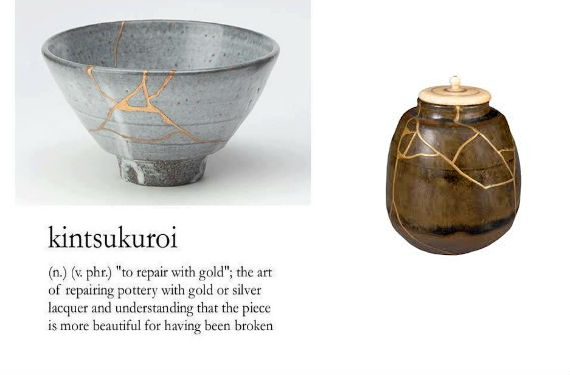
Kintsukuroi – Micropoetry

In my brokenness
I am made beautiful
You collected
the broken pieces
Sealed fleshly wounds
With golden scars
I wear as triumph


This poem was inspired by the Japanese art form of kintsukuroi

Kintsukuroi


I see creativity as an act of creation and as an act of repair. Sometimes it is in the act of creating that a person finds wholeness by putting their emotional and mental trauma and experiences into a work of art. It may be a difficult and draining but it can also be a catharsis, a release, a giving away of the issues and experiences held onto like removing a splinter from under the skin.

Sometimes we need to understand we are broken so we can be repaired and made beautiful again. Creativity is the medium through which it can happen.

What can you make beautiful again?

Antidisestablishmentarianism – A Haiku

I set my Year 8 class a writing task today, 10 Things I Know to be True, or 10 Things I Should Know By Now (taken from Sarah Kay’s TED talk – it’s brilliant. Go watch it).

One of my students wrote, “I know ‘antidisestablishmentarianism’ is the longest word I know.”

We joked it was almost a haiku in itself. So I thought I’d make one. I know it’s not a correct or proper haiku but it’s a fun form to play with.

An-ti-dis-es-tab-
lish-ment-ar-i-an-ism
Longest word I know

What creative act have you done today?

Random Creativity (And Why It’s Important)

On Friday my Year 8 class were set the task of writing haiku.

The English approximation of a beautiful Japanese art form is known to most, if not all, primary school children. They learn it is a poem of 17 syllables broken into 3 lines (5, 7, 5) and it is about nature (or something…).

It is taught because it is easy and accessible for students. It gives definite boundaries and restrictions, confinements for words and their interplay of meaning.

But writing great haiku is difficult.

I told my students I wanted them to experiment and play with language. I encouraged them to enjoy the process, to have fun with language. And so I had a go at writing a couple myself.

Summer Haiku

Summer Haiku

A dance of barefoot (awkward) steps
Crossing the neighbour’s front lawn
Picking bindis out

Watermelon seeds
Spat for distance from the steps
You always beat me

Winter Haiku

Winter Haiku

Watching our breath
Condense in the morning air
Pretending we smoke

Are they any good? Probably not.

Why is random creativity important?

It can be done quickly and in spare moments, disposable as an empty soft drink container or laboured over and agonised and deliberated for each and every syllable.

This is why creativity is important. 


Understanding Alchemy – My Writing Process

I suspect many readers, and indeed if conference questions are anything to go by, are mystified by the process writers have of hunting down, killing and skinning an idea and presenting it as a story. It’s like the medieval alchemists who attempted to combine elements and transform it into gold.

I was reluctant to write this post, tagged by another writer, my collaborative writing partner Jodi, but realised if I believe everyone can be creative then it behooves me to explain the process and guide new writers into the mystery.

Please don your robes and grab a doughnut; the initiation is about to begin.

There are many pithy quotes by writers about how to write but they are only relevant if you have immersed yourself in the craft of writing. Experienced writers nod sagely and ironically at the pithy wit and wisdom of those they admire but it doesn’t let the novice into an understanding.

The focus of the My Writing Process tagalong was to ask writers 4 questions. Here are the 4 questions asked and my attempt at an answer. Particularly #4 where I will attempt to show how I work and see if it helps novice writers on their journey.

1. What are you working on at the moment?

Too many things. Here are the most significant projects.

a. Post Marked: Piper’s Reach is a collaborate epistolary novel written with Jodi Cleghorn. It was hand written in real time and sent through the mail.
We are now at the stage of finalising our synopsis and getting it ready to submit to a variety of avenues.

b. The Java Finch (novella – working title) This is the logline I developed in my planning:
When Jack displays his finches at a bird breeding convention he meets Takashi who is painting the birds. They form an unlikely friendship and begin to come to terms with their experiences of World War 2 that shaped their lives, discovering that the very things that trap them are the things that give them the most freedom.

c. The Broken Chord (YA verse novel – working title) The (very rough) logline: Caitlyn-Rose is a gifted musician in her final year of high school, and having lost her mother in her first year of high school, struggles with her identity and purpose on the verge of graduating, afraid of the future and who she is.

d. I am also working on Degenerate Dictionary, Post It Note Poetry and a non-fiction book on creativity.

2. How do you think your writing differs from that of other writers in your genre?

I honestly have no idea. I am a newbie author so comparisons to other writers is unfounded.I do not have a substantial body of work to hold up for scrutiny. What I do have is an interest in authors who writing I admire: Tim Winton, Marcus Zusak, Craig Silvey. It is from these writers that I take inspiration in terms of style. I like Winton’s poetic prose, Zusak’s voice and Silvey’s humour.
My own writing infuses elements of all three, but it is my voice. I do not intend to be a slavish copyist but to speak articulately in my own voice. I love how the minutiae of life is a smaller version of the bigger thematic concerns of a work.

3. Why do you write what you do?

I remember watching an indie film with an old friend when we were growing up called ‘The Saint of Fort Washington’ and it was a couple of lines of dialogue that stuck with me.
“What’s your story?”
“I haven’t got one.”
“Everybody got a story.”
At the heart of it is a desire to know people’s story; how often do you hear someone say, “My life is uninteresting” or “I’m so boring” but that is the point of intersection where I want to ask the person about his or her life and listen to the stories that are important to them (I have plans for a project to take this idea a step further).
I write what I do because it’s the little things in life that interest me. For example:
* who decided it was a good idea to share a bed with someone?
* why does it take so long to hang out socks and underpants on the washing line?
* how long should you let someone walk around with their fly unzipped?
* is falling in love better or worse than getting gravel rash when you fall off your skateboard?
I wrote a manifesto some time ago, to articulate my vision for why I write.

I am a writer.

I write because I want to tell a story, but not just any story.

I write because I want to tell the story of those who are not heard.

I write because I want to tell the story of those who cannot speak.

I write because I want to tell the story of those who are disempowered.

I write because I want to tell the story for those who cannot.

I write because I believe that telling a person’s story is integral in understanding who they are.

I create art to speak into the darkness, that I may be a light for others to ignite their own flame and walk clearly.

People’s lives are not boring; writing is an exploration of how and why the everyday variables and events impact a person.

4. What’s your writing process, and how does it work?

Process assumes a regularity of work habit. Yeah, about that. Nope. Doesn’t work for me.
I know writers who can park their backside in a seat for an entire day and churn out 2000 words, 5000 words or even 10,000 words. Others I know work in small chunks of time, half an hour or an hour while others write until they have 1000 words.
For me, I work in bite-sized portions of time, snatching words in paragraph fashion. I have, in the past, written in chunks of time and written to 1000 words. It is always dependent on the workload of my day job.
I can go days or weeks without substantial writing yet still manage to scrawl words here and there. And I write slowly.
I also don’t have a regular process because I also write poetry and short stories. What I am working towards is a more consistent pattern, say 2-3 times a week of set aside time to write.
There is no formula to writing; you simply write.

How you create stories is another matter.

When I first started writing I knew a story needed a beginning, a middle and an end; a complication, a series of events, a resolution. But how to put these into a cohesive piece was what I needed to learn. I read as many blogs as I could about the writing process and how to craft a good story. I wrote 1000 word pieces of flash fiction and posted them to my blog, linked them to others and sought feedback to improve my work.

You learn to write by writing and reading. A writer is the sum of their reading influences and their vision and perspective on the world. You tell stories for myriad reasons but at the heart of it for me is the power of story to transform the individual and also a love of words and language.

Find a pen, a piece of paper, and write a story. Find your voice.