Tag Archives: experimental

When In Doubt, Write Poetry By Erasing Words

Diving back into the classics for more blackout poetry.

You’ll find my first two attempts here (Moby Dick – Herman Melville) and here (Heart of Darkness – Joseph Conrad)

I have taken the first page of a range of texts and used the tone and ideas to create something new.

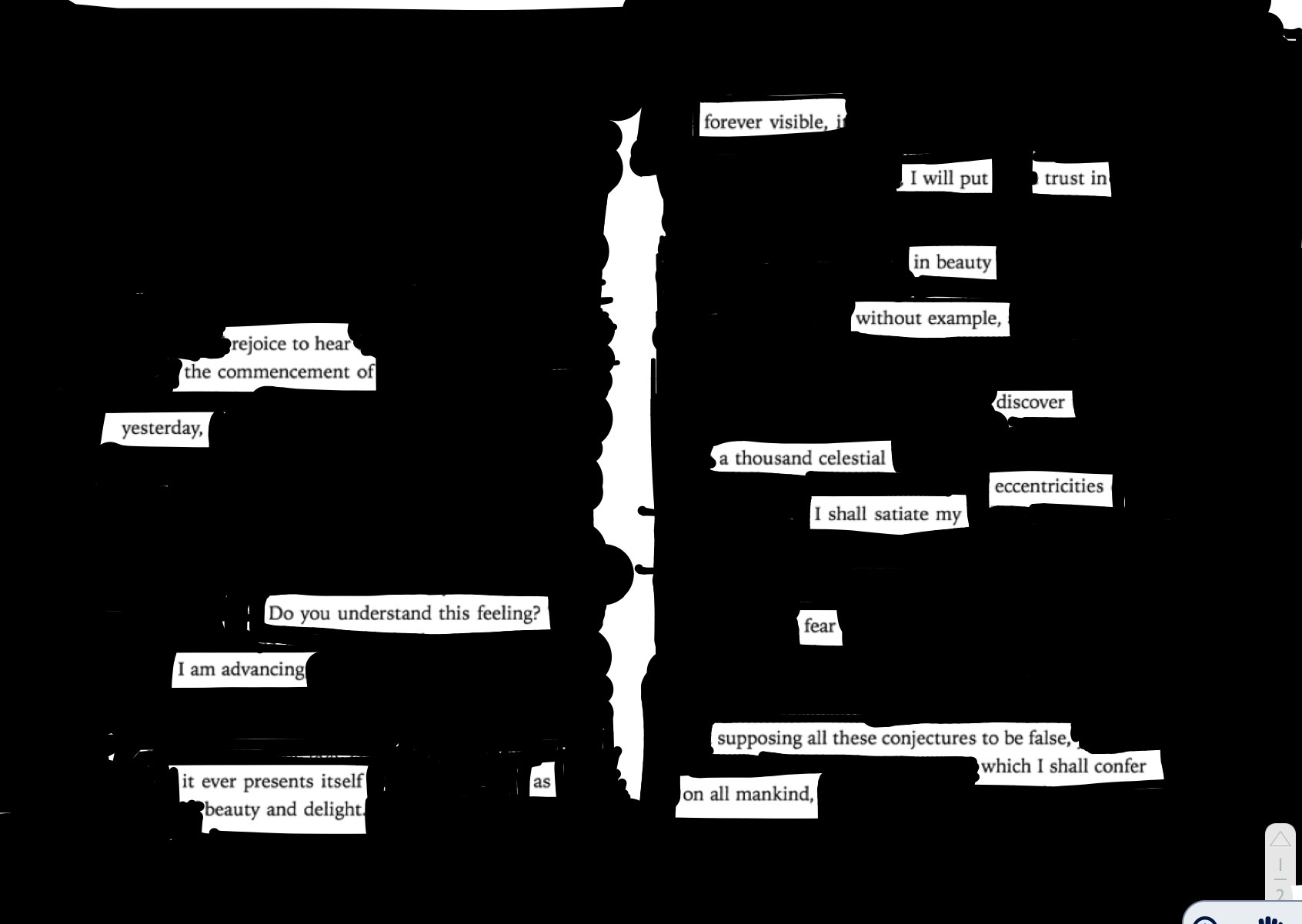
Epistemology

from Frankenstein – Mary Shelley (click image to enlarge)

image

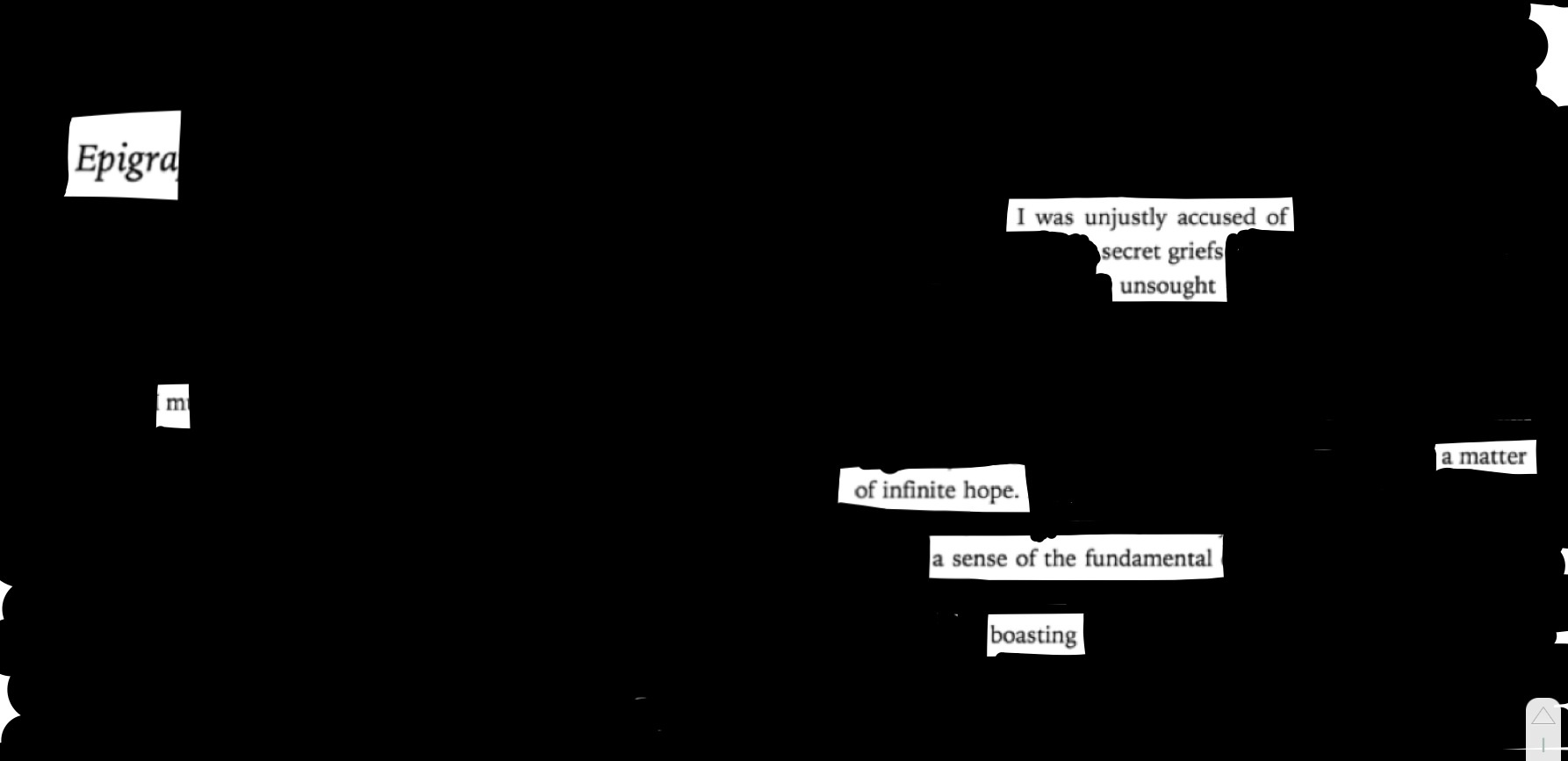
Who I Am

from The Great Gatsby – F. Scott Fitzgerald (click image to enlarge)

image

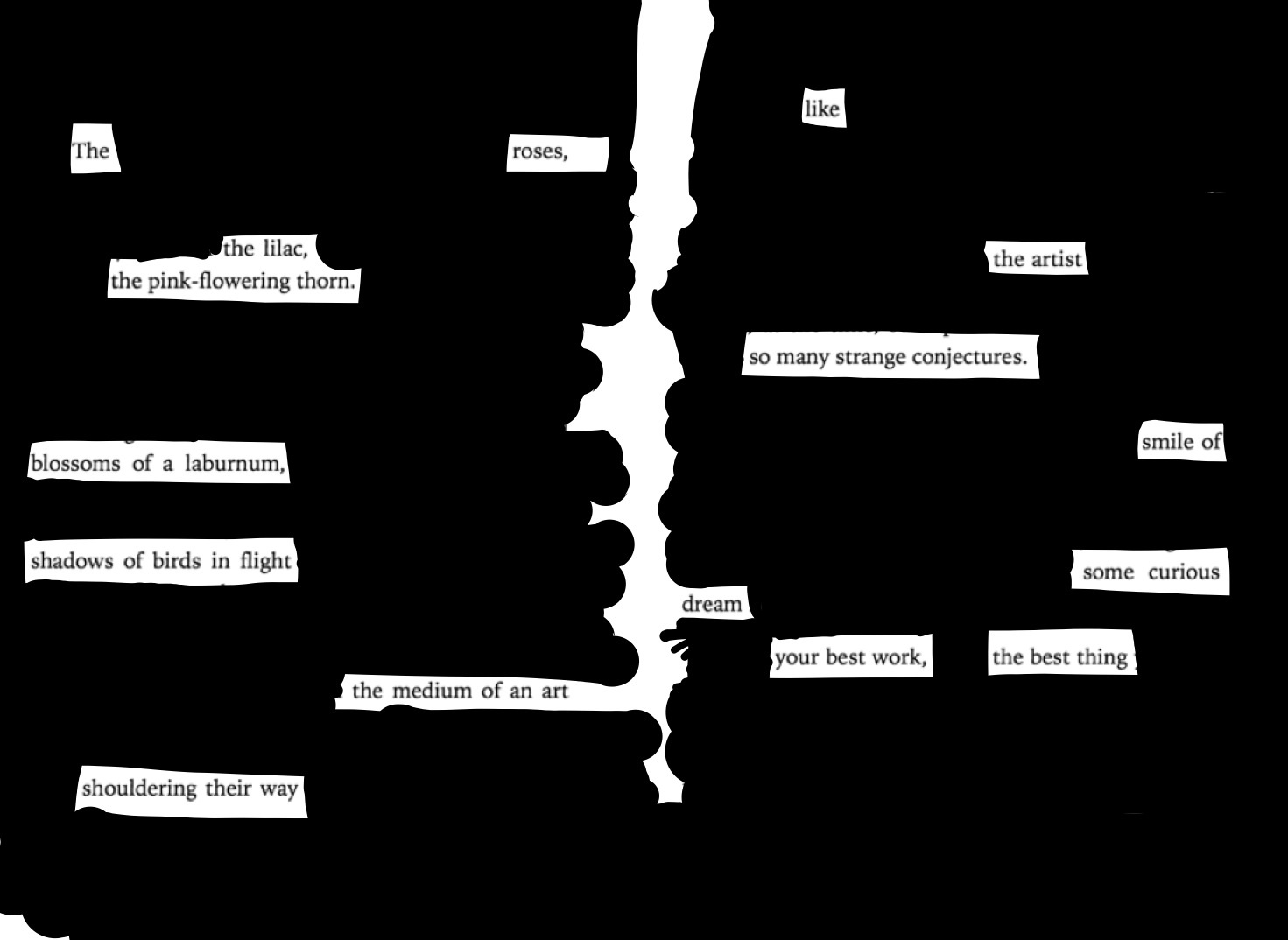
What Your Mind Has Made 

from The Picture of Dorian Grey – Oscar Wilde (click image to enlarge)

image


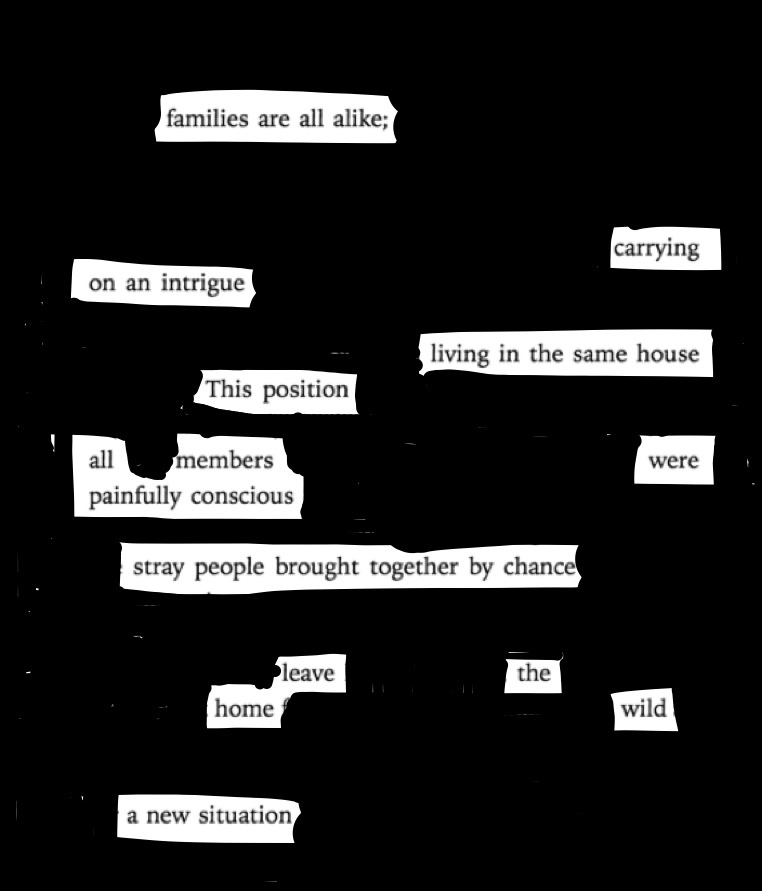
A New Situation for Families

from Anna Karenina – Leo Tolstoy (click image to enlarge)


image


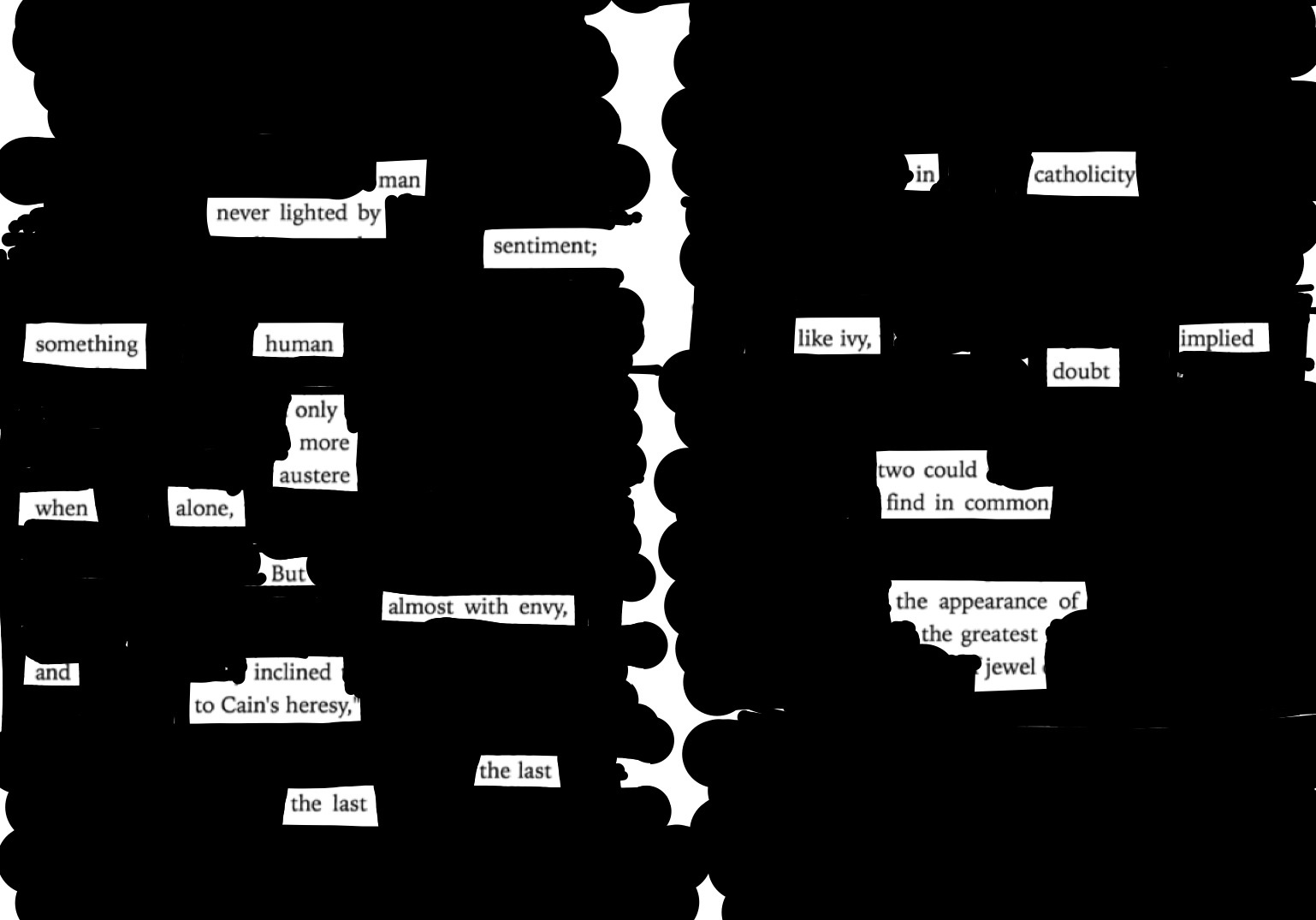
Like Ivy

from The Strange Case of Dr. Jeykll and Mr. Hyde – Robert Louis Stevenson (click image to enlarge)

image

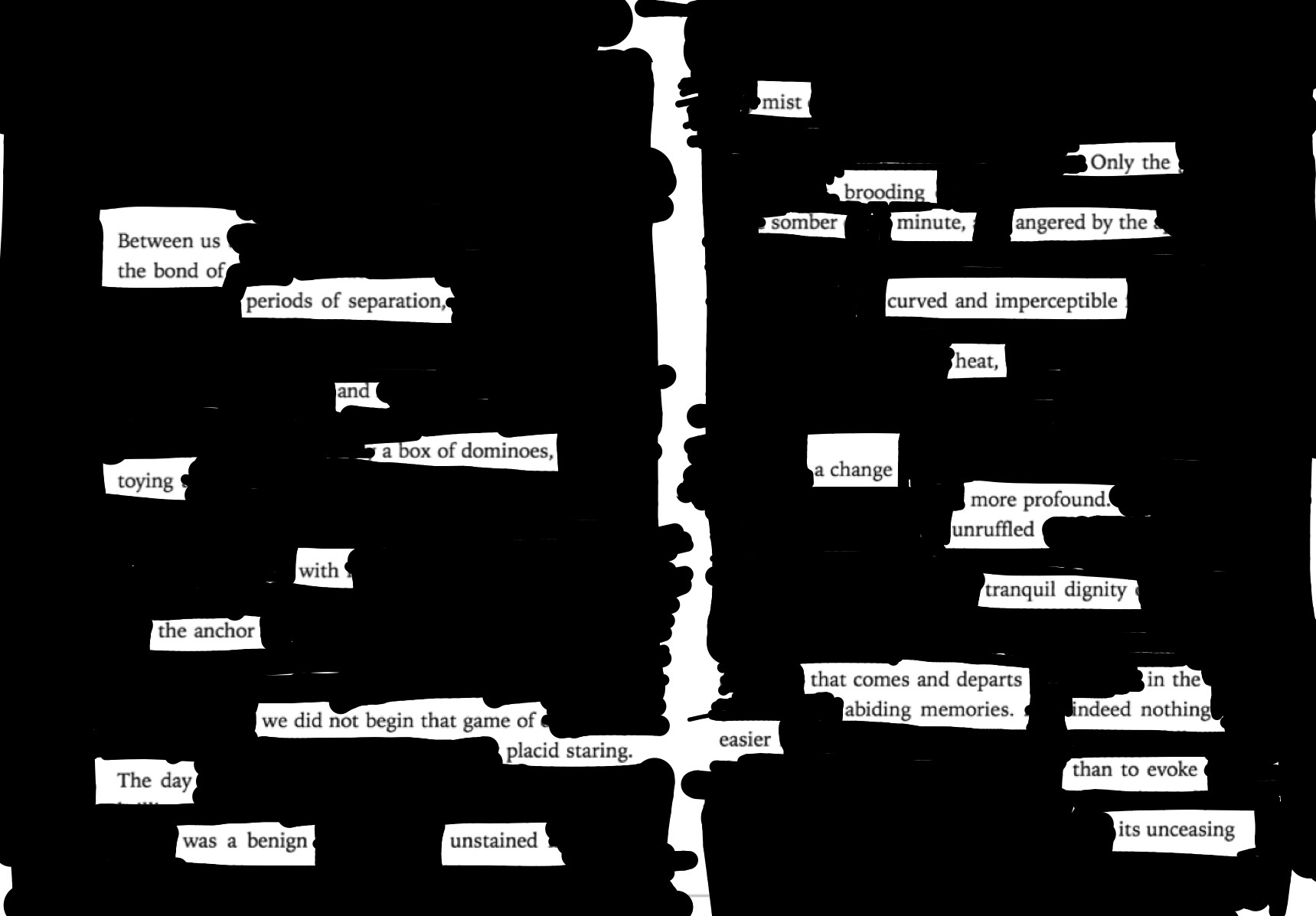
Blackout Poetry – Another Questionable Attempt

image


Between us
the bond of
periods of separation
and
a box of dominoes
toying 
with 
the anchor
we did not begin that game of
placid staring
The day 
was a benign unstained
mist
Only the 
brooding
somber minute
angered by the
curved and imperceptible
heat
a change
more profound
unruffled dignity
that comes and departs in the
abiding memories. Indeed nothing’s
easier
than to evoke
its unceasing

After yesterday’s modicum of success with blackout poetry, I tried my hand at another (need to do something creative at the moment while I get my head back into shape to tackle some significant writing projects in January).

This page comes from Joseph Conrad’s “Heart of Darkness.” I studied this text in high school last century and thoroughly enjoyed it. Admitting at the time I didn’t quite understand the colonialism and inherent racism, it still holds as a powerful metaphor. Tie it with Francis Ford Coppola’s “Apocalypse Now” and you have a teenager’s existential orgasm. 

So, with that in mind, I wanted explored the idea of relationships through the text.

It’s a diversion from writing Post It Note Poetry (and a couple of other major works in progress) but I posit that flogging someone else’s idea to pursue something creative is better than nothing. Blackout, or erasure, poetry makes you look at words, their order and the meaning created. It opens your mind to see other possibilities, limited as it is by the choice of text, to create something new.

I encourage you to try it yourself. Or buy a colouring book and pencils. Do something to stimulate your brain. 

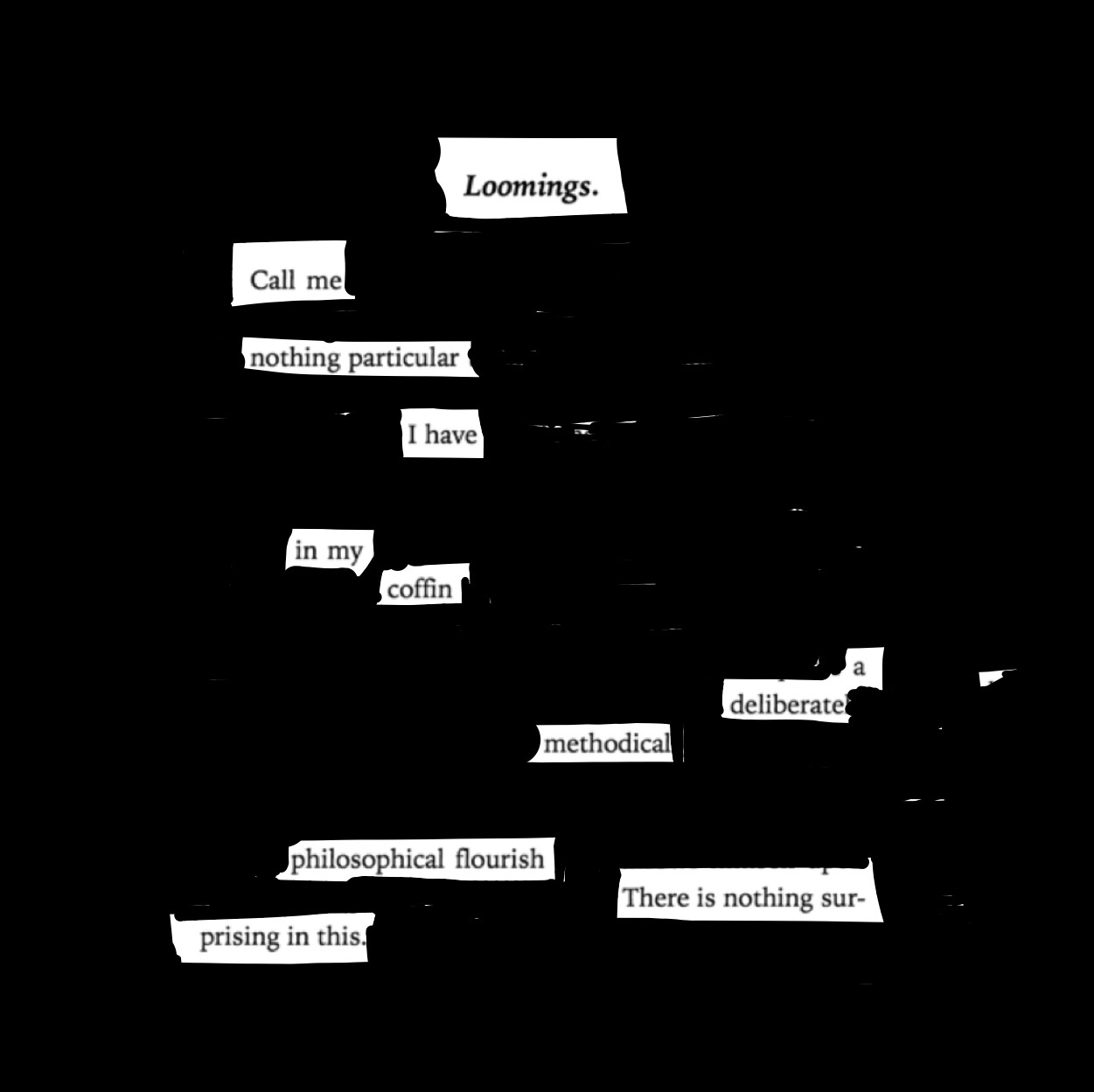
Blackout Poetry – An Attempt of Questionable Merit

image


I have loved Austin Kleon’s work (@austinkleon) and I own his book, Steal Like An Artist (It’s fabulous. Get a copy). I follow his tumblr and love reading his work.

So I decided to give it a go. Armed with my iPad, a digital copy of Moby Dick and Notability, I ripped into the first page of Herman Melville’s tome. 

What does it mean? I. Have. Absolutely. No. Idea. I like how it sounds. And I’ll be adding this to the collection of poems I have on tumblr (even if it’s not a Post It Note).


Releasing A Story Is Like Farting In An Elevator

In the midst of my writing journey I am contemplating releasing a collection of Post It Note Poetry and Micropoetry. This is before I have sold a novel, completed a novella or sold more than one short story to a paying market. 

There are a bunch of questions hanging around:
Is it too early? 
Have I progressed as a writer to have confidence in my work?
Is it an act of onanism?
Or is it, as the title of the post alludes to, farting in an elevator. You want to do it because all the comedy films tell you it’s funny. You want to let it go it but unsure if there will be a sound to tell people of your release. Or maybe you want there to be a mighty trumpet.

The reality is, it may simply stink no matter how much you enjoy the release.

A writer never has confidence in his or her own work. I know I doubt what I write. I look back at the early beginnings of what I wrote, as evidenced here on the blog, and cringe, but I see the foundations of my writing. And others also saw the potential in the chaff and offered me opportunities to develop. And yet, I still lack confidence. But I believe in the potential I have.

But here’s the thing. I know I can get the opinions and advice from people I trust, who will tell me if my work is a pile of word vomit or worth putting out. 

Every piece I write will be a reflection of my skill and development as a writer AT THAT POINT. I won’t be embarrassed at the beginnings but understand it is part of the apprenticeship I served to become a writer. I liken it to going through a band’s back catalogue.

So next time I fart in the elevator, I hope you laugh along with me because I’ll be laughing with you if it’s you who farts instead.

Throw Out Thursday – 99 Word Stories

Recently I came across a site 99fiction.net running a monthly competition for stories no longer than 99 words.

I started to write a couple of pieces but ended up abandoning them. It was a good experiment and writing exercise but they were taking away time from other projects that needed priority.

I will share them below as I intend to adapt them into poems in the future.

1.
He pulled up on the footpath, bringing the scooter to a halt before the STOP sign in literal, simple obedience. A first trip around the block without Mum or Dad. He waited with an understanding that permission needed to be granted before he could GO.

He waited, hands hung loosely over the handle bar, one foot on the deck while the other poised to push off the concrete footpath, shifting feet when one became tired of bearing weight.

Cars pulled up to the intersection, stopped, proceeded and he wondered who gave them permission. Looking around, he rebelled.

2.
I wait for the days when the four lanes of road outside my house are silent. When I can stand in the middle of the road, one foot on each of the parallel white lines, and watch the road bend and dip to the right when facing south. Or turn north, feet still planted on the parallel lines and see the road rise towards the crest and veer slightly to the right again. It is when I imagine I am the only person. Today I intend to stop traffic.

You may want to have a crack at writing your own very short stories or using one of these as the prompt for your own piece of writing.

Remixing is the New Creating Part 2

Earlier in the month I mentioned I had a piece listed on the if:books Australia Open Changes project titled The Storm. It was a remix of a previous work, Jodi Cleghorn’s poem, ‘Later.’ I took the line, “born up on the cicada chorus.”

In good news, I have another piece featured in the last week. You can read ‘The Naked Rosehere.

I took inspiration from Jodi Cleghorn’s piece, ‘She Would Be Grass.’ In particular, the line “On the ninth day, green patches of turf appeared.”

Now the project is closed, it will take the form of a story tree. I will let you know when it is up for you to have a goosey gander at.

Remixing Is The New Creating

if:books Australia is running a remix challenge, Future of the Book.

Each week, 4 or 5 very short pieces (all sub-200 words) are posted and you get to use a paragraph or line or word and remix it in whatever way you choose.

You can write a poem, submit a drawing or photograph or write a short piece of fiction.

This week, one of my pieces is up for a remix.

Here’s the link:  Future of the Book

Have at it!

Do You Want Story Time?

My collaborative writing partner, Jodi Cleghorn (with whom I wrote Post Marked: Piper’s Reach) has just released a new collaboration with Claire Jansen.

She explains the process here.

Let me give you the blurb.

Three days before Christmas Amber lands in Australia to celebrate the festive season with Ben. But he’s not expecting her or the news she brings. Her presence sends radial fractures into Ben’s life and those close to him, from his sister to his lover and beyond.

Told across a single day, through the eyes of five characters, ’24’, delves into the complexities of the relationships closest to our hearts.

This is not a long read, 12 episodes of approximately 500 words each, criss-crossing between blogs. What hooked me was the multiple narrative points of view telling different aspects of the story, but more than that, in such a concise word limit and narrative time frame, the characters are wonderfully fleshed out.

I can see the possibilities of this being developed further into a longer short story, even a collaborative novel. Dare I say it, a TV miniseries. 

This is a great read and well worth your time with a cup of tea or coffee and your favourite biscuit.

The first instalment of your reading journey starts here with “24” – 06:00.

Throw Out Thursday – Changing Form

During the week I was sifting through old poems on my hard drive looking for possible works to submit to an anthology a friend worded me up to (didn’t find anything of note although I did find a younger version of me writing complete tripe).

I came across two half-finished pieces and combined some stanzas to make a relatively cohesive whole.

The starry satellites stand sentinel
over silent musings while an observer
of a different reality speculates on the starry host
these pinpoints of silver across the velvety blanket
blink without recognisance
Looking towards the blanket of the night sky
He sees a thousand times a thousand times a thousand
pinpoints of light and asks
“Does God shine a torch at night through the little holes?”

Posting it to my crit group for giggles brought one of the group to suggest it would work as a tanka. No, not a tank top.

What is tanka? Think of it as an extended haiku.

It has a 5-7-5-7-7 syllable count, as per the Japanese guidelines (not necessarily the same in English when translated but English writers use this basic format when starting out).

Go here for an introduction: http://www.ahapoetry.com/Bare%20Bones/wfftocintro.html (with thanks to my crit member, Sean for the link. There are some wonderful examples to read.)

A quick check with my copy of Stephen Fry’s ‘The Ode Less Travelled’ and the link above, I had a grasp of the basics of tanka. And by grip I mean a loose hold. And by loose, barely touching.

And this is what I came up with:

pinpoints of silver
against the velvety black
a blanket of stars
“Does God shine a torch at night
through the little holes?” he asks

I now have a new understanding of how form can affect and benefit a piece of writing. Changing form, in this case, forced me to focus on what were the significant images I wanted to convey in the poem, leading to the final line. Sometimes it could be as simple as breaking the line or stanza arrangement. Sometimes less is more.

But changes to a piece could be in the form of changing point of view, turning a story into a poem or a poem into a short story.

Has changing form helped you with a piece of writing?

I Found More Poetry Under The Lounge

 I find poetry in all kinds of places, often under the lounge and I found some more there recently.

Right now the end of winter is approaching here in the southern hemisphere (not that we had much of a winter where I live – what happened to those good old fashioned frosts we had as kids?) and with it the promise of hay fever, runny noses, itchy eyes and a cursing of all things frolicking. The first and last poems assembled here, Magnolias and Windy Days, are inspired by the wintery season.

Magnolias

As I drive past
The magnolia blooms
A thousand sunrises
Of pink to white and
A thousand sunsets
Of white to pink
Simultaneously

Standing By

I stand in the longest corridor
possible, pretending I’m Red 5
barrelling down the trench
avoiding laser blasts
to my office door

The Last Page

When you close a book
Do you think it will be
The final time?
Never to peer
Between the pages and
Read the tongues of men
Again

My Companion

I walked in darkness
But was never afraid
For I felt your hand
In mine, or around
my waist, looped over
my shoulder as my light

Generations

She watches
grandmother’s knitting
learns the art of rhythm
the pulse of long thin bones
curses the dropped stitch
like her grandmother

Windy Days

I imagine with each 
breath of wind
the trees ask
for our silence
a gentle ‘Shhhh’
simply to listen
to our own
heartbeat
Which poem resonates with you?