Tag Archives: experimental

Experimenting with Storybird

I came across the Storybird www.storybird.com website during the week and was initially reluctant to sign up for the free account (yet another log in to remember) but I gave it a crack.

You can do three things with it

  1. write poetry
  2. write a picture book
  3. write a chapter book/novel

You use the images as a stimulus to create a piece of work.

You can write for the following age groups.


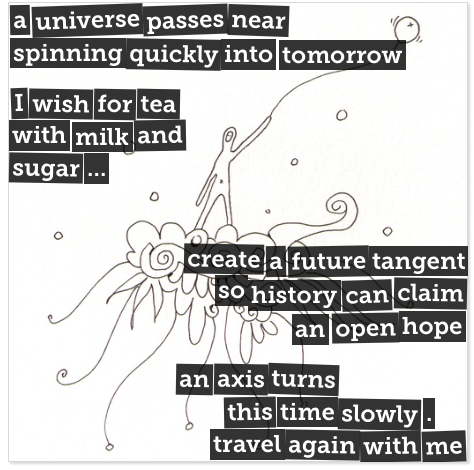
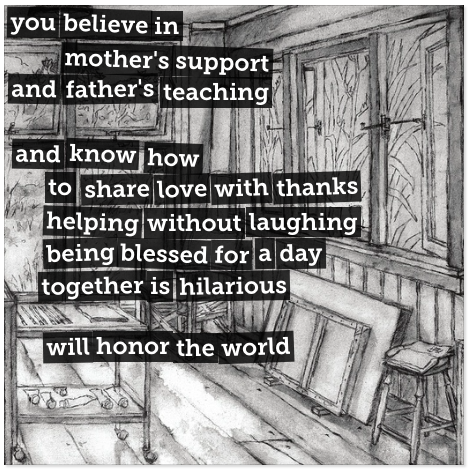
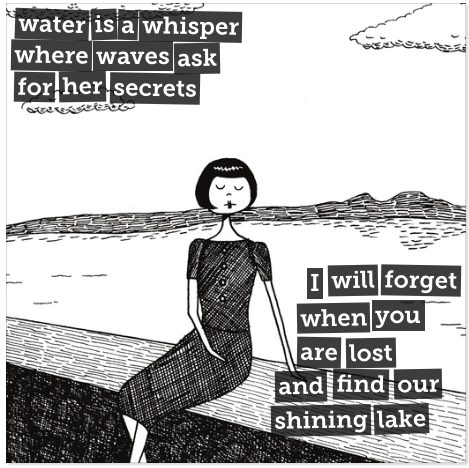
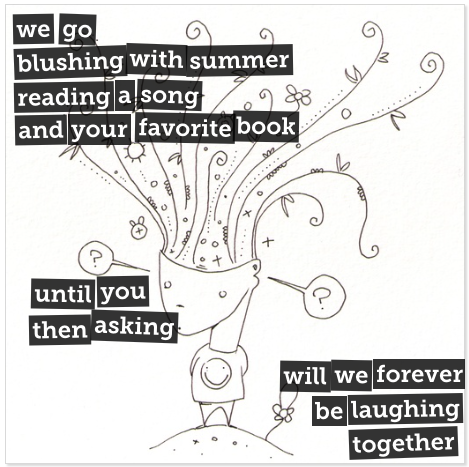
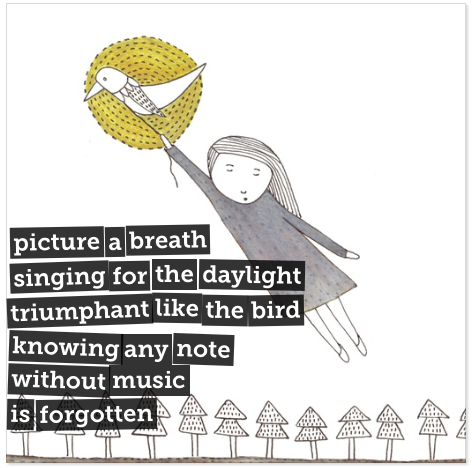
I began experimenting with poetry. You take a single image and are given a random selection of words. Think Magnetic Poetry for your fridge.

You are limited with the words you are given and this can sometimes be a frustration. However, the limited vocabulary makes you focus on what you can do with the words at hand. Sometimes the words are almost useless and you scrap it and start again.


These are some poems I have created.
Screen Shot 2015-09-23 at 10.03.44 am

Screen Shot 2015-09-23 at 10.03.53 am

Screen Shot 2015-09-23 at 10.04.04 am

Screen Shot 2015-09-23 at 10.04.11 am

Screen Shot 2015-09-23 at 10.04.18 am

I also have a picture book using a haibun(a mixture of prose and haiku) as an experiment. I was limited by the number of images provided to create a strong narrative.

Before a picture book is ‘published’ it is vetted by the site. I found my story had been approved within less than 24 hours. I suspect this is due to the broad audience range available.

I can see this being a good tool from an educator’s point of view as a way of helping students experiment with language, create their own stories with visuals already created (artists can also submit their work for use but I do not know how they are supported and/or paid).

It is useful for a 10 minute creative break, or something to spark your imagination if you’re feeling stifled.

I am not sure how far to go with it but for the moment it is a fun, creative way to pass the time and get you thinking and creating. It may lead to other works or ideas. Ultimately it’s another tool you can use to be creative.


The (Auto)Biographical Act of Story Telling

There is an adage used to help novice and beginning writers to “write what you know.” It is a helpful piece of advice to assist new writers to tap into personal experience to develop an emotional, spiritual, physical authenticity to their writing. It helps to frame the emotional resonance of story that makes a reader want to continue, tapping into the shared emotional journey we all face.

At some point a new writer needs to move beyond this adage and into the broader realms of imagination. Once you understand the emotional focus of the story you are telling, the characters take on a life of their own.

The emotional repertoire at your disposal is based on your own life experiences, stories you’ve heard, read or seen.

But at what point does the author separate herself/himself from the character of the story? How much of a character is a reflection of the author? What is deliberately included or excluded.

The answer to that is up to the individual author to decide. Some authors may make a character a thinly veiled version of themselves or a direct parody. It may even be an autobiographical version in a fictional universe.

For me it is the engagement with the character as presented on the page, their trials, tribulations and triumphs; engaging with the emotional core of who the character is and how I see myself within, or influenced by, the character.

Poetry is perhaps more problematic when using the first person pronoun as it is, I suspect, interpreted by the reader as the persona of the author. This may be true in some cases but what if it is not?

I posted this poem to Twitter recently and use the first person pronouns yet it is not autobiographical, nor is it based on the experience of another.

our intimacy is found 
in the peeling of a mandarin 
damaging the skin to eat 
the flesh inside 
uncertain of a bitterness 
or sweetness

It is drawn from my emotional repertoire, an understanding of human relationships. Is there a part of me in this poem? Perhaps. But it was not written from my perspective. You, as the reader, will not know my intention or purpose; you read the poem as it is and respond to it from your own experiences and perspectives.

Within the act of reading poetry I think we internalise the focus of the poem if it is written in first person, taking on a new perspective and seeing the world as presented through the poem. It is an intimate connection with a text separate from the persona presented or the author’s intent behind the construction.

All of this is academic meanderings, like searching through your underwear drawer for the odd sock to make a pair.

Do you read a story differently to a poem? Why?

What’s In A Pronoun?

The other day I scribbled this hastily worded poem onto twitter

She ties the night sky
loosely at her throat
a cape of stars trails behind
curls it around the boy
with the cape of sunshine
a gentle kiss

So far, so good.

However, it started differently.

The original line was “He ties the night sky/loosely at his throat”. To me it was reminiscent of children playing superheroes, tying an old towel or something similar around their throats as an impromptu cape (even if Edna Mole says, “No capes!”).

I was halfway through writing the poem, had an ending in sight, and I stopped myself and asked why I had used the masculine pronoun. On Twitter space is a premium and the inclusion of an extra letter could mean tighter editing in other places.

If I am writing poetry I will use pronouns in place of names for the sake of brevity and to give the persona a general facade for the reader to ascribe her/his own interpretation.

However, the masculine pronoun is not my default position; the content of the poem generally dictates my choice of gendered pronoun. Many of my stories focus on the feminine.

In this case, the use of the masculine pronoun was predicated by the content. Boys and capes are familiar tropes. The masculine is the dominant voice in our culture, to the exclusion of the feminine.

Therefore to change the pronoun is to change the emphasis of the narrative. 

There is nothing deep or meaningful on this poem but to change the pronoun order from masculine to feminine is to give agency and power, something our society needs to do more of.

Even in looking over the word choices in the poem as it currently stands, changes would affect meaning. If I used “man” instead of “boy” I alter the emphasis, the perception of the reading. Similarly, replace “boy” with “girl.” How would you read it now?

The written language is the best way we have to communicate, as inadequate as it some times. 

Are you conscious of the gender you ascribe to your work? How do you apply it?

What Is the Parallel Between Writing and Drumming?

What is the parallel between writing and drumming?

The TL;DR version: vocabulary is essential for writer and drummer. Read widely, listen carefully, & choose the right word for the sentence.

For a fuller explanation, read on.

The parallels between writing and drumming become clearer each time I pick up a pen or a set of sticks.

Writing fiction consists of ordering letters into words, words into sentences, sentences into paragraphs, paragraphs into a completed narrative, whether it is a short story, novella or novel.

Drumming consists of ordering strokes into patterns, patterns into grooves, and patterns into fills.

Drumming is made up of 3 basic sticking combinations:
– the single stroke roll RLRL RLRL*
* R = right hand L = left hand
single-stroke-roll-1– the double stroke roll RRLL RRLL
double-stroke-roll-1– flams
flams-1
Everything is then a combination of these basic sticking patterns. For example, the paradiddle RLRR LRLL combines the single stroke and the double stroke
single-paradiddle-1

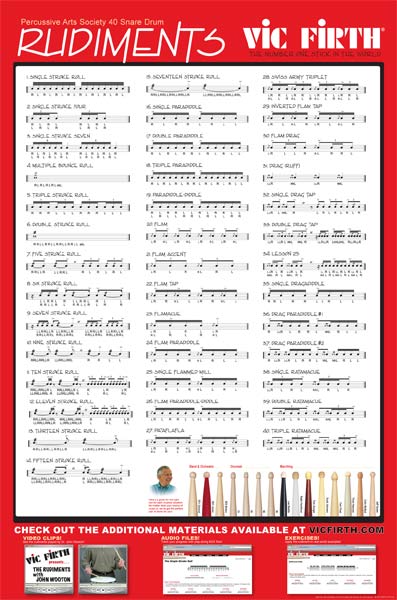
Other rudiments include the 5-, 7-, 9-, 11- and 13-stroke roll; flam paradiddles, triplets etc. All in all, there are 40 recognised basic rudiments to master. 

PAS 40 Drum Rudiments

This forms the vocabulary of the drumset, starting with the snare drum then expanding the rudiment to be played on other surfaces of the drumset from toms to bass drum to cymbals or other sound sources. 

Knowledge, and mastery, of the rudiments gives a drummer a vocabulary to draw from when playing. At times it can be as simple as this:

to the complexity of this: (it is well worth the time to listen to the introduction to understand why this piece came into being)

And then this because it is just so cool:

Being literate is the fundamental key for both writing and drumming. A limited vocabulary limits the power and extension of what you are trying to say. 

Profound thoughts are often expressed with the simplest of words.

When I was studying New Testament Greek, at the first class, our lecturer had us turn to the Gospel of John and read the first few verses, in Greek. We were novices, had no idea, but with a few helpful hints we garbled our way through. The lecturer’s response was to comment that it was very simple Greek, yet contained much that was deep and profound. 

Similarly, when I was reading Cormac McCarthy’s “The Road,” I was struck by the simplicity of the language; very understated without frivolous embellishment. Yet it was in the simplicity of the language that the depths of the horrors of the world he was describing were manifest.

And complex ideas are also expressed in language so dense you need to be initiated to understand it. I have tried to read A.S. Byatt’s “Possession” but couldn’t get past the first page.

The hardest part is knowing when you use the vocabulary you have at hand: either the simple or the complex. Both serve a purpose.

The Takeaway

Mastery of vocabulary is paramount for both writing and drumming. Expanding your own vocabulary and voice is essential to tell the narrative you want to tell, to communicate the emotions you want the reader or listener to engage with.

Master the language by
* Reading widely

* Listening carefully.
* Experimenting with voice.
* Choosing the right word for the sentence.

Hopes and Fears – A Poem and Deconstruction

As I am wont to do, I write poetry on twitter to explore, experiment and elucidate. 

This is today’s poem

Hopes and Fears

we are scared of our dreams;
not that our worst fears
will come to life
but the fulfilment of our hopes
will be the end of who we are

But I also have a good group of writing friends who are happy to pile on critique and feedback. Rob C suggested this: “This is great: simple-yet-complex, hugely poignant, heavily true. If you’ll allow a suggestion – ‘afraid’ instead of ‘scared’, for the softer sound, the more thoughtful intonation to match the philosophical backbone of the poem, and to match the ‘f’ sounds that run throughout.”

My response was this: It’s a little more philosophical than I am used to writing; there is no concrete imagery to ground the idea (my writing modus operandi), relying more on the intellectual to make it function.

Rob felt he may have overstepped the mark. He hadn’t. I said to him, “Nope; I like the feedback. Helps to see new things. It was written on the spur of the moment, as is most of my twitter poetry so refinement is not a part of the process. Some editing is involved but without depth. Comments help refine and edit, with the hope of putting it into an anthology in the near future.”

Writing is never a solitary act; it’s collaborative. I may write in isolation but my writing tribe helps me refine and improve my work. 

So a simple suggestion, the replacement of a single word, has made the poem stronger. 

we are afraid of our dreams;
not that our worst fears
will come to life
but the fulfilment of our hopes
will be the end of who we are

Finally, there is the reader who is involved in the construction of meaning. That’s you. What meaning do you make?

Things To Throw Away – A Poem And Its Deconstruction

This started as a poem on twitter and I thought I wanted to expand on the idea a little as a practice exercise.

Things to Throw Away:
the shaggy toothbrush
the unworn shirt
the leftovers
the poetry I wrote as a child
the fear I cannot do this

When I came to expand it, I saw the completeness of it; adding to it would be padding out the original idea, hastily written as it was.

Instead, let me explain why I chose the images and the final line. As an English teacher, this is what I get my students to do: deconstruct a text to see how the components fit together. Therefore it behoves me to do it to my own work, to understand what I am doing and why; to make conscious the unconscious.

I chose the images as concrete ones, specific items the reader would recognise, an item they could visualise in their own house. Each item contains the principle that they have been held on to for too long, or has outlived its usefulness.

I am known to hang on to toothbrushes for longer than is recommended, and it’s not a big effort to get a new one, but there’s a comfort in what is known. I could replace the shaggy toothbrush image with that of holey underpants for more of a giggle.

The image of the unworn shirt suggests an item that we hold on to because it was a gift, or it was something we want to fit into, but it’s another delusion of ourselves.

Leftovers in my fridge are either consumed immediately or linger like a lost soul, discovered when there is a culture of organisms breeding. Why do we do it? Neglect? Forgetfulness? Apathy? 

Bad emo poetry; we all have to start somewhere as writers. I still have notebooks I wrote in as a teenager and I recognise the child that I was. Nostalgia holds very tightly onto objects of significance and is afraid to relinquish them.

The final line was always designed to be a twist, a shift from the concrete to the metaphysical and emotional. For me, a poem about emotions needs to be grounded in physical objects, a concrete image. It can also be done with clever similes or metaphors but I prefer physical descriptions (perhaps a weakness to strengthen – to think more poetically).

It’s about letting go, releasing yourself and being free of objects, memories or emotions that restrict your development. Would it help you to know it’s autobiographical?

There you have it. A poem and its deconstruction. If you disagree, have at it in the comments.

Thanks for reading.

Absence – A Poem

It’s been a week of rediscovering micropoetry, using the boundaries and confines of 140 characters on Twitter.

This poem was inspired by a comment from Australian author, James Bradley, on depression. His comment also inspired an idea for a short story I have written down and filed away for further development. Right now it’s on the compost heap, fed with scraps of thought until I see what sprouts.

Absence

Absence grows like a shadow
lengthening with the sun
and turns light to darkness
to fill the space
retreating at its turn
never disappearing

On reflection on the type of poetry I write, focused on the little things of the everyday, I resist the urge to use simile. Metaphor, or sustained metaphor, feels less jarring than the input of a simile. However for this one the imagery required the simile to set up the remainder of the poem and the final line. 

Looking at it now, I could replace the first line with a metaphor, “Absence is a shadow,” and I feel it works better, making the link to the imagery cleaner and less like a teacher demonstration. 

The other issue is the use of “its” (line 5) as it is unclear what is the subject of the preposition. I know “its” refers to the sun but that may be unclear to the reader and you want the imagery and lines to stand for itself, not require the reader to unpack the grammar to find out what is truly meant.

So, an edited version.

Absence is a shadow
lengthening with the sun
turns light to darkness
to fill the space
retreating at the turn
never disappearing

Slogans for Poetry – A Poem

This excerpt was the inspiration for another twitter poem. 

Tomorrowland, directed by Brad Bird, was a box office disappointment and has been poorly received by critics. It has a 49% on Rotten Tomatoes. A. O. Scott of the New York Times wrote that the film, “searching for incitements to dream, finds slogans and mistakes them for poetry.”
The full article is here on Buzzfeed.

our poetic voice
of heart’s passion
mind’s emotion
is reduced to
soundbite
slogan
sycophancy
slowing the heart
until the pulse
peters
out

To be honest, I’m not happy with the result because A. O. Scott says it so much better. There’s such poetry in his statement that my attempt to remix his words into something new seems feeble.

It’s a sentiment I like and one I will return to after it has composted in my head for a while longer.

What do you think of it? In the words of Count Rugen, “Remember, this is for posterity, so please, be honest.”

More Collaborative Poetry

I wrote another haiku yesterday, posted it to twitter and copied in Sean (@SeanBlogonaut) to see what he could add to form a tanka.

fading amber leaves
blown into the courtyard corner
lovers’ forgotten kisses

Sean added the final lines:

fading amber leaves
blown into the courtyard corner
lovers’ forgotten kisses
would that my love return
like the green leaves of spring

He also played with the second last line

fading amber leaves
blown into the courtyard corner
lovers’ forgotten kisses
how I wish my lover would return
like the green leaves of spring

We were playing around with this on Facebook, on a private page for our small group of writers, and after reading through Sean’s ideas, I added my own versions.

fading amber leaves
blown into the courtyard corner
lovers’ forgotten kisses
I wait for my love’s return
with the green shoots of spring

*****

fading amber leaves
blown into the courtyard corner
lovers’ forgotten kisses
I wait for my heart’s return
with the green shoots of spring

This is the fun of collaboration, learning with each other the intricacies of a new art form.

Into the mix Jodi Cleghorn (@JodiCleghorn) added her own version using my original haiku and added her own final lines to form another tanka.

fading amber leaves
blown into the courtyard corner
lovers’ forgotten kisses
left to decay
with the memory of you

As she said, “Thank you for new ways to play and collaborate.” 

Ultimately, this is what it is all about: new ways to play and collaborate. The apparent simplicity of haiku and tanka reveals a deeper, more sophisticated art form that while simple to learn is difficult to execute and takes years to master.

But the evening’s fun continued. Jodi wrote two haiku while out at the shops and posted them for us to add two final lines to form a tanka.

an autumnal drift
shedding selves compost
buried beneath

*****

frost-bitten feet
walk from the place
I forgot to leave

I took the haiku and added my own final couplet

an autumnal drift
shedding selves compost
buried beneath
resurrection of the dead
in someone else’s life

*****

frost-bitten feet
walk from the place
I forgot to leave
in the hope
your heart will thaw

frost-bitten feet
walk from the place
I forgot to leave
in the hope
your heart would thaw

In the last two, the change of a single word, “would” for “will” creates two very different meanings and both a valid.

Here’s a challenge: take my haiku and write two final lines to form a tanka.

fading amber leaves
blown into the courtyard corner
lovers’ forgotten kisses

Mending the War – Flash Fiction

This was a piece I submitted last year to a competition. No result. Another piece to help me practice. 

But I’d like you to have a read and tell me what you think.

She looked up from the sock she was darning, needle paused mid-stitch, and watched the missile burn across the blank expanse of blue sky, rending it in two.

“Where is it going?” asked her granddaughter.

“To war.”

The smoke trail began as a small tear, slowly expanding, making the rift wider, ragged. Slowly, imperceptibly at first, the blue pushed through the vapour trail, dissipating the smoke.

“There will be another,” said the grandmother.

“When will we have peace?”

The needle wound through the fabric and pulled the two halves together.

“When we have learned to mend our hearts.”