What is the parallel between writing and drumming?
The TL;DR version: vocabulary is essential for writer and drummer. Read widely, listen carefully, & choose the right word for the sentence.
For a fuller explanation, read on.
The parallels between writing and drumming become clearer each time I pick up a pen or a set of sticks.
Writing fiction consists of ordering letters into words, words into sentences, sentences into paragraphs, paragraphs into a completed narrative, whether it is a short story, novella or novel.
Drumming consists of ordering strokes into patterns, patterns into grooves, and patterns into fills.
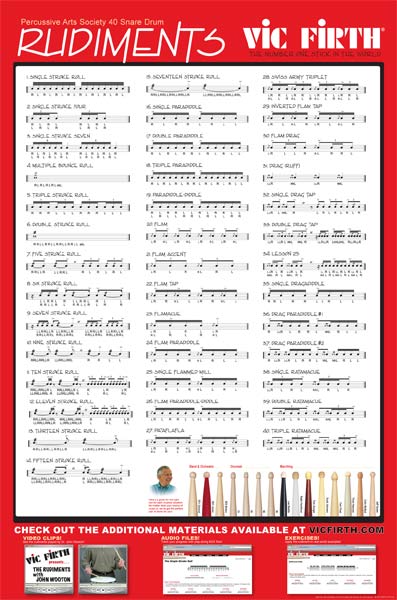
Drumming is made up of 3 basic sticking combinations: – the single stroke roll RLRL RLRL* * R = right hand L = left hand – the double stroke roll RRLL RRLL – flams Everything is then a combination of these basic sticking patterns. For example, the paradiddle RLRR LRLL combines the single stroke and the double stroke
Other rudiments include the 5-, 7-, 9-, 11- and 13-stroke roll; flam paradiddles, triplets etc. All in all, there are 40 recognised basic rudiments to master.
This forms the vocabulary of the drumset, starting with the snare drum then expanding the rudiment to be played on other surfaces of the drumset from toms to bass drum to cymbals or other sound sources.
Knowledge, and mastery, of the rudiments gives a drummer a vocabulary to draw from when playing. At times it can be as simple as this:
to the complexity of this: (it is well worth the time to listen to the introduction to understand why this piece came into being)
And then this because it is just so cool:
Being literate is the fundamental key for both writing and drumming. A limited vocabulary limits the power and extension of what you are trying to say.
Profound thoughts are often expressed with the simplest of words.
When I was studying New Testament Greek, at the first class, our lecturer had us turn to the Gospel of John and read the first few verses, in Greek. We were novices, had no idea, but with a few helpful hints we garbled our way through. The lecturer’s response was to comment that it was very simple Greek, yet contained much that was deep and profound.
Similarly, when I was reading Cormac McCarthy’s “The Road,” I was struck by the simplicity of the language; very understated without frivolous embellishment. Yet it was in the simplicity of the language that the depths of the horrors of the world he was describing were manifest.
And complex ideas are also expressed in language so dense you need to be initiated to understand it. I have tried to read A.S. Byatt’s “Possession” but couldn’t get past the first page.
The hardest part is knowing when you use the vocabulary you have at hand: either the simple or the complex. Both serve a purpose.
The Takeaway
Mastery of vocabulary is paramount for both writing and drumming. Expanding your own vocabulary and voice is essential to tell the narrative you want to tell, to communicate the emotions you want the reader or listener to engage with.
Master the language by
* Reading widely * Listening carefully. * Experimenting with voice.
* Choosing the right word for the sentence.
2015 is here and whether you celebrate it with good intentions or good champagne, there is something about the marking of a new year that sets it apart.
Last night I played at a New Year’s Eve gig (I play drums in my spare time when I’m not teaching English or writing) and we always end our set with the song, ‘Wish You Well’ by Bernard Fanning (Powderfinger).
It’s a beautiful sentiment and we love playing it at weddings especially, to bless the new bride and groom, but it’s a positive sentiment to give to all our audiences.
This year holds so many possibilities, many of which I have not foreseen, some I have planned for, but I intend to live out the year focused on the adage to ‘love thy neighbour’ because only when I seek to serve others will there be freedom and peace on Earth.
And so, with that in mind, I just want to wish you well for 2015.
As a child, colouring outside the lines was the mark of a juvenile understanding of boundaries and parameters: they were ignored.
You were handed a pencil or crayon and a colouring book and told to have fun. And fun was most definitely had. Scratched lines of pencil or crayon all over the page. There was fun simply in the act of creating marks on the page.
Yet gentle adult encouragement made you aware of the lines of the picture; the boundaries drawn to keep the colours within.
So you took extra care and effort to colour within the lines and make the picture look special. You were disappointed if your pencil or crayon slipped over the line, extending the colour beyond its prearranged designation.
And so it is with any creative endeavour. Initial enthusiasm and fun is gradually replaced with awareness of the skills, parameters and boundaries of your chosen creative medium. You become a skilled practitioner of your creative art and can produce good work.
So, how do you extend your creative skills? How do you extend your knowledge and understanding of your medium? When you are entrenched in your chosen creative medium, whether it’s art, literature, film, painting or music, how do you extend the boundaries and parameters?
You learn to colour outside the lines again.
As a drummer playing contemporary music and musical theatre, I am used to the drums forming a rhythmic foundation, providing timbre, dynamics and tone colour, the beat and rhythm.
The other day I had the opportunity to meet up with Adrian, an old teaching colleague of mine who is an art teacher, musician, boutique record label owner and producer, and a mutual friend and drummer, Costa.
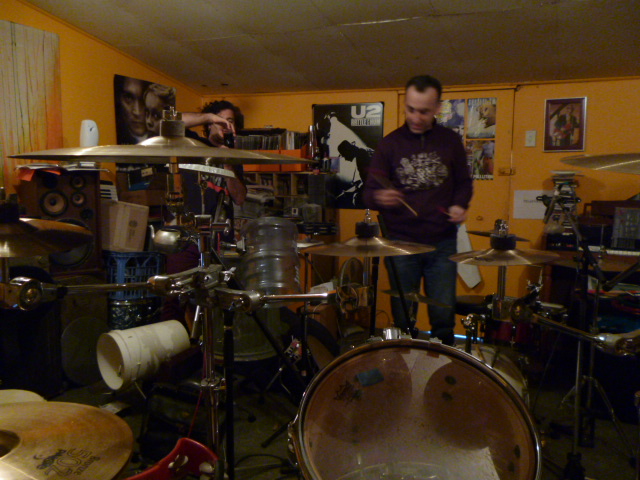
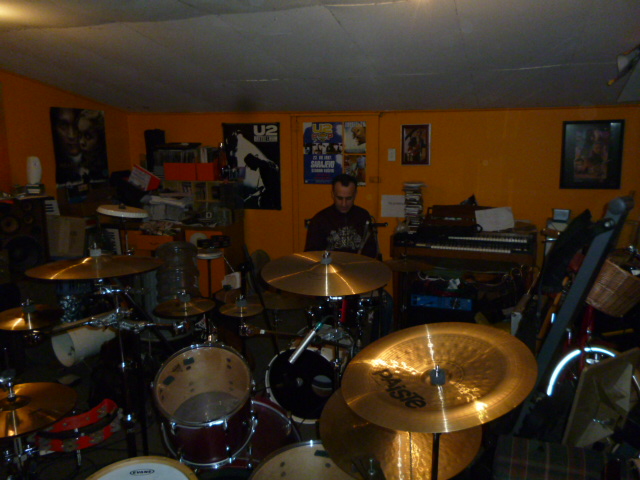
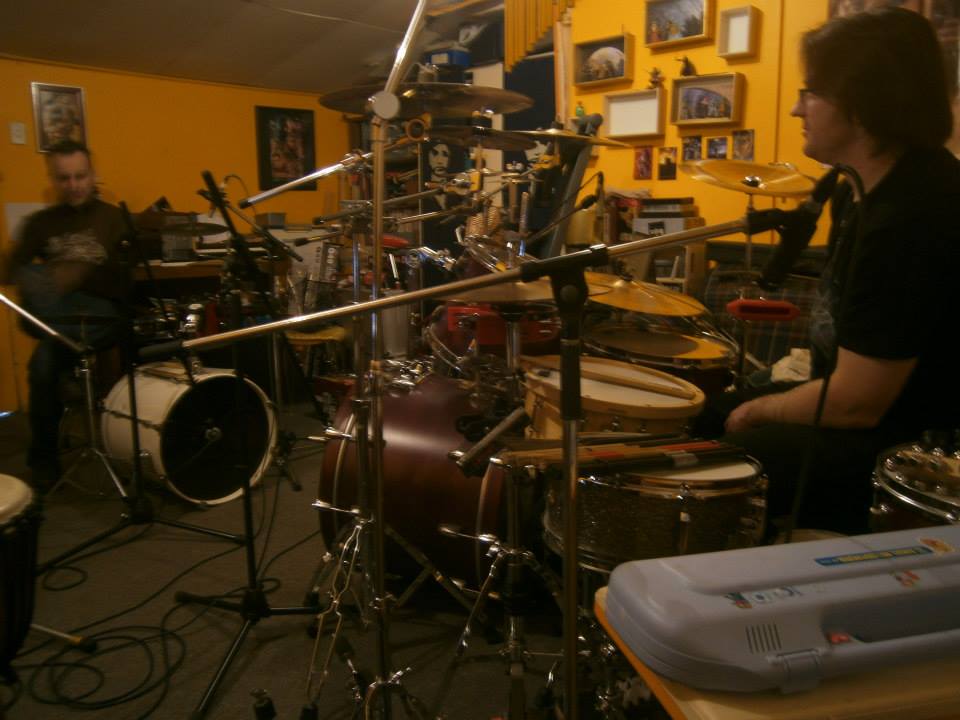
The three of us convened in a small home studio out the back of Adrian’s house. We lugged gear in and set up while Adrian placed mics.
There was no preconceived ideas as to what we were going to play and record, except for some youtube clips we had looked at earlier. There were no lines to demarcate the boundaries of our creativity.
Yet how easy it is to rely on the boundaries of what we know. As drummers Costa and I fell into an improvised jam in 6/8, using a form that was familiar to us, creating a beat and rhythm. As we played we listened to each other, playing around each other’s grooves and timbres, sometimes playing with the groove, sometimes playing against it.
We were colouring within the lines.
I learned to colour outside the lines because of Adrian’s artistic vision and creativity.
Adrian suggested for the second jam an experimental form playing in different time signatures: Costa played in 4/4, I played in 5/4 and Adrian played in 7/4. It sounded gloriously messy as we experimented within the constraints of the time signature allocated while listening to what the others were playing.
The last jam was truly a learning experience of colouring outside the lines. Adrian suggested we play not rhythms or beats, but focus on the sounds produced from each part of our instrument.
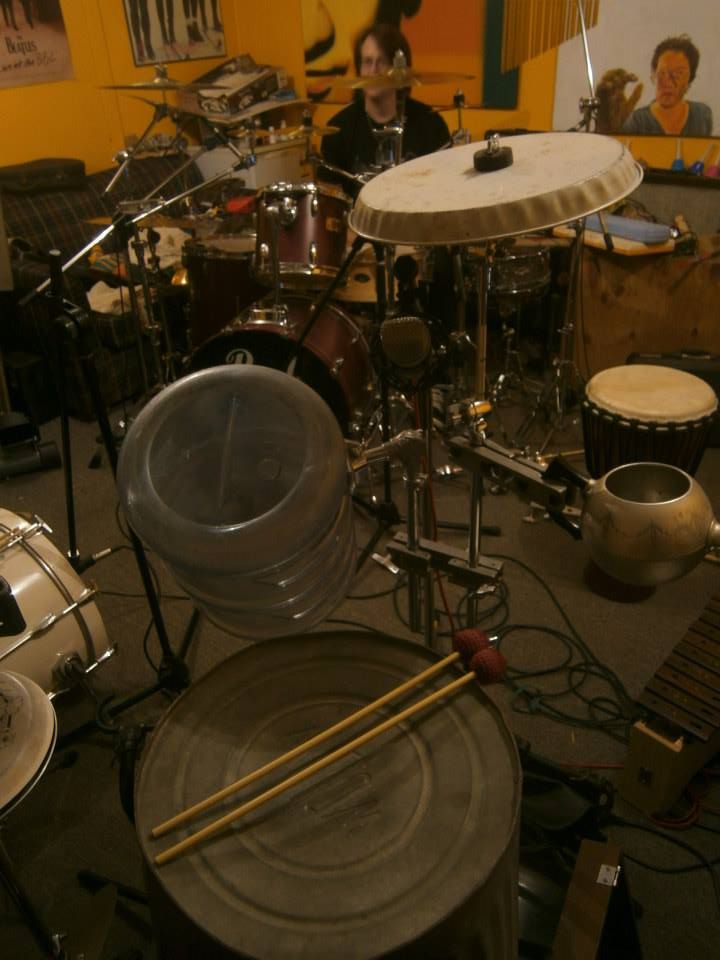
We used sticks, mallets, brushes, rods, plastic rods on all parts of the drums and cymbals including the rims and stands. I threw a handful of sticks into the air and let them fall where they may. I bounced sticks, mallets and rods off my snare to see where they landed. Adrian used a violin bow on cymbals and played mallets on my kit, Costa’s kit and their “junk” drum kit which consisted of a metal garbage bin, water bottles, saucepan lids made into hi-hats and a metal tea pot.
It was this last improvisational jam that really expanded my understanding of rhythm, drums and music in terms of creativity. It allowed me to colour outside the lines as I was not focused on the traditional parameters of my instrument, rather learning to see outside the lines and create accordingly.
Artists talk about the ‘negative space’ on the page; what is not there is as important as what is there.
My next step is to apply this principle to my writing.
Whatever creative medium you are engaged in, whether it’s writing, music, art, have you learned to colour outside the lines again?
Want to be a better writer? Learn to play the drums.
This is a strong statement to make, but one worth pursuing. I am postulating that understanding the tenets of rhythm in drumming helps to understand the tenets of rhythm in writing.
As a drummer it is very frustrating to have someone come up to me and say, “Can I have a go?” If I’m feeling generous I will offer the sticks and step aside.What is worse is when they sit down without permission.
Then they proceed to go about bashing and thumping my drums. They hack and whack. There is no rhythm, no pattern or structure. No thought to dynamics, velocity or touch.
And writing is just the same. If you have no idea what you are doing, you are going to be making a lot of noise and not a lot of sense.
Learning to play drums is fundamentally about understanding rhythm and how it relates to the purpose of the music.
Learning to write is fundamentally about understanding how the rhythm and cadence of words relates to the purpose of the narrative.
Learning to play the drums is like first learning how to write. We are still learning the rules of drumming (or the rules of writing) and our playing (or prose).
Let’s learn a few basic principles of drumming to understand how playing drums can improve your writing.
When you learn to play drums, you learn the simple action of RLRL (where R= right hand and L = left hand) Then you learn to play doubles: RRLL RRLL Combine the singles and the doubles to create a new combination known as a paradiddles: RLRR LRLL Then there is the triplet (counted 1 2 3): RLR LRL (or RLL RLL or LRR LRR) One more thing to know: the flam. The flam is an unaccented note (or grace note) followed by a main note. It is written as lR, rL.
Once you know these basic phrases of vocabulary, everything else is simply a combination of these phrases to form a fill pattern (or musical sentence).
When you learn to play drums, it first sounds mechanical and awkward as you adjust your body to learn new movements and patterns. It takes time to internalise the rudiments, patterns and techniques. Once you internalise the methods and patterns, it ceases to be simply rudimentary techniques, but becomes a free flowing extension of your playing.
The same applies to writing. Our first pieces of prose are often clunky and formulaic, lacking finesse and a sense of style. It takes time to internalise the process and structures of writing. For example, learning to write short sentences increases the pace or action of a passage while longer sentences slow down the pace. It’s a matter of knowing when to use different techniques.
And learning to understand rhythm in a piece of music will help you understand how rhythm works in a piece of writing and will help you to construct better prose. You understand how to achieve your purpose by using or amending the rules.
In music, as in writing, there is a place for the simple and the complex.
The simple can be effective as evidenced by Phil Rudd from AC/DC – Back In Black. It’s not a complex drum pattern, but it fits the music perfectly.
But the complex also has its place, both in writing and in drumming. Frank Zappa wrote The Black Page for drumming virtuoso, Terry Bozzio as a challenge. Nailed it.
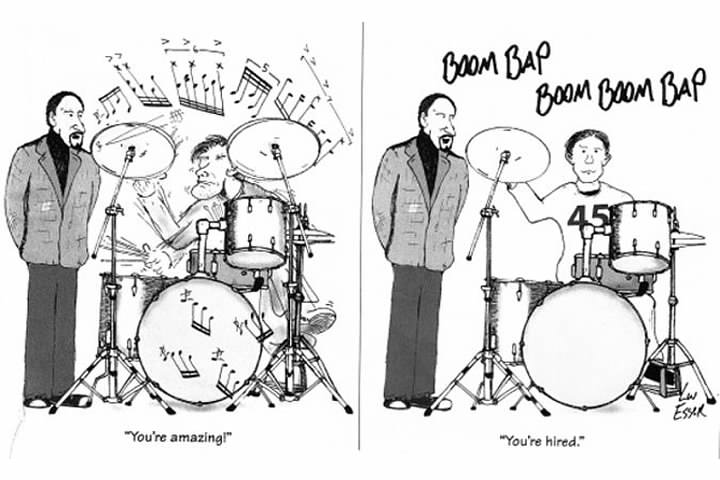
But more importantly, knowing you can be complex does not mean you have to show it off.
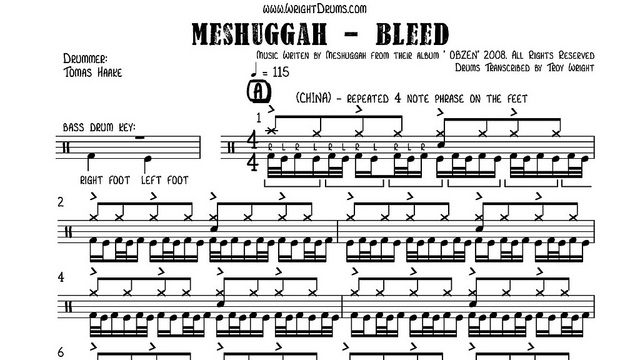
Whenever we learn a new writing trick, it is tempting to incorporate it into our latest work in progress. Drummers are no different. Learning a new fill or pattern, we tend to use it at every opportunity. Not always appropriately. Imagine a dramatic Meshuggah-style double bass drum onslaught in the middle of a jazz standard. Not always going to work. But mash ups can work. Try this: Meshuggah vs Lady Gaga– Bleedarazzi
And this is what the drums look like
In writing, the same principles apply. Sometimes simple prose communicates the message most clearly while at other times complex, dense prose is required to communicate the ideas of the writer. Neither is necessarily superior although we still tend to elevate some genres and forms (both in writing and music) over others. But each writer needs to work out what vocabulary and style is required for the message he or she wants to communicate.
Drummers: Learn. Practice. Internalise. Repeat.
Writers: Write. Edit. Revise. Show someone your work. Edit. Revise. Repeat.
I can now play drums with ease and write with ease (some of the time). But I still have a lot to learn.
When I learn a new drum pattern or piece (whether it is simple or complex), I break it down into one or two bar phrases and practice it until I have it right and internalised the pattern. Then I can move on to the next phrase and repeat the process until I have learned the whole passage. Something new always takes time to learn.
When I am writing, I am aware of the rhythm I want to create in the sentences, paragraphs, descriptions and dialogue and the emotional impact I want to create in my reader. When revising and editing, I am looking for when the writing is not fulfilling my intentions and aims, to hasten or slow down the narrative, or increase the flow and rhythm of the narrative.
A wrong word disturbs the rhythm of the narrative, much like playing the wrong fill or hitting the wrong cymbal breaks the feel of a song. The best patterns and fills sound effortless, as does beautiful passages of prose, but you know there has been a lot of thinking (and writing, editing, revising) behind it to make it seem effortless.
Learning to play drums is another way to understand how you approach the process of writing.You are building a foundation of rhythm, drawing the reader into the world you have created. You want the reader’s heartbeat to increase in the tense moments, relax during the languid moments, and to break because they have become invested in your character’s life.
Trying something new and different, perhaps difficult (for those who think they have no sense of rhythm, I think everyone can grasp the fundamentals of rhythm and beat) will have a benefit – tapping into another aspect of the creative side of your brain, and allow you to extrapolate how it can have an impact and influence on your writing.
Go and buy a pair of sticks and a practice pad, and learn how to improve your writing. If you can’t afford them, buy a small shaker. Listen to a song on the radio and play along.
If you are a writer who plays an instrument other than drums e.g. guitar, piano, saxophone or bagpipes, does that musical knowledge make you understand and approach your writing differently?
Do you really want an answer to the question, ”Who are you?”
I am an English teacher and drummer/percussionist with an interest in literary pursuits, creative endeavours, rhythmic permutations, theological amplifications and comedic outbursts.
Here you will find my creative detritus: articles on living a creative life and writing explorations.
And other ideas I have snaffled from the papers stuck on the fridge door.

 – the double stroke roll RRLL RRLL
 – flams




 A Fullness in Brevity - Adam Byatt