Tag Archives: children

Post It Note Poetry #2 – Germination

PINP 2

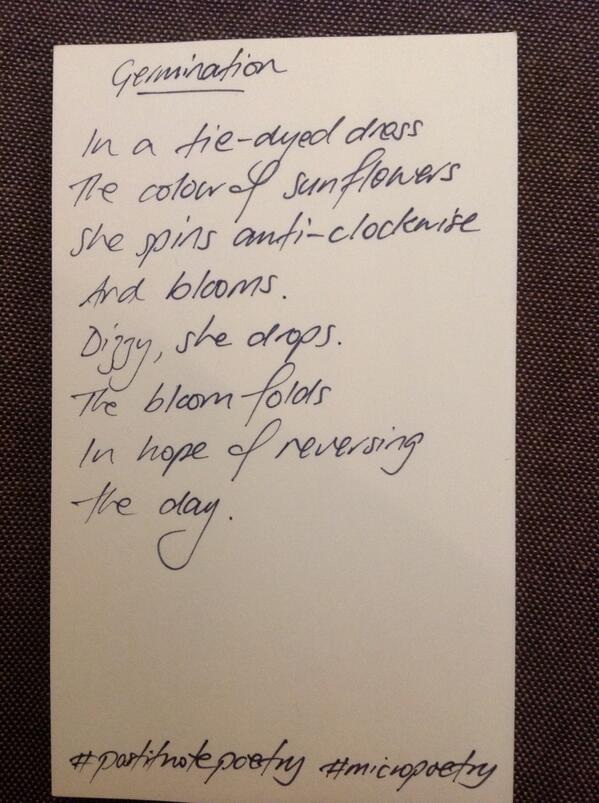
Germination

In a tie-dyed dress

The colour of sunflowers

She spins anti-clockwise

and blooms.

Dizzy, she drops.

The bloom folds

In hope of reversing

the day.

Playground Atrophy – Micropoetry

She swings back and forth
sky ground sky ground sky
Tempted to jump like her brothers
Momentum atrophies because
Choice remains

The Fence Between My Fingers

I peer between the fractured fingers of the old paling fence, the common connection of our backyards. The weathered wood splays out with lichen fingernails and mossy knuckles.

Putting my foot on the bottom rail I push up. I can just loop my fingers over the top and my lips move closer to the splintered wood, riddled with deepening cracks of age and ants in their travels. I hear it creak as it takes my added weight. The fence bears it like I’m in my father’s arms, leaning against the strain.

I imagine your hair smells like the jasmine and the wisteria crowning the fence; tangled threads and strands of green shot through with sprigs of white flowers and clusters of purple reminding me of grapes.

I peer into your backyard catching slatted snippets of sight. Squinting one eye I can see the clothesline turning slowly in the breeze. And I wonder which t-shirt belongs to you; there is a new one on the line I don’t recognise. Maybe you have some new undies too. Mum bought me Superman undies and Teenage Mutant Ninja Turtle ones.

There’s your bike leaning against the house. And you’re riding without training wheels now.

The fence is biting into my fingers and I let go, dropping back to the grass. But I look through the slatted wall again, my nose pressed into the fence. Your back door opens and I run back to mine afraid you might see me.

I wonder if you sometimes look into my backyard.

Teaching Your Children To Be Creative

Teaching Your Children To Be Creative

Creativity is an intuitive skill developed at an early age. Watch a group of children playing and they will demonstrate the intuitive skill of MacGyver with a pencil, a piece of paper, a tub of glue and some glitter.

Creativity is also a learned skill. There are those who have an innate ability to be creative, and it leaves some parents wondering where on earth it came from considering the raw material they came from.

Yet creativity is replaced with logical, analytical skills once they reach school and creative skills are sidelined. Children, and adults, need both in equal measure.

In the modern age, the creative division of parent and child is separated because we have lost the idea from the ancient world (and in the adage) that it takes a village to raise a child.

Children learned alongside their parents, were taught consciously and unconsciously in the field or the workshop, around the table or by the fire. It was taught through example and illustration, through demonstration and practical experience, through metaphor and parable, through song, dance and music.

The learning experiences between father and son, mother and daughter, father and daughter, mother and son have been broken or weakened, lessened and devalued. The interaction of parent and child is a bond to be nurtured and developed. It is a fragile bond that needs careful attention.

We must embrace new opportunities for engaging in meaningful learning and creative experiences with our children. Therefore we must teach our children to be creative.

Teaching Creativity is an Inheritance.

Proverbs 13:22 A good man leaves an inheritance for his children’s children.

Teaching your child to be creative means they have a broader skills set, balanced between the logical, analytical skills of the maths and sciences, and the creative skills of writing, art, music and dance.

It is a responsibility for the continuing holistic approach to the life of your child. The importance of developing a creative culture in the family cannot be emphasised enough.

Children need to see learning, knowledge and education are not compartmentalised aspects of life. They gain this understanding through the regimented program of school. Children find it difficult to make the links between information and subjects; it needs to be made explicit. 

An essential understanding is the connection within and between subjects for creative and analytical skills. Therefore creativity is not limited to subjects such as English, Art, Music, Design and Technology (woodwork, metalwork etc) but also an essential skill in Science and Mathematics.

Encouraging creativity in all areas of your child’s life gives them a life long inheritance, regardless of natural ability and talent in sport, academic pursuit, and traditional artistic and creative endeavours. 

Teaching Creativity is Active

Listen, my son (and my daughter), to your father’s instruction and do not forsake your mother’s teaching. (Proverbs 1:8)

Teaching creativity is an active experience. The most important aspect is also having your child see you being creative and involving your children whenever possible.

Take time to be with your child. Sit alongside them and do it with them, especially when they are younger when creativity is encouraged at all times.

If you are unsure what to do, here are some suggestions:

  • Draw half a picture and have your child finish it
  • Write half a paragraph and have them write the end
  • Write a story together
  • Build Lego
  • Garden with them
  • Colour in beside them
  • Participate in your son or daughter’s tea party
  • Make a map for your child to follow and be a real life Dora the Explorer
  • Wear a cape and be a superhero (superheroes are superheroes for either gender. Don’t discriminate.)
  • Work with them when doing Maths and Science homework
  • Build a cubby house from sheets and cushions
  • Make cars from cardboard boxes and race around the house

Teaching Creativity is Continual

My son (and my daughter), do not forget my teaching, but keep my commands in your heart  (Proverbs 3: 1)

Teaching creativity is a continual process. You model creativity by doing it with them present.

Invite your child to be a part of your creativity. Can they contribute to what is being done? Ask for their input to make them feel included.

  • Encourage them to try what you are doing or whatever they’re interested in. Encourage failure because knowing how and why a project didn’t work is a great learning tool
  • Teach them how to do it
  • Display their work on the fridge, on a special art wall, digitise it and display it on the computer
  • Write a blog with your child
  • Praise their involvement 
  • Show an interest

Teaching creativity is continual when boys and girls participate and learn to be creative alongside their fathers and mothers.

Teaching Creativity is Commitment

Hold on to instruction, do not let it go; guard it well, for it is your life. (Proverbs 4: 13) 

Teaching creativity involves a dedicated commitment from you to your children. For it to be an inheritance, it must be active, continual and committed.

Even when it is a drain on your time and energy; when it occurs at an inconvenient time; when it is frustrating and repetitive, commit to educating your child on the importance of creativity.

When they are in high school, help them choose a creative subject as a balance to the academic subjects.

Teach a child to be creative and you unlock their imagination in everything they do.

A texta is a dangerous creative tool in the hands of the inexperienced. They might just discover their own genius.

You Know You’re a Parent of Young Children When…

1. You can name all the members of The Wiggles AND Hi-5, past and present.

2. You cannot name a single new song on the radio, but you can know all the words to The Wiggles and Hi-5

3. Silence is when you get to go the toilet without being interrupted

4. “Legato” is not a musical term, but a means of finding pieces of Lego lost in the carpet in the middle of the night with your toes. They wedge themselves in-between your big toe and second toe, sharp edge first

5. You make a sandwich for your spouse, cut the crusts off and cut it into 4 small triangles

6. Quality time with your spouse is having a cup of tea or coffee and it doesn’t get cold and require reheating

7. You’re helping with their mathematics homework and you forget 2+2=4

8. Nudey runs from the bathroom (by you) are becoming a source of amusement and embarrassment (for your children)

9. “Bum” is still considered a rude word and is said with subtle sniggering

10. You look at their toys and wonder if any of them will ever become collectibles so you can turn a profit when they turn 21

Add your own ideas to the comments below.

A Boy and His Dragon

The young knight moved with the rhythm of his horse as it plodded on through the rising mountain range. He remembered the day he left the citadel when dawn’s rosy fingers crept over the landscape, warming the cold earth with her delicate touch. A rooster heralded the day while the sows chuffed and snuffled amongst the hay in the stalls. The cows waited impatiently in the yard, eager to be rid of their bulging surplus, scuffing their hooves and quietly rumbling their displeasure at having to wait for the milkmaid.

In the stables, his horse sensed his nervousness and anticipation, and whinnied uneasily.  Mounting the steed the knight looked around at the grim, grey walls.  No fanfare sounded, no merriment signalled his departure.  This was a journey anticipated with excitement and foreboding.  Every knight had to earn his rank with a deed of valour.  This knight sought the most prized of all trophies, the horn of the dreaded wyrm, the ancient red dragon.

Day followed day as the knight traversed the kingdom’s terrain.  The green plains surrounding the castle and the village merged into the sparsely wooded forests.  The trees transformed into cathedral-like pillars; sunlight filtering as a candle chandelier.  The forest neither threatened nor welcomed, simply accepted the presence of the knight and his steed.  High in the canopy birds chatted about the passing of the weather and the movement of the deer across the ranges.

Each passing day took the knight closer to his destination, the lair of the great wyrm. With each passing footfall of his horse, the animals became quieter until silence lowered its head in sombreness as the knight approached the dragon’s cavern.

The forest ended abruptly at the foot of the mountains. The sides rose steeply into the clouds forming a white wall. Wisps streamed out like banners unfurling declaring signals of war.

“Let us take the battle to this scourge,” said the knight.

The traverse was steep, littered with the bones of earlier combatants. The knight’s strength melted in his chest like the spring thaw.

“Have courage and fear not,” he said to himself.

Close to the summit the knight paused to plan his assault. At the cusp of daybreak the knight crept to the edge of the dragon’s cavern. Peering around a boulder he spied the great wyrm, curled on himself like a dog. The red sheen of the dragon’s scales glittered in the early light, a magnificent vision of ruby and rose. The slow rise and fall of its great body suggested it was sleeping.

“And what is your name, knight?”

The knight was taken aback by the sudden hail. “How did you know I was here?”

“You humans are clumsy and so predictable,” said the dragon. “You are best swatted out of the air like flies. But your name young knight.”

The knight took a stance of combat. “My name is Sir Justin of Thornleigh.”

“Ultimately, your name is unimportant. It is simply protocol. You are one more to add to the collection.” The dragon rolled to one side, exposing its underbelly. Melded into its scaly hide was a wall of shields. Justin recognised the standards of known champions.

“Dragon, would you give me the pleasure of your name.”

“Ulfthalas. Now pleasantries are over, we can commence hostilities.”

The fireball exploded from the dragon’s mouth. The knight dove to his right before rolling under the dragon’s tail as it swung overhead, the spikes grazing against his shield.

The element of surprise gambled on and lost, the knight sprang forward to attack at the dragon’s forequarters where the shield wall ended. The dragon’s cavern afforded some room for the wyrm to manoeuvre but the knight harried and hacked at the weak points, away from the fiery blast and the swinging tail.

Roars of frustration emanated from the dragon’s throat as it clawed back and forth to reach for the harrying knight underneath. The dragon raised its left foreleg and aimed to squash the knight. Bringing the claw down, the tips of its claws scored the shield, splintering the wood.

Taking his chance, the knight leapt up the dragon’s leg and swung onto its back. Sitting astride the dragon’s shoulders, the knight took his sword in two hands and raised it above his head, preparing to strike the death blow.

Suddenly, a motherly voice sang out like church bells at Sunday service.

“Justin, it’s time to come in for lunch.”

“I’m coming Mum.  I’ll be there in a minute,” replied the young knight, pushing the bike helmet out of his eyes while the dog yapped and dodged around him. A green towel tucked into the collar acted as a cape, fluttering out behind.


The knight turned and addressed the dragon, “I beg your pardon, but I am summoned forthwith to sup.”

“Forsooth, one cannot deny the command.  We will continue our melee at a later stage.”

Drawing his sword to his chest, Justin saluted the dragon and bowed in reverence to his worthy opponent.  The dragon lowered its head to the knight in solemn respect.


The knight turned and began to discard his weapons and armour.  The wooden sword clattered against the garbage can lid shield as it dropped into the dirt. Large gardening gloves fell easily off little fingers.  The bicycle helmet bounced along the ground and caused the dog to leap away for fear of being skittled.  A cardboard box covered in aluminium foil served as a breastplate and was left at the foot of the stairs as the screen door clattered shut.  The dog sat expectantly at the door waiting for the boy’s return, but soon gave up and returned to gnaw its favourite bone under the shade of the orange tree.

The Umbrella Flowers

The rain made mad dashes down the windowpane.  Droplets raced one another to reach the bottom.  Kneeling against the back of the couch Charlotte settled into the cushions, peeking at the street through the rain.  She pretended the rain was writing messages in a special language only able to be read by a four-almost-five year old.

Charlotte pressed her hands to the window and watched the condensation form around her fingers tips. She touched her nose to the glass.  The moisture and coldness tickled the tip of her nose making her giggle.  As she giggled her breath clouded the glass and obscured her view.  Wiping the glass clear with the sleeve of her t-shirt she breathed again to see how far she could fog the glass.
“Daddy, the umbrellas are flowering again.”
Her father came and put his arm around her shoulders and kissed the top of her head.
“Umbrellas only flower when it rains,” she said with the authority of a four-almost-five year old.  “They are mostly black in colour, which are sad looking.  I like it when there are some coloured ones to look at.  They are my happy umbrella flowers.”
Father and daughter knelt side by side on the couch and counted the umbrella flowers blooming in the street on their fingers.  Daddy counted black umbrella flowers while Charlotte counted happy umbrella flowers.

“Can we go outside and be umbrella flowers too, Daddy?”

A loaded question with the weight of a young girl’s expectations balanced against a father’s responsibilities.

He looked at his daughter, stroking her hair with his hand.  “I’m sorry darling, but Daddy has a lot of work to do.  Maybe some other time.”

He kissed her on the forehead and pushed himself off the couch.  Charlotte sank into the lounge cushions and went back to watching the rain.  The four-almost-five year old body language matched the gloomy pattern of the weather.

Back at his desk the storm of papers, spreadsheets, bills and accounts swirled into random patterns.  He tried to focus but couldn’t.  Leaning back in his chair he could see into the lounge room where Charlotte still sat peering out the glass.

“Stuff it.  It can wait another half an hour.”  Throwing down his pen he called out.  “Come on sweetheart, let’s go and be umbrella flowers.”
There was a mad scurry to find Dorothy the Dinosaur gumboots, raincoat and hat.  A short delay was encountered as they scrounged for umbrellas.

Standing in the doorway to the backyard Charlotte and her father watched the rain hand in hand.

“Are you ready, darling?”  With a snap of plastic an umbrella bloomed, bright red with black lady bug spots.  “Here you are.”

Charlotte dashed into the rain and stopped in the middle of the backyard, a brightly coloured flower.  She looked with glee at the rain dripping off the tips of the umbrella as it played a nursery rhyme rhythm.

“I am a happy umbrella flower, Daddy.  Look at me.”  She sploshed and splashed through the puddles in the backyard, a bright red spot of fun.

Squatting down on the garden verge Charlotte peered into the wet foliage.

“What can you see, sweetie?”

“Come look, Daddy.”

Joining his daughter at the garden’s edge he looked to where she was pointing.  A common garden snail trawled the leaf.

“His eyes are up on long, long stalks and they are looking at me,” Charlotte said.  “We won’t squash this one, Daddy, will we?”

“Not if you don’t want to.”

“This snail is grey and his shell is all brown and swirly and he’s moving along the leaf.”

Under the pitter-patter of the rain on a black umbrella flower and red umbrella flower with black dots, father and daughter watched the progress of the snail until it reached the tip where it turned around and headed back again.

“Let’s go, Daddy,” said Charlotte.

The umbrella flowers went on an expedition around the backyard, looking under leaves, poking sticks into puddles and counting the rain drops as they fell from the corner of the clothesline.

“I want to go inside now, Daddy,” said Charlotte.

At the back door, umbrellas were shaken out, gumboots pulled off and raincoats discarded.  Charlotte rushed into her bedroom and brought out her dolls to the lounge room.  From his office desk, her father heard a replayed account of their time in the garden as umbrella flowers.  A broad smile emerged on his face.

While he sat at his desk poring over the storm of paperwork, a little person who was four-almost-five appeared at his side.  She threw her arms around his middle and said, “I love you, Daddy,” before running back to the lounge room and her dolls.

“I love you, too,” he called out loud enough for Charlotte to hear.

The Highchair Philosophers 3: A Christmas Tale

Jeffrey sat amongst the ruins of a Lego wasteland.  Cross-legged his head rested in the palm of his left hand while the right pushed the coloured bricks around.  An air of despondency hung over his shoulders.

Samuel toddled in, noticing the morose figure in the desolate playground.  “It’s Christmas, Jeffrey, and you’re sitting there like you lost your favourite toy.”

“I’ve got some bad news.”

Samuel sat cross legged in front of his friend.  “What happened?”

“My Big Sister said that if I wasn’t good then I wouldn’t get any presents from Santa.  Instead, I would find potatoes in my stocking on Christmas morning.”

Quiet tut-tut noises came from Samuel.  Jeffrey continued his tale of misery.

“It got me to thinking.  Have I done enough good things to balance out all the bad things I’ve done this year?”

“Well, let’s make a list of the good things and the bad things you have done,” suggested Samuel.  “I’ll count while you tell.”

“Right,” said Jeffrey.  “This year there was the time I cut Big Sister’s Barbie doll’s hair.  I swear she said it would grow back.  Then there was the time I flushed Mum’s lipstick down the toilet.”  He rubbed his backside in sympathetic memory.

“Another time I broke Grandma’s favourite sugar bowl.  I was being ever so careful but the carpet tripped me up.  Last week I was drawing all over Dad’s papers on his desk.  I didn’t know they were exam papers he was marking.  And I got into trouble for pulling apart one of my books.  I wanted to use the pictures to go on my wall.  It was an honest misunderstanding.  How many is that?”

“Count my fingers.”

“One, two, three, four, five.”

“So, you need five or more things to put things in your favour,” said Samuel.

The pondering took some time as Jeffrey trawled through his memory banks.

“I help Dad wash the car, so that’s a good thing.  When Mummy comes home from the shops I help put away the groceries.  I remember to say ‘please’ and ‘thankyou’ most of the time.  And when Big Sister is watching television I let her choose the program,” conclude Jeffrey.

“That’s four.  What if you packed up all your toys without being asked?  Surely that counts for something,” suggested Samuel.

“It’s worth a try.”

Dragging over the plastic tub, Jeffrey plonked the plastic bricks one by one, a furrowed brow still lingering.

“But what if I haven’t done enough?  I’m not sure I have.”  Jeffrey sank to the floor, resting his head in his hands.

Samuel wandered away to give his friend some space to think.  He stopped at the coffee table in the corner.

“What’s this over here with the baby and the people with tea towels on their heads?”

“Mum says that’s the baby Jesus and Mary and Joseph and the shepherds and some wise guys,” said Jeffrey.  “They have something to do with Christmas, but I forget what Mum said.  I think she said that it was about the true meaning of Christmas.”

Samuel had a brainwave.  “What if we ask the baby Jesus?  Mum is always saying you can ask Jesus.  Couldn’t hurt.”

“Good idea.”

The boys knelt down beside the nativity scene, screwed their eyes tightly shut, hands folded in supplication and prayer.

“Dear Baby Jesus,” said Jeffrey.  “I was wondering if you would be able to put a good word in for me with Santa.  Amen.”

The Armchair Philosophers

Samuel and Jeffrey took up their afternoon positions on the back deck, beverages in hand and a plate of snacks between them.

In the dimming afternoon sun they listened to the squeals of kids on backyard trampolines and the pings of bicycle bells and loose chains rattle down the side laneway.  The neighbourhood dogs joined in the conversation from time to time.

The pensive mood had taken over as they relaxed into the camaraderie.

“You know what, Sam,” said Jeff.

“What?”

“What if the Tooth Fairy wasn’t real?”

Sam stopped midway reaching for a piece of rockmelon.  “That would be the biggest trick ever exposed.  What makes you say that?”

“Well, my older sister lost a tooth the other day.  She put it in a glass of water…”

“My older brother put his under his pillow,” interrupted Sam.

Jeff continued, “I don’t think it matters which one it is, but the ritual is the important part.  As I was saying; she put it in a glass of water and the next morning there were coins in the glass.  She said it was payment for the tooth.”

“Wow,” said Sam reaching for a cracker and a piece of cheese.  “I haven’t lost a tooth yet.  But I’ve got one that is beginning to get wiggly.”

Jeff took a sip of his apple juice from his Transformers cup.  “Same here.  But then, when we were at breakfast, she said to me that it wasn’t the Tooth Fairy, but that it was really Mum and Dad.”

“What did you say to that?”

“I said ‘liar liar pants on fire’ but she said ‘Nuh uh.  It is Mum and Dad.’ I said she was the worst big sister in the whole wide world for lying and I said that I hope a boy kisses her one day. And she likes it.”

Sam spluttered his apple juice through his nose.  “Oh, kissing.  That’s gross.  I hope the Tooth Fairy knows that we still believe in her.  I’m saving up for a Teenage Mutant Ninja Turtle action figure and I need the cash.”

Jeff nodded in affirmation of their shared belief.  They digested their food and shared faith in the currency exchange for lost teeth.

Sam broke the silence, “If the Tooth Fairy isn’t real the next thing you know they’ll be telling us that apple juice doesn’t taste as good when you turn ten.”

Afternoon Tea and Philosophy

Jack and Stewie sat on the back step of the porch with a bowl of grapes and crackers philosophising on the things that are important to a five year old such as the change of seasons.

“What makes all the leaves on the tree change colour?” asked Stewie.

“Mum says that in autumn the tree begins to shut down and keep its energy for spring, so the leaves die and that’s why the leaves change colour,” said Jack. “What do you think?”

“I reckon that a bunch of little painters go around every night and paint the leaves a different colour, but it takes a lot of painters and time so it’s kind of like how Santa Clause can get around all the world in one night.”

“Yeah, that’s what I reckon too,” said Jack as they fell back to munching on their afternoon tea.