Tag Archives: art

I Found More Poetry Under The Lounge

 I find poetry in all kinds of places, often under the lounge and I found some more there recently.

Right now the end of winter is approaching here in the southern hemisphere (not that we had much of a winter where I live – what happened to those good old fashioned frosts we had as kids?) and with it the promise of hay fever, runny noses, itchy eyes and a cursing of all things frolicking. The first and last poems assembled here, Magnolias and Windy Days, are inspired by the wintery season.

Magnolias

As I drive past
The magnolia blooms
A thousand sunrises
Of pink to white and
A thousand sunsets
Of white to pink
Simultaneously

Standing By

I stand in the longest corridor
possible, pretending I’m Red 5
barrelling down the trench
avoiding laser blasts
to my office door

The Last Page

When you close a book
Do you think it will be
The final time?
Never to peer
Between the pages and
Read the tongues of men
Again

My Companion

I walked in darkness
But was never afraid
For I felt your hand
In mine, or around
my waist, looped over
my shoulder as my light

Generations

She watches
grandmother’s knitting
learns the art of rhythm
the pulse of long thin bones
curses the dropped stitch
like her grandmother

Windy Days

I imagine with each 
breath of wind
the trees ask
for our silence
a gentle ‘Shhhh’
simply to listen
to our own
heartbeat
Which poem resonates with you?

Kintsukuroi – Micropoetry

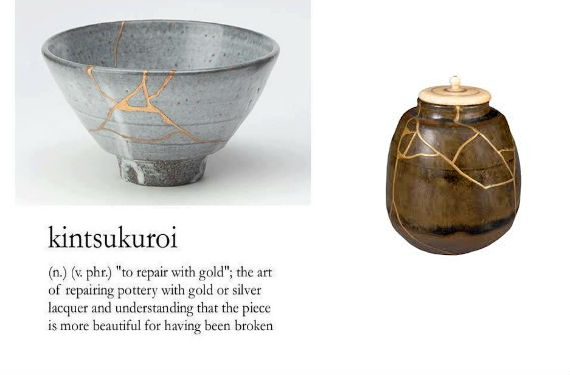
In my brokenness
I am made beautiful
You collected
the broken pieces
Sealed fleshly wounds
With golden scars
I wear as triumph


This poem was inspired by the Japanese art form of kintsukuroi

Kintsukuroi


I see creativity as an act of creation and as an act of repair. Sometimes it is in the act of creating that a person finds wholeness by putting their emotional and mental trauma and experiences into a work of art. It may be a difficult and draining but it can also be a catharsis, a release, a giving away of the issues and experiences held onto like removing a splinter from under the skin.

Sometimes we need to understand we are broken so we can be repaired and made beautiful again. Creativity is the medium through which it can happen.

What can you make beautiful again?

What Makes Your Life Extraordinary?

What Makes Your Life Extraordinary?

In Dead Poet’s Society, Mr Keating takes the boys to the hallway to see the photos of past students and whispers the immortal lines, “Carpe diem. Seize the days, boys. Makes your lives extraordinary.”

A current television commercial runs the slogan, “Escape ordinary.”

What makes a life extraordinary?

People buy into this idea of your life having to be a Broadway extravaganza or a Hollywood blockbuster ALL. THE. TIME.

We are presented with hyper-idealised notions of reality. Do life BIGGER, BETTER, FASTER, LOUDER, MORE DEMONSTRATIVE, IN YOUR FACE and (dare I use it because I hate the acronym) YOLO! It’s perfectly captured in the Selfie Generation: LOOK AT ME, I’M IMPORTANT AND I DESERVE YOUR ATTENTION.

It is the wrong perspective.*adjusts cardigan and puts on slippers*

What’s wrong with ordinary? Ordinary is where I live and find my inspiration. I joke my life is coloured beige for boring, making my life extra ordinary.

For the creative person, extraordinary is a way to burn out because it demands you give out so much more of yourself than is returning to you.

“The candle that burns twice as bright burns half as long.”

For me as a writer, the greatest stories are not the ones we see in films, the lives of movie stars, but in the embarrassing ordinariness of people doing things in their every day lives that benefits others. The ones who don’t see their work as anything important; they are filling a need, taking care of their community, advocating for the poor and disadvantaged. Living an extraordinary life is one lived in service of others and pursing your own dreams. Balancing the self with the care of others. Telling their story is an extraordinary privilege.

I like to think of the word as “extra-ordinary.” The one thing that defines the ordinary from the extraordinary is passion. Mr Keating exhorted his young charges to engage with the aspects of life that they were passionate about.

For the creative person, the passion manifests itself in the choice of medium whether it’s writing, art or music.

As it relates to creativity, to continually produce great art, to live an extra ordinary life, requires repetition, ritual and reflection.

Repetition

Not once, not twice, not even thrice but continually and habitually. Continue to produce art: write regularly; sketch, doodle, scribble whenever possible; practice scale and rudiments.

Repetition can become staid and uninspiring so it requires a dedication and committed work ethic to maintain your focus on being creative.

Early efforts will be complete and utter rubbish. But that’s the point of repetition: you do it until you get better.

Ritual

Setting aside an assigned time to work on your creative project is like attending church or settling onto the couch to watch your favourite television show or sport team compete. Like repetition, it is a repeated event but the goal is one of individual development.

Ritual provides structure and is an active reminder to develop a disciplined approach to our creativity.

Reflection

Movement without reflection will only end up with you moving in a circular fashion, only ever returning to the starting point without having learned or progressed.

Every once in a while it is important to reflect on your goals, your progress in terms of work produced and skills developed. Are you improving? Has anything weakened? What else do you need to know?

Creativity makes your life extraordinary because you have embraced repetition, ritual and reflection. You are taking the ordinariness of life and giving it meaning through creating great art.

This makes you extraordinary.

Addendum: This morning in the shower (place of many great epiphanies along with the kitchen sink while washing up) I had another idea to add. It was the one thing that makes a life extraordinary: Relationship.

Without relationship, we are merely individuals without community and connection. In relationship with other creative people we make our lives extraordinary because we have companionship, connection and community. We are no longer alone. This is fundamental in making our lives extraordinary.

6 Things A Writer Can Learn From Watching A Dance Show

The current season of So You Think You Can Dance is airing on television in Australia. It’s the home-grown version, not the US version telecast. I’m fascinated with the performance and artistry of physical movement that can be graceful, violent, articulate, mechanical, whimsical and profoundly intellectual.

I have two daughters who are enamoured with dance as a performing art, and my wife danced when she was younger. Many years ago, she stood in front of me, feet planted flat on the ground and proceeded to kick cleanly over my head. I’m approaching six feet tall and my wife is somewhat shorter. I vowed never to get on her bad side after that.

As a writer and creative type person I look for inspiration from a variety of sources. After watching a couple of episodes I saw parallels for writers.

1. Style in dance is genre in literature

The beginning of the series divided the dancers into their preferred style: ballet, jazz, contemporary and urban. They learned choreography in their style by an expert in the field. The dancers knew the talent and reputation of their teacher and sought to excel in the choreography they were taught.

For a writer the equivalent is immersing yourself in your preferred genre: literary, science fiction, western, romance, horror, speculative fiction, gothic. Learn from the masters of your field; absorb the lessons by reading and deconstructing their work.

2. Adaptability is essential (but know your strengths)

To whittle down the contestants, the dancers were then asked to perform in a style they were unfamiliar with. Ballet dancers had to learn an urban performance; jazz dancers had to learn a contemporary routine.

Some dancers adapted quickly to the new movements and techniques; others struggled. Yet they persevered. The results varied for each dancer; some excelled while others maintained a form of equilibrium, enough to get by but not enough to stand out from the pack.

As a writer, know your form, your technique, your movements. Then learn from another style. Adapt. But know your strengths. Learning from other genres will enhance your own writing and may even separate you from the pack and put you in front of it.

3. Discipline is Key

Part of the reality tv schtick is to give the viewer some background on individuals of note. The focus is on those who are endeavouring to succeed, but ultimately are shown their skills are wanting, and on those dancers who excel in their gifting.

And it is in these gifted individuals that you see due diligence and discipline in their practice and an innate sense of understanding about their chosen art form.

For a writer, as it is for a dancer, it is practice, practice, practice. I firmly suspect that practice for a writer and a dancer is two-fold: maintenance and improvement.

Practice for maintenance keeps you writing stories and producing work.

Practice for improvement means you’re seeking feedback on your work or taking classes, attending forums and conferences, to seek to understand your art form better and to produce better work.

4. Movement and rhythm is both graceful and violent

Every dance style has its form, repertoire, vocabulary and structure. Its manifestation in movement and rhythm is both graceful and violent. I don’t mean violence in an aggressive, physical act but the ability to portray emotion through face, body, limbs and the overall form of the dancer.

Vocabulary for the writer is the raw material to capture the emotion of the scene and engage the reader with its visceral description of beauty or horror.

A colleague described the language of “Lolita” as exquisitely beautiful while the content became darker and offensive.

Learn to utilise the movement and rhythm of language to create grace and violence.

5. Stories are interpreted through different forms

Ask a ballet dancer, a jazz dancer, a contemporary dancer and an urban dancer to perform a love story and the interpretation will vary, based on the lexicon of the specific dance style. I love contemporary dancing for its narrative capabilities, but what can I learn from the narrative in ballet? Or jazz? Or urban?

Learn to tell stories in a different form. Learn to tell a narrative from another angle.

6. Show your work, and know when to hide it

The show is built around showing the progression and development of each dancer as they learn new routines, often in styles they are not conversant with. I like seeing the growth of the dancer as artist when they are open to learning, stepping into an arena they are unfamiliar with and untrained in. Yet the psychology of dance, the mental framework of adaptability and learning allows them to rise above it.

As the viewer, I get to see the falls and stacks during rehearsal, and so appreciate the performance knowing the effort they have sustained to make it look effortless.

Sometimes as writers we are too quick to show off a new piece of work, not allowing it to settle before another round of edits or sent to a trusted beta reader.

Snippets on blogs is a good way of keeping readers hooked prior to a new release, or showing them works in progress. Know when to show your working; make it shiny and new and fresh and of a high standard.

Don’t rush it.

Now if you’ll excuse me I hear a lively tune; I’m inspired to dance.

Post It Note Philosophy #14

PINP 14

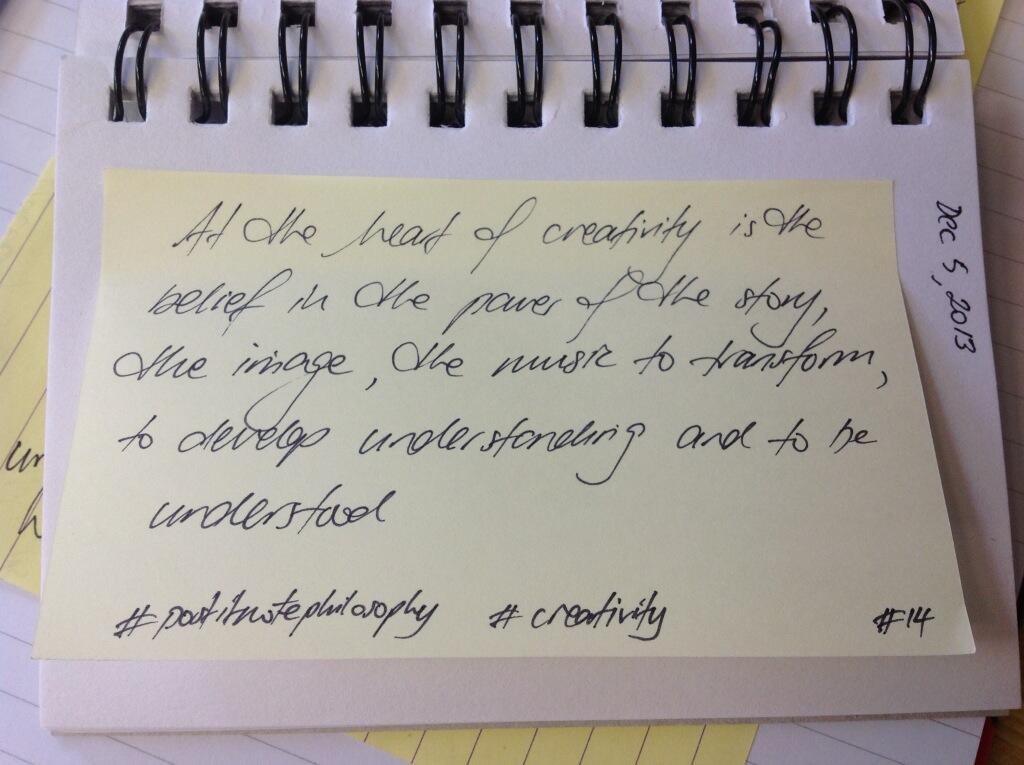
At the heart of creativity is the belief in the power of the story, the image, the music to transform, to develop understanding and to be understood.

Creativity and Disability – Will You Listen?

Pick your label:

Downs Syndrome.

Asperger’s Syndrome.

Autism.

Cerebral palsy.

Bipolar.

Schizophrenia.

Paraplegia.

Quadriplegia.

Blind.

Deaf.

All of the above.

Any I may have missed?

When used in relation to people with a disability we use distinctions and nomenclature to quantify who someone is, something other than “normal.”

To pacify our guilt and discomfort at a person’s lack of physical or intellectual ability we offer art and music as a remedial activity. It is put forward as a pastime to keep someone occupied, a way of staving off boredom.

Why do we relegate arts and creativity as a remedial activity; as something to amuse or fill in time?

To do so is to mute the voice of those who have none and to disempower the individual. 

When a person with a physical, mental or intellectual disability is given the opportunity to speak in another voice, they are empowered.

Creativity (art, music, literature) is a voice for those who do not have one.

Don’t dis my ability. Not disabled.

Differently abled.

We disempower them because we refuse to listen to their voice; we believe they have nothing of value to say. We are sanctimonious and privileged in our opinion that a person with a disability cannot be creative.

I believe in the power of creativity to tell your story, using your own voice, your own expression, your own understanding and your own perception of the world.

When we relegate creativity to a remedial activity, a pastime to occupy and amuse, we diminish the role of the creative arts and silence the voice of the individual.

Creativity is a voice with which to speak. Voices with unique timbre and quality, even if the words are not easy to understand.

Hear my voice regardless of how I speak. Don’t view me as disabled or look at me through my disability; listen to what I have to say. 

Yet sometimes, art and creativity is the only voice with which someone has to speak.

We ostracise the artistic rather than balancing it against the academic and logical, the scientific and practical. Even in these areas there is great creativity.

Can we help tell their story? Give them the skills and techniques to create their own works of art? I believe in the dignity of the humanity of each person and it should be respected. 

Allow each person to find their voice. Give each person permission to speak.

We must move beyond treating people with a physical, intellectual or mental disability as incapable of having a voice.

The ad promoting the London Paralympics Games in 2012 gives me goose bumps every time because it is a powerful statement of voice. You can watch it here.

Art, like sport, is transcendent of language. The coded symbolism is independent of the alpha-numeric symbolism of codified spoken and written language. Culture and knowledge informs the construction of the work of art; we may not speak English or French or Spanish or Mandarin or Afrikaans but we understand the message coded in the art.

When we speak with and through art, we use a commonality of language that gives voice. When I look at and appreciate a piece of art, I do not need to know the background of the artist, their ability or disability. I hear their voice in their work. Knowledge of their background enhances and brings clarity of understanding to their message, but it is not essential.

There are many great organizations giving voice to people with disabilities. One of them is Studio ARTES  (They are also on Facebook) – a facility for people with a range of physical and intellectual disabilities, for life skills training, art training and socialization. It has been something I’ve encountered for many years because my mother was one of the founding members. She was working as an occupational therapist at a school for students with specific needs and her creative partner, Wendy, was the art teacher. Their vision was to extend the opportunities for people with specific needs post school.

I have seen the power of art when people are given a voice to express themselves. Lars was a young man with an intellectual disability who gained a remarkable voice through the nurturing of his artistic talent. His art was bought by members of parliament and hung in the foyers of well-known companies. He had a droll, dry wit and was a remarkable talent. 

On the occasion of his passing, Member of Parliament, Judy Hopwood, had this to say. Hansart Transcript 

You can see retrospective collection of some of his works on Facebook

Besides painting at Studio ARTES, many are involved in the practice of Saori weaving (‘sa’ = difference; ‘ori’ = weaving), a Japanese art form that has come to represent the ability of all to be creative without preconceived notions of correctness.

The beginnings of Saori start with Misao Jo who wove a cloth but because of a missing warp thread it was perceived as flawed. Undeterred, she wove more cloths with ‘flaws’ and ‘faults’ and produced beautiful cloths, praised by a high-end cloth merchant. Read about the philosophy of Saori here.

When teaching her students, Misao taught them the basics of weaving and left them to do as they pleased; an opportunity to discover their true self. My mother has had the pleasure of meeting Misao Jo on occasions when she has visited Japan.

Hence the application for people with disabilities is inexhaustible because there are no preconceived rules and boundaries; it is the individual who creates. Carmel, a client of Studio ARTES, is deaf and blind and spends hours at the loom using the texture of wools, twigs, feathers, ribbons etc to create beautiful works of art.

It removes the pretence of ‘correct’ and gives power to speak.

When will we let go of the idea that people with disabilities have no need to be creative? To let go of the notion that they cannot be creative? That art and music is only remedial and a pastime to stave off boredom? When will we allow them to speak with their own voice instead of presuming we know how to speak for them?

We must stop treating creative arts as a sidelined respite and return it to the centre of our cultural heritage alongside mathematics, science and the humanities. Creativity inhabits the spectrum of cognitive disciplines; it is not the domain of one and nor is it limited to those considered “normal.”

If you are without a voice, borrow someone else’s until you find your own.

I want to spend some more time amongst the people of Studio ARTES, to hear their stories, to be their hands to write when they cannot and project their story when and where I can. There is a beautiful lack of inhibition in many of the people who attend the studio, and a great deal of candor; they will tell you how they feel, direct and to the point. It’s a voice I want to hear more of.

I know that we won’t truly learn to love our neighbour as ourselves if we do not hear their story. Not for the sake of pity or sympathy, but for the dignity of the individual.

I have written before that everyone needs a creative manifesto, a reason why they create. I have also spoken about creating from a place of pain (and it has relevance to people with mental illness like depression or anxiety or bipolar) and I believe it is appropriate for a person with a physical or intellectual disability to have the same belief in their creativity.

I had a couple of responses when I put the idea of creativity and disability out there on Facebook one day.

Writer Marc Nash (@21stCscribe), put forward this point, “The people who can’t speak for themselves or can’t be heard, are unlikely to be able to read the words of those who want to help amplify them. That is an inherently political act of writing, which is how I regard my own approach, but it still is one based on certain privileges: – literacy, education, technology (e-readers) and the free time to write. These I find are paradoxes as much as inspirations.”

It is a paradox and a dichotomy but I want to stand for those who are marginalised and to help speak for them.

Two others commented:

“I had never given it a thought until a heard an interview on Radio National a fortnight ago with a burlesque teacher who was given the privilege of teaching a young woman with Down syndrome. At first I thought it sounded exploitative, but it gave the young woman so much joy and made her feel like a regular woman.” 

“A friend of ours has a son with Down Syndrome who has been a regular at our local Uniting Care. They have really done wonderful things with him (and others apparently), introducing him to art (painting, sculpture etc) and music. He has since taken to painting like a duck to water (even selling some of them through his parents business) and has recently taken up music lessons. Uniting Care need to be commended for both developing a sense of worth for this boy but also for their commitment to more than just paint-by-numbers in their approach.”

Tangential Question: what other avenues do the disempowered and marginalised have for speaking? Rap? Hip hop? Graffiti? Heavy metal? Poetry? Painting? Sculpture? Photography?

Are we listening to the marginalised and disempowered?


Let me hear your voice without words.

Let me hear your voice through the images you paint.

Let me hear your voice through the music you play.

Let me hear your voice through your hands, your heart, your mind.

Speak, and I will listen.


Eat Your Heroes

After my post on Tuesday, Is Comparison Killing Your Creativity? a good friend of mine, Deane, sent me a lengthy response.

I have his permission to reproduce it here because it dovetails nicely with Tuesday’s post.

Deane has been a creative inspiration to me, even before I applied myself to writing, music and teaching. He’s the kind of guy whose artistic vision and creative endeavours leaves you slavering for more. When he talks about the things he wants to do, intends to do, gets around to doing, you want to go there with him and see it all happen.

Tuesday’s post dealt with the danger of comparing yourself to others and how it kills your creativity. Deane discusses the effect of slavish devotion and imitation of your creative heroes. And it comes with a warning. 

Eat Your Heroes

DEANE PATTERSON

Even the most ardent and individual creator needs input to learn, excel and eventually dominate their field. We all want to be like the giants of our chosen art form, and we read their books, blogs and imbibe their art as part of the process of learning to bring our own endeavours to life.

I recently read the first chapter of a book created by a personal inspiration: photographer Gregory Heisler. The book delves more into the mind-set rather than the technical approach of a man who has shot more than 70 Time Magazine covers.

I have wanted to expand my photography. I have one light. I have one short lens. The only thing smaller would be a body cap with a hole drilled in it as a pinhole camera. I usually have 5 minutes or less to craft a portrait that is intended for a wall sized print.

But in the first few pages, the master suggests that he too wished that he had more than 5 minutes to take a picture. He emoted his desire to just travel with one light. His description of the need to keep a certain distance (not to close, not to far) suggested I had the perfect lens.

I was looking for the magic beans, the formula. Perhaps, dare I utter the words, a reproducible technique?

Heisler said in a recent interview, “You can learn a technique, but the first time you get in a situation where it doesn’t work, you’re done.”

As artists, we look up to the pantheon of heroes who have gone before us. Prize winners. Gallery wall limpets. Best sellers. Icons of cool.

We wonder if we need to have the same tools. Perhaps a Moleskine, or a Mont Blanc. An original Les Paul or a Steinway. Leica or Hasselblad.

When we grow up, or at least reach the understanding some tools are too expensive for mere noob mortals, we try and ape technique.

Portraiture is based on trust.

Everyone who has every written about Mr Heisler mentions how he gains the trust of his subjects – forging a quick but mutually respectful relationship. To him, trust outweighs any equipment, because his photos depend on a connection with the person (not merely a talking meat puppet) he is engaged with.

That’s who I need to become in order to approach that level of work in my field. That’s character, not technique. You don’t learn character in an ‘Idiot’s Guide to Legendary Artistic Achievement.’

I am all for learning the basics – and certainly practicing till your fingers or your neighbour’s ears bleed. But art is not a mechanical achievement. The mechanics are necessary, but they don’t put words in your head, a song in your heart or an image in your eye.

You must learn the heart of those who have gone before you. You must partake of their motives, their emotion and their reason. This is why you must choose your inspirations carefully.

Better to choose Christopher Nolan (Inception) than Lloyd Kauffman (The Toxic Avenger).

When selecting a role model, look at who they are – because that’s the direction your life is headed for at least the next few months or years. It’s who they are, their character, that truly informs their art.

This means you are free to be inspired by many people outside the narrow confines of your niche or genre. You can revel in the creativity of a wide range of very original individuals – and you (and your speciality) will be richer for it.

You are what you eat – and you will consume your role models. You will forage the interwebs for every morsel from their mouths and every project they every let loose in the public domain.

When you are ready to learn from a master, take a good long look at who they are and ask yourself: would I put that in my mouth?

Deane Patterson is a portrait photographer and sometimes composer and filmmaker living in rural New Zealand.

Visit him at http://itellstories.co.nz/

Find his work on flickr and National Geographic Your Shot.

Creating Community and Collaborative Creativity

Creating Community and Collaborative Creativity

Making my own music is ALL about self-expression. Working on other people’s is all about the privilege of helping realise their visionSteve Lawson (@solobasssteve)

Music, like literature, art, film, photography and dance, any other creative medium or form, are aspects of self-expression. As a writer, I use words as my vehicle for self-expression to create stories. I use words to create imagery, atmosphere and stories to create emotional responses in the reader.

Literature, music and dance are the foundational aspects of community; an integral voice of culture and community as representative of a society. It celebrates, connects, questions, makes political statements, raises philosophical debate, criticises and praises.

Without community we are isolated individuals trapped by the artificial boundaries surrounding ourselves. Literature, music and dance create a cultural identity and shared awareness of each other.

“Here we are now, entertain us.”

When did the creative arts become an entertainment rather than a shared community experience?

I postulate we’ve made art, music and literature an entertainment. In doing so, we have made creativity a product, a brand, an identity. Survey the popular artists and look at the products they are flogging apart from their music: perfume, clothing, jewellery, personal hygiene products. It’s hard to see a writer being asked to endorse a product, as if the writer him/herself is a brand and an identity to market.

Music has become a spectacle and an entertainment, dividing the artist from the audience. You go to a pub, a coffee shop, an opera house, and you go to see someone perform for you. You are transferred into the world of the performer as they create it for you.

There are transcendental moments of euphoria, a shared connection with the musicians or performer on stage. I’ve been to gigs where the excitement and passion are almost palpable, but I know I am there to be entertained. I have no personal connection with the artist nor the audience. We share physical space, unknown to one another except in shared connection with the music we are listening to.

I like music, literature and art as entertainment but I want to explore the community aspect of the creative arts. Artists have collaborated and supported one another for millennia. Ultimately I see creativity (literature, music and the arts) as a shared community and communication. Creativity takes on a stronger voice when we combine as a group of people to create, to share, to communicate.

Creativity as entertainment is passive. Creativity as a communication is active and engaging.

The Dichotomy of Audience and Community

What if we changed the perspective and stopped talking about an audience for our work, whether it’s literature or music or art, and talked about community instead?

When we speak of an audience, we are speaking of one-way communication from the artist to the receiver.

When we speak of a community, we enter into a dialogue. Our voice becomes stronger when there are many to spread the message.

Our stories, our music, our dance, our art; this is the voice we have to communicate our message.

By having the artist/audience dichotomy we have weakened our voice to communicate our message.

Creating Community

In the age of digital connection and hyper connectivity, the link between artist and community is ever present and easy to do.

Amanda Palmer’s (@amandapalmer) TED Talk, “The Art of Asking” is a brilliant explanation of her art. It’s worth your time to watch and engage with her vision.

Here is a summary of her vision as I see it and its relationship to creating community in the creative arts.

Art is metaphorically, and sometimes literally, falling into your audience and trusting one another. It is an act of asking because through the act of asking, you make a connection and when you connect, people want to help you. But asking makes you vulnerable and you have to have trust in your tribe (or your community). Give and receive freely. Ask without shame. Musicians and artists (and writers) are part of the community; they are connectors and openers. Celebrity is being loved from a distance instead of being loved up close.

This is what I want from my art, my writing: the direct connection with the reader so that we create a community. In my last post, “What Will Be Your Creative Legacy?”, I spoke about what I will leave behind. I’m not worried about my words; I’m worried about my community. It’s about direct connection with people and creating a moment of contact, a moment of prolonged contact in order to build trust and build a community.

How Do You Create Community? You Ask.

In the last few years the rise of crowd-sourcing and crowd-funding has caused debate in and out of the creative community, but I see it has benefit for musicians and artists like film makers, more so than for writers. Think kickstarter, pozible or indiegogo or something similar. These platforms are generating the community aspect to creativity.

Here are a few examples that I know of where creative people have asked for help:

Australian-based metal outfit, Twelve Foot Ninja (@twelvefootninja) had a comic written for the release of their album, Silent Machine and had the largest and most successful crowd-funding campaign for their new video clip because they had engaged their community.

Helen Perris (@helenperris) was recently able to attract enough funding to record her new EP. One of the contributors was rewarded with time in the studio with Helen and try her hand at backing vocals.

It’s about creating community and connection, rewarding contributors and engaging in meaningful conversations. If you’re an artist, offer the reward to create art and liner notes or design work (cut them in for a share or a fee – I’m all for the artist being paid.) Some may choose to volunteer their time or efforts, but there is also a place for paid contributors.

Other Ways To Create Community?

What if we made venues conducive to community? What if coffee shops, cafes, art galleries and libraries made it a point of creating community between musician, artist, writer and their clients?

Create spaces for creative communities by moving into cafes and coffee shops, parks and houses for art groups or writers groups (I know they already exist but let’s broaden the horizon), perform music in the form of house concerts (Steve Lawson is big proponent of house concerts) and have literature groups meet in art galleries.

Let’s learn from the DIY aesthetic and bring the crowd right up to the band and share in the dialogue and discussion.

One of my favourite bands, Sydney-based post-rock band Dumbsaint, make short films to accompany their post-rock instrumental songs. Both music and films stand alone and the experience of watching the film and the band perform live is fantastic. Check out their new song, The Auteur.

With my current penchant for post-rock (instrumental music) in the likes of sleepmakeswaves (@sleepmakeswaves), Meniscus (@Meniscusmusic) (representing my home town) I’d like to write short narratives based on the titles of their songs to appear on the CD liner notes or on the band’s website. I haven’t asked the bands yet but what if you could engage with the artist in a creative collaboration?

I first came across this idea when reading the liner notes to King’s X album “Gretchen Goes to Nebraska.” You can read it here.

What about collaborating with a band to create a short film or video clip or a visual background for one of their songs? Offer to create visuals for their flyers, website, album artwork. Ask. Ask a writer if you could design a book cover. Ask a dancer if you could write a piece of music for them as the inspiration for new choreography.

It’s about connection (and fandom; can I get a fan “squee”?) and extending the focus outwards, not inwards.

As a writer, collaboration is a great way of helping someone realise his/her vision. The epistolary serial I co-wrote with Jodi Cleghorn, Post Marked: Piper’s Reach, was a way of realising Jodi’s vision for a new writing adventure. We are now at the editing stage, turning it into a novel and pursuing publication options.

The vision we hold for our own creative and artistic endeavours is our self-expression, our goal and purpose.

Yet, it is better to give than to receive.

To help foster and create community and assist others in realising their artistic vision is a remarkable privilege. By creating a positive and encouraging artistic community we enrich our lives.

Ask.

Be involved.

Create community.

Colouring Outside The Lines

As a child, colouring outside the lines was the mark of a juvenile understanding of boundaries and parameters: they were ignored.

You were handed a pencil or crayon and a colouring book and told to have fun. And fun was most definitely had. Scratched lines of pencil or crayon all over the page. There was fun simply in the act of creating marks on the page.

Yet gentle adult encouragement made you aware of the lines of the picture; the boundaries drawn to keep the colours within.

So you took extra care and effort to colour within the lines and make the picture look special. You were disappointed if your pencil or crayon slipped over the line, extending the colour beyond its prearranged designation.

And so it is with any creative endeavour. Initial enthusiasm and fun is gradually replaced with awareness of the skills, parameters and boundaries of your chosen creative medium. You become a skilled practitioner of your creative art and can produce good work.

So, how do you extend your creative skills? How do you extend your knowledge and understanding of your medium? When you are entrenched in your chosen creative medium, whether it’s art, literature, film, painting or music, how do you extend the boundaries and parameters?

You learn to colour outside the lines again.

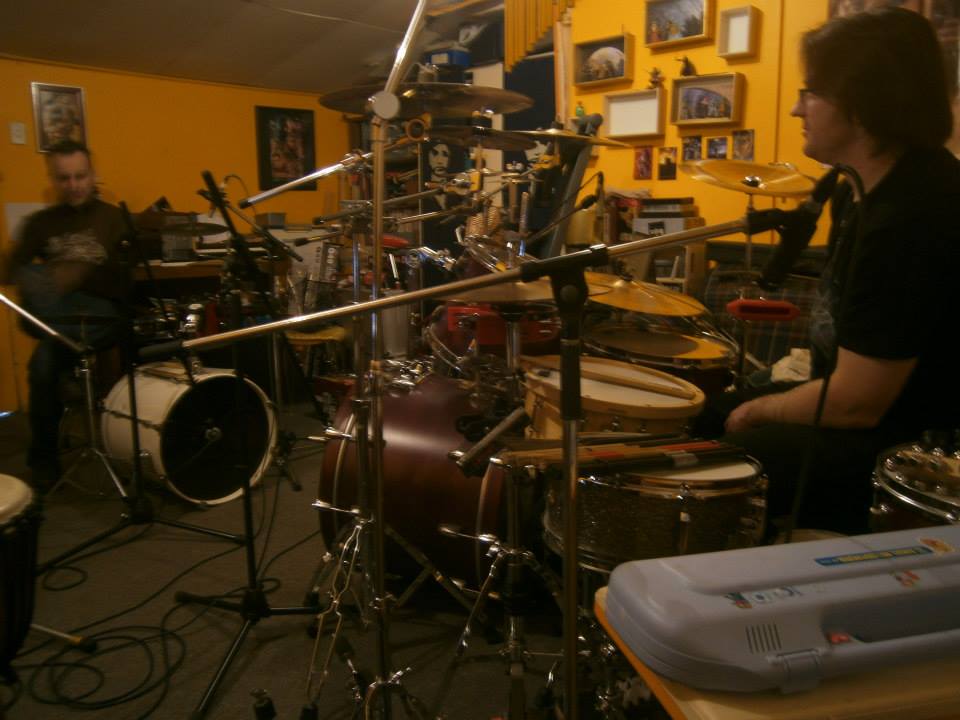
As a drummer playing contemporary music and musical theatre, I am used to the drums forming a rhythmic foundation, providing timbre, dynamics and tone colour, the beat and rhythm.

The other day I had the opportunity to meet up with Adrian, an old teaching colleague of mine who is an art teacher, musician, boutique record label owner and producer, and a mutual friend and drummer, Costa.

P1010973

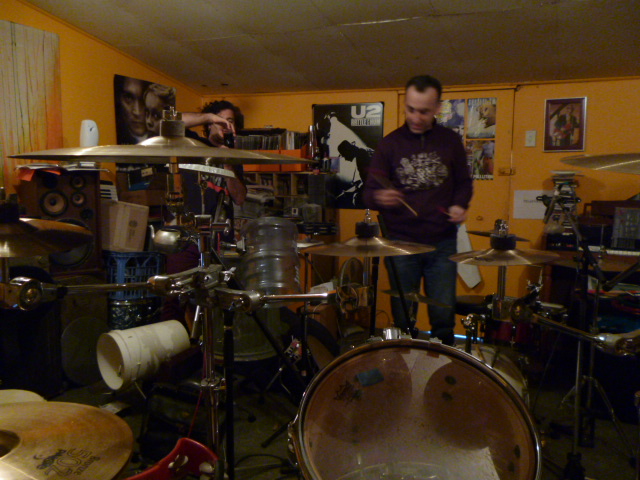
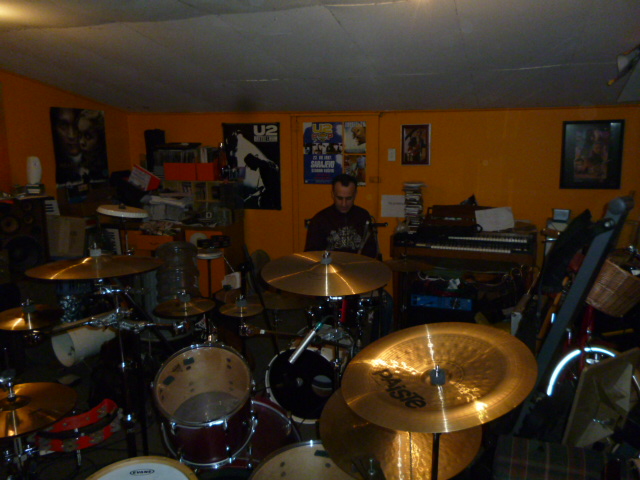
The three of us convened in a small home studio out the back of Adrian’s house. We lugged gear in and set up while Adrian placed mics.

There was no preconceived ideas as to what we were going to play and record, except for some youtube clips we had looked at earlier. There were no lines to demarcate the boundaries of our creativity.

Yet how easy it is to rely on the boundaries of what we know. As drummers Costa and I fell into an improvised jam in 6/8, using a form that was familiar to us, creating a beat and rhythm. As we played we listened to each other, playing around each other’s grooves and timbres, sometimes playing with the groove, sometimes playing against it.

We were colouring within the lines.

P1010968

I learned to colour outside the lines because of Adrian’s artistic vision and creativity.

Adrian suggested for the second jam an experimental form playing in different time signatures: Costa played in 4/4, I played in 5/4 and Adrian played in 7/4. It sounded gloriously messy as we experimented within the constraints of the time signature allocated while listening to what the others were playing.

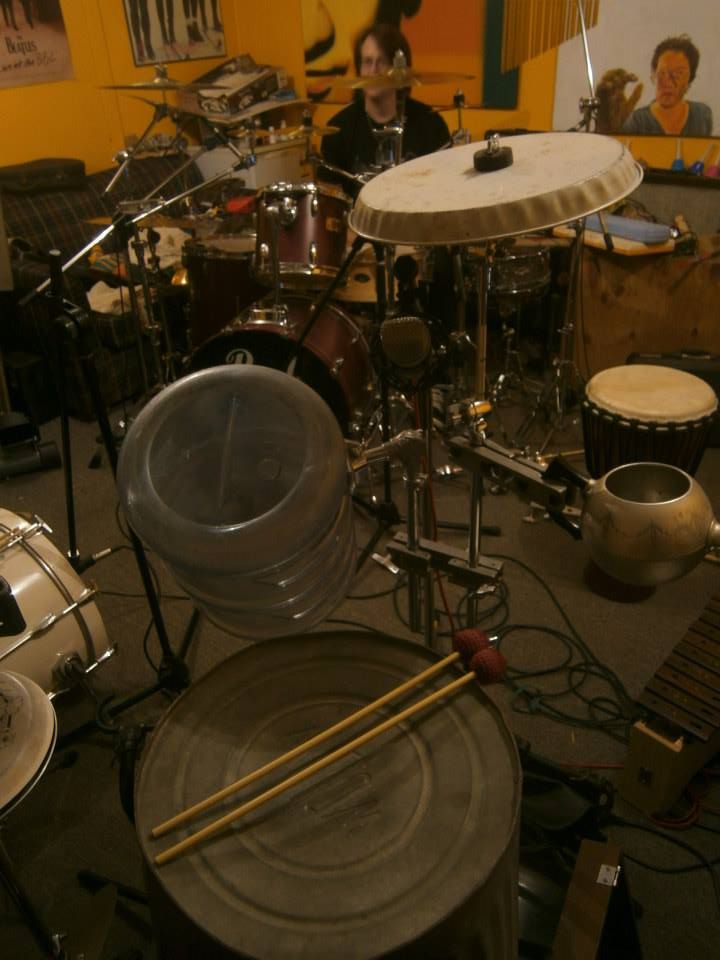
The Junk Collective 3

The last jam was truly a learning experience of colouring outside the lines. Adrian suggested we play not rhythms or beats, but focus on the sounds produced from each part of our instrument.

We used sticks, mallets, brushes, rods, plastic rods on all parts of the drums and cymbals including the rims and stands. I threw a handful of sticks into the air and let them fall where they may. I bounced sticks, mallets and rods off my snare to see where they landed. Adrian used a violin bow on cymbals and played mallets on my kit, Costa’s kit and their “junk” drum kit which consisted of a metal garbage bin, water bottles, saucepan lids made into hi-hats and a metal tea pot.

The Junk Collective 2

It was this last improvisational jam that really expanded my understanding of rhythm, drums and music in terms of creativity. It allowed me to colour outside the lines as I was not focused on the traditional parameters of my instrument, rather learning to see outside the lines and create accordingly.

Artists talk about the ‘negative space’ on the page; what is not there is as important as what is there.

My next step is to apply this principle to my writing.

Whatever creative medium you are engaged in, whether it’s writing, music, art, have you learned to colour outside the lines again?

Create Because It Counts

We create not for fame.

Not for money.

Not for recognition.

Not for glory.

Not for the praise of others.

We create because it counts.

This principle came out of an article on pianist James Rhoades, “Find What You Love and Let It Kill You” from The Guardian newspaper in the UK.

Create because it counts.

James put himself through an extreme, almost ascetic regime: “no income for five years, six hours a day of intense practice, monthly four-day long lessons with a brilliant and psychopathic teacher in Verona, a hunger for something that was so necessary it cost me my marriage, nine months in a mental hospital, most of my dignity and about 35lbs in weight.”

I do not connect with the extremism (yet I can see the validity in it if you want to take something as far as you can go) but I do connect with the emotional response he has when he has put in the time and practice to learn and master a new piece of music; I apply it to writing.

“And yet. The indescribable reward of taking a bunch of ink on paper from the shelf … Tubing it home, setting the score, pencil, coffee and ashtray on the piano and emerging a few days, weeks or months later able to perform something … A piece of music that will always baffle the greatest minds in the world, that simply cannot be made sense of, that is still living and floating in the ether and will do so for yet more centuries to come. That is extraordinary. And I did that. I do it, to my continual astonishment, all the time.”

This is what counts: the emotional connection in creating, and in mastering a skill.

It is about the experience of joy in any creative endeavour. The joy in folding an origami crane for the first time; completing a short story; learning a new chord for guitar; finishing a water colour painting.

Doing it because it brings you a sense of completeness and wholeness as a person.

We do not have to go to the same extremities as James but his encouragement goes further to explore the “What if’s…?”

What if we used our time more wisely? Spent less time wasted on social media and engage in a creative activity? Spent a little bit of money to start a creative pastime like painting or photography? Knit? Crochet? Took our phone, shot some footage and made a short film? Used our time to engage with others in a writers’ circle? Wrote the story or novel we have been aching to tell for decades?

What if…?

So many possibilities. So many options.

And we create because it counts for something.

It counts for the children whose father draws a new picture on their lunch bag EVERY SINGLE DAY.

It counts for the short story writer, novelist or picture book writer creating worlds for others to inhabit.

It counts for the musician sitting in a cafe playing her guitar to six people.

It counts for the grandmother making a quilt as an heirloom for her grandchild.

It counts for the child who discovers the joy of the world through the lens of a camera and documents his journey to and from school every day.

It counts for the dancer at the bar, perfecting a pirouette.

It counts because we need stories and art and music and film and theatre and dance.

Creativity liberates your spirit. It enriches who you are, and the people who engage with your work.

Creativity is a mentality of giving; giving to yourself and others.

Creativity costs in terms of commitment, of sacrifice, of dedication.

You create because it counts.