Are You Born a Writer or Made Into a Writer?

Writers are born, not made.

It’s an emphatic, declarative statement.

There is an assumption that the innate talent inherent in a person to be a writer is woven into their molecular structure. It is used to differentiate between those who can write and those who cannot.

The intention behind the statement is that a writer knows, without a doubt, writing is their passion, their career, their life. They cannot see any other path than being a writer.

You know the person; they are the ones who say, “I’ve always written. I can’t think of a time when I wasn’t writing” or “I’ve been writing since I could hold a pencil.” They then proceed to show you their scribblings in a scrap book from when they were three years old. Or worse, whip out their ipad and show you their blog.

You avoid them at dinner parties like you avoid the asparagus entree. I’m not one of them but I have aspired to write for many years. Looking back I can see an interest in writing (letters, stories, journals) yet it has only been in the last 3 years that I have actively pursued writing.

But I want to deconstruct this statement a little.

Each person understands there is a distinctive purpose to their life. Usually this distinctive purpose or passion is revealed in an occupation. We identify ourselves by the things that we are passionate about.

The other manifestation is an interest or hobby. This extends to volunteer work, art or music, community groups, religious fraternities, sports clubs and associations.

In terms of careers and occupations, if you were to speak with a representative, I posit many of them would feel they were “born” into their occupation or interest.

I completed high school without a clear direction of what I wanted to do as a career. I went to university and completed a Bachelor of Arts in English and History, the subjects I enjoyed most at school. At the end of my Arts degree the question was asked, “What next?”

The societal assumption was to become a teacher. I enrolled in the Master of Teaching course and within the first week, I knew this was my career.

Was I born into it? I don’t think so. I have a natural inclination for teaching and working with people. “Born” becomes a substitionary word for a person’s natural personality and character traits which helps them understand the career path they have chosen.

You could rewrite this statement, substituting “writer” for the career of your choice.

Is a writer ‘made’?

A writer is born, not made.

Imagine a thousand monkeys at a thousand typewriters. Now imagine the noise and the poo being thrown. No work being done there. The opposable thumb allows us to grasp a pen with ease, but being born with it doesn’t make us a writer or chef, nurse, landscape designer or rocket surgeon.

The statement seems to be made by writers to distinguish themselves from new and emerging writers. It is said in a slightly disdainful way.

If our natural inclination manifests in a passion to pursue a specific career, can we change the definition of “made?”

My passion is to teach and to write, thus being ‘born’ with it. I knew I wanted to be a teacher, but I still had to be taught to become one. I still undergo professional development to improve my knowledge and understanding of pedagogy and teaching methods.

A writer is born. But a writer is also taught.

The cornerstone of developing and maturing as a writer is education, formal and informal. Education is about the application of knowledge in order to make our words the best they can be.

Ways of improving your education as a writer:

  • get a mentor
  • read articles on the art and craft of writing
  • find a writing partner
  • sub to competitions or participate in online writing communities
  • be a beta reader for someone

A new and emerging writer is an apprentice writer, one who is learning the art and craft of writing. I’ll be exploring this in a blog post on Write Anything later in the month.

Final Thoughts

I don’t believe a writer is born, any more than a teacher, nurse or chef is born. We are taught.

What do you think?
10 Signs Your Child Is Destined to be a Writer

You might be a failed pen monkey, a starter of stories (but not a finisher of fables), or a wit in conversation but witless with words, yet your progeny has inherited the gift of the gab and the social mores of Hunter S. Thompson.

Here are 10 signs your child is destined to be a writer (hopefully without the social mores of Hunter S. Thompson).

1. The first gift they ask for is Roget’s Thesaurus and a copy of the Oxford English Dictionary (the 20 volume hardback edition, including supplementary volumes).

2. On their birthday they receive a card and gift certificate from their local bookstore AND local stationery supply store.

3. At bed time they don’t ask for a bed-time story; they ask you to read from Roget’s Thesaurus and the Oxford English Dictionary.

4. Your child categorically states, “a red pen is not for marking, it’s for editing.”

5. Your child is editing the work of other students. In kindergarten. For a fee (usually biscuits or first turn with the toys).

6. Your child has memorised the Associated Press Style Guide.

7. Your child no longer refers to you as “mother” or “father.” Instead you are referred to as “agent” or “publisher.”

8. You spend more money on printer ink cartridges and stationery than clothes for your child. You’ve even considered buying stocks in companies producing printer ink cartridges and paper manufacturers.

9. Last week’s family argument suddenly appears in the latest edition (completely fictitious, mind you, so they say) of their weekly web serial, “Stress Family Robinson.”

10. Your child edits the family Christmas letter and sends it back to you for revisions.


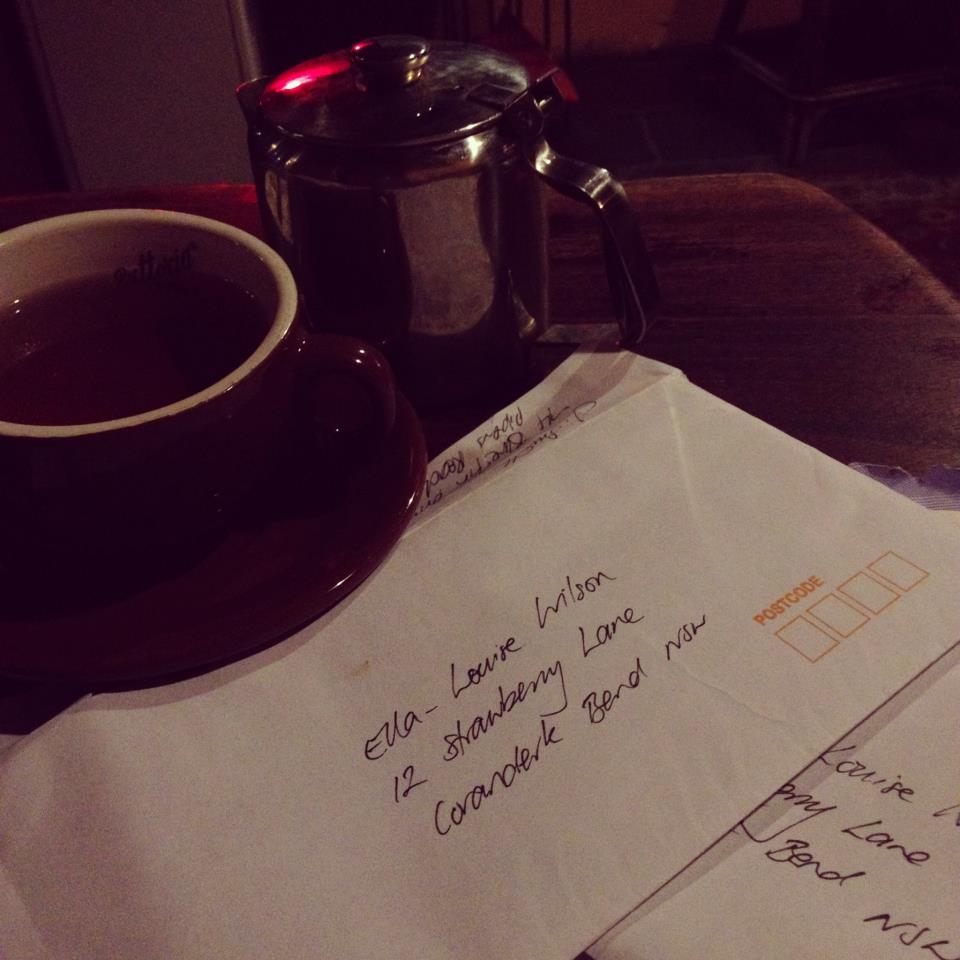
Diving Into The Piper’s Reach Shoe Box

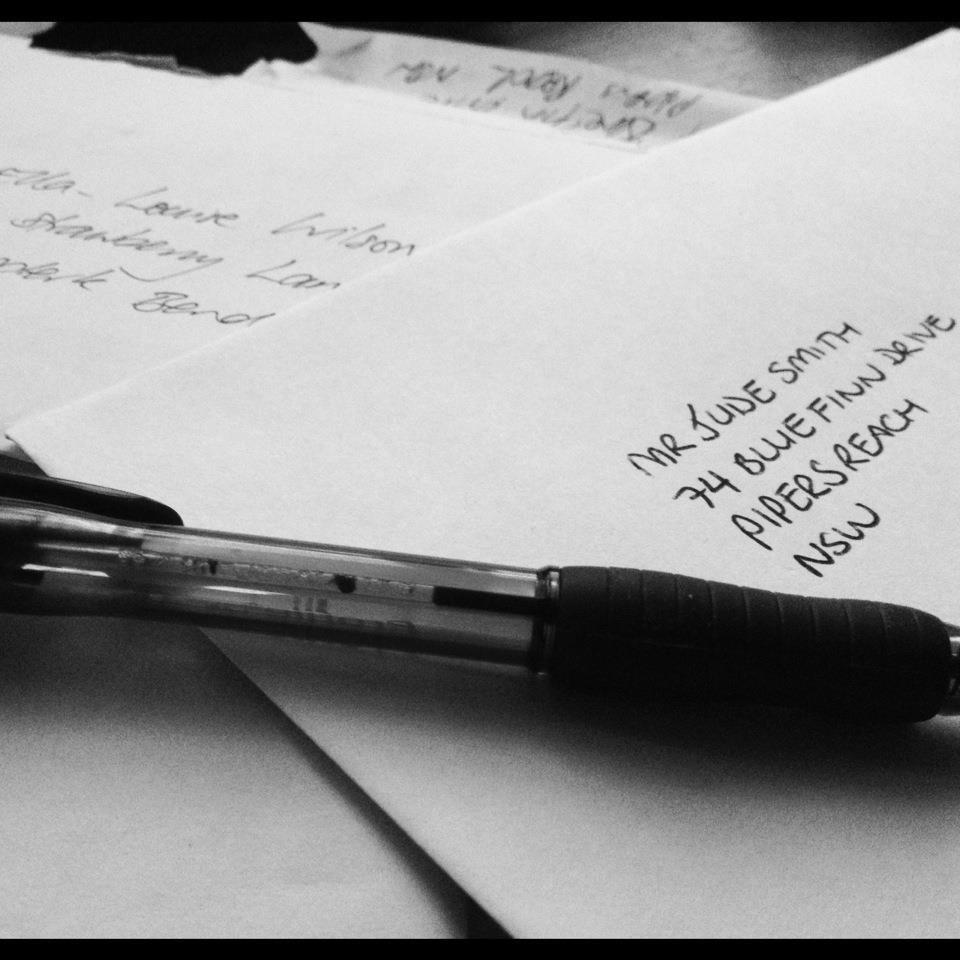
Today is the posting of the 4th letter in the Post Marked: Piper’s Reach series (this is Jude’s second letter). What began at the beginning of the year is now rolling out weekly even as Jodi and I write new letters.

It’s a weird situation re-reading the early letters, knowing what revelations and intimate details lie ahead in the coming weeks. Yet their future is uncertain and unknown. I am about to sit down and read Ella-Louise’s 8th letter before writing Jude’s response.

We’ve maintained our strict “no spoilers” policy which has made for entertaining reading and frustrating writing.

I have come to love Jude and Ella-Louise as characters. In the initial letters there is a hesitancy, an uncertainty of themselves and of each other. Ella-Louise reaches out from the past, interrupting Jude’s acceptance of it and questioning who and what he was back then. Jude saw Ella-Louise from one perspective when they were growing up but is forced to confront it by reliving the significant events.

They remember different events, different versions or perceptions of shared moments. As the letters continue Ella-Louise and Jude offer the reader an intimate insight into their lives and their memories.

See if you can spot the continuity error in Jude’s letter today; you will need to re-read Ella-Louise’s last letter. Jodi and I like to think of it as two characters remembering different aspects of the past. As a writer, I cringe at the mistake. However, it lends an authenticity to the writing of Jude and Ella-Louise.

At the conclusion of the letters, I would love to compile them as an ebook. There’s something quite ironic about archiving a story written in letters as a digital footprint. But I love the contradiction.

In the meantime, their letters are being collected in The Shoe Box for you to read.

10 Reasons Why Writers Can’t Have Nice Things

Writers, we can’t have nice things. Here are 10 reasons why.

1. We believe we have a capricious muse who wanders in (rarely) and out of our head space (often at the worst possible time). We curse him or her or it (can’t be genderist) when we can’t write and praise and worship when the words flow with the viscosity and taste of honey. We are kidding ourselves when we say, “I couldn’t write today because my Muse was off at the day spa and didn’t invite me.”

2. We invent characters loosely based on the our own fears and misgivings, but make them thinly veiled caricatures of people we know (yes, you have irritated us once too often, so we made you into a character who dies a slow death by having your buttocks scrubbed with sand paper and washed with lemon juice).

3. We eavesdrop on every conversation, squirrelling away choice bits of dialogue, character traits and personality tics. Whenever the family gets together our brains melt with all the juicy tidbits. On Christmas Day we experience the high of a sugar junkie.

4. We haunt twitter and facebook and any other avenue of social media to pimp our wares. Support for one another is important, but we end up feeding the circle creating narcissistic, preening believers of our own onanism, making us grow extra digits, and probably another head. Look beyond the immediate circle and seek an audience. Do something that doesn’t involve writing.

5. We believe our ego has the tensile strength of an egg shell. And I’ve seen a raw egg thrown a fair distance only to bounce and not break. If you can handle being popped out a sphincter with no harm done, you can handle a bit of criticism and rejection. Go and play in the dirt like chickens. It builds character.

6. We can teach glaciers a thing or two about procrastination. Apply a blowtorch to the things that have frozen up, and liberally spray WD-40 as if it were a can of Lynx deodorant body spray and create your own climate change. Get it done!

7. We believe we hold the monopoly of ideas creation and generation (along with artists and musicians). Psst… look at the business world, corporate strategy, management, child care, education, health care. They have some bloody good ideas. Now, go outside and play, and learn from other areas of life.

8. We arbitrarily create rules for writing. And then change them because we anticipate the ad break to allow us to void our bladder. Rules are cultural, aesthetic and social constructs of ‘taste’ when it comes to writing. I will use adverbs summarily. Simply write to your purpose and function, not ideas of fashion and taste.

9. We complain, whinge, tweet, start flame wars, and troll about the publishing industry because it’s in a state of flux and we are afraid of the changes. When the dust settles, publishing will still be there. It will look different, but there will still be avenues to publish, even if we have to invent it.

10. We believe reading, and our words,  is important and therefore require recompense. We do not have a right to make money from our art. It’s a privilege. Even if we don’t get paid, let’s use our words to reflect, question, entertain, amuse, horrify, and challenge, even in the one story.

Can I Beta Read That for You?


In a little over 2 years I have had my first 2 stories published (the Literary Mix Tapes anthologies, Nothing But Flowers and Eighty-Nine) and had 3 pieces of flash fiction picked up by Ether Books.

And recently I signed on as part of the team of Write Anything, submitting blog posts twice a month.

This is all really cool and a great way to expand and improve my writing skills, and as an emerging writer, I am becoming acutely aware of my strengths and weaknesses.

To help me in the early stages, I must acknowledge the help of a wonderful group of beta readers who helped shape stories, narratives and ideas: Jodi Cleghorn (@JodiCleghorn), IcySedgwick (@icypop), Jason Coggins (@JaseCee) and Laura Meyer (L_Meyer). I know I have forgotten others and I apologise for the omission.

I am very thankful for the opportunities I have been given through different avenues and now it is time to return the favour.

Do you need a beta reader?

I want to develop and depth my skills in beta reading. If you are an emerging writer and want to take your work to the next level, I am offering my services as a beta reader. As others have helped me, I want to extend help to others on the journey.

Am I the right reader for you?

I write contemporary fiction/suburban realism and YA with a literary bent. I read fantasy and sci-fi, genre. However I am not a horror or writer or reader, but that might help. If I’m scared, you’ve achieved your goal. The same applies to romance.

I have limited time and will take on what I can around my own projects. If I cannot fit you in, I will let you know. At this stage, the offer is for flash fiction or short stories, not novel manuscripts.

Send me a message if you’re interested.


The Wrap – Piper’s Reach Blog Tour

“To send a letter is a good way to go somewhere without moving anything but your heart.” ~ Phyllis Theroux

http://postmarkedpipersreach.wordpress.com

Post Marked: Piper’s Reach is an ambitious organic narrative collaborative project between Jodi Cleghorn and Adam Byatt traversing an odd path between old and new forms of communication, differing modalities of storytelling and mixed media, all played out in real and suspended time.

THE BLURB
In December 1992 Ella-Louise Wilson boarded the Greyhound Coach for Sydney leaving behind the small coastal town of Piper’s Reach and her best friend and soulmate, Jude Smith. After twenty years of silence, a letter arrives at Piper’s Reach reopening wounds that never really healed. When the past reaches into the future, is it worth risking a second chance?

The above is what we pitched to our prospective audience, in the hope someone would like to offer their blog to host an interview. It went beyond what we expected. Here are some numbers:

9 days, 9 interviews, 43 questions, more than 12,200 words written. I haven’t been able to get stats for each blog, but this is enough.

I never expected such a response. From an initial pitch, to a workable project (which is still going), to a blog tour and now a launch.

Today, the first letter is live. Ella-Louise reaches out to her best friend, Jude, after 20 years of silence. Each week, every Tuesday, another letter is posted. We have no end in sight for our characters, so we’ll see where this all ends up.

It has been such a rush creating and writing the character of Jude. Jumping back into the beginning of the process (we started writing in secret 3 months ago) helped me go back to see where Jude was at the beginning, compared to what he is in my head now (3 months and 6 letters written by Jude and 6 by Ella-Louise).

During last week, Jodi and I talked about the psychology of our characters (thus not contravening the ‘no spoilers’ policy) and revealed interesting truths about who our characters are, how they think, and how they respond.

Check out the interviews for an understanding of our project and what it means to us. Behind the Scenes – The Making of Piper’s Reach

I hope you, as reader, will enjoy the story as much as we have had in writing it.

Post Marked: Piper’s Reach Blog Tour – Rebecca Emin

Today the lovely Rebecca Emin (@RebeccaEmin) hosts the 8th stop on the promo blog tour for Post Marked: Piper’s Reach.

While we leave crumbs on the kitchen table, we talk about why we wrote a story in letters and what it’s like to work collaboratively on a project; especially one that has a ‘no spoilers’ policy.

Writing collaboratively has always been a bigger and better experience than going solo for me. I find it almost intoxicating… sharing the responsibility of building a narrative; riding the joint momentum… Most of all I love watching my characters come alive through another writer – Jodi

We write independently of each other but the narratives are intrinsically tied to the other. We weave in and out of each other’s stories. The advantage of collaboration is the perspectives and insights another person provides. The downside to this project is the ‘no spoilers’ clause – Adam

To read the whole interview, click here.

[FGC#9] Songbird

“Why does the fat lady get to sing the last song?” asked Claire. “I mean, it’s not like she’s Aretha Franklin or anything.” She dragged on the cigarette before extinguishing it. “This songbird’s gonna have the final note tonight. Fat chick be damned.”

The karaoke microphone was vacant, illuminated by a single spot light. Claire’s best friend, Rachelle, dubbed it The Truth Amplifier. The microphone revealed a person’s ability, she said. If they could sing, it magnified the singer’s competent vocal chords. If the singer was a hairbrush vocalist, it simply amplified their cat-being-pulled-by-a-toddler screeching.

Flicking through the karaoke menu, Claire chose her song. It was 2 am and the bar was emptying. MIDI strains of Bon Jovi clambered out of the speaker. From their table, Rachelle whooped her encouragement. Claire pulled the wireless microphone from the stand, feeling its weight, balancing it before winking at Rachelle. In her head she counted off the final bar before the lyrics started. On the last beat she spun the mic in her hand, caught it, leaned forward and breathed the lyrics, “If you’re ready, I’m willing and able/Help me lay my cards out on the table.”

At the first chorus she pushed the vocals, but deliberately held back from giving it everything, “Lay your hands on me, lay your hands on me, lay your hands on me.” Her hands followed the curves of her body, starting at her breasts, moving over her hips and towards her crotch before she extended her hand towards the crowd. A polite smattering of applause came from the thinning crowd, but Claire knew she had them. The second verse spun from her lips like caramel. Perched on the edge of the tiny stage, she could feel herself flying with the music. Grasping the mic stand in her left hand she threw her head back for the final chorus and released the diva within, finding the pure note and producing a sonic boom.

Putting the mic back into the clip, the audience erupted in whoops, cheers and whistles.

“Take that, you fat cow,” said Claire, dropping into the chair beside Rachelle.

Post Marked: Piper’s Reach Blog Tour – Victoria Boulton

As launch day rapidly approaches for Post Marked: Piper’s Reach, today on the blog tour, we drop in on the delightful Victoria Boulton (@Vicorva).

In this interview, Victoria asks us why we decided to write our story completely in letters. She also asks us about the origin of our characters, how they are informed by the process of letter writing and what we love about this project.

A letter is intimate and personal. It is a private, shared moment between two people – Adam

There is a sense of freedom and danger in pursuing a non-traditional form of story telling – Jodi

Ella-Louise is broken and burned out, living a sea change to try and reclaim her life. This is the most intimate connection I have ever had with a character. I’m drawn to the first person POV, but this is something altogether different – Jodi

Jude is the essential every man. But at the same time he’s vulnerable, he’s loyal and has a deep centred sense of place and purpose – Adam

To read the rest of the interview click here.

Post Marked: Piper’s Reach Blog Tour – Nicole Murphy

Today we have the extraordinary privilege of being hosted by Australian fantasy, science fiction and romance writer Nicole Murphy.

It begins by asking “Why text messaging to brain storm a new project?” before exploring the importance of place to the project.

Location is important because where you live shapes who you are, what you do, the opportunities available (especially during adolescence) and the way people see and treat you – Jodi

We created the fictional town of Piper’s Reach before we even had characters. Location puts the characters into a frame of reference… it became the framework for understanding the relationship between the characters – Adam

To read the full interview click here.