When Things Turn Pear-Shaped

What do you do when your plans head south? Turn pear-shaped? Or resemble a dried up pile of dog poo?

The Plan

I took long service leave from teaching in order to write my first novel. My aim was to have a 90,000 word manuscript finished by the time I went back to work in the middle of July. Having 14 weeks of leave (2 weeks of school holidays, the entire 10 week term and 2 weeks of holidays) I planned for a few weeks of outlining, followed by weeks of writing where I could commit a few hours a day and write a couple of thousand words. This would allow for more family time and for a few other bits and pieces.

Then it all went pear-shaped.

My wife’s grandmother had a serious stroke and died in the first few week of the term (I used the school holidays to rest and recuperate). She died 10 days later. My wife spent a lot of time at the hospital with family. I took up the domestic duties of getting children to school and other places.

This was followed by the funeral and the wake held at our house, which meant a whole lot of cleaning and tidying.

When things go wrong, what do you do? Change the plans.

My new plan went like this: outline for the latter part of May, write for all of June and *ta da* there’s a novel.

I had a plan. I wrote an 11 page, 6.6K word outline. I had an aim of 3000 words a day. Did it work?

Nope.

I couldn’t write 3000 words a day. The best I managed was 2.6K. One day I managed the grand total of 437. Right now, my novel stands at 24,000 words.

What to do now? The best laid plans of mice and men become the equivalent of sitting in a wad of chewing gum in your best trousers. Sometimes stuff just happens and even if you feel right royally shafted, you have to rethink and plan again.

To say the least, I am a little disappointed. It has forced some thinking and introspection and here is my solution.

Identify the Problems

Problems can be external (things you cannot control) and internal (things you can control).

External – illness, family commitments, domestic duties, unexpected visitors. Things just happen and there’s not a thing you can do about it. You work around it.

Internal – these are the things you have control over and I identified a number of reasons why I wasn’t successful in my planning.

* I’m easily distracted – discipline is a key characteristic I’m developing

* I was thinking about the scene, the characters, the conflict and tension, where it might end. I had done the planning, but spent time thinking about the scene rather than writing what I had in mind. Thinking time is not wasted time, but it is if it detracts from writing.

* It’s a whole lot harder than I thought – being more prepared for me is essential and I had no idea how hard is it to write a novel. I didn’t think it was going to be easy; I know it’s hard to write. I am still developing routines and disciplines.

Make New Plans

Over the next two weeks I will be writing when I can, adding to the word count and continuing with my outline. I will not be finished by the time I return to work, but I my new plan will have the novel completed by September.

I am not defeated, just rethinking and planning. It’s taking a little longer than I wanted, but so it be it.

I have also learned I could conceivably plan and write a novel in a year to 18 months, allowing for the busyness of my job and allowing for life’s little distractions to get in the way.

What do you do when your plans go pear-shaped?

Shoelaces – Postcard Prose


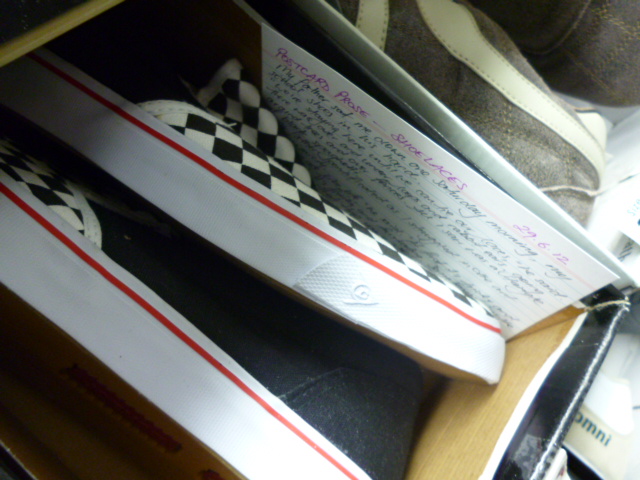
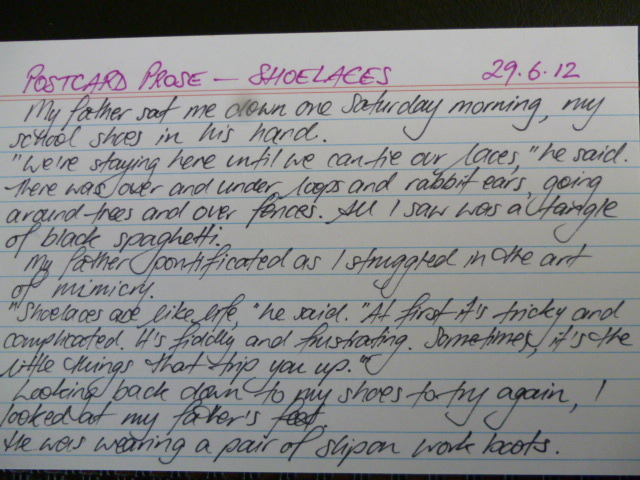
My latest effort in guerrilla literature, ironically dropped in a shoe store as I was buying new shoes.

Payless Shoes – Centro Shopping Centre, Seven Hills

My father sat me down one Saturday morning, my school shoes in his hand.

“We’re staying here until we can tie our laces,” he said.

There was over and under, loops and rabbit ears, going around trees and over fences. All I saw was a tangle of black spaghetti.

My father pontificated as I struggled in the art of mimicry.

“Shoelaces are like life,” he said. “At first it’s tricky and complicated. It’s fiddly and frustrating. Sometimes, it’s the little things that trip you up.”

Looking back down to my shoes to try again, I looked at my father’s feet. He was wearing a pair of slip on work boots.

And, yes, I did put the postcard into a box of slip on shoes.


Guest – Jessica Bell

FabricToday I’m celebrating the release of Jessica Bell’s new poetry collection, Fabric Wait! Please don’t close the tab at the the mention of poetry! Trust me, just read a little note from the author herself before deciding to disappear …


Jessica says:
My poetry will not baffle you with phrasing that scholars award for academic genius and that can only be understood by those who wrote it. My poetry is for the everyday reader. In fact, it is even for those who don’t like to read poetry at all. Because it is real, stark and simple.

The poems in Fabric are no different. They explore specific moments in different people’s lives that are significant to whom they have become, the choices they’ve made. It’s about how they perceive the world around them, and how each and every one of their thoughts and actions contributes to the fabric of society. Perhaps you will even learn something new about yourself.

So, even if you do not usually read poetry, I urge you to give this one a go. Not because I want sales (though, they are fun!), but because I want more people to understand that not all poetry is scary and complex. Not all poetry is going to take you back to high school English, and not all poetry is going make you feel “stupid”.

You can still say to people that you don’t read poetry … I really don’t mind. Because if you read Fabric, you’re not reading poetry, you’re reading about people. And that’s what reading is about, yes? Living the lives of others?

Are you still here? I hope so!
Please support the life of poetry today by spreading the news about Fabric. Hey, perhaps you might even like to purchase a copy for yourself? The e-book is only $1.99 and the paperback $5.50.
Here are the links:
Let’s keep poetry alive! Because not all poetry is “dead” boring …
About Jessica Bell:
If Jessica Bell could choose only one creative mentor, she’d give the role to Euterpe, the Greek muse of music and lyrics. And not because she currently lives in Greece, either. The Australian-native author, poet and singer/songwriter/guitarist has her roots firmly planted in music, and admits inspiration often stems from lyrics she’s written.

She is the Co-Publishing Editor of Vine Leaves Literary Journal, and co-hosts the Homeric Writers’ Retreat & Workshop on the Greek Isle of Ithaca, with Chuck Sambuchino of Writer’s Digest.

For more information about Jessica Bell, please visit:

Website:

Postcard Prose

Today I subverted the literary establishment in an act of guerrilla warfare against the digitisation of literature and the commodification of words.

I gave away my words for free.

I give away my words for free here on my blog, but this is subterfuge of the highest order, infiltrating the reading minds of the public one by one.

Moving away from faux hyperbolic rhetoric, I started a new project today: Postcard Prose.

The idea is simple.

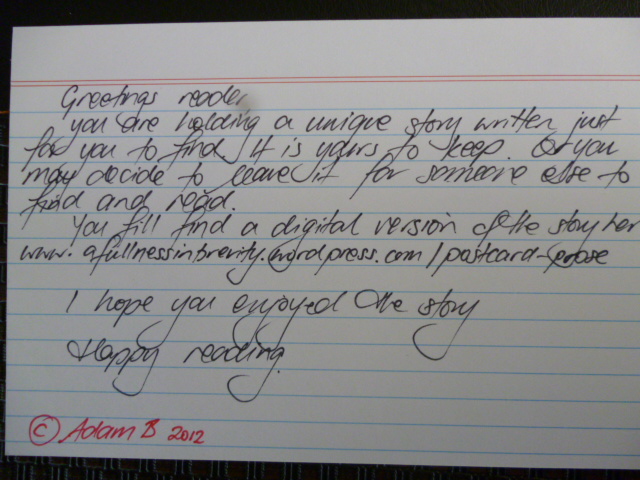
Write a story (about 100 words or less is the maximum space) on a 6″x4″ index card (for all intents and purposes, a postcard) and leave it in a public place for someone to find and read.

On the back of the postcard, the reader is invited to take the story home or leave it for someone else to read. It may be read by one person, five people, or no one at all. Also on the back is my web address, and a link to the Postcard Prose page.

It is an individual, handwritten story for the enjoyment of someone to read.

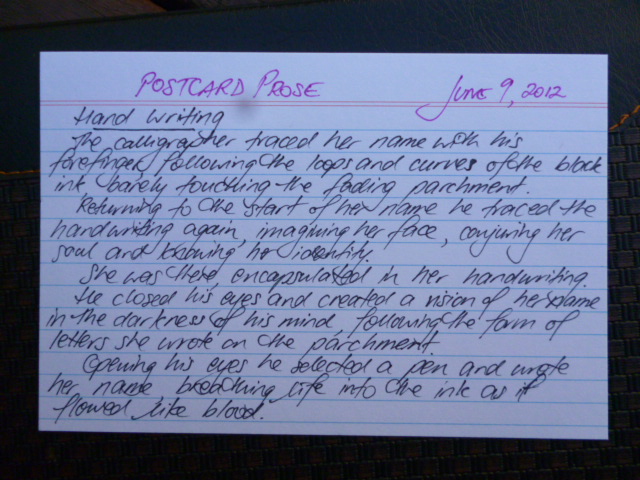
Today I wrote out my #fridayflash Hand Writing from yesterday and left it in the food court of Rouse Hill Town Centre.

You can read the story and see the pictures here – https://afullnessinbrevity.wordpress.com/postcard-prose/

I am always carrying a notebook and pen, ready for ideas. I am now carrying around a packet of index cards should the moment strike. Some will be planned drops, others will be spur of the moment compositions. Wherever I write a piece of Postcard Prose, I will take photos and post them to the Postcard Prose page.

I have plans for two other Postcard Prose projects which will see the light of day later this year.

Now it’s your turn to write someone a story.

Hand Writing

The calligrapher traced with his forefinger, following the loops and curves of her name scribed in black ink, barely touching the fading parchment. Returning to the start of her name he traced the handwriting again, imagining her face, conjuring her soul and knowing her identity. She was there, encapsulated in her handwriting. He closed his eyes and created a vision of her name in the darkness of his mind, following the form of letters she wrote on the parchment. Opening his eyes he selected a pen and wrote her name, breathing life into the ink as it flowed like blood.

On The Last Day of Being Something Other than Writer

On The Last Day of Being Something Other than Writer…

A Guest Interview with Jodi Cleghorn.

Jodi and I have been writing partners since January when we began Post Marked: Piper’s Reach.

On the eve of June 1, Jodi and I are standing on the precipice of a new adventure, doing something neither of us have done before: write a novel. I must say part of the feeling is pure dread and fear, like throwing yourself from a cliff and hoping you miss the ground. Another part of it is excitement at trying something new.

Glad to say I’m wearing clean underwear.

For Jodi writing a novel is also about claiming her position as a writer, not just as editor and publisher.

We are swapping blogs to preview our respective works in progress. I asked Jodi a few questions about her forthcoming novel. You can click on the link at the bottom to find out about my novel.

Tell us a little about your novel eagerly waiting in the wings? Can you give a blurb of your novel and it’s genre?

BYRTHED is a birthpunk* novel set in a ‘medicratic’, semi-futuristic New York City. Reproduction, considered the founding principle of society, has become a Government controlled process, beginning with microchip contraceptive implants and ending in a surgical production line of compulsory Caesarean Sections.

Outlawed in raft of draconian laws a decade earlier, natural birth is consider the festering wound of society and the few advocates and practioners left alive, exist as a secret, semi-militant deme in the bowels of the City. They serve, at risk of death, the women who refuse to hand their lives, and the lives of their babies, over to Government control.

In The Dead Zone (the former Central Park) survivors of a biological massacre thirty years earlier, plot revenge on the City’s residents and officials, spurred on by a prophecy that “a baby will be born to heal the past”.

Caught between worlds disconnected and at loggerheads with each other, five people stand on the cusp of social upheaval, each with their own part to play, each with their own demons to face.

Will Brian capture the City’s most feared terrorist? Will Joseph protect his wife? Will Sylvie navigate hell and gain her freedom? Will Marcus betray those who place their trust in him? Will Taleia unleash her biological fury on the city?

How would you encapsulate each major character in your novel in a single sentence?

BYRTHED follows five major characters.

SYLVIE: a feisty young midwife, living in The Underground, yearning for her freedom and a different life.

TALEIA: an embittered former activist and haematologist, living in The Dead Zone, plotting retribution for a massacre the rest of the city has forgotten.

JOSEPH: a powerful systems analyst, willing to do anything to save his pregnant wife from dying.

MARCUS: a supernatural being unable to succumb to his fate because of a blood bond with a mortal.

BRIAN: relentless head of a secret Government task force, obsessed with achieving his dead mentor, Gustave White’s, goal of eradicating natural birth.

How did you prepare for this novel? Do you have a particular word count or goal you’re aiming for?

Preparation

How long has this idea been kicking around your head?

I’m lucky in some ways. BYRTHED came out of an unfinished novella from 2009, so I already had the core of Marcus and Sylvie’s story… with a peripheral understanding of where and how Taleia, Brian and Joseph fitted into the picture.

What I’ve done, using the start of Karen Weisner’s First Draft in 30 Day is isolate and tease apart all the potential narrative threads then expand each. I’ve beefed up each character, focusing especially on understanding their motivations. And while I did my skeletal plotting, I scribed all the research questions pertaining to the novel—everything from knowing what’s in a basement in New York (and if you could live temporarily in one during winter) to how you might perform blood magic!

At this moment, I have pages and pages of scrawled notes, colour coded, in an A4 spiral bound exercise book—my first effort at conscious plotting!

In March I signed up for Year of the Novel. It started three weeks ago—and outside of doing a brief introduction and listening to the first tutorial, I’ve been too busy tying up editing projects to really dive in (though I think having written the answer to the first two questions I’ve just satisfied the first fortnight’s requirements).

When I wrote BIRTHED (the short story) I did it on a mental timeline of less than 12 hours—start to finish—and compiled a kick-arse playlist of high-octane songs to fuel the action (and me). So I’ve got a basic soundtrack to write, music being just as important to me, as knowing my characters.

I also accidentally secured a beta reader with books published by the publisher I have my eye on to submit BYRTHED to. I say accidentally because I hadn’t even started to think about that end of the writing process. It just happened.

Word Count

I’m kicking off the writing campaign of BYRTHED with a word explosion during The Rabbit Hole this week. The goal for The Rabbit Hole is 30,000 words but there is no way I’ll be able to write all of that for my novel. I’m aiming to write 10,000 for The Rabbit Hole—the opening chapters for each of the characters—bringing me nicely into the 10% word count zone for set up of the novel.  I’m angling somewhere toward 100,000 words (or 5 x 20,000 word narrative threads).

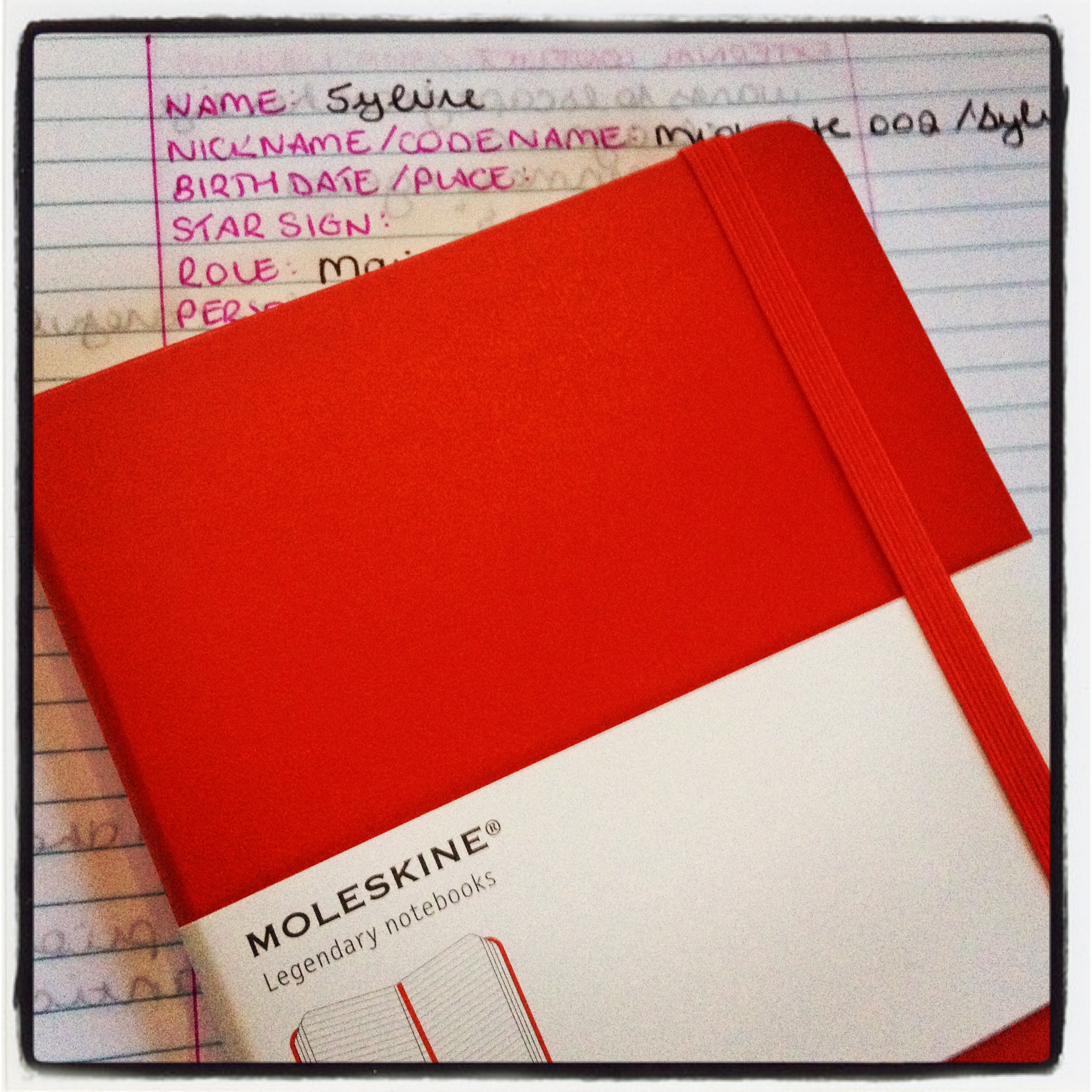
At the very minimum I will be spending 10 minutes everyday with my idea book (my very first Moleskin notebook – in gorgeous red!) as per Kim Wilkins’ (creator of the Year of the Novel) instructions. Outside of that I’m aiming to write a 1,000 words or half a chapter a day. Because the Year of the Novel lasts… for a year, I’m pacing myself. Having said that, if I’m in the zone, I’ll be putting down as many words that come to me.

Where will you be at this time in ten days?

I’ll be farther along than I am today, just as I am farther along today than I was 10 days ago.

I’ll be able to stare at (at least) five completed chapters, have a solid outline for each of the five narrative strains and better understand how I can use the Year of the Novel to get ahead. I’d also like to have secured a map of Central Park.

There is a temptation to come out hard, but for once time is on my side and rather than rally against it, I’m surrendering and going with the flow. Plus, I’m mindful I still have plenty of publishing projects pending completion, even if I do step away (officially) from editing tomorrow.

I hope I’m still just as excited, but less terrified having made the unknown slightly more known.

Birthpunk* is a sub-genre of urban fantasy I created to especially to categorise the novel I wanted to write.
Jodi Cleghorn is a writer, editor and publisher with a penchant for the dark and twisted undercurrents of humanity. Her stories have appeared in anthologies in Denmark, the USA, Canada and Australia. Follow Jodi as @jodicleghorn or via www.jodicleghorn.com.

Who Is Jude Smith?

Since the release of Post Marked: Piper’s Reach, I’ve been asking the question “Who is Jude Smith?”

On Tuesday, the seventh letter in the series was posted, (open The Shoe Box to read the letters so far) but Jude has only had two. Readers have seen a lot of Ella-Louise and can glimpse into the darkness that is her past. Jude, on the other hand, is a mystery. Ostensibly, he is the character I am writing as he responds to the letters of his best friend of 20 years ago, Ella-Louise Wilson.

The premise of the project is the exploring the relationship between two old friends who shared a very close friendship, reconnecting after 20 years. But what do you say to someone after 20 years of silence once the ennui and minutiae have been covered?

Initially Jude is reluctant to reveal his present situation to Ella-Louise, for fear of offending her. Even as Ella-Louise opens up about what has happened to her, Jude remains closed, reticent to confront the collision of the past and the present.

The intensity of their friendship and its sudden dissolution left many unanswered questions for both of them. In Jude’s mind it is safer to reconnect through shared memories of events that were significant, from Ella-Louise’s arrival in Piper’s Reach to skinny-dipping and sneaking a glance, to the Year 12 Formal and after party.

Jude is an “everyman,” yet more than that. In the initial exchange of letters, I feared Jude had nothing to say in comparison to Ella-Louise’s revelations of the darkness of her life. It felt too light (emotionally, spiritually, relationally) but he could not see the balance he was to Ella-Louise.

In the present Jude remembers Ella-Louise as she was in the past and the relationship they shared. He loved Ella-Louise but something held him back. The strong nostalgic sentimentality prevents him from fully understanding of how Ella-Louise has changed, and from understanding her intentions (which may or may not be clear).

But I am writing his letters some months later and a lot has changed. What I am looking at now is Jude’s emotional capacity. Was he emotionally naive in high school to be able to cope with what Ella-Louise was going through? Is he emotionally unready to deal with it now? Is it the cause of his inability to share?

The reader is about to embark on a very intense emotional journey with both characters in the coming weeks, almost voyeuristic in the intimate details shared, in particular by Jude. He is enamoured by nostalgia and in his letters  recounts in vivid detail the moments he remembers sharing with Ella-Louise; what he did do, what he didn’t do and what he wished he did.

There are lots of questions, as there are revelations.

You Know You’re a Parent of Young Children When…

1. You can name all the members of The Wiggles AND Hi-5, past and present.

2. You cannot name a single new song on the radio, but you can know all the words to The Wiggles and Hi-5

3. Silence is when you get to go the toilet without being interrupted

4. “Legato” is not a musical term, but a means of finding pieces of Lego lost in the carpet in the middle of the night with your toes. They wedge themselves in-between your big toe and second toe, sharp edge first

5. You make a sandwich for your spouse, cut the crusts off and cut it into 4 small triangles

6. Quality time with your spouse is having a cup of tea or coffee and it doesn’t get cold and require reheating

7. You’re helping with their mathematics homework and you forget 2+2=4

8. Nudey runs from the bathroom (by you) are becoming a source of amusement and embarrassment (for your children)

9. “Bum” is still considered a rude word and is said with subtle sniggering

10. You look at their toys and wonder if any of them will ever become collectibles so you can turn a profit when they turn 21

Add your own ideas to the comments below.

Words and Music

When putting together a series of ideas for Write Anything’s weekly PROMPTed post, I realised how much I focus on music as a source for understanding an emotional state when writing. When compiling the sets of prompts I began each one with a piece of music. Some of them are well known songs (Pink Floyd – On the Turning Away, Suzanne Vega – Tom’s Diner) and others more relatively obscure such as Hilltop Hoods – Chase That Feeling (an Australian hip hop group) and Primitive Radio Gods – Standing Outside a Broken Phone Box (more of a one hit wonder from the 90s). The first song is a current track by Kate Miller-Heidke – The Tiger Inside Will Eat the Child.

They were seemingly random selections taken from my memory or from play lists on my computer. Despite the diversity of genres and the different eras of music represented, each song has an emotional connection to me. Nothing world shattering or significant but a connection to the groove, the lyrics or the overall feeling of the song.

I love my music and play drums (not a bad level of playing suckage). I listen to a broad range of genres (rock, pop, jazz, whatever), but particularly like heavy metal. Engaging with the music I listen to, there is an emotional or spiritual connection with the music.

Let me talk drums for a minute. The essence of drumming is rhythm and the focus of rhythm is the pulse.  The earliest pulse we hear, but more accurately feel, is the pulse of the human heartbeat within the womb. 

Drumming is physical, spiritual, ethereal, primeval, tribal, conscious, unconscious and subconscious.  It moves your feet and taps your hands.  It provides a rhythm for the cycles of everyday living.  Relaxes the soul and hastens the heart. Drumming is sensual and visceral.

Drumming drives the rhythm.  Even in the absence of a played drum groove, the beat and rhythm are implied. Time can waver, become loose or tight depending on the emotional moment, but the pulse is never lost. 

There is a spiritual element to drumming and rhythm.  The pulse and the heartbeat of music is the driving force.  The pulse and heartbeat of rhythm can be found in the cycles of life; from the measured ritual of a cup of tea to the flow and movement of words across the page. 

As a musician, alright a drummer, I want people to engage with the music. As a writer I want the reader to engage with the words I have written, to find an emotional connection, a similar spiritual experience.

When writing I use music as a background soundtrack to either create a mood, a head space for writing or to suit the mood of the scene I’m writing. Some writers prefer the sound of silence when writing while others prefer a specific genre, band or song to help create the mood or atmosphere. Of late I have preferred instrumental music (sleepmakeswaves, Steve Lawson, Meniscus).

In Post Marked: Piper’s Reach, my character Jude, uses music as a reflection on his head space, or as a link to the past with Ella-Louise. If the reader is familiar with the music referenced, it creates a connection between the reader and the character whereby the reader is able to inhabit a similar emotional space because of the music.

Music is a conduit between the reader and the text; a pathetic fallacy to represent a character’s emotional or mental state, a reflection on their culture or the zeitgeist, or just because they’re really hip and are listening to bands you’ve never heard of. It’s another tool to draw your reader into the world of the narrative. In the novel I’m working on the main characters, both of whom play an instrument, music creates another level of characterisation.

I could fill post after post of music and musicians that inspire me, but here are a few that have inspired me of late.

Imogen Heap – Just for Now I love this song because of the live looping Imogen performs. Brilliant.

Steve Lawson Don’t Stop Believin’ 

Steve is a solo bass player who loops his instrument live. I often use his music as the background music when writing. Beautiful atmospheric and melodic playing.

Meniscus and sleepmakeswaves – Two Sydney (my home town) based post-rock instrumental bands. Brilliant live acts and wonderfully complex music. Never far off rotation on my player when writing.

A couple of other Aussie artists worth checking out: Andrew Drummond, Helen Perris, Emmy Bryce, Lissa, Telefonica. I’m pushing my hometown here, and if I could get my best mate, Steve, to hurry up and finish his album I’d promote it here, too.

I’ll have another post where I go \m/ >.< \m/ heavy metal crazy.

What music do you listen to when you write?

Traditional Literacy and Digital Literacy

In the Australian education system there is a push towards the basics of ‘traditional literacy’ in the form of the NAPLAN (National Assessment Program – Literacy and Numeracy). This is a nation-wide assessment program for students in Years 3, 5, 7 and 9.

It is a useful diagnostic tool but the problem lies with its disconnection with the current English syllabus. The incoming National Curriculum addresses some of the issues by having a focus on traditional aspects of literacy – spelling, reading and writing.

However, the breadth of the English syllabus (especially in high school) means I cannot give adequate time to developing these skills. I have to assess the modes of reading, writing, speaking, listening and representing.

Representing will disappear from the new National Curriculum, but it requires students to present written material in a new form, often visual (poster, website, advertisement). It requires learning a new form of literacy: digital literacy.

A New Language

In our visually saturated society, we have to learn to read the information presented to us in the form of advertisements, web pages, comics, films, television shows, street signs, text messaging, multimedia. We have to learn to read colour, form, shape, camera angles and techniques, line, placement, design concepts in order that we may read the message correctly. I teach film to students, teaching them to read a film in the same way I teach them to read a novel, play or poem.

Today’s students are well versed in digital literacy but I do not think they have learned to read it well because their fundamental understanding of traditional literacy is weak.

Technology is touted as the way of the future for education and pedagogical delivery. It will revolutionise the way teaching is delivered but it will not change the core business of teaching.

A tension exists between the need for traditional literacy (in the form of novels, plays, poems, short stories) and digital literacy (television, film, web and other visual texts). Digital literacy may promote greater student engagement, but what are the essential platforms required for student understanding?

Students are adept at using technology to create. It is quick, easy to use and they are capable of producing fantastic products. They often know more about the programs and technology than I do. However, their ability to articulate their ideas in written form is lacking. I sincerely believe a student will create a better digital product like a film, if they are able to clearly, and with a developing sophistication, express their ideas in writing.

Students are quick to brainstorm their ideas and begin creating a product quickly. The brainstorming phase is essential to develop ideas, but students neglect or ignore the editing and refining phase. This is where a good idea becomes fantastic.

The fluidity of modern language, expressed for example, in text messaging, needs to be balanced with an understanding of formal levels of language usage. Technology may shift the focus from traditional methods of print to laptops, e-readers, tablets and i-devices, yet underpinning the reading experience is an understanding of traditional literacy. Using technology for the sake of engagement (kids like things to be ‘fun’) is not teaching our children to read properly. It assumes students have a good knowledge of digital literacy. They don’t. They need to be taught digital literacy as well as traditional literacy.

Throwing this out there: traditional literacy v digital literacy. Which promotes greater critical thinking? Books or multimedia, both or neither? Does it come down to the person teaching you to think and to learn?

For Writers

As writers, we need to understand and maintain high levels of traditional literacy and be conversant with the language of digital literacy. We may not be screen writers for film or television, but we can endow our novels with an understanding of our audience and open up greater possibilities for new multimedia products.