Starting The Creative Life Afresh

Over the Christmas/New Year period I ran a series of three posts about the creative life: Reflection, Resurrection and Recreation.

I have combined the three posts into a PDF you can download for FREE.

Starting the Creative Life Afresh

This article is for you if:

  • you were once creative and you have abandoned your creative life.
  • you need to shut down a creative life in order to resurrect it.
  • you want to recreate yourself and reclaim your creativity

Download the article for yourself to read.

Please share it with someone you know who would benefit from reading it.

Three Words for the Year

The beginning of a new year is a time for pause and reflection. It is a time to look back and see what you have achieved and look forward to plan what you want to do. 

I had a long list of projects I want to complete (short stories, novellas, a picture book, novels, collaborative projects including a multimedia production, short films/storyboards and non-fiction) so I divided them into a 3-year plan.

I typed up my goals, printed them on coloured paper and stuck it on my wall:

  • GREEN (2013 – Go For Launch),
  • YELLOW (2014 – Look, but preferably stay on target)
  • RED (2015 – Do Not Touch Under Any Circumstances)

I did this to ensure I stayed on target (Red 5 standing by), to keep me focused on the work at hand and make sure it gets finished.

I am continually writing down ideas for stories and blog posts in my notebook, and keep a record on my computer of new ideas. Any new thoughts I have on future projects are written down and filed away.

My focus is therefore on the big picture. My plans are flexible and are subject to change but I needed to sort out the tangled spaghetti mess of ideas in my head.

Plans are all good and well, but how do you maintain the focus needed to fulfil lofty ambitions (I realise I am aiming quite high in what I expect to achieve but the bar has to be set somewhere)?

It is useful to distil the focal point of a year to a clear statement or paragraph or a set of words. Some people choose a S.M.A.R.T. plan  (Specific. Measurable. Attainable. Relevant. Timely.)

I choose three words.

This distillation is easy to recall. It is a check for me against what I am doing compared to what I know I should be doing.

I find using three words is a good way to monitor myself and my progress. This year I have chosen three words relevant to what I am aiming to achieve for my writing and myself. They are a measure of maintaining my creative life.

  1. Disciplined

  2. Dedication

  3. Purposeful

Disciplined

One area in my life that deserves attention is discipline. One of my favourite Proverbs (25:28) is “Like a city whose walls are broken down is a man who lacks self-control.”

If I want to pursue a creative life through writing, I must be disciplined. For me it will involve setting aside specific times for writing, editing, planning, while minimising distractions and time-wasting activities. It will also be a year of a disciplined mind and a disciplined body.

It requires discipline to keep your eye on the goals you have set and to work towards achieving those goals. I incorporate aspects and elements of a S.M.A.R.T. plan into my writing goals, although I allow for greater flexibility knowing certain times of year are busy for me with work.

Dedication

The commitment to a creative life, the pursuit of excellence in a creative endeavour requires dedication. I write and I create because I believe it is an integral part of who I am. To ignore it is to forget who I am.

I am also dedicated to excellence in my work. I will not settle for substandard work. In my dedication to my craft and to improving my work I will seek out beta readers, gather feedback and critique, then edit and rewrite until it is finished.

Purposeful

I will frame this third word as a question: “Is what I am doing moving me towards my goals or moving me away from it?”

I allow for down time, rest periods and general shenanigans, but when it comes to writing time, am I writing with a purpose? Am I wasting time or am I being productive?

being purposeful might mean saying “no” to a project I want to work on. It might mean forgoing entry into a prestigious competition.

But the ultimate question is, “Is it moving me towards, or away from, my goals?”

Disciplined. Dedication. Purposeful.

What are your 3 words for the year?

Recreation – Becoming a Creative Person Again

Welcome to the third part of the “Reflection, Resurrection, Recreation” series.

In Part 1, Reflection, it was asked what kept you from being creative. Part 2, Resurrection, asked if you needed to shut down your creative life.

Part 3 brings both groups of people to a focal point: the need for re-creation. At the beginning of the new year it is good to have looked back at what was, evaluated the positive and the negative, in order to look forward.

Recreation of yourself and your creative life requires a new focus, a new perspective, a new challenge. It comes down to the core of who you are, your values, your purpose and the tools and skills you need.

At our core we are creative beings. If we have lost the creative core of who we are, we need to recreate ourselves like the phoenix is reborn from the ashes of itself.

The act of recreating yourself is a spiritual one.

The act of creating is a spiritual act, a divine unction to do something. It is time for recreation. Here’s how.

Know Who You Are

Knowing who you are requires a bold, declarative statement. It requires a fundamental belief in what it is you do.

Get a pen and a piece of paper. Write down the following:

“I am a creative person.”

Repeat it. Write it down again. Say it in your head. Say it aloud.

This is who you are. You are a creative person. How it is manifested in your life is based on your interests and skills.

There is a fundamental need to create inherent in each one of us.

Embracing the fact you are a creative person is the first step to recreation.

Creativity Gives You Purpose

“I am a creative person.”

You identify creativity as a purpose in your life. It gives meaning to your life because in the act of creating it helps you make sense of the world. Even if all you do is ask questions through your creative acts, you understand creativity gives you purpose.

Creativity is the means you explore ideas, confront fears, confront negativity, promote positivity, birth beauty, truth and wisdom into the world.

Creativity brings you child-like joy in the act of creating.

Creativity is who you are.

Update Your Tool Box

What tools do you need to be creative?

Pens and pencils? Notebooks? Canvas, paint and brushes? Scissors? A ream of Post-It Notes? A camera? A stick of glue and tube of glitter?

If you have abandoned your creative life or are resurrecting it, you will have the tools at your disposal.

Keep it simple. As a writer I only need a pen (preferably an Artline 0.4 black felt tip pen) and a notebook (any cheap thing will do). I don’t need fancy pens or paper; they will not make me write better. I don’t use writing applications on my computer.

Work out what you really need. Start simply.

Don’t go out splurging massive amounts of money.

As a drummer it is tempting to walk into a drum store or browse through catalogues and believe I need the latest and greatest or the most expensive. But each time it happens I stop myself. I have the tools I need and they are good tools. I must master the tools I currently own. I need to focus on developing my skills to improve my technique.

What skills do you need?

Being creative requires very little skill at all. Pick up a pen, a piece of paper and a pair of scissors and hours of fun await you.

Use what you do have to create.

But to take your skills further may require training, new information, a mentor, or professional classes to enable you to be excellent at what you do. Part of your recreation may involve enrolling in a community college or a university course.

Recapturing the Creativity

The beauty of creativity is in its simplicity. There is much joy and wonder to be gained by creating simple things.

Creativity is about play, being child-like in our enthusiasm. The child-like simplicity of play is something we forget as adults. We grow, mature, develop sophistication and somehow forget the need to play. I suggest reading Jodi Cleghorn’s recent post on rediscovering creativity through the eyes of a child.

When recreating yourself, coming back to the very essence of who you are, come back with a sense of playfulness and joy. In your recreation:

  • Be playful
  • Be adventurous
  • Be spontaneous
  • Be silent from time to time
  • Be aware of wondrous things: the remarkable and the everyday
  • Be observant
  • Be proactive
  • Be musical
  • Be kinaesthetic
  • Be you

This will feed your creative spirit and find expression in creative acts.

May your creativity be reborn from the ashes as you rediscover who you are, your purpose and your tools.

Resurrection – When To Shut Down a Creative Life (And When To Resurrect It)

Welcome to Part 2 of Reflection, Resurrection and Recreation.

Friday’s post, Reflection, asked why we gave up a creative life and encouraged us to live creatively again.

Part 2 is about death: the need to shut down a creative life, and resurrection: when it take it up again.

As creative people, the idea of shutting down our creative life is akin to hacking a limb off or stopping breathing. While it might appear to be the opposite thing to do, it may in fact be apposite.

Every so often you need to evaluate your creative life, check the map for where you are compared to where you are headed and work out whether you are lost in the Pit of Despair or frolicking in the ball pit at Ikea.

If your creativity is not in the place you want it to be, you need some serious self-reflection.

Do you need to shut down your creative life?

Ask yourself the following questions:

Have You Lost the Passion?

Being creative is hard work. Every creative person will proclaim it loudly from the toilet cubicle (better resonance). We enjoy being creative because we are passionate about it. The passion drives us to continue, to persevere, to work through the tough periods. There is great joy in creating.

But without passion, you are continually giving of yourself and not feeding your own needs. There is more going out than what is coming in. The reasons for the lack of passion are numerous, both internal and external; you will know what has taken away your love for creativity.

Without passion, your creative work will suck you dry and spit out your withered carcass.

To find your passion again, shut down your creative life.

Are You Grieving A Loss?

The loss of a creative project or the completion of something you have invested yourself heavily into can be like a death in the family.

You have to grieve what you have lost; remember what you have accomplished and celebrate the achievements.

It is natural to grieve after a loss. In order to deal with the grief and loss, shut down your creative life.

Does Your Work Suck?

This is tricky. If you are not developing and improving in your chosen creative field, you have to ask someone to objectively and critically evaluate your work. You need to ask the hard question, “Does my work suck?”

If the overwhelming consensus is your work sucks, you have two choices. Firstly, improve your skills. Enrol in a course, find a mentor, workshop your project, seek advice. Or secondly, shut it down. Focus your creative energies elsewhere if what you are doing is truly not what you want to do. Experiment with a few areas to see where your skills are best suited.

Have You Moved Away From Your Core Values?

It can be too easy to seek out the latest trend, jump aboard the bandwagon and ride shotgun. All the while you are moving further away from your original intentions and purpose.

Are you in the wrong creative field?

Are you writing short stories when you should be producing short films?

Are you painting when you should be writing?

Who are you and what do you want to be doing?

Are you doing it?

Why not?

There is nothing wrong with diversifying and experimenting, trying out new creative mediums, but if it takes you away from the core of who you are and what you do, it is time to shut it down.

Has Your Creative Life Crossed Boundaries?

Creative people can be obsessive and focused or ethereal and unreliable as they pursue a creative life. If your creativity is taking over your life and interfering with relationships, if it is taking away from family and friends, it may be time to shut it down.

Creativity involves a sacrifice of time and effort, but not at the expense of you being a selfish pillock. Communicate what you want, negotiate the boundaries so that all involved have a clear understanding of what is required. It may require the drawing up of an agreement, stuck to the fridge as a constant reminder of each person’s responsibilities.

Focus and dedication are important to the life of a creative individual, but if it crosses boundaries, shut it down.

Has The Well Run Dry?

Creative people speak of the “well of ideas,” a place to draw inspiration. Reading a book, watching a movie, visiting art galleries or taking a walk with the rabbit on a leash can fill the well of ideas. A project needs time to develop, consciously, unconsciously and subconsciously. Ideas generate ideas.

Sometimes the creative well is dry because the plug has been pulled out. The draining of ideas may have its source in a range of things: your own emotional state, external situations and circumstances, demands and pressures on your time, or relationships.

You need to refill the well by putting the plug back in and letting it refill in its own time from a trickle to a torrent. Feed yourself on good things like art and music, books and films. Fall in love with simple pleasures again. Leave the tools on your desk and have no regrets in leaving them alone.

If you are dry, shut down your creative life.

Death and Resurrection

But how long should your creative life be shut down?

If you shut down your creative life, will it be resurrected?

Will it become a derelict building, boarded up, dilapidated, falling into ruin and fit for demolition? The shutting down of a creative life may be an individual’s choice or the result of external circumstances and situations, or a combination of both. Some may choose to leave the creative life altogether and never return. This is a shame because I believe creativity should be a part of everyone’s life.

If the shutting down is a voluntary choice, you are giving yourself permission to step aside from a creative life. When you make that decision, embrace it. Grieve your loss and mourn the death.

Set a period of time for your creative life to be dormant: days, weeks, months, or even years.

During that time clear your space; throw out what is not needed; purge the unwanted and irrelevant.

Then set a specific date to resurrect your creative life.

Focus on a project; set achievable goals. Have a project ready to pick up and finish or a project to start afresh.

The creative life is one that is inherently a part of you and brings benefit, but you need to return to the thing you fell in love with. It’s like a relationship: you have to work at it.

Grieve when you need to grieve. Always find ways to improve your work. Reclaim what you are passionate about and establish the core values of who you are. Establish the boundaries of your creative life and keep the well full of ideas.

Only then will you live a creative life to the full.

Do you need to shut down your creative life and resurrect it?

* this is an edited version of a post that originally appeared at Write Anything.

Reflection – Why Did You Stop Being Creative?

As the year draws to a close like the end of a roll of toilet paper, I am running a series of three posts about the creative life: Reflection, Resurrection and Recreation.

Reflection addresses those who have stopped creative activities, while Resurrection (Sunday) addresses the need to stop creative endeavours. It all leads to New Year’s Day (Tuesday): Recreation.

Reflection – why have you stopped being creative?

Have you paused to ask yourself why you stopped being creative? Has your once prolific creative output reduced from a torrent to a dribble? Or is the well of creativity nothing but a cracked dust bowl?

Here are five reasons you have stopped being creative (and a plea to start being creative again):

1. Logic and Reason Replaced Emotion and Passion

Once upon a time, perhaps when you were a child or a teenager, you were passionate about creating something: you wrote or painted or composed or gardened. Whatever it was, you were passionate about it; you engaged emotionally with your creative process.

But that passion and emotion you threw into creative endeavours was replaced with the cold push of logic and reason. Artistic, creative people were typecast as overly emotional, passionate and highly illogical.

You were encouraged to put away childish things and focus on more adult pursuits. Emotions are considered primitive brain responses to be suppressed, ignored or detached. The Vulcans have a lot to answer for; I’m looking at you Spock.

Creativity gives equal balance the emotions and to logic and reason. Great art comes out of logical, reasoned thinking AND impassioned, emotive thinking.

What you create is a product of your logic, reason, emotion and passion. Tap into it again.

 2. Career Over Hobby

What did you dream about doing as a child? Did you want to paint? Design clothes or fashion? Did you want to write?

These pursuits are often considered a hobby, not something you make a career from. Too often creativity is seen as a hobby, a pastime to be indulged in during holidays or the occasional weekend. It is not valued as worthwhile because it at best it does not produce income, or at worst, it costs money, time and effort.

Instead our chosen career path dominates our time and resources, pushing creative endeavours to the periphery. The regularity of what we do for a living is a drain on our time and resources. If you have a family, there are still greater demands on your time. The chance to be creative is reduced, pushed out as a thing you do when you have the time or the inclination.

Being creative is something you make time for. It refreshes and rejuvenates. It is not a hobby to be done in spare moments; it is a vital extension of all facets of your life.

Rediscover the joy of your hobby.

3. Pragmatism Over Recreation

When was the last time you did something creative simply because it felt good for you? Or did you feel guilty, feeling like you should be doing something more productive? Have you put pragmatism over the need for recreation and rest?

We are obsessed with knowing, with proving something through empirical data and evidence, hypothesis and conclusion. We do something because it is proven to be beneficial or productive. Creativity does not easily fall into a pragmatic category therefore people are wont to give it up.

Creativity is not neatly defined by a formula or pattern. Creativity is a chance for recreation, to pause, to rest, to have a sabbatical.

Because you can.

Because you need to.

Your best reason to create is “just because.”

4. Utilitarianism Over Culture

In Aldous Huxley’s “Brave New World” utilitarianism creates a consumptive culture: If it is not for the greater good, if it is not productive and beneficial, if it does not advance, it is not deemed worthwhile.

Culture is not measured in scientific or technological progress alone. It is measured in the greatness of art produced. Poetry, art, philosophy, literature, film, drama are the benchmarks of a culture. The paucity of good art needs addressing because we have made creativity and art something we consume, a fast food meal. Creativity can never be mediocre.

In recent years, especially in Australia, the government’s investment in creative activities such as literary awards has waned. Funding cuts to reduce budget deficits hit creative spheres first. They are deemed unimportant. (The rights and wrongs of this need not be debated here; there are other ways to fund creative projects).

The culture of a society, a community, a family and as an individual, is created consciously and unconsciously. If you do not participate and contribute to a creative culture, another culture will dominate.

Creativity can appear to be frivolous and wasteful, a solo production without discernible benefit to someone other than the creator.

Take a risk and develop a positive, creative culture. Start with yourself then extend it to your family, your community, your society.

5. Structure Over Boredom

Throughout our infant and adolescent lives, we are run by timetables. School provides a rigid structure, chronicling where we need to be at any given moment. A university timetable is less rigid, and a workplace gives broader latitude, yet the moments of our day are accounted for.

We fear boredom if our children are not engaged in a meaningful activity. Boredom promotes creativity (when was the last time you were bored), allowing the subconscious time to percolate, compost and rejuvenate. Stimulus is good for the brain but it also needs to rest.

Have you filled your life with so many activities you do not have time to rest, to be bored in order to be creative?

Schedule some down time to be bored.

Final Thoughts

Creativity is not a tacked on adjunct to life; it is an integral part of it. To lessen its role in our lives is to diminish the fulfilment creativity brings. Creativity brings life, that you may live it to the full.

Creativity is not self-centeredness but a means of recreating yourself and the world around you.

Will you dare be creative again?

Tell Me Your Story

“What’s your story, boy?”
“I don’t have a story.”
“Every man got a story.”
The Saint of Fort Washington

Three simple lines of dialogue.

A simple declaration by a homeless man: “Every man has a story.”

I saw this film, starring Danny Glover and Matt Dillon, many years ago in my late teens and the lines above resonated with me, deep in my spirit and in my soul.

I wrote down the lines in a notebook (which I still have). Deep in my spirit and deep within my soul these words planted a seed that is only now beginning to germinate and take root.

When I am asked why I write, this will be my answer: “Every man got a story.”

I wrote a manifesto.

It is my declaration of who I am as a creative person.

It is my declaration of who I am as a writer.

Towards A Creative Manifesto

I am a writer.

I write because I want to tell a story, but not just any story.

I write because I want to tell the story of those who are not heard.

I write because I want to tell the story of those who cannot speak.

I write because I want to tell the story of those who are disempowered.

I write because I want to tell the story for those who cannot.

I write because I believe that telling a person’s story is integral in understanding who they are.

I create art to speak into the darkness, that I may be a light for others to ignite their own flame and walk clearly.

Last night in a quick burst of ideas on twitter I threw down some words. It extrapolates further on my manifesto. I have compiled them here (with some editing for clarity and development).

People matter because every individual has the potential to be amazing in their own way. We ignore the everyday because we think it’s insignificant.

Instead we worship the grandeur of the successful and the famous. They are inspirational and we learn from them but it is little more than hollow idolatry.

The most influential people in our lives are the ones we know intimately because we’ve learned from their example, both in word and in deed, even when they are not looking. We have been mentored by their advice, corrected by their discipline and modelled our lives after theirs.

They are fathers, mothers, brothers, sisters, cousins, friends, coaches, teachers. They are servants at heart.

And they are ordinary people.

But in their ordinariness, they have become extraordinary.

We have learned to listen to their story and recognise its value and importance.
Celebrate the little things people do. Believe in them. Support them. Love them.

For in doing so, we grant them dignity & respect.

I write truths about life through story by focusing on the little things, the seemingly insignificant: an argument before a family holiday (The Holiday), a gardening accident (Open Wounds), mental illness (Scar Tissue/Pieces of A Puzzle), cancer (The Naked Jacaranda), discrimination and disability (Give Me Your Hands), life expressed through sound (Sounds of the Heartbeat).

Simple truths expressed through story; parables and fables in their own way. It is an expression of loving your neighbour as yourself because story connects people.

Let me tell you a story.

But first, tell me your story.

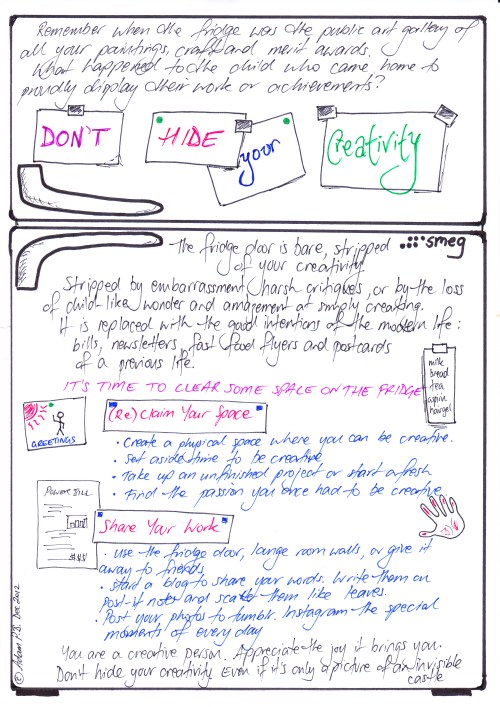
Don’t Hide Your Creativity

Don't Hide Your Creativity_0002

P.S. I have always thought that kitchen appliance stores are too clinical and antiseptic. The displays lack character: clean chrome or white surfaces with no hand prints smearing peanut butter or jam down the length of the fridge.

To be authentic they need to be decorated with paintings, cards, photos, bills and newsletters.

Anyone for a kitchen appliance store flash bomb?

Why Writing is Like Building Furniture from Ikea

Pick up the novel nearest to your hand you have read. Flick through it. You understand the plot, the characters, thematic concerns and the nuances of the language used by the author. It is said that everyone has a novel in them. Then you think, “I can give one of these novel things a crack. Doesn’t seem too hard.”

In your hand you hold a pen, ready to scribe your first novel. You know your story will unfold like a fresh bed sheet snapped out, floating down with delicate grace. The characters are complex individuals; the dialogue witty and full of sly observations; the plot is fresh and modern; the thematic concern touches on the toughest questions of life (but you have all the answers).

Sitting down you aim to start, but suddenly you are verbally constipated, stuck with the result of too much cheese and crackers. There are brief starts and squeezing out paragraphs with such force you could turn coal into a diamond.

So while it is said there is a novel in everyone, it is also said that no man is an island or that, all in all, we’re just another brick in the wall. And maybe that novel inside you should stay there because not everyone is called to be a novelist in the same way I am not called to be the Prime Minister of Australia (it would be a benevolent dictatorship, I assure you).

And it is because writing is difficult. It is hard. It is brutal at times. To understand how hard writing is, let me write you a simile.

Writing is like building furniture from Ikea.

In your hands you hold the instruction manual and emblazoned on the front is a catalogue image of what the finished product should look like. Caveat Addendum: power tools and me are mutually exclusive entities. I am useless with things that would validate my Man Card for all eternity.

Turning to the first page, the opening declaration states: “You must be two people to assemble this item.” (True story – was in the instructional leaflet for a lamp my wife and I received as a wedding gift).

So you lay out on the ground all the component pieces, checking you have everything you need. Then there’s the Allen key, the hexagonal tool of mystery. It is the key to success but lose it and you’re doomed to a lifetime of failure if you cannot wield it’s magical properties.

And so you begin. The instructions make no sense, you need the input of 6 people and certain words fly out of your mouth that would cause your mother to wash your mouth out with a wire brush and Dettol if she heard you.

People know to stand clear because the vein in your temple is throbbing and pulsating like a death metal blast beat, and one more inconvenient dropped screw or slipped piece of timber will cause your frustration level to become cataclysmic.

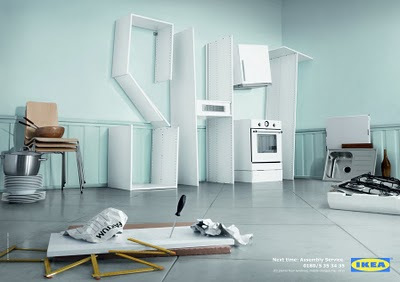
I am not usually a swear-y person, but this ad was too good not to include. Please excuse me.
http://madisonadblog.wordpress.com/2011/05/05/oh-sht/

The object before you takes on the appearance of Frankenstein’s monster; it is ugly, gangly, obtuse, imperfect, but dammit, you’re making it!

And yet you persevere; this thing will not beat you. Your aim is to give it life, and LIFE IT SHALL HAVE!

Finally, after hours of building, cursing, swearing, begging, pleading and grovelling, IT IS FINISHED. All the lines and angles are straight. Its beauty and function are unparalleled.

You did it!! (with a little help from your friends) And you don’t have a piece missing or a leftover screw.

And then someone asks why couldn’t have just bought one that was already put together.

This is why writing is like building furniture from Ikea.

With thanks to Jodi Cleghorn (@JodiCleghorn) and Monica Marier (@lil-monmon) whose comments I have appropriated.

Add your own additions to this idea in the comments below.

Creativity As Seeing The Real World Differently

Gary Brown, owner of G3 Photographics, wrote this on my Facebook wall in response to my questions about how he sees the creative life.

It is one of the most powerful statements about creativity I have ever read. It is an insight into Gary’s creative mindset, and into the darkness that sometimes plagues creative people.

It is a statement asking for understanding, a declaration of intent to bring beauty and art into the world .

It is reprinted here with permission.

The reason so many creative people feel alone, whether they are in a crowd, married, have many many friends, even at the moment of being applauded or recognised for their work… the alone feeling is this: in our imagination, in our soul, in our music, in our writing, in our photos is a world that we see/feel/envision in ourselves.

We try to express it, to share it but we know our skill can never truly, perfectly represent what we hear or see or feel. It’s like a parallel universe overlayed on our real life that we try to pull into existence. We can’t be placated, we can’t be made truly at home because our home is somewhere only we can visit.

So when the ‘real’ world dominates our time, thinking and/or efforts, we feel torn away from paradise. That’s why we go off, and spend time alone, visiting the place we truly feel at home.

Thanks for understanding and maybe, just maybe, you can get a glimpse of where we truly exist in peace.

I think this has been part of my reason for the battle I have with depression. I have fought for the first 30years of my life to try and bring the beautiful world in my soul into this one and used up all my life’s energy in doing so too fast. Then at 30 had nothing left but the realisation that I really don’t belong here. Went catatonic with this realisation, literally for 2 months. Then have spent the next 5 years learning that may be it’s good enough just to add a dash of colour and be happy at that.

I see such beautiful places, hear such powerful music, get to sit and just BE with some amazing people in my imagination. The worlds I walk through, exploring the landscapes of impossibility, skipping through time, dancing with thoughts, feasting on emotional realities, testing possible outcomes, directing hordes, caring for a ONE, saving many, loosing a few, battling on the battlements and lamenting the fallen. It all happens in vivid colours, vibrant sounds.

Here, here I am truly REAL.

You can see Gary’s work here at G3 Photography or on Facebook.

The Naked Jacaranda

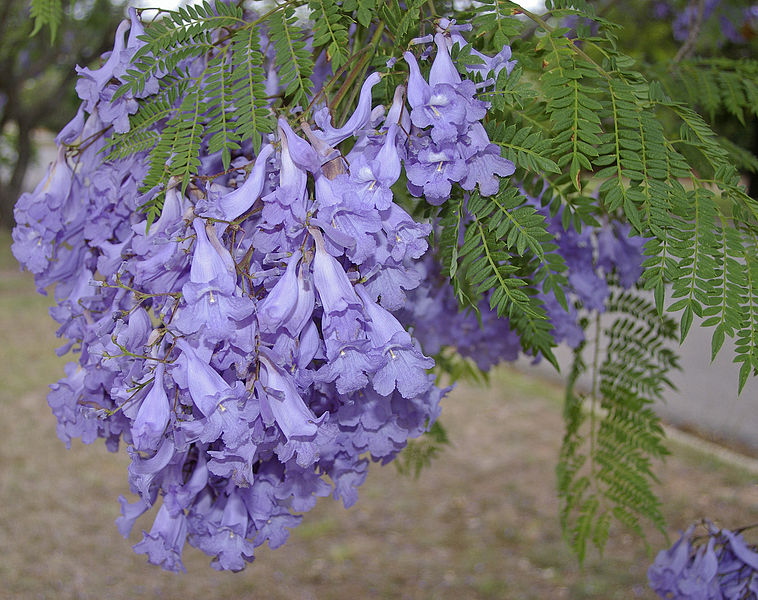
As October faded and decayed, November blossomed; the jacaranda tree exploded in fireworks of purple flowers amongst the green tree tops haggling and hunkering over the back fence. 

The invasion of colour  occurred at the same time they injected her with drugs to fight the cancer in her blood. 

And the flowers began to fall, denuding the tree, forming a purple carpet on the backyard lawn; scattered randomly and suggesting they could be counted where they fell or numbered as the hairs on her head. The purple flowers faded, cut off from the tree, turned brown and became one with the earth. 

As the last of the flowers fell, tiny green shoots pushed through, heralds of the turning season. And she waited.