Post It Note Poetry February 6

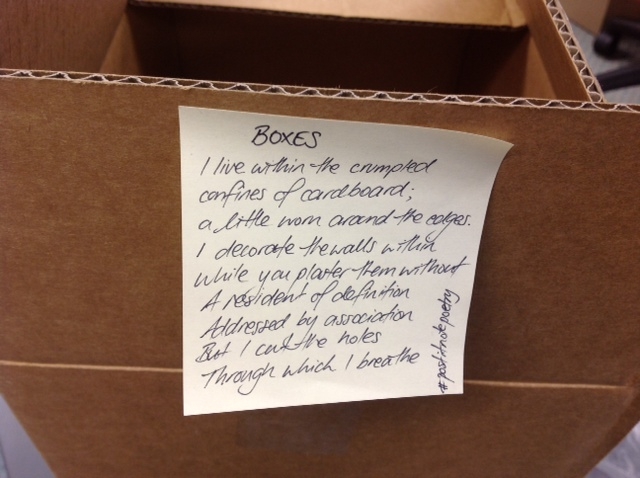
February 6 – Boxes

Post It Note Poetry Feb 6

I live within the crumpled

confines of cardboard;

a little worn around the edges.

I decorate the walls within

while you plaster them without

A resident of definition

Addressed by association

But I cut the holes

Through which I breathe

Post It Note Poetry February 5

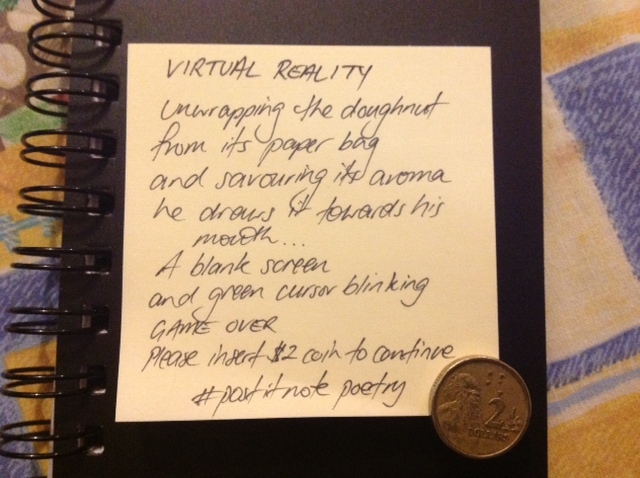
February 5 – Virtual Reality

Post It Note Poetry Feb 5

Unwrapping the doughnut

from its paper bag

and savouring its aroma

he draws it towards his mouth…

A blank screen

and green cursor blinking

GAME OVER

Please insert $2 coin to continue

Post It Note Poetry February 4

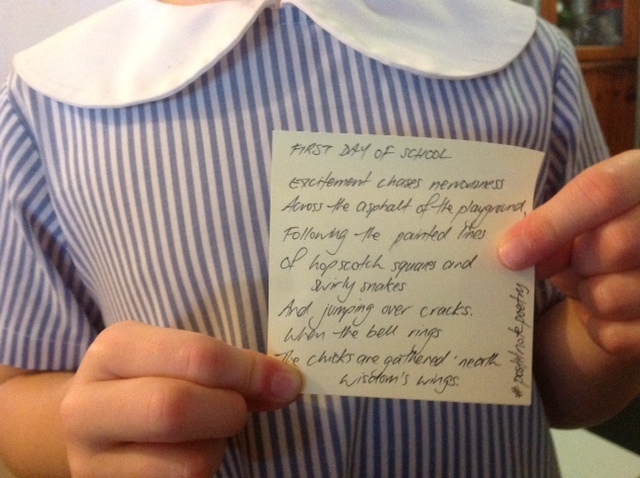
February 4 – First Day of School

A themed #postitnotepoetry submission today as my youngest, Little Miss #2, starts her first day of Kindergarten.

Post It Note Poetry Feb 4

Excitement chases nervousness

Across the asphalt of the playground,

Following the painted lines

Of hopscotch squares and swirly snakes

And jumping over cracks.

When the bell rings

The chicks are gathered ‘neath Wisdom’s wings

Post It Note Poetry February 3

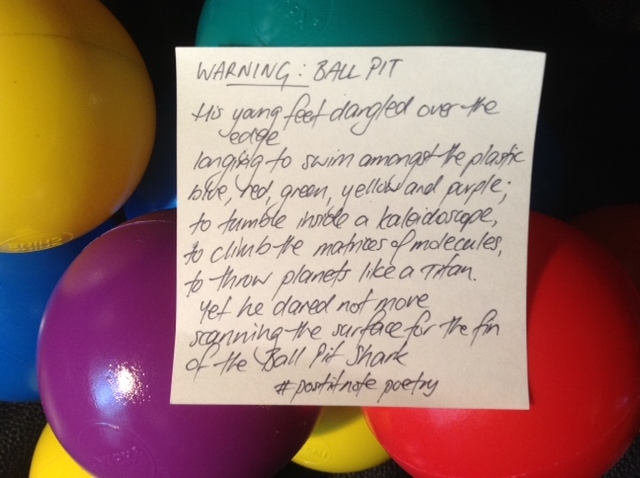
February 3 – WARNING: BALL PIT

Post It Note Poetry Feb 3

His young feet dangled over the edge

longing to swim amongst the plastic

blue, red, green, yellow and purple balls;

to tumble inside a kaleidoscope

to climb the matrices of molecules

to throw planets like a Titan

Yet he dared not move

scanning the surface for the fin

of the Ball Pit Shark

Post It Note Poetry February 2

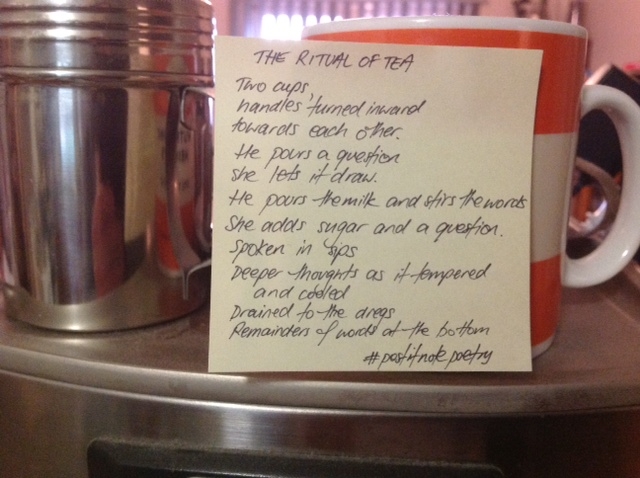
February 2 – The Ritual of Tea

Post It Note Poetry Feb 2

Two cups,

Handles turned inward

Towards each other.

He pours a question

She lets it draw.

He pours the milk and stirs the words.

She adds sugar and a question.

Spoken in sips

Deeper thoughts as it tempered and cooled

Drained to the dregs

Remainders of words at the bottom

Post-It Note Poetry February 1

I set myself a challenge of writing a poem a day during the month of February. A poem on a Post It note.

Each day I’ll post a new poem*.

I have also set up a permanent page on the blog where I will collate all the poems.

You can also follow me on twitter @revhappiness and follow the hashtag #postitnotepoetry

* Results may vary and you can probably expect dog-awful, spleen rupturing, Vogon-inspired poetry. You have been warned.

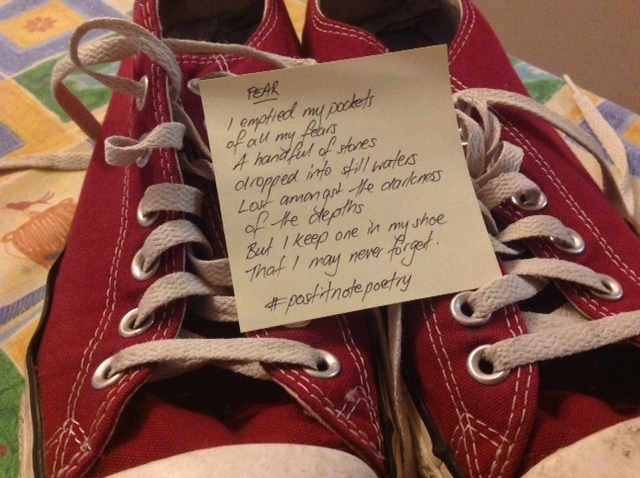
February 1 – Fear

Post It Note Poetry Feb 1

I emptied my pockets

of all my fears

A handful of stones

dropped into still waters

Lost amongst the darkness

of the depths

But I keep one in my shoe

That I may never forget

National Geographic

My first exposure to, and subsequent interest in, breasts was at the impressionable age of nine, fastened to the vinyl waiting room chairs of the local doctor. A kindly old chap with more hair protruding from his ears than sprouting from his head. I was there because swallowing felt like drinking a cup of marbles, broken Weet-Bix and Sao biscuits topped with a covering of sand.

In a measure to keep the idle from making mischief, and in the hope of expanding my educational perspective, my mother handed me a dog-eared copy of National Geographic dated around the time of my birth. Boredom is the birthplace of genius yet the prospect of a bored nine year old frightens adults. To appease my mother’s insecurities more than anything else I flicked through the pages enraptured by sumptuous photography of urban landscapes, scientific phenomena and pastoral idylls.

Within the pages a tribe of African women stood with their hair matted by ochre the colour of dried blood. I was fascinated by this first glimpse of human nudity, unsullied by sexuality. The glossy brown of their naked chests was bedecked in beads of bold reds, summery yellow and horizon blue cresting above the rising and falling curvature of their breasts. I saw in their mammary tissue the topography of life: full, taut and shapely to wrinkled and deflated like a week old balloon, sagging without shape or form.

My attention was transfixed on the shape and form but lest I be caught staring intently at something that my brain believed was wrong but my groin said was right, I flipped the page, keeping a finger lodged between the appropriate sections.

Called into the doctor’s office, my attention wavered, concocting a plan to liberate the copy of National Geographic from the waiting room and into my possession. Inside the doctor’s office I opened my mouth and recited the mantra, answered the official petitions and let my mother accept the diagnosis of tonsillitis.

Returning to the waiting room I approached the receptionist’s desk, a bold request forming on my lips. “May I please have the copy of National Geographic for a school assignment?”

The receptionist nodded and I scurried to claim my prize and followed in the wake of my mother to visit the chemist for medicine. Seconded to bed rest for a couple of school days I took the opportunity to develop an understanding of my initial discovery with the benefit of the encyclopedia and a dictionary.

Perusing the article again I was drawn to the mathematical artistry and beauty of their curvature and form in space, the tone colouring of the areola and the cylindrical form of the nipple.

Upon my return to school the copy of National Geographic came with me. I thought nothing of it in terms of it containing pictures of naked breasts. At recess I was thumbing through the pages, rereading an article on spelunking. The breeze rustled the pages and opened them to the focal point of the magazine.

“Check out the tits,” said Jude Templeton over my shoulder.

I was initially non-plussed, unfamiliar with the vulgar colloquial vernacular. My ignorance made knowledge by Jude stabbing his finger at the page before flicking the pages back and forth. A small crowd flocked around, aghast and intrigued by the display of the naked female form.

I was lord of the Lunchbox, King of the Canteen. For twenty-four glorious hours I had stature and kudos but its presence was ephemeral. Until Jude Templeton smuggled his older brother’s copy of Playboy to school. A few too many leering eyes caused a commotion, whereby our teacher upon discovery, promptly confiscated it as Jude attempted to stow it under his desk.

Aiming to deflect his guilt Jude pointed in my direction, “He has one, too, Miss.”

She raised her eyebrows, folded her arms and I gambled. Withdrawing the magazine from under my desk, I held up my National Geographic. She turned and faced Jude.

“That is not a Playboy,” she said, holding her hand towards Jude for his magazine.

“But…” He was cut off by a snap of her fingers. The magazine was handed over, a guilty baton. Miss hurriedly rolled the magazine and stuffed it into her desk drawer. “I will be speaking with your parents,” she said to Jude.

I imagined the male staff sitting around the lunch table, cups of tea and coffee in hand, turning the pages, tut-tutting at the indiscretion of youth while having a good gander.

At lunch Jude tried to convince me to show him the pages again but I refused. However, I convinced him “areolas” was the name of a Spanish goalkeeper.

In the following years of developing adolescence when my friends mined the seam of hormones laid down by puberty they moved on from the simplicity of nudity to secret collections and surreptitious glances. The embarrassed indignity of being caught with masturbatory material did nothing to quell their enthusiasm. Conversations used thirty-two synonyms for genitals, male and female, with salacious intent. They snorted at vintage adult magazines, at the variation of shape and form against the homogenous shapes they ogled in contemporary glossy pages.

If I wanted nudes, I didn’t go to the magazines my friends pored over, nor to the sewerage pipeline of the internet in this modern age. I went to art galleries and studied the Reubenesque women of art books, the voluptuousness of the Renaissance, modern abstracts, Titian, Whitely, Picasso, the sculptures of the ancient world and of Rodin’s sensuality.

I pursued another learning and became a collector of National Geographic, browsing second hand bookstores, scrounging copies from relatives on the pretext of research for school assignments, random doctors’ surgeries, looking for issues from a bygone era of a different censorship. My interest in breasts was cultural, sociological, anthropological, medical, scientific, artistic, more so than simply sexual.

Even now I have an extensive collection. If you’ll excuse me, I think I hear the postman, and with him I hope, the next edition of National Geographic.

Writers Are Really Weird

If you complete some research on famous writers and their writing habits you find interesting things like this:

Writer A writes 2000 words a day without fail.

Writer B can only write standing up and produces 3000 words a day.

Writer C writes 1,500 words in the early hours of the morning before the family wakes up.

Writer D dances widdershins around the coffee pot before lighting an incense stick and playing whale song CDs, and writes with rainforest-certified pencils on hand-made paper recycled from a daily newspaper from Australia. And then writes 5000 words.

(I made the last one up).

Whenever I read about the habits of famous authors, all I take away from the information is that there are some really whacked-out, freaky, obsessive-compulsive writers, probably alcoholic and addicted to something.

All you learn is that each writer has their own idiosyncrasies which may or may not work for you.

It’s an interesting exercise from a creative point of view but rather pointless in understanding how YOU create and write.

There is no single formula applicable to every creative person or writer. There is no “one size fits all” category.

And there’s no point in telling you how I work because it probably won’t be applicable to you.

Simply, find the process that works for you.

Addendum

Knowing how someone creates gives you a template to begin understanding your own process.

I am a new and emerging writer. I have had a number of short stories published and I am working towards a number of fiction and non-fiction projects. I am not professional in the sense I make a living from writing.

I teach high school English full time. This means there are times when writing cannot be fitted in to my week.

This is how I write: my writing is fitted into the timetable of my day in regards to work and family. Normally this means evenings (once the children are in bed) or on weekends. I cannot guarantee the same amount of time to write each week so I have to be as productive as possible.

I don’t write at school because there is enough to do there without adding extra. School holidays provide more time to write, but even then there is school work to do (marking of assessments and preparation).

Simply put it is a case of write when you can write.

Make time to write.

Fit it into the spare moments of the day.

Plan to write and follow through on that plan. Even if it’s only 200 words.

Again, find the process that works for you.


Microwave Literature

How many words MUST you write EVERY day? 100? 200? 500? 1000? 2000? 5000?

Are you writing (fast) enough to get your work out there?

There are two things wrong with the opening question: “must” and “every.”

It is used as a whip-like carrot to push writers to produce work as quickly as possible. There is a sense of urgency, almost panic, to make writers seat themselves down and write furiously. Think National Novel Writing Month (NaNoWriMo) and you’re on the right track.

It’s a complete load of bollocks.

But where’s it all coming from?

In the current changing literary climate of uncertainty between the forms of traditional publishing and self-publishing, there is a push to produce work as fast as possible, lest the opportunity for publication disappears.

As a new and emerging author, I do feel the pressure to “get work out there” in some form or another, as soon as possible. The sense I gain from reading bloggers, authors and industry experts, if I don’t, I am supposedly missing out on future income, building a platform for the market and the audience.

Microwave Literature

The danger I see for writers, myself included in all this, is a risk of producing microwave literature: it’s hot on the outside, cold in the middle and not entirely satisfying. It’s bland, tastes like cardboard and the packaging is more interesting than the product.


It’s a measure of quantity over quality. Prolific out put does not necessarily equal quality work (and the two concepts are not mutually exclusive).

In an article I read some time ago (and for the life of me, can’t find the link again) an advertising creator was discussing the changes he had seen in his industry. The push to create a campaign changed the way they had to work. No longer did they have the luxury of days or weeks to brainstorm an idea or concept, refine it and develop it. Their creative time had been whittled down to almost a matter of hours.

Literature is experiencing a similar time constraint.

The Technology Factor

Technology makes the act of creating easier, convenient and accessible, but it should only ever be a tool to assist in the creation of beautiful, crafted prose. I worry about the next generation of writers, those born into the digital world, and have known nothing else.

As an English teacher (my full time job) I teach students born into a digital, hyper-connected world where the digital is too easily considered disposable.

They are enamoured with the process of creating, especially using technology, more than the quality of the product they are creating. These are students need to understand the difference between disposable and longevity (and there is a place for both), between process and product.

I would rather spend time crafting a solid piece of work and make it the best it can be than sending it out into the world half baked. I enjoy books where I dive into the story, not caring about the writing, but sometimes I want to linger over a sentence or paragraph and marvel at its construction. It may be a simple sentence, breathtaking in its simplicity, or a languorous sentence to be slowly dissolved in the mouth, savouring the lexicon and construction.

What I fear is a generation of writers and readers who will only know the quality of microwave literature. As Cookie Monster says, “Cookies are a sometimes food.”

The same rule applies to literature.

As writers there is a need for serious dedication to craft and art of writing. There will always be works published where the writing is considered below par, but it reflects on the power of the story to engage (not the quality of the writing). I want the literary heroes of my generation to be on par with the literary giants of other eras because they spent time perfecting the craft.

It is what I aspire to.

What I Intend To Do

Take my time

Even if it takes me five years to write my first novel, so be it.

I don’t need to rush just because I feel opportunities are rushing past. There will always be opportunities for publication. Sometimes I will see an opportunity I want to submit and will work within the time restraints.

Focus on producing excellent, quality work.

This means having it drafted, edited, beta read, corrected *rinse and repeat cycle for as many times necessary*

I will put in the required hours.

All this talk of writing has made me hungry. Where’s a bag of popcorn I can put in the microwave?

Your Life In Centimetres

You stood beside me as the workmen gutted the kitchen, stripping the carcass to its constituent framework. Twenty-eight years of old Formica and lino, wonky hanging doors, spilled food stains and enough crockery broken through accident and anger.

“Hey Dad, I’m Jonah trapped inside the belly of the whale,” you said waving your hands beneath the exposed timber beams.

You winced as a crowbar jammed into the doorframe leading into the dining room and levered the old timber.

“Please be careful,” you said. Almost an invocation and the workman stopped. You walked over to the bending wood and ran your hand over the names and numbers. My hand followed yours down the lists like a medieval scribe interpreting the sacred texts and pictograms.

I remember when it started, when you were a wobbly one year old, unsteady on her feet. Against the doorframe between the kitchen and the dining room I measured your life in centimetres.

On the evening of each birthday you stood with your feet flat on the floor and I placed a ruler on your head and scratched at the mark with a pencil. You slipped out from under the ruler at the first instance to compare it against last year’s mark. I reached for the permanent marker and fixed your height against the wall like the rising marker of a flood level.

When you were smaller you bounced on the balls of your feet, pigtails dancing in unison, the tape measure in your hand. You wanted to hold the end of the tape measure flat to the floor, looking up it extended towards the ceiling. Scrambling up, you watched me scribe your height onto the wall, writing the secret code shared between us on the wall.

“How high am I now, Daddy?”

“How tall are you now.”

“How tall am I now, Daddy?”

“One hundred and twenty one centimetres.”

Sometimes I would catch you measuring yourself against the wall in-between birthdays.

“Measure me today Dad because I’m taller.”

“It’s not your birthday.”

“I can’t wait that long.”

“You’ll have to.”

A resigned smile followed by a mental calculation of how many days remained until your birthday.

Against the markers the extended family was subjected to a heightist conspiracy: uncles, aunts, cousins, friends. And Gary Brown remains the tallest person you know and measured against the wall, even taller than your younger brothers.

Your mother refused to be measured after a certain age, convinced she was shrinking. Especially after you celebrated the day your line passed your mother’s. You even tried to stand on your tiptoes to prove you were taller than me when you maxxed out at nineteen.

You charted and graphed the growth of you and your brothers for a maths assignment, logging the differences in height from year to year; the growth spurts and the gradual slowing down.

And when I thought you were too old to care about measuring your height, when your friends became more important, you sidled up to me as I was sitting in my chair working on the computer. In your hand was a ruler, pencil and permanent marker. You kissed my forehead, took my hand and pulled me towards the doorframe and said, “You have to measure me, Dad. It’s my birthday.”

Now the wall is flaking and peeling in a thousand layers of sunburnt skin. Or pulled up by the Batlow Red Delicious apple stickers (your favourite) applied around the doorframe. A trail of two hundred and twenty six minute green stepping stones traversing the frame beginning at the floor, following the markers of your height and extending beyond until it came back down the other side of the frame. It annoyed your mother but she relented.            

“At least she’s eating fruit,” she said.

This is your life, measured in increments, dated and catalogued until you were taller no more. This is my photo album, my filing system of memories.

At each evening meal you sat on my left hand side to see the television better but I watched your face and matched it to the lines on the wall.

And then there’s the photo on your wedding day, crouched beside the doorframe pointing at your first height marker. The freckles are still there, I know they are, hidden beneath the layer of makeup. You played dot-to-dot on your nose with a purple texta when you were seven. You scrubbed your face until it was red and raw. Going to school the next day you were so embarrassed about faint lines evident on your face.

Taking your hand from the wood the workmen continued and you waited for the delivery of the totem.

You cradled the wrenched wood as you would a child. Moving out of the noise of the renovations I followed you outside where you leaned it against the wall near the back door.

“It won’t be the same without the old height marker there,” I said.

“It would be nice if you started a new one,” you said. “For the grandchildren.”

You circled your stomach with your hand, looked at me and smiled.