11 Ways to Create Momentum In Writing

Creating Momentum in Writing

One of the hardest aspects of being a new and emerging writer is creating momentum in your writing; the ability to make writing a consistent part of your creative life, whether it is for starting a new project or maintaining a current work in progress.

In a new and emerging writer, the first spark of creativity produces a flurry of activity and a rush of new ideas, hastily committed to paper. Into the primordial soup the new writer throws down words in an act of creativity where worlds are created, universes explode in spiralling arms of stars and the waters are gathered into one place to separate the land from the sea.

But it isn’t finished yet. You may have only written the first three paragraphs or 500 words. Or you’ve only written the first draft. There is no rest until it is finished and you can see that it is good.

You put it aside, meaning to come back to it tomorrow, or the next day, but no later than Sunday.

However before you know it, your work in progress is languishing in the corner of the room like a forgotten object because life gets in the way: the goldfish requires a burial at sea, no one has replaced the empty toilet roll. You know, the BIG things in life.

You look at it from time to time, guilty about neglecting it, but you don’t know what to do or how to go about it. Once the bonfire of the initial creative act fades to embers, works are left unfinished.

In order to produce momentum the new and emerging writing requires practice, discipline and forming the habit of writing.

But how do you add fuel to the embers, ignite the flame and build momentum to make writing a habit?

Set Targets

Begin by setting targets.

  • a daily or weekly or monthly word count;
  • a certain number of stories or chapters written in a month, two months, six months or a year.

Keep yourself accountable by recording your progress. I use a spread sheet to keep track.

Plan To Write

Set aside time to write. Timetable it into the week where it fits for you. Or whenever you can scrounge ten minutes of spare time. Take a pen and paper to the bathroom. It’s quiet time; use it.

Plan What You Are Doing

Waiting for the right time is not going to work to build momentum. Nor is sitting in front of a blank page or computer screen and waiting for words to drop into your lap. Think about what you are going to work on: the next chapter of your novel, a new piece of flash fiction, edits for a short story or planning for your next novella.

Preparation builds momentum because it focuses your attention and goals.

Keep Writing

It is dangerous as a new and emerging writer to “wait for the right time.” There is no Muse waiting for you. Put your backside into the chair and write. Even if it is rubbish, write.

You build momentum by consistently turning up to the page to write.

Multiple Projects

You may like to have multiple projects on the go at different stages of completion to build momentum. If one project is stalled, you can move on to something else.

A word of caution: have some measure of consistency. Jumping from one project to another without continuity could make your work read like the gospels of a madman.

Minimise the Distractions

Oh look, shiny things. My attention span makes a goldfish look intelligent. I can focus, but I have to work hard at it. Try this post from Jodi Cleghorn on Destroying the Distractions.

Nothing destroys momentum like social media and inane pictures of cats.

Record Your Ideas

I carry a pen and notebook wherever I go. Each page is dedicated to a single idea to allow for notes and planning.

If I am at my computer I record ideas on a Sticky Note (Mac application) or open a new document and throw down the initial ideas, a few words or paragraphs. I usually transfer the idea to my notebook at the first opportunity to have a central location for my projects.

It builds momentum because you’re composting ideas in your head all the time so when it comes to writing, you have something to work with.

Hoard your ideas

Scrounge them from every place imaginable. Build a bank of potential story projects. Having a notebook full of ideas allows your brain to subconsciously think of them, developing the narrative. Flick through your ideas from time to time. One may have appeal and give you an opportunity to work on it.

Blog

Use a blog to record your progress, trials and tribulations as a measure of accountability. Sometimes writing non-fiction can be a break for your brain. And in the process of writing about your progress in a current work in progress, you may find a solution to your planning presents itself.

Use The Down Time

The mundane activities of life are a great way to build momentum for your writing. As I’ve said before here, the washing up is a great place for me to think through ideas. The physical activity of washing dishes allows the brain to wander aimlessly through a current project, shining a torch into the dark corners and under the couch cushions.

A new character may appear or you suddenly work out how to kill off your hero. Or you have left your hero dangling by her fingertips (literally or metaphorically) and a solution to her predicament appears in the guise of a monster truck traversing through the breakfast cereal aisle.

Finish What You Started

There is a great sense of accomplishment when a piece of writing is finished. It encourages you to look forward to the next piece.

But what happens when momentum slows down, when the bonfire of enthusiastic creativity collapses in on itself in a shower of sparks, leaving naught but coals and embers?

You are allowed to let things die down from time to time. Give yourself permission to have time away from writing. Like all creative endeavours, you need to refill your creative well. Watch a movie, read a book, take a walk through the aforementioned breakfast cereal aisle of the supermarket late one evening.

I know there are certain parts of the school term (I teach high school English) when writing is all but impossible. I make best use of the time I have available to me. At the very least, if I am not writing, I am reading, making notes, scrounging ideas for blogs or stories.

Don’t let the fire go out. Keep writing.

* This article first appeared at Write Anything

Footpaths – A Poem 21 March

Footpaths

The bicycle’s highway

With raggedy doll copilot

Running away from home

Once around the block

Before returning

For afternoon tea

Footpaths March 21

There’s something intrinsically humbling about temporary art. You put effort into a piece of art only to have it washed or worn away.

It reminds me of Arthur Stace (9 February 1884 – 30 July 1967), a resident of Sydney, Australia, who wrote the word “Eternity” in chalk in a magnificent script.

All art serves a purpose, even if it’s temporary.

Teaching Your Children To Be Creative

Teaching Your Children To Be Creative

Creativity is an intuitive skill developed at an early age. Watch a group of children playing and they will demonstrate the intuitive skill of MacGyver with a pencil, a piece of paper, a tub of glue and some glitter.

Creativity is also a learned skill. There are those who have an innate ability to be creative, and it leaves some parents wondering where on earth it came from considering the raw material they came from.

Yet creativity is replaced with logical, analytical skills once they reach school and creative skills are sidelined. Children, and adults, need both in equal measure.

In the modern age, the creative division of parent and child is separated because we have lost the idea from the ancient world (and in the adage) that it takes a village to raise a child.

Children learned alongside their parents, were taught consciously and unconsciously in the field or the workshop, around the table or by the fire. It was taught through example and illustration, through demonstration and practical experience, through metaphor and parable, through song, dance and music.

The learning experiences between father and son, mother and daughter, father and daughter, mother and son have been broken or weakened, lessened and devalued. The interaction of parent and child is a bond to be nurtured and developed. It is a fragile bond that needs careful attention.

We must embrace new opportunities for engaging in meaningful learning and creative experiences with our children. Therefore we must teach our children to be creative.

Teaching Creativity is an Inheritance.

Proverbs 13:22 A good man leaves an inheritance for his children’s children.

Teaching your child to be creative means they have a broader skills set, balanced between the logical, analytical skills of the maths and sciences, and the creative skills of writing, art, music and dance.

It is a responsibility for the continuing holistic approach to the life of your child. The importance of developing a creative culture in the family cannot be emphasised enough.

Children need to see learning, knowledge and education are not compartmentalised aspects of life. They gain this understanding through the regimented program of school. Children find it difficult to make the links between information and subjects; it needs to be made explicit. 

An essential understanding is the connection within and between subjects for creative and analytical skills. Therefore creativity is not limited to subjects such as English, Art, Music, Design and Technology (woodwork, metalwork etc) but also an essential skill in Science and Mathematics.

Encouraging creativity in all areas of your child’s life gives them a life long inheritance, regardless of natural ability and talent in sport, academic pursuit, and traditional artistic and creative endeavours. 

Teaching Creativity is Active

Listen, my son (and my daughter), to your father’s instruction and do not forsake your mother’s teaching. (Proverbs 1:8)

Teaching creativity is an active experience. The most important aspect is also having your child see you being creative and involving your children whenever possible.

Take time to be with your child. Sit alongside them and do it with them, especially when they are younger when creativity is encouraged at all times.

If you are unsure what to do, here are some suggestions:

  • Draw half a picture and have your child finish it
  • Write half a paragraph and have them write the end
  • Write a story together
  • Build Lego
  • Garden with them
  • Colour in beside them
  • Participate in your son or daughter’s tea party
  • Make a map for your child to follow and be a real life Dora the Explorer
  • Wear a cape and be a superhero (superheroes are superheroes for either gender. Don’t discriminate.)
  • Work with them when doing Maths and Science homework
  • Build a cubby house from sheets and cushions
  • Make cars from cardboard boxes and race around the house

Teaching Creativity is Continual

My son (and my daughter), do not forget my teaching, but keep my commands in your heart  (Proverbs 3: 1)

Teaching creativity is a continual process. You model creativity by doing it with them present.

Invite your child to be a part of your creativity. Can they contribute to what is being done? Ask for their input to make them feel included.

  • Encourage them to try what you are doing or whatever they’re interested in. Encourage failure because knowing how and why a project didn’t work is a great learning tool
  • Teach them how to do it
  • Display their work on the fridge, on a special art wall, digitise it and display it on the computer
  • Write a blog with your child
  • Praise their involvement 
  • Show an interest

Teaching creativity is continual when boys and girls participate and learn to be creative alongside their fathers and mothers.

Teaching Creativity is Commitment

Hold on to instruction, do not let it go; guard it well, for it is your life. (Proverbs 4: 13) 

Teaching creativity involves a dedicated commitment from you to your children. For it to be an inheritance, it must be active, continual and committed.

Even when it is a drain on your time and energy; when it occurs at an inconvenient time; when it is frustrating and repetitive, commit to educating your child on the importance of creativity.

When they are in high school, help them choose a creative subject as a balance to the academic subjects.

Teach a child to be creative and you unlock their imagination in everything they do.

A texta is a dangerous creative tool in the hands of the inexperienced. They might just discover their own genius.

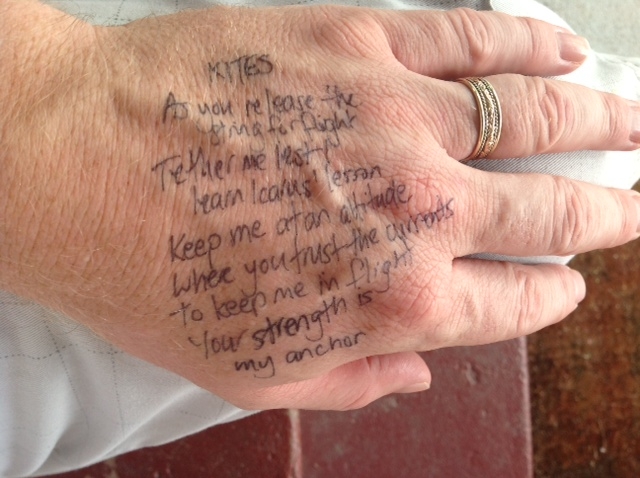
Post It Note Poetry – Kites

Post It Note Poetry – Kites

As you release the string for flight

Tether me lest I learn Icarus’ lesson.

Keep me at an altitude

Where you trust the currents

To keep me in flight.

Your strength is my anchor.

Post It Note Poetry - Kites

The Paradigm of Permission, Or You’re Allowed to Suck

The Paradigm of Permission,

or You Are Allowed to Suck

You are allowed to suck.

You are allowed to write drivel.

You are allowed to write dog-awful poetry.

You are allowed to paint with your fingers.

You are allowed to draw random doodles in the margins of the novel you’re reading.

You are allowed to create something fit to line the bottom of the budgie cage.

You are allowed to chuck it out.

In fact, you are encouraged to suck.

You are allowed to suck because you have permission to create.

The permission to write; to draw; to paint; to film. Whatever you want to create.

When you have permission to write, or draw or paint or take photos, you do not need to fear.

Fear of failure often inhibits you from starting.

What if my drawing is bad?

What if my writing is awful?

What if no one likes it?

Who cares?

Here’s a new way of thinking.

It’s a new paradigm.

It’s a paradigm of permission.

  • You have permission to try something new.
  • You have permission to suck at it. And suck spectacularly.

Don’t worry if people tell you that you’re colouring outside the lines.

Don’t worry if people say that what you’re doing is wrong.

You don’t have to show anyone anything.

Permission To Suck Allows You to Experiment

Creativity is about experimenting and having fun with new ideas. For the month of February I took on the creative challenge to write a poem on a Post It note every day. You can see the results here: Post It Note Poetry.

I am not a poet; I write fiction. I gave myself permission to write Vogon poetry; to write badly. And I was willing to share it. (You don’t have to share with anyone if you don’t want to.)

But we gave ourselves permission to suck. None of us are regular poets so we revelled in our sucky efforts and experimentation.

Permission To Suck Allows You To Learn and Improve

When #postitnotepoetry started up, it gathered a small group of like minded individuals. We shared it via twitter, on our blogs and we clustered around a Facebook page and shared our daily scribbles of poetry. It was accepting and challenging and supportive. We asked for feedback; we critiqued when asked. We learned and improved because we didn’t care if our work sucked.

When you want to start a new creative endeavour, give yourself permission to suck.

Post It Note Poetry Wrap Up

The Post It Note Poetry Challenge was initially a frivolous idea I threw out to my collaborative writing partner, Jodi Cleghorn (@JodiCleghorn).

28 days.

28 poems.

Written on a Post It Note.

Post It Note Poetry Feb 1

I was returning to school (I’m a teacher) and the beginning of the term is a dearth for creativity and continuing with longer projects. It was something to keep the creative wheels turning while the busyness of school consumed time and effort, allowing me to return to other projects when things settled down.

I haven’t written much poetry, although I teach the mechanics of poetry deconstruction (and poetry appreciation) in my English classes. I understood rhyme, rhythm, meter, onomatopoeia, metaphor, simile but did not have the practical experience. I usually write short fiction and I wanted to explore the intricacies of poetry, albeit in a short form, constricted by the physical boundaries of a square of paper.

The initial idea was launched on February 1, 2013 on twitter with the hashtag #postitnotepoetry. And it suddenly took off. People we knew loved the idea and began writing their own poetry, posting it to twitter and/or their blog.

Jodi’s spectacular cat-wrangling skills herded the participants towards a facebook page where it became a salon of sorts. People shared their poetry, commented, critiqued, deconstructed and analysed, in a collegial and supportive community.

The power of writers to connect and form a community is a special thing. We might write in isolation but the strength of community and the connections made between writers means we are never alone.

Therefore, in

28 days.

I wrote

28 poems totalling

1,128 words (this last point is somewhat irrelevant except I am keeping a tally of my writing output this year across all forms of fiction and non-fiction).

You can read the collection of poems are here.

What I Learned Along the Way

  • Creativity is habit forming.

28 days of writing poetry became an obsession. For all but the last 3 days, I had a poem written, photographed and scheduled to be posted. Yet the routine developed. Scraps of lines and ideas were hastily written in my notebook for later observation. I have a few ideas leftover I intend to use for a later project. I cannot imagine maintaining it for a longer period of time but it develop the concept of doing something creative on a regular basis.

  • It sparked new ideas for creative concepts.

Yesterday I had a flurry of new ideas for creative endeavours while in a conversation with Sean Wright (@SeanBlogonaut). Maintaining the alliterative form I threw these out (and some of them have creative potential. Feel free to take the idea and run with it).

#fableflyers, #serviettesermons, #placematproverbs, #amphoraaphorisms, #postitnoteplatitudes, #paddlepopstickpoetry

They are mostly frivolous ideas but what’s to say one of these can’t be turned into an ongoing creative outlet? Austin Kleon started Black Out Poetry using a newspaper and a black marker to create something unique.

  • Creativity fuels others.

The strength of the writing community to engage with ostensibly a trivial and frivolous concept, and to participate with enthusiasm and pride is a joyful thing. It lead to a core group of writers championing each other’s work, providing a supportive and trusting environment. The flow on effect to this is having a new group of people to call upon for feedback, critique, advice and encouragement.

I wrote a last post on the group’s Facebook page yesterday, thanking everyone for their time and effort, their participation in the journey, and for me to be able to accompany them for such a short time.

Creativity finds its strength first in the creator, then finds its purpose when shared with an audience. For when you draw crisp, clean water from the well of creativity, you slake your own needs first, then you can offer it to those around you.

  • Poetry is hard.

I have always maintained when I become Prime Minister of Australia, no child shall be permitted to write poetry until they have reached the age of 18 and completed a one year intensive poetry course.

While somewhat facetious, there is some truth. Writing poetry is hard. I was amazed at the skill some poets had to wrangle rhythm, meter and rhyme in their work. The adage to be a writer, you need to read, is applicable to poetry. I do not read enough poetry to be conversant with styles, techniques and forms.

I wrote one poem in cinquain form; everything else was free verse. I didn’t use rhyme but was conscious of rhythm; the years of drumming give me a good feel for it.

  • My poetry is really rather prosaic.

People have commented that my short stories have a poetic, lyrical feel to them. This is not surprising considering my influences. Therefore my poetry has more of a narrative feel to it, setting up ideas and emotions through the structure of the line and words, rather than letting the words speak for themselves to create the emotional resonance and atmosphere.

  • Humour is hard.

To write humourous or frivolous poetry is not an easy. It takes a skilled comedian time to craft the lines and delivery of their routine and poetry is no different. Jodi commented my default (for any of my writing) is “deep” (although she typed it as “depp” in conversation and the malapropism has stuck). I do write humour but it is not my first focus.

  • Creativity is fun.

There were times when I struggled for ideas or words or line length or structure, but it was never a chore or burden. As I said before, it is not something I want to maintain or prolong beyond the initial parameters.

And it was fun because I was doing it with a great group of people. We wrote, photographed, posted, commented and critiqued in a collegial and positive environment.

Even if there was not the group support, I would have enjoyed it anyway.

Post It Note Poetry Feb 20

If you dropped in to read the poems, left a comment or a “like,” THANK YOU. I hope it encourages you to continue with your own creative projects or sparks you to try something for the first time.

Next February, who knows what the challenge will be. But I’m looking forward to it. Hopefully you’ll join me.

Post It Note Poetry February 28

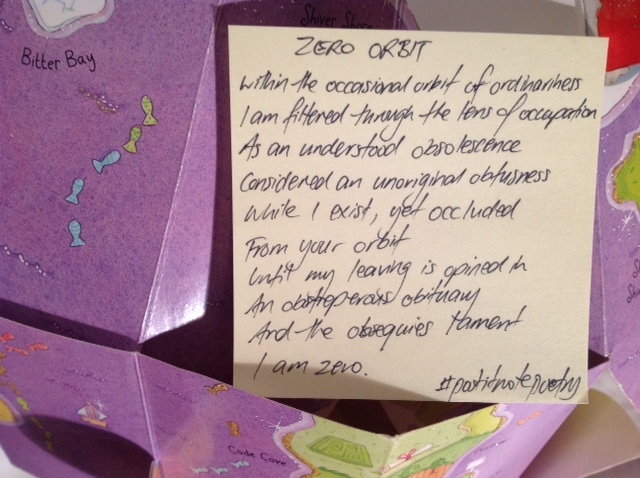
February 28 – Zero Orbit

Post It Note Poetry Feb 28

Within the occasional orbit of ordinariness

I am filtered through the lens of occupation

As an understood obsolescence

Considered an unoriginal obtuseness

While I exist, yet occluded

From your orbit

Until my leaving is opined in

An obstreperous obituary

And the obsequies lament

I am zero.

Post It Note Poetry February 27

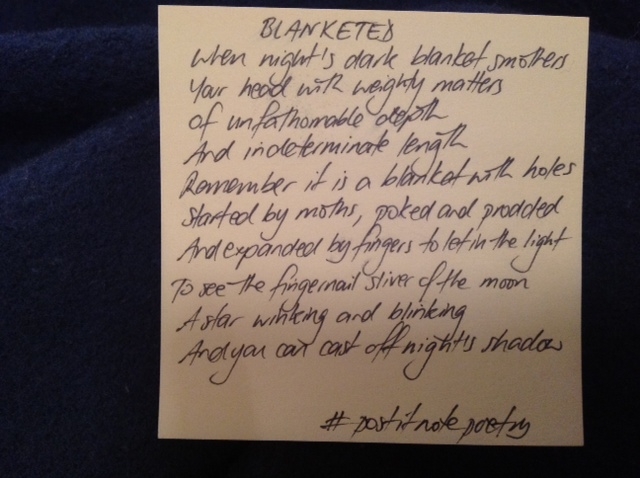
February 27 – Blanketed

Post It Note Poetry Feb 27

When night’s dark blanket smothers

Your head with weighty matters

Of unfathomable depth

And indeterminable length

Remember it is a blanket with holes

Started by moths, poked and prodded

And expanded by fingers to let in the light

To see the fingernail sliver of the moon

A star winking and blinking

And you can cast off night’s shadow

Post It Note Poetry February 26

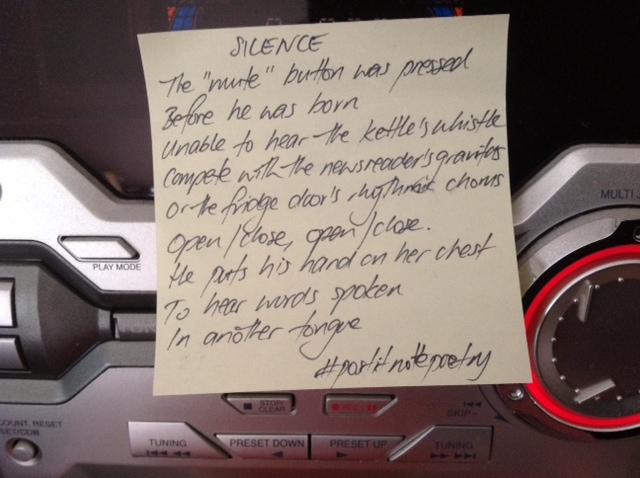
February 26 – Silence

Post It Note Poetry Feb 26

The “mute” button pressed

Before he was born

Unable to hear the kettle’s whistle

Compete with the newsreader’s gravitas

Or the fridge door’s rhythmic chorus

Open/close, open/close.

He puts his hand on her chest

To hear words spoken

In another tongue

Post It Note Poetry February 25

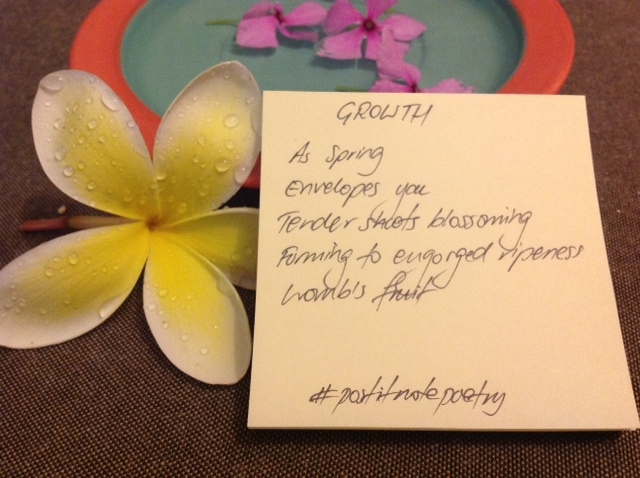
February 25 – Growth

Post It Note Poetry Feb 25

As Spring

Envelopes you

Tender shoots blossoming

Forming to engorged ripeness

Womb’s fruit