What Happens When You Reach ‘The End?’

In the early hours of Wednesday morning, my collaborative writing partner, Jodi Cleghorn, and I finished writing the first draft of our epistolary narrative Post Marked: Piper’s Reach.

We are separated by distance, living in different states in Australia and have written this novel by handwriting the letters and sending them via the post. Yes, we wrote 85,500 words BY HAND.

Fortuitously, for the first time we were able to sit down together in the one place and write the final installments.

If you want to know what Post Marked: Piper’s Reach is all about, here’s the blurb:

In December 1992 Ella-Louise Wilson boarded the Greyhound Coach for Sydney leaving behind the small coastal town of Piper’s Reach and her best friend and soul mate, Jude Smith. After twenty years of silence, a letter arrives at Piper’s Reach reopening wounds that never really healed.

When the past reaches into the future, is it worth risking a second chance?

Post Marked: Piper’s Reach is an ambitious collaborative project traversing an odd path between old and new forms of communication, differing modalities of storytelling and mixed media, all played out in real and suspended time. The project has at its heart a love of letter writing and music.

The letters are handwritten and posted in “real time.”

“To send a letter is a good way to go somewhere without moving anything but your heart.” ~ Phyllis Theroux
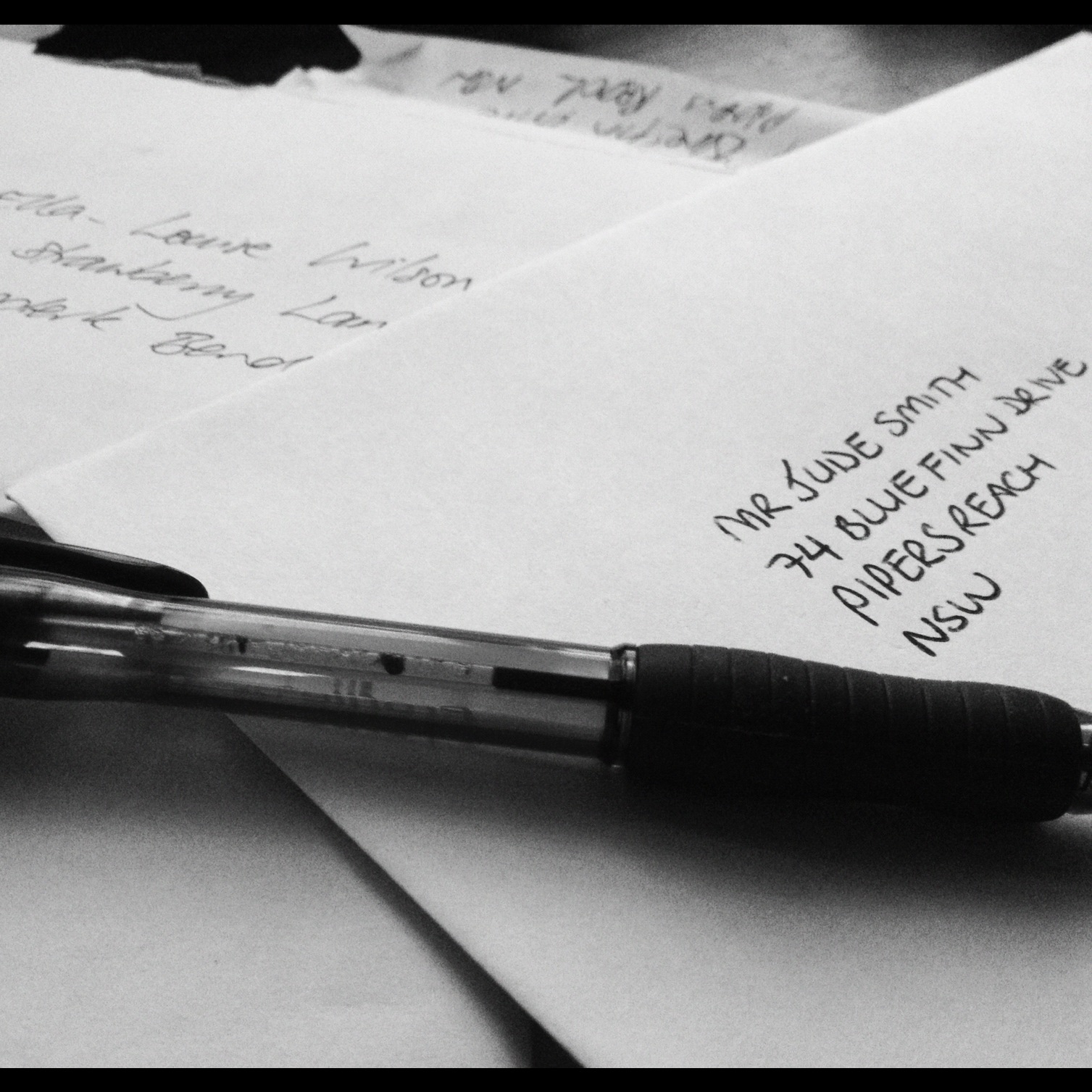
photo 2 copy

And now we have written “The End.” The story is finished.

This is the first significant piece of writing I have completed apart from flash fiction. It is the first novel I have written (I have another currently in the works that I began last year but have put on hold for a number of reasons).

How do I feel?

I feel excitement at having completed the novel; joy and relief; a sense of accomplishment because of what I have completed, and with it also, I feel sadness.

Coming to the end of this project brings with it a whole series of conclusions and endings.

  • The ending of the narrative and the story of Ella-Louise and Jude.

We have had such an emotional investment in our characters and their intertwined lives that coming to ‘The End’ is like the passing of a dear friend. I wrote the character Jude while Jodi wrote the character Ella-Louise and for the better part of 16 months we have lived with these characters. We keep saying we’ll need some therapy to get through the tumultuous times our characters experienced. And vicariously we have too, reading each letter through the lens of our character and as a reader.

We were sitting at opposite ends of my dining room table, writing the final lines. When we finished, we handed them over to be read. There were tears, stunned silences and a gutted feeling that it was all over.

  • The end of the interaction with our small, but dedicated, core of readers who we dubbed “Posties.”

They engaged with the characters and the writing, commenting on the weekly letter, discussing the characters’ motivations, arguing over what should or should not happen to the characters.

Over on the Facebook page we had long conversations with the Posties, ran contests and trivia, and had a whole lot of fun.

And we will feel the sorrow of the ending all over again when our readers get to ‘The End’ in about 8 weeks’ time.

  • The ending of the collaborative partnership.

Jodi pitched the idea to me in January, 2012 after we met for the first time in real life in December the year before. She runs eMergent Publishing and I had the privilege of working with her to have my first two short stories published. Our friendship developed and grew as we worked together, and when we met in real life it was like we had known each other for decades.

After the initial pitch we spent three days brainstorming by text and the first letter arrived later that month.

Since that time we have worked closely together during this project and it has been an exhilarating journey.

It was not a traditional collaboration; rather than plan and talk through ideas on the plot and structure, we let it develop in an organic way in what we came to term the “No Spoilers Policy.” Without discussing plot and ideas it kept the writing, and anticipation, fresh as we waited for the arrival of the postman to deliver the next letter.

We spent hours talking and deconstructing each letter after it arrived and we had read it. You can hear about our process of writing and what we learned as writers in an audio interview we did with Sean Wright (@SeandBlogonaut) over on his blog.

But our collaboration (but not our friendship) has come to en end, and with it, a strong sense of sadness.
img_1100

After ‘The End’

With the writing of ‘The End’ comes a feeling of finality (at least temporarily), that the initial phase of writing and drafting is finished and complete. Yet the end of a draft is only one step in the path to publication.

Now comes the time to put it all aside for a while, let it sit and be forgotten about until it comes time for editing.

This is then followed by synopsis writing, query letters and the like; but that’s in the future (we have big dreams for this novel).

After ‘The End’ comes a new project. For me it will be a novella, some short pieces, a picture book and a multimedia project.
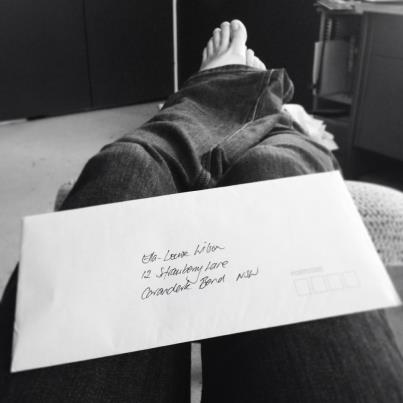
Envelope Addressed

What Next?

‘The End’ does not mean I stop. It means I begin the next step in the process. I begin writing new material. I begin editing other projects before I return to the manuscript of Post Marked: Piper’s Reach and polish it ready for submission.

Reaching ‘The End’ is only one part of the process, because for a writer, there is always another story to tell.
Tempest’s Questions – A Poem

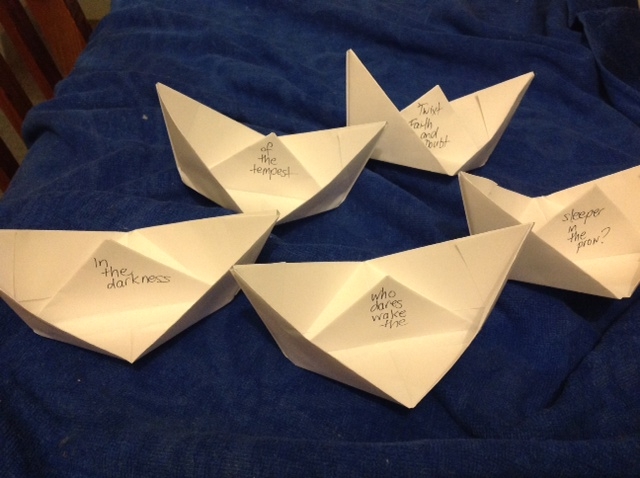
Tempest’s Questions

Tempest's Questions

In the darkness

of the tempest

twixt Faith and Doubt

who dares wake the

sleeper in the prow?

Hands – A Poem

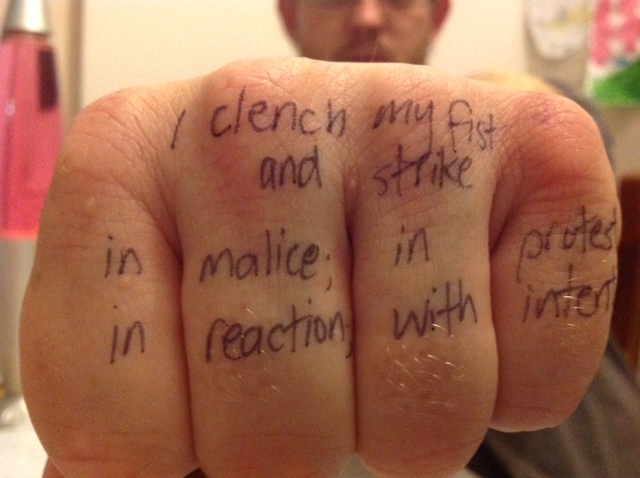
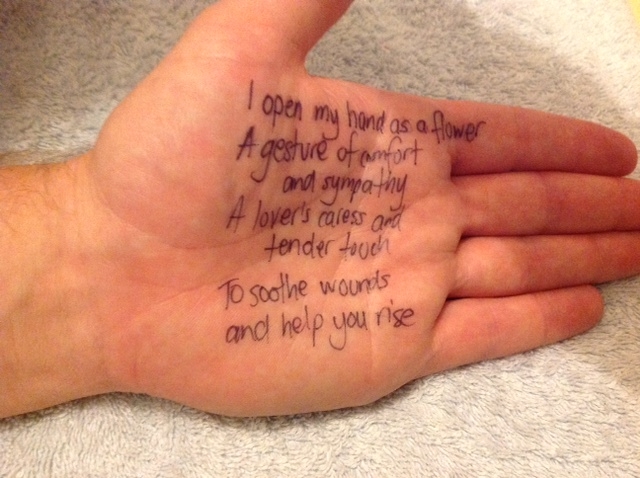
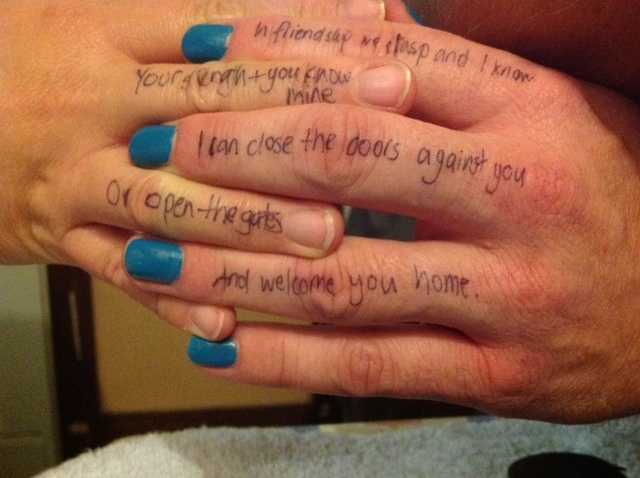
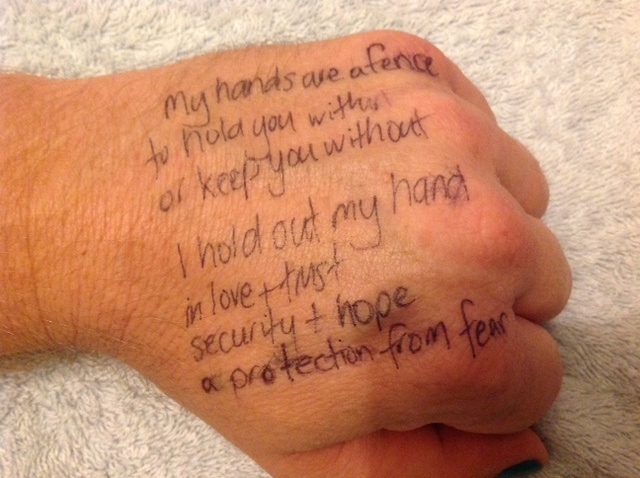
Hands

Hands 1Hands 2Hands 3Hands 4

My hands are a fence

to hold you within

or keep you out

I hold out my hand

In love + trust, security + hope

a protection from fear

I clench my fist and strike

in malice; in protest

in reaction; with intent

I open my hand as a flower

A gesture of comfort and sympathy

A lover’s caress and tender touch

To soothe wounds and help you rise

In friendship we clasp and I know

Your strength and you know mine

I can close the doors against you

or open the gates

and welcome you home

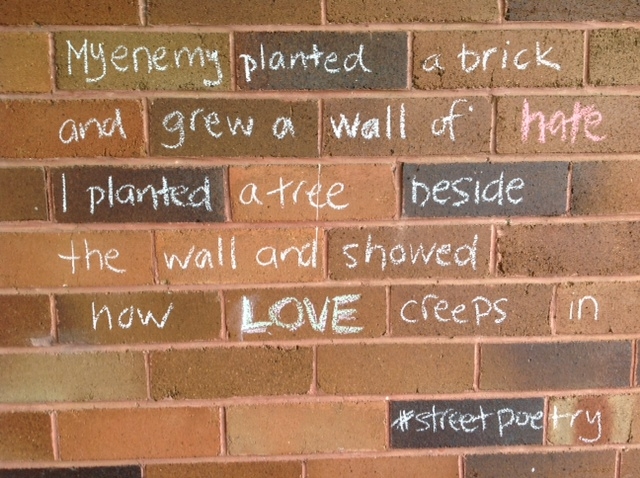
My Enemy – A Poem

The genesis of these lines started last night and take on greater significance in the light of today’s events.

In fact, every day is a day to #lovethyneighbour

My enemy planted a brick
and grew a wall of hate
I planted a tree beside
the wall and showed
how love creeps in

My Enemy

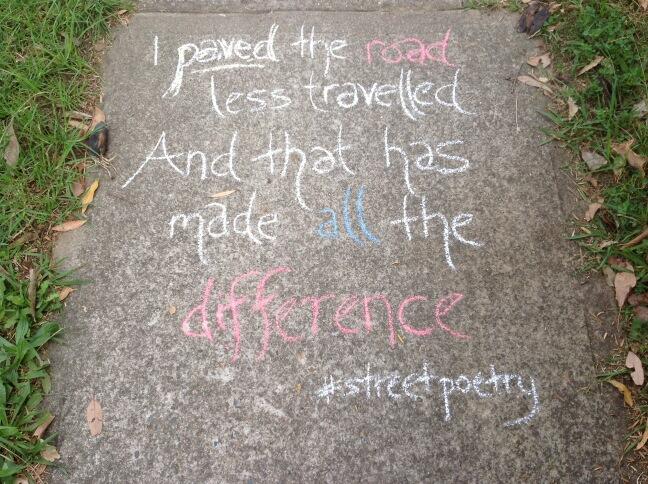
I Paved The Road…

I Paved The Road

I paved the road

less travelled

And that has

made all the

difference

#streetpoetry

What If I Don’t “Make It?”

What if I don’t make it?

This is a question that confronts every new and emerging writer. 

I am a new and emerging writer and I have confronted it.

Armed with a new pen, a Moleskine notebook and a dream, you set out to become a writer. But at some point the blind ambition comes face to face with the reality of the publishing industry.

It’s like having an experience with a face hugger from the movie Alien; you know at some point a xenomorph will burst out of your chest, killing you and then feed on the remnants of your dream of being a writer.

Despite every scrap of determination, every skerrick of aptitude, every committed moment of diligence, every hour of writing spent honing your craft, every fortune cookie predicting an ambiguous uncertainty of guaranteed success, there is no guarantee of you “making it” as a writer.

Alan Baxter recently hosted a blog series, The Ongoing Angst of Successful Writers, with six authors, all of whom still carry the fear of “What if I’m not good enough?”

Even though they have “made it,” based on their own standards, there is still a fear. Go and read the conclusions then work your way through the different authors. You will cheer and weep and know you’re not alone.

So what chances do I have as a new and emerging writer to “make it?”

The same chance they did.

How will I define if I have “made it?”

I see on social media reports of authors who carved out a successful blogging career and turned it into fiction or non-fiction book deal and have gone on to financially successful careers.

And they make it sound SO EASY! “I wrote a book, it was picked up by an agent and sold to the highest bidder. And I’ve sold 1,000,000 copies and now have a three book advance deal.”

I have had two short stories published in anthologies, had a vignette published, and have three stories offered for free on Ether Books app (see the Publications page). Nothing to rock the world, but it’s a start.

“Making it” implies financial success, selling stories, novellas and/or novels, whatever literary form you care to think of.

“Making it” implies critical acclaim and public praise.

And, yes, I want these things. I want to be financially successful and have critical acclaim and public praise.

But…

  • I have never made a sale for a short story.
  • I have not won a respected or prestigious competition (or even a disreputable one).
  • I have not finished writing my first novel.

Not a great start. Yet there are more fears lurking.

  • What if I never finish a novel? And assuming I finish a novel, what if I never sell it?
  • Will I write a second novel? A third? A fourth? What if they don’t sell either?
  • What if I NEVER sell a short story, a novella or a novel?
  • What if I never *fill in the blank here*?

Trying to answer the question of “Have I ‘made it’?” is akin to trying to catch a fart in a cyclone.

I want to make it. I want to sell short stories, and just like known authors, experience rejection.

I am committed to improving my craft, developing my art and telling good stories. I will have tried my hardest. I will have written to the best of my aptitude and skill; learned what I can from whomever and wherever to ensure my work is the best it can be to have every chance to be considered.

I’m going to make damn sure I give it everything I am to have a crack at “making it.”

But if I don’t make it, I don’t mind.

Because…

Despite everything looking like a failure, I will continue to write.

This is how I know I will have ‘made it.’ I will have continued despite the “failure.”

When I’ve “made it” financially or critically, I’ll let you know.

If I don’t make it, I’m ok with that.

I won’t be ok if I have failed to continue writing.

11 Facetious (And 1 Serious) Answers to the Question, “Where Do You Get Your Ideas?”

11 Facetious (And 1 Serious) Answers to the Question, “Where Do You Get Your Ideas?”

Invariably a writer gets asked a question, in fact THE question:

“Where do you get your ideas?”

And as a teacher when I set my students a creative writing task there comes a glassy eyed look of vacancy that would give a vacuum cleaner a run for its money when it comes to sucking the will to live.

Let me count the ways. It’s too easy to be facetious and sarcastic but let’s travel down that well-worn trope for a while.

  1. I poo rainbows. When I wipe my bum, I have 2 or 3 ideas ready to go.
  2. The washing up. The subconscious works overtime when you get time to yourself, and you can pause for a bit.
  3. Your life story. Yes, I’ve been recording our conversations.
  4. Facebook. An open account is a gold mine for personality traits, character tics and questionable hygiene habits.
  5. I steal your dreams while you sleep.
  6. I have a unicorn scribe who records my every thought.
  7. I read the ideas left in the scraps of food left on trays in the food court. It’s like an augur divining the entrails of animals. Only greasier.
  8. I get my ideas from failed Academy Award nominees press conferences when they say, “It was an honour to be nominated.”
  9. I get fed my ideas from my best friend via carrier pigeon.
  10. I gather ideas from the broken clusters of dandelions as they float on the evening breeze.
  11. I collate Ideas from the comments section on YouTube, where the stupid lives.

But what is the person really asking? What is the heart and purpose of their question?

What they are asking is, “If I replace the empty toilet roll does that mean I get to eat the last doughnut?”

Sorry, wrong question.

The question being asked is, “Why can’t I be as creative as you?”

There is a core concept at the heart of the question: a desire to be creative yet they imagine themselves without the skills or knowledge to do so.

They are saying, “I really want to be creative but I don’t know how.”

The answer is simple. It’s one word: IMAGINATION.

It’s about exercising the ol’ grey matter and THINK.

For the non-creative person, the concept of using the imagination to develop ideas is like giving them a piece of Ikea furniture and a Phillips head screwdriver to assemble it.  You’re better off asking them to stand naked in the middle of the road during a thunderstorm with a colander on their head for protection.

For a writer and the creative person, the imagination is the most important tool to use. But you need to know how to use it, to train it, to develop it and expand it.

Train your imagination. If you’re unsure how to do it, watch children play. They imagine all the time in their play, their drawings, their stories. Learn from them. Mimic their creativity, ingenuity and imagination.

On a side note, imagination gets minimised and sidelined during the school years in favour of logic and reason, when it should be expanded, developed and encouraged.

So how should we answer the question: “Where do you get your ideas?”

Remember, this is for posterity, so please, be honest. Tell me the truth.

It starts with my imagination, but that’s a wibbly-wobbley spongey-marshmallow answer.

My perspective sparks my imagination, the way I have of seeing the world. It shapes how I see people, events, incidents, and helps me understand that the individual stories of people are important.

In truth, I look for ideas. I search for them. I track them like ants at a picnic.

I find ideas in:

  • books and poetry
  • pictures and Images
  • newspaper articles
  • conversations with friends
  • blog posts
  • tweets
  • other writers’ opinions
  • and from some of the facetious ideas I gave above

I get ideas because I actively pursue them.

I use my imagination to create scenarios and situations.

I ask “What if…?”

I ask “Why?” and “Why not?”

As Albert Einstein said, “Imagination is more important than knowledge. For knowledge is limited to all we now know and understand, while imagination embraces the entire world, and all there ever will be to know and understand.”

That’s where I get my ideas.

And now I’m off to read the comments on youtube.

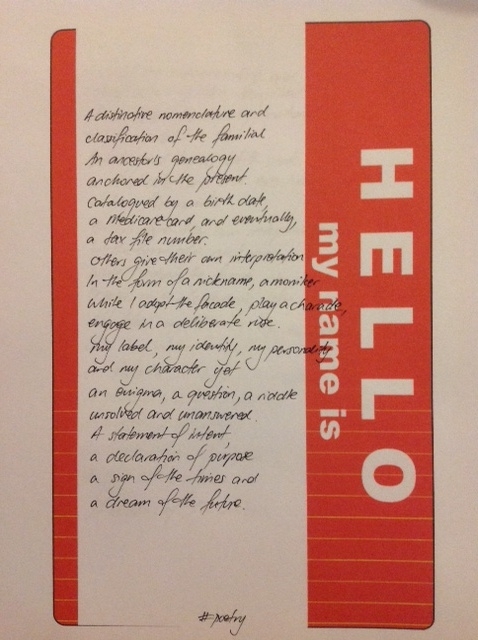
Hello, My Name Is…

Hello, My Name Is…


A distinctive nomenclature and

classification of the familial

An ancestor’s genealogy

anchored in the present 

Catalogued by a birth date,

a Medicare card, and eventually,

 a tax file number 

Others give their own interpretation

In the form of a nickname, a moniker

While I adopt the facade, play a charade,

engage in a deliberate ruse.

My label, my identity, my personality

and my character yet

an enigma, a question, a riddle

unsolved and unanswered

A statement of intent,

a declaration of purpose

a sign of the times and

a dream of the future.

 Hello My Name Is V2

The Best Times and Places to Plan New Writing

When are the best times and where are the best places to plan new writing?

Time is precious.

We all have the same number of grains of sand filtering through the hourglass each day.

Writing time is precious.

We protect and hoard our allotted (and dedicated) time to write.

But we’re all busy.

And if you’re a new and emerging writer, you fit writing into the nooks, crevasses and tiny compartments of time available between the crack of dawn and when you finally feed the door and lock the cat for the night.

So when are the best times and where are the best places to plan new writing?

There is an untapped resource in the mundane ennui of our lives. Times and places where we can let our minds wander through the cereal aisle of our minds and happily browse all the pretty colours.

Remember to carry a pen and notebook so you can write down new ideas, revelations, plots, characters.

The bathroom – Use those quiet minutes to generate new ideas, plots, characters. If you’re constipated, you can always work it out with a pen. Maybe it’s just a guy thing, but seriously, uninterrupted time is precious especially when you have children. 

Washing up – a friend of mine calls it ‘sudspiration.’ Let your subconscious compost the ideas you have. Mull over concepts for plots or allow the characters in a scene to throw around some dialogue.

Have a tea towel handy as you’ll need to dry your hands quickly to take down notes.

Hanging washing on the line – As you hang out the next load on the line, observe how you do it. Is it socks (and do you pair them or leave them on the line randomly) and underwear first? Or whatever comes to hand? Do you use the same coloured pegs for each garment or you don’t care?

Now think about how you approach a new plot. Is it similar to your washing line approach?

Use the time to plan a new plot; with each garment think of it as the next scene in your story.

In the shower – nothing like a quickie to get your mind turning over. Think about how your character would carry out their ablutions. Maybe he or she uses the face washer only for the face, or they don’t care and use it all over. What kind of shampoo and conditioner would your character use? Would your character have sex in the shower?

There is something refreshing and rejuvenating about water and the process of becoming clean. Visualise the bad ideas washed away to leave the good ideas. If a good idea slips away, hope it gets stuck in the mat of hair clogging the drain.

On the commute to work – regardless of your mode of transportation you can use the time to chunk down the massive sprawling plot into scenes.

This is a little harder if you drive to work but perhaps a dictaphone (what am I saying? Every phone these days as the ability to record audio. Use your phone instead. Forget I said ‘dictaphone’). Or train your brain to remember all the minute details (we really should exercise the ol’ grey matter a little more by developing our memory).

During the commercial break – how many plot ideas can you generate in the ad break? Make a challenge of it. If you write down 2 ideas in the first ad break, can you double it to 4 in the next?

Taking a walk – stop being sedentary. Stand up out of the chair and take a turn around the block. Get the blood moving through the body. Movement creates momentum and clarity.

Use the time to process a character’s motivation. Imagine, as you walk, the character’s movement through the plot. What is their internal and external motivation?

At any family gathering (or wherever people congregate) – watch people and their mannerisms. Listen to how Great Aunt Ethel speaks about fashion and last week’s Bingo fiasco and watch how she uses gesture and body language. Become an acute observer of human behaviour and language. Can you apply it to a character?

You’ll find your own mundane moments to compost and percolate ideas.

What works best for you?

8 Things Writers Should Be Doing Now

8 Things Writers Should Be Doing Now

Last year I wrote about why writers can’t have nice things. It’s narcissistic and futile to whinge and moan about why the empty toilet roll hasn’t been replaced.

The whinging is partially about the changes in the publishing world and partially about our own self doubt and disbelief. It’s divisive and unproductive.

Let me reverse the focus, so we can have the nice things.

Here are 8 things writers should be doing.

1. Innovating –Why wait for the dust to settle on the ebook/digital revolution/death of the dead tree industry?

Learn all you can about publishing and go it alone or form a collective and do it together.

Innovate with form: flash fiction, short story, novella, multimedia, graphic  novel, novel.

Set up a network (blog or facebook page or similar) to encourage new and emerging writers. Pass on the information you have learned to help others along the creative road.

Stop trying to predict the next trend in literature or imitate the latest Harry Potter/Twilight/Game of Thrones/50 Shades of Blue Rinse. Popular fads in our culture are like pop music; in two years’ time you won’t be able to give a good reason why something was popular.

Those things that stand the test of time do so for a reason. That’s why we have English Literature classes.

Recognise your influences and use them to your advantage. Acknowledge the canon of literature in your genre, learn the tropes and archetypes, and study it fastidiously.  Then go and innovate.

2. Collaborating – writers are stereotyped as isolated and solitary beings. Break the pattern and work with someone on a project.

Here are four ideas to get you started:

  • gather twelve people (preferably in your genre, or for a different challenge, select participants with different generic tastes). Set some parameters and create an anthology or novella, with each participant contributing a chapter or a piece of flash fiction
  • create two characters and have them write letters to one another
  • find an illustrator and work on a comic strip, picture book, illustrated story or graphic novel
  • find a writing partner and write a series of essays about a particular topic, with each person taking the opposite position. Eg Is there such a thing as a Muse?

It may be simply for fun (like the Post Marked: Piper’s Reach project Jodi and I have been working on) and posted to your blog, or you may look for publication.

Collaborate within your genre and outside of it. You may find an area of interest you hadn’t considered.

3. Encouraging – if we do not pass on the information we have learned from one generation to the next, our legacy and inheritance will fade like cut flowers in a vase.

As writers, our aim should be to encourage new writers. It is not about being competitive but nurturing the essential artistic practices that constitute our culture.

The world needs more artists, whether their reach is to five people or five million.  Provide guidance and mentorship to new artists.

Encourage people by starting conversations with people, either via social media or in person.

Communication and encouragement is the goal, not competition.

4. Meditating – go quietly about the noise.

Learn to tune out the white noise of social media, those spruikers who shout from the street corner, standing on their stolen milk crate, yelling above the heads of the pedestrians.

Instead, seek out the wise and learned for they have quieted themselves. And when they speak, we listen. Talk with friends about your progress; don’t shout it from the street corners.

Disconnect from social media once in a while. Don’t get distracted by all the shiny things.

Go about your business of writing and let it speak for you.

5. Learning – every writer should be a learner. Each new piece of work from flash fiction to a multi-volume fantasy series, there is something new to learn.

If you have only ever written novels, write short stories. If you have only ever written flash fiction, write a novella. Each format has its advantages and disadvantages and knowing them will improve your writing.

Learn as much as you can about the technical aspects of writing: grammar, point of view, dialogue, characterisation, setting and plot.

6. Focusing – Why do we write? This is the most fundamental question a writer must answer. I believe the idea of story is why I write.

Story is the heart of community. It is the shared history of a community. It binds, strengthens, admonishes, critiques, uncovers the truth, and questions.

As writers, we are sharing the story with our community. Let’s aim to tell the story in the best way we can.

Tell me a story and I’ll remember.

7. Revering – language is a powerful tool and we would do well to revere the power of words. Delve into the history of language; absorb it like a sponge. Let your characters delight in the words they use, even when they are ugly and hateful.

Words can seduce your reader into undressing, challenge them to take up arms or slap them in the face, breaking the fragile moistness of their lip causing blood to seep in between their teeth.

Understand the alchemy when words combine to tell a powerful story.

8. Writing – never lose focus or passion for your current work in progress. You will have moments when you believe your laptop wishes to fly (and you secretly hope it transforms mid-air into Optimus Prime).

Never let social media or promotion or blogging dominate your time.

Your characters can have a nice cup of tea while you have your little petulant frenzy, but get back to what you should be doing: writing.

Writing is the means by which we speak to the world. It is our voice calling in the wilderness, telling parables, fables, myths and legends.

Leave a legacy, not a meme.

* this article first appeared at Write Anything and has been modified for appearance here.